[![Build](https://github.com/ben-manes/gradle-versions-plugin/actions/workflows/build.yml/badge.svg?branch=master)](https://github.com/ben-manes/gradle-versions-plugin/actions/workflows/build.yml) [![gradlePluginPortal](https://img.shields.io/maven-metadata/v/https/plugins.gradle.org/m2/io/github/ben-manes/versions/io.github.ben-manes.versions.gradle.plugin/maven-metadata.xml.svg?label=gradlePluginPortal)](https://plugins.gradle.org/plugin/io.github.ben-manes.versions) # Gradle Versions Plugin This plugin reports which of your build's dependencies, plugins, and Gradle itself have newer versions available, in the spirit of the [Maven Versions Plugin](https://www.mojohaus.org/versions-maven-plugin). **Table of contents** - [Getting Started](#getting-started) - [Applying the plugin](#applying-the-plugin) - [Running the task](#running-the-task) - [Configuring the task](#configuring-the-task) - [The `dependencyUpdates` task](#the-dependencyupdates-task) - [Cache invalidation](#cache-invalidation) - [Task properties](#task-properties) - [Revisions](#revisions) - [RejectVersionsIf and componentSelection](#rejectversionsif-and-componentselection) - [Constraints](#constraints) - [Configuration filter](#configuration-filter) - [Optional parameters](#optional-parameters) - [Gradle release channel](#gradle-release-channel) - [Gradle versions API base URL](#gradle-versions-api-base-url) - [Report format](#report-format) - [Multi-project builds](#multi-project-builds) - [Shared task settings](#shared-task-settings) - [Composite builds](#composite-builds) - [Per-project reports](#per-project-reports) - [Isolated projects](#isolated-projects) - [Other ways to apply the plugin](#other-ways-to-apply-the-plugin) - [The `plugins` block](#the-plugins-block) - [Legacy plugin application](#legacy-plugin-application) - [Contributor plugin](#contributor-plugin) - [Initialization script](#initialization-script) - [Samples](#samples) - [Compatibility](#compatibility) - [Migrating from prior versions](#migrating-from-prior-versions) - [v0.59.0](#v0590) - [v0.58.0](#v0580) - [v0.57.0](#v0570) - [v0.56.0](#v0560) - [v0.55.0](#v0550) - [v0.54.0 and earlier](#v0540-and-earlier) - [Related plugins](#related-plugins) ## Getting Started ### Applying the plugin The recommended way to add the Gradle Versions Plugin to any build is to apply the settings plugin once in the settings script. This approach allows the plugin to report updates for the plugins and buildscript dependencies that the settings script declares, in addition to each project's own plugins, buildscript dependencies, and dependencies. It also automatically covers every subproject in a multi-project build (see [Multi-project builds](#multi-project-builds)).
Kotlin "settings.gradle.kts": ```kotlin plugins { id("io.github.ben-manes.versions.settings") version "$version" } ```
Groovy "settings.gradle": ```groovy plugins { id 'io.github.ben-manes.versions.settings' version '$version' } ```
> [!IMPORTANT] > Replace `$version` with the current release, shown in the badge at the top of > this page. ### Running the task After adding the settings plugin to your build, run the `dependencyUpdates` task to get the report of up-to-date and outdated dependencies (see [The dependencyUpdates task](#the-dependencyupdates-task)): ```text ./gradlew dependencyUpdates ``` The report prints to the console and is written to `build/dependencyUpdates/report.txt`: ```text ------------------------------------------------------------ : Project Dependency Updates (report to plain text file) ------------------------------------------------------------ The following dependencies have later milestone versions: - com.google.inject:guice [2.0 -> 7.0.0] https://github.com/google/guice - org.springframework.boot:spring-boot-dependencies [1.5.8.RELEASE -> 4.1.0] https://spring.io/projects/spring-boot Gradle release-candidate updates: - Gradle: [8.4 -> 9.6.1 -> 9.7.0-rc-2] ``` ### Configuring the task The task is configured in the root project's build script:
Kotlin "build.gradle.kts": ```kotlin import com.github.benmanes.gradle.versions.updates.DependencyUpdatesTask tasks.named("dependencyUpdates") { revision = "release" outputFormatter = "json" } ```
Groovy "build.gradle": ```groovy tasks.named("dependencyUpdates").configure { revision = 'release' outputFormatter = 'json' } ```
A build with no root build script can configure the task from the settings script instead:
Kotlin "settings.gradle.kts": ```kotlin import com.github.benmanes.gradle.versions.updates.DependencyUpdatesTask gradle.rootProject { tasks.withType(DependencyUpdatesTask::class.java).configureEach { revision = "release" outputFormatter = "json" } } ```
Groovy "settings.gradle": ```groovy import com.github.benmanes.gradle.versions.updates.DependencyUpdatesTask gradle.rootProject { tasks.withType(DependencyUpdatesTask).configureEach { revision = 'release' outputFormatter = 'json' } } ```
Every task property is covered in [Task properties](#task-properties). Most builds want a stability filter next, so that a pre-release version is not offered as an update (see [RejectVersionsIf and componentSelection](#rejectversionsif-and-componentselection)). ## The `dependencyUpdates` task Displays a report of the project dependencies that are up-to-date, exceed the latest version found, have upgrades, or failed to be resolved. When a dependency cannot be resolved the exception is logged at the `info` level. The report includes dependencies declared through a version catalog, but the plugin only reports—it never edits build files or the catalog. See [Related plugins](#related-plugins) for tools that apply updates automatically. The report also includes the dependencies that a plugin contributes lazily rather than the build declaring them, such as the Kotlin standard library and the tool versions of the `jacoco`, `checkstyle`, and `pmd` plugins. Their current version is whatever the contributing plugin supplies when the task runs, so a tool version the build never sets reports at the default bundled with Gradle—a version that appears nowhere in the build script. The reports mark such an entry so it does not read as a resolution bug, naming the configuration the plugin declared it against: ```text - org.jacoco:org.jacoco.ant [0.8.11 -> 0.8.13] contributed by a plugin into the 'jacocoAnt' configuration ``` Set the extension's version, such as `jacoco.toolVersion`, to control what the report compares against. A plugin that fills its classpath when it is applied, rather than when the configuration is first resolved, cannot be told apart from the build declaring the dependency. Such an entry names the configuration it was declared against instead: ```text - org.jetbrains.kotlin:kotlin-build-tools-impl [2.4.0 -> 2.4.10] declared in the 'kotlinAbiValidationCompatClasspath' configuration ``` A configuration the build declares against directly, such as a tool configuration of its own, is named the same way. Use [`filterConfigurations`](#configuration-filter) to leave a configuration out of the report entirely. Gradle updates are checked for on the `current`, `release-candidate` and `nightly` release channels. The plain-text report displays Gradle updates as a separate category in breadcrumb style, excluding nightly builds. The XML and JSON reports cover all three release channels: whether a release is an update with respect to the Gradle instance running the build, whether an update check failed, and a reason field explaining failures or missing information. The update check may be disabled using the `checkForGradleUpdate` flag. ### Cache invalidation To find the latest version of a dependency, the task asks each repository which versions exist. Gradle caches that answer for 24 hours, so a version published within the last day may be missing from the report even though the repository already has it. Re-run with `--refresh-dependencies` to bypass the cache and query the repositories again: ```bash ./gradlew dependencyUpdates --refresh-dependencies ``` > [!TIP] > The `--refresh-dependencies` flag applies to the whole build rather than to > this task alone, so it also re-checks every other dependency the build > resolves and is slower than a normal run. Use it when a release you are > expecting does not appear, not routinely. ### Task properties #### Revisions The `revision` task property controls the [Ivy resolution strategy](https://ant.apache.org/ivy/history/2.4.0/settings/version-matchers.html#Latest%20%28Status%29%20Matcher) for determining what constitutes the latest version of a dependency. Maven's dependency metadata does not distinguish between milestone and release versions. The following strategies are natively supported by Gradle: * release: selects the latest release * milestone: select the latest version being either a milestone or a release (default) * integration: selects the latest revision of the dependency module (such as SNAPSHOT) The strategy can be specified either on the task or as a system property for ad hoc usage: ```bash ./gradlew dependencyUpdates -Drevision=release ``` Because Maven repositories do not mark pre-release versions, an alpha or release candidate can still appear as the latest version under any revision. To only be offered stable updates, reject pre-release candidates (see [RejectVersionsIf and componentSelection](#rejectversionsif-and-componentselection)). #### RejectVersionsIf and componentSelection To further control which versions are accepted, define what counts as an unstable version. There is no agreed standard, but this is a good starting point:
Kotlin ```kotlin fun String.isNonStable(): Boolean { val stableKeyword = listOf("RELEASE", "FINAL", "GA").any { uppercase().contains(it) } val regex = "^[0-9,.v-]+(-r)?$".toRegex() val isStable = stableKeyword || regex.matches(this) return isStable.not() } ```
Groovy ```groovy def isNonStable = { String version -> def stableKeyword = ['RELEASE', 'FINAL', 'GA'].any { it -> version.toUpperCase().contains(it) } def regex = /^[0-9,.v-]+(-r)?$/ return !stableKeyword && !(version ==~ regex) } ```
You can then configure [Component Selection Rules](https://docs.gradle.org/current/userguide/dynamic_versions.html#sec:component_selection_rules). The current version of a component can be retrieved with the `currentVersion` property. You can either use the simplified syntax `rejectVersionIf { ... }` or configure a complete resolution strategy. Multiple registrations compose, so a candidate is rejected if any registered filter rejects it.
Kotlin Example 1: reject all non-stable versions ```kotlin import com.github.benmanes.gradle.versions.updates.DependencyUpdatesTask tasks.named("dependencyUpdates") { rejectVersionIf { candidate.version.isNonStable() } } ``` Example 2: disallow release candidates as upgradable versions from stable versions ```kotlin import com.github.benmanes.gradle.versions.updates.DependencyUpdatesTask tasks.named("dependencyUpdates") { rejectVersionIf { candidate.version.isNonStable() && !currentVersion.isNonStable() } } ``` Example 3: using the full syntax ```kotlin import com.github.benmanes.gradle.versions.updates.DependencyUpdatesTask tasks.named("dependencyUpdates") { resolutionStrategy { componentSelection { all { if (candidate.version.isNonStable() && !currentVersion.isNonStable()) { reject("Release candidate") } } } } } ``` Example 4: disallow candidates less mature than the current version, so an `-rc` keeps being offered `-rc` updates but never a `-beta` ```kotlin import com.github.benmanes.gradle.versions.updates.DependencyUpdatesTask tasks.named("dependencyUpdates") { val qualifiers = listOf("preview", "alpha", "beta", "m", "cr", "rc") // order is important fun maturityLevel(version: String): Int { val index = qualifiers.indexOfFirst { version.matches(".*[.\\-]$it[.\\-\\d]*".toRegex(RegexOption.IGNORE_CASE)) } return if (index < 0) qualifiers.size else index } rejectVersionIf { maturityLevel(candidate.version) < maturityLevel(currentVersion) } } ```
Groovy Example 1: reject all non-stable versions ```groovy tasks.named("dependencyUpdates").configure { rejectVersionIf { isNonStable(candidate.version) } } ``` Example 2: disallow release candidates as upgradable versions from stable versions ```groovy tasks.named("dependencyUpdates").configure { rejectVersionIf { isNonStable(candidate.version) && !isNonStable(currentVersion) } } ``` Example 3: using the full syntax ```groovy tasks.named("dependencyUpdates").configure { resolutionStrategy { componentSelection { all { if (isNonStable(candidate.version) && !isNonStable(currentVersion)) { reject('Release candidate') } } } } } ``` Example 4: disallow candidates less mature than the current version, so an `-rc` keeps being offered `-rc` updates but never a `-beta` ```groovy tasks.named("dependencyUpdates").configure { def qualifiers = ['preview', 'alpha', 'beta', 'm', 'cr', 'rc'] // order is important def maturityLevel = { String version -> def index = qualifiers.findIndexOf { version ==~ /(?i).*[.\-]$it[.\-\d]*/ } return (index < 0) ? qualifiers.size() : index } rejectVersionIf { maturityLevel(candidate.version) < maturityLevel(currentVersion) } } ```
#### Constraints If you use constraints, for example to define a BOM using the [`java-platform`](https://docs.gradle.org/current/userguide/java_platform_plugin.html) plugin or to [manage](https://docs.gradle.org/current/userguide/dependency_constraints.html) transitive dependency versions, you can enable checking of constraints by specifying the `checkConstraints` attribute of the `dependencyUpdates` task. If you want to check external constraints (defined in init scripts or by Gradle itself) you can do so by specifying the `checkBuildEnvironmentConstraints` attribute of the `dependencyUpdates` task.
Kotlin ```kotlin import com.github.benmanes.gradle.versions.updates.DependencyUpdatesTask tasks.named("dependencyUpdates") { checkConstraints = true checkBuildEnvironmentConstraints = true } ```
Groovy ```groovy tasks.named("dependencyUpdates").configure { checkConstraints = true checkBuildEnvironmentConstraints = true } ```
#### Configuration filter You can change which dependency configurations the plugin checks for updates like this:
Kotlin ```kotlin import com.github.benmanes.gradle.versions.updates.DependencyUpdatesTask tasks.named("dependencyUpdates") { filterConfigurations = Spec { it.name == "runtimeClasspath" || it.name == "compileClasspath" } } ```
Groovy ```groovy tasks.named("dependencyUpdates").configure { filterConfigurations { it.name == "runtimeClasspath" || it.name == "compileClasspath" } } ```
Because each entry names the configuration it was declared against (see [The `dependencyUpdates` task](#the-dependencyupdates-task)), a build can leave out a configuration a plugin fills for its own tooling. The Kotlin Gradle Plugin's ABI validation classpath is one, holding a version the build never set:
Kotlin ```kotlin import com.github.benmanes.gradle.versions.updates.DependencyUpdatesTask tasks.named("dependencyUpdates") { filterConfigurations = Spec { it.name != "kotlinAbiValidationCompatClasspath" } } ```
Groovy ```groovy tasks.named("dependencyUpdates").configure { filterConfigurations { it.name != "kotlinAbiValidationCompatClasspath" } } ```
Take the names from your own report rather than matching on a prefix. They belong to the plugins rather than to Gradle and they differ between plugin versions, and a broad match leaves out more than intended: the Kotlin Gradle Plugin's compiler plugin classpaths hold the compiler plugins a build adds itself. The Android Gradle Plugin declares into families of its own, such as `androidLintTool` and `unified-test-platform-*`. #### Optional parameters The `dependencyUpdates` task takes several optional parameters to adjust its behavior. The `revision`, `gradleReleaseChannel`, `outputFormatter`, `outputDir`, and `reportfileName` properties may also be set as system properties, which override the task configuration for ad hoc runs (e.g. `-Drevision=release`):
Kotlin ```kotlin import com.github.benmanes.gradle.versions.updates.DependencyUpdatesTask tasks.named("dependencyUpdates") { checkForGradleUpdate = true outputFormatter = "json" outputDir = "build/dependencyUpdates" reportfileName = "report" } ```
Groovy ```groovy tasks.named("dependencyUpdates").configure { checkForGradleUpdate = true outputFormatter = "json" outputDir = "build/dependencyUpdates" reportfileName = "report" } ```
#### Gradle release channel The `gradleReleaseChannel` task property controls which release channel of the Gradle project is used to check for available Gradle updates. Options are: * `current` * `release-candidate` * `nightly` The default is `release-candidate`. The value can be changed as shown below:
Kotlin ```kotlin import com.github.benmanes.gradle.versions.updates.DependencyUpdatesTask tasks.named("dependencyUpdates") { gradleReleaseChannel = "current" } ```
Groovy ```groovy tasks.named("dependencyUpdates").configure { gradleReleaseChannel = "current" } ```
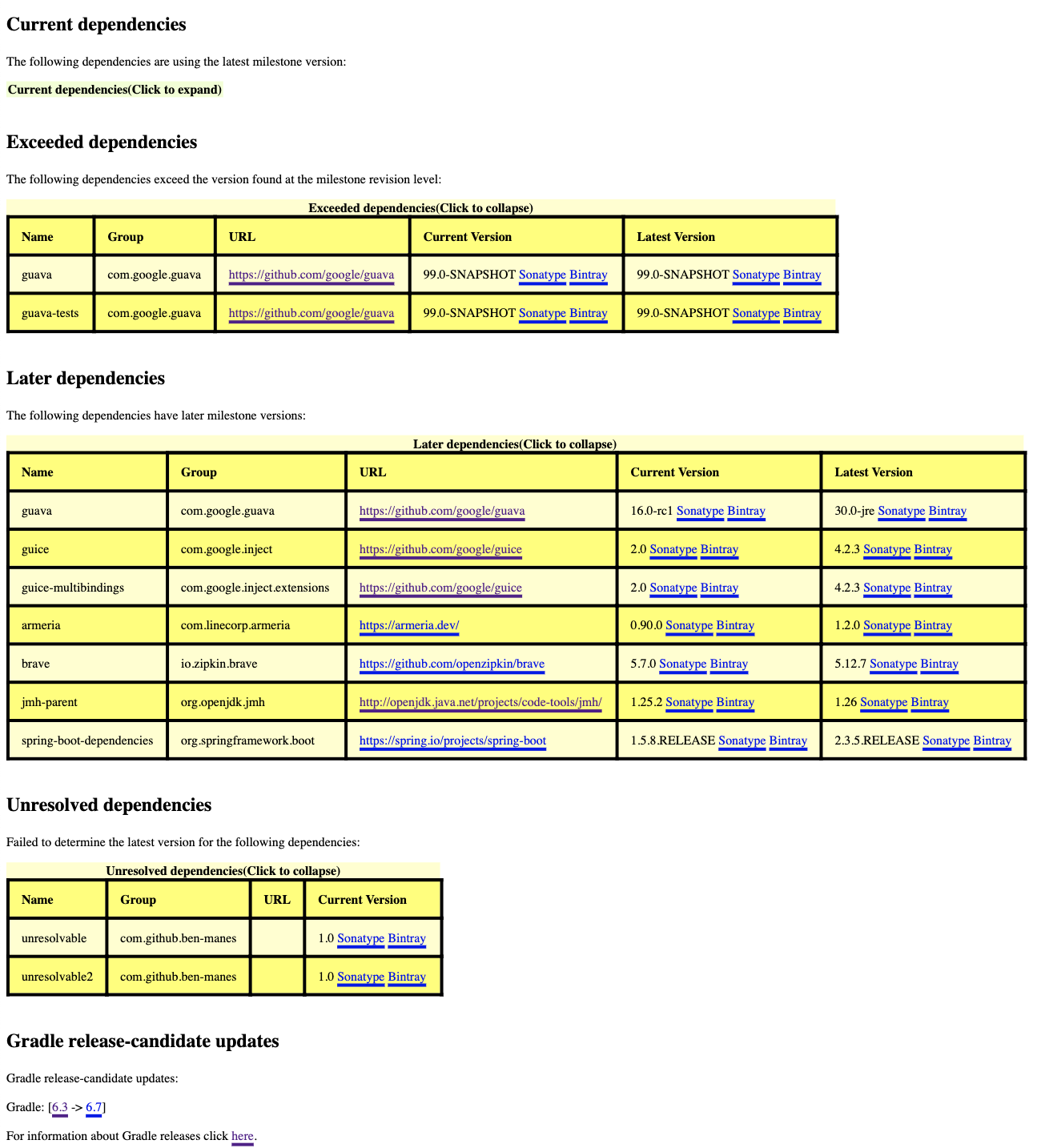
#### Gradle versions API base URL The `gradleVersionsApiBaseUrl` task property provides an option for customization of the Gradle versions service URL. If not specified, the default value https://services.gradle.org/versions/ is used. The customization can be useful in restricted environments without direct internet access and proxy availability. #### Report format The task property `outputFormatter` controls the report output format. The following values are supported: * `"plain"`: format output file as plain text (default) * `"json"`: format output file as json text * `"xml"`: format output file as xml text, can be used by other plugins (e.g. sonar) * `"html"`: format output file as html * `Closure`: will be called with the result of the dependency update analysis (from Kotlin, use the `outputFormatter(Action)` function instead) The console summary is printed at the lifecycle log level, so `--quiet` suppresses it. The report file is still written; read it, or drop `--quiet`, if a script was piping the console output. You can also set multiple output formats using comma as the separator: ```bash ./gradlew dependencyUpdates -Drevision=release -DoutputFormatter=json,xml,html ``` The task property `outputDir` controls the output directory for the report file(s). The directory will be created if it does not exist. The default value is set to `build/dependencyUpdates` ```bash ./gradlew dependencyUpdates -Drevision=release -DoutputFormatter=json -DoutputDir=/any/path/with/permission ``` Last the property `reportfileName` sets the filename (without extension) of the generated report. It defaults to `report`. The extension will be set according to the used output format. ```bash ./gradlew dependencyUpdates -Drevision=release -DoutputFormatter=json -DreportfileName=myCustomReport ``` Sample output in each format:
Text report ``` ------------------------------------------------------------ : Project Dependency Updates (report to plain text file) ------------------------------------------------------------ The following dependencies are using the latest milestone version: - backport-util-concurrent:backport-util-concurrent:3.1 - backport-util-concurrent:backport-util-concurrent-java12:3.1 - io.github.ben-manes:gradle-versions-plugin:0.55.0 The following dependencies exceed the version found at the milestone revision level: - com.google.guava:guava-tests [99.0-SNAPSHOT <- 23.3-jre] https://github.com/google/guava The following dependencies have later milestone versions: - com.google.guava:guava [15.0 -> 23.0] https://github.com/google/guava - com.google.inject:guice [2.0 -> 7.0.0] https://github.com/google/guice - com.google.inject.extensions:guice-multibindings [2.0 -> 4.2.3] https://github.com/google/guice - com.linecorp.armeria:armeria [0.90.0 -> 1.40.0] https://armeria.dev/ - io.zipkin.brave:brave [5.7.0 -> 6.3.1] https://github.com/openzipkin/brave/brave - org.springframework.boot:spring-boot-dependencies [1.5.8.RELEASE -> 4.1.0] https://spring.io/projects/spring-boot Failed to compare versions for the following dependencies because they were declared without version: - com.google.code.gson:gson Failed to determine the latest version for the following dependencies (use --info for details): - com.github.ben-manes:unresolvable:1.0 - com.github.ben-manes:unresolvable2:1.0 - com.google.guava:guava:15.0 https://github.com/google/guava - dom4j:dom4j Gradle release-candidate updates: - Gradle: [8.4 -> 9.6.1 -> 9.7.0-rc-2] ```
Alternatively, the report may be output to a structured file.
JSON report ```json { "count": 15, "current": { "count": 3, "dependencies": [ { "group": "backport-util-concurrent", "name": "backport-util-concurrent", "version": "3.1", "projectUrl": "http://backport-jsr166.sourceforge.net/", "userReason": null }, { "group": "backport-util-concurrent", "name": "backport-util-concurrent-java12", "version": "3.1", "projectUrl": "http://backport-jsr166.sourceforge.net/", "userReason": null }, { "group": "io.github.ben-manes", "name": "gradle-versions-plugin", "version": "0.55.0", "projectUrl": null, "userReason": null } ] }, "outdated": { "count": 6, "dependencies": [ { "group": "com.google.guava", "name": "guava", "version": "15.0", "projectUrl": "https://github.com/google/guava", "userReason": null, "available": { "release": null, "milestone": "23.0", "integration": null } }, { "group": "com.google.inject", "name": "guice", "version": "2.0", "projectUrl": "https://github.com/google/guice", "userReason": null, "available": { "release": null, "milestone": "7.0.0", "integration": null } }, { "group": "com.google.inject.extensions", "name": "guice-multibindings", "version": "2.0", "projectUrl": "https://github.com/google/guice", "userReason": null, "available": { "release": null, "milestone": "4.2.3", "integration": null } }, { "group": "com.linecorp.armeria", "name": "armeria", "version": "0.90.0", "projectUrl": "https://armeria.dev/", "userReason": null, "available": { "release": null, "milestone": "1.40.0", "integration": null } }, { "group": "io.zipkin.brave", "name": "brave", "version": "5.7.0", "projectUrl": "https://github.com/openzipkin/brave/brave", "userReason": null, "available": { "release": null, "milestone": "6.3.1", "integration": null } }, { "group": "org.springframework.boot", "name": "spring-boot-dependencies", "version": "1.5.8.RELEASE", "projectUrl": "https://spring.io/projects/spring-boot", "userReason": null, "available": { "release": null, "milestone": "4.1.0", "integration": null } } ] }, "exceeded": { "count": 1, "dependencies": [ { "group": "com.google.guava", "name": "guava-tests", "version": "99.0-SNAPSHOT", "projectUrl": "https://github.com/google/guava", "userReason": null, "latest": "23.3-jre" } ] }, "undeclared": { "count": 1, "dependencies": [ { "group": "com.google.code.gson", "name": "gson", "version": null, "projectUrl": null, "userReason": null } ] }, "unresolved": { "count": 4, "dependencies": [ { "group": "com.github.ben-manes", "name": "unresolvable", "version": "1.0", "projectUrl": null, "userReason": null, "reason": "Could not find any matches for com.github.ben-manes:unresolvable:+ as no versions of com.github.ben-manes:unresolvable are available.\nSearched in the following locations:\n - https://repo.maven.apache.org/maven2/com/github/ben-manes/unresolvable/maven-metadata.xml" }, { "group": "com.github.ben-manes", "name": "unresolvable2", "version": "1.0", "projectUrl": null, "userReason": null, "reason": "Could not find any matches for com.github.ben-manes:unresolvable2:+ as no versions of com.github.ben-manes:unresolvable2 are available.\nSearched in the following locations:\n - https://repo.maven.apache.org/maven2/com/github/ben-manes/unresolvable2/maven-metadata.xml" }, { "group": "com.google.guava", "name": "guava", "version": "15.0", "projectUrl": "https://github.com/google/guava", "userReason": null, "reason": "Could not resolve com.google.guava:guava:+." }, { "group": "dom4j", "name": "dom4j", "version": "none", "projectUrl": null, "userReason": null, "reason": "Could not resolve dom4j:dom4j:+." } ] }, "gradle": { "enabled": true, "running": { "isFailure": false, "isUpdateAvailable": false, "reason": "", "version": "8.4" }, "current": { "isFailure": false, "isUpdateAvailable": true, "reason": "", "version": "9.6.1" }, "releaseCandidate": { "isFailure": false, "isUpdateAvailable": true, "reason": "", "version": "9.7.0-rc-2" }, "nightly": { "isFailure": false, "isUpdateAvailable": false, "reason": "update check disabled", "version": "" } } } ```
XML report ```xml 15 3 backport-util-concurrent backport-util-concurrent 3.1 http://backport-jsr166.sourceforge.net/ backport-util-concurrent backport-util-concurrent-java12 3.1 http://backport-jsr166.sourceforge.net/ io.github.ben-manes gradle-versions-plugin 0.55.0 6 com.google.guava guava 15.0 https://github.com/google/guava 23.0 com.google.inject guice 2.0 https://github.com/google/guice 7.0.0 com.google.inject.extensions guice-multibindings 2.0 https://github.com/google/guice 4.2.3 com.linecorp.armeria armeria 0.90.0 https://armeria.dev/ 1.40.0 io.zipkin.brave brave 5.7.0 https://github.com/openzipkin/brave/brave 6.3.1 org.springframework.boot spring-boot-dependencies 1.5.8.RELEASE https://spring.io/projects/spring-boot 4.1.0 1 com.google.guava guava-tests 99.0-SNAPSHOT https://github.com/google/guava 23.3-jre 1 com.google.code.gson gson 4 com.github.ben-manes unresolvable 1.0 Could not find any matches for com.github.ben-manes:unresolvable:+ as no versions of com.github.ben-manes:unresolvable are available. Searched in the following locations: - https://repo.maven.apache.org/maven2/com/github/ben-manes/unresolvable/maven-metadata.xml com.github.ben-manes unresolvable2 1.0 Could not find any matches for com.github.ben-manes:unresolvable2:+ as no versions of com.github.ben-manes:unresolvable2 are available. Searched in the following locations: - https://repo.maven.apache.org/maven2/com/github/ben-manes/unresolvable2/maven-metadata.xml com.google.guava guava 15.0 https://github.com/google/guava Could not resolve com.google.guava:guava:+. dom4j dom4j none Could not resolve dom4j:dom4j:+. true 8.4 false false 9.6.1 true false 9.7.0-rc-2 true false false false update check disabled ```
HTML report [](examples/html-report.png)
Custom report If you need to create a report in a custom format, you can provide a formatter function to the `dependencyUpdates` task's `outputFormatter`. The formatter receives the analysis as an instance of [com.github.benmanes.gradle.versions.reporter.result.Result](gradle-versions-plugin/src/main/kotlin/com/github/benmanes/gradle/versions/reporter/result/Result.kt): in the Kotlin DSL it is the receiver of the formatter block, and in Groovy it is passed as the closure argument. > [!IMPORTANT] > Under the configuration cache, the formatter cannot reach the project or the > build script from inside the closure, because it runs at execution time. Read > what it needs into local variables beforehand, as shown in > [Migrating from prior versions](#v0540-and-earlier). Gradle's > [configuration cache requirements](https://docs.gradle.org/current/userguide/configuration_cache_requirements.html) > cover the underlying rules. For example, if you wanted to create an html table for the upgradable dependencies, you could use:
Kotlin ```kotlin import com.github.benmanes.gradle.versions.updates.DependencyUpdatesTask tasks.named("dependencyUpdates") { outputFormatter { val updatable = outdated.dependencies if (updatable.isNotEmpty()) { val table = buildString { appendLine("") appendLine(" ") appendLine(" ") appendLine(" ") appendLine(" ") updatable.forEach { dependency -> appendLine( " " + "" + "" ) } appendLine(" ") appendLine("
GroupModuleCurrent versionLatest version
${dependency.group}${dependency.name}${dependency.version}${dependency.available.release ?: dependency.available.milestone}
") } println(table) } } } ```
Groovy ```groovy tasks.named("dependencyUpdates").configure { outputFormatter = { result -> def updatable = result.outdated.dependencies if (!updatable.isEmpty()) { def table = new StringBuilder() table.append("\n") table.append(" \n") table.append(" \n") table.append(" \n") table.append(" \n") updatable.each { dependency -> table.append(" ") table.append("") table.append("\n") } table.append(" \n") table.append("
GroupModuleCurrent versionLatest version
${dependency.group}${dependency.name}${dependency.version}${dependency.available.release ?: dependency.available.milestone}
") println table } } } ```
### Multi-project builds Running the task in the root project generates one merged report covering every project. The report is aggregated from a task in each project, so it works with parallel execution, the configuration cache, and configure on demand. Under the configuration cache the dependency metadata read during resolution is tracked as an input, so a newly published version invalidates the cached entry rather than serving a stale report. The merged report and the partial results it merges live in the aggregating project's build directory. `clean` removes them only if that project has a `clean` task, which the `base` plugin supplies. A root project that applies no other plugin can add `base` for that alone; the task itself does not need it.
Kotlin "build.gradle.kts": ```kotlin plugins { base } ```
Groovy "build.gradle": ```groovy plugins { id 'base' } ```
When a coordinate's declared version differs across the aggregated projects, the plain text, JSON, XML, and HTML reports name the projects that declared each version, so the entry no longer reads as self-contradictory: ```text The following dependencies have later milestone versions: - org.jacoco:org.jacoco.ant [0.8.14 -> 0.8.15] declared in root project ``` The plain text and HTML reports name the first five projects and count the rest (`declared in :app, :lib, ... and 60 others`). The JSON and XML reports always carry the complete list, so use one of them when a tool needs every project. With the settings plugin applied (see [Applying the plugin](#applying-the-plugin)), the root project receives the `dependencyUpdates` task and every other project contributes to it. No project applies a plugin itself, and a root build script is not required—add one only if you want to configure the task. The report also covers the plugins the settings script declares, which no project's buildscript carries; a version pinned in `pluginManagement` for a plugin the build never applies is not reported. The settings plugin registers the root project's `dependencyUpdates` task before the root build script runs, so a build script that registers its own task by that name now fails with a duplicate-task error—rename yours. #### Shared task settings Each project takes the settings that control resolution (`revision`, `rejectVersionIf` or a full `resolutionStrategy`, `filterConfigurations`, `checkConstraints`, and `checkBuildEnvironmentConstraints`) from the nearest project up the hierarchy whose task set them. Configuring the root project's task therefore covers every project, unless a subproject configures its own (see [Task properties](#task-properties)). #### Composite builds An included build is a separate build with its own settings script, so its projects are not part of this build's report. Apply the settings plugin in the included build's settings script as well, and run its `dependencyUpdates` task separately. `buildSrc` is a separate build too, and is likewise excluded. This is not specific to the settings plugin—an included build has never been covered. To report on every build in one invocation, register a lifecycle task that depends on each included build's task. Each build still writes its own report; there is no merged report across builds:
Kotlin "build.gradle.kts": ```kotlin tasks.register("allDependencyUpdates") { gradle.includedBuilds.forEach { dependsOn(it.task(":dependencyUpdates")) } } ```
Groovy "build.gradle": ```groovy tasks.register("allDependencyUpdates") { gradle.includedBuilds.each { dependsOn(it.task(':dependencyUpdates')) } } ```
Every included build needs the plugin applied for its `dependencyUpdates` task to exist. A build that must stay unmodified can have the plugin injected by an [init script](#initialization-script) instead. #### Per-project reports A project can have a `dependencyUpdates` task of its own, reporting on itself and its subprojects (see [Other ways to apply the plugin](#other-ways-to-apply-the-plugin)). Run it by its path to get just that report: ```bash ./gradlew :subproject:dependencyUpdates ``` ### Isolated projects Under [isolated projects](https://docs.gradle.org/current/userguide/isolated_projects.html) a project plugin cannot register a task in another project, so a project only contributes to the aggregate report if it applies a plugin itself. The settings plugin covers this: it applies a plugin to each project as the project is evaluated, so the recommended setup works unchanged (see [Applying the plugin](#applying-the-plugin)). A build that cannot apply the settings plugin can still cover every project (see [Contributor plugin](#contributor-plugin)). Under isolated projects, contributing projects that share a group and name are aggregated as one; the console warns about any project the report is missing. ## Other ways to apply the plugin The settings plugin is the recommended way to apply the plugin (see [Applying the plugin](#applying-the-plugin)). The options below cover builds that need something different: * apply the plugin to a single project—for a separate per-project report, alongside or instead of the settings plugin (see [The `plugins` block](#the-plugins-block) and [legacy plugin application](#legacy-plugin-application)); * contribute every project to the root report without a settings plugin (see [Contributor plugin](#contributor-plugin)); * apply the plugin to every build you run on your machine (see [Initialization script](#initialization-script)). In the snippets below, replace `$version` with the current release, shown in the badge at the top of this page. > [!IMPORTANT] > When the settings plugin is also applied, request the per-project plugin > *without* a version—the settings plugin already puts it on every project's > classpath, and a versioned request fails to resolve. This includes a version > catalog alias, which always carries a version. ### The `plugins` block
Kotlin "build.gradle.kts": ```kotlin plugins { id("io.github.ben-manes.versions") version "$version" } ```
Groovy "build.gradle": ```groovy plugins { id "io.github.ben-manes.versions" version "$version" } ```
### Legacy plugin application > [!TIP] > Prefer the `plugins` block—it is the modern replacement for > `buildscript`-based plugin application.
Kotlin "build.gradle.kts": ```kotlin buildscript { repositories { gradlePluginPortal() } dependencies { classpath("io.github.ben-manes:gradle-versions-plugin:$version") } } apply(plugin = "io.github.ben-manes.versions") ```
Groovy "build.gradle": ```groovy buildscript { repositories { gradlePluginPortal() } dependencies { classpath "io.github.ben-manes:gradle-versions-plugin:$version" } } apply plugin: "io.github.ben-manes.versions" ```
### Contributor plugin A build that cannot apply the settings plugin—under isolated projects, where a project plugin cannot register a task in another project (see [Isolated projects](#isolated-projects))—can keep applying `io.github.ben-manes.versions` in the root project, and apply `io.github.ben-manes.versions.contributor` in every other project, typically from a convention plugin they already share:
Kotlin "buildSrc/src/main/kotlin/my-conventions.gradle.kts": ```kotlin plugins { id("io.github.ben-manes.versions.contributor") } ```
Groovy "buildSrc/src/main/groovy/my-conventions.gradle": ```groovy plugins { id 'io.github.ben-manes.versions.contributor' } ```
The convention plugin's own build must have the plugin on its classpath, e.g. as an `implementation("io.github.ben-manes:gradle-versions-plugin:$version")` dependency in `buildSrc/build.gradle.kts`. The contributor plugin registers only the producer that feeds the aggregate report, so `dependencyUpdates` remains a single task in the root project. The main plugin is a superset of the contributor plugin: a project that applies `io.github.ben-manes.versions` instead still feeds the aggregate report, and also gets its own `dependencyUpdates` task covering itself and its subprojects. ### Initialization script You can also transparently add the plugin to every Gradle project that you run via a [Gradle init script](https://docs.gradle.org/current/userguide/init_scripts.html). Apply the settings plugin from `beforeSettings`, which covers every project of the build and works under isolated projects (see [Isolated projects](#isolated-projects)). Every build that runs gets its own `dependencyUpdates` task, so an included build is reported without being modified (see [Composite builds](#composite-builds)):
Kotlin "$HOME/.gradle/init.d/add-versions-plugin.init.gradle.kts": ```kotlin import com.github.benmanes.gradle.versions.VersionsSettingsPlugin import com.github.benmanes.gradle.versions.updates.DependencyUpdatesTask initscript { repositories { gradlePluginPortal() } dependencies { classpath("io.github.ben-manes:gradle-versions-plugin:+") } } gradle.beforeSettings(Action { pluginManager.apply(VersionsSettingsPlugin::class.java) }) gradle.rootProject(Action { tasks.withType(DependencyUpdatesTask::class.java).configureEach { // configure the task, for example wrt. resolution strategies } }) ```
Groovy "$HOME/.gradle/init.d/add-versions-plugin.gradle": ```groovy import com.github.benmanes.gradle.versions.VersionsSettingsPlugin import com.github.benmanes.gradle.versions.updates.DependencyUpdatesTask initscript { repositories { gradlePluginPortal() } dependencies { classpath 'io.github.ben-manes:gradle-versions-plugin:+' } } beforeSettings { settings -> settings.pluginManager.apply(VersionsSettingsPlugin) } gradle.rootProject { tasks.withType(DependencyUpdatesTask).configureEach { // configure the task, for example wrt. resolution strategies } } ```
A script has no implicit import for the plugin's types, so the imports at the top of these snippets are required to reference them by their simple names. An init script resolves the plugin on a classpath of its own, so a build that applies the plugin itself holds a second copy of it. An init script reaches a build before the build's own scripts do, so its copy is the one that reports and the build's copy defers to it, which leaves such a build working as it did. For the same reason the plugin is absent from the project's own classpath, so a `plugins` block that requests it alongside an init script needs a version, unlike one in a build whose settings script applies the settings plugin (see [Other ways to apply the plugin](#other-ways-to-apply-the-plugin)). ## Samples Have a look at [`examples/kotlin`](https://github.com/ben-manes/gradle-versions-plugin/tree/master/examples/kotlin) and [`examples/groovy`](https://github.com/ben-manes/gradle-versions-plugin/tree/master/examples/groovy) ```bash # Publish the latest version of the plugin to mavenLocal() $ ./gradlew publishToMavenLocal # Try out the samples $ ./gradlew -p examples/kotlin dependencyUpdates $ ./gradlew -p examples/groovy dependencyUpdates ``` ## Compatibility The plugin requires Gradle 8.4 or later, checked when the plugin is applied. It targets Java 8 bytecode, so it runs on any JVM that can run Gradle itself. Parallel execution, the configuration cache, configure on demand, and isolated projects (see [Isolated projects](#isolated-projects)) are supported. ## Migrating from prior versions To migrate to the current version, start at the section for the version your build is on and work upward. Each section migrates to the version covered by the section above it, and the topmost migrates to the current release. *Important*s are must-dos, *Tip*s are actions you should or may want to take, and *Note*s are things worth knowing that need no action. ### v0.59.0 v0.60.0 names the configuration a dependency was declared directly against, so a plugin that fills a classpath of its own when it is applied no longer reads as the build declaring the dependency: > [!IMPORTANT] > An entry can now carry an attribution line where it carried none, naming the > configuration the dependency was declared against. A tool that parses the plain > text report line by line has to skip it, as it already does for the other > attribution lines (see [Report format](#report-format)). ### v0.58.0 v0.59.0 reports the version another resolution found for a dependency that failed to resolve, and collects the partial result of every project under the project that aggregates them, so a project that exists only to hold a nested `include` no longer gains a `build` directory of its own: > [!IMPORTANT] > * A declared version that resolved in one place and failed in another is now > reported twice: once with the version found for it, and again as > unresolved. A dependency declared without a version doubles the same way, as > undeclared and unresolved. The JSON and XML reports count it in each place. > A tool reading `count` as a dependency total, or treating the sections as > disjoint, has to allow for the overlap (see > [Report format](#report-format)). > * The unresolved section of the plain text report now names the declared > version, as every other section does. A tool that parses that section line > by line has to allow it. > [!TIP] > Run `./gradlew dependencyUpdates --clean-legacy-partials` once to remove the > `build/dependencyUpdates/partial.json` that earlier releases wrote into each > project. The `clean` task removes it from a project that directly or > indirectly applies the > [Base plugin](https://docs.gradle.org/current/userguide/base_plugin.html), but > a project with no build script has no `clean` task. ### v0.57.0 v0.58.0 routes the reporters through the build's logger and adds attribution lines to the reports: > [!IMPORTANT] > * The console summary now prints at the lifecycle log level, so `--quiet` > suppresses it. The report file is still written; read it, or drop > `--quiet`, if a script was piping the console output (see > [Report format](#report-format)). > * An entry may carry an indented attribution line naming the projects that > declared a divergent version (see > [Multi-project builds](#multi-project-builds)) or the configuration a > plugin contributed it into (see > [The `dependencyUpdates` task](#the-dependencyupdates-task)). A tool that > parses the plain text report line by line has to skip them; the JSON and > XML reports carry the same signal as fields instead. ### v0.56.0 v0.57.0 supports applying the settings plugin from an init script: > [!IMPORTANT] > An init script that applies `VersionsPlugin` to `allprojects` reports per > project rather than once, omits the plugins that the settings script declares, > and fails under isolated projects. Apply the settings plugin from > `beforeSettings` instead (see > [Initialization script](#initialization-script)). ### v0.55.0 v0.56.0 adds the settings plugin and makes it the recommended setup: > [!TIP] > Apply `io.github.ben-manes.versions.settings` in the settings script (see > [Applying the plugin](#applying-the-plugin)) and remove > `io.github.ben-manes.versions` from your build scripts. A project that keeps > the main plugin for a separate per-project report must request it without a > version, because the settings plugin already puts the plugin on every > project's classpath. > [!NOTE] > * A build that applied `io.github.ben-manes.versions.contributor` from a > convention plugin for isolated projects support no longer needs it: the > settings plugin covers every project. The contributor plugin remains > available for builds that cannot apply a settings plugin. > * Task configuration is unchanged: configure `dependencyUpdates` in the root > build script as before. ### v0.54.0 and earlier v0.55.0 moves the plugin from the `com.github.ben-manes` namespace to `io.github.ben-manes` and raises the minimum supported Gradle version to 8.4: > [!IMPORTANT] > * Move a `buildscript` or `initscript` `classpath` dependency to the > `io.github.ben-manes:gradle-versions-plugin` coordinate. v0.54.0 is the > last release published under > `com.github.ben-manes:gradle-versions-plugin`, so the old coordinate no > longer sees updates. > * Under the configuration cache, a custom `outputFormatter` cannot reach the > project or the build script from inside the closure, because it runs at > execution time (see [Report format](#report-format)). Read what it needs > into local variables inside the `configure` block, and use the > `PlainTextReporter` constructor that takes the project path, as shown > below. > >
> Kotlin > > "build.gradle.kts": > ```kotlin > import com.github.benmanes.gradle.versions.reporter.PlainTextReporter > import com.github.benmanes.gradle.versions.updates.DependencyUpdatesTask > > tasks.named("dependencyUpdates").configure { > val projectPath = project.path > > outputFormatter { > PlainTextReporter(projectPath, revision, gradleReleaseChannel).write(System.out, this) > } > } > ``` > >
> >
> Groovy > > "build.gradle": > ```groovy > import com.github.benmanes.gradle.versions.reporter.PlainTextReporter > > tasks.named("dependencyUpdates").configure { > def projectPath = project.path > def taskRevision = revision > def releaseChannel = gradleReleaseChannel > > outputFormatter { result -> > new PlainTextReporter(projectPath, taskRevision, releaseChannel).write(System.out, result) > } > } > ``` > >
> > Groovy also needs `revision` and `gradleReleaseChannel` read up front, because > the closure is coerced to an `Action` without a delegate. In a precompiled > script plugin a top-level `val` is a field of the script, so hoisting the > value out of the `configure` block does not work. > [!TIP] > Switch the plugin ID from `com.github.ben-manes.versions` to > `io.github.ben-manes.versions`. The legacy ID is deprecated but keeps > receiving releases, so this can happen at your convenience; only the main > plugin has a legacy ID. > [!NOTE] > v0.55.0 also reworks how the merged report of a multi-project build is > produced: it is aggregated from a task in each project, which adds support for > parallel execution, the configuration cache, and isolated projects (see > [Multi-project builds](#multi-project-builds)). The report content is > unchanged, as is task configuration apart from a custom `outputFormatter` > under the configuration cache. Then continue with the v0.55.0 steps above. ## Related plugins This plugin only reports. To apply the updates it finds automatically: * [version-catalog-update-plugin](https://github.com/littlerobots/version-catalog-update-plugin): updates the versions in your version catalog (`libs.versions.toml`) based on this plugin's report * [gradle-use-latest-versions](https://github.com/patrikerdes/gradle-use-latest-versions-plugin): updates versions declared directly in build scripts based on this plugin's report * [gradle-upgrade-interactive](https://github.com/kevcodez/gradle-upgrade-interactive): interactive CLI that applies the updates you select from this plugin's report Other related tools: * [gradle-versions-filter-plugin](https://github.com/janderssonse/gradle-versions-filter-plugin) * [gradle-update-checker](https://github.com/marketplace/actions/gradle-update-checker) * [gradle-libraries-plugin](https://github.com/fkorotkov/gradle-libraries-plugin) * [gradle-update-notifier](https://github.com/y-yagi/gradle-update-notifier) * [refreshVersions](https://github.com/jmfayard/refreshVersions) * [update-versions-gradle-plugin](https://github.com/tomasbjerre/update-versions-gradle-plugin) * [caupain](https://github.com/deezer/caupain/)