# amdb



**amdb turns your codebase into AI context — entirely on your machine.**
amdb is a zero-runtime, single-binary code context MCP server with combined graph + vector retrieval. No code leaves the machine and no Node/Python runtime is required. Built for air-gapped environments, CI containers, and regulated industries where cloud-based codebase indexing is prohibited.
## Install
```bash
cargo install amdb
```
Or download a static binary for Linux/macOS from the [Releases page](https://github.com/BETAER-08/amdb/releases) — no toolchain required.
## Quickstart
```bash
amdb init . # index the repo: AST parse + local embeddings, incremental
amdb serve # expose the index as an MCP server over stdio
```
Done. Prefer a file instead of a server? `amdb generate --focus "auth"` writes a targeted context file to `.amdb/`.
## Connect your editor
**VSCode / Cursor** — add `.vscode/mcp.json` to your project:
```json
{
"servers": {
"amdb": {
"command": "amdb",
"args": ["serve"]
}
}
}
```
**Claude Code**:
```bash
claude mcp add amdb -- amdb serve
```
The server exposes three tools, all reading from the pre-built local index:
| Tool | What it returns |
| :- | :- |
| `amdb_get_context` | Full project overview: files, symbols, and the mermaid dependency graph |
| `amdb_focus` | Context narrowed to a query via name match + semantic vector search, expanded by `depth` dependency hops |
| `amdb_get_symbol` | Every definition of a symbol name as JSON: file, kind, line, signature, callers, and callees — each callee carries its resolved file and a `resolution` value (`same-file`, `global-unique`, or `unresolved`) |
If no index exists the tools respond with an error asking you to run `amdb init` — the server never indexes on its own.
## Demo
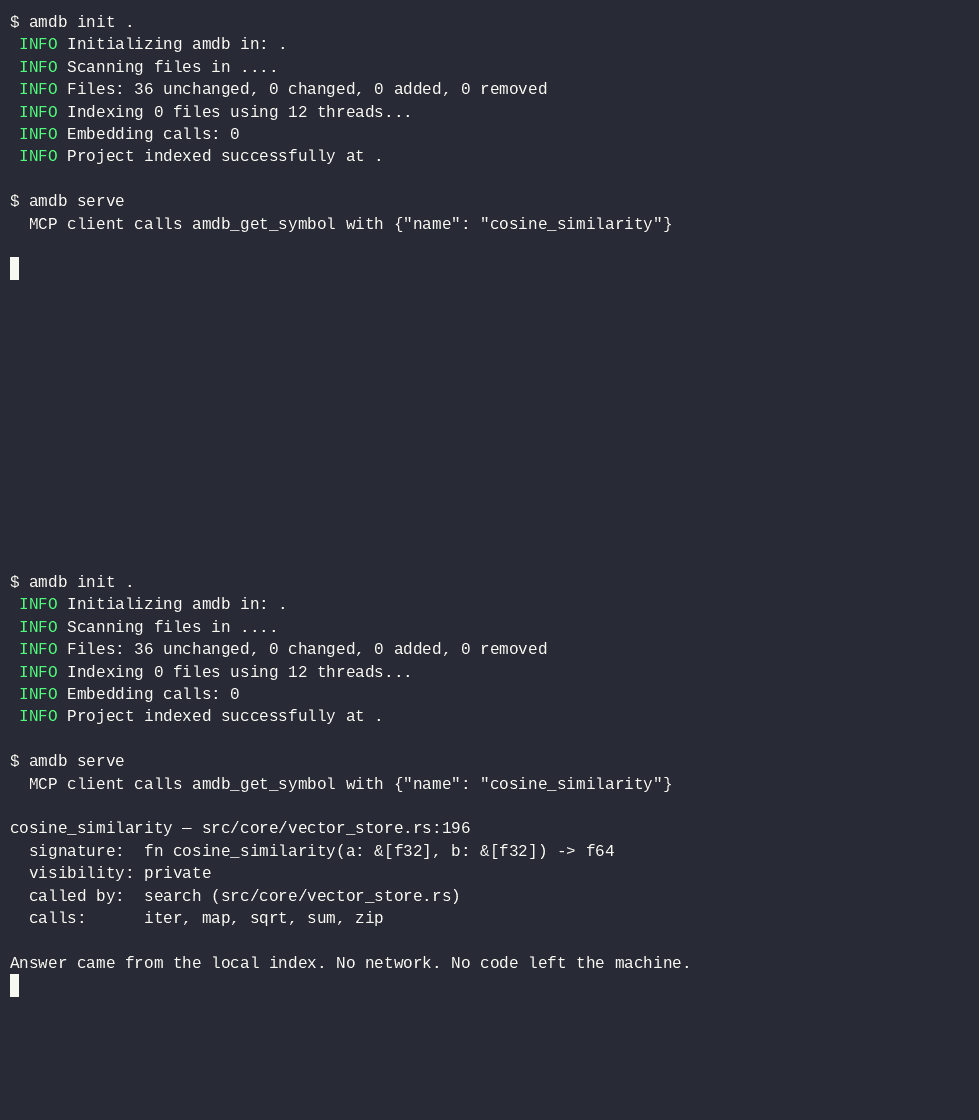
Real session, 1.0 seconds end-to-end ([scripts/demo.sh](scripts/demo.sh)):
```console
$ amdb init .
INFO Initializing amdb in: .
INFO Scanning files in ....
INFO Files: 35 unchanged, 0 changed, 0 added, 0 removed
INFO Indexing 0 files using 12 threads...
INFO Embedding calls: 0
INFO Project indexed successfully at .
$ amdb serve
MCP client calls amdb_get_symbol with {"name": "cosine_similarity"}
cosine_similarity — src/core/vector_store.rs:196
signature: fn cosine_similarity(a: &[f32], b: &[f32]) -> f64
visibility: private
called by: search (src/core/vector_store.rs)
calls: iter, map, sqrt, sum, zip
Answer came from the local index. No network. No code left the machine.
```
To record the cast on a host with asciinema: `asciinema rec -c "AMDB_BIN=./target/release/amdb ./scripts/demo.sh" demo.cast`, then `agg demo.cast demo.gif`.
## Benchmarks
Measured by [`benchmark.py`](benchmark.py) against amdb's own source tree (31 files, 21,887 raw tokens). Full methodology and caveats in [benchmark.md](benchmark.md).
| Metric | Score | Meaning |
|--------|-------|---------|
| Precision targeting | 100% (28/28 indexed files) | Query = exact file stem; the file's own section comes back. A retrieval-plumbing test, not a semantic-search-quality test |
| Global efficiency | 91.5% reduction | Focus output tokens vs. a full-repo dump |
| Noise reduction | 81.7% compression | Interface tokens vs. raw tokens, top-5 largest files |
| Graph presence | 100% (28/28) | Output contains real `-->` dependency edges |
3 of 31 files are module-declaration files with no extractable symbols; they are not in the index and are excluded from the denominator, not silently counted.
## Language support
Symbols and the call graph are extracted for all 16 grammars, but `is_public` and `signature` enrichment is AST-accurate for only three languages. The rest fall back to `is_public = true` and no signature — honest table below, so you know what you get:
| Language | Extensions | Symbols + call graph | `is_public` / `signature` |
|----------|-----------|:---:|:---|
| Rust | `.rs` | ✅ | ✅ AST-accurate |
| Python | `.py` | ✅ | ✅ AST-accurate |
| TypeScript | `.ts`, `.tsx` | ✅ | ✅ AST-accurate |
| JavaScript | `.js`, `.jsx`, `.mjs` | ✅ | fallback (`true` / none) |
| C | `.c`, `.h` | ✅ | fallback (`true` / none) |
| C++ | `.cpp`, `.hpp`, `.cc`, `.cxx` | ✅ | fallback (`true` / none) |
| C# | `.cs` | ✅ | fallback (`true` / none) |
| Go | `.go` | ✅ | fallback (`true` / none) |
| Java | `.java` | ✅ | fallback (`true` / none) |
| Ruby | `.rb` | ✅ | fallback (`true` / none) |
| PHP | `.php` | ✅ | fallback (`true` / none) |
| HTML | `.html`, `.htm` | ✅ | fallback (`true` / none) |
| CSS | `.css` | ✅ | fallback (`true` / none) |
| JSON | `.json` | ✅ | fallback (`true` / none) |
| Bash | `.sh`, `.bash` | ✅ | fallback (`true` / none) |
## How it works
`amdb init` parses every source file with Tree-sitter, extracts symbols and call edges, and embeds each symbol with a local fastembed model — content-hashed, so unchanged files are skipped entirely on re-runs. Everything lands in two SQLite files: a symbol/relationship store and a vector store. Retrieval combines exact name matching, cosine similarity over the vectors, and call-graph expansion, served over MCP stdio or written to a Markdown context file.
## Comparison
Same fixture repo (amdb's own source), same five questions ("where is symbol X defined, and who calls it?"), all numbers actually measured by `benchmark.py`. We did not run competitor indexing tools, so none appear here; the baselines are a raw full-repo dump and a scripted grep-then-read-matched-files agent protocol.
| Strategy | Avg tokens to model | Avg tool calls |
|----------|--------------------:|---------------:|
| Raw full-repo dump | 21,887 | 1 |
| grep + read matched files | 4,180 | 2.4 |
| amdb (`--focus`, depth 1) | 3,972 | 1 |
On a 31-file repo, grep is genuinely competitive on tokens — amdb's edge at this scale is one structured call instead of 2–4, with signatures, visibility, and resolver-accurate caller/callee attribution instead of raw text. The token gap widens with repo size: the dump grows linearly, grep grows with match noise, amdb's focus output grows with the size of the relevant interface.
## More
**Daemon mode** — `amdb daemon` watches the project and incrementally re-indexes on save, keeping the MCP answers fresh.
**Focus depth** — `amdb generate --focus --depth N` expands context N call-graph hops from the matched files (default 1).
**Configuration** — optional `amdb.toml` in the project root:
```toml
db_path = ".database"
ignore_patterns = ["target", ".git", "node_modules", ".amdb", ".fastembed_cache", "__pycache__", ".database"]
```
`AMDB_DB_PATH` overrides `db_path`. Add `.database/` and `.amdb/` to your `.gitignore`.
**Verbose** — `-v` / `--verbose` on any command for debug logs.
**Docker** — the repo `Dockerfile` builds a slim image whose entrypoint is `amdb serve`, so the container speaks MCP over stdio immediately:
```bash
docker build -t amdb .
docker run --rm -v "$PWD:/workspace" --entrypoint amdb amdb init .
docker run -i --rm -v "$PWD:/workspace" amdb
```
The published `ghcr.io/betaer-08/amdb:1.0.0` image predates the serve entrypoint — it runs bare `amdb`, so pass the subcommand explicitly: `docker run -i --rm -v "$PWD:/workspace" -w /workspace ghcr.io/betaer-08/amdb:1.0.0 serve`. Images published from the next tag serve by default.
## Stability
amdb follows semantic versioning. 1.0.0 freezes the contract below; anything listed as covered changes only in a 2.0 release, and contract tests in `tests/contract_test.rs` fail loudly if it drifts.
**Covered by the 1.0 promise:**
- **CLI** — subcommands `init`, `daemon`, `generate`, `serve`; flags `--focus`/`-f`, `--depth`/`-d`, `--verbose`/`-v`; the optional path argument to `init` and `daemon`. Exit codes: 0 on success, 1 on unrecoverable error.
- **MCP tools** — exactly `amdb_get_context`, `amdb_focus`, `amdb_get_symbol` with their current input parameters. `amdb_get_symbol` responses keep every current field with its current type: `file`, `name`, `kind`, `line`, `signature`, `is_public`, `callers[]` (`name`, `file`), `callees[]` (`name`, `file`, `resolution` ∈ `same-file` | `global-unique` | `unresolved`). New fields and new `resolution` values may be *added* in minor releases; existing ones are never renamed, removed, or retyped.
- **Config** — `amdb.toml` keys `db_path` and `ignore_patterns`, and the `AMDB_DB_PATH` environment override. Unknown keys are ignored.
- **Database upgrades** — the index schema is versioned via `PRAGMA user_version`. Any database written by amdb ≥ 0.6 opens without error and migrates automatically; the next `amdb init` rebuilds whatever the migration invalidated. Deleting `.database/` is a last-resort fallback, never a required upgrade step.
- **Generated Markdown anchors** — two things in `generate` output are stable for scripts: each indexed file gets a heading line of exactly `### ` (forward slashes, relative to the project root), and the dependency graph is a single fenced ` ```mermaid ` block containing `graph TD;` with `-->` edge lines.
**Not covered (may change in any release):**
- Every other detail of the Markdown layout: bullet and signature formatting, section ordering, mermaid node-id sanitization, header text.
- Log and progress text on stdout/stderr.
- The SQLite table layout and the vector-store file format (only automatic migration is promised, not the bytes).
- The benchmark harness (`benchmark.py`) and its output format.
- Internal Rust APIs — amdb is a binary crate; depending on its modules as a library is unsupported.
## License
MIT. Bug reports and inquiries: try.betaer@gmail.com