# VeritasGraph — The Governed, On-Prem GraphRAG & Agent Framework
**Stop chunking blindly. Combine Tree-Search structure with Knowledge-Graph reasoning — and wire it into governed AI agents. Runs 100% locally or in the cloud.**
 [](https://badge.fury.io/py/veritasgraph)
[](https://www.python.org/downloads/)
[](https://opensource.org/licenses/MIT)
[](https://github.com/bibinprathap/VeritasGraph/actions)
[](https://github.com/bibinprathap/VeritasGraph)
[](https://mcpvault.io/servers/veritasgraph/health?utm_source=external_badge&utm_medium=referral&utm_campaign=mcp_health_report)
> **🎯 Traditional RAG guesses based on similarity. VeritasGraph reasons based on structure.**
> Don't just find the document — understand the connection, then act on it with governed agents.
⭐ [Star](https://github.com/bibinprathap/VeritasGraph) · 🍴 [Fork](https://github.com/bibinprathap/VeritasGraph/fork) · 💬 [Discuss](https://github.com/bibinprathap/VeritasGraph/discussions) · 🐛 [Report a bug](https://github.com/bibinprathap/VeritasGraph/issues)
---
## 📚 Featured Guide — Build Governed AI Agents On-Prem
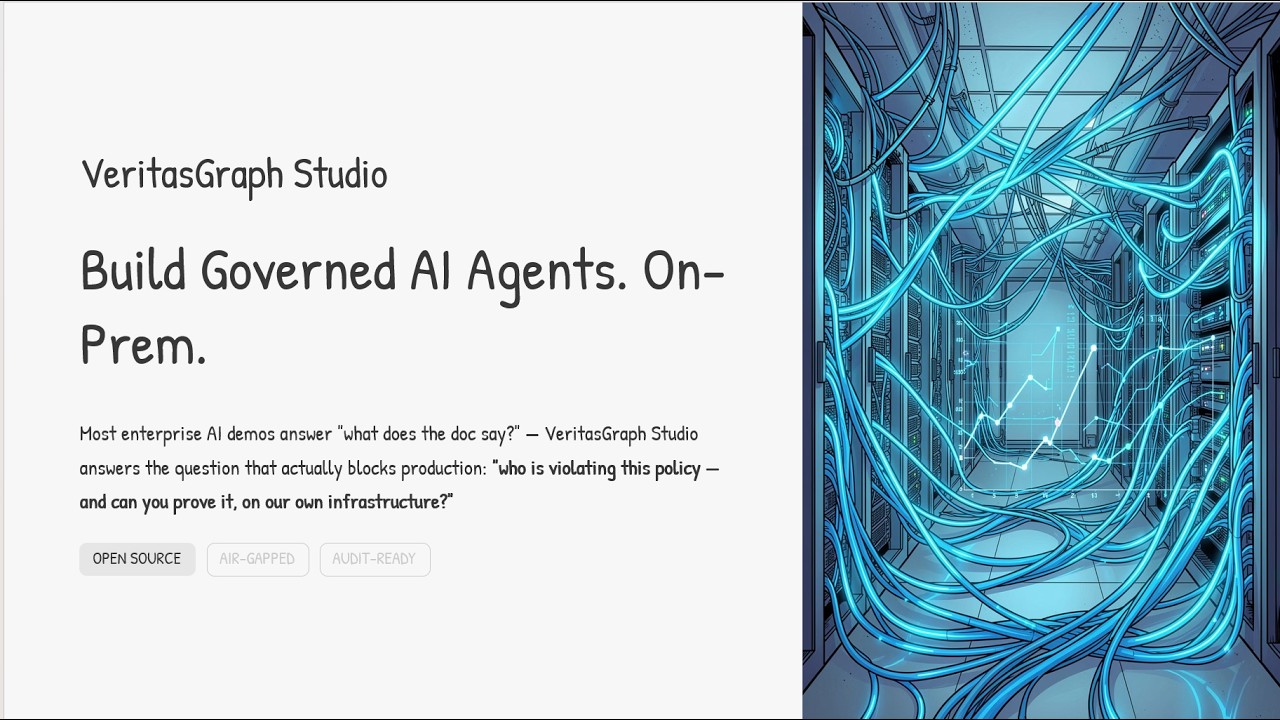
A complete walkthrough of designing, wiring, and shipping governed AI agents entirely on your own infrastructure.
**[📄 Read the guide: *Build Governed AI Agents On-Prem* (PDF)](https://github.com/bibinprathap/VeritasGraph/blob/restored-main/Build-Governed-AI-Agents-On-Prem.pdf)**
[](https://youtu.be/sA7ReEgdJfg)
[](https://youtu.be/Po2Z6QtqFks)
> ▶️ **[Watch the walkthrough on YouTube](https://youtu.be/sA7ReEgdJfg)**
---
## 🚀 Quick Start (2 lines, no GPU)
```bash
pip install veritasgraph
veritasgraph demo --mode=lite
```
That's it — an interactive demo using cloud APIs (OpenAI/Anthropic), no local models required.
| Mode | Best For | Requirements |
|------|----------|--------------|
| `--mode=lite` | Quick demo, no GPU | OpenAI/Anthropic API key |
| `--mode=local` | Privacy, offline use | Ollama + 8GB RAM |
| `--mode=full` | Production, all features | Docker + Neo4j |
```bash
export OPENAI_API_KEY="sk-..." # Lite: cloud APIs, zero setup
veritasgraph demo --mode=lite
veritasgraph demo --mode=local --model=llama3.2 # 100% offline with Ollama
veritasgraph start --mode=full # full GraphRAG pipeline
```
[](https://badge.fury.io/py/veritasgraph)
[](https://www.python.org/downloads/)
[](https://opensource.org/licenses/MIT)
[](https://github.com/bibinprathap/VeritasGraph/actions)
[](https://github.com/bibinprathap/VeritasGraph)
[](https://mcpvault.io/servers/veritasgraph/health?utm_source=external_badge&utm_medium=referral&utm_campaign=mcp_health_report)
> **🎯 Traditional RAG guesses based on similarity. VeritasGraph reasons based on structure.**
> Don't just find the document — understand the connection, then act on it with governed agents.
⭐ [Star](https://github.com/bibinprathap/VeritasGraph) · 🍴 [Fork](https://github.com/bibinprathap/VeritasGraph/fork) · 💬 [Discuss](https://github.com/bibinprathap/VeritasGraph/discussions) · 🐛 [Report a bug](https://github.com/bibinprathap/VeritasGraph/issues)
---
## 📚 Featured Guide — Build Governed AI Agents On-Prem
A complete walkthrough of designing, wiring, and shipping governed AI agents entirely on your own infrastructure.
**[📄 Read the guide: *Build Governed AI Agents On-Prem* (PDF)](https://github.com/bibinprathap/VeritasGraph/blob/restored-main/Build-Governed-AI-Agents-On-Prem.pdf)**
[](https://youtu.be/sA7ReEgdJfg)
[](https://youtu.be/Po2Z6QtqFks)
> ▶️ **[Watch the walkthrough on YouTube](https://youtu.be/sA7ReEgdJfg)**
---
## 🚀 Quick Start (2 lines, no GPU)
```bash
pip install veritasgraph
veritasgraph demo --mode=lite
```
That's it — an interactive demo using cloud APIs (OpenAI/Anthropic), no local models required.
| Mode | Best For | Requirements |
|------|----------|--------------|
| `--mode=lite` | Quick demo, no GPU | OpenAI/Anthropic API key |
| `--mode=local` | Privacy, offline use | Ollama + 8GB RAM |
| `--mode=full` | Production, all features | Docker + Neo4j |
```bash
export OPENAI_API_KEY="sk-..." # Lite: cloud APIs, zero setup
veritasgraph demo --mode=lite
veritasgraph demo --mode=local --model=llama3.2 # 100% offline with Ollama
veritasgraph start --mode=full # full GraphRAG pipeline
```



**Useful links:** [⚡ Live docs](https://bibinprathap.github.io/VeritasGraph/index.html) · [🎮 Live demo](https://bibinprathap.github.io/VeritasGraph/demo/) · [📖 Article](https://medium.com/@bibinprathap/beyond-vector-search-building-trustworthy-enterprise-ai-with-the-veritasgraph-rag-pipeline-53fc8e9e8ff9) · [📄 Research paper](VeritasGraph%20-%20A%20Sovereign%20GraphRAG%20Framework%20for%20Enterprise-Grade%20AI%20with%20Verifiable%20Attribution.pdf)
---
## 🛠️ VeritasGraph Studio — Build, wire & test governed agents locally
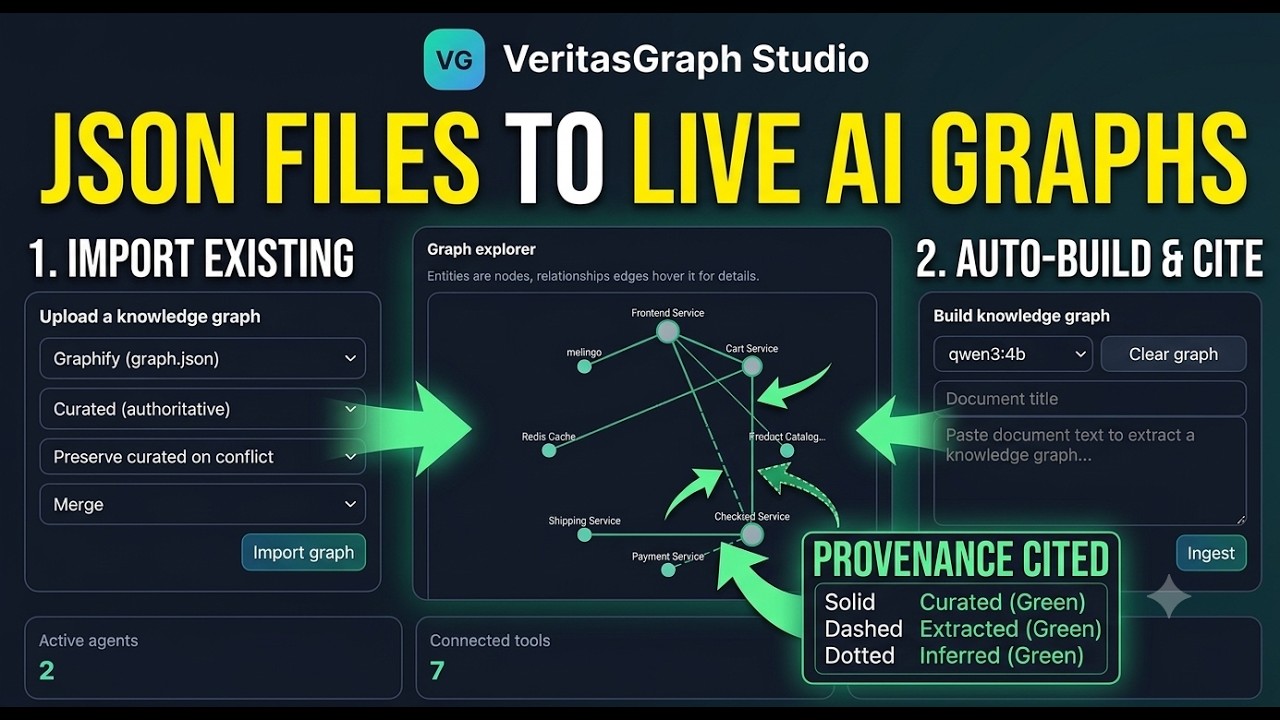
**Studio** is a local Agent Build Workspace (FastAPI + single-page UI) that lets you build a knowledge graph from your own documents and **wire it into agents** alongside tools, memory, data logging, guardrails, and headroom-style context budgeting — then chat with those agents live and watch every stage of the orchestration pipeline. Everything runs **100% locally** against [Ollama](https://ollama.com).
> **[🎮 Try the Studio Live](https://bibinprathap.github.io/VeritasGraph/studio/)** — *stable URL that always redirects to the current running studio tunnel.*
**Run it:**
```bash
pip install -r requirements.txt
ollama serve & ollama pull qwen3:latest # any local chat model
STUDIO_DATA_DIR="$PWD/studio_api/data" \
uvicorn studio_api.main:app --host 127.0.0.1 --port 8200 --log-level warning
# Studio UI → http://localhost:8200/studio · API docs → /docs
```
**One-command end-to-end demo** (builds a graph + drives a fully-wired agent through graph reasoning, memory recall, PII redaction, and a guardrail block):
```bash
python3 demos/agent-studio/sample_pipeline.py --model qwen3:latest
```
What's inside — full Studio feature set
- 🧩 **Knowledge Graph builder & explorer** — ingest text, extract entities/relationships locally, inspect nodes/edges with grounded evidence.
- 🔎 **Graph Q&A with citations** — multi-hop answers backed by `[doc#chunk]` source attribution.
- 🤖 **Agent workspace** — create/edit agents with model selection, prompt/persona settings, and per-agent capability toggles.
- 🔀 **Governed orchestration pipeline** — per-turn flow of Guardrails → Memory → Knowledge Graph → Headroom budget → Tools → Data log, with full trace visibility.
- 🧰 **Editable tools catalog** — add, edit, enable/disable, test, and delete tools directly in Studio.
- 🌐 **External real tool support** — call real HTTP endpoints with configurable method, auth header, and custom headers.
- 🔌 **MCP bridge integrations** — local MCP proxy connectors (e.g. Chrome DevTools MCP, Unity MCP) with health-aware probing.
- 🛡️ **Guardrails** — PII redaction and policy-block controls with visible guardrail-block metrics.
- 🧠 **Memory + Data logs** — per-agent short-term memory and interaction-log persistence.
- 📈 **Evaluation & fine-tune simulation** — run eval suites, track pass-rate trends, and queue/monitor fine-tune jobs.
- 💬 **Playground** — run governed agent conversations live and inspect the pipeline trace.
- 📊 **KPI dashboard** — active agents, connected tools, eval pass rate, and guardrail-block counters.
See [`studio_api/README.md`](studio_api/README.md) for API and architecture, and [`docs/STUDIO_ENTERPRISE_TEST.md`](docs/STUDIO_ENTERPRISE_TEST.md) for enterprise test scenarios.
### 📋 Examples
| # | Example | What it demonstrates | Run |
|---|---------|---------------------|-----|
| 1 | [`sample_pipeline.py`](demos/agent-studio/sample_pipeline.py) | **Studio agent pipeline** — ingests a company brief → builds KG → multi-hop Q&A with citations → memory recall → PII redaction → guardrail block → audit log. | `python3 demos/agent-studio/sample_pipeline.py` |
| 2 | [`sample_tools_explorer.py`](demos/agent-studio/sample_tools_explorer.py) | **Tool catalog seeder** — registers 17 tools and creates sample explorer agents. Idempotent. | `python3 demos/agent-studio/sample_tools_explorer.py` |
| 3 | [`clinical-kg/`](clinical-kg/) | **Medical AI — Clinical Knowledge Graph** — de-identifies notes (Safe Harbor), extracts entities, detects contradictions, normalizes to ICD-10/RxNorm/SNOMED/LOINC, builds patient KG with citations. | `cd clinical-kg/backend && python run.py` |
| 4 | [`municipality-incident-chatbot/`](municipality-incident-chatbot/) | **DMT Inspection System** — citizen incident reporting with CV validation (YOLO/VLM), KG-grounded routing, evidence fusion, case registration. | `cd municipality-incident-chatbot && python cli.py` |
🏥 Example 3 — Medical AI: HIPAA-Safe Clinical Knowledge Graph
> Turn unstructured clinical notes into a governed, citable knowledge graph — fully on-prem.
**The 7-step pipeline:**
| Step | What it does |
|------|--------------|
| **De-identify** | Safe Harbor regex redaction with a sealed `SurrogateVault` for audited re-identification |
| **Extract** | Section-aware NER, med-sig / lab-value parsing, ConText axes (negation, certainty, temporality, experiencer) |
| **Reconcile** | Groups mentions by concept; detects contradictions across notes (e.g. *"no diabetes"* in HPI vs *"T2DM"* in problem list) |
| **Normalize** | Maps mentions → coded concepts (ICD-10-CM, RxNorm, SNOMED CT, LOINC) |
| **Knowledge Graph** | Patient / Encounter / Condition / Medication / LabResult nodes with `EVIDENCED_BY` provenance edges |
| **Query** | NL → structured `CohortQuery` → multi-hop traversal with `[doc#chunk]` citations |
| **Governance** | k-anonymity over released cohorts |
```bash
# Backend (FastAPI on :8300)
cd clinical-kg/backend
pip install -r requirements.txt
python run.py
# Frontend (Next.js dashboard on :3200)
cd clinical-kg/frontend
npm install && npm run dev
```
Open **http://localhost:3200** → click **Load sample notes** → run queries. The UI has 6 tabs: Cohort Query, Ingest Note, Patients, Contradictions, Graph, Re-ID Risk.
🏛️ Example 4 — DMT Inspection System: Municipality Incident Chatbot
> AI chatbot for citizens to report civic incidents, validated by computer vision and grounded by a knowledge graph.
**Pipeline flow:** citizen photo + description → KG classification → CV validation (YOLO/VLM) → cross-check (CCTV, location, prior reports) → evidence fusion → case registration.
**Supported incidents:** trash overflow · abandoned vehicles · overcrowding · illegal parking *(extensible)*
```bash
cd municipality-incident-chatbot
pip install -r requirements.txt
# Interactive CLI
python cli.py
# you> trash overflowing near the market | photo=garbage_overflow.jpg | zone=downtown
# Test suite
python -m pytest -q
```
| Component | File |
|-----------|------|
| Knowledge graph (grounding + routing) | [`app/knowledge_graph.py`](municipality-incident-chatbot/app/knowledge_graph.py) |
| CV validation (YOLO + VLM) | [`app/cv_service.py`](municipality-incident-chatbot/app/cv_service.py) |
| Evidence fusion & scoring | [`app/fusion.py`](municipality-incident-chatbot/app/fusion.py) |
| Chatbot orchestrator | [`app/orchestrator.py`](municipality-incident-chatbot/app/orchestrator.py) |
| Architecture docs | [`01_architecture.md`](municipality-incident-chatbot/01_architecture.md) |
**Enterprise scenario** — follow the [Northwind Bank compliance test playbook](docs/STUDIO_ENTERPRISE_TEST.md) for a guided walkthrough using realistic financial-services data.
For API-level examples and curl recipes, see [`studio_api/README.md`](studio_api/README.md).
---
## 🌳 + 🔗 Graph + Tree: the ultimate retrieval
**Why choose?** VeritasGraph includes the hierarchical "Table of Contents" navigation of PageIndex **PLUS** the semantic reasoning of a Knowledge Graph.
```
Document Root
├── [1] Introduction
│ ├── [1.1] Background ←── Tree Navigation
│ └── [1.2] Objectives
├── [2] Methodology ←───────── Graph Links
│ └── relates_to ──────────→ [3.1] Findings
└── [3] Results
```
### 📊 Feature comparison
| Feature | Vector RAG | PageIndex | **VeritasGraph** |
|---------|:----------:|:---------:|:----------------:|
| **Retrieval type** | Similarity | Tree search | 🏆 Tree + Graph reasoning |
| **Attribution** | ❌ Low | ⚠️ Medium | ✅ **100% verifiable** |
| **Multi-hop reasoning** | ❌ | ❌ | ✅ |
| **Tree navigation (TOC)** | ❌ | ✅ | ✅ |
| **Semantic search** | ✅ | ❌ | ✅ |
| **Cross-section linking** | ❌ | ❌ | ✅ |
| **Visual graph explorer** | ❌ | ❌ | ✅ **Built-in UI** |
| **100% local/private** | ⚠️ Varies | ❌ Cloud | ✅ **On-premise** |
| **Open source** | ⚠️ Varies | ❌ Proprietary | ✅ **MIT license** |

---
## 🎬 See it in action
[](https://youtu.be/oa8ektm7nLY)
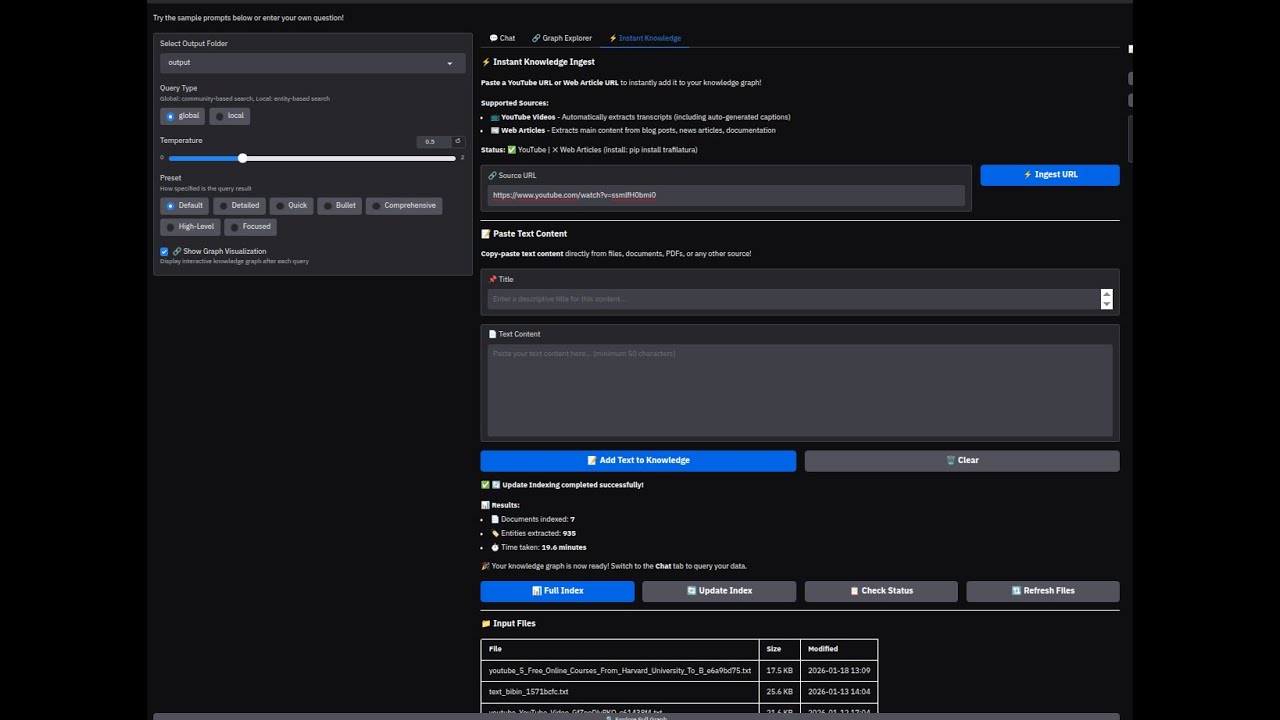
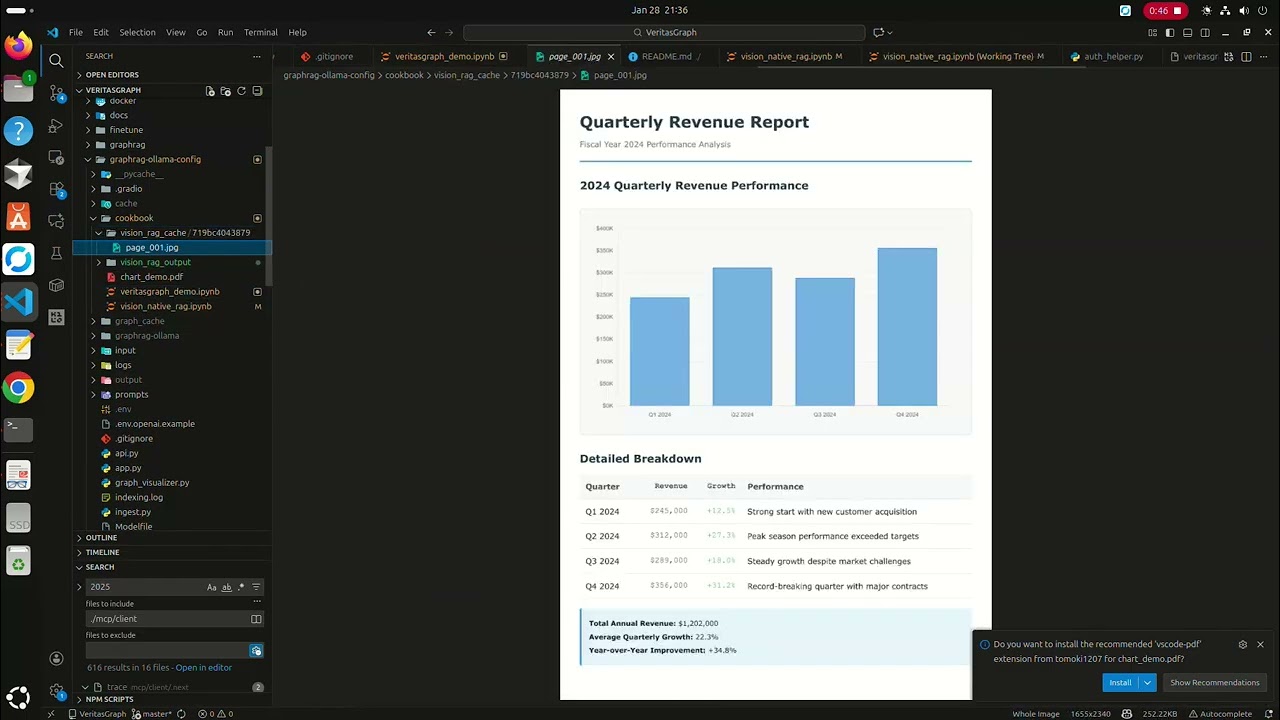
> **💡 What you're seeing:** a query triggers multi-hop reasoning across the knowledge graph. Nodes light up as connections are discovered, showing exactly *how* the answer was found — not just *what* was found.
---
## 🔌 MCP Server — connect your IDE agent to VeritasGraph
VeritasGraph ships a dedicated **[Model Context Protocol](https://modelcontextprotocol.io/) server** — *the first zero-trust, air-gapped Enterprise GraphRAG server for MCP.* Connect Claude Desktop, Cursor, VS Code, Windsurf, Cline, or Continue directly to the GraphRAG engine over JSON-RPC 2.0 stdio, with **zero external data egress**.
```bash
python -m veritasgraph_mcp # from repo root (needs local Ollama for ingest/query)
```
Tools: `veritasgraph_ingest_document`, `veritasgraph_query` (multi-hop answers with `[doc#chunk]` citations), `veritasgraph_search_entities`, `veritasgraph_get_graph`, `veritasgraph_clear_graph`. See [`veritasgraph_mcp/README.md`](veritasgraph_mcp/README.md) for IDE registration snippets.
### 🏥 VeritasGraph-MCP Use Case — Production Medical AI on Azure
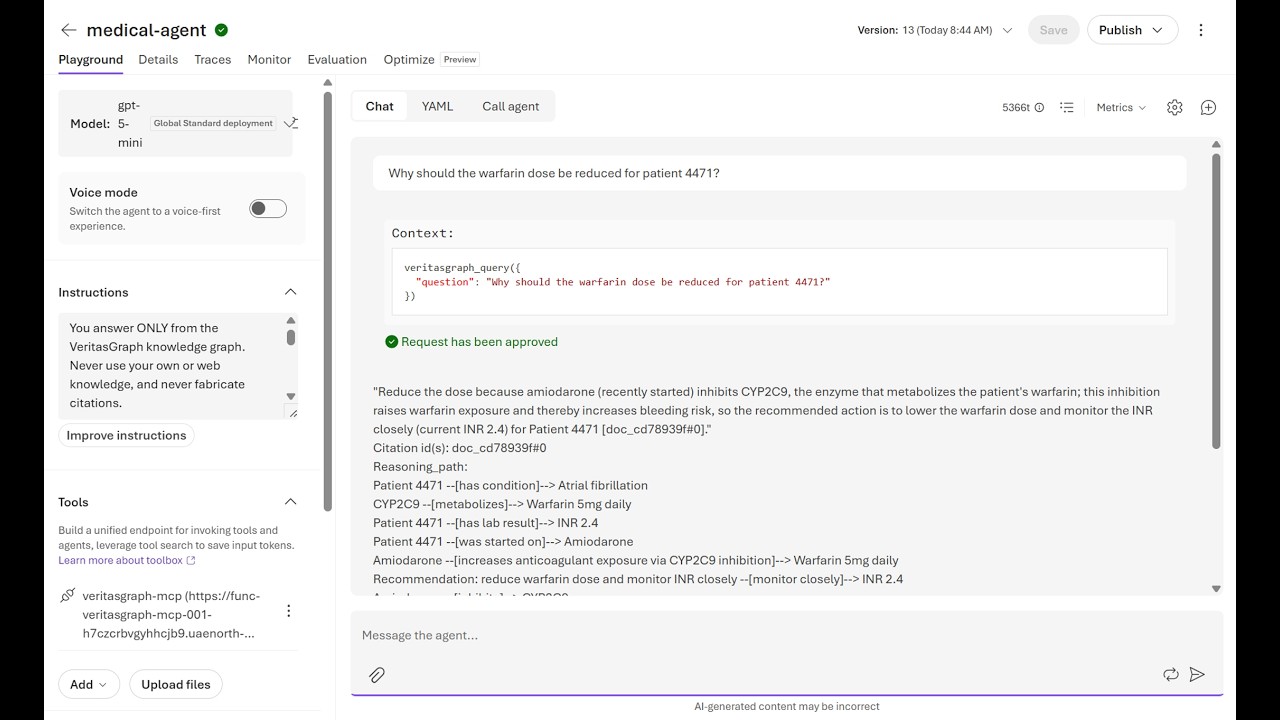
**Real-world deployment:** VeritasGraph MCP server running on Azure Functions with Azure AI Foundry, delivering GraphRAG-powered clinical decision support with verifiable citations and compliance-ready architecture.
📖 Production deployment walkthrough
**The Challenge:** 90% of Azure AI demos work. Most never ship. The gap isn't the model — it's architecture, security, state management, and compliance.
**The Solution:** VeritasGraph deployed as a remote MCP server that Azure AI Foundry agents call to answer clinical questions with:
- ✅ **Multi-hop GraphRAG reasoning** — assembles answers from separate graph edges
- ✅ **Verifiable citations** — every claim traces to `[doc#chunk]` sources
- ✅ **Production-grade architecture** — externalized state, identity at boundary, observability
- ✅ **Compliance-ready** — region-pinned, PHI-aware guardrails, semantic-layer RBAC
**Architecture highlights:**
```
Foundry Agent / MCP client
→ Identity (Entra ID + function key)
→ Azure Functions (Flex Consumption, 4 mcpToolTrigger tools)
→ veritasgraph-mcp + graphrag_engine
→ Azure OpenAI (extraction + reasoning)
→ Knowledge Graph
→ Durable Azure Files mount (externalized state)
→ Storage + App Insights (observability)
```
**Key production lessons learned:**
1. **State externalization** — Flex Consumption wiped in-memory graphs; fixed with mounted Azure Files share
2. **Identity at boundary** — Carry Entra identity; enforce Power BI RLS / Dataverse roles on-behalf-of user
3. **Self-correcting agents** — Feed errors + schema back; retry up to 3× (e.g., DAX generation)
4. **Compliance by design** — Foundry guardrails block PHI-leaking requests before reaching the model
5. **Observability layers** — Application Insights + Foundry Traces + Evaluations + Alerts
**Example query flow:**
```json
{
"question": "Should we adjust warfarin for patient 4471 on amiodarone?",
"answer": "Reduce the warfarin dose because amiodarone inhibits CYP2C9...",
"citations": ["doc_warfarin_note#0", "doc_warfarin_note#1"],
"reasoning_path": ["Amiodarone → CYP2C9", "CYP2C9 → Warfarin", "Warfarin → Bleeding Risk"]
}
```
**Technical stack:**
- **Compute:** Azure Functions (Flex Consumption) — scales to zero, fast event-driven scale-out
- **State:** Azure Files mount — survives cold starts and scale events
- **Inference:** Azure OpenAI (gpt-4-turbo/gpt-5-mini, swappable)
- **Identity:** Entra ID + function/system key
- **Observability:** Application Insights + Foundry Traces
- **Compliance:** Region-pinned deployments, PHI-aware guardrails, Key Vault secrets
**Deployed systems:**
1. **Medical MCP Server** — Clinical knowledge graph with multi-hop reasoning and `[doc#chunk]` citations
2. **Power BI Natural-Language Agent** — Validates OAuth token → discovers schema → generates DAX → executes via `executeQueries` REST API with row-level security enforced by the platform
[](https://youtu.be/z-CPS5WUvyw?si=LG5HVMsvcwTQsQCy)
> ▶️ **[Watch the deployment walkthrough on YouTube](https://youtu.be/z-CPS5WUvyw?si=LG5HVMsvcwTQsQCy)**
**Resources:**
- 📄 **[Read the full guide: *From Proof of Concept to Production: Azure AI That Actually Ships*](https://bibinprathap.com/blog/azure-ai-proof-of-concept-to-production)** — Complete walkthrough covering architecture, deployment, GraphRAG reasoning, auditability, semantic-layer access control, resilience, observability, and compliance.
- 💻 **[Azure AI Foundry + VeritasGraph Implementation Repository](https://github.com/bibinprathap/azure-ai-foundry-veritas-graph)** — Production deployment code, configuration, and examples.
**Production-ready checklist:**
- ✓ Grounded — answers cite your data (`[doc#chunk]`)
- ✓ State externalized — no reliance on serverless memory
- ✓ Identity at boundary — Entra + keys; on-behalf-of for data
- ✓ Entitlements enforced — RLS/roles before data reaches model
- ✓ Resilient — handles bad params, throttling, tool failures
- ✓ Observable — logs, traces, evals, cost alerts
- ✓ Region-pinned & compliant — inference in-tenant, PHI-aware
- ✓ Secrets in Key Vault — managed identity, least privilege
- ✓ Reproducible deploy — remote build, pinned config
> **💡 Key insight:** The gap between POC and production is architecture, not the model. Ground it, externalize state, secure it, observe it, make it resilient, keep it compliant.
---
## 📖 Python API
```python
from veritasgraph import VisionRAGPipeline
pipeline = VisionRAGPipeline() # auto-detects available models
doc = pipeline.ingest_pdf("document.pdf")
result = pipeline.query("What are the key findings?")
print(result.answer)
```
🌳 Hierarchical tree navigation + graph search
```python
from veritasgraph import VisionRAGPipeline
pipeline = VisionRAGPipeline()
doc = pipeline.ingest_pdf("report.pdf")
# View the document's hierarchical structure (like a Table of Contents)
print(pipeline.get_document_tree())
# Document Root
# ├── [1] Introduction (pp. 1-5)
# │ ├── [1.1] Background (pp. 1-2)
# │ └── [1.2] Objectives (pp. 3-5)
# └── [2] Methodology (pp. 6-15)
# Navigate to a specific section (tree-based retrieval)
section = pipeline.navigate_to_section("Methodology")
print(section['breadcrumb']) # ['Document Root', 'Methodology']
# Or use graph-based semantic search
result = pipeline.query("What methodology was used?")
# → answer with section context: "📍 Location: Document > Methodology > Analysis Framework"
```
🔧 Custom configuration & ingestion modes
```python
from veritasgraph import VisionRAGPipeline, VisionRAGConfig
config = VisionRAGConfig(ingest_mode="document-centric") # tables stay intact!
pipeline = VisionRAGPipeline(config)
doc = pipeline.ingest_pdf("annual_report.pdf")
```
| Mode | Description | Best For |
|------|-------------|----------|
| `document-centric` | Whole pages/sections as nodes (default) | Most documents |
| `page` | Each page = one node | Slide decks, reports |
| `section` | Each section = one node | Structured documents |
| `chunk` | Traditional 500-token chunks | Legacy compatibility |
### CLI
```bash
veritasgraph --version # show version
veritasgraph info # check dependencies
veritasgraph init my_project # initialize a project
veritasgraph ingest document.pdf --ingest-mode=document-centric # Don't Chunk. Graph.
veritasgraph ingest https://youtube.com/watch?v=xxx # auto-extract transcript
veritasgraph ingest https://example.com/article # extract web article
```
### Installation options
```bash
pip install veritasgraph # basic (includes lite mode)
pip install veritasgraph[web] # Gradio UI + visualization
pip install veritasgraph[graphrag] # Microsoft GraphRAG integration
pip install veritasgraph[ingest] # YouTube & web-article ingestion
pip install veritasgraph[all] # everything
```
---
## 🏛️ Enterprise Compliance — VeritasGraph + VeritasReason
GraphRAG is brilliant at *describing* what your documents say. But enterprise questions like **"Which purchase orders violated our Segregation-of-Duties policy last quarter?"** are **rule-evaluation problems** over structured records — not similarity search.
For those, VeritasGraph ships a sister module: **[VeritasReason](veritas-reason/README_VERITASREASON.md)** — a deterministic reasoning engine (forward-chaining + Rete + SPARQL) that fires policy rules over a triplet store and returns auditable answers with W3C PROV-O provenance.
```
Policy PDFs ─┐ ┌─ ingest_structured.py (SQL → triples + text)
▼ ▼
VeritasGraph GraphRAG VeritasReason (TripletStore + RuleSet
(quotes policy text) + ForwardChainer + PROV-O)
└──────────┬───────────────┘
▼
Compliance answer + violators table + clause citations
```
### 30-second smoke test (no install, stdlib only)
```bash
python tests/test_policy_compliance_demo.py
```
Seeds a fake ERP into a tiny in-memory triple store, evaluates four SoD rules from [rules/sod_policy.yaml](rules/sod_policy.yaml), and prints violators with citations:
```
✓ Reasoner fired. Detected 4 violation(s):
po:PO-2204 SOD-01 Approved & paid by emp:E118
po:PO-2301 SOD-02 Requested & approved by emp:E091
po:PO-2317 SOD-03 $48,750.00 approved by emp:E091 (role:Manager, not Director)
po:PO-2402 SOD-04 Vendor vendor:V77 related to approver emp:E140
```
Or install and run the packaged demo:
```bash
pip install veritas-reason
veritasreason-policy-demo
```

The same pattern applies to leave-policy violations (HRIS attendance), expense-report fraud (ledger + receipts), clinical protocol breaches (EHR + guidelines), or KYC/AML (transactions + watchlists). Define the SQL → triple mapping in [ingest_structured.py](graphrag-ollama-config/ingest_structured.py), write rules in `rules/*.yaml`, and ask in plain English. See [veritas-reason/plan.md](veritas-reason/plan.md) for a full walk-through.
---
## 🔗 Interactive Graph Visualization
VeritasGraph includes an **interactive 2D knowledge-graph explorer** (PyVis) that visualizes entities and relationships in real time.
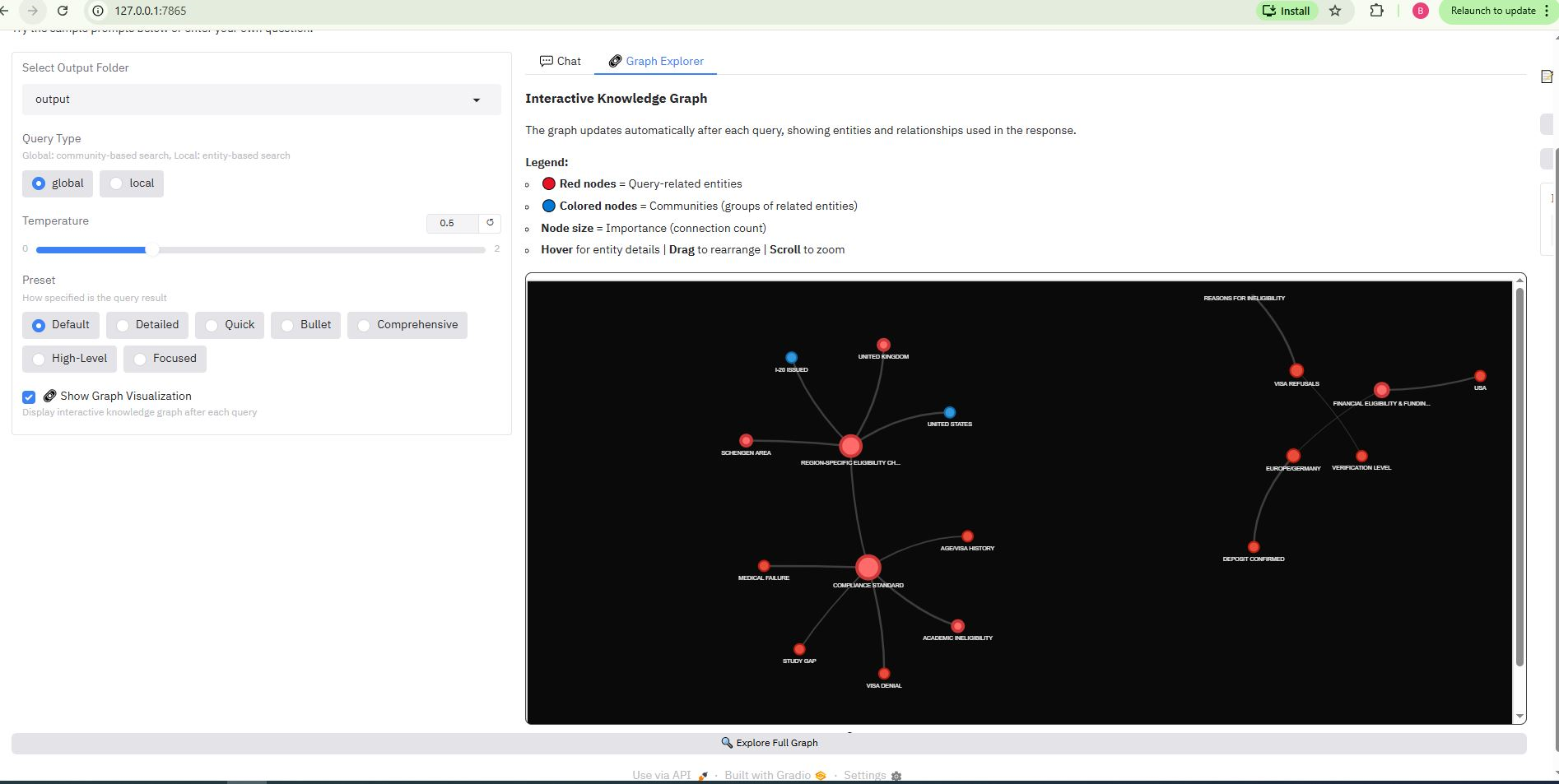
| Feature | Description |
|---------|-------------|
| **Query-aware subgraph** | Shows only entities related to your query |
| **Community coloring** | Nodes grouped by community membership |
| **Red highlight** | Query-related entities shown in red |
| **Node sizing** | Bigger nodes = more connections |
| **Interactive** | Drag, zoom, hover for entity details |
| **Full graph explorer** | View the entire knowledge graph |
---
## ⚙️ Provider Support (OpenAI-compatible)
VeritasGraph works with **any OpenAI-compatible API** — mix and match cloud and local:
| Provider | API Base | API Key | Example Model |
|----------|----------|---------|---------------|
| **Ollama** (default) | `http://localhost:11434/v1` | `ollama` | `llama3.1-12k` |
| **OpenAI** | `https://api.openai.com/v1` | `sk-proj-...` | `gpt-4-turbo-preview` |
| **Groq** | `https://api.groq.com/openai/v1` | `gsk_...` | `llama-3.1-70b-versatile` |
| **Together AI** | `https://api.together.xyz/v1` | your-key | `Meta-Llama-3.1-70B-Instruct-Turbo` |
| **LM Studio** | `http://localhost:1234/v1` | `lm-studio` | (model loaded in LM Studio) |
Also supported: Azure OpenAI, OpenRouter, Anyscale, LocalAI, vLLM.
```bash
cd graphrag-ollama-config
cp settings_openai.yaml settings.yaml
cp .env.openai.example .env # edit with your provider settings
python -m graphrag.index --root . --config settings_openai.yaml
python app.py
```
> ⚠️ **Embeddings must match your index.** If you indexed with `nomic-embed-text` (768 dims), you must query with the same model — switching embedding models requires **re-indexing**. Full details in [OPENAI_COMPATIBLE_API.md](graphrag-ollama-config/OPENAI_COMPATIBLE_API.md).
---
## 🐳 Deployment
### Five-Minute Magic Onboarding (Docker)
Run a full stack (Ollama + Neo4j + Gradio) with one command:
```bash
cd docker/five-minute-magic-onboarding
# set your Neo4j password in .env, then:
docker compose up --build
```
Services: Gradio UI → http://127.0.0.1:7860 · Neo4j → http://localhost:7474 · Ollama → http://localhost:11434. See [`docker/five-minute-magic-onboarding/README.md`](docker/five-minute-magic-onboarding/README.md).
### Share with your team (free)
| Method | Duration | Local Ollama | Setup | Best For |
|--------|----------|:------------:|-------|----------|
| `python app.py --share` | 72 hours | ✅ | 1 min | Quick demos |
| Ngrok tunnel | Unlimited* | ✅ | 5 min | Team evaluation |
| Cloudflare tunnel | Unlimited* | ✅ | 5 min | Team evaluation |
| Hugging Face Spaces | Permanent | ❌ (cloud LLM) | 15 min | Public showcase |
_*Free tier has some limitations._
---
## 🏗️ Architecture
```mermaid
graph TD
subgraph "Indexing Pipeline (one-time)"
A[Source Documents] --> B{Document Chunking};
B --> C{"LLM Extraction
(Entities & Relationships)"};
C --> D[Vector Index];
C --> E[Knowledge Graph];
end
subgraph "Query Pipeline (real-time)"
F[User Query] --> G{Hybrid Retrieval Engine};
G -- "1. Vector search for entry points" --> D;
G -- "2. Multi-hop graph traversal" --> E;
G --> H{Pruning & Re-ranking};
H -- "Rich context" --> I{LoRA-Tuned LLM Core};
I -- "Answer + provenance" --> J{Attribution Layer};
J --> K[Attributed Answer];
end
style A fill:#f2f2f2,stroke:#333,stroke-width:2px
style F fill:#e6f7ff,stroke:#333,stroke-width:2px
style K fill:#e6ffe6,stroke:#333,stroke-width:2px
```
**The four stages:**
1. **Automated Knowledge Graph construction** — chunk documents into `TextUnits`, extract `(head, relation, tail)` triplets, assemble nodes + edges in a graph DB (e.g. Neo4j).
2. **Hybrid retrieval engine** — vector search finds entry nodes, multi-hop traversal uncovers hidden relationships, pruning & re-ranking keeps the most relevant facts.
3. **LoRA-tuned reasoning core** — a locally hosted, LoRA-tuned open model generates attributed answers with efficient fine-tuning for reasoning + attribution.
4. **Attribution & provenance layer** — propagates source IDs, chunks, and graph nodes into a structured, traceable JSON output.
On-premise prerequisites
**Hardware:** 16+ CPU cores · 64GB+ RAM (128GB recommended) · NVIDIA GPU with 24GB+ VRAM (A100 / H100 / RTX 4090).
**Software:** Docker & Docker Compose · Python 3.10+ · NVIDIA Container Toolkit.
Copy `.env.example` → `.env` and populate with environment-specific values.
---
## Why VeritasGraph?
- ✅ **Fully on-premise & secure** — 100% control over your data and models.
- ✅ **Verifiable attribution** — every claim traces back to its source.
- ✅ **Advanced graph reasoning** — answers complex, multi-hop questions.
- ✅ **Hierarchical tree + graph** — PageIndex-style TOC navigation with graph flexibility.
- ✅ **Governed agents** — guardrails, memory, tools, and context budgeting wired together in Studio.
- ✅ **Open-source & sovereign** — MIT-licensed, no vendor lock-in.
**Who is it for?** Engineers building enterprise search, compliance assistants, research copilots, scientific literature explorers, and agent memory systems — anywhere "the answer" depends on how facts *connect*, not just whether they appear near each other in a vector index.
---
## 🙌 Acknowledgments
Builds on the foundational work of **HopRAG**, **Microsoft GraphRAG**, **LangChain & LlamaIndex**, and **Neo4j**.
## 🏆 Awards & Citation
Presented at the **International Conference on Applied Science and Future Technology (ICASF 2025)** — [📄 Appreciation Certificate](ICASF%202025%20-%20Appreciation%20Certificate.pdf).
```bibtex
@article{VeritasGraph2025,
title={VeritasGraph: A Sovereign GraphRAG Framework for Enterprise-Grade AI with Verifiable Attribution},
author={Bibin Prathap},
journal={International Conference on Applied Science and Future Technology (ICASF)},
year={2025}
}
```
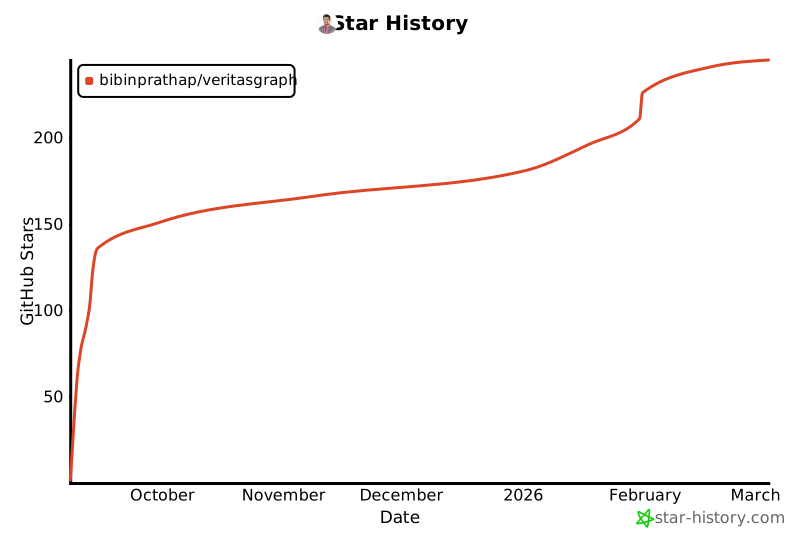
## Star History
[](https://www.star-history.com/#bibinprathap/VeritasGraph&Date)
---


Licensed under MIT. ⭐ Star the repo to follow the roadmap for open-source, governed GraphRAG.