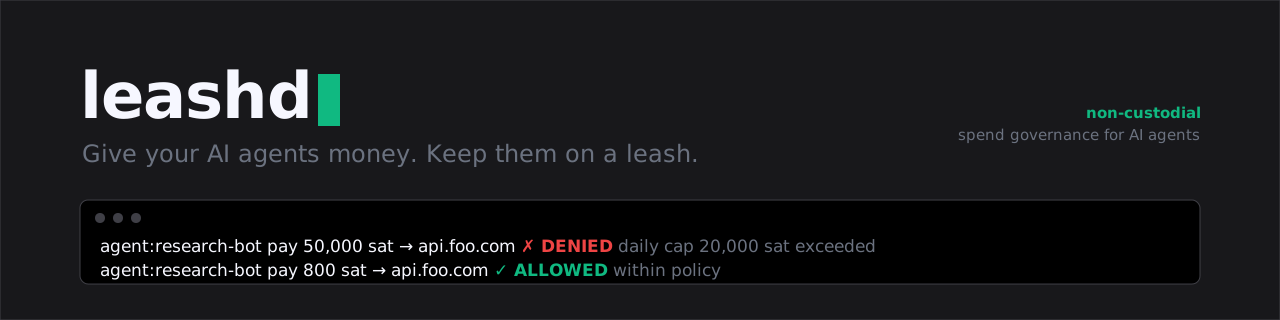
Non-custodial spend governance for AI agents.
Hard budgets, allowlists, rate limits, time windows, graded shutdown, signed audit trail.
Lightning (NWC), Cashu and x402/USDC on Base and Ethereum.







Website · Docs · FAQ · Community
--- ## What the chain guarantees, what leashd guarantees, what nobody guarantees - **Chain (x402):** the owner wallet grants a Spend Permission: at most `allowance` USDC per `period`, until `end`, revocable any time. leashd's agent key can never hold more than one period. - **leashd (all rails):** per-transaction max, endpoint/domain allowlists, rate limit, time windows, approval threshold, kill switch and graded shutdown, signed append-only audit. Deterministic; a prompt cannot talk it out of a decision. - **Not guaranteed:** within one period, a fully compromised host running leashd can spend that period's allowance. Pick the period and allowance you can afford to lose. ## Rails | Rail | Funding | Chain-side cap | |---|---|---| | Lightning (NWC) | your node / Alby Hub | NWC connection budget | | Cashu | mint proofs in the local store | balance | | x402 / USDC | Base Account Spend Permission (or manual) | allowance per period | ## The problem Autonomous AI agents now discover services, buy compute, and pay other agents on their own. The moment you give an agent a wallet, one prompt injection, one dependency exploit, or one runaway loop can drain it. Probabilistic guardrails in the model are not a control. You need a deterministic gate between the agent and the money. ## What leashd is leashd is a bouncer with a rulebook standing between your AI agent and your funds. The agent asks to pay, leashd checks your policy (budget left, recipient allowed, under the limit, kill-switch off), then authorises or blocks it, and writes every decision to a signed log. It is non-custodial: leashd runs on your own machine and holds your wallet connection locally. It never touches your funds or keys. ## How it works ``` AI agent ──pay 50 sat──▶ leashd (your machine) │ check policy (caps · allowlist · rate · kill-switch) ├─ allowed ─▶ your wallet (NWC) ──▶ api.foo.com ├─ capped / denied ─▶ structured refusal to the agent └─ signed audit event ──▶ control plane feed ``` The agent never gets your wallet. It gets a policy-gated `pay` tool over MCP that points at leashd. Funds settle directly between your own wallet and the counterparty. leashd sits in the policy path, never the custody path. ## Features | | | |---|---| | Budget caps | per transaction, per task, rolling hourly / daily / monthly | | Scoped credentials | allowlists and denylists for endpoints, domains, Lightning addresses, mints | | Rate limits | cap transactions per window | | Time windows | only let agents spend when you allow | | Approval thresholds | human-in-the-loop above a value you set | | Graded shutdown | a dimmer, not just a kill-switch: attenuate scope, drop tools, escalate approvals | | Signed audit trail | append-only, tamper-evident, exportable. EU AI Act Article 12 grade | | Multi-rail | Lightning (NWC) and L402, Cashu ecash, x402/USDC on Base and Ethereum | | MCP-native | drops into Claude Code or any MCP host | ## Quickstart leashd is in early access. Install from source for now; a published one-line install is on the way. ```bash # install from source (requires node >= 22.5 and pnpm) git clone https://github.com/brainbytes-dev/leashd cd leashd && pnpm install # run leashd with your env (token + control plane URL) LEASH_AGENT_TOKEN=lsh_live_xxxxxxxx \ LEASH_API_URL=https://leashd.dev \ pnpm --filter @repo/leashd dev ``` Wire it into Claude Code via `.mcp.json`: ```json { "mcpServers": { "leashd": { "command": "leashd", "args": ["--mcp"], "env": { "LEASH_AGENT_TOKEN": "lsh_live_xxxxxxxx", "LEASH_API_URL": "https://leashd.dev" } } } } ``` Then create a workspace and agent, set a policy, and your agent's `pay` calls are policy-gated. Full guide at [leashd.dev/docs](https://leashd.dev/docs). ## Architecture (open core) leashd is open core. leashd (the program that runs on your machine) and the policy engine are open source under AGPL-3.0. The hosted control plane (policy authoring, audit aggregation, team, billing) is available at [leashd.dev](https://leashd.dev), and a commercial license is available (see [COMMERCIAL.md](./COMMERCIAL.md)). ``` packages/ leash-core/ deterministic policy engine + shared contract (zod) leashd/ runs on your machine: MCP server, governor, rail adapters, audit apps/ web/ the control plane (Next.js) ``` Stack: TypeScript, Next.js, Turborepo, Drizzle, node:sqlite. Zero native build for leashd. ## Non-custodial by design You hold the keys. leashd holds the policy. The control plane stores only policies and the audit log, never funds or keys. Even a full compromise of leashd, or of the control plane, cannot move your money, because the keys never leave your machine. leashd is not a money transmitter. ## Roadmap - [x] Lightning / L402 rail, policy engine, MCP server, signed audit - [x] Cashu ecash rail - [x] x402 / USDC rail (Base + Ethereum), on-chain enforced Spend Permissions - [x] Team and RBAC, audit CSV export - [ ] Approval workflow UI, alerting, long audit retention ## Funding the x402 rail x402/USDC is funded non-custodially: your own wallet grants a per-period Spend Permission, and leashd's local agent key can never hold more than one period's allowance. ```bash # 1. Generate a local agent key (private key never leaves this machine) pnpm --filter @repo/leashd x402 keygen # 2. Grant a Spend Permission from your own wallet — client-side, no server involved # open the grant page and sign with the owner wallet, save the downloaded JSON: open https://leashd.dev/dashboard/rails/x402/grant # 3. Point leashd at the granted permission LEASH_X402_NETWORK=eip155:8453 \ LEASH_X402_PRIVATE_KEY=0x... \ LEASH_X402_RPC_URL=https://mainnet.base.org \ LEASH_X402_FUNDING=base-spend-permission \ LEASH_X402_PERMISSION_PATH=~/.leashd/x402-permission.json \ LEASH_X402_OWNER_ADDRESS=0xYourOwnerWallet \ pnpm --filter @repo/leashd dev # 4. Check remaining allowance and period end anytime pnpm --filter @repo/leashd x402 status ``` Revoke the grant any time from the same grant page, or directly in the owner wallet. leashd's agent key can never pull more than the last granted period. Gas: a `spend()` call measures roughly 186,880 gas in the contract's own gas snapshot. At the fees recorded in `docs/x402-spikes.md` (Step 2, fetched live 2026-09-16) that's about **$0.0027 on Base** (0.006 gwei) and about **$0.083 on Ethereum mainnet** (0.185 gwei) — point-in-time estimates, not a promise, and Base is the launch rail for a reason. ## Open issues, help wanted Full list once filed: [issues labelled `help wanted`](https://github.com/brainbytes-dev/leashd/issues?q=is%3Aopen+label%3A%22help+wanted%22). - **funding: ERC-7715 delegation as a second `FundingSource`** — MetaMask smart accounts, an erc20 periodic permission as an alternative to the Base Account Spend Permission. - **funding: Kernel signature policy enforcing EIP-3009 typed data on-chain** — a Kernel v3 policy that validates a `transferWithAuthorization` typed-data signature on-chain, capping an x402 payment without the pull-into-agent-key step. - **rail: Solana x402** — the x402 `exact` scheme on Solana, non-custodial per-period cap (Spec 2). ## Contributing PRs welcome. See [CONTRIBUTING.md](./CONTRIBUTING.md). The one invariant you must never break: leashd stays non-custodial. Report vulnerabilities per [SECURITY.md](./SECURITY.md). ## Support development leashd is built in the open by an indie solo-dev. If it saves your agents from spending your sats, send some back: ``` ⚡ leashd@walletofsatoshi.com (TODO: replace with the real Lightning address) ``` A GitHub sponsor button is set up via [.github/FUNDING.yml](./.github/FUNDING.yml). ## License [AGPL-3.0](./LICENSE). Commercial licenses available, see [COMMERCIAL.md](./COMMERCIAL.md).Built by BrainBytes Studio, an indie solo-dev shop.