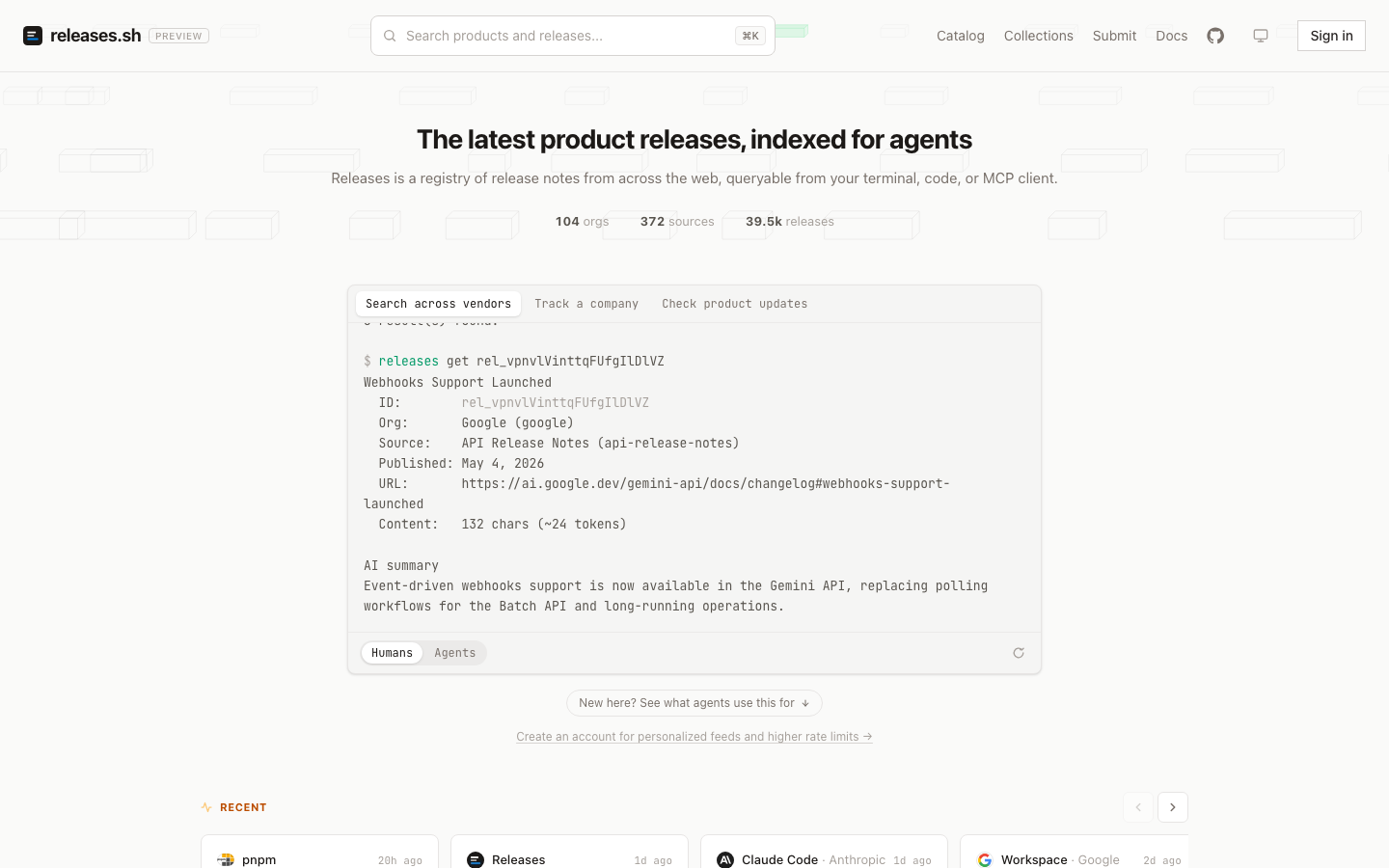
Release Notes Index — the latest product releases, indexed for agents

Release Notes Index

**The latest product releases, indexed for agents.** A registry of release notes from across the web — pulled from vendor changelogs, normalized into one schema, summarized, and queryable from your terminal, your code, or any MCP client. Readable by you and your agent.

releases.sh  ·  Docs  ·  CLI →  ·  Use it  ·  What's in this repo  ·  Develop

CI npm (CLI) MCP server Ask DeepWiki License: Apache-2.0

This repo is the backend for releases.sh (API · MCP · web · ingest) and the source of the command-line tool.

--- ## What is this? "What changed?" is a question agents and developers ask constantly — before an upgrade, after an incident, when a tool suddenly behaves differently. The answer is scattered across GitHub releases, RSS feeds, changelog pages, and blog posts in a hundred different formats. **Release Notes Index** collects those into one registry. It watches hundreds of sources across the vendors developers actually depend on, and for every release stores the original content plus an AI-generated title, summary, and breaking-change classification. Each organization gets a maintained overview of what it shipped recently. The web page a human reads and the JSON an agent fetches are the same content. This repo is the source of the canonical deployment at [releases.sh](https://releases.sh): the API worker (the authoritative data plane), the MCP server, the web frontend, and the ingest pipeline + agent harness that keep the registry fresh. The user-facing CLI lives in `apps/cli/` and ships from this repo (npm + Homebrew). ## Use it No account or API key needed for reads — all four surfaces are public. **MCP** — hosted at `agents.releases.sh/mcp` (`mcp.releases.sh/mcp` still works), listed in the [MCP Registry](https://registry.modelcontextprotocol.io/v0.1/servers?search=sh.releases/mcp) as `sh.releases/mcp`, and in the [Claude connector directory](https://claude.ai/directory/releases-index) for Claude on the web, desktop, and mobile: ```bash claude mcp add --transport http releases https://agents.releases.sh/mcp # Claude Code codex mcp add releases --url https://agents.releases.sh/mcp # Codex npx -y mcp-remote https://agents.releases.sh/mcp # stdio bridge (VS Code, Zed, …) ``` **CLI** — one-off via npx, or `brew install buildinternet/tap/releases`: ```bash npx @buildinternet/releases get anthropic # what did Anthropic ship lately? npx @buildinternet/releases search "MCP" # search across every vendor ``` **REST API** — public GET endpoints on `api.releases.sh`, spec at [/v1/openapi.json](https://api.releases.sh/v1/openapi.json): ```bash curl "https://api.releases.sh/v1/releases/latest?limit=5" ``` **Agent skills** — auto-triggering playbooks, installable into any agent (Claude Code / Codex / Cursor / OpenCode) without checking out anything. Start with the reader skills — search, MCP lookups, and release analysis — which is what almost everyone wants: ```bash npx skills add buildinternet/releases # reader skills — search, MCP, release analysis # just the skill that writes a releases.json manifest for your own product npx skills add buildinternet/releases --skill creating-releases-json ``` On Claude Code, the CLI repo also installs as a plugin — the reader skills plus a bundled MCP connection and a `/releases` command: ``` /plugin marketplace add buildinternet/releases /plugin install releases@releases ``` Running or maintaining the registry itself? This repo also ships **operator skills** (source onboarding, parsing, bulk maintenance) — most need an admin key: `npx skills add buildinternet/releases`. See [releases.sh/docs/skills](https://releases.sh/docs/skills). **Docs** — user-facing documentation is served from the web app at [releases.sh/docs](https://releases.sh/docs) (source in [`apps/web/src/content/docs/`](apps/web/src/content/docs)): [installation](https://releases.sh/docs/installation) · [skills](https://releases.sh/docs/skills) · [REST API](https://releases.sh/docs/api/rest) · [MCP](https://releases.sh/docs/api/mcp) · [webhooks](https://releases.sh/docs/api/webhooks) · [listing your product](https://releases.sh/docs/listing). Agents consuming the product start from [releases.sh/llms.txt](https://releases.sh/llms.txt); the MCP tool catalog and auth model are also covered in [docs/architecture/mcp.md](docs/architecture/mcp.md). Creating a [free account](https://releases.sh/signup) unlocks higher rate limits (mint an API key at [releases.sh/account](https://releases.sh/account)), plus follows, personalized feeds, webhooks, and email digests.
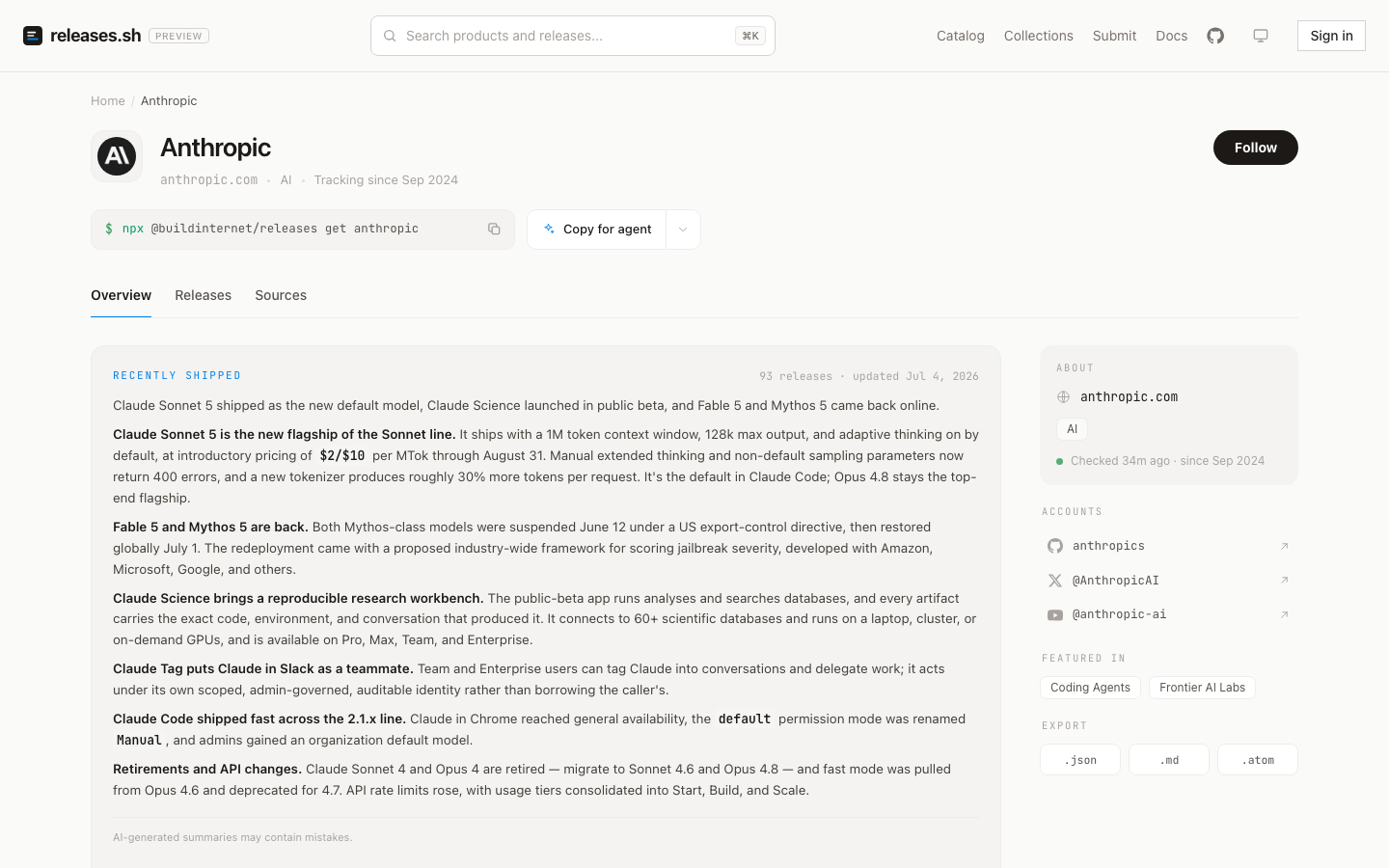
An organization page: AI-maintained overview of recent releases, source list, and JSON/Markdown/Atom export
Every org page carries an AI-maintained overview and exports as JSON, Markdown, or Atom.
## What's in this repo | Path | What | | ---------------- | --------------------------------------------------------------------------------------------- | | `apps/api/` | Hono API on Cloudflare D1 — the authoritative data plane | | `apps/mcp/` | Remote MCP server at `agents.releases.sh` (alias `mcp.releases.sh`) | | `apps/webhooks/` | Signs + delivers `release.created` events (HMAC-SHA256, retry/DLQ) — [docs](docs/webhooks.md) | | `apps/web/` | Next.js frontend, deploys on Vercel | | `packages/` | Shared code — `core` + `api-types` publish to npm; the rest are private workspaces | | `.claude/` | Claude Code config — `skills/` (canonical skill home), `agents/`, `commands/`, `workflows/` | How it fits together: - **Storage** — Cloudflare D1 (FTS5 + Vectorize). The API worker is the sole data plane. - **Ingest** — adapters for GitHub Releases, RSS/Atom/JSON feeds, and a browser-rendering fallback for feed-less pages (`packages/adapters/`). The crawler signs outbound fetches (RFC 9421) as a Cloudflare Verified Bot. - **AI** — changelog parsing, summarization, grouping, and org overviews run in the API worker as direct Anthropic SDK calls. ## Contributor mental model This repo has four kinds of code: | Area | Paths | What to know | | ------------------ | ------------------------------------------------------------- | ---------------------------------------------------------------------------------------------------------------------------- | | Product surfaces | `apps/api/`, `apps/mcp/`, `apps/webhooks/`, `apps/web/` | The API worker is the data plane. Web, MCP, CLI, and webhooks read from or route through it. | | Shared packages | `packages/core/`, `packages/api-types/`, private `packages/*` | `core` owns schema and pure helpers; `api-types` owns wire shapes. Change these first when shared contracts move. | | Hosted operations | `.claude/skills/`, `.claude/workflows/` | These power the canonical releases.sh ingest and operator loop. Some paths need hosted credentials, but local work does not. | | Historical context | `docs/architecture/`, `docs/plans/`, `docs/superpowers/` | Architecture docs are maintained references. Plans and specs are point-in-time design history. | For normal contributions, start with `bun run bootstrap`, `bun run check`, and `bun run test`. You do not need production Cloudflare, Anthropic, Vercel, email, or Firecrawl access to work on the core loop. If you are trying to fork or self-host the full service, read [deploy-coupling.md](docs/architecture/deploy-coupling.md). Per-package detail and project conventions live in [AGENTS.md](AGENTS.md) — the agent entry point for working in this repo. Architecture deep-dives are in [docs/architecture/](docs/architecture/), with a reader's guide at [docs/README.md](docs/README.md). ## Local development **Prerequisites:** [Bun](https://bun.sh). No external accounts needed for the core loop: ```bash bun run bootstrap # one-command setup: tooling, deps, env files, local D1 bun run doctor # diagnose the setup — reports what's missing and how to fix it bun run check # lint + type-check + format (the CI gate) bun run test # full test suite, secret-free bun run dev:api # API worker on local D1 bun run dev:web # Next.js frontend ``` `bootstrap` is idempotent (safe to re-run; never overwrites your env files or wipes the local DB) and `doctor` is read-only. Prefer the manual steps? They're `bun install`, copy each `*.example` env file, then `bun run db:reset:local`. AI passes, scrape fetches, and semantic search take your own keys (`ANTHROPIC_API_KEY`, Cloudflare Browser Rendering, `VOYAGE_API_KEY`) and degrade gracefully without them. Setup detail, environment variables, testing, deployment, and the full no-accounts / bring-your-own-keys / hosted-only breakdown live in [CONTRIBUTING.md](CONTRIBUTING.md). ## License [Apache-2.0](LICENSE). The published npm packages ([`releases-core`](packages/core), [`api-types`](packages/api-types)) and the Claude Code plugin ([`plugins/claude/releases`](plugins/claude/releases)) are deliberately MIT for maximum reuse.
