legacy2mcp — legacy SOAP/WSDL turned into safe, typed MCP tools

CI PyPI Python versions MCP Registry Glama score License

Point it at a WSDL. Get an MCP server whose tools can't drift from the service, can't send unvalidated arguments, and can't call write operations you didn't opt into.

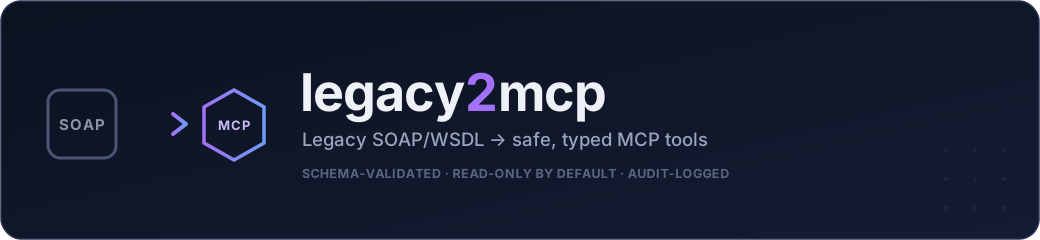
legacy2mcp turning a Calculator WSDL into four typed, schema-validated MCP tools
--- > [!NOTE] > `legacy2mcp` introspects every operation in a WSDL, builds a real JSON Schema for each one **from the WSDL's own XSD types**, and exposes them as [MCP](https://modelcontextprotocol.io/) tools — with **every call schema-validated before it reaches your SOAP endpoint**, **write-like operations excluded by default**, and **every call audit-logged**. No hand-written adapter code, no hand-maintained schemas. ## Contents - [Install](#install) - [Quick start](#quick-start) - [How it works](#how-it-works) - [Point it at your own WSDL](#point-it-at-your-own-wsdl) - [Use it from Claude Desktop](#use-it-from-claude-desktop-or-any-mcp-client) - [What's handled](#whats-handled) - [Safety model](#safety-model) - [Use cases](#use-cases) - [Real-world usage](#real-world-usage) - [Configuration reference](#configuration-reference) - [Roadmap](#roadmap) - [Development](#development) · [Contributing](#contributing) · [License](#license) ## Install ```bash pip install legacy2mcp # or: uv tool install legacy2mcp · pipx install legacy2mcp ``` Also published to the **[MCP Registry](https://registry.modelcontextprotocol.io/v0.1/servers?search=io.github.bvenkata/legacy2mcp)** as `io.github.bvenkata/legacy2mcp`, so registry-aware MCP clients can discover it directly. ## Quick start Try it end-to-end against the bundled mock SOAP service — no external network, no real backend: ```bash git clone https://github.com/bvenkata/legacy2mcp.git cd legacy2mcp pip install -e ".[dev]" # 1. start the demo SOAP service (dneonline-style Calculator WSDL) python examples/soap/run_mock_calculator.py & # 2. see the MCP tools generated from its WSDL legacy2mcp inspect --config examples/soap/config.calculator.yaml ```
Or with Docker ```bash docker compose up demo-soap-service -d docker compose run --rm legacy2mcp legacy2mcp inspect \ --config examples/soap/config.calculator.docker.yaml ```
## How it works ```mermaid flowchart LR WSDL["WSDL / XSD"] --> GEN["legacy2mcp
schema generation"] GEN --> TOOLS["Typed MCP tools
one per operation"] AGENT["AI agent /
MCP client"] -->|tool call| VAL{"schema
validation"} TOOLS -. defines .-> VAL VAL -->|invalid args| REJ["rejected, never
reaches SOAP"] VAL -->|valid and allowed| SOAP["SOAP endpoint"] SOAP --> RESP["plain JSON
back to the agent"] VAL --> LOG[("audit log")] ``` 1. Loads the WSDL with [`zeep`](https://docs.python-zeep.org/), a mature, widely-used Python SOAP client. 2. For every operation on every port/binding, converts the XSD input type into a JSON Schema ([`schema/xsd_to_jsonschema.py`](src/legacy2mcp/schema/xsd_to_jsonschema.py)) — simple types, nested complex types, enums and arrays, recursively, depth-limited for pathological WSDLs. 3. Registers one MCP tool per operation, named `_`. 4. On a tool call: validates arguments with `jsonschema` (schemas use `additionalProperties: false`), calls the operation via `zeep`, serializes the response to plain JSON, and writes an audit entry. 5. Operations whose names look like writes are excluded unless `allow_write_operations: true`. ## Point it at your own WSDL ```yaml # config.yaml server: name: my-legacy-mcp adapters: - id: legacy type: soap config: wsdl_url: "https://service.example.com/LegacyService?wsdl" auth: type: basic username: "svc-account" password_env: "SERVICE_PASSWORD" # value read from the environment, never the file allow_write_operations: false # Create*/Update*/Delete*/… stay hidden include_operations: ["GetRecord", "GetRecordDetails", "SearchRecords"] security: audit: enabled: true path: "./legacy-mcp-audit.log" ``` ```bash export SERVICE_PASSWORD=... legacy2mcp inspect --config config.yaml # review the generated tools legacy2mcp run --config config.yaml # start the MCP server (stdio) ``` A production-shaped template with comments lives at [`examples/soap/config.template.yaml`](examples/soap/config.template.yaml). ## Use it from Claude Desktop (or any MCP client) ```json { "mcpServers": { "legacy": { "command": "legacy2mcp", "args": ["run", "--config", "/absolute/path/to/config.yaml"] } } } ``` ## What's handled | Area | Covered | |---|---| | **Type mapping** | `string` / `int` / `long` / `decimal` / `boolean` / `date` / `dateTime` / `base64Binary` / … → JSON Schema types + formats | | **Structure** | nested complex types, repeated elements → arrays, `xsd:enumeration` → `enum`, recursion depth-limited | | **Discovery** | every service → port → binding → operation; duplicate tool names rejected at startup | | **Invocation** | argument validation, `zeep` call, response serialized to plain JSON, single-field responses re-wrapped to a named result | | **Errors** | SOAP faults and transport errors caught and returned as clean messages — no stack traces to the caller | | **Auth** | HTTP basic (username + `*_env` password); anonymous | | **Transport** | `stdio` (the transport Claude Desktop and most agent frameworks spawn) | See [docs/security.md](docs/security.md) for the full, honest security model — what's covered today and what isn't yet. ## Safety model | Layer | What it does | |---|---| | **Schema validation** | No arguments reach the SOAP layer without passing `jsonschema.validate` against that operation's generated schema. | | **Read-only by default** | Operation names are matched against write-verb prefixes (`Create`, `Update`, `Delete`, `Cancel`, `Void`, `Submit`, `Pay`, …); those tools aren't exposed unless you set `allow_write_operations: true`. | | **Explicit allow / deny** | `include_operations` (allowlist) and `exclude_operations` (denylist) on top of the heuristic. | | **Audit log** | One JSON line per call — tool, arguments, timestamp, outcome, duration. | | **Secret hygiene** | Credentials come from named environment variables; the YAML stays safe to commit. | > [!WARNING] > The write-operation filter is a **name heuristic, not semantic analysis** — an operation called `ProcessRecord` that deletes data would not be caught. For any system where a wrong call has real consequences, set `include_operations` explicitly and don't rely on the heuristic. There is also no auth/authz on the MCP server itself yet — don't expose a v0.1 server to untrusted callers. Details in [docs/security.md](docs/security.md). ## Use cases | Domain | Shape | |---|---| | **Systems of record** | An agent reads status/detail records from a legacy back-office platform, read-only, every lookup logged. | | **Financial services** | Expose account and transaction *reads* without exposing transfers or adjustments. | | **Supply chain / ERP** | Surface order status, inventory, shipment tracking from an old SOAP middleware layer. | | **Internal support tooling** | A support copilot gets safe, typed access to the system of record instead of a scraped UI. | | **Migration & modernization** | Put an MCP layer in front of a legacy service now; swap the backend later without touching the agent. | ## Real-world usage ### In CI/CD — catch WSDL drift before it reaches production `legacy2mcp inspect` loads the config, contacts the WSDL, builds every schema, and exits non-zero if anything fails: ```yaml - name: Check the WSDL still generates valid MCP tools env: SERVICE_PASSWORD: ${{ secrets.SERVICE_PASSWORD }} run: | pip install legacy2mcp legacy2mcp inspect --config config/legacy.yaml > tools.json git diff --exit-code --no-index tools/legacy.snapshot.json tools.json # optional: pin the contract ``` ### As a sidecar / long-running MCP server `legacy2mcp run` speaks MCP over stdio. Package it with your config using the provided [`Dockerfile`](Dockerfile) and let your MCP client launch it. ### In a data pipeline Call the same generated, validated tools from your own code via any MCP client library to pull records on a schedule — the audit log records exactly what was fetched. ## Configuration reference | Key | Default | Meaning | |---|---|---| | `server.name` | `legacy2mcp` | MCP server name reported to clients | | `server.transport` | `stdio` | only `stdio` is implemented in v0.1 | | `adapters[].id` | — | prefix for this adapter's tool names | | `adapters[].type` | — | `soap` (implemented); `db` / `queue` are on the roadmap | | `adapters[].config.wsdl_url` | — | WSDL location (`http(s)://…?wsdl` or a file path) | | `adapters[].config.auth` | `{type: none}` | `none` or `{type: basic, username, password_env}` | | `adapters[].config.allow_write_operations` | `false` | expose write-like operations | | `adapters[].config.include_operations` | all | allowlist of operation names | | `adapters[].config.exclude_operations` | `[]` | denylist of operation names | | `adapters[].config.timeout_seconds` | `15` | per-call SOAP timeout | | `security.audit.enabled` | `true` | write the audit log | | `security.audit.path` | `./legacy2mcp-audit.log` | audit log location | ## Roadmap | Version | Scope | Status | |---|---|---| | **v0.1** | SOAP/WSDL adapter, schema generation, validation, read-only default, audit log, `run` + `inspect` CLI, basic auth, stdio | ✅ shipped | | v0.2 | Database adapter (parameterized-query-only, table/operation allowlists), HTTP/SSE transport, role→tool authorization, OAuth2 for SOAP | planned | | v0.3+ | Queue adapter (Kafka/RabbitMQ/SQS), workflow composition with approval gates, OpenTelemetry export | ideas | Full detail in [docs/roadmap.md](docs/roadmap.md). The [`BaseAdapter`](src/legacy2mcp/adapters/base.py) interface (`discover_tools()` + `invoke()`) is the extension point — the server core handles validation, dispatch and audit for any adapter. ## Development ```bash pip install -e ".[dev]" pytest tests/ -v # runs against an in-process mock SOAP service — no network ``` CI runs the suite on Python 3.10–3.12 ([`ci.yml`](.github/workflows/ci.yml)). Releases to PyPI and the MCP Registry are tag-triggered — see [docs/releasing.md](docs/releasing.md). The demo GIF is regenerated with `vhs demo/demo.tape` ([`demo/`](demo/)). ## Contributing Adapters for new legacy systems are the highest-value contribution — implement `BaseAdapter` and the core handles the rest. Issues and PRs welcome. ## License [Apache 2.0](LICENSE)
legacy2mcp · github.com/bvenkata/legacy2mcp