# MCP SSH Manager - SSH Remote Server Management via Model Context Protocol 🚀
A Model Context Protocol (MCP) server that enables **Claude Code** and **OpenAI Codex** to manage multiple SSH connections. Execute commands, transfer files, manage databases, create backups, monitor health, and automate DevOps tasks across your servers — directly from your AI assistant.
[](https://www.npmjs.com/package/mcp-ssh-manager)
[](https://www.npmjs.com/package/mcp-ssh-manager)
[](https://github.com/bvisible/mcp-ssh-manager/releases/tag/v3.8.5)
[](https://claude.ai/code)
[](https://openai.com/codex)
[](https://modelcontextprotocol.io)
[](https://scorecard.dev/viewer/?uri=github.com/bvisible/mcp-ssh-manager)
[](LICENSE)
[](https://mcptoplist.com/server/glama%2Fbvisible%2Fmcp-ssh-manager)
---
## 🎉 What's New in v3.8.5
**🔒 Security release — three command-injection advisories fixed, one of which defeated `readonly` mode** (Released: August 28, 2026)
**Upgrade if you use `ssh_backup_*`, `ssh_db_dump`, `ssh_service_status` or `ssh_tail` — and especially if you rely on the `readonly` / `restricted` security modes.**
- **🔴 RCE bypassing `readonly` / `restricted`** (GHSA-m793-whw6-f537) — `ssh_service_status` and `ssh_tail` are read-only, so they stay enabled on servers you locked down, and neither quoted its arguments nor consulted the policy layer. A service name like `nginx; id > /tmp/pwned` executed. This defeated the exact control those modes exist to provide.
- **🔴 RCE through `ssh_db_dump`** (GHSA-796j-h5q5-jx6p) — the `stat` command run after the dump interpolated the output path raw. The v3.6.7 patch had stopped one line short.
- **🟠 RCE through every `ssh_backup_*` tool** (GHSA-qwwm-vrm9-4mw8) — `backup-manager.js` had **zero** shell escaping across its 9 builders, while `database-manager.js` had 95. The v3.6.7 fix was never extended to it.
The quoting helper now lives in one module (`src/shell-quote.js`) so "did this builder quote its inputs?" has a single answer, and a new test drives **340 builder × argument × payload combinations** through a real shell to prove none of them execute.
[Read full changelog →](CHANGELOG.md#385---2026-08-28)
---
## 🔐 Giving an agent SSH access, safely
An MCP SSH server is the most dangerous tool you can hand an AI agent: a shell on
machines that matter. This one is built so you decide how far the agent can go —
**per server**, not globally.
| Mode | What the agent can do |
|---|---|
| `unrestricted` *(default)* | Everything. Same behaviour as any other SSH MCP server. |
| `readonly` | Mutating tools are refused outright — no deploy, no upload, no sudo, no database import. Read commands still work. |
| `restricted` | Every command must match an allow pattern **and** no deny pattern. Anything else is refused before it reaches the host. |
```env
SSH_SERVER_PROD_MODE=readonly
SSH_SERVER_STAGING_MODE=restricted
SSH_SERVER_STAGING_ALLOW_PATTERNS=^systemctl (status|restart) myapp$;^tail -n \d+ /var/log/
```
Alongside that:
- **The sudo password never reaches the remote command line.** It travels on the
SSH channel's stdin, so it is not visible in `ps`, in `/proc//cmdline`, or
in an `auditd` trail — unlike the `echo "$pass" | sudo -S` pattern common in
this category ([#34](https://github.com/bvisible/mcp-ssh-manager/issues/34)).
- **Every database argument is shell-quoted** through one centralised helper,
guarded by a 648-combination injection test.
- **Read-only SQL is enforced**, not suggested: `ssh_db_query` refuses anything
that is not a `SELECT`.
- **Vulnerabilities are published, not buried.** See [SECURITY.md](SECURITY.md)
for the reporting process and the advisories already fixed.
- **Reproducible installs**: the lockfile is committed, CI installs with
`npm ci`, and a test enforces that every dependency resolves to
registry.npmjs.org with an integrity hash and no unreviewed install scripts.
---
## Previous Releases
📜 Release history — v3.8.4 down to v1.0.0 (click to expand)
### v3.8.4 - Secrets stop reaching the log, CodeQL on every commit (August 28, 2026)
- **🔒 The logger no longer writes secrets in clear text** — it writes to `~/.ssh-manager.log` and stderr (which your MCP host captures), so one call site handing it a server config would have persisted a production password. Redaction now happens inside the logger. Also: CodeQL on every push, every action pinned by SHA, and a broken example that never parsed. [Full changelog →](CHANGELOG.md#384---2026-08-28)
### v3.8.2 / v3.8.3 - Sudo password leak fixed, MCP Registry, signed releases (August 28, 2026)
- **🔒 The sudo password no longer reaches the remote command line** ([#34](https://github.com/bvisible/mcp-ssh-manager/issues/34)) — it travelled through `echo "" | sudo -S`, readable in `ps` and `/proc//cmdline` by every account on the host. It now goes over the SSH channel's stdin. Also: listed in the **official MCP Registry** as `io.github.bvisible/mcp-ssh-manager`, releases published from CI with **SLSA provenance** and a CycloneDX SBOM, and the per-server security modes documented at last. [Full changelog →](CHANGELOG.md#383---2026-08-28)
### v3.8.1 - Reproducible installs and blocking quality gates (August 28, 2026)
- **Committed lockfile** ([#60](https://github.com/bvisible/mcp-ssh-manager/pull/60) — contributed by [@cudatuda](https://github.com/cudatuda)) plus `npm run test:lockfile` guarding it against drift and tampering. CI installs with `npm ci`; ESLint and the JSDoc typecheck became blocking gates after being purely decorative. [Full changelog →](CHANGELOG.md#381---2026-08-28)
### v3.8.0 - Groups in your config, `ssh_sync` on Windows, tunnel crash fix (August 14, 2026)
- **👥 New optional `group` field per server** ([#56](https://github.com/bvisible/mcp-ssh-manager/pull/56) — contributed by [@ice616](https://github.com/ice616), requested in [#55](https://github.com/bvisible/mcp-ssh-manager/issues/55)) — tag a server with `group = "production"` and it *is* in that group: `ssh_execute_group` resolves members straight from your `.env`/TOML, union'd with any `.server-groups.json` you already keep. Also: `ssh_sync` fixed from a Windows host ([#59](https://github.com/bvisible/mcp-ssh-manager/pull/59) — contributed by [@2836603852](https://github.com/2836603852)), a tunnel on a busy port no longer takes the whole MCP server down, the `@modelcontextprotocol/sdk` floor raised to `^1.30.0` over three advisories, and JSDoc type-checking added to CI. [Full changelog →](CHANGELOG.md#380---2026-08-14)
### v3.7.0 - Per-server SSH agent forwarding (July 13, 2026)
- **🔗 New opt-in `FORWARD_AGENT` / `forward_agent` option** ([#53](https://github.com/bvisible/mcp-ssh-manager/pull/53) — requested by [@raphaelbahat](https://github.com/raphaelbahat) in [#52](https://github.com/bvisible/mcp-ssh-manager/issues/52)) — the equivalent of OpenSSH's `ForwardAgent yes`, per server: processes on the remote host authenticate to *other* SSH hosts with the keys in your local `ssh-agent`, without copying any private key. Requires a running agent and defaults to `false`. [Full changelog →](CHANGELOG.md#370---2026-07-13)
### v3.6.7 - Security: command injection fix in the database helpers (July 11, 2026)
- **🔒 Every `ssh_db_*` argument is now shell-quoted** ([#51](https://github.com/bvisible/mcp-ssh-manager/pull/51) — responsibly disclosed by **Ugur Ozer, Aeon AI Risk Management** (http://airiskmanagement.ca), see [#48](https://github.com/bvisible/mcp-ssh-manager/issues/48)) — caller-controlled values (`ssh_db_list` most notably, which stayed allowed in `readonly`/`restricted` modes) were interpolated into shell-evaluated strings, allowing arbitrary command execution on the SSH target. A centralized `shellQuote()` now wraps every value across all 15 builders, guarded by a 648-combination injection test. [Full changelog →](CHANGELOG.md#367---2026-07-11)
### v3.6.6 - `SUDO_PASSWORD` / `DEFAULT_DIR` / `ssh_sync` key auth work again (July 11, 2026)
- **🔑 camelCase config field reads** ([#50](https://github.com/bvisible/mcp-ssh-manager/pull/50) — thanks [@egoan82](https://github.com/egoan82)) — since the v3.0.0 ConfigLoader refactor, `ssh_execute_sudo` ignored `SUDO_PASSWORD`, `DEFAULT_DIR` was ignored by `ssh_execute`/`ssh_group_execute`/`ssh_list_servers`, and `ssh_sync` never passed the configured SSH key to rsync. All aligned with the loader's camelCase fields, with a regression test locking the loader output shape. [Full changelog →](CHANGELOG.md#366---2026-07-11)
### v3.6.5 - `ssh_db_query` shell-injection security fix + real row_count (June 30, 2026)
- **🔒 Queries are delivered on stdin via a single-quoted heredoc** ([#44](https://github.com/bvisible/mcp-ssh-manager/pull/44), [#45](https://github.com/bvisible/mcp-ssh-manager/pull/45) — thanks [@technophile77](https://github.com/technophile77)) — the remote shell no longer parses backticks/`$(…)` inside queries (which corrupted backtick identifiers **and** let the "SELECT-only" tool run arbitrary shell commands), and `row_count` now reflects each engine's real output instead of counting wrapper lines. [Full changelog →](CHANGELOG.md#365---2026-06-30)
### v3.6.4 - Internal cleanup + a dead-code quality gate (June 18, 2026)
- **🧹 Dead-code removal (−343 lines), zero behavioral change** — removed 27 unused exports and 2 duplicate exports; the MCP server and CLI behave identically (command builders/parsers byte-identical, all 37 tools verified end-to-end). A calibrated `knip.json` plus a **blocking** `knip` CI step keep unused code from creeping back. [Full changelog →](CHANGELOG.md#364---2026-06-18)
### v3.6.3 - `ssh_sync` reports the real transfer count (June 18, 2026)
- **📊 No more false "No files needed to be transferred"** ([#42](https://github.com/bvisible/mcp-ssh-manager/pull/42) — thanks [@MakksSh](https://github.com/MakksSh)) — fixed rsync `--stats` parsing: `--stats` is always passed now, and rsync 2.x/3.x wording, openrsync's `B` suffix, and locale separators are all handled. [Full changelog →](CHANGELOG.md#363---2026-06-18)
### v3.6.2 - Richer tool descriptions (June 9, 2026)
- **📝 All 37 tool descriptions rewritten** — every MCP tool now documents its real behavior (side effects, destructive vs read-only nature, idempotency, sudo/auth requirements, security-mode gating, parameter semantics) instead of a 4-to-10-word summary. Agents now know the consequences before invoking a tool; no behavioral change — only `description` strings changed. [Full changelog →](CHANGELOG.md#362---2026-06-09)
### v3.6.1 - Teardown hygiene follow-up (June 9, 2026)
- **🔌 Module-level timers no longer pin the event loop** (follow-up to [#41](https://github.com/bvisible/mcp-ssh-manager/pull/41)) — `tunnel-manager.js` and `session-manager.js` registered module-level `setInterval`s that were never `unref()`'d, so importing either module kept Node's event loop alive. Both are now `unref()`'d. [Full changelog →](CHANGELOG.md#361---2026-06-09)
### v3.6.0 - Live config hot reload + stdio lifecycle fix (June 9, 2026)
- **♻️ Configuration hot reload** ([#40](https://github.com/bvisible/mcp-ssh-manager/pull/40) — thanks [@EnjoySR](https://github.com/EnjoySR)) — add or edit a server in your `.env`/TOML and the running MCP server picks it up on the next call, no restart. A `ServerConfigManager` reloads lazily on file-signature change (path + `mtime` + size); a failed reload keeps the last known-good config; real `process.env` vars keep top priority. No watcher, no polling.
- **🔌 No more orphaned stdio processes** ([#41](https://github.com/bvisible/mcp-ssh-manager/pull/41) — thanks [@LegendaryGatz](https://github.com/LegendaryGatz)) — a stdio MCP server is torn down by stdin EOF / SIGTERM, not SIGINT; with only a `SIGINT` handler every session leaked a ~83 MB node process. Shutdown is now idempotent across `SIGINT`/`SIGTERM`/`SIGHUP`/stdin-close, timers are `unref()`'d, and the process exits **~10 ms** after teardown instead of never. [Full changelog →](CHANGELOG.md#360---2026-06-09)
### v3.5.1 - Robust SSH ping health-check on Windows/OpenSSH (May 26, 2026)
- **🪟 Healthy Windows sessions no longer reported as `Dead`** ([#39](https://github.com/bvisible/mcp-ssh-manager/pull/39) — thanks [@username77](https://github.com/username77)) — the liveness probe ran `echo "ping"` and `cmd.exe` echoed the quotes literally, failing a strict `=== 'ping'` check and needlessly rebuilding live connections. Now uses `echo ping` parsed by a null-safe `isPingAlive(stdout)` helper (CRLF/quote/case-normalized), covered by `tests/test-ssh-ping.js`. [Full changelog →](CHANGELOG.md#351---2026-05-26)
### v3.5.0 - Per-server security modes — `readonly` / `restricted` + audit log (May 18, 2026)
A second authorization layer that filters tool invocations **inside the MCP server**, complementing the existing client-side `autoApprove`. Useful when sharing the MCP with a third-party agent, a CI bot, or any client where `ssh_execute` shouldn't be unconditionally trusted.
- **🔒 Three modes, opt-in per server** (no `MODE` field = identical to v3.4.x):
- **`unrestricted`** (default) — strict no-op. `evaluatePolicy()` early-returns on the first line, zero overhead.
- **`readonly`** — blocks mutating tools (`ssh_upload`, `ssh_deploy`, `ssh_sync`, `ssh_execute_sudo`, `ssh_backup_*`, `ssh_db_import/dump`, plus action-gated `ssh_key_manage accept|remove`, `ssh_alert_setup set`, `ssh_process_manager kill`) AND applies a built-in denylist on `ssh_execute` (rm, mv, dd, mkfs, chmod, chown, sudo, systemctl restart/stop, docker rm/stop, pipe-to-sh, redirect outside `/tmp`, curl|sh, etc.).
- **`restricted`** — every command must match at least one `ALLOW_PATTERNS` regex AND no `DENY_PATTERNS` regex. **DENY wins**. With no `ALLOW_PATTERNS` everything is refused (fail-closed).
- **📝 Audit log** — opt-in JSONL per server (`SSH_SERVER__AUDIT_LOG=/path/to/audit.jsonl`). Records `ts`, `server`, `tool`, args, `allowed`, `reason` on denial, `exitCode`/`success` on execution. Sensitive arg fields (`password`, `passphrase`, `sudoPassword`, `token`, `secret`, `apikey`) are replaced with `***`.
- **🪄 Command aliases expanded BEFORE policy evaluation** — a `DENY` pattern can't be bypassed via an alias.
- **♻️ Backward-compatible by design** — a v3.4.x `.env` or TOML loads identically. No `MODE` field → zero behavior change. The interactive wizard (`ssh-manager server add`) defaults all three new prompts to skip. All 13 pre-existing tests pass unmodified. New `tests/test-policy.js` adds 26 tests covering modes, DENY > ALLOW precedence, invalid-regex handling, redaction, and the backward-compat fast path. [Full reference →](docs/SECURITY_MODES.md)
### v3.4.1 - Modern OpenSSH 9.x compatibility (May 16, 2026)
- **🔐 Expanded SSH algorithm list — handshake against OpenSSH 9.x out of the box** ([#32](https://github.com/bvisible/mcp-ssh-manager/pull/32))
- **KEX**: `curve25519-sha256` (+`@libssh.org`), `diffie-hellman-group15-sha512`, `diffie-hellman-group16-sha512`
- **Server host key**: `rsa-sha2-512`, `rsa-sha2-256` (RFC 8332)
- **Cipher**: `aes128-gcm@openssh.com`, `aes256-gcm@openssh.com`
- **HMAC**: `hmac-sha2-256-etm@openssh.com`, `hmac-sha2-512-etm@openssh.com`, `hmac-sha1-etm@openssh.com`
- Backward-compatible — legacy algorithms preserved at lower preference, older servers (CentOS 7, Debian 10) keep working. Thanks [@YoungHong1992](https://github.com/YoungHong1992).
### v3.4.0 - Windows OpenSSH support + shell-agnostic session sync (May 7, 2026)
- **🪟 Windows OpenSSH encoding & syntax fixes** — UTF-16LE base64 PowerShell payloads (Ansible-style) + `Set-Location` replacing `cd && ` ([#31](https://github.com/bvisible/mcp-ssh-manager/pull/31), thanks [@WenKingSu](https://github.com/WenKingSu))
- **🎯 Marker-based SSH session sync** — UUID v4 protocol boundaries with `ECHO: 0` PTY, real `$?` exit codes, no more "Timeout waiting for shell prompt" on custom/slow/AIX shells ([#30](https://github.com/bvisible/mcp-ssh-manager/pull/30), thanks [@MakksSh](https://github.com/MakksSh))
### v3.3.0 - ProxyCommand & Critical Fixes (May 2, 2026)
- **🔌 ProxyCommand support** for SOCKS5 / custom proxy commands ([#24](https://github.com/bvisible/mcp-ssh-manager/pull/24))
- **⏱️ `ssh_execute` timeout silently capped at 30 s** — fixed ([#28](https://github.com/bvisible/mcp-ssh-manager/issues/28), [#29](https://github.com/bvisible/mcp-ssh-manager/pull/29))
- **🪟 Windows global install `/bin/bash` shim error** — fixed ([#22](https://github.com/bvisible/mcp-ssh-manager/issues/22), [#23](https://github.com/bvisible/mcp-ssh-manager/pull/23))
- **🔧 `server add` blocked by missing `rsync`** — `rsync` now optional ([#26](https://github.com/bvisible/mcp-ssh-manager/pull/26))
- **🔡 Hyphenated server names silently dropped** — validation hardened ([#25](https://github.com/bvisible/mcp-ssh-manager/issues/25), [#27](https://github.com/bvisible/mcp-ssh-manager/pull/27))
### v3.2.2 - Global Install Fix & CLI Binary (April 7, 2026)
- **🔧 Global install fixed**: `.env` path resolution now uses a fallback chain instead of hardcoded `__dirname` — works correctly with `npm install -g` ([#16](https://github.com/bvisible/mcp-ssh-manager/issues/16), [#19](https://github.com/bvisible/mcp-ssh-manager/issues/19))
- Fallback chain: `~/.ssh-manager/.env` → `cwd/.env` → `~/.env` → project `.env`
- Auto-creates `~/.ssh-manager/.env` on first `ssh-manager server add`
- **📦 `ssh-manager` CLI registered as binary**: `npm install -g` now creates both `mcp-ssh-manager` and `ssh-manager` commands ([#18](https://github.com/bvisible/mcp-ssh-manager/issues/18))
- **⚡ Race condition fix**: Server config is now fully loaded before the MCP server accepts requests
### v3.2.0 - ProxyJump / Bastion Host Support (March 18, 2026)
- **🔀 ProxyJump support**: Connect to servers behind bastion/jump hosts with a simple `PROXYJUMP` config field ([#15](https://github.com/bvisible/mcp-ssh-manager/issues/15))
- Chain multiple jumps (A → B → C) via recursive connections
- Circular dependency detection prevents infinite loops
- All tools work transparently through jump hosts
- **📦 npx support fixed**: `npx mcp-ssh-manager` now works correctly ([#14](https://github.com/bvisible/mcp-ssh-manager/issues/14))
### v3.1.5 - SSH Agent & Passphrase Support (March 5, 2026)
- **🔑 SSH Agent support**: Automatically uses `ssh-agent` when `SSH_AUTH_SOCK` is available — passphrase-protected keys work transparently
- **🔐 Passphrase configuration**: New `passphrase` field for both `.env` and TOML formats
Thanks to [@snjax](https://github.com/snjax) for the original contribution ([#12](https://github.com/bvisible/mcp-ssh-manager/pull/12)).
### v3.1.4 - Windows SSH Host Support (February 22, 2026)
- **🪟 Windows SSH host fix**: Commands no longer fail on Windows hosts running OpenSSH ([#10](https://github.com/bvisible/mcp-ssh-manager/issues/10))
- New per-server `platform` config field (`SSH_SERVER_FOO_PLATFORM=windows` or `platform = "windows"` in TOML)
- When `platform=windows`, the Linux `timeout`/`sh -c` command wrapper is skipped and the SSH library's native timeout is used instead
- All tools (`ssh_execute`, `ssh_tail`, `ssh_monitor`, `ssh_deploy`, `ssh_execute_sudo`, `ssh_group_execute`) are platform-aware
### v3.1.2 - Windows Compatibility Fix (February 9, 2026)
- **🪟 Windows support**: Fixed crash on Windows where `process.env.HOME` is undefined ([#8](https://github.com/bvisible/mcp-ssh-manager/issues/8))
- Now uses `os.homedir()` for cross-platform compatibility (Linux, macOS, Windows)
### v3.1.0 - Tool Activation System (November 15, 2025)
### 🎯 Context Usage Optimization
- **92% context reduction**: Enable only the tools you need (minimal mode: 5 tools vs all 37)
- **Tool management CLI**: `ssh-manager tools list/configure/enable/disable`
- **6 tool groups**: Core, Sessions, Monitoring, Backup, Database, Advanced
- **Auto-approval export**: Generate Claude Code auto-approval configs
### v3.0.0 - Enterprise DevOps Platform (October 1, 2025)
This release adds **12 new MCP tools** transforming SSH Manager into a comprehensive DevOps automation platform:
### 💾 Backup & Restore System (4 tools)
- **Automated backups** for MySQL, PostgreSQL, MongoDB, and file systems
- **Smart scheduling** with cron integration and retention policies
- **One-click restore** with cross-database support
- **Metadata tracking** for audit and compliance
### 🏥 Health & Monitoring (4 tools)
- **Real-time health checks** with CPU, RAM, Disk, and Network metrics
- **Service monitoring** for nginx, mysql, docker, and custom services
- **Process management** with CPU/RAM sorting and kill capabilities
- **Alert thresholds** with configurable notifications
### 🗄️ Database Management (4 tools)
- **Safe database dumps** with compression and selective exports
- **Database imports** with automatic decompression
- **Schema exploration** listing databases, tables, and collections
- **Secure queries** with SQL injection prevention (SELECT-only)
**📊 Total: 37 MCP Tools** | **🔧 ~4,100 Lines of Code Added** | **✅ Production Ready**
[Read Full Changelog →](CHANGELOG.md#300---2025-10-01)
---
## 📑 Table of Contents
- [Features](#-features)
- [Tool Management](#-tool-management--context-optimization)
- [Prerequisites](#-prerequisites)
- [Quick Start - Claude Code](#-quick-start---claude-code)
- [Quick Start - OpenAI Codex](#-quick-start---openai-codex)
- [Available MCP Tools](#-available-mcp-tools)
- [Configuration](#-configuration)
- [Usage Examples](#-usage-examples)
- [Security](#-security-best-practices)
- [Troubleshooting](#-troubleshooting)
- [Known Limitations](#known-limitations)
- [Contributing](#-contributing)
- [License](#-license)
---
## 🌟 Features
### Core Features
- **🔗 Multiple SSH Connections** - Manage unlimited SSH servers from a single interface
- **🔐 Secure Authentication** - Support for password, SSH key, and ssh-agent authentication (including passphrase-protected keys)
- **🔀 ProxyJump / Bastion Host** - Connect to servers behind jump hosts with chained multi-hop support
- **🔌 ProxyCommand / Custom Proxy** - Connect through SOCKS5 proxies or custom proxy commands (ncat, ssh -W, etc.)
- **📁 File Operations** - Upload and download files between local and remote systems
- **⚡ Command Execution** - Run commands on remote servers with working directory support
- **📂 Default Directories** - Set default working directories per server for convenience
- **🎯 Easy Configuration** - Simple `.env` file setup with guided configuration tool
### Enterprise DevOps Features (v3.0) 🎉
- **💾 Backup & Restore** - Automated backups for MySQL, PostgreSQL, MongoDB, and files
- **🏥 Health Monitoring** - Real-time server health checks (CPU, RAM, Disk, Services)
- **🗄️ Database Management** - Safe database operations with SQL injection prevention
- **📊 Process Management** - Monitor and control server processes
- **⚠️ Smart Alerts** - Configurable health thresholds and notifications
### v2.0 Features
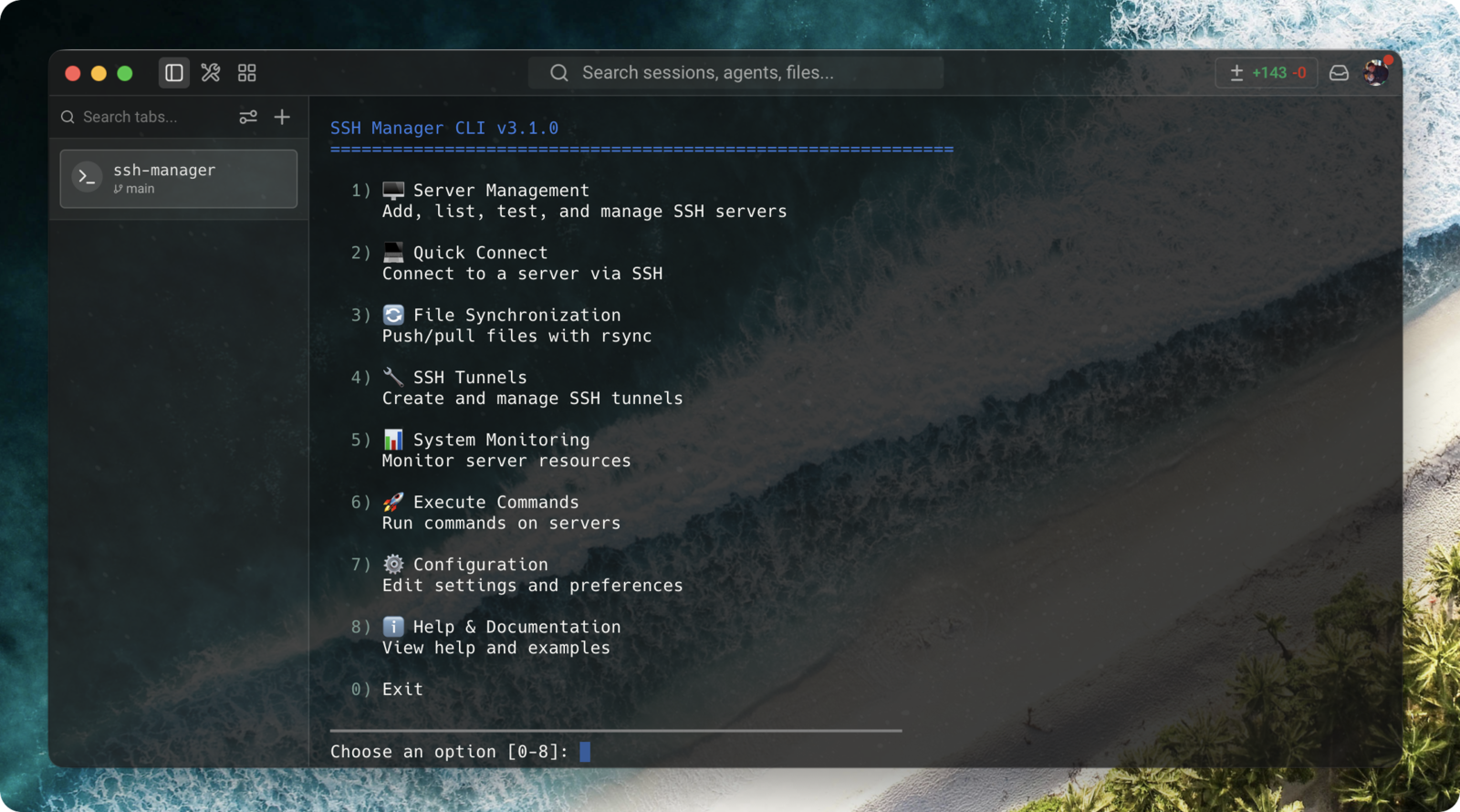
- **🚀 Bash CLI** - Lightning-fast pure Bash CLI for server management
- **📊 Advanced Logging** - Comprehensive logging system with levels and history
- **🔄 Rsync Integration** - Bidirectional file sync with rsync support
- **💻 Persistent Sessions** - Maintain shell context across multiple commands
- **👥 Server Groups** - Execute commands on multiple servers simultaneously
- **🔧 SSH Tunnels** - Local/remote port forwarding and SOCKS proxy support
- **📈 System Monitoring** - Real-time monitoring of CPU, memory, disk, and network
- **🏷️ Server Aliases** - Use short aliases instead of full server names
- **🚀 Smart Deployment** - Automated file deployment with permission handling
- **🔑 Sudo Support** - Execute commands with sudo privileges securely
- **📝 OpenAI Codex Support** - Compatible with OpenAI Codex via TOML configuration
---
## ⚙️ Tool Management & Context Optimization
**NEW in v3.1**: Reduce Claude Code context usage by 92% with tool activation management!
MCP SSH Manager includes **37 tools** organized into **6 groups**. By default, all tools are enabled, but you can optimize for your specific workflow:
### Quick Setup
```bash
# Interactive configuration wizard
ssh-manager tools configure
# View current configuration
ssh-manager tools list
# Enable/disable specific groups
ssh-manager tools enable monitoring
ssh-manager tools disable backup
```
### Configuration Modes
| Mode | Tools | Context Usage | Best For |
|------|-------|---------------|----------|
| **All** (default) | 37 tools | ~43.5k tokens | Full feature set, most users |
| **Minimal** | 5 tools | ~3.5k tokens | Basic SSH operations only |
| **Custom** | 5-37 tools | Varies | Tailored to your workflow |
### Tool Groups
- **Core** (5 tools) - Always enabled: list, execute, upload, download, sync
- **Sessions** (4 tools) - Persistent SSH sessions
- **Monitoring** (6 tools) - Health checks, service status, process management
- **Backup** (4 tools) - Database and file backups
- **Database** (4 tools) - MySQL, PostgreSQL, MongoDB operations
- **Advanced** (14 tools) - Deployment, sudo, tunnels, groups, aliases, etc.
### Benefits
- **92% context reduction** in minimal mode (~40k tokens saved)
- **Fewer approval prompts** in Claude Code
- **Faster loading** and cleaner interface
- **Auto-approval configuration** export for Claude Code
📖 [**Complete Tool Management Guide →**](docs/TOOL_MANAGEMENT.md)
---
## 📋 Prerequisites
- Node.js (v18 or higher)
- npm (comes with Node.js)
- **Platforms**: Linux, macOS, Windows
- **For Claude Code**: Claude Code CLI installed
- **For OpenAI Codex**: Codex CLI configured
- Bash 4.0+ (for CLI management tools)
- rsync (for file synchronization)
- sshpass (optional, for rsync with password authentication)
- macOS: `brew install hudochenkov/sshpass/sshpass`
- Linux: `apt-get install sshpass`
## 🚀 Quick Start - Claude Code
### 1. Install MCP SSH Manager
**Option A: Install from npm (recommended)**
```bash
# Install globally from npm
npm install -g mcp-ssh-manager
# Or install locally
npx mcp-ssh-manager
```
**Option B: Install from source**
```bash
# Clone and install
git clone https://github.com/bvisible/mcp-ssh-manager.git
cd mcp-ssh-manager
npm install
# Install the Bash CLI
cd cli && ./install.sh
# Configure your first server
ssh-manager server add
```
### 2. Install to Claude Code
```bash
# For personal use (current user only)
claude mcp add ssh-manager node /path/to/mcp-ssh-manager/src/index.js
# For team sharing (creates .mcp.json in project)
claude mcp add ssh-manager --scope project node /path/to/mcp-ssh-manager/src/index.js
# For all your projects
claude mcp add ssh-manager --scope user node /path/to/mcp-ssh-manager/src/index.js
```
### 3. Configure Auto-Approval (Optional but Recommended)
To avoid being prompted for approval on every SSH command, add auto-approve configuration:
Edit `~/.config/claude-code/claude_code_config.json`:
```json
{
"mcpServers": {
"ssh-manager": {
"command": "node",
"args": ["/path/to/mcp-ssh-manager/src/index.js"],
"autoApprove": [
"mcp__ssh-manager__ssh_execute",
"mcp__ssh-manager__ssh_list_servers",
"mcp__ssh-manager__ssh_upload",
"mcp__ssh-manager__ssh_download",
"mcp__ssh-manager__ssh_sync",
"mcp__ssh-manager__ssh_alias"
]
}
}
}
```
**Important**: Restart Claude Code after making this change.
For full auto-approval of all SSH tools, see the complete list in [examples/claude-code-config.example.json](examples/claude-code-config.example.json).
### 3.5. Security Modes (Optional, v3.5.0+)
`autoApprove` is all-or-nothing per tool: once `ssh_execute` is approved, anything goes. If you want a **second layer** that filters what the MCP server actually accepts to run — useful when sharing the MCP with a third-party agent, a CI bot, or a client's server — declare a per-server **security mode**.
```bash
# In your .env — three optional fields. Omit them all to keep v3.4.x behavior exactly.
SSH_SERVER_CLIENT_PROD_HOST=client-prod.example.com
SSH_SERVER_CLIENT_PROD_USER=consultant
SSH_SERVER_CLIENT_PROD_KEYPATH=~/.ssh/consultant_ed25519
SSH_SERVER_CLIENT_PROD_MODE=readonly # unrestricted | readonly | restricted
SSH_SERVER_CLIENT_PROD_AUDIT_LOG=~/.ssh-manager/audit.jsonl # opt-in JSONL audit trail
# For mode=restricted, provide an allowlist of regex (DENY wins over ALLOW):
# SSH_SERVER_CI_ALLOW_PATTERNS="^docker (ps|logs);^kubectl get "
```
- **`unrestricted`** (default, no field needed) — identical to pre-v3.5.0 behavior. Zero overhead.
- **`readonly`** — blocks `ssh_upload`, `ssh_deploy`, `ssh_sync`, `ssh_execute_sudo`, backup/db write tools, and built-in destructive commands (`rm`, `mv`, `sudo`, `systemctl restart`, redirects outside `/tmp`, `curl | sh`, …).
- **`restricted`** — every `ssh_execute` command must match at least one `ALLOW_PATTERNS` regex AND no `DENY_PATTERNS` regex.
Existing configs are unaffected — no field is mandatory, no behavior changes unless you opt in. See **[docs/SECURITY_MODES.md](docs/SECURITY_MODES.md)** for the full reference, recipes, and limitations.
### 4. Start Using!
In Claude Code, you can now:
```
"List all my SSH servers"
"Execute 'ls -la' on production server" # Uses default directory if set
"Run 'docker ps' on staging"
"Upload config.json to production:/etc/app/config.json"
"Download logs from staging:/var/log/app.log"
```
**With Default Directories:**
If you set `/var/www/html` as default for production, these commands are equivalent:
- `"Run 'ls' on production"` → executes in `/var/www/html`
- `"Run 'ls' on production in /tmp"` → executes in `/tmp` (overrides default)
---
## 🚀 Quick Start - OpenAI Codex
### 1. Install MCP SSH Manager
Same installation as Claude Code (see above), then configure for Codex:
```bash
# Set up Codex integration
ssh-manager codex setup
# Migrate existing servers to TOML format (if you have .env servers)
ssh-manager codex migrate
# Test the integration
ssh-manager codex test
```
### 2. Manual Configuration (Optional)
If you prefer manual setup, add to `~/.codex/config.toml`:
```toml
[mcp_servers.ssh-manager]
command = "node"
args = ["/absolute/path/to/mcp-ssh-manager/src/index.js"]
env = { SSH_CONFIG_PATH = "/Users/you/.codex/ssh-config.toml" }
startup_timeout_ms = 20000
```
### 3. Configure Servers in TOML Format
Create or edit `~/.codex/ssh-config.toml`:
```toml
[ssh_servers.production]
host = "prod.example.com"
user = "admin"
password = "secure_password" # or use key_path
key_path = "~/.ssh/id_rsa" # for SSH key auth (recommended)
passphrase = "key_passphrase" # optional, for passphrase-protected keys
port = 22
default_dir = "/var/www"
group = "production" # optional, free-form label for grouping/import-export
description = "Production server"
[ssh_servers.staging]
host = "staging.example.com"
user = "deploy"
key_path = "~/.ssh/staging_key"
port = 2222
default_dir = "/home/deploy/app"
[ssh_servers.winhost]
host = "192.168.1.90"
user = "svc-ssh"
key_path = "~/.ssh/winhost_key"
port = 2222
platform = "windows"
description = "Windows host via OpenSSH"
[ssh_servers.bastion]
host = "bastion.example.com"
user = "jumpuser"
key_path = "~/.ssh/bastion_key"
[ssh_servers.internal]
host = "10.0.0.5"
user = "admin"
key_path = "~/.ssh/internal_key"
proxy_jump = "bastion"
description = "Private server behind bastion"
```
💡 **See [examples/codex-ssh-config.example.toml](examples/codex-ssh-config.example.toml) for more complete examples!**
### 4. Start Using in Codex!
In OpenAI Codex, you can now:
```
"List my SSH servers"
"Execute 'docker ps' on production"
"Upload file.txt to staging:/tmp/"
"Monitor CPU usage on all servers"
"Download production:/var/log/app.log to ./logs/"
```
### Converting Between Formats
Switch easily between Claude Code (.env) and Codex (TOML):
```bash
# Convert .env to TOML (for Codex)
ssh-manager codex convert to-toml
# Convert TOML back to .env (for Claude Code)
ssh-manager codex convert to-env
```
Both formats can coexist! The system supports both simultaneously.
---
## 🛠️ Available MCP Tools
### Core Tools
#### `ssh_list_servers`
Lists all configured SSH servers with their details.
#### `ssh_execute`
Execute commands on remote servers.
- Parameters: `server` (name), `command`, `cwd` (optional working directory)
- **Note**: If no `cwd` is provided, uses the server's default directory if configured
#### `ssh_upload`
Upload files to remote servers.
- Parameters: `server`, `local_path`, `remote_path`
#### `ssh_download`
Download files from remote servers.
- Parameters: `server`, `remote_path`, `local_path`
### Backup & Restore Tools (v2.1+) 🔄
#### `ssh_backup_create`
Create backup of database or files on remote server.
- Types: MySQL, PostgreSQL, MongoDB, Files
- Parameters: `server`, `type`, `name`, `database`, `paths`, `retention`
- Automatic compression and metadata tracking
- See [Backup Guide](docs/BACKUP_GUIDE.md) for detailed usage
#### `ssh_backup_list`
List all available backups on remote server.
- Parameters: `server`, `type` (optional filter)
- Returns backup details with size, date, and retention info
#### `ssh_backup_restore`
Restore from a previous backup.
- Parameters: `server`, `backupId`, `database`, `targetPath`
- Supports cross-database restoration
#### `ssh_backup_schedule`
Schedule automatic backups using cron.
- Parameters: `server`, `schedule` (cron format), `type`, `name`
- Automatic cleanup based on retention policy
### Health & Monitoring Tools (v2.2+) 🏥
#### `ssh_health_check`
Perform comprehensive health check on remote server.
- Checks: CPU, Memory, Disk, Network, Uptime, Load average
- Returns overall health status (healthy/warning/critical)
- Optional detailed mode for extended metrics
#### `ssh_service_status`
Check status of services (nginx, mysql, docker, etc.).
- Parameters: `server`, `services` (array)
- Returns running/stopped status for each service
- Works with both systemd and sysv init systems
#### `ssh_process_manager`
List, monitor, or kill processes on remote server.
- Actions: list (top processes), kill (terminate), info (details)
- Sort by CPU or memory usage
- Filter processes by name
#### `ssh_alert_setup`
Configure health monitoring alerts and thresholds.
- Actions: set (configure), get (view), check (test thresholds)
- Configurable CPU, memory, and disk thresholds
- Automatic alert triggering when thresholds exceeded
### Database Management Tools (v2.3+) 🗄️
#### `ssh_db_dump`
Create database dump/backup on remote server.
- Supports: MySQL, PostgreSQL, MongoDB
- Parameters: `server`, `type`, `database`, `outputFile`, `dbUser`, `dbPassword`, `dbHost`, `dbPort`
- Optional: `compress` (gzip), `tables` (specific tables only)
- Returns dump size and location
#### `ssh_db_import`
Import SQL dump or restore database on remote server.
- Supports: MySQL, PostgreSQL, MongoDB
- Parameters: `server`, `type`, `database`, `inputFile`, `dbUser`, `dbPassword`, `dbHost`, `dbPort`
- Handles compressed (.gz) files automatically
- Optional: `drop` (drop database before restore for MongoDB)
#### `ssh_db_list`
List databases or tables on remote server.
- Parameters: `server`, `type`, `database` (optional), `dbUser`, `dbPassword`, `dbHost`, `dbPort`
- Without database: lists all databases (filters system DBs)
- With database: lists all tables/collections
- Returns structured list with count
#### `ssh_db_query`
Execute read-only SQL queries on remote database.
- Parameters: `server`, `type`, `database`, `query`, `dbUser`, `dbPassword`, `dbHost`, `dbPort`
- **Security**: Only SELECT queries allowed for safety
- MongoDB: Use `collection` parameter for find queries
- Returns query results with row count
### Deployment Tools (v1.2+)
#### `ssh_deploy` 🚀
Deploy files with automatic permission and backup handling.
- Parameters: `server`, `files` (array), `options` (owner, permissions, backup, restart)
- Automatically handles permission issues and creates backups
#### `ssh_execute_sudo` 🔐
Execute commands with sudo privileges.
- Parameters: `server`, `command`, `password` (optional), `cwd` (optional)
- Securely handles sudo password without exposing in logs
### Server Management
#### `ssh_alias` 🏷️
Manage server aliases for easier access.
- Parameters: `action` (add/remove/list), `alias`, `server`
- Example: Create alias "prod" for "production" server
#### `ssh_command_alias` 📝
Manage command aliases for frequently used commands.
- Parameters: `action` (add/remove/list/suggest), `alias`, `command`
- Aliases loaded from active profile
- Example: Custom aliases for your project
#### `ssh_hooks` 🎣
Manage automation hooks for SSH operations.
- Parameters: `action` (list/enable/disable/status), `hook`
- Hooks loaded from active profile
- Example: Project-specific validation and automation
#### `ssh_profile` 📚
Manage configuration profiles for different project types.
- Parameters: `action` (list/switch/current), `profile`
- Available profiles: default, frappe, docker, nodejs
- Example: Switch between different project configurations
## 🔧 Configuration
### Profiles
SSH Manager uses profiles to configure aliases and hooks for different project types:
1. **Set active profile**:
- Environment variable: `export SSH_MANAGER_PROFILE=frappe`
- Configuration file: Create `.ssh-manager-profile` with profile name
- Default: Uses `default` profile if not specified
2. **Available profiles**:
- `default` - Basic SSH operations
- `frappe` - Frappe/ERPNext specific
- `docker` - Docker container management
- `nodejs` - Node.js applications
- Create custom profiles in `profiles/` directory
### Environment Variables
Servers are configured in the `.env` file with this pattern:
```env
# Server configuration pattern
SSH_SERVER_[NAME]_HOST=hostname_or_ip
SSH_SERVER_[NAME]_USER=username
SSH_SERVER_[NAME]_PASSWORD=password # For password auth
SSH_SERVER_[NAME]_KEYPATH=~/.ssh/key # For SSH key auth
SSH_SERVER_[NAME]_PASSPHRASE=key_passphrase # Optional, for passphrase-protected keys
SSH_SERVER_[NAME]_PORT=22 # Optional, defaults to 22
SSH_SERVER_[NAME]_DEFAULT_DIR=/path/to/dir # Optional, default working directory
SSH_SERVER_[NAME]_DESCRIPTION=Description # Optional
SSH_SERVER_[NAME]_GROUP=production # Optional, free-form label for grouping/import-export
SSH_SERVER_[NAME]_PLATFORM=windows # Optional: "linux" (default) or "windows"
SSH_SERVER_[NAME]_PROXYJUMP=bastion # Optional: name of another server to use as jump host
SSH_SERVER_[NAME]_PROXYCOMMAND=command # Optional: custom proxy command (ncat, ssh -W, etc.)
SSH_SERVER_[NAME]_FORWARD_AGENT=true # Optional: forward local ssh-agent to remote (needs SSH_AUTH_SOCK; security risk — see SSH Agent section)
# Example: Linux server
SSH_SERVER_PRODUCTION_HOST=prod.example.com
SSH_SERVER_PRODUCTION_USER=admin
SSH_SERVER_PRODUCTION_PASSWORD=secure_password
SSH_SERVER_PRODUCTION_PORT=22
SSH_SERVER_PRODUCTION_DEFAULT_DIR=/var/www/html
SSH_SERVER_PRODUCTION_DESCRIPTION=Production Server
SSH_SERVER_PRODUCTION_SUDO_PASSWORD=secure_sudo_pass # Optional, for automated deployments
# Example: Windows server (OpenSSH for Windows)
SSH_SERVER_WINHOST_HOST=192.168.1.90
SSH_SERVER_WINHOST_USER=svc-ssh
SSH_SERVER_WINHOST_KEYPATH=~/.ssh/winhost_key
SSH_SERVER_WINHOST_PORT=2222
SSH_SERVER_WINHOST_PLATFORM=windows
SSH_SERVER_WINHOST_DESCRIPTION=Windows host via OpenSSH
# Example: Server behind a bastion/jump host
SSH_SERVER_BASTION_HOST=bastion.example.com
SSH_SERVER_BASTION_USER=jumpuser
SSH_SERVER_BASTION_KEYPATH=~/.ssh/bastion_key
SSH_SERVER_INTERNAL_HOST=10.0.0.5
SSH_SERVER_INTERNAL_USER=admin
SSH_SERVER_INTERNAL_KEYPATH=~/.ssh/internal_key
SSH_SERVER_INTERNAL_PROXYJUMP=bastion
SSH_SERVER_INTERNAL_DESCRIPTION=Private server behind bastion
```
### Server Management Tool
The Python management tool (`tools/server_manager.py`) provides:
1. **List servers** - View all configured servers
2. **Add server** - Interactive server configuration
3. **Test connection** - Verify server connectivity
4. **Remove server** - Delete server configuration
5. **Update Claude Code** - Configure MCP in Claude Code
6. **Install dependencies** - Setup required packages
## 📁 Project Structure
```
mcp-ssh-manager/
├── src/
│ ├── index.js # Main MCP server (37 tools)
│ ├── ssh-manager.js # SSH connection handling
│ ├── config-loader.js # .env & TOML config loading
│ ├── session-manager.js # Persistent SSH sessions
│ ├── backup-manager.js # Backup & restore
│ ├── health-monitor.js # Health checks & alerts
│ ├── database-manager.js # Database operations
│ ├── tunnel-manager.js # SSH tunnel management
│ ├── server-groups.js # Group operations
│ └── ...
├── cli/
│ ├── ssh-manager # Bash CLI entrypoint
│ ├── commands/ # CLI command modules
│ └── lib/ # CLI libraries
├── profiles/ # Configuration profiles (frappe, docker, nodejs...)
├── examples/ # Example configs
├── docs/ # Documentation
└── package.json
```
## 🧪 Testing
### Test Server Connection
```bash
python tools/test-connection.py production
```
### Verify MCP Installation
```bash
claude mcp list
```
### Check Server Status in Claude Code
```
/mcp
```
## 🔒 Security Best Practices
1. **Never commit `.env` files** - Always use `.env.example` as template
2. **Use SSH keys when possible** - More secure than passwords
3. **Limit server access** - Use minimal required permissions
4. **Rotate credentials** - Update passwords and keys regularly
### 🔑 Passphrase-Protected SSH Keys
MCP SSH Manager supports passphrase-protected SSH keys in two ways:
**Option 1: SSH Agent (recommended)**
If your SSH key is loaded into `ssh-agent`, MCP SSH Manager will use it automatically — no configuration changes needed:
```bash
# Add your key to the agent (enter passphrase once)
ssh-add ~/.ssh/your_key
# Verify the key is loaded
ssh-add -l
```
The server detects the `SSH_AUTH_SOCK` environment variable and connects to the running agent. This is the same mechanism that regular `ssh` uses for GUI passphrase prompts.
**Option 2: Passphrase in configuration**
You can store the passphrase directly in the server config:
`.env` format:
```env
SSH_SERVER_MYSERVER_KEYPATH=~/.ssh/id_rsa
SSH_SERVER_MYSERVER_PASSPHRASE="your_passphrase"
```
TOML format:
```toml
[ssh_servers.myserver]
key_path = "~/.ssh/id_rsa"
passphrase = "your_passphrase"
```
> **Note:** SSH Agent is preferred over storing passphrases in config files for better security.
### 🔗 SSH Agent Forwarding
Enable per-server agent forwarding (the equivalent of OpenSSH's `ForwardAgent yes`) so processes on the remote host can authenticate to *other* SSH hosts using the keys in your **local** `ssh-agent` — e.g. `git clone` over SSH on a remote server using your local GitHub key, without copying any private key to the server.
It is **opt-in per server** and defaults to `false`. It requires a running local agent (`SSH_AUTH_SOCK` present); when the agent is unavailable the flag is simply ignored.
`.env` format:
```env
SSH_SERVER_MYSERVER_FORWARD_AGENT=true
```
TOML format:
```toml
[ssh_servers.myserver]
forward_agent = true
```
> ⚠️ **Security warning:** agent forwarding lets any process that can read the forwarded agent socket on the remote host — including anyone with **root** there — use your loaded keys to impersonate you against other hosts *for the life of the connection*. Only enable it for servers you trust, mirroring the same caution `ssh_config(5)` advises for `ForwardAgent`.
## 📚 Advanced Usage
### ProxyJump / Bastion Host
Connect to servers behind a bastion or jump host. The connection is tunneled through the jump server transparently — all tools (execute, upload, download, sync) work as usual.
```env
# Define the bastion server
SSH_SERVER_BASTION_HOST=bastion.example.com
SSH_SERVER_BASTION_USER=jumpuser
SSH_SERVER_BASTION_KEYPATH=~/.ssh/bastion_key
# Point the target server to the bastion
SSH_SERVER_PRIVATE_HOST=10.0.0.5
SSH_SERVER_PRIVATE_USER=admin
SSH_SERVER_PRIVATE_PROXYJUMP=bastion
```
Or in TOML:
```toml
[ssh_servers.bastion]
host = "bastion.example.com"
user = "jumpuser"
key_path = "~/.ssh/bastion_key"
[ssh_servers.private]
host = "10.0.0.5"
user = "admin"
proxy_jump = "bastion"
```
**Chained jumps** are supported: if `bastion` itself has a `proxy_jump`, the chain is followed recursively. Circular references are detected and rejected.
### ProxyCommand / Custom Proxy
Connect through SOCKS5 proxies or custom proxy commands. The proxy command executes locally and forwards traffic to the remote host.
```env
# SOCKS5 proxy via ncat
SSH_SERVER_SOCKS_HOST=target.example.com
SSH_SERVER_SOCKS_USER=admin
SSH_SERVER_SOCKS_PROXYCOMMAND="ncat --proxy 127.0.0.1:1080 --proxy-type socks5 %h %p"
# Windows SSH proxy command
SSH_SERVER_WINPROXY_HOST=internal.example.com
SSH_SERVER_WINPROXY_USER=admin
SSH_SERVER_WINPROXY_PROXYCOMMAND="C:\Windows\System32\OpenSSH\ssh.exe -W %h:%p user@jump-host"
```
Or in TOML:
```toml
[ssh_servers.socks]
host = "target.example.com"
user = "admin"
proxy_command = "ncat --proxy 127.0.0.1:1080 --proxy-type socks5 %h %p"
[ssh_servers.winproxy]
host = "internal.example.com"
user = "admin"
proxy_command = "C:\\Windows\\System32\\OpenSSH\\ssh.exe -W %h:%p user@jump-host"
```
The proxy command must be a valid command that reads from stdin and writes to stdout, accepting `%h` and `%p` placeholders for host and port.
### Server Groups
Tag a server with `group` and it becomes part of that group — no extra file to maintain. The label is free-form and travels with the server definition, so it survives an export to (or import from) another tool.
```env
SSH_SERVER_WEB1_HOST=10.0.0.1
SSH_SERVER_WEB1_USER=deploy
SSH_SERVER_WEB1_GROUP=production
SSH_SERVER_WEB2_HOST=10.0.0.2
SSH_SERVER_WEB2_USER=deploy
SSH_SERVER_WEB2_GROUP=production
```
Or in TOML:
```toml
[ssh_servers.web1]
host = "10.0.0.1"
user = "deploy"
group = "production"
```
Both servers are then reachable as a group:
```
Run "uptime" on the production group → ssh_execute_group
List my server groups → ssh_group_manage (action: list)
```
`ssh_list_servers` also reports the group of each server, so you can see membership without opening the config.
**How it combines with `ssh_group_manage`:** groups you create with `ssh_group_manage` live in `.server-groups.json` and carry execution settings (strategy, delay, stop-on-error). Groups implied by the `group` field carry membership only. When a name exists on both sides, **membership is the union** — the stored list plus every server tagged with that name — and the stored execution settings apply. Group names are case-insensitive.
A group that exists only through the `group` field is read-only for `ssh_group_manage`: to change who belongs to it, edit the servers' `group` in your `.env`/TOML. Creating a group of the same name with `ssh_group_manage` is still allowed and simply adds stored members and settings on top.
### Documentation
- [DEPLOYMENT_GUIDE.md](docs/DEPLOYMENT_GUIDE.md) - Deployment strategies and permission handling
- [ALIASES_AND_HOOKS.md](docs/ALIASES_AND_HOOKS.md) - Command aliases and automation hooks
- Real-world examples and best practices
## 🐛 Troubleshooting
### Claude Code Crashes / Interruptions
**Symptoms:**
- Claude shows "Interrupted: What should Claude do instead?"
- MCP tools execute but Claude stops working
- Commands succeed but Claude freezes
**Solution:** v3.1.1 includes automatic fixes:
- ✅ Output auto-truncated to prevent context overflow
- ✅ Timeout increased to 2 minutes (default), max 5 minutes
- ✅ Standardized error responses
**Performance Tuning** (add to `.env`):
```bash
# Reduce output size (default: 10000 characters)
MCP_SSH_MAX_OUTPUT_LENGTH=5000
# Increase timeout for slow commands (default: 120000ms)
MCP_SSH_DEFAULT_TIMEOUT=180000
# Use compact JSON to save tokens (default: false)
MCP_SSH_COMPACT_JSON=true
```
**For large outputs:**
```bash
# Instead of: cat huge-log.txt
# Use: tail -n 100 huge-log.txt
# Or: grep ERROR huge-log.txt | tail -n 50
```
See [docs/TROUBLESHOOTING.md](docs/TROUBLESHOOTING.md) for complete guide.
### MCP Tools Not Available
1. Ensure MCP is installed: `claude mcp list`
2. Restart Claude Code after installation
3. Check server logs for errors
### Connection Failed
1. Test connection: `ssh-manager server test [server_name]`
2. Verify network connectivity
3. Check firewall rules
4. Ensure SSH service is running on remote server
### Permission Denied
1. Verify username and password/key
2. Check SSH key permissions: `chmod 600 ~/.ssh/your_key`
3. Ensure user has necessary permissions on remote server
## 📚 Usage Examples
### Backup & Restore
```
"Backup production MySQL database before deployment"
"List all backups on production server"
"Restore backup from yesterday"
"Schedule daily database backup at 2 AM"
"Backup website files excluding cache and logs"
```
For detailed backup examples, see [examples/backup-workflow.md](examples/backup-workflow.md) and [docs/BACKUP_GUIDE.md](docs/BACKUP_GUIDE.md).
### Using the Bash CLI
```bash
# Basic server management
ssh-manager server list
ssh-manager server add
ssh-manager ssh prod1
# File synchronization
ssh-manager sync push prod1 ./app /var/www/
ssh-manager sync pull prod1 /var/log/app.log ./
# SSH tunnels
ssh-manager tunnel create prod1 local 3307:localhost:3306
ssh-manager tunnel list
# Execute commands
ssh-manager exec prod1 "docker ps"
```
### Using in Claude Code or OpenAI Codex
Once installed, simply ask your AI assistant:
**Claude Code examples:**
- "List my SSH servers"
- "Execute 'df -h' on production server"
- "Upload this file to staging:/var/www/"
- "Create an SSH tunnel to access remote MySQL"
- "Monitor CPU usage on all servers"
- "Start a persistent session on prod1"
**OpenAI Codex examples:**
- "Show my SSH servers"
- "Run df -h on production"
- "Upload file.txt to staging:/tmp/"
- "Check CPU usage on all servers"
Both AI assistants support the same MCP tools! 🚀
---
## 🤝 Contributing
We welcome contributions! Please see [CONTRIBUTING.md](CONTRIBUTING.md) for details.
### Development Setup
1. Fork the repository
2. Clone and install dependencies
3. **Setup pre-commit hooks** for code quality:
```bash
./scripts/setup-hooks.sh
```
4. Create your feature branch
5. Make your changes (hooks will validate on commit)
6. Push to your branch
7. Open a Pull Request
### Code Quality
This project uses automated quality checks:
- **ESLint** for JavaScript linting
- **Black** for Python formatting
- **Flake8** for Python linting
- **Prettier** for code formatting
- **Pre-commit hooks** for automated validation
- **Secret detection** to prevent credential leaks
Run validation manually: `./scripts/validate.sh`
## 📄 License
This project is licensed under the MIT License - see the [LICENSE](LICENSE) file for details.
## 🙏 Acknowledgments
- Built for [Claude Code](https://claude.ai/code)
- Uses the [Model Context Protocol](https://modelcontextprotocol.io)
- SSH handling via [node-ssh](https://www.npmjs.com/package/node-ssh)
- Server management with [Paramiko](https://www.paramiko.org)
---
## Known Limitations
### Command Timeout
- The timeout parameter for SSH commands is advisory only
- Due to SSH2 library limitations, commands may continue running on the server even after timeout
- On Linux/macOS hosts, a system `timeout` wrapper is used for reliable command termination
- **Windows hosts**: Set `PLATFORM=windows` in your server config to skip the Linux `timeout`/`sh -c` wrapper (which is incompatible with Windows OpenSSH)
### SSH Sync (rsync)
- Password authentication requires `sshpass` to be installed
- SSH key authentication is recommended for better security and reliability
- **Windows MCP hosts**: pass native local paths such as `local:C:\project` or `local:.\project`; `ssh_sync` converts drive-letter and UNC paths to MSYS2 format before launching rsync. Prefer native paths, since Node checks them on disk using Windows path semantics — a path already written as `/c/...` or `//server/share` is passed through to rsync untouched rather than converted twice.
- Large file transfers may take time and appear to hang - be patient
### Connection Management
- Connections are pooled and reused for performance
- If a connection becomes stale, it will be automatically reconnected on next use
- Force reconnection by using the `ssh_connection_status` tool with `reconnect` action
## 📧 Support
For issues, questions, or suggestions:
- Open an issue on [GitHub Issues](https://github.com/bvisible/mcp-ssh-manager/issues)
- Check existing issues before creating new ones
---
Made with ❤️ for the Claude Code community