# Cairn
[](https://github.com/CairnRemembers/cairn/blob/v0.3.3/LICENSE)




> **Build knowledge. Leave signals.** — Tools for modern explorers.
**Local-first episodic memory for AI agents — and for you.**
A cairn is a stack of stones that marks a trail. This one marks the trail of your
*thinking*: every decision, dead end, and reason becomes a node you — and any model —
can find again, across sessions and across model generations.
- **Local-first** — everything lives in one SQLite file at `~/.cairn/`. No cloud, no account, no telemetry.
- **Model-agnostic** — any agent that runs a shell command or speaks MCP: Claude, GPT/Codex, Gemini, local models.
- **Append-only** — memories are voided, never deleted. The record is the record.
- **Yours** — Cairn sends nothing off your machine. Your chat still goes to whatever model you chose, exactly as it would without Cairn — use a local model and nothing leaves at all.
**Two ways in:**
- 🧑 **A person setting this up?** Keep reading — [Quick start](#quick-start) takes about 5 minutes. Every option and fix: [QUICKSTART.md](https://github.com/CairnRemembers/cairn/blob/v0.3.3/QUICKSTART.md).
- 🤖 **An AI agent installing Cairn for someone?** → [SETUP_FOR_AGENTS.md](https://github.com/CairnRemembers/cairn/blob/v0.3.3/SETUP_FOR_AGENTS.md) is written for you (install, consent, attribution).
---
## See inside Cairn
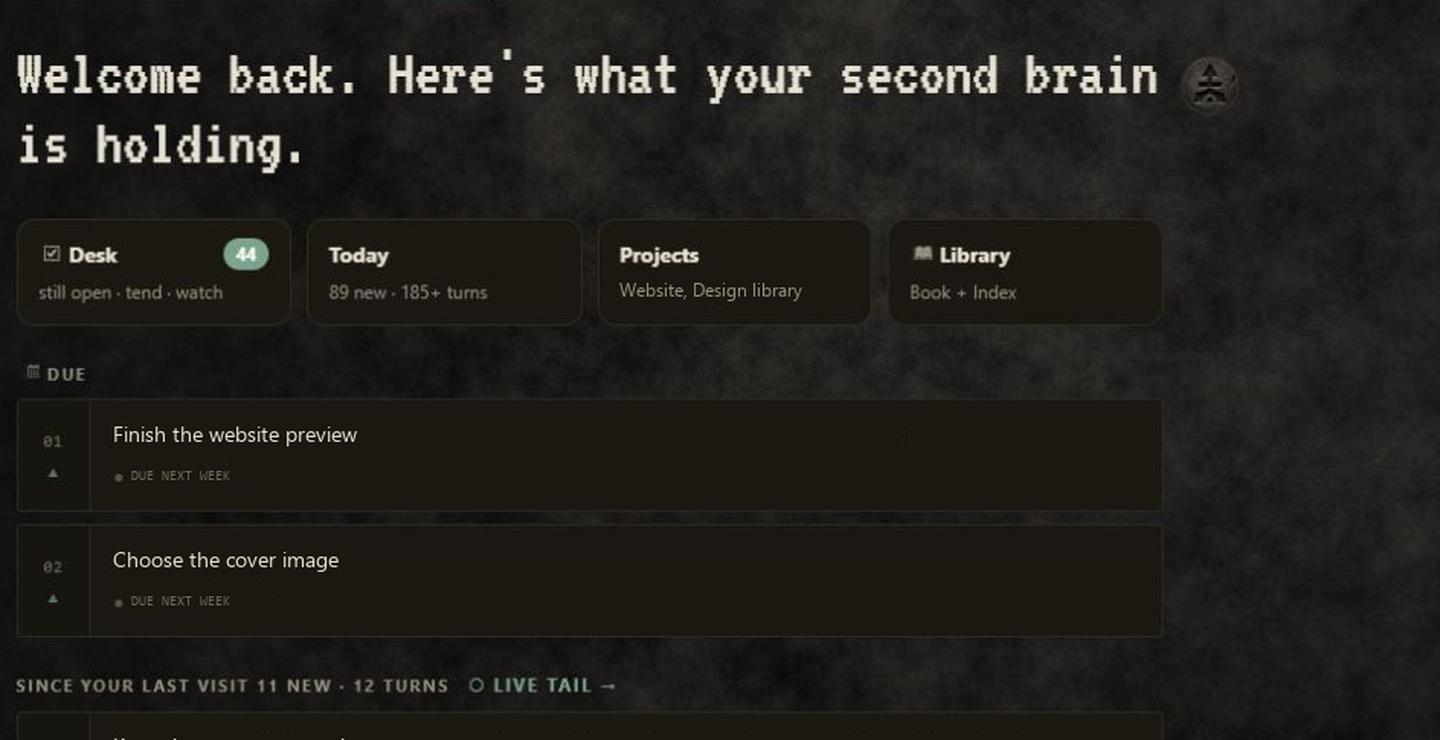
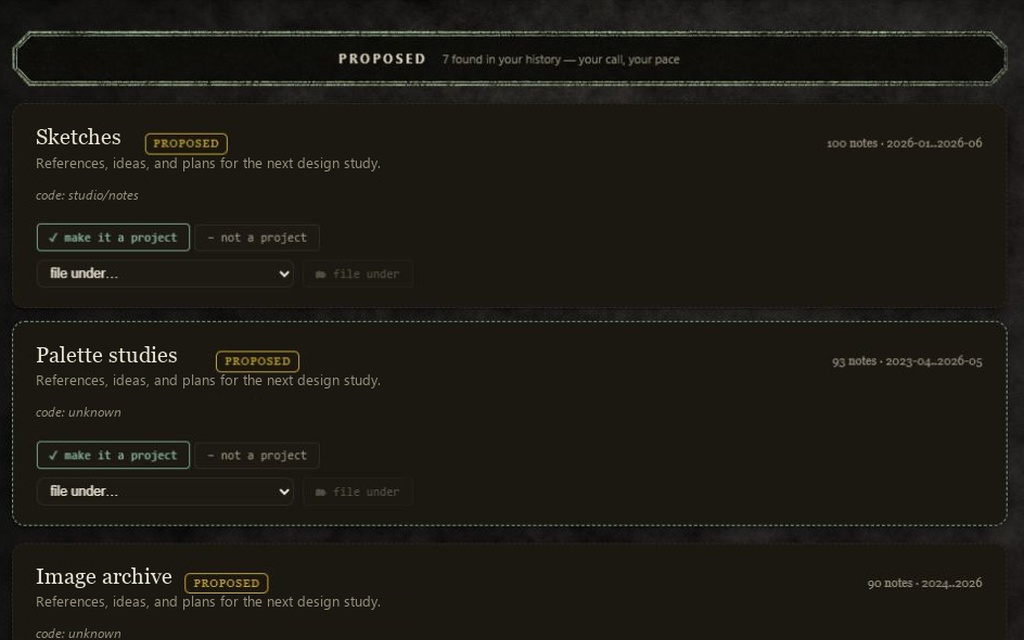
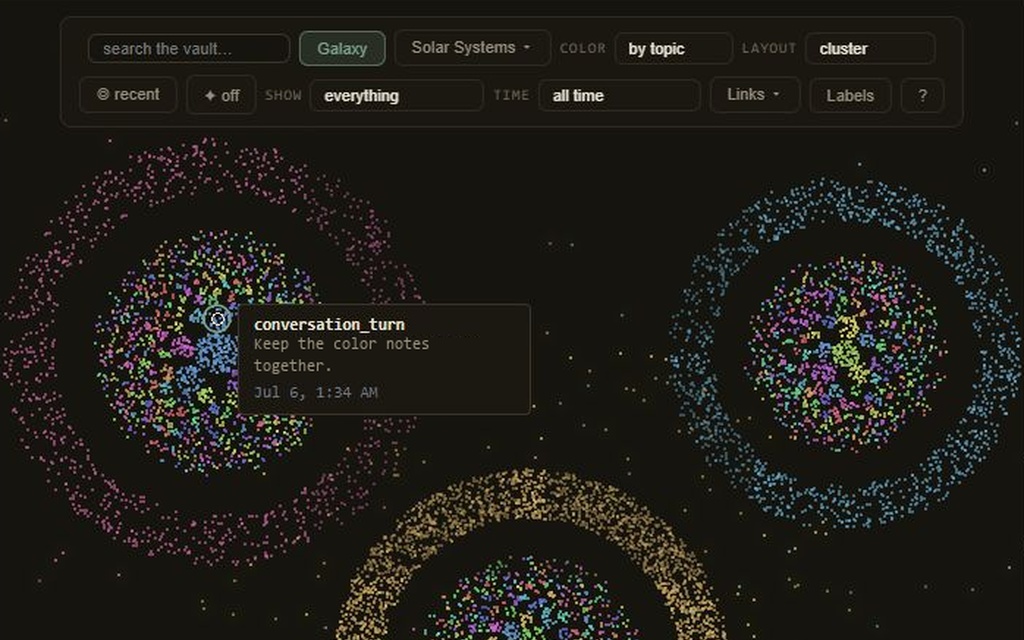
Keep the decisions, reasons and unfinished work you want to return to. Cairn stores them in a local vault that you and your connected AI tools can read and add to. Each AI keeps its own memory and context. These demos show the optional dashboard for exploring the record.
Hub
Projects
Connections
Pick up unfinished work.
Keep related work together.
Explore linked memories.
[Explore all five demos and descriptions](docs/inside-cairn/README.md).
- [Hub — 9 seconds](docs/inside-cairn/clips/hub.mp4)
- [Projects — 18 seconds](docs/inside-cairn/clips/projects.mp4)
- [Index — 6 seconds](docs/inside-cairn/clips/index.mp4)
- [Live Feed — 14 seconds](docs/inside-cairn/clips/live-feed.mp4)
- [Connections — 8 seconds](docs/inside-cairn/clips/connections.mp4)
Recorded in a local installation. Private text uses examples; controls and source attribution are retained. The filmed installation has not been verified against every control in release 0.3.3. [Demo descriptions and recording notes](docs/inside-cairn/README.md).
---
## Contents
- [Quick start](#quick-start)
- [Wire up your AI](#wire-up-your-ai)
- [What you get](#what-you-get)
- [Advanced install](#advanced-install)
- [Multiple accounts](#multiple-accounts)
- [What to back up](#what-to-back-up)
- [Common commands](#common-commands)
- [License](#license)
---
## Quick start
> **Two places, never mixed up:**
> 🖥️ **Your terminal** (PowerShell / Terminal) — every command on this page runs here, on your computer. Wiring is always a terminal command or a config-file edit — an AI can run those terminal steps *for* you (that's the fastest path below), but wiring is never something you paste into the chat box.
> 💬 **The AI chat** — where memory shows up, and where you *test* the wiring by asking the AI to use it.
### Fastest — let your AI do it
Open Claude Code, Codex, or Cursor and paste:
> Install and set up Cairn for me from https://github.com/CairnRemembers/cairn
Your AI runs the terminal steps and asks before switching memory on — one yes/no per
AI on your machine, default **No**. Nothing records without your yes. *(Using Codex?
There's one extra paste after that — see [Wire up your AI](#wire-up-your-ai).)*
### Or do it yourself
**1 — Install** 🖥️ *(installs software only — records nothing, the vault starts empty)*
> ⚠️ **Installing `[all]` on Linux / WSL?** Run
> `pip install torch --index-url https://download.pytorch.org/whl/cpu` **first**, or pip
> pulls a multi-GB CUDA torch stack you don't need. Windows and macOS torch wheels are
> already CPU-only.
```bash
pip install cairn-remembers # base install
pip install "cairn-remembers[all]" # + embedder + dashboard
```
#### From source
Still the richer path — the installer handles the CPU-torch step for you:
**Get the code** 🖥️
```bash
git clone https://github.com/CairnRemembers/cairn
cd cairn
```
**Run the installer** 🖥️
```bash
# Windows: .\install.ps1 (blocked? powershell -ExecutionPolicy Bypass -File .\install.ps1)
# macOS/Linux: ./install.sh
```
The installer finds Python 3.11+, installs everything (first run downloads PyTorch — the
lean CPU build on Linux/Windows, a few minutes), and checks itself.
**2 — Wire up your AI.** This is where memory actually turns on, and **each AI needs
different wiring** — a `y` in setup finishes the job for Claude Code, but *not* for
Codex or Claude Desktop. Find your AI below and follow it to its ✅.
---
## Wire up your AI
Cairn has **two separate wires**, and knowing the difference prevents every common surprise:
- **Capture** — your chats get *remembered* automatically (writes to the vault).
- **Tools** — the AI can *search and note* your vault from inside the chat (reads + on-demand writes).
Some AIs need one wire, some need both. Don't stop at the first ✓ — follow your AI to its ✅ line.
### Claude Code — one command
🖥️ In the terminal:
```bash
python -X utf8 -m cairn setup # answer y for Claude Code
```
That wires **capture**: every **new** Claude Code chat auto-orients (you'll see the
banner), records as you work, and compiles when it ends. Machine-wide, one-time,
reversible (`cairn disconnect --global`). Prefer one project only? Run `cairn connect`
inside that repo instead (global and per-project are mutually exclusive — `doctor` flags it).
✅ **Done when:** a **new** chat opens with a **"CAIRN — inherited context"** banner,
and 🖥️ `python -X utf8 -m cairn doctor` shows **✓ capture**.
*Optional — native tools:* Claude Code can already read the vault by running `cairn`
commands in its shell. For native `cairn_*` tools instead, register the MCP server
user-wide, pointing at the Python that can `import cairn` (a bare `python` that can't
is the #1 failure — [prove the path first, QUICKSTART §6a](https://github.com/CairnRemembers/cairn/blob/v0.3.3/QUICKSTART.md#6a--tools-via-mcp)):
```bash
claude mcp add --scope user cairn -- -X utf8 -m cairn mcp
```
💬 Proof: ask the chat to *"call cairn_orient"*. *(`doctor` can't see this wire — the ask is the test.)*
### OpenAI Codex — three pieces, each does a different job
1. **Capture** 🖥️ — `python -X utf8 -m cairn setup` → `y` for Codex (= `codex-hook install`).
Captures turns live as Codex fires `notify` (deduped by turn id). For a comprehensive
sweep of everything on disk, run 🖥️ `python -X utf8 -m cairn import codex-sessions --apply` anytime.
2. **Tools** 📄 — add to `~/.codex/config.toml`, then fully restart Codex
([full §6 walk-through](https://github.com/CairnRemembers/cairn/blob/v0.3.3/QUICKSTART.md#6--use-cairn-from-codex)):
```toml
[mcp_servers.cairn]
command = ""
args = ["-X", "utf8", "-m", "cairn", "mcp"]
startup_timeout_sec = 30
tool_timeout_sec = 120
default_tools_approval_mode = "approve"
```
3. **Habit** 📄 — create `~/.codex/AGENTS.md` and paste the memory protocol from
[QUICKSTART §6c](https://github.com/CairnRemembers/cairn/blob/v0.3.3/QUICKSTART.md#6--use-cairn-from-codex) so Codex orients, fetches,
and notes **unprompted**. *(Needs piece 2 — the protocol calls those tools.)*
✅ **Done when:** 🖥️ `python -X utf8 -m cairn codex-hook status` prints **INSTALLED**,
and 💬 a Codex chat answers *"call cairn_orient"* with a digest (with piece 3, its first
reply starts `[cairn: oriented — N]`).
⚠️ *Honest note:* `cairn doctor` structurally detects Codex MCP registration (the
`[mcp_servers.cairn]` block), but it does not prove the server launches or that the notify
hook captures — the checks above are the real proof of those.
### Claude Desktop / Cursor — one paste
📄 Add to `claude_desktop_config.json` (or Cursor's MCP settings), then restart the app:
```json
{
"mcpServers": {
"cairn": { "command": "python", "args": ["-X", "utf8", "-m", "cairn", "mcp"] }
}
}
```
That's the **tools** wire — search, fetch, wander, note from inside the chat. These
surfaces have **no ambient capture**; what you ask the AI to `cairn_note` is what lands.
*(If the app can't find Python, use the full path of the Python that installed Cairn.)*
✅ **Done when:** `doctor` shows **✓ MCP — registered in Claude Desktop config**
(Desktop), or 💬 the *"call cairn_orient"* smoke test answers (Cursor).
---
**Applies to every AI above:**
- **Wiring is one-time.** New chats just remember — you never activate per chat. `orient` *reads* memory; it never switches anything on. Scope varies by wire: Claude Code hooks are machine-wide (or one project via `cairn connect`); Desktop/Cursor and Codex live in each app's own config, per account.
- **Only NEW chats pick up new wiring** — finish wiring, then open a fresh chat. (Long-lived MCP clients re-read the tools only on a full restart.)
- **Privacy controls:** skip one chat — `CAIRN_CAPTURE=0` in that shell (PowerShell `$env:CAIRN_CAPTURE="0"` · cmd `set CAIRN_CAPTURE=0` · bash `export CAIRN_CAPTURE=0`) · pause everywhere: `cairn capture off` / `on` · secrets scrubbed before write (append-only, fail-closed).
- **Undo:** `cairn disconnect [--global]` · `cairn codex-hook uninstall` · re-run `cairn setup` to review.
---
## What you get
- **One vault, every model.** Any agent that speaks MCP or can run `cairn` reads and writes the same memory — so one agent builds on what another wrote, even across rival vendors.
- **Keep your place across a usage cap.** Hit a limit on one model, continue on another, and point it at where you left off — the trail is in the vault, not in one model's context.
- **Captured as you work** — decisions, dead ends, tool calls, and turns become searchable nodes, from the moment you wire it.
- **Nothing worth keeping disappears.** Every captured turn stores its complete text: search results are gists — an index — `cairn read ` prints any node in full, and MCP `cairn_read` pulls it whole with a raised `max_chars`.
- **A local maintenance pass you run** — `cairn sleep`, nightly by habit or on your own scheduler (it doesn't schedule itself): embed → consolidate → prune → rebuild the graph → compile, all on your machine. One exception to "no network": the very first embed downloads the ~80 MB model, once.
- **A map of your thinking** — the dashboard galaxy (`cairn dashboard` → http://127.0.0.1:7331), plus a human-readable Hub / Book / Index.
- **Backfill** — distill old conversations into sharp, connected `claim` nodes.
---
## Advanced install
Manual install, lighter builds, and venvs
**By hand** (what the installer runs):
```bash
# Linux / WSL: install the CPU-only PyTorch first, or pip pulls a ~4.6 GB CUDA
# stack you don't need. (Want a GPU build? Install your torch first, then run the
# line below — it's preserved.) macOS: skip this line — its default wheel is CPU/MPS.
pip install torch --index-url https://download.pytorch.org/whl/cpu
pip install -e ".[all]" # package + embedder + dashboard
```
**Lighter builds:**
```bash
pip install -e ".[embeddings]" # no dashboard
pip install -e ".[dashboard]" # no embedder
```
Base install is stdlib + `numpy`. Extras add the embedder (`sentence-transformers` — the ~80 MB model downloads once, on first use) and the dashboard (`fastapi` + `uvicorn`).
**PEP-668 "externally-managed-environment"** (Ubuntu/Debian/Homebrew/WSL): install into a venv first —
```bash
python3 -m venv .venv && source .venv/bin/activate && ./install.sh
```
---
## Multiple accounts
**One login per AI? Skip this — it just works.** Each AI signs in with its own
account, and Cairn files that AI's work under its own galaxy automatically —
Claude and GPT never mix, with zero setup.
**Read on only if you run two accounts of the *same* AI** (two Claude logins, two
ChatGPT/Codex logins — say, **personal and company**). Galaxies are keyed to each
login's stable id and **never merge** — but with two same-AI logins on one machine,
Cairn can't always *prove* which one is active. The rule that keeps it clean:
> **Declare, don't detect: set `CAIRN_ACCOUNT` per account, up front.**
```bash
# Claude Code — launch each account with its label:
export CAIRN_ACCOUNT=work && claude # bash/zsh (or set it in that profile)
# PowerShell: $env:CAIRN_ACCOUNT="work"; claude
# Codex — put it in that account's ~/.codex/config.toml:
# [mcp_servers.cairn] env = { CAIRN_ACCOUNT = "work" }
# Importing old history? Always pass the flag:
cairn import --source=claude --account=work
```
Name and manage them anytime:
```bash
cairn account # list galaxies + node counts
cairn account rename "Company" # display label only — never merges or deletes
cairn account doctor # read-only check — prints the exact fix command per mismatch
cairn account fix-session # re-file ONE named session (backed up, then locked)
cairn account fix-session # same, for the current session only
```
**Honest limits** — so you're never surprised:
- **Claude Desktop** proves the active account per session automatically. **Claude Code CLI and Codex can't** — they follow the machine's current login file, so an account switch mid-stream can label sessions with the previous account, silently. `CAIRN_ACCOUNT` is the guarantee; detection is not.
- `account doctor` verifies what's *provable* (Claude Desktop sessions); it can't audit pure-CLI or Codex history.
- Append-only applies here too: renames change display labels only; nothing merges, nothing deletes.
---
## What to back up
One folder: your vault at **`~/.cairn/`** (that's `cairn.db` — your actual memories). Back that up. Everything else is replaceable — the code lives here on GitHub, and reinstalling never touches your vault.
---
## Common commands
`orient` · `note` · `fetch` · `wander` · `query` · `read` (any node in full) · `dashboard` · `doctor` · `setup` · `connect` / `disconnect` / `capture` · `account` · `backfill` · `sleep` (the maintenance cycle — you run it) · `edges` · `book` · `import`
Full reference with every option: [QUICKSTART.md](https://github.com/CairnRemembers/cairn/blob/v0.3.3/QUICKSTART.md).
---
## License
**Free for personal and non-commercial use** under the [Business Source License 1.1](https://github.com/CairnRemembers/cairn/blob/v0.3.3/LICENSE) — read it, run it, modify it, self-host it. **Commercial or business use requires a commercial license** — email **licensing@cairnremembers.com**. Source-available (not OSI "open source"); each release converts to the permissive MIT License on the Change Date in its LICENSE.
Patent pending — a U.S. provisional patent application covering Cairn's core mechanisms was filed 2026-07-07. **Cairn Remembers™** is a trademark of James Wescott Maitland IV.
---
*Knowledge is a trail, not a destination.*