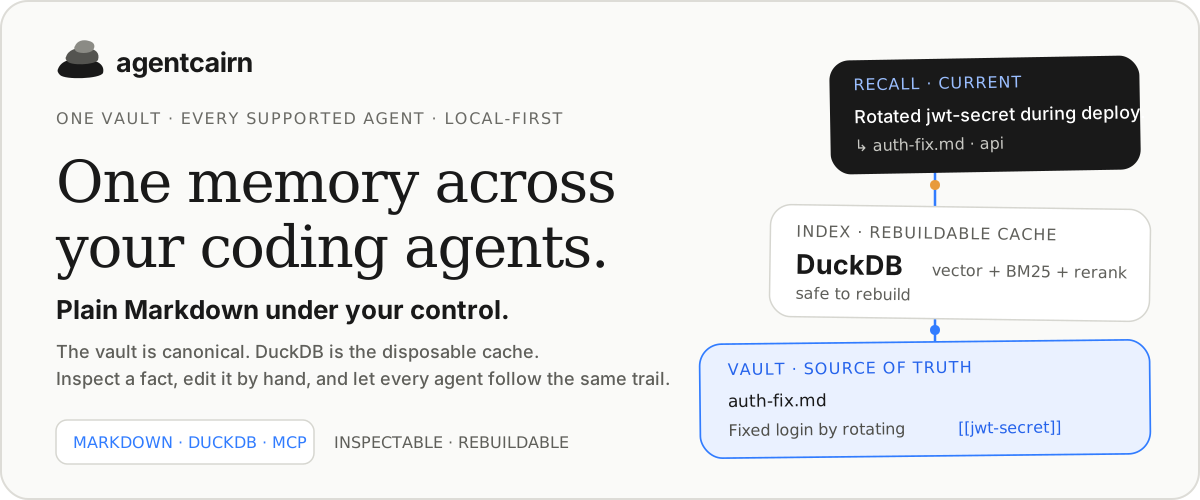
A cairn marks a trail for whoever comes next. **agentcairn** does that for coding agents: it captures durable context from the tools you use, stores it as inspectable Markdown with provenance, and recalls only the most relevant pieces when another agent needs them.
## Proof you can inspect
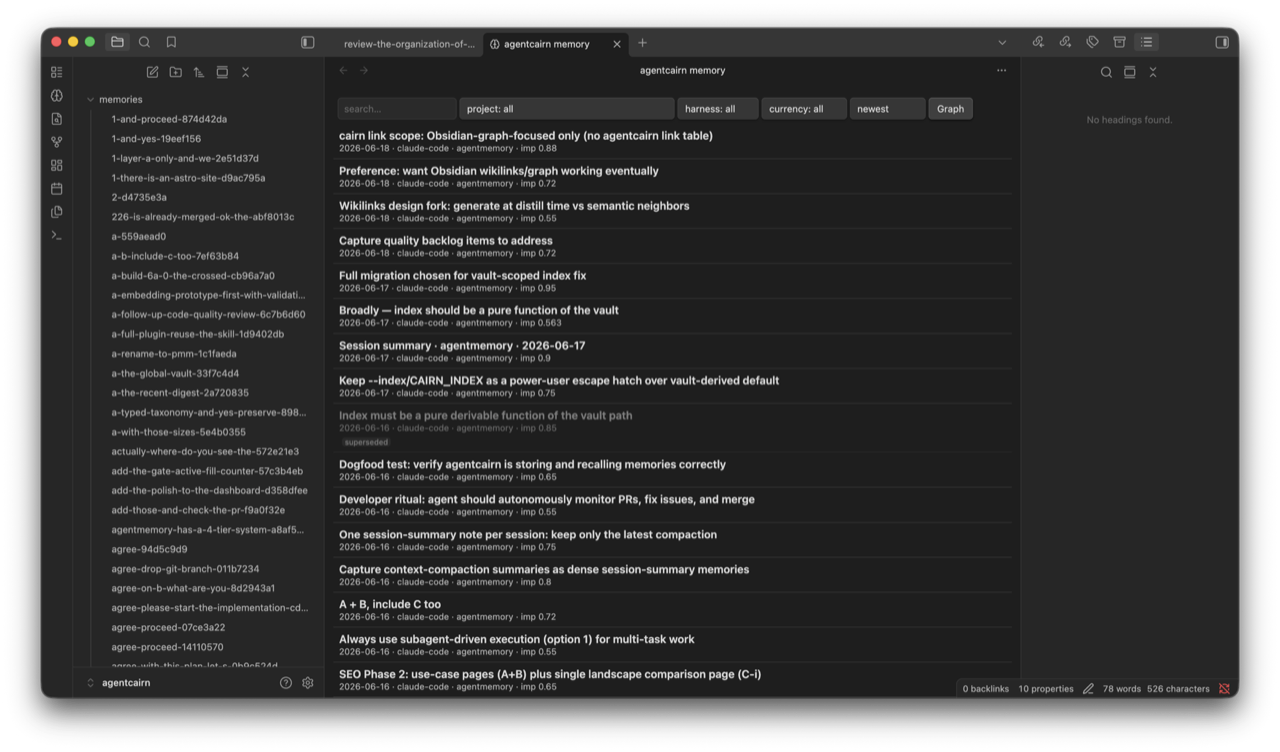
The memory is not hidden behind an admin console or a hosted database. The separate [agentcairn-obsidian](https://github.com/ccf/agentcairn-obsidian) companion reads the same Markdown files as the agents and exposes provenance, currency, importance, supersession, and `related:` links.
A real agentcairn vault in Obsidian. The list is a view over the files—not a second memory store.
> **Dogfood snapshot · 2026-07-15.** Across 417 local recalls, the maintainer's vault returned context about `262× smaller` than loading the full vault each time—an estimated `136.6M tokens of full-vault context avoided` in aggregate. Token counts use approximately four characters per token. This is not billed-token savings, and agentcairn sends no telemetry.
## Install
The shortest path is a first-class plugin. It bundles the MCP server, the memory skill, and the host-specific ambient hooks—no separate agentcairn package install. The plugin launches through `uvx`, so install [uv](https://docs.astral.sh/uv/getting-started/installation/) first if `uvx --version` is not already available.
### Claude Code
```bash
claude plugin marketplace add ccf/agentcairn
claude plugin install agentcairn@agentcairn
```
Claude Code gets per-turn project-scoped recall, session/compaction capture, and the `/agentcairn:recall`, `/agentcairn:remember`, `/agentcairn:memory`, `/agentcairn:savings`, and `/agentcairn:ingest` commands.
### Codex
```bash
codex plugin marketplace add ccf/agentcairn
codex plugin add agentcairn@agentcairn
```
Codex gets the bundled MCP tools and memory skill, live-verified SessionStart recall, and SessionEnd capture with `cairn sweep` as the out-of-band backstop.
### Agent-assisted setup
Already use [skills.sh](https://skills.sh/) or a `find-skills` workflow? Install the public setup assistant:
```bash
npx skills add ccf/agentcairn --skill agentcairn-setup -g
```
Then ask your agent: `Use $agentcairn-setup to preview, install, and verify AgentCairn for this coding agent.`
This installs setup guidance only—not the AgentCairn runtime, MCP server, plugin, or hooks. The assistant delegates those changes to AgentCairn's preview-first native installer and verifies the resulting integration. The Claude Code and Codex plugin commands above remain the shortest path.
The default vault is `~/agentcairn` and is created on first use. A new empty vault has nothing useful to recall yet, so prove the whole loop explicitly:
```text
You → Remember this durable fact: staging deploys use blue-green.
Agent → written and indexed
You → Recall the staging deploy strategy.
Agent → staging deploys use blue-green. ↳
```
`remember` writes the Markdown note and index entry together, so immediate recall is part of the contract. The first local run may download and warm the configured embedding/reranking models.
## The contract
| Promise | What it means in practice |
|---|---|
| **Markdown is canonical** | Notes, frontmatter, and `[[wikilinks]]` are the durable memory. Edit a fact by hand; the next reconciled read honors it. |
| **The index is disposable** | DuckDB is a derived cache. Deleting or rebuilding it does not delete the Markdown vault. |
| **One vault crosses agents** | Supported hosts share the same configured vault instead of building isolated memories per tool. |
| **History is non-lossy** | Derived notes do not silently erase stored notes; superseded and expired facts remain inspectable and are demoted rather than hidden. |
| **Every result has context** | Project, validity status, and permalinks travel with recall so an agent can distinguish current local evidence from cross-project history. |
## How it works