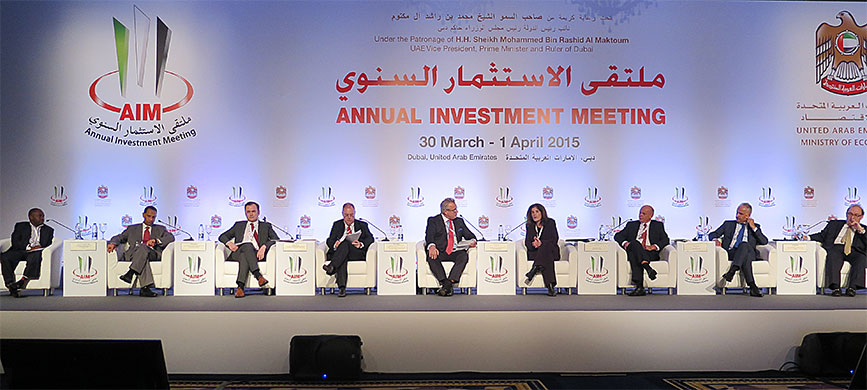
 CFI.co moderating a plenary session at the 2015 Annual Inevstment Meeting (AIM) which took place from March 30 to April 1 in Dubai and was hosted by that country’s Ministry of Economy. CFI.co was a knowledge partner of the event. Photo Copyright © CFI.co.[/caption]
Worldwide, foreign direct investment (FDI) volumes are shortly expected to breach the $3tn mark – representing fully 4% of the global GDP. Foreign direct investment and trade liberalisation, two faces of the same coin, are seen as key drivers of economic development and powerful enablers that allow countries to escape poverty and thus realise their full potential.
However, as was pointed out at this year’s Davos Summit of the World Economic Forum, there is currently no comprehensive multilateral legal framework or global institution that oversees investment flows and activities. Instead, investment flows face a bewilderingly complex overlay of bilateral, plurilateral, and interregional treaties that do little to encourage the growth of FDI volumes. If investment volumes grow, as they do, it is in spite of – rather than because of – this mesh of countervailing agreements.
Ten Guiding Principles for Governments’ Effective FDI Policies
Play on Strengths (comparative advantage)
Be predictable and Friendly (clear rules and welcoming attitude)
Create Incentives (encourage investors)
Do Not Discriminate (all are equal in the eyes of the law)
Regulate for Sustainability (growth now and in the future)
Protect Intellectual Property Rights (shield creativity from pirates)
Remove Red-Tape (minimise bureaucracy)
Provide Access to Finance and Risk Management Services
Fund FDI-Agencies and Listen to their Feedback (data and research are essential)
Communicate, Communicate, Communicate (keep talking and listening)
Trying to make sense of the FDI universe, participants of the fifth Annual Investment Meeting (AIM) celebrated in Dubai between March 30 and April 1, at length debated ways to ease and encourage investment flows. The 2015 edition of the meet focused on FDI as an agent for sustainable development via innovation and the transfer of technology.
In their final declaration, attending ministers and other government representatives called upon the United Nations to include the critical role of foreign direct investment in the attainment of the sustainable development goals (SDGs) that are expected to be adopted later this year by the UN General Assembly. The ministerial declaration emphasises that FDI can contribute towards ensuring food security and help countries exploit their competitive advantages. The ministers further concluded that in order to increase investment volumes to the level necessary for SDGs to be fully met, it is necessary for recipient nations to put a stable and predictable policy framework in place.
“In their final declaration, attending ministers and other government representatives called upon the United Nations to include the critical role of foreign direct investment in the attainment of the sustainable development goals (SDGs) that are expected to be adopted later this year by the UN General Assembly.”
As an AIM 2015 knowledge partner, CFI.co teamed up with the Deputy-Director Ann Low of the Office for Investment Affairs at the US State Department and officials of the UAE Ministry of Economy to draw up a list of ten guiding principles for effective FDI policies.
The principles aim to help countries compose a legal framework that facilitates FDI flows and ensures key elements are put in place that encourage sustainable development.
The objective of these principles is to be effective: the government policies and actions they encourage should result in the transfer of technology and encourage innovation, including by small and medium-sized enterprises.