Beyond Time Shifts

🎬 Adapting Omni-LLM as a Reference-Free Evaluator for Generative Audio-Visual Models

A reference-free audio-visual synchronization metric on Qwen2.5-Omni-3B. One video clip in β†’ one scalar out (higher = better synced). Official code for our ECCV 2026 paper, with the full training recipe and inference stack.

πŸš€ Quick Start | 🧠 Method | πŸ“Š Evaluation | πŸ”§ Training | πŸ“ Custom Data | 🧭 Roadmap | πŸ“ Citation

arXiv HF Model HF Dataset ECCV 2026 Qwen2.5-Omni-3B MIT

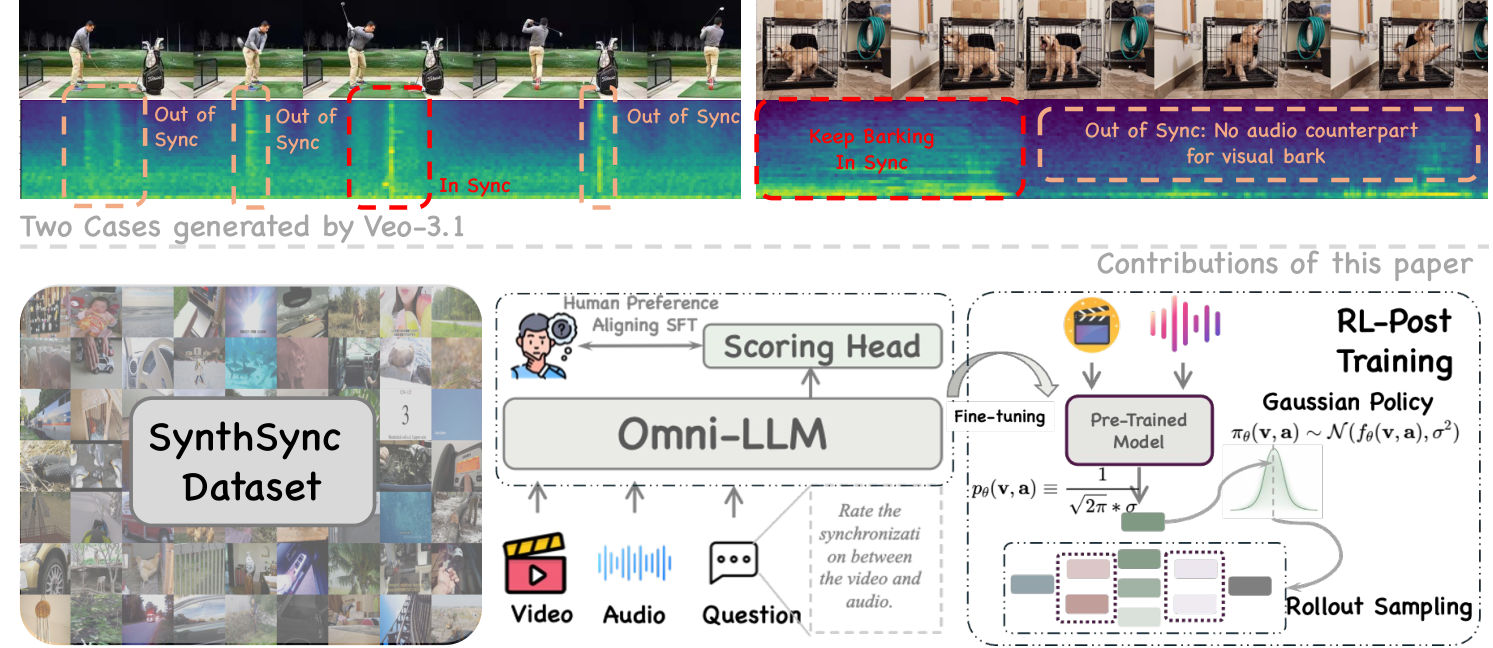
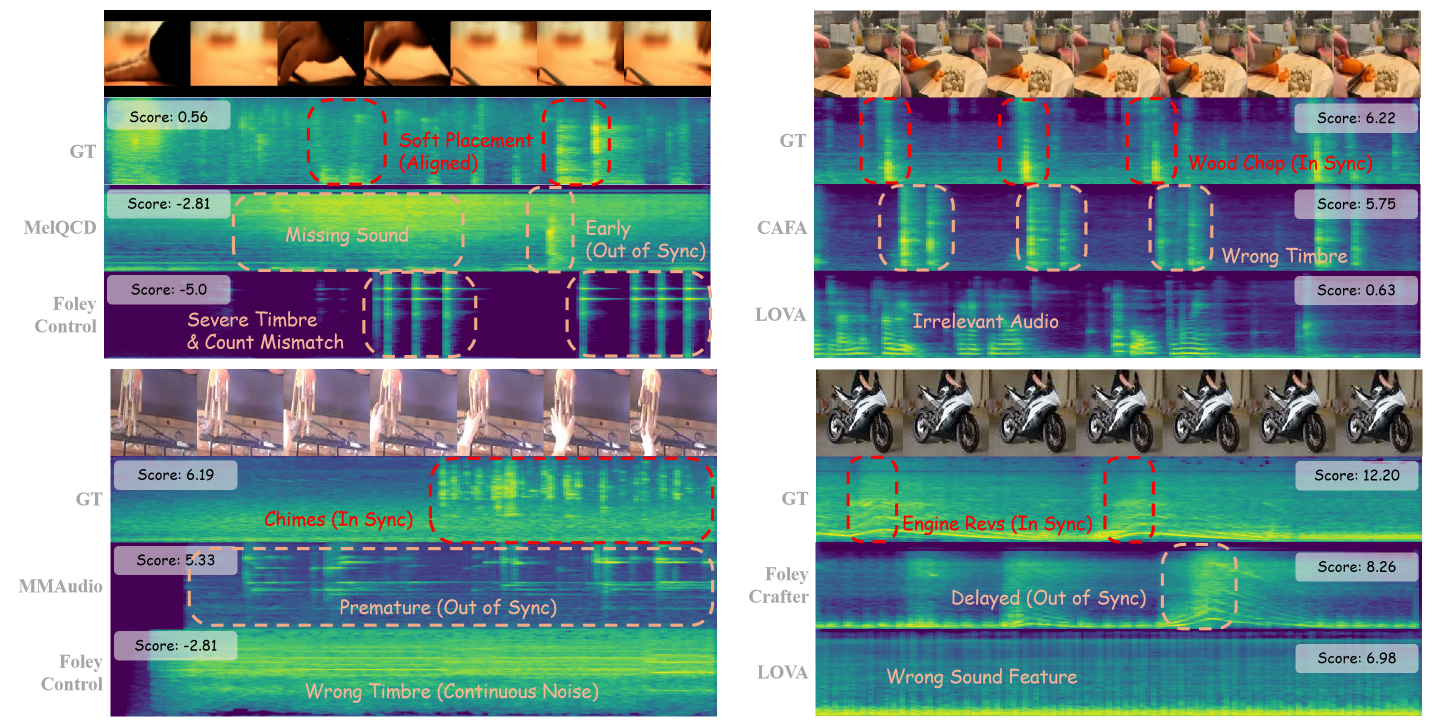
Failure cases and pipeline overview
## πŸ”₯ News - **[2026-07]** πŸŽ‰ Code released β€” inference/evaluation + full two-stage training pipeline. - **[2026-07]** πŸ€— Trained checkpoint released: [qianyijie/avsync-evaluator](https://huggingface.co/qianyijie/avsync-evaluator). - **[2026-07]** πŸ“¦ SyncBench released: [πŸ€— qianyijie/SyncBench](https://huggingface.co/datasets/qianyijie/SyncBench). You can also run on your [own dataset](#-use-your-own-dataset). - **[2026-06]** πŸ“„ Paper accepted to **ECCV 2026**. ## ✨ Introduction Generative audio-visual models fail synchronization in ways classic metrics can't catch β€” *structural hallucinations*, *asymmetric cross-modal relations*, and *temporally diffuse events* β€” not the simple time shifts those metrics assume. Humans judge such failures by **relative comparison**, yet a deployable metric must be **reference-free and absolute**. We resolve this with a three-part recipe: 1. **SynthSync** β€” the first dataset of *authentic* generative sync failures: 10 V2A models generate competing audios per video, with β‰ˆ306K pairwise human annotations. 2. **Continuous Omni-LLM evaluator** β€” Qwen2.5-Omni-3B with a `[SCORE]`-token projection head replacing the language head, giving one reference-free scalar. 3. **R-GRPO** β€” RL post-training that treats the scalar as a Gaussian policy and optimizes the whole *listwise* score distribution, internalizing global causal structure. The resulting metric powers **SyncBench**, our leaderboard for AV-generation models. > Self-contained: bundles the Qwen2.5-Omni / Qwen2-VL code; only `transformers` needed for tokenizer/config. ## πŸ“Š Results New state of the art on SynthSync, over off-the-shelf Omni-LLMs, non-LLM metrics, and trained LLM evaluators: | Metric | PFT baseline | **+ R-GRPO** | |--------|:---:|:---:| | NDCG | 0.9353 | **0.9435** | | Kendall's Ο„ | 0.4515 | **0.4899** | | MRR | 0.7316 | **0.7674** | | Pairwise Acc (%) | 71.16 | **72.38** | Ablation (NDCG / Pair-Acc): base 0.8531 / 51.02 β†’ +SynthSync 0.9224 / 66.60 β†’ +SFT 0.9353 / 71.16 β†’ +R-GRPO **0.9435 / 72.38**. ## πŸš€ Quick Start ```bash pip install -r requirements.txt # Download the trained weights from the HF Hub hf download qianyijie/avsync-evaluator avsync_eval_weights.pt --local-dir . # Score one clip python demo_single_video.py --weights ./avsync_eval_weights.pt --video /path/to/clip.mp4 # -> Sync score for /path/to/clip.mp4: 3.14 ``` > Trained your own model? Convert its DeepSpeed checkpoint to a single `.pt` once: > `python tools/convert_checkpoint.py --ckpt_dir /path/to/your.ckpt --out ./avsync_eval_weights.pt` `transformers==4.57.1`, `qwen-omni-utils==0.0.8`; base weights download from the HF Hub on first run. For training: `pip install -r requirements_train.txt`. `tools/convert_checkpoint.py` keeps only the `transformer.*` / `regression_head.*` tensors from the ZeRO dir β€” `zero_to_fp32.py` is not needed. ## 🧠 Method

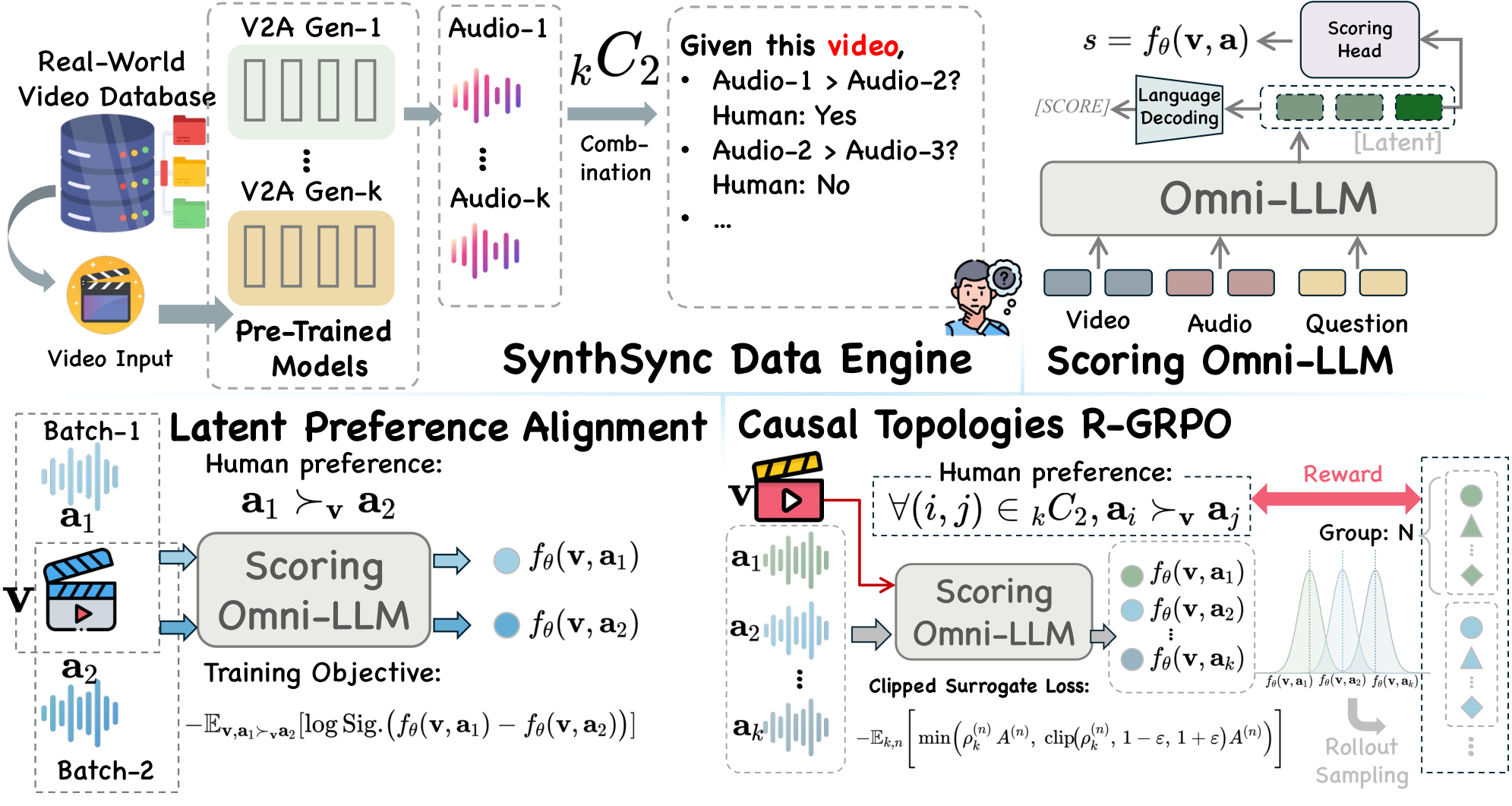
Framework overview
Qwen2.5-Omni-3B with a continuous MLP head reading the hidden state at a `[SCORE]` token: `s = MLP(h_score)`. Trained in two stages: - **Stage I β€” Preference SFT.** Bradley-Terry-Luce loss over pairwise preferences (no MSE regression), inducing a globally consistent reference-free scale. A **dynamic curriculum** anneals from easy (high-margin) to hard pairs. - **Stage II β€” R-GRPO.** Reparameterize the scalar `ΞΌ_ΞΈ` as a Gaussian policy, sample listwise rollouts per video, and reward each by its full-ranking match to ground truth (NDCG / Kendall / Spearman / Top-1 / MRR / pairwise). Group-relative advantages + closed-form Gaussian ratio + PPO clip + KL penalty.
R-GRPO validation learning curves
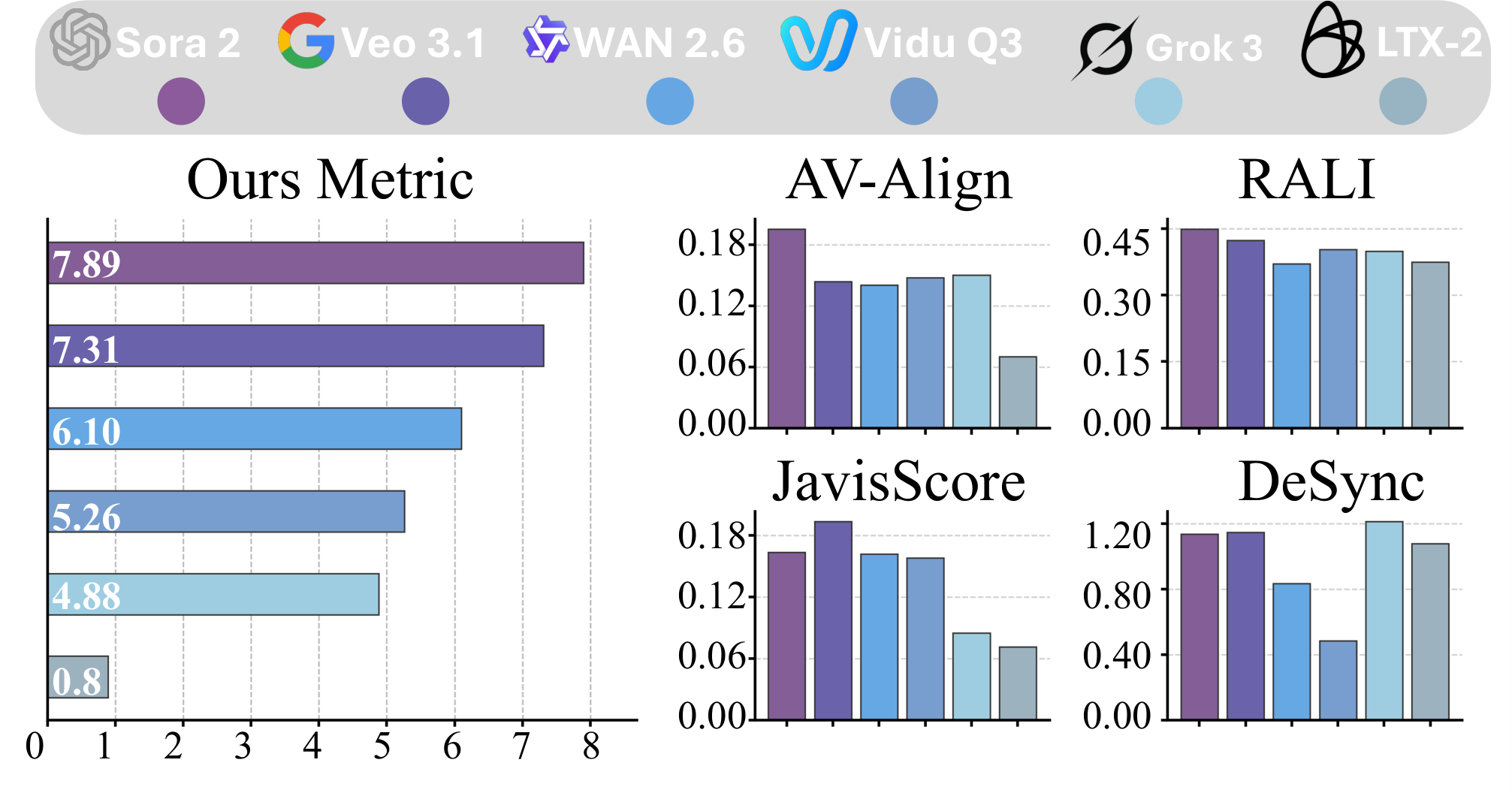
### πŸ† SyncBench We rank six AV-generation models (Sora-2, Veo-3.1, WAN-2.6, Vidu-Q3, Grok-3, LTX-2) on 185 prompts. Legacy metrics (AV-Align, JavisScore, DeSync) give volatile, contradictory rankings; ours stratifies model quality cleanly.
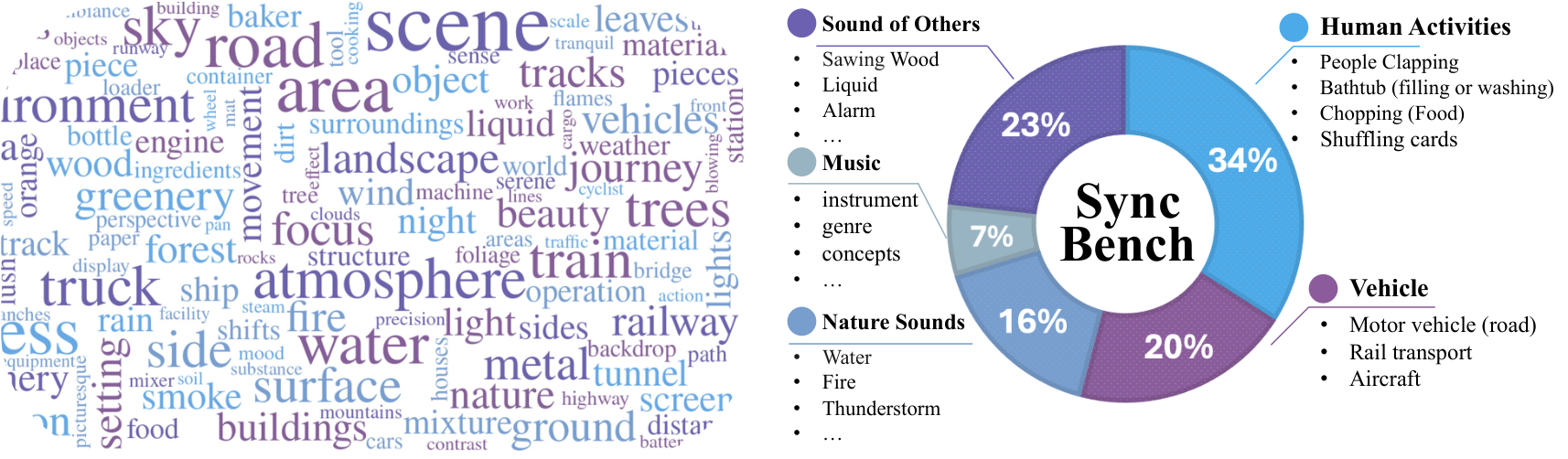
SyncBench content distribution

SyncBench leaderboard
### πŸ” Qualitative examples
Qualitative SyncBench examples
Our metric penalizes missing events, mistimed responses, timbre mismatch, and event-count errors β€” not low-level signal similarity.
## πŸ“Š Evaluation ```bash python evaluate.py --weights ./avsync_eval_weights.pt --data_root /path/to/data --batch_size 3 ``` Reports pairwise accuracy (with easy/medium/hard breakdown), correlation, and MAE; writes predictions to `eval_results.json`. | Flag | Default | Notes | |------|---------|-------| | `--precision_mode` | `bf16` | `bf16-mixed` = training autocast path | | `--attn_implementation` | `sdpa` | `flash_attention_2` = training kernel | | `--batch_size` | `3` | lower to `1` if memory-constrained | ### Batch scoring (no labels) ```bash # Flat layout: one sub-dir per model, each holding clips directly python tools/score_videogen.py --weights ./avsync_eval_weights.pt --root /path/to/outputs --out ./scores.json # Nested layout: one sub-dir per sample with several candidates (e.g. LTX); # each sample is reduced to one representative score (--nested_reduce) python tools/score_videogen.py --weights ./avsync_eval_weights.pt --root /path/to/LTX \ --layout nested --model_label LTX --out ./ltx_scores.json ``` ### Programmatic use ```python import torch from avsync_eval.models.evaluator import AVSyncEvaluator model = AVSyncEvaluator(model_name="Qwen/Qwen2.5-Omni-3B", v_fps=12, v_size=140) ckpt = torch.load("avsync_eval_weights.pt", map_location="cpu") model.load_eval_checkpoint(ckpt["state_dict"]) model.to_eval_device() # -> cuda, bf16, eval() scores = model.score_batch([video_tensor], [audio_array]) # list[float] ``` `video_tensor`: `(frames, 3, H, W)`; `audio_array`: 1-D 16 kHz waveform. Decode mp4s with `qwen_omni_utils.process_mm_info(..., use_audio_in_video=True)` (see `demo_single_video.py:load_clip`). ## πŸ”§ Training Two stages via `train.py`, selected by `--train_mode`. Only the LLM layers and the score head are trained (encoders/embeddings frozen); a frozen reference copy serves the RL objectives. Checkpoints trained here convert and evaluate identically. | Mode | Objective | Data / item | |------|-----------|:-----------:| | `SFT` | CE on `SCORE` token + Bradley-Terry pairwise | 1 pair | | `RL` | Pairwise GRPO | 1 pair | | `RL_rank` | Listwise GRPO (global ranking reward) | *K* methods | ```bash # Stage 1 β€” SFT cold start python train.py --train_mode SFT --data_root /path/to/data --exp_dir ./runs/sft --devices 6 # Stage 2 β€” listwise RL from the SFT checkpoint (convert it to .pt first) python train.py --train_mode RL_rank --data_root /path/to/data \ --pretrained ./sft_weights.pt --sample_list_path /path/to/data/train.txt \ --num_methods 6 --exp_dir ./runs/rl_rank --devices 6 ``` - **Dynamic curriculum** (SFT/RL): advances easyβ†’hard when accuracy exceeds `--curriculum_threshold` (0.88). `RL_rank` has no curriculum. - **Key flags**: `--num_methods` (K per sample, bounds VRAM), `--manual_std` / `--num_rollout` / `--epison` / `--kl_weight` (GRPO), `--batch_size` (auto: 1 for RL_rank, 8 else). `python train.py --help` for all. - **VRAM (RL_rank, bs=1)**: ~4–5 methods @ 24 GB Β· ~6–8 @ 40 GB Β· 11 @ 80 GB. ### πŸ“ Use your own dataset > The training and evaluation code runs on **any custom dataset** that follows the layout below. ``` my_dataset/ β”œβ”€β”€ overall_scores.json # {sample: {method: gt_score}} [required] β”œβ”€β”€ valing_pairs.json # eval / validation pairs [eval + val] β”œβ”€β”€ train.txt # sample names, one per line [RL_rank] β”œβ”€β”€ curriculumn_SFT/level_{0..9}.json # curriculum pairs β€” SFT [SFT only] β”œβ”€β”€ curriculumn_RL/level_{0..9}.json # curriculum pairs β€” pairwise RL [RL only] └── /.mp4 # one clip per (method, sample) [required] ``` Each *sample* is a video; each *method* is an audio source (a V2A model, or `GT_A`). Audio is read from the video track. Evaluation-only needs just `overall_scores.json`, `valing_pairs.json`, and the mp4s. πŸ“– Full JSON schemas, per-mode files, and the custom method-name note: [`docs/CUSTOM_DATASET.md`](docs/CUSTOM_DATASET.md). ## πŸ“‚ Repository Layout ```text opensource_eval/ β”œβ”€β”€ evaluate.py # dataset eval -> pairwise accuracy β”œβ”€β”€ demo_single_video.py # score one mp4 β”œβ”€β”€ train.py # training entry (SFT / RL / RL_rank) β”œβ”€β”€ requirements*.txt # inference / + training deps β”œβ”€β”€ tools/ β”‚ β”œβ”€β”€ convert_checkpoint.py # DeepSpeed ZeRO ckpt -> single .pt β”‚ └── score_videogen.py # batch-score outputs (flat + nested, no GT) └── avsync_eval/ β”œβ”€β”€ models/ # evaluator.py, hacked_qwen.py β”œβ”€β”€ data/dataset.py # AV_ValDataset β”œβ”€β”€ training/ # module.py, train_dataset.py, ranking_reward.py β”œβ”€β”€ metrics.py # pairwise ranking accuracy β”œβ”€β”€ qwen2_5_omni/ # bundled Qwen2.5-Omni └── qwen2_vl/ # bundled Qwen2-VL ``` ## πŸ” Reproducibility `fps=12`, `140Γ—140` (5 s β†’ 60 frames), audio 80 000 samples, bf16 β€” the defaults everywhere; use `--precision_mode bf16-mixed` to match the training autocast path. Training and inference share the same model/head/forward, so `train.py` outputs evaluate identically through `evaluate.py`. ## 🧭 Roadmap - [x] Inference / evaluation package - [x] Full training pipeline (preference SFT + R-GRPO) - [x] Batch scorers for unlabeled outputs - [x] **Trained checkpoint** β€” [πŸ€— qianyijie/avsync-evaluator](https://huggingface.co/qianyijie/avsync-evaluator) - [x] **SyncBench benchmark** β€” [πŸ€— qianyijie/SyncBench](https://huggingface.co/datasets/qianyijie/SyncBench) - [ ] **SynthSync training set** β€” V2A clips + pairwise human annotations *(to be released)* ## πŸ“ Citation ```bibtex @inproceedings{qian2026beyond, title = {Beyond Time Shifts: Adapting Omni-LLM as a Reference-Free Evaluator for Generative Audio-Visual Models}, author = {Qian, Yijie and Wang, Juncheng and Xu, Chao and Wang, Huihan and Feng, Yuxiang and Liu, Yang and Sun, Baigui and Liu, Yong and Wang, Shujun}, booktitle = {European Conference on Computer Vision (ECCV)}, year = {2026}, eprint = {2607.09091}, archivePrefix = {arXiv} } ``` ## πŸ™ Acknowledgments Built on [Qwen2.5-Omni](https://github.com/QwenLM/Qwen2.5-Omni); trained with [PyTorch Lightning](https://github.com/Lightning-AI/pytorch-lightning) + [DeepSpeed](https://github.com/deepspeedai/DeepSpeed); R-GRPO adapts [GRPO](https://github.com/deepseek-ai/DeepSeek-R1) to continuous policies. ## πŸ“„ License [MIT](LICENSE). Qwen2.5-Omni base weights follow their provider's license.