---
description: Learn about Decentralized Trust Chains (DTCs) on cheqd.
---
# Decentralized Trust Chains (DTCs)
## Introduction[](https://hub.ebsi.eu/vc-framework/trust-model/issuer-trust-model-v3#introduction)
Verifiable Credentials (VCs) are most commonly issued by legal entities to assert facts such as identity, qualifications, or authorization. Their core purpose is to provide the **Relying Party** — the entity verifying the credential — with a **Level of Assurance (LoA)** that the claims within the credential are legitimate.
However, in practice, it’s often difficult for relying parties to determine whether a legal entity issuing a credential is **authentic**, or a **fraudulent impersonation**. There is no built-in mechanism in most credential ecosystems for verifying whether a DID-based issuer is recognised, authorized, or trustworthy.
{% hint style="info" %}
Note: This lack of trusted issuer infrastructure is a critical blocker for many digital credential ecosystems — and a common reason why solutions stall before reaching production.
{% endhint %}
To fully establish trust, relying parties must be able to:
* Identify **who issued** a credential
* Understand **whether the issuer was authorized** to issue it
* Trace **who accredited the issuer**, and under what governance framework
### Introducing Decentralized Trust Chains (DTCs)
To solve this challenge, **cheqd** introduces a v**erifiable trust infrastructure** called **Decentralized Trust Chains (DTCs)** — a model that complements and extends approaches like the **EBSI Trust Chain Framework**.
DTCs allow participants to create **hierarchical chains of trust**, where:
* A **Root Trusted Accreditation Organisation (rTAO)** defines the governance model
* **Verifiable Accreditations** delegate authority to other legal entities (e.g., TAOs, Trusted Issuers)
* **Verifiable Credentials** are issued by accredited issuers, with embedded metadata that references the trust chain
Together, these components form a **decentralized trust registry** for each ecosystem.
### Publicly Verifiable, Policy-Governed Trust
cheqd’s DTC model introduces both **permissions** and **policies**:
* **Permissions** define what an entity is allowed to do (e.g. issue or accredit)
* **Policies** define **who granted that permission**, under what framework, and with what legal or operational requirements.
This infrastructure is made **publicly resolvable** by publishing all authorizations and accreditations as **DID-Linked Resources** on the cheqd ledger. This means:
* 🧩 Trust relationships are **machine-verifiable**
* 🔍 Verifiers do not need prior knowledge of each entity
* 🛠️ Resolution follows W3C standards like **DID-Core, DID Resolution and DID-Linked Resources.**
The result: A scalable, cryptographically verifiable way to determine whether an issuer — and the credential they issue — can be trusted.
## Glossary[](https://hub.ebsi.eu/vc-framework/trust-model/issuer-trust-model-v3#glossary)
There are many terms used within this guide, and as such, familiarise yourself or refer back to the concepts within the glossary below:
| Abbreviation | Term | Description |
| --------------- | --------------------------------------- | ---------------------------------------------------------------------------------------------------------------------------------------------------------------------------------------------------------------------------------------------------------------------------------------------------------- |
| - | Accreditation Policy | A machine-readable policy embedded in a **Verifiable Accreditation** that defines the scope, conditions, and governance under which an entity is authorized to accredit others or issue Verifiable Credentials. |
| - | Attestation Policy | A machine-readable policy embedded in a **Verifiable Credential** that links the credential to the issuer’s accreditation and root authorization, enabling verifiers to validate that the issuer was authorized to make the attestation. |
| DID | Decentralized Identifier | Legal entity identifier for Trust Registry, cannot be natural person in context of Trust Infrastructure |
| GA | Governance Authority | The legal entity or consortia responsible for writing the Governance Framework. In many instances the Governance Authority is also a Root TAO |
| GF | Governance Framework | A policy document outlining the purpose, roles, scopes and permissions for a given ecosystem using the Trust Infrastructure. |
| Root TAO (rTAO) | Root Trusted Accreditation Organization | A **Root Trusted Accreditation Organisation (rTAO)** is the top-level authority in a Decentralized Trust Chain responsible for defining the governance framework and issuing the Root Authorization that anchors all downstream accreditations and attestations within the trust ecosystem. |
| TAO | Trusted Accreditation Organization | A **Trusted Accreditation Organisation (TAO)** is an entity accredited by a Root Trusted Accreditation Organisation (rTAO) or another TAO to govern a segment of the trust chain by issuing accreditations to other entities or authorizing the issuance of Verifiable Credentials within a defined scope. |
| - | Trust Chain | Hierarchy of Verifiable Accreditations. Multiple Trust Chains may comprise a Trust Registry. |
| TI | Trusted Issuer | A **Trusted Issuer** is an entity accredited within a Decentralized Trust Chain to issue domain-specific Verifiable Credentials, operating under the scope and governance defined by an upstream accreditation and the overarching trust framework. |
| - | Trust Infrastructure | The overall set of technical and governance components to establish end-to-end trust. |
| - | Verifiable Accreditation | A **Verifiable Accreditation** is a Verifiable Credential that delegates authority from one entity to another, specifying the types of credentials they are permitted to issue or the roles they are authorized to perform within a defined trust framework. |
| - | Verifiable Trust Model | Permissions with policies to either accredit, or to attest |
## Establishing a Trust Hierarchy
Decentralized Trust Chains are based on the concept of a **hierarchical trust model**, conceptually similar to traditional Public Key Infrastructure (PKI). At the top sits a **Root of Trust**, from which trust is delegated through a verifiable chain of credentials.
In this model, each participant is identified by a **Decentralized Identifier (DID)** and may be granted permission — via a Verifiable Accreditation — to accredit others or issue credentials themselves.
### How the Hierarchy Works
Trust is delegated top-down through **Verifiable Accreditations**:
| Role | Description |
| -------------------------------------------- | -------------------------------------------------------------------------------------------------------- |
| **Root TAO (rTAO)** | Issues Root Authorizations and initial Accreditations to other TAOs. Sets the governance baseline. |
| **Trusted Accreditation Organization (TAO)** | Can accredit other TAOs or Trusted Issuers. Acts as an intermediary layer in larger ecosystems. |
| **Trusted Issuer (TI)** | Issues **Verifiable Credentials** to users/entities, based on permissions received from an upstream TAO. |
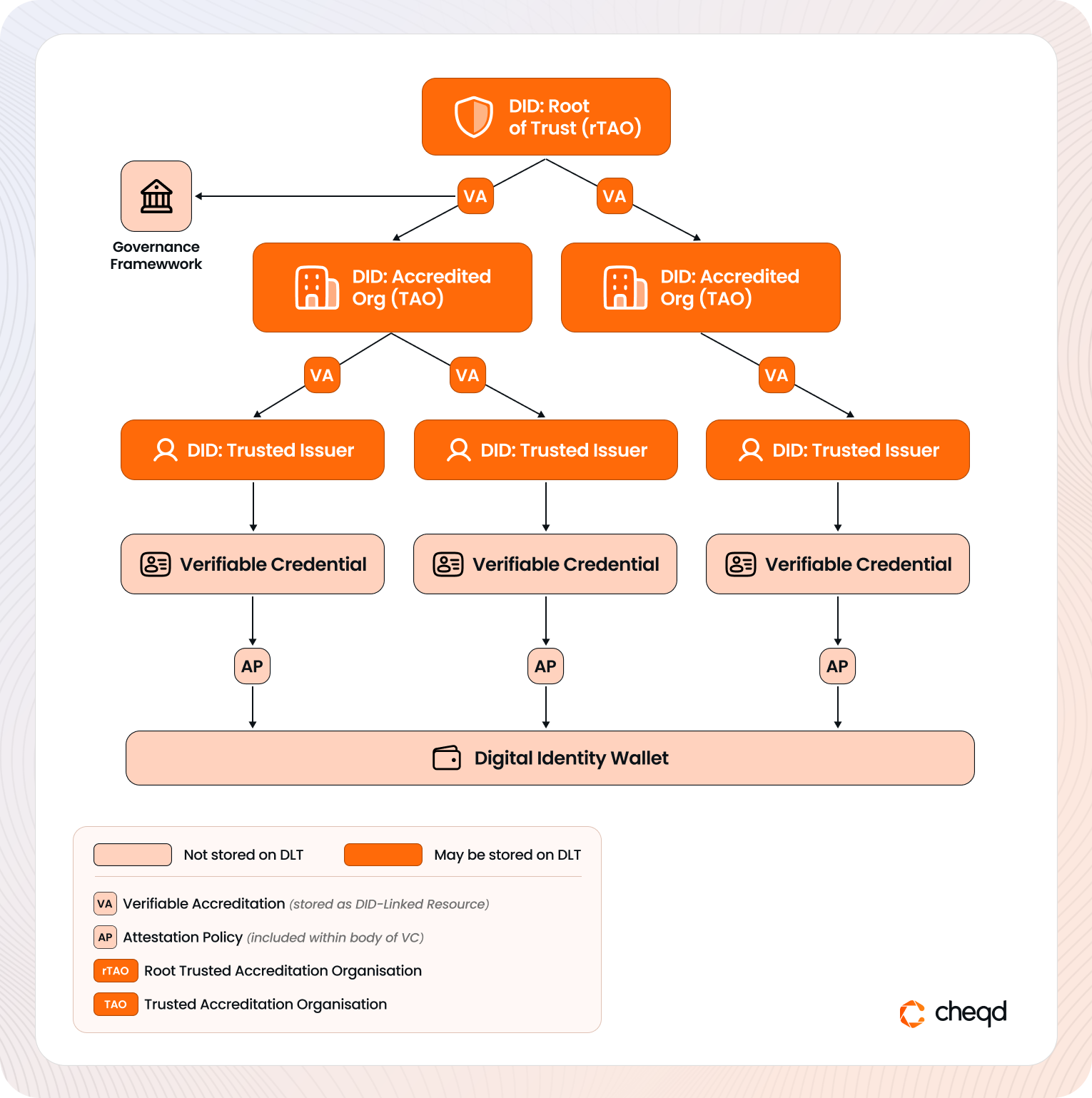
The following diagram show how a Root TAO accredits two TAOs lower in the hierarchy:
Hierarchical Decentralized Trust Chain architecture on cheqd
Each role is cryptographically linked through issued Verifiable Credentials, creating a **machine-verifiable trust path**.
### Verifiable Credentials & Policy Enforcement
* **Credentials** are issued with a `termsOfUse` section that references an **Attestation Policy**, linking them back to the issuer’s accreditation and the root of trust.
* **Digital Wallets** or agents can present these credentials for verification.
* **Verifiers** can then resolve and validate the entire trust chain — from the issuer to the rTAO — using DID resolution and optional DNS anchoring.
## Trust Infrastructure Roles and their Permissions
As shown in the diagram above, legal entities can play the following roles:
* In a Decentralized Trust Chain, each legal entity assumes a defined role with clearly scoped permissions. While a single DID may represent multiple roles in simple ecosystems, every complete trust chain should include these three functional roles:
* **Root Trusted Accreditation Organisation (rTAO)**
* **Trusted Accreditation Organisation (TAO)**
* **Trusted Issuer (TI)**
Only the **Trusted Issuer (TI)** is permitted to issue domain-specific Verifiable Credentials (VCs).
### **Root Trusted Accreditation Organisation (rTAO)**
The **rTAO** is the root of governance in a trust chain. It establishes the ecosystem’s rules and authorizes who can issue or accredit within it.
**Capabilities:**
* Issue a **Root Authorization** that defines the Trust Framework
* Self-accredit for governance or issuance
* Accredit TAOs and TIs to delegate responsibility
* Revoke accreditations from any participant in the trust chain
**Credential Type:**
* `VerifiableAuthorizationForTrustChain`
**Policy Type:**
* `TrustFrameworkPolicy` (included in `termsOfUse`)
Root Authorizations
Learn how Root TAOs can set the governance baseline, including the governance framework for the trust chain through Root Authorizations.
### **Trusted Accreditation Organisation (TAO)**[****](https://hub.ebsi.eu/vc-framework/trust-model/issuer-trust-model-v4#trusted-accreditation-organisation-tao)
A **TAO** manages a delegated segment of the trust chain under the rTAO. It may further accredit entities or take on the role of issuer if permitted.
**Capabilities:**
* Accredit itself to issue VCs
* Accredit other TAOs or Trusted Issuers
* Revoke accreditations issued within its scope
**Credential Type:**
* `VerifiableAccreditationToAccredit`
**Policy Type:**
* `AccreditationPolicy` (included in `termsOfUse`)
TAO -> SubTAO
Learn about how TAOs can accredit other SubTAOs in the trust ecosystem with permissions and Accreditation Policies.
### **Trusted Issuer (TI)**[****](https://hub.ebsi.eu/vc-framework/trust-model/issuer-trust-model-v4#trusted-issuer-ti)
A **Trusted Issuer** is an entity that issues domain-specific Verifiable Credentials under the conditions granted by its accreditation.
**Capabilities:**
* Issue Verifiable Credentials to users or organisations
* Only within the types, schemas, and jurisdictions defined in their accreditation
**Credential Type:**
* `VerifiableAccreditationToAttest`
**Policy Type:**
* `AccreditationPolicy` (accreditation) +\
`AttestationPolicy` (included in the issued credential’s `termsOfUse`)
Referencing Trust Registry within a Verifiable Credential
Learn how a Trusted Issuer can reference a Trust Registry in an issued credential, enabling a relying party to traverse the Trust Chain.
## Policies Overview[](https://hub.ebsi.eu/vc-framework/trust-model/issuer-trust-model-v4#policies-overview)
Policies define the **rules, permissions, and governance bindings** for each layer of the trust chain. They are embedded into credentials via the `termsOfUse` field and fall into three types:
| Policy Type | Used In | Purpose |
| ------------------------ | ------------------------ | --------------------------------------------------------------------------- |
| **TrustFrameworkPolicy** | Root Authorization | Defines the root governance model |
| **AccreditationPolicy** | Verifiable Accreditation | Constrains and describes the scope of authority |
| **AttestationPolicy** | Verifiable Credential | Links the credential back to the issuer’s accreditation and trust framework |
### How Policies are Linked
* **Root Authorization** includes a `TrustFrameworkPolicy`
* **Each Accreditation** must reference:
* A parent `AccreditationPolicy`, or
* The original `TrustFrameworkPolicy`
* **Each Credential (Attestation)** must reference:
* The `AttestationPolicy` pointing back to the issuer’s accreditation
Diagram showing different policy relationships in the trust chain
This layered policy model enables verifiers to **traverse and validate the entire trust chain** — from a single credential back to a rTAO (optionally anchored in DNS) — while ensuring that all participants adhere to consistent governance and operational standards.
## Trust Types in Decentralized Trust Chains
Trust Chains are constructed from three verifiable building blocks:
### 1. **Authorizations**
* Define the rules of the ecosystem
* Issued by the rTAO as a `VerifiableAuthorizationForTrustChain`
* Reference the root governance framework
### 2. **Accreditations**
* Grant permission to accredit or issue
* Are always domain-specific and non-transferable
* Must include an `AccreditationPolicy` in `termsOfUse`
* Allow entities to govern or issue **only** within the authorized scope
### 3. **Credentials (Attestations)**
* Assert facts (identity, qualifications, rights)
* Must include an `AttestationPolicy` that:
* Links back to the issuer's accreditation
* Establishes a trust path to the root authority
* Issuable only by **accredited Trusted Issuers**
#### In Summary:
| **Element** | **Purpose** |
| ------------------------------ | ---------------------------------------------------------------------- |
| **Authorizations** | Define the governance and policy rules at the root of the trust chain |
| **Accreditations** | Delegate trust authority for accreditation or credential issuance |
| **Credentials (Attestations)** | Assert verifiable facts within the scope of a governed trust framework |
## Get Started
## Get started
Use **cheqd Studio APIs** to define, issue, and publish trust registry entries:
* Create and manage **Root Authorizations**, **Accreditations**, and **Attestations**
* Resolve trust chains in real time using standard DID resolution
* Anchor trust registries on-chain while keeping business logic off-chain
For verification, use TRAIN to validate the trust registry to determine whether an issuer DID is accredited, and what they are accredited for — by traversing the full trust chain to its root.
Set up Trust Chain
Design and build a trust chain for establishing a trust hierarchy in your ecosystem.