Agent Core + Production Harness for governed, durable, and reusable domain agents.
DomainPack · Event-first Runtime · Governed Capabilities · Recovery · Cache & Reuse
English | 中文
User Guide · Official Website · Release v1.0.1 · npm Packages
> **Current public release:** v1.0.1, with 15 aligned packages named > `@codesoul-co/hypha-*`. The [versioned user guide](https://codesoul-co.github.io/Hypha/) > includes an API atlas for every package, custom FSM control, and a complete composition example. ## What is hypha? hypha is an open-source TypeScript framework built around two cooperating layers: an **Agent Core** and a **Production Harness**. The Agent Core handles reasoning/ReAct, planning, tool selection, Memory access, and model/context orchestration; the Production Harness turns those decisions into bounded, event-backed execution with FSM control, policy/approval, checkpoints, recovery, replay, and audit. Product-specific behavior is declared through a `DomainPack`, not hard-coded into the runtime. A DomainPack compiles tasks, workflows, capabilities, prompts, Memory, policy, evaluation, and output contracts into the shared Core + Harness. A cross-cutting **Cache & Reuse Plane** then reuses validated work across reasoning, tools, Memory, execution, and inference while remaining a disposable projection: cache state can accelerate execution, but it can never become authority or replace Event, Artifact, receipt, or checkpoint evidence. ## Architecture at a glance
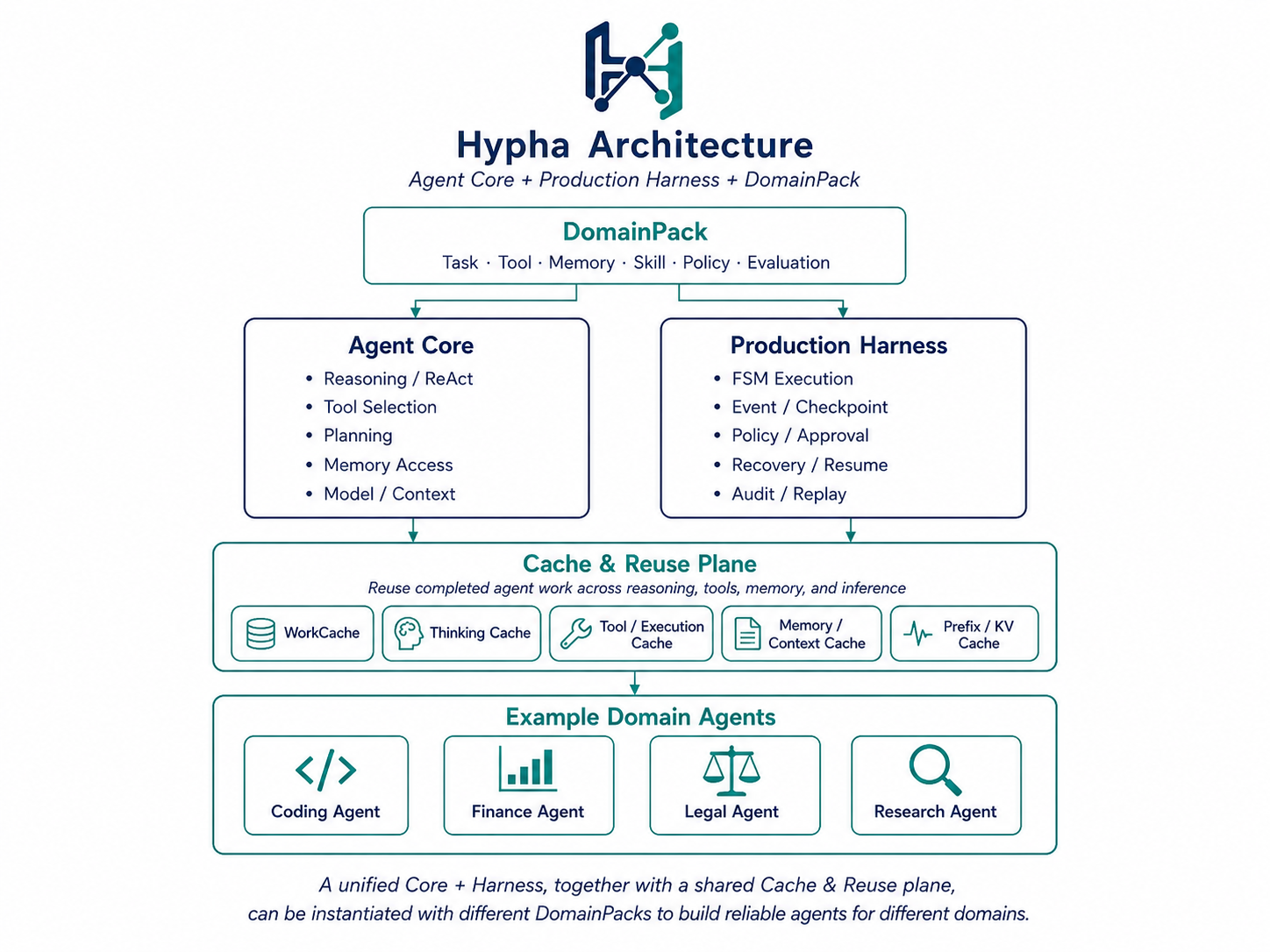
One Agent Core + Production Harness can be instantiated with different DomainPacks, while the Cache & Reuse Plane spans reasoning, tools, Memory, execution, and inference.
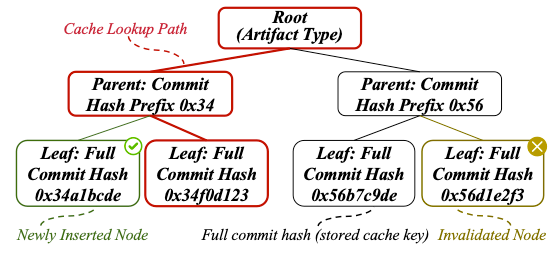
| Layer | Primary responsibility | | ----------------------- | --------------------------------------------------------------------------------------------------------------------------------------------------------------------------- | | **Agent Core** | Reasoning/ReAct, planning, tool selection, Memory access, model and context orchestration. | | **Production Harness** | FSM execution, Event/checkpoint control, policy/approval, continuation, recovery, audit, and replay. | | **DomainPack** | Declares the product-specific task, workflow, capability, Memory, Skill, Prompt, Policy, evaluation, and output contracts compiled into the shared runtime. | | **Cache & Reuse Plane** | Reuses validated model work, reasoning structures, tool/execution results, Memory/context projections, and prefix/KV state without becoming a source of truth or authority. | This separation is what lets the same runtime support very different agent products. A coding agent, finance agent, legal agent, or research agent can share the same Core + Harness while changing the DomainPack, capability bindings, policies, evaluation contracts, and domain-specific state. ## Cache management and typed cache trees Cache is a first-class control plane in hypha, not a single response-cache feature. The system distinguishes several reuse layers because an exact LLM response, a reasoning subgraph, a tool result, a Memory projection, and a KV prefix have different validity and invalidation requirements. | Cache layer | Reusable unit | Typical validity boundary | | -------------------------- | ------------------------------------------------------------------ | ------------------------------------------------------------------------------------------------------------- | | **Serving Cache** | Exact normalized model response | Model/provider identity, normalized request, scope, TTL, and response validity. | | **Thinking Cache** | Reasoning node, path, or reusable subgraph | Model/provider, reasoning strategy/version, prompt blocks, tool schema, inference parameters, and scope. | | **WorkCache** | Event-derived typed agent work | Source-event provenance, dependency/revision closure, scope, validity state, and future demand. | | **Tool / Execution Cache** | Eligible read-only tool results or deterministic execution results | Capability revision, Policy, external-state evidence, workspace/environment snapshot, idempotency, and scope. | | **Memory / Context Cache** | Memory search and assembled context projections | Memory scope, mutation generation, source revision, provenance, and context policy. | | **Prefix / KV Cache** | Prompt-prefix blocks, provider prefixes, or backend KV segments | Model/backend, Agent/Session/Domain scope, prompt dependencies, and prefix/KV revision. |
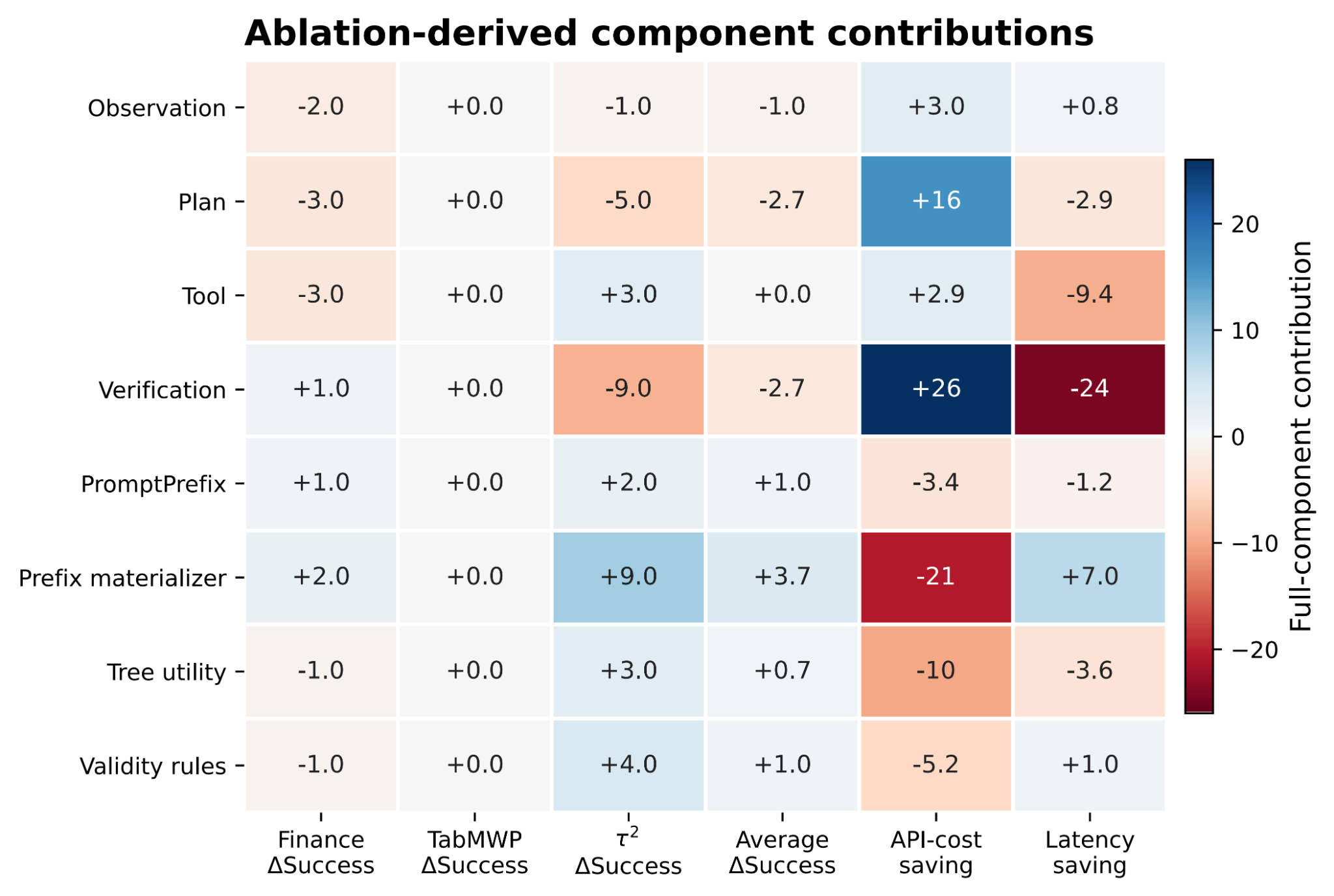
Ablation-derived component contributions across task success, API-cost saving, and latency saving.
## Tau3 benchmark results The latest three-way comparison was run against Hypha `main@ef33263` with one trial per task (385 tasks total). The base model was `deepseek-v4-flash`. Hypha is the framework result and Direct is the direct model-call baseline. Neither arm reported a system error. | Benchmark | Tasks | Hypha | Direct | | ----------------- | ------: | ------------------: | ------------------: | | Mock | 10 | 0.800 (8/10) | 0.800 (8/10) | | Airline | 50 | 0.880 (44/50) | 0.900 (45/50) | | Retail | 114 | 0.912 (104/114) | 0.895 (102/114) | | Telecom | 114 | 0.605 (69/114) | 0.588 (67/114) | | Banking knowledge | 97 | 0.206 (20/97) | 0.196 (19/97) | | **Total** | **385** | **0.636 (245/385)** | **0.626 (241/385)** | ## Product model | Concept | Responsibility | | ------------ | -------------------------------------------------------------------------------------------------------------------------------------------- | | `DomainPack` | Declares tasks, workflows, output contracts, skills, tools, MCP, memory, context, policy, evaluation, regression, and deployment references. | | `Agent` | Selects model aliases and receives the capability references compiled from a DomainPack. | | `Session` | Holds user and product context. A Session references a DomainPack and optional Session profile. | | `Run` | Represents one durable execution under a Session. | | `Event` | Records source-of-truth facts from which state, replay, audit, and regression views are projected. | | `Artifact` | Stores content-addressed inputs, outputs, checkpoints, and execution evidence. | The canonical execution path is: ```text DomainPack -> validated bindings and dependency snapshot -> framework-owned Harness FSM -> bounded ReAct quantum and Domain pipeline evidence -> governed Tool / MCP / Memory / Execution activity -> Event + receipt + Artifact evidence -> projection, continuation, recovery, replay, and evaluation ``` No cache hit or provider response can authorize a side effect, advance the FSM, or replace Event and Artifact evidence. Tool, MCP, Memory, file, execution, and external writes pass through policy, trace, cancellation, deadline, idempotency, and harness boundaries. ## Included capabilities | Area | Included runtime capability | | ------------------ | -------------------------------------------------------------------------------------------------------------------------------------------------------------------------------------------------------- | | Runtime | ReAct + FSM, durable session commands, bounded continuation, timers, leases, fencing, cancellation, recovery workers, human review, replay, audit, and regression projections. | | Domain | YAML/JSON/TypeScript Domain Packs, runtime validation, overlays, registry, deterministic compiler, dependency snapshots, and Agent patches. | | Memory | Hypha Native Memory, local Native Lite, self-hosted Mem0 OSS, Mem0 Platform, and Vertex AI Memory Bank adapters behind one governed contract. | | Tools and MCP | Local, HTTP, plugin, mock, and MCP adapters through one governed invocation path with capability snapshots and drift control. | | Skills and prompts | Built-in, filesystem, package, and signed remote Skill registries; progressive loading; versioned prompt references and templates. | | Execution | Provider-neutral Workspace, Sandbox, Command, Artifact, Store, lease, recovery, and cache contracts with local-process, Docker, remote HTTP, SQLite, PostgreSQL, local-file, and S3-compatible adapters. | | Cache | Serving Cache, event-derived WorkCache, Thinking Cache, typed semantic cache trees, capability-result caches, Memory/context projections, Prefix/KV reuse, scoped validity, and invalidation. | | Surfaces | Express API server and an example CLI that consume the same framework runtime. | ## Quick start ### Requirements - Node.js 22 or newer - npm - MongoDB and Redis for the bundled API server - At least one configured model provider or a reachable local model endpoint ### 1. Install the workspace ```bash git clone https://github.com/CodeSoul-co/Hypha.git cd Hypha npm ci cp .env.example .env ``` Keep product configuration out of tracked templates. Set `HYPHA_CONFIG_PATH` to a user-owned YAML overlay; see [Upgrading](UPGRADING.md) for the conflict-free update layout. For a disposable local MongoDB and Redis environment, you may use containers: ```bash docker run -d --name hypha-mongodb -p 27017:27017 mongo:8 docker run -d --name hypha-redis -p 6379:6379 redis:7-alpine ``` You can instead set `MONGODB_URI` and `REDIS_URL` to self-hosted or managed services. ### 2. Configure identity and a model provider Edit `.env`. Keep credentials out of `config.yaml` and source control. ```bash HYPHA_OWNER_EMAIL=owner@example.com HYPHA_OWNER_PASSWORD=replace-with-a-private-password JWT_SECRET=replace-with-at-least-32-random-characters HYPHA_LLM_DEFAULT_PROVIDER=openai HYPHA_LLM_DEFAULT_MODEL=gpt-4o-mini OPENAI_API_KEY=your-provider-key ``` The default deployment mode is single-user. Registration remains disabled and the configured owner is created during startup. Internal data access still retains user, Session, Run, Workspace, and tenant boundaries. ### 3. Start and verify the server ```bash npm run dev ``` In another terminal: ```bash curl -fsS http://127.0.0.1:3000/api/v1/health curl -fsS http://127.0.0.1:3000/api/v1/ready ``` `/health` is process liveness. `/ready` is the traffic gate: it returns a failure status until storage, the selected model provider, Memory, the canonical Runtime graph, and required workers are ready. The route index is available at `http://127.0.0.1:3000/api/v1/docs`. ### 4. Use the CLI ```bash npm run cli -- login --email owner@example.com npm run cli -- chat "Explain the active runtime" --stream npm run cli -- tools npm run cli -- skills npm run cli -- workflows ``` The CLI stores its endpoint configuration and JWT under `~/.hypha` by default. Set `HYPHA_BASE_URL` and `HYPHA_HOME` to use another server or an isolated client profile. ## Develop an agent with a DomainPack Domain Packs are the supported product-integration boundary. Product-specific tasks, prompts, workflows, rules, and capability selections belong in a Domain Pack or product application—not in `@codesoul-co/hypha-core`, `@codesoul-co/hypha-kernel`, or the generic Runtime. For an application that consumes a versioned npm release, including separate Prompt, Skill, Tool, policy, contract test, and HTTP Run submission, see the [`release-agent` example](examples/release-agent/README.md). ### 1. Declare the domain Start from [`configs/domain-packs/minimal.domain.yaml`](configs/domain-packs/minimal.domain.yaml). A production Domain Pack normally defines: | Declaration | What it controls | | ---------------------------------------- | ------------------------------------------------------------------------------------------------------------------------------------------------------------------------------------------------------------------------------- | | `taskSchemas` | Accepted task types, input schemas, output-contract references, and default workflows. | | `outputContracts` | Machine-verifiable final output schemas. | | `sessionProfiles` | Default metadata and Memory, Context, Reasoning, Tool, MCP, Skill, and Policy profile references. | | `workflows` | Product stages, guards, retry/timeout intent, human review, state-scoped capabilities, and topology evidence. ReAct Runs retain the protected Harness FSM; custom FSM Runs may use a separately validated application topology. | | `tools`, `toolProfiles` | Stable Tool contracts and the profiles allowed to bind them to executable adapters. | | `mcpProfiles` | Server references, capability import rules, trust policy, and version pinning. | | `memoryProfiles`, `contextProfiles` | Memory selection, retrieval/write policy, context sources, provenance, and token budgets. | | `allowedSkills`, `skillPolicies` | Which Skills an Agent may load and which tools or policies each Skill may use. | | `allowedPromptRefs`, `defaultPromptRefs` | Versioned prompt templates that application composition must resolve. | | `policies`, `businessRules` | Permission, approval, precondition, postcondition, and output constraints. | | `evaluationProfiles`, `regressionCases` | Event-derived acceptance and regression definitions. | Keep provider URLs, bearer tokens, API keys, and deployment secrets out of the Domain Pack. It should select stable profile references; the trusted application composition resolves those references to live providers. ### 2. Load, validate, and compile ```ts import { applyDomainAgentPatch, compileDomainPackToHarnessedSystem, DomainPackRegistry, LocalDomainPackLoader, } from '@codesoul-co/hypha-domain'; const registry = new DomainPackRegistry(); await new LocalDomainPackLoader({ directories: ['configs/domain-packs'], }).loadInto(registry); const domainPack = registry.get('domain.minimal', '0.0.0'); if (!domainPack) throw new Error('DomainPack not found'); const compiled = compileDomainPackToHarnessedSystem(domainPack, { agentRef: { id: 'agent.default', version: '1.0.0' }, taskSchemaId: 'task.minimal', workflowId: 'workflow.minimal', sessionProfileId: 'session.local', memoryProfileId: 'memory.local', }); const agent = applyDomainAgentPatch( { id: 'agent.default', version: '1.0.0', name: 'Default Agent', modelAlias: 'default-chat', }, compiled.agentPatch ); ``` The compiler validates internal references and produces all data needed by application composition: | Compiler output | Integration use | | ------------------------- | --------------------------------------------------------------------------------------------------- | | `fsmProcess` | Register the canonical, framework-owned Harness `FSMProcessSpec`. | | `harnessedSystem` | Bind Agent, FSM, policy, trace, Memory, MCP, Context, Tool, Skill, evaluation, and output refs. | | `agentPatch` | Apply resolved prompt, Skill, Tool, Memory, Context, Reasoning, and Policy references to the Agent. | | `bindings` | Register only the selected concrete capabilities and state-level allowlists. | | `sessionInitialization` | Create Session metadata and default profile references. | | `dependencySnapshot` | Persist the complete versioned dependency closure used for replay and cache validity. | | `processHash` and `audit` | Prove the compiler input and workflow identity associated with a Run. | ### 3. Register the compiled system explicitly A Domain Pack file does not become executable merely because it exists on disk. During application startup, the trusted composition layer must: 1. Load the pack into a `DomainPackRegistry` and compile the selected task/workflow/profile set. 2. Resolve the Agent's model alias and versioned Prompt references. 3. Register the selected Skills and enforce workflow-state `allowedSkills` and `requiredSkills`. 4. Bind declared Tool contracts to local, HTTP, plugin, execution, or MCP adapters through the governed Tool runner. 5. Connect and approve exact MCP capability revisions required by the compiled bindings. 6. Resolve the selected Memory profile through the Server Memory runtime configuration. 7. Create the Session from `sessionInitialization`, then persist `processHash` and `dependencySnapshot` with the Run's Event evidence. 8. Execute the canonical `fsmProcess`, record Domain stage ids as Event evidence, and derive status only from Events and persisted checkpoints. This explicit activation step prevents an unreviewed YAML file, Skill, Tool, or remote MCP catalog change from silently gaining runtime authority. ### Custom FSM topology and owner control Workflow-only Runs may execute a validated application-owned `FSMProcessSpec`, including custom State ids, transitions, guards, retry/timeout declarations, and terminal states. ReAct Runs retain the framework-owned Harness FSM so a product graph cannot bypass reasoning, policy, activity, observation, verification, memory, or recovery phases. Use `analyzeFSMTopology()` from `@codesoul-co/hypha-fsm` to inspect reachability, dead ends, and cycles. The Server exposes `GET /runtime/runs/:runId/fsm` and the governed `POST /runtime/runs/:runId/fsm/transitions` owner endpoint. Manual transitions require exact process identity, expected State and Run revision, an idempotency key, a reason, and any guard variables; the Runtime also enforces permission, Policy, Lease, fencing, terminal, Event, and replay rules. See [Custom FSM Topologies](docs/guides/custom-fsm.md). ### 4. Narrow capability at the workflow state DomainPack capability declarations are upper bounds. Each workflow state should narrow them: ```yaml states: - id: Research goal: Collect bounded evidence. allowedTools: [common.search] allowedSkills: [skill.context-enrichment] requiredSkills: [skill.context-enrichment] allowedMCPProfiles: [mcp.local] permissionScopes: [search.query] policyRefs: [policy.readonly] timeoutPolicy: timeoutMs: 30000 onTimeout: fail retryPolicy: maxAttempts: 2 ``` Required Skills or capabilities that are missing, untrusted, policy-denied, expired, or different from the Run snapshot fail closed before inference or dispatch. ### 5. Extend without copying the base pack Use `extendDomainPack()` to upsert or remove declarations by stable id, then assign a new version: ```ts import { extendDomainPack } from '@codesoul-co/hypha-domain'; const customized = extendDomainPack(domainPack, { version: '1.1.0', defaultSkills: [{ id: 'skill.context-enrichment', version: '0.0.0' }], remove: { regressionCases: ['regression.obsolete'] }, }); ``` The extended result is validated again. Removing a referenced Tool, Policy, Prompt, Skill, Memory profile, or output contract therefore requires updating every dependent reference. ### 6. Test the domain as a product contract For every supported DomainPack selection, test: - schema validation and unresolved-reference rejection; - deterministic `processHash` and dependency snapshots; - legal and illegal FSM transitions, retry, timeout, cancellation, and terminal states; - state-scoped Tool, MCP, Skill, Prompt, Memory, and Policy enforcement; - human-review approval, rejection, expiry, and resume revalidation; - Event-derived replay, audit, regression, and output-contract validation; - cache enabled and disabled without changing source-of-truth behavior. The maintained field reference and complete examples are in the [`Domain Packs` guide](docs/guides/domain-packs.md) and [`Framework API`](docs/api/framework.md). ## Configure Memory The bundled Server reads [`configs/memory-profiles.yaml`](configs/memory-profiles.yaml). Choose the active profile in that file or point `HYPHA_MEMORY_CONFIG_PATH` to another validated profile set. | Profile | Intended topology | Required deployment configuration | | -------------------- | ---------------------------- | ------------------------------------------------------------------------------------------- | | `native-lite` | Embedded, single process | Local SQLite records, in-memory working state, local vector and embedding adapters. | | `native-default` | Durable Hypha-native runtime | MongoDB record/history/outbox evidence and Redis working state. | | `mem0-oss` | Self-hosted Mem0 | `HYPHA_MEM0_OSS_URL`, optional API key, and Hypha-owned durable mapping/operation evidence. | | `mem0-platform` | Managed Mem0 | `HYPHA_MEM0_PLATFORM_TOKEN` and Hypha-owned durable mapping/operation evidence. | | `memorybank-managed` | Vertex AI Memory Bank | Project, location, reasoning engine, and short-lived Google authorization configuration. | Profiles do not place credentials in DomainPack or Memory specs. Provider calls remain scoped, audited, idempotent, revision-aware, and reconciled before uncertain writes are replayed. See [`Memory provider profiles`](docs/guides/memory-provider-profiles.md) and [`External Memory runtime`](docs/guides/memory-external-provider-runtime.md). ## Configure Tools, MCP, Skills, and prompts - Tool definitions and trusted adapter bindings live in `config.yaml`, `configs/tools.yaml`, and the application composition layer. - Local MCP servers use a command and argument vector; remote servers use an endpoint plus a Secret reference. Newly discovered capability revisions must satisfy trust and approval policy. - Skills can come from built-ins, `~/.hypha/skills`, package registries, or an explicitly enabled signed remote registry. Required Skills fail startup or context construction when unavailable. - Prompt templates live under `apps/server/src/prompts`; Domain Packs reference versioned prompt ids rather than embedding deployment-specific prompt loading logic in core. The Server includes governed `utility.json`, `utility.text`, `utility.hash`, filesystem, search, and real local stdio MCP paths. Use [`Tool adapters`](docs/guides/tool-adapters.md), [`Tool and MCP security`](docs/guides/tool-mcp-security.md), and the [`HTTP API`](docs/api/http.md) for configuration and invocation contracts. ## Runtime, execution, and recovery The Express Server composes the canonical Event authority and durable execution graph during startup. Session-command, ReAct continuation, timer, recovery, and reconciliation workers perform an initial sweep before readiness. Shutdown drains workers while their providers remain available. Long-running work progresses in bounded quanta. The next quantum is reconstructed from Events, checkpoints, Artifacts, capability snapshots, and provider receipts. Recovery uses explicit bounded retry, reconciliation, fallback, degradation, compensation, human review, quarantine, cancellation, and failure states; repeatedly entering a loop is not considered progress. Execution providers are registered explicitly. Local process, Docker, remote sandbox HTTP, PostgreSQL execution records, and S3-compatible Artifacts are available as adapters, but a deployment should activate only the providers it trusts and can verify. See [`Execution architecture`](docs/architecture/execution.md) and [`Runtime model`](docs/reference/runtime-model.md). ## Cache model The detailed architecture is summarized in [Cache management and typed cache trees](#cache-management-and-typed-cache-trees). Operationally: - **Serving Cache** reuses exact, normalized model responses. Enable it with `HYPHA_SERVING_CACHE=memory`, `sqlite`, or `redis`. - **WorkCache** stores bounded, event-derived projections and semantic cache trees. Use `HYPHA_WORKCACHE=off`, `memory`, `sqlite`, or `redis`. - **Thinking Cache** reuses reasoning nodes, paths, and subgraphs through computation-oriented WorkCache projections when the current model, reasoning, prompt, tool-schema, and scope identity remain valid. - **Tool result cache** is opt-in for eligible `none`/`read` calls and requires stable external-state evidence for reads. - **Execution, Memory/context, Prompt-prefix, and Prefix/KV caches** remain subject to their own capability, dependency, revision, provenance, and scope checks; deployments may enable only the providers they can validate. All caches are disposable views. A cache miss or cache-provider failure can bypass reuse; a cache hit cannot authorize a side effect, skip Policy or Approval, fabricate a receipt, advance the FSM, or replace Event and Artifact evidence. Cache-enabled and cache-disabled execution must preserve the same source-of-truth semantics. ## HTTP API The default API prefix is `/api/v1`. Protected routes use `Authorization: Bearer