# c2detect
**Fingerprint the C2 server behind the beacon.** Point it at network telemetry and it names the command-and-control framework — Cobalt Strike, Sliver, Mythic, Havoc, Brute Ratel, and 11+ more — with a confidence score and the exact indicators that matched.
[](https://pypi.org/project/cognis-c2detect/) [](https://github.com/cognis-digital/c2detect/actions) [](LICENSE)  
*Blue-team / defensive: detect known C2 infrastructure from telemetry. Passive by default; the active probe is opt-in and authorization-gated.*
```bash
pip install cognis-c2detect
c2detect scan . # → prioritized C2 findings in seconds, offline
```
## See it work
Real, reproducible output — point it at a captured observation and it fingerprints the framework:
```console
$ c2detect scan demos/01-cobalt-strike-network/observations.json
host: 203.0.113.10
jarm=07d14d16d21d21d07c42d41d00041d24a458a375eef0c576d23a7bab9a9fb1 port=443
CONF SEV FAMILY INDICATORS
-----------------------------------------
48 critical Cobalt Strike jarm, port
TOP: Cobalt Strike (48% / critical)
- jarm [+42] matched '07d14d16d21d21d07c42d41d00041d24a458a375eef0c576d23a7bab9a9fb1'
- port [+6] matched '443'
c2detect: 3 C2 indicator(s) across 3 observation(s)
```
It fuses JA4/JARM/certificate/URI/port indicators against a bundled signature DB — and can **emit ready-to-deploy Sigma and Suricata rules** from those same signatures (`c2detect rules`), so a detection goes straight into your SIEM/IDS.
## Why c2detect
| | threat-intel IP lists | JARM alone | **c2detect** |
|---|:---:|:---:|:---:|
| Names the C2 *framework* (not just "bad IP") | ✗ | partial | ✅ |
| JA4 + JARM + cert + URI + port fusion | ✗ | ✗ | ✅ |
| Confidence score + matched indicators | ✗ | ✗ | ✅ |
| Generates Sigma / Suricata rules | ✗ | ✗ | ✅ |
| Campaign correlation (shared infrastructure) | ✗ | ✗ | ✅ |
| Runs offline, zero runtime deps | varies | ✓ | ✅ |
```console
$ c2detect-emit --help
usage: c2detect [-h] [--version]
{scan,match,db,rules,feeds,correlate,probe,self-check,mcp} ...
Fingerprint-match TLS/network observations against a bundled database of known
C2 frameworks (JA4/JARM/cert/URI/port indicators). Defensive triage only.
positional arguments:
{scan,match,db,rules,feeds,correlate,probe,self-check,mcp}
scan Scan JSON observation files / telemetry text / dirs /
stdin.
match Match explicit indicators (--ja4/--jarm/--port/...).
db List the bundled C2 signature database.
rules Generate Sigma / Suricata detection rules from the
signature DB.
feeds List/update/get the live abuse.ch Feodo-C2 + SSLBL
threat-intel feeds c2detect consumes (keyless; cached;
offline re-serve).
correlate Cluster many observations into shared-infrastructure
campaigns (same JARM/JA4S/cert across hosts = one
operator's estate).
probe AUTHORIZED ACTIVE: TLS-fingerprint a consented
host:port in scope (default OFF; needs --authorized +
--target-allowlist + rate limit).
self-check Scan bundled demo scenarios and report C2 detection
coverage.
mcp Run the MCP server (stdio JSON-RPC).
options:
-h, --help show this help message and exit
--version show program's version number and exit
```
```console
$ c2detect-emit self-check
c2detect self-check — bundled scenario coverage
================================================
[DETECT ] 01-basic Cobalt Strike
[DETECT ] 01-cobalt-strike-network Cobalt Strike
[DETECT ] 02-deep Cobalt Strike
[DETECT ] 02-mixed-frameworks Brute Ratel C4, Mythic, Sliver
[DETECT ] 03-behavioral Cobalt Strike
[CLEAN ] 03-benign-baseline (quiet)
[DETECT ] 04-sliver-mtls Cobalt Strike, Sliver
[DETECT ] 05-havoc-demon Havoc
[DETECT ] 06-mythic-agent Mythic
[DETECT ] 07-brute-ratel Brute Ratel C4
[DETECT ] 08-adaptixc2-teamserver AdaptixC2
[DETECT ] 09-metasploit-meterpreter Metasploit / Meterpreter
[DETECT ] 10-empire-windows PowerShell Empire
[DETECT ] 11-multi-framework-incident AdaptixC2, Cobalt Strike, Havoc, Sliver
[DETECT ] 12-threat-hunt-jarm-sweep Cobalt Strike, Sliver
[feeds/corr] 13-threat-intel-feeds (non-signature demo)
[DETECT ] 14-campaign-correlation Cobalt Strike, Metasploit / Meterpreter
------------------------------------------------
malicious detected : 14/14
benign clean : 1/1
frameworks exercised: 8/21 in DB
status : HEALTHY
```
```console
$ c2detect-emit db
FAMILY SEV INDICATORS
------------------------------------------------------
Brute Ratel C4 critical ja3:1, jarm:1, uri:3, cert_quirk:2, port:2
Cobalt Strike critical ja4s:1, ja3:1, ja3s:1, jarm:1, uri:5, uri_regex:1, http_banner:2, user_agent:1, cert_quirk:3, beacon:1, port:3
Metasploit / Meterpreter critical ja3:1, jarm:1, uri:3, cert_quirk:2, port:3
AdaptixC2 high uri:3, http_banner:4, cert_quirk:1, port:4
Covenant high jarm:1, uri:3, http_banner:1, cert_quirk:1, port:3
Godzilla WebShell high uri:3, uri_regex:1, cert_quirk:1, port:3
Havoc high jarm:1, uri:3, http_banner:1, port:3
Mythic high jarm:1, uri:2, http_banner:1, port:3
PoshC2 high uri:4, cert_quirk:2, port:2
PowerShell Empire high ja3:1, uri:3, http_banner:1, port:3
Pupy RAT high ja3:1, uri:2, cert_quirk:2, port:3
SILENTTRINITY high uri:3, http_banner:1, beacon:1, port:3
Sliver high ja4:1, ja4x:1, jarm:1, uri:5, cert_quirk:2, beacon:1, port:3
Caldera (MITRE) medium uri:4, http_banner:1, beacon:1, port:5
Deimos C2 medium uri:3, http_banner:1, port:2
Koadic medium uri:3, user_agent:1, port:3
Merlin medium uri:2, http_banner:1, cert_quirk:1, port:1
NimPlant medium uri:3, http_banner:1, user_agent:1, beacon:1, port:2
Villain medium uri:3, http_banner:2, user_agent:1, port:3
Generic Beaconing Heuristic low beacon:1, port:6
Generic Self-Signed C2 Heuristic low cert_quirk:4, port:5
21 families in bundled signature DB.
```
> Blocks above are real `c2detect` output — reproduce them from a clone.
## Usage — step by step
`c2detect` is defensive C2-infrastructure triage: it scans telemetry/observation records against a bundled signature DB and flags beaconing, suspicious TLS fingerprints, and staging URIs. **It is passive by default** — `scan`/`match`/`correlate`/`db`/`rules` read input you provide and make no network calls (the optional `--feeds` only pulls public abuse.ch intel feeds, which can run fully offline from cache). A separate, **opt-in and authorization-gated** active probe (`c2detect probe`) can TLS-fingerprint a consented host you are authorized to assess — see [Passive vs. active](#passive-vs-active).
1. **Install** (Python 3.10+):
```bash
pip install -e . # or: pipx install c2detect
```
2. **Scan observation files / telemetry text / a directory / stdin**:
```bash
c2detect scan telemetry.json
cat telemetry.log | c2detect scan
```
3. **Match explicit indicators** on the command line (no file needed):
```bash
c2detect match --ja4 t13d1516h2_8daaf6152771_b186095e22b6 --port 443 --beacon-interval 60 --jitter 0.1
c2detect db # list the bundled C2 signature database
```
Or **correlate a batch** to cluster hosts that share C2 infrastructure into campaigns (see [Campaign correlation](#correlate)):
```bash
c2detect correlate telemetry.json # which hosts are one operator's estate, and why
```
Add `--feeds` to any `scan`/`match` to cross-reference host IPs / JA3s against the live [abuse.ch](https://abuse.ch) Feodo-C2 + SSLBL threat-intel feeds (cached, offline-capable — see [Live threat-intel feeds](#live-threat-intel-feeds-edge--air-gap-deployable)).
4. **Read the output** in JSON / SARIF / HTML / badge (e.g. for code scanning):
```bash
c2detect scan telemetry.json --format sarif > c2.sarif
c2detect scan telemetry.json --format json | jq '.findings'
```
5. **Gate CI** with `--fail-on ` (exit non-zero at/above that severity). Optional `--ai` adds an opt-in Cognis-fleet LLM pass that degrades to rules if no backend is configured:
```yaml
- run: pip install -e . && c2detect scan telemetry.json --fail-on high
```
## Passive vs. active
| | Passive (default) | Active (opt-in, gated) |
|---|---|---|
| Commands | `scan` · `match` · `correlate` · `db` · `rules` | `probe` |
| Network | none (`--feeds` pulls public intel, offline-capable) | one TLS handshake + optional benign HTTP HEAD per target |
| Default | **on** | **OFF** — refuses unless explicitly enabled |
| Input | telemetry files / JSON / JSONL / text / stdin | a host:port **in an explicit allowlist** |
**Passive mode** is the safe default and the right tool for almost everything: feed it Zeek/Suricata/EDR exports (JSON, JSONL/NDJSON, or free text), IOC sightings, or a directory of captures, and it scores them against the bundled C2 signature DB. It never reaches out to the targets.
> ### ⚠️ Active mode — authorized defensive use only
>
> `c2detect probe` opens a **TLS handshake** (plus an optional, benign `HEAD /`) to a host **you are authorized to assess**, records its certificate / JARM / banner, and runs the same passive scanner on the result — effectively an authorized `openssl s_client` that fingerprints a suspected C2 team server. **It sends no payloads, runs no exploits, and takes no offensive action.**
>
> Active probing is **OFF by default**. To run a probe, **all** of the following are required, or it refuses:
>
> 1. `--authorized` — you assert you have documented authorization for every target in scope;
> 2. `--target-allowlist ` (repeatable, or `--allowlist-file`) — a **mandatory** scope; any target not in it is refused and skipped;
> 3. a positive `--rate-limit` (connections/second; default `2.0`).
>
> A loud authorized-use banner is printed to stderr on every invocation. Probing a host without authorization may be illegal — you are responsible for your scope.
>
> ```bash
> # Authorized assessment of a single consented team server:
> c2detect probe teamserver.lab.example:50050 \
> --authorized \
> --target-allowlist teamserver.lab.example:50050 \
> --rate-limit 1 --format json
>
> # Sweep an owned subnet from a scope file (out-of-scope hosts are skipped):
> c2detect probe 10.10.5.10 10.10.5.11 8.8.8.8 \
> --authorized --allowlist-file scope.txt --rate-limit 2
> # → 8.8.8.8 refused (out of scope); 10.10.5.x fingerprinted + scored
> ```
## Contents
- [Why c2detect?](#why) · [Passive vs. active](#passive-vs-active) · [Features](#features) · [Quick start](#quick-start) · [Example](#example) · [Detection depth](#detection-depth) · [Campaign correlation](#correlate) · [Demos](#demos) · [GitHub Action](#github-action) · [Status badge](#status-badge) · [HTML report](#html-report) · [AI mode](#ai-mode) · [Architecture](#architecture) · [AI stack](#ai-stack) · [How it compares](#how-it-compares) · [Integrations](#integrations) · [Install anywhere](#install-anywhere) · [Related](#related) · [Contributing](#contributing)
## Why c2detect?
C2 server fingerprinter — Cobalt Strike, Sliver, Mythic, Havoc, Brute Ratel — without standing up heavyweight infrastructure.
`c2detect` is single-purpose, scriptable, and self-hostable: point it at a target, get prioritized results in the format your workflow already speaks (table · JSON · SARIF), gate CI on it, and let agents drive it over MCP.
## Features
- ✅ **21 C2 families** fingerprinted — **AdaptixC2** `new`, Cobalt Strike, Metasploit, Sliver, Covenant, Mythic, Brute Ratel, Empire, Havoc, PoshC2, Merlin, Deimos, NimPlant, Villain, Caldera, Pupy, Koadic, SILENTTRINITY, Godzilla + generic self-signed/beaconing heuristics
- ✅ **TLS + behavioral indicators** — JA4 / JA4S / JA4X / JA3 / JA3S / JARM, plus **beacon-interval/jitter cadence**, checksum/encoded **URI regexes**, default **User-Agents**, cert quirks and ports
- ✅ Output: **table · JSON · SARIF · HTML report · shields.io badge**
- ✅ **Deploy as detection rules** — generate ready-to-ship **Sigma** (SIEM) and **Suricata** (IDS/IPS) rules for every C2 family straight from the signature DB: `c2detect rules --format suricata`
- ✅ **Prove your coverage** — `c2detect self-check` scans every bundled scenario and reports detection coverage (**14/14 malicious detected, 0 false-positives on the benign baseline**), so you can trust the DB and catch regressions in CI
- ✅ **Reusable GitHub Action** (`uses: cognis-digital/c2detect@main`) — comments findings on PRs, fails CI on `--fail-on`
- ✅ **Opt-in AI mode** (`--ai`) over your local Cognis fleet — **off by default**, deterministic without it
- ✅ Runs on Linux/macOS/Windows · Docker · devcontainer · MCP server
- ✅ Polyglot core ports — Python (reference), Go, Rust, JavaScript, TypeScript, and POSIX Shell (`ports/`), each with its own tests + CI
- ✅ **Authorization-gated active probe** (`c2detect probe`) — **off by default**; TLS-fingerprints a *consented, in-scope* host (needs `--authorized` + `--target-allowlist` + a rate limit). See [Passive vs. active](#passive-vs-active)
- 🛡️ Strictly **defensive** — passive triage by default; the optional active probe is authorization-gated, scope-enforced, and sends no payloads
## Quick start
```bash
pip install cognis-c2detect
c2detect --version
c2detect scan . # scan current project
c2detect scan . --format json # machine-readable
c2detect scan . --fail-on high # CI gate (non-zero exit)
```
## Deploy as detection rules
Don't just scan — **ship the intelligence to your stack.** `c2detect rules`
turns the bundled signature DB into deployable detection content for every C2
family, generated from the same high-confidence TLS fingerprints and documented
defaults the scanner uses.
```bash
# Sigma rules for your SIEM (one rule per C2 family, TLS-fingerprint keyed)
c2detect rules --format sigma -o c2detect.sigma.yml
# Suricata IDS/IPS rules (JA3/JA4 hash + HTTP URI/User-Agent matches)
c2detect rules --format suricata -o c2detect.rules
```
Example Suricata output:
```
alert tls any any -> any any (msg:"C2DETECT Cobalt Strike default JA3"; \
ja3.hash; content:"a0e9f5d64349fb13191bc781f81f42e1"; \
classtype:trojan-activity; sid:9200000; rev:1; \
metadata:c2_family Cobalt_Strike, source c2detect, confidence high;)
```
SIDs are deterministic in the private `9.2M` range so they won't clash with
ET/Talos rule sets. Sigma rules carry stable ids, `attack.command_and_control`
tags, and per-family `c2detect.family.*` tags. Tune/threshold before production.
## Example
```text
$ c2detect scan .
[HIGH ] C2D-001 example finding (./src/app.py)
[MEDIUM ] C2D-002 another signal (./config.yaml)
2 findings · risk score 5 · 38ms
```
## Detection depth
`c2detect` scores every observation against a bundled DB of **21 C2 families**.
Each family is a blend of *observational* indicators — nothing describes an
attack, only the out-of-the-box defaults a defender can spot:
| Indicator class | Examples |
|---|---|
| **TLS fingerprints** | JA4, JA4S, JA4X (x509), JA3, JA3S, JARM |
| **Behavioral** | beacon interval window + jitter ceiling (e.g. CS default 60s / ~0% jitter), URI checksum/encoding regexes |
| **HTTP** | default User-Agent strings, spoofed `Server` banners, default listener URIs |
| **PKI** | certificate subject/issuer/serial quirks (e.g. *“Major Cobalt Strike”*, serial `146473198`) |
| **Network** | default listener ports (weak, corroborating only) |
Confidence (0–100) is a weighted blend; two or more *strong* indicators earn a
corroboration bonus. Tune the floor with `--threshold`.
### Worked demos — `c2detect scan demos//observations.json`
Fifteen self-contained, real-use-case scenarios (each with a `SCENARIO.md`),
grounded in the documented defaults so they genuinely fire:
| Demo | Scenario |
|------|----------|
| `04-sliver-mtls` | Sliver implant over mTLS (JARM + JA4 + beacon cadence) |
| `05-havoc-demon` | Havoc "Demon" agent (`Havoc` banner + `/demon`) |
| `06-mythic-agent` | Mythic C2 (`/agent_message`) |
| `07-brute-ratel` | Brute Ratel C4 (JARM + JA3) |
| `08-adaptixc2-teamserver` | **AdaptixC2** teamserver — branded `Server: AdaptixC2` header (2025-26) |
| `09-metasploit-meterpreter` | reverse_https Meterpreter (`/INITM`) |
| `10-empire-windows` | PowerShell Empire (spoofed IIS banner) |
| `11-multi-framework-incident` | **IR:** one intrusion staging CS + Sliver + Havoc + AdaptixC2 — all four attributed |
| `12-threat-hunt-jarm-sweep` | **Threat hunt:** a JARM export where 2 of 5 egress IPs are C2, hiding among benign CDNs |
| `14-campaign-correlation` | **Correlation:** `c2detect correlate` clusters 6 hosts into 2 shared-infrastructure campaigns + 1 isolated benign host |
Plus the original `01-*`/`02-*`/`03-*` basics, mixed-frameworks, behavioral, and
benign-baseline (false-positive) scenarios.
**Don't take our word for it — run the coverage self-check:**
```bash
c2detect self-check
# ...
# malicious detected : 14/14
# benign clean : 1/1
# frameworks exercised: 8/21 in DB
# status : HEALTHY
```
`self-check` scans every bundled scenario, confirms each malicious one fires and
the benign baseline stays quiet, and exits non-zero if coverage regresses — drop
it straight into CI. `--format json` for machine-readable coverage.
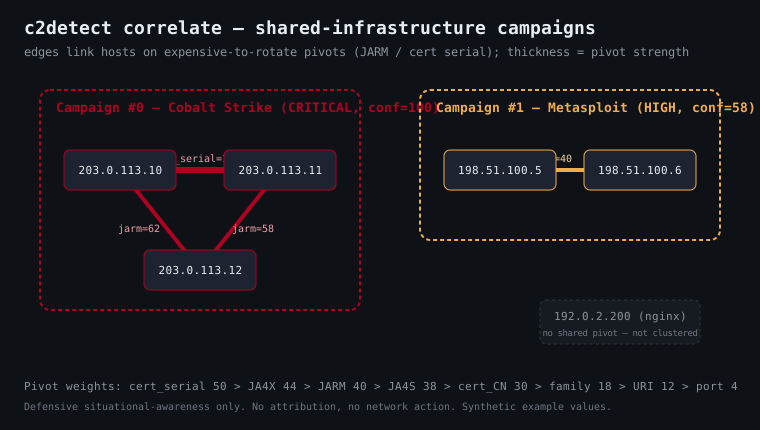
## Campaign correlation — `c2detect correlate`
One detection says *"this host looks like Cobalt Strike."* Correlation answers
the question that actually drives incident response: **which of your hosts are
the same operator's infrastructure, and why.**
Adversaries rotate IPs, domains and URL paths cheaply, but the *shape* of their
listener and certificate stack is expensive to change — so it leaks across the
estate. `correlate` clusters hosts that **literally share** an expensive-to-
rotate pivot (reused cert serial, JARM, JA4S/JA3S, cert CN, …), draws the
campaign graph with union-find, and shows the exact evidence inline. A lone
shared port (weight 4) never fuses two hosts; a shared JARM (40) always does.
```bash
$ c2detect correlate week_telemetry.json
== Campaign #0 [CRITICAL] confidence=100 hosts=3 families: Cobalt Strike
host: 203.0.113.10
host: 203.0.113.11
host: 203.0.113.12
shared infrastructure pivots:
- cert_serial (w=50): 0a1b2c3d4e5f6a7b
- jarm (w=40): 07d14d16d21d21d07c42d41d00041d24a458a375eef0c576d23a7bab9a9fb1
- family (w=18): cobalt strike
c2detect: 2 campaign(s) clustering 5 host(s) by shared C2 infrastructure.
```
```bash
c2detect correlate obs.json --format json # machine-readable campaigns + edges
c2detect correlate obs.json --format dot | dot -Tsvg -o g.svg # Graphviz pivot graph
c2detect correlate obs.json --fail-on critical # CI gate (exit 2)
c2detect correlate obs.json --edge-floor 38 # only JARM-class pivots link
c2detect correlate obs.json --include-singletons # full inventory incl. lone hosts
```
It does **not** attribute to a named actor and invents nothing — every reported
pivot is a value two observations actually share. Full threat context, the
weighting model, and a worked walkthrough are in
**[docs/CORRELATION.md](docs/CORRELATION.md)**.
## GitHub Action
Scan telemetry in CI, comment findings on the PR, and fail on a severity floor —
drop this into any repo as `.github/workflows/c2detect.yml`:
```yaml
name: c2detect
on: [push, pull_request]
permissions:
contents: read
pull-requests: write # to comment findings on PRs
security-events: write # to upload SARIF
jobs:
scan:
runs-on: ubuntu-latest
steps:
- uses: actions/checkout@v4
- uses: cognis-digital/c2detect@main
with:
path: telemetry/ # file or dir to scan
format: sarif # table | json | sarif | html | badge
fail-on: high # fail the build at/above this severity
threshold: "35" # min confidence to report
comment-pr: "true" # post a findings comment via gh api
```
The action uploads a **SARIF + HTML** report artifact and exposes
`steps..outputs.findings` and `steps..outputs.badge`.
## Status badge
`--format badge` prints a [shields.io endpoint](https://shields.io/endpoint)
JSON you can host and reference:
```bash
c2detect scan telemetry/ --format badge > badge.json
# {"schemaVersion":1,"label":"c2detect","message":"clean","color":"brightgreen"}
```
```md

```
## HTML report
```bash
c2detect scan telemetry/ --format html > report.html # clean, self-contained
```
A single self-contained HTML file (no external assets) with per-host findings,
severity pills, indicator breakdown, and any AI-suggested candidates.
## AI mode (opt-in, off by default)
Add `--ai` to layer a local-fleet LLM pass over the **same** source the scanner
already processed. AI findings are merged in, tagged `source="ai"`, novel
candidates flagged, and **deduped** against the deterministic rule findings:
```bash
# Point at a LOCAL OpenAI-compatible endpoint (nothing leaves the box):
export COGNIS_AI_BACKEND=uncensored-fleet # or COGNIS_AI_ENDPOINT=http://127.0.0.1:8774/v1
c2detect scan telemetry/ --ai
```
Guarantees:
- **Off by default.** Without `--ai`, output is **byte-for-byte deterministic** and contains no AI keys.
- **Never crashes.** If `--ai` is given but no backend is configured, or the backend is unreachable, `c2detect` prints a clear note and continues with the rule findings only.
- **Local-first.** Honors `COGNIS_AI_BACKEND` / `COGNIS_AI_ENDPOINT` / `COGNIS_AI_MODEL` / `COGNIS_AI_KEY` — designed for the [uncensored-fleet](https://github.com/cognis-digital/uncensored-fleet) and `cognis-code` local endpoints.
## Live threat-intel feeds (edge / air-gap deployable)
The bundled signature DB catches the *default* fingerprints of known C2
frameworks. `--feeds` adds a complementary signal: it cross-references every
observation against **real, public, keyless** [abuse.ch](https://abuse.ch)
threat-intel feeds, so a host that is already *known* malicious is flagged even
when its TLS profile has been customised away from a documented default.
Two feeds are wired (c2detect's domain is threat-intel — the catalog is
filtered so only these surface):
| feed id | source | what it adds |
|---|---|---|
| `feodo-c2` | [Feodo Tracker C2 IP blocklist](https://feodotracker.abuse.ch/downloads/ipblocklist.json) | observation **host IP** on the active-botnet C2 list → **CRITICAL** hit (Emotet/Dridex/QakBot/…) |
| `sslbl` | [SSLBL malicious JA3 fingerprints](https://sslbl.abuse.ch/blacklist/ja3_fingerprints.csv) | observation **JA3** on the malicious-fingerprint blacklist → **HIGH** hit |
```bash
c2detect feeds list # the feeds c2detect consumes + cache age
c2detect feeds update # fetch + cache them (online)
c2detect feeds get feodo-c2 # inspect parsed indicators
# Enrich a scan. A feed hit at/above --fail-on severity also trips the CI gate.
c2detect scan telemetry.json --feeds
c2detect scan telemetry.json --feeds --fail-on critical
```
### Edge / air-gap (offline + snapshot)
Feeds are fetched over HTTPS once, cached to disk
(`COGNIS_FEEDS_CACHE`, default `~/.cache/cognis-feeds`), and re-served with
`--offline` so c2detect keeps working on a disconnected / military / edge box.
To move intel across an air gap, sneakernet the cache:
```bash
# Connected host: refresh + pack.
c2detect feeds update
python -m c2detect.datafeeds snapshot-export feeds.tar.gz
# Air-gapped enclave: import + run with zero network.
python -m c2detect.datafeeds snapshot-import feeds.tar.gz
c2detect scan obs.json --feeds --offline
```
`--feeds` never crashes the scan: if the cache is missing while `--offline`, or
a feed is unreachable while online, c2detect prints a note and continues with
the deterministic rule findings. See **`demos/13-threat-intel-feeds/`** for a
pre-seeded snapshot you can run offline immediately.
## Demos
Five runnable, audience-specific scenarios in [`demos/`](demos/) — each loads a
real bundled telemetry fixture, runs the actual engine **fully offline**, prints
narrated output, and exits 0 (so they double as smoke tests):
```bash
PYTHONUTF8=1 python demos/run_all.py # all five, end to end
PYTHONUTF8=1 python demos/05_campaign_correlation.py # or just one
```
| # | Scenario | Audience | What it shows |
|---|----------|----------|---------------|
| 1 | [`01_soc_triage.py`](demos/01_soc_triage.py) | **SOC / blue team** | Prioritize a 5-host JARM egress sweep — 2 C2 hosts pulled out, 3 benign CDNs cleared, ranked for escalation |
| 2 | [`02_threat_intel_feeds.py`](demos/02_threat_intel_feeds.py) | **Threat intel** | Cross-reference observations against the real abuse.ch Feodo + SSLBL feeds, served from the bundled offline snapshot |
| 3 | [`03_detection_rules.py`](demos/03_detection_rules.py) | **Detection engineers** | Generate Sigma + Suricata rules from the signature DB; verify deterministic, clash-free SIDs |
| 4 | [`04_incident_response.py`](demos/04_incident_response.py) | **Incident response / DFIR** | Attribute one intrusion staging 4 frameworks (CS + Sliver + Havoc + AdaptixC2), with the indicators that fired |
| 5 | [`05_campaign_correlation.py`](demos/05_campaign_correlation.py) | **Threat hunters** | Cluster a week of telemetry into shared-infrastructure campaigns via union-find, pivot evidence inline |
Full write-ups in **[docs/DEMOS.md](docs/DEMOS.md)**.
## Architecture
```mermaid
flowchart LR
in["Telemetry
JSON · JSONL · text · stdin"] --> obs["Observation
ingest"]
obs --> score["Matching engine
+ signature DB (21 families)"]
score --> res["ScanResult
(ranked matches)"]
res --> corr["Correlation
(campaigns)"]
res --> rep["Reports
table · JSON · SARIF · HTML · badge"]
res -.opt.-> feeds["abuse.ch feeds
(offline-capable)"]
score --> rules["Sigma · Suricata
rule generation"]
res --> mcp["MCP server"]
classDef hot stroke:#6b46c1,stroke-width:3px;
class score hot;
```
Full component walkthrough with diagrams in **[docs/ARCHITECTURE.md](docs/ARCHITECTURE.md)**.
## Use it from any AI stack
`c2detect` is interoperable with every popular way of using AI:
- **MCP server** — `c2detect mcp` (Claude Desktop, Cursor, Cognis.Studio, [uncensored-fleet](https://github.com/cognis-digital/uncensored-fleet))
- **OpenAI-compatible / JSON** — pipe `c2detect scan . --format json` into any agent or LLM
- **LangChain · CrewAI · AutoGen · LlamaIndex** — wrap the CLI/JSON as a tool in one line
- **CI / scripts** — exit codes + SARIF for non-AI pipelines
## How it compares
| | **Cognis c2detect** | salesforce |
|---|:---:|:---:|
| Self-hostable, no account | ✅ | varies |
| Single command, zero config | ✅ | ⚠️ |
| JSON + SARIF for CI | ✅ | varies |
| MCP-native (AI agents) | ✅ | ❌ |
| Polyglot ports (JS/Go/Rust) | ✅ | ❌ |
| Open license | ✅ COCL | varies |
*Built in the spirit of **salesforce/jarm**, re-framed the Cognis way. Missing a credit? Open a PR.*
## Integrations
Pipes into your stack: **SARIF** for code-scanning, **JSON** for anything, an **MCP server** (`c2detect mcp`) for AI agents, and a webhook forwarder for SIEM/Slack/Jira. See [`docs/INTEGRATIONS.md`](docs/INTEGRATIONS.md).
## Install — every way, every platform
```bash
pip install "git+https://github.com/cognis-digital/c2detect.git" # pip (works today)
pipx install "git+https://github.com/cognis-digital/c2detect.git" # isolated CLI
uv tool install "git+https://github.com/cognis-digital/c2detect.git" # uv
pip install cognis-c2detect # PyPI (when published)
docker run --rm ghcr.io/cognis-digital/c2detect:latest --help # Docker
brew install cognis-digital/tap/c2detect # Homebrew tap
curl -fsSL https://raw.githubusercontent.com/cognis-digital/c2detect/main/install.sh | sh
```
| Linux | macOS | Windows | Docker | Cloud |
|---|---|---|---|---|
| `scripts/setup-linux.sh` | `scripts/setup-macos.sh` | `scripts/setup-windows.ps1` | `docker run ghcr.io/cognis-digital/c2detect` | [DEPLOY.md](docs/DEPLOY.md) (AWS/Azure/GCP/k8s) |
**Drop the core check into any stack** — the JARM/JA3/port/URI scorer is ported to Go, Rust, JavaScript, TypeScript, and POSIX Shell (each with its own tests + CI) under [`ports/`](ports/README.md):
```bash
node ports/javascript/index.js obs.json # JavaScript
node --experimental-strip-types ports/typescript/index.ts obs.json # TypeScript
cd ports/go && go run . obs.json # Go
cd ports/rust && cargo run -- obs.json # Rust
sh ports/shell/c2detect.sh obs.json # POSIX shell
```
## Related Cognis tools
- [`payloadlab`](https://github.com/cognis-digital/payloadlab) — Static malicious payload analyzer — PE/ELF/LNK/macro/OneNote
- [`redpath`](https://github.com/cognis-digital/redpath) — Active Directory attack path mapper — minimum-cost paths + remediation priority
- [`pwnreview`](https://github.com/cognis-digital/pwnreview) — Pentest report generator — YAML findings to CREST-grade PDF
- [`crackq`](https://github.com/cognis-digital/crackq) — Self-hosted password cracking queue — multi-user hashcat with audit log
**Explore the suite →** [🗂️ all 170+ tools](https://github.com/cognis-digital/cognis-neural-suite) · [⭐ awesome-cognis](https://github.com/cognis-digital/awesome-cognis) · [🔗 cognis-sources](https://github.com/cognis-digital/cognis-sources) · [🤖 uncensored-fleet](https://github.com/cognis-digital/uncensored-fleet) · [🧠 engram](https://github.com/cognis-digital/engram)
## Contributing
PRs, new rules, and demo scenarios are welcome under the collaboration-pull model — see [CONTRIBUTING.md](CONTRIBUTING.md) and [SECURITY.md](SECURITY.md).
> ### ⭐ If `c2detect` saved you time, **star it** — it genuinely helps others find it.
## Interoperability
`{}` composes with the 300+ tool Cognis suite — JSON in/out and a shared
OpenAI-compatible `/v1` backbone. See **[INTEROP.md](INTEROP.md)** for the
suite map, composition patterns, and reference stacks.
## License
Source-available under the **Cognis Open Collaboration License (COCL) v1.0** — free for personal, internal-evaluation, research, and educational use; **commercial / production use requires a license** (licensing@cognis.digital). See [LICENSE](LICENSE).
---