Zeroshot. Self-driving software engineering. Layer 01 · Verification, The Open Engine.   Website X · @OpenEngineCo LinkedIn Discord [![npm](https://img.shields.io/npm/v/@the-open-engine/zeroshot?style=flat&labelColor=171411&color=171411)](https://www.npmjs.com/package/@the-open-engine/zeroshot) [![CI](https://img.shields.io/github/actions/workflow/status/the-open-engine/zeroshot/ci.yml?style=flat&labelColor=171411&label=CI)](https://github.com/the-open-engine/zeroshot/actions/workflows/ci.yml) [![License: MIT](https://img.shields.io/badge/license-MIT-171411?style=flat)](LICENSE) [![node](https://img.shields.io/badge/node-%E2%89%A5%2018-171411?style=flat)](#install) [![platforms](https://img.shields.io/badge/platforms-linux%20%C2%B7%20macos-171411?style=flat)](#install) [![stars](https://img.shields.io/github/stars/the-open-engine/zeroshot?style=flat&labelColor=171411&color=171411)](https://github.com/the-open-engine/zeroshot) [![Layer 01 · The Open Engine](https://img.shields.io/badge/Layer_01-The_Open_Engine-C2240C?style=flat&labelColor=171411)](#the-open-engine)
**The agent that wrote the code shouldn't be the one that says it works.** Zeroshot is an open-source, multi-agent orchestration engine for autonomous software engineering. It drives a coding agent you already run (Claude Code, OpenAI Codex, Gemini CLI, or OpenCode) through an **executor-verifier loop**: an agent writes the change, then an _independent_ verifier that never saw how it was made approves it, or hands back a reproducible failure. The loop runs until the change is verified. ## Install ```bash npm install -g @the-open-engine/zeroshot ``` Requires **Node ≥ 18** and at least one provider CLI (Claude Code, Codex, Gemini, or OpenCode). Linux and macOS today; Windows is deferred.
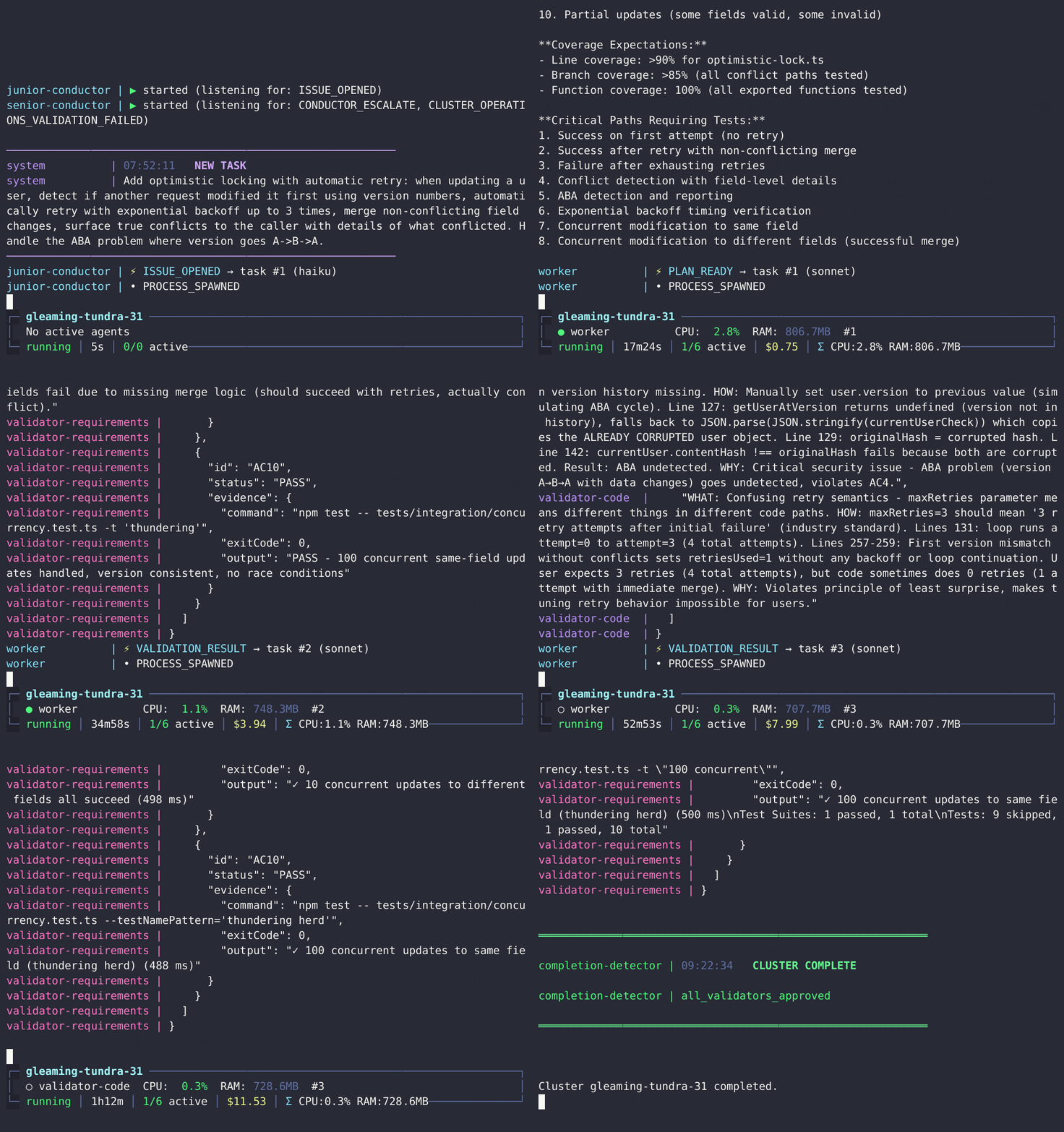
Zeroshot resolving an issue through the executor-verifier loop
One run, unattended. 100× speed · 90-minute run · 5 iterations to approval.
## How it works Zeroshot separates the agent that **writes** the code from the agent that **judges** it. A conductor sizes the workflow to the task. An executor (an AI coding agent) implements the change in an isolated workspace (git worktree or Docker). Then an **independent verifier** inspects the result without ever seeing the executor's context or history, so it cannot approve its own reasoning. The verifier returns `APPROVED`, or `REJECTED` with an actionable, reproducible failure, and the loop repeats until the change is verified or hands back a concrete reason it isn't. Every step is written to a crash-safe SQLite ledger, so a run survives a reboot and resumes where it stopped. ```text task --> plan --> implement --> verify --> APPROVED --> done ^ | +- REJECTED -+ (reproducible failure) ``` Bring your own provider and your own backend. Zeroshot orchestrates the agents that write your code; it doesn't store your keys or replace your models. ## How is this different from a single coding agent? | | A single coding agent | Zeroshot | | --------------------------- | ---------------------------- | ------------------------------------------------------------------------------------------- | | Who says it is correct? | the same agent that wrote it | a separate agent that never saw how it was written | | Is the code actually run? | usually just claimed | executed against your real tests | | When it fails, you get | an assertion it is fine | a reproducible failure | | When does it stop? | when it decides it is done | when the change is verified, or provably is not | | Which coding agent runs it? | one, fixed | any you already run: Zeroshot is the harness around Claude Code, Codex, Gemini, or OpenCode | ## Quick start ```bash zeroshot run 123 # a GitHub issue number zeroshot run feature.md # a markdown spec zeroshot run "Add a --json flag" # inline text ``` Describe a non-trivial task inline and let the loop run it to a verified change: ```bash zeroshot run "Add optimistic locking with automatic retry: when updating a user, retry with exponential backoff up to 3 times, merge non-conflicting field changes, and surface conflicts with details. Handle the ABA problem where version goes A->B->A." ```
Command reference ```bash # Run zeroshot run # issue number / URL / key / markdown file / inline text zeroshot run 123 --worktree # isolate in a git worktree zeroshot run 123 --docker # isolate in a container zeroshot run 123 --pr # worktree + open a pull request zeroshot run 123 --ship # worktree + PR + auto-merge on approval zeroshot run 123 -d # background (daemon) zeroshot run 123 --provider gemini # override the provider for this run # Monitor & manage zeroshot list # all clusters (--json) zeroshot status # cluster details zeroshot logs -f # stream logs zeroshot resume [prompt] # resume a stopped/failed run zeroshot stop # graceful stop zeroshot kill # force kill zeroshot export # export the conversation # Library & config zeroshot providers # list providers / set-default / setup zeroshot agents list # available agents (agents show ) zeroshot settings # view / get / set settings zeroshot cmdproof check # reuse a verified command result ```
## Providers and backends Zeroshot shells out to provider CLIs; it stores no API keys and manages no auth. Pick a default and override per run. | Provider | CLI | | ------------ | -------------------------------------- | | Claude Code | `npm i -g @anthropic-ai/claude-code` | | OpenAI Codex | `npm i -g @openai/codex` | | Gemini CLI | `npm i -g @google/gemini-cli` | | OpenCode | see [opencode.ai](https://opencode.ai) | ```bash zeroshot providers # see what's installed zeroshot providers set-default codex zeroshot run 123 --provider gemini ``` Issue backends are **auto-detected from your git remote**: **GitHub, GitLab, Jira, and Azure DevOps**. Paste a number, key, or URL: ```bash zeroshot run 123 # GitHub zeroshot run https://gitlab.com/org/repo/-/issues/456 # GitLab zeroshot run PROJ-789 # Jira zeroshot run https://dev.azure.com/org/project/_workitems/edit/999 # Azure DevOps ``` Each backend needs its own CLI installed (`gh`, `glab`, `jira`, or `az`). See [`docs/providers.md`](docs/providers.md) for model levels and setup. ## Isolation By default, agents modify files only; they do **not** commit or push. Opt into isolation to let the loop own a branch (the flags cascade: `--ship` → `--pr` → `--worktree`). | Mode | Flag | Use when | | ------------ | ------------ | ------------------------------------------------ | | None | _(default)_ | quick task, you review the changes yourself | | Git worktree | `--worktree` | PR workflows, lightweight branch isolation | | Docker | `--docker` | risky experiments, parallel runs, full isolation |
Docker credential mounts When using `--docker`, Zeroshot mounts credential directories so agents can reach provider CLIs and tools. Defaults: `gh`, `git`, `ssh`. Presets include `aws`, `azure`, `kube`, `terraform`, `gcloud`, and the provider configs. ```bash zeroshot settings set dockerMounts '["gh","git","ssh","aws"]' zeroshot run 123 --docker --mount ~/.aws:/root/.aws:ro zeroshot run 123 --docker --no-mounts ``` See [`docs/providers.md`](docs/providers.md) for mount details.
## Scope and status Zeroshot performs best when a task has **clear acceptance criteria**. If you can't say what "done" means, an independent verifier can't confirm it. | Task | Good fit? | Why | | ----------------------------------------------- | --------- | ----------------------- | | Add rate limiting (sliding window, per-IP, 429) | Yes | clear requirements | | Refactor auth to JWT | Yes | defined end state | | Fix a login bug | Yes | success is measurable | | "Make the app faster" | No | needs exploration first | | "Improve the codebase" | No | no acceptance criteria | - **Pre-1.0 in spirit.** Interfaces still move between releases; pin your version. (The npm version auto-increments on every merge, so read it as a build counter, not a stability promise.) - **Crash-safe.** All state persists to a SQLite ledger; `zeroshot resume ` continues at any time. - **No TUI in this release.** Monitor with `zeroshot logs -f`, `zeroshot list`, and `zeroshot status `.
Architecture, quality gates and command proofs Zeroshot is a message-driven coordination layer: a conductor classifies each task by complexity and type, a workflow template selects agents and validators, agents publish results to a SQLite ledger, and validators approve or reject with specific findings. - **Required handoff quality gates**: in `--pr`/`--ship` flows, the git-pusher fails closed until every configured gate has fresh passing evidence. - **Cmdproof**: make expensive exact commands reusable across agents with `zeroshot cmdproof check `. See [CLAUDE.md](./CLAUDE.md) for the cluster schema, primitives, and the conductor's classification model.
## The Open Engine Zeroshot is **Layer 01 · Verification** of [The Open Engine](https://theopenengine.com), the open stack for autonomous software production. Generating code is easy; trusting it is not. The engine is layered because trust is layered: | | Layer | Status | | ------ | -------------------------- | --------------------------- | | **01** | **Verification: Zeroshot** | This repo · open · shipping | | 02 | Constraints: **Opcore** | Sibling · alpha | | 03-05 | Intent · Context · Runtime | In development | Zeroshot runs the loop: an agent writes the change, and an **independent** verifier decides whether it holds: approve, or a reproducible failure. **Opcore** is the sibling layer, a deterministic, local, read-only **constraints** gate for coding agents (currently private alpha `0.1.0-alpha.0`, built in the open, not yet published). Verification asks _"does this meet the goal?"_; constraints ask _"is this within tolerance?"_ Each layer ships the same way: extracted from the platform we run, then opened. **Trust nothing. Verify everything.** ## Contributing See [CONTRIBUTING.md](CONTRIBUTING.md) for development setup, [CODE_OF_CONDUCT.md](CODE_OF_CONDUCT.md) before participating, and [SECURITY.md](SECURITY.md) for security reports. More in [`docs/`](docs/) and [CLAUDE.md](./CLAUDE.md). Questions and help: [Discord](https://discord.gg/fZyzf2Cut9). ## License MIT. [The Open Engine Company](https://github.com/the-open-engine).