# NezhaCyberMCP
**A production-grade Model Context Protocol (MCP) server for CVE vulnerability intelligence.**
Aggregate, store, and query security advisories from CIRCL, MyCERT, and GitHub Advisory Database — served directly to your AI assistant via MCP JSON-RPC 2.0.
[](https://go.dev)
[](https://github.com/modelcontextprotocol/go-sdk)
[](./LICENSE)
[](https://aws.amazon.com/lambda/)
[](https://gorm.io)
[English](#) | [中文](./README_zh.md)
---
## Table of Contents
- [Overview](#overview)
- [System Architecture](#system-architecture)
- [Data Sources](#data-sources)
- [MCP Tools Reference](#mcp-tools-reference)
- [Data Models](#data-models)
- [Security Considerations](#security-considerations)
- [Runtime Environments](#runtime-environments)
- [Quick Start](#quick-start)
- [Configuration Reference](#configuration-reference)
- [Build & Deployment](#build--deployment)
- [Database Support](#database-support)
- [Rendered Diagrams](#rendered-diagrams)
- [Project Structure](#project-structure)
- [License](#license)
---
## Overview
NezhaCyberMCP is a Go-based MCP server that bridges AI assistants (Claude, Cursor, VS Code Copilot) with a continuously updated CVE vulnerability database. It operates in three distinct runtime modes:
| Mode | Trigger | Transport | Use Case |
| --------------- | -------------------- | ---------------------- | --------------------------------- |
| **Local** | `IS_LOCAL=true` | stdio (JSON-RPC 2.0) | Claude Desktop, local development |
| **Lambda Sync** | EventBridge cron | — | Scheduled data ingestion only |
| **Lambda MCP** | `MCP_HTTP_MODE=true` | SSE over HTTP (`/sse`) | Cloud-hosted MCP endpoint |
The server exposes **18 registered MCP tools** covering CVE lookup, multi-dimensional search, CPE matching, severity filtering, trend analysis, and vendor/product statistics.
---
## System Architecture
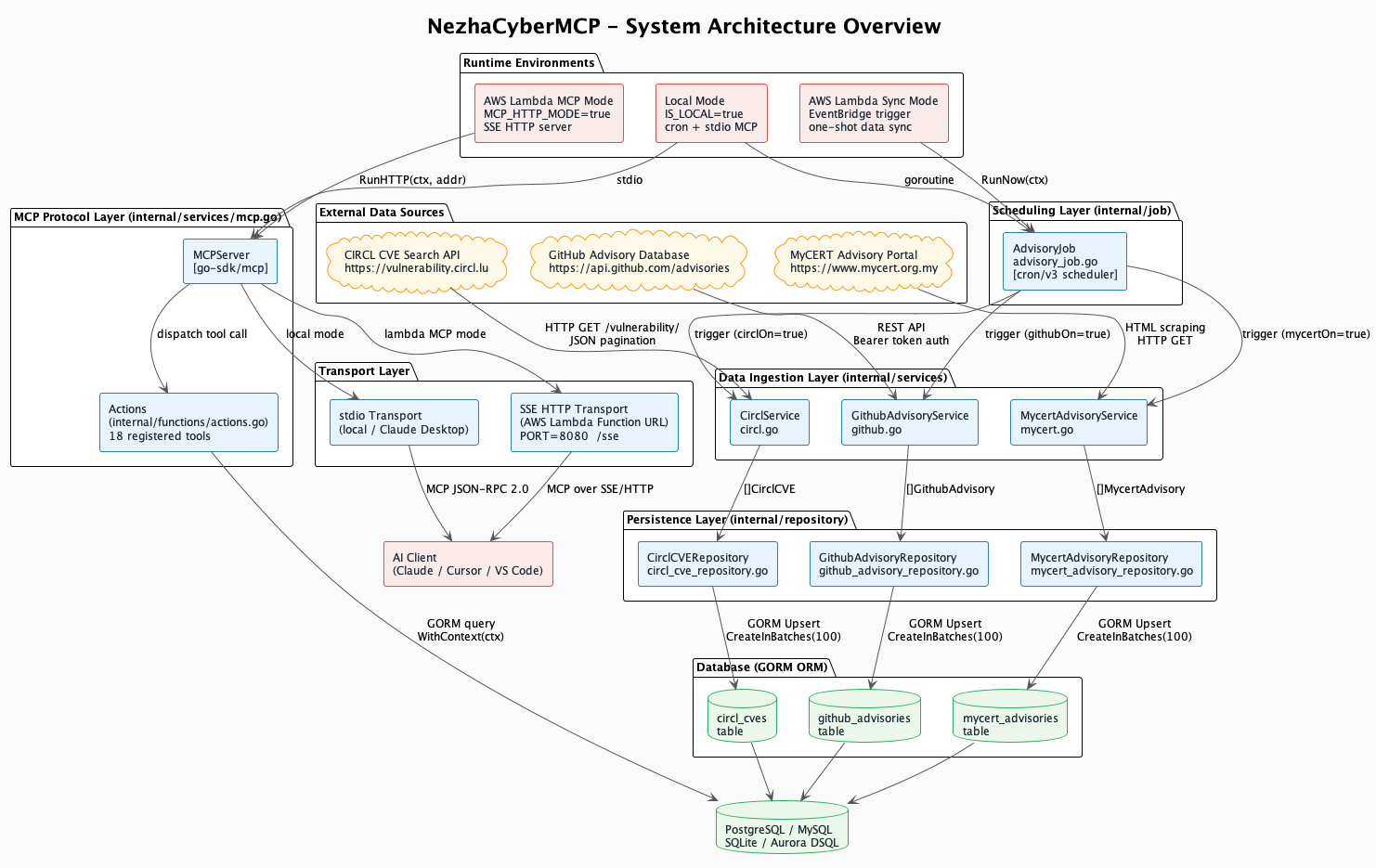
The system is organized into six distinct layers. Each layer has a single, well-defined responsibility and communicates only with adjacent layers.
```
+---------------------------+
| AI Client | Claude / Cursor / VS Code
| (MCP JSON-RPC 2.0) |
+---------------------------+
|
v
+---------------------------+
| Transport Layer | stdio (local) | SSE HTTP (Lambda)
+---------------------------+
|
v
+---------------------------+
| MCP Protocol Layer | MCPServer + 18 Tools (mcp.go)
| Actions Dispatcher | actions.go — query routing
+---------------------------+
|
v
+---------------------------+
| Persistence Layer | GORM repositories (3 tables)
| (Repository Pattern) | Upsert, batch write, query
+---------------------------+
|
v
+---------------------------+
| Database | PostgreSQL / MySQL / SQLite
| | Amazon Aurora DSQL (AWS)
+---------------------------+
^
|
+---------------------------+
| Data Ingestion Layer | CirclService / GithubService
| + Scheduling Layer | MycertService + cron/v3
+---------------------------+
^
|
+---------------------------+
| External Data Sources | CIRCL API / GitHub API
| | MyCERT Portal (HTML scraping)
+---------------------------+
```
### Architecture Diagram (PlantUML)
> The full PlantUML source is available at [`docs/en/flow.puml`](./docs/en/flow.puml).
> Render it with [PlantUML Online](https://www.plantuml.com/plantuml/uml/) or the VS Code PlantUML extension.
```plantuml
@startuml
' See docs/en/flow.puml for the complete diagram source.
' Key component relationships:
'
' External Sources --> Services --> Repositories --> Database
' AdvisoryJob (cron) --> Services (trigger)
' MCPServer --> Actions --> Database (query)
' MCPServer --> Transport --> AI Client
@enduml
```
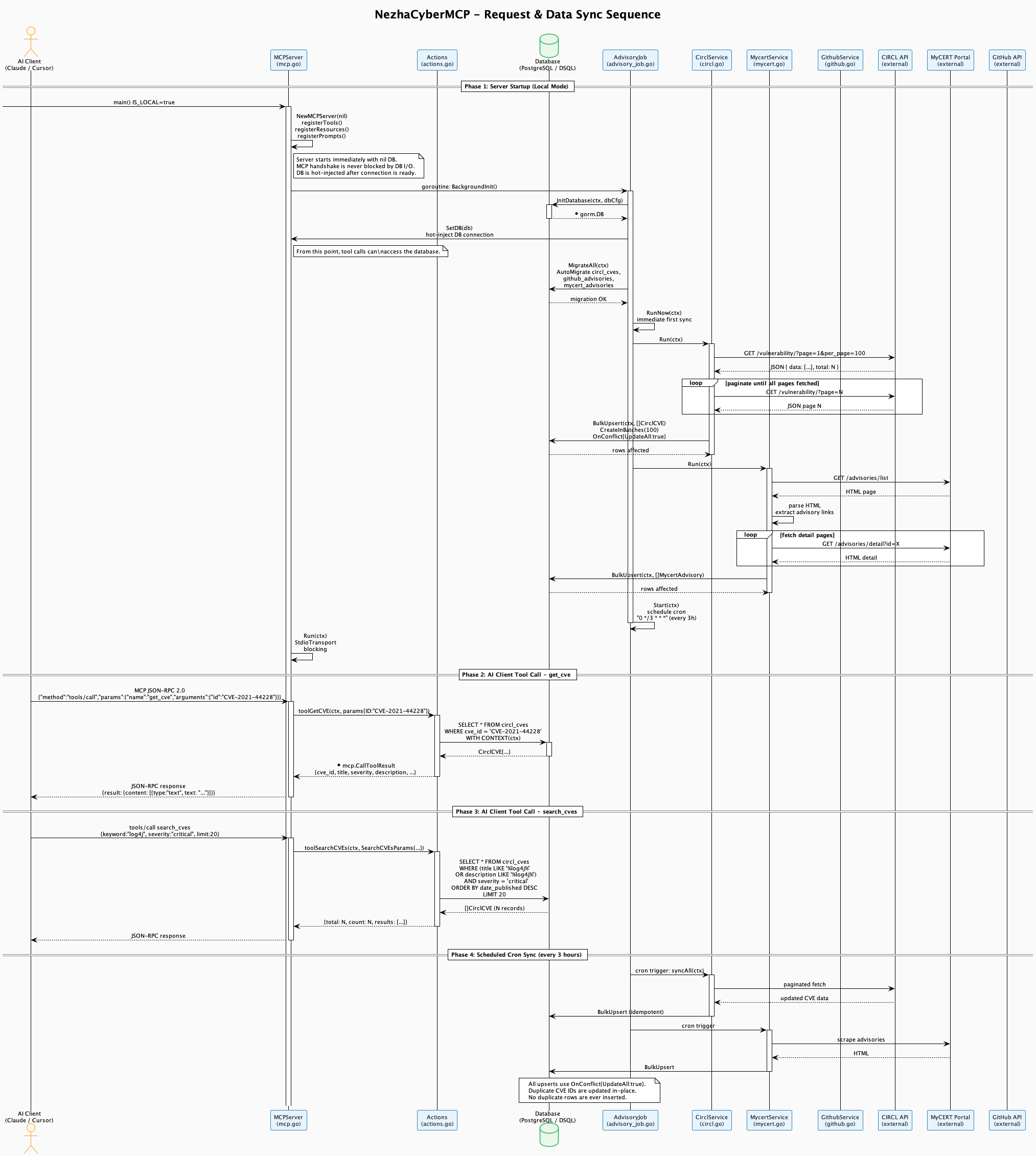
### Sequence Diagram (PlantUML)
> The full request lifecycle and data sync sequence is at [`docs/en/sequence.puml`](./docs/en/sequence.puml).
**Key design decision — non-blocking startup:**
The `MCPServer` is constructed with a `nil` database connection and starts immediately. The MCP protocol handshake (`initialize` → `initialized`) completes before any database I/O begins. The database connection is established in a background goroutine and hot-injected via `SetDB()` once ready. This ensures the AI client never experiences a connection timeout during server startup.
```
main()
|
+-- NewMCPServer(nil) <-- starts immediately, no DB needed
| registerTools()
| registerResources()
| registerPrompts()
|
+-- goroutine: BackgroundInit()
| InitDatabase(ctx, cfg)
| mcpServer.SetDB(db) <-- hot-inject when ready
| MigrateAll(ctx)
| RunNow(ctx) <-- immediate first sync
| advisoryJob.Start(ctx) <-- schedule cron
|
+-- mcpServer.Run(ctx) <-- blocking stdio loop
```
---
## Data Sources
### 1. CIRCL CVE Search API
- **Endpoint:** `https://vulnerability.circl.lu/api/vulnerability/`
- **Protocol:** HTTP REST, JSON pagination (`page`, `per_page=100`)
- **Authentication:** None required (public API)
- **Data:** Full CVE records including CVSS scores, CWE IDs, affected packages, references
- **Sync frequency:** Every 3 hours (configurable via cron expression)
- **Rate limiting:** 500ms between requests (`RateLimit` config field)
- **Retry policy:** Up to 5 retries with 2-second exponential backoff
**Pagination algorithm:**
```
page := 1
for {
resp = GET /vulnerability/?page={page}&per_page=100
if len(resp.Data) == 0 { break }
BulkUpsert(resp.Data)
page++
}
```
### 2. GitHub Advisory Database
- **Endpoint:** `https://api.github.com/advisories`
- **Protocol:** GitHub REST API v3
- **Authentication:** Bearer token (`GITHUB_TOKEN` environment variable)
- **Data:** GHSA records with CVE cross-references, severity, affected packages (ecosystem-aware)
- **Toggle:** Controlled by `IsGithubAdvisoryTurnOn` constant (currently `false`)
### 3. MyCERT Advisory Portal
- **Source:** `https://www.mycert.org.my`
- **Protocol:** HTML scraping via `golang.org/x/net/html`
- **Authentication:** None required (public portal)
- **Data:** Malaysian CERT security advisories with full-text content
- **Detail fetch:** Enabled when `FetchDetail=true` (fetches individual advisory pages)
- **Toggle:** Controlled by `IsMycertAdvisoryTurnOn` constant (currently `true`)
---
## MCP Tools Reference
All tools communicate via MCP JSON-RPC 2.0. Tool inputs are validated against JSON Schema. All responses are structured JSON.
### Query Tools
| Tool | Description | Key Parameters |
| -------------------- | --------------------------------- | -------------------------------------------------------------------------------- |
| `get_cve` | Fetch a single CVE record by ID | `id: string` (e.g. `CVE-2021-44228`) |
| `search_cves` | Multi-dimensional CVE search | `keyword`, `vendor`, `product`, `cwe`, `date_from`, `date_to`, `status`, `limit` |
| `search_by_cpe` | Search CVEs by CPE 2.3 string | `cpe_string` (full CPE or `vendor:product` fragment) |
| `bulk_get` | Batch fetch up to 50 CVEs | `ids: []string` |
| `filter_by_severity` | Filter by severity level | `severities: []string`, `date_from`, `date_to`, `limit` |
| `get_cwe` | Extract CWE IDs from a CVE | `id: string` |
| `get_references` | Extract reference URLs from a CVE | `id: string` |
| `related_cves` | Find CVEs sharing assigner or CWE | `id: string` |
| `whats_new` | CVEs published after a given date | `since: string`, `min_severity: string` |
### Analytics Tools
| Tool | Description | Key Parameters |
| ----------------------- | ----------------------- | -------------------------------------------------------------- |
| `vuln_trends` | CVE count over time | `group_by: day\|week\|month\|severity`, `date_from`, `date_to` |
| `top_vendors` | Vendors with most CVEs | `date_from`, `date_to`, `limit` |
| `top_products` | Products with most CVEs | `vendor`, `date_from`, `date_to`, `limit` |
| `severity_distribution` | Count by severity level | `date_from`, `date_to`, `vendor` |
### Asset Matching Tools
| Tool | Description | Key Parameters |
| ----------------- | ------------------------------------- | ----------------------------------------------------------------------- |
| `match_inventory` | Match software inventory against CVEs | `packages: []string` (`vendor:product[:version]`), `cpe_list: []string` |
### Placeholder Tools (Not Yet Implemented)
These tools are registered and return a clear `not implemented` error. They are designed for future integration:
| Tool | Planned Data Source |
| ---------------- | --------------------------------------------- |
| `get_kev_status` | CISA Known Exploited Vulnerabilities catalog |
| `get_epss` | EPSS (Exploit Prediction Scoring System) feed |
| `prioritize` | CVSS + EPSS + KEV composite scoring |
| `match_sbom` | CycloneDX / SPDX SBOM parsing |
---
## Data Models
### `CirclCVE` — `circl_cves` table
Primary source of CVE data. Populated from the CIRCL Vulnerability-Lookup API.
| Column | Type | Description |
| ----------------- | -------------- | ------------------------------------------------------------------ |
| `cve_id` | `VARCHAR` (PK) | CVE identifier (e.g. `CVE-2021-44228`) |
| `state` | `VARCHAR` | `PUBLISHED` \| `REJECTED` \| `RESERVED` |
| `assigner_org_id` | `VARCHAR` | Assigning organization UUID |
| `assigner_short` | `VARCHAR` | Short name (e.g. `apache`) |
| `title` | `TEXT` | Vulnerability title |
| `description` | `TEXT` | Full description |
| `severity` | `VARCHAR` | Normalized: `critical` \| `high` \| `medium` \| `low` \| `unknown` |
| `cwe_ids` | `TEXT` (JSON) | Array of CWE identifiers |
| `affected` | `TEXT` (JSON) | Affected packages array |
| `references` | `TEXT` (JSON) | Reference URLs array |
| `date_published` | `TIMESTAMP` | First publication date (nullable) |
| `date_updated` | `TIMESTAMP` | Last update date (nullable) |
| `date_reserved` | `TIMESTAMP` | CVE ID reservation date (nullable) |
| `scraped_at` | `TIMESTAMP` | Last ingestion timestamp (auto-updated) |
### `GithubAdvisory` — `github_advisories` table
| Column | Type | Description |
| ----------------- | -------------- | ----------------------------------------- |
| `ghsa_id` | `VARCHAR` (PK) | GitHub Security Advisory ID |
| `cve_id` | `VARCHAR` | Cross-referenced CVE ID (nullable) |
| `summary` | `VARCHAR` | One-line summary |
| `description` | `TEXT` | Full description |
| `severity` | `VARCHAR` | `low` \| `medium` \| `high` \| `critical` |
| `type` | `VARCHAR` | `reviewed` \| `unreviewed` \| `malware` |
| `vulnerabilities` | `TEXT` (JSON) | Affected packages with ecosystem info |
| `published_at` | `TIMESTAMP` | Publication date (nullable) |
| `withdrawn_at` | `TIMESTAMP` | Withdrawal date (nullable) |
### `MycertAdvisory` — `mycert_advisories` table
| Column | Type | Description |
| -------------- | -------------- | -------------------------------------------- |
| `advisory_id` | `VARCHAR` (PK) | MyCERT advisory ID (from URL parameter) |
| `title` | `TEXT` | Advisory title |
| `category` | `VARCHAR` | Advisory category (e.g. `Advisory`, `Alert`) |
| `summary` | `TEXT` | Advisory summary |
| `detail_url` | `VARCHAR` | Full URL to advisory detail page |
| `full_content` | `TEXT` | Full page content (when `FetchDetail=true`) |
| `published_at` | `TIMESTAMP` | Publication date (nullable) |
| `scraped_at` | `TIMESTAMP` | Last ingestion timestamp (auto-updated) |
---
## Security Considerations
### Authentication & Authorization
**No credentials are hardcoded.** All sensitive values are read exclusively from environment variables:
| Secret | Environment Variable | Required |
| --------------------- | ----------------------- | --------------------------------------- |
| GitHub API token | `GITHUB_TOKEN` | Only when `IsGithubAdvisoryTurnOn=true` |
| Database password | `DB_PASSWORD` | Always |
| AWS Access Key ID | `AWS_ACCESS_KEY_ID` | AWS environments only |
| AWS Secret Access Key | `AWS_SECRET_ACCESS_KEY` | AWS environments only |
**AWS credential validation** (`utilities/aws.go`): The `IsRunInAWS()` function validates that `AWS_ACCESS_KEY_ID` and `AWS_SECRET_ACCESS_KEY` are not empty and do not contain placeholder values (e.g. strings consisting of a single repeated character like `xxx`, or strings beginning with `multiple`). This prevents silent failures from misconfigured deployments.
**AWS Lambda IAM:** In Lambda runtime (`AWS_LAMBDA_RUNTIME_API` is set), credentials are automatically injected by the IAM execution role. No static credentials are needed or used.
### Data Protection
- **No PII stored:** The database contains only public CVE data from open sources. No user data, session tokens, or personal information is persisted.
- **Context propagation:** All database queries use `WithContext(ctx)`, ensuring that request cancellation and timeout signals propagate correctly to the database driver. This prevents goroutine leaks and runaway queries.
- **Idempotent writes:** All ingestion operations use `OnConflict{UpdateAll: true}` with `CreateInBatches(100)` wrapped in a database transaction. This guarantees atomicity and prevents partial writes.
### Input Validation
- MCP tool parameters are validated against JSON Schema by the `go-sdk/mcp` library before reaching `Actions`.
- SQL injection is prevented by GORM's parameterized query builder. Raw SQL is never constructed via string concatenation.
- CVE ID format is not validated at the application layer — the database primary key constraint enforces uniqueness.
### Transport Security
- **stdio mode:** Communication is over local process pipes. No network exposure.
- **SSE HTTP mode:** The server listens on `localhost:PORT`. In Lambda, AWS handles TLS termination at the Function URL layer. The internal HTTP server is never directly exposed to the internet.
### Logging
Structured logging via `utilities/logger.go`. Log levels: `DEBUG`, `INFO`, `WARN`, `ERROR`, `VERBOSE`. Sensitive values (credentials, tokens) are masked using `utilities.Mask()` before being written to logs. The `LOG_LEVEL` environment variable controls verbosity.
---
## Runtime Environments
### Local Mode
```
IS_LOCAL=true
```
Starts a long-running process with:
1. Background goroutine: DB init → migration → immediate sync → cron scheduler
2. Foreground: MCP stdio server (blocking)
The DB is hot-injected into the MCP server after connection is established. Tool calls made before DB is ready return a clear error message rather than panicking.
### AWS Lambda — Sync Mode (default)
Triggered by EventBridge scheduled rules. Executes one complete sync cycle (migrate + fetch all sources) and exits. No MCP server is started.
```
# EventBridge rule example
rate(3 hours)
```
### AWS Lambda — MCP HTTP Mode
```
MCP_HTTP_MODE=true
PORT=8080
```
Starts an SSE HTTP server. AWS Lambda Function URL proxies HTTPS requests to `localhost:8080`. The `/sse` endpoint serves the MCP SSE transport. No cron scheduler is started — data is written by the sync Lambda.
---
## Quick Start
### Prerequisites
- Go 1.26.1+
- A running PostgreSQL instance (or SQLite for local testing)
- `make` (optional, for convenience targets)
### 1. Clone and configure
```bash
git clone https://github.com/ctkqiang/NezhaCyberMCP.git
cd NezhaCyberMCP
cp .env.example .env # edit with your database credentials
```
### 2. Configure `.env`
```dotenv
# Runtime mode
IS_LOCAL=true
# Database (PostgreSQL example)
DB_HOST=localhost
DB_PORT=5432
DB_USER=postgres
DB_PASSWORD=your_password
DB_NAME=nezha_cyber
DB_TIMEZONE=Asia/Shanghai
# Optional: GitHub Advisory sync
GITHUB_TOKEN=ghp_xxxxxxxxxxxx
# Logging
LOG_LEVEL=INFO
```
### 3. Build and run
```bash
make build
./advisory
```
Or run directly:
```bash
go run .
```
### 4. Inspect with MCP Inspector
```bash
make run
# Equivalent to: npx @modelcontextprotocol/inspector ./advisory
```
### 5. Configure Claude Desktop
Add to `~/Library/Application Support/Claude/claude_desktop_config.json`:
```json
{
"mcpServers": {
"nezha-cyber": {
"command": "/absolute/path/to/advisory",
"env": {
"IS_LOCAL": "true",
"DB_HOST": "localhost",
"DB_PORT": "5432",
"DB_USER": "postgres",
"DB_PASSWORD": "your_password",
"DB_NAME": "nezha_cyber"
}
}
}
}
```
---
## Configuration Reference
### Environment Variables
| Variable | Default | Description |
| ----------------------- | ---------------- | ------------------------------------------------------------------ |
| `IS_LOCAL` | `false` | Set `true` to run in local mode (cron + stdio MCP) |
| `MCP_HTTP_MODE` | `false` | Set `true` to run SSE HTTP server (Lambda MCP mode) |
| `IS_AWS` | `false` | Set `true` to use Amazon Aurora DSQL |
| `DB_HOST` | — | Database host |
| `DB_PORT` | `5432` | Database port |
| `DB_USER` | — | Database username |
| `DB_PASSWORD` | — | Database password |
| `DB_NAME` | — | Database name |
| `DB_TIMEZONE` | `Asia/Shanghai` | IANA timezone for cron scheduler |
| `GITHUB_TOKEN` | — | GitHub Personal Access Token (for GitHub Advisory sync) |
| `AWS_REGION` | `ap-southeast-1` | AWS region (Aurora DSQL) |
| `AWS_ACCESS_KEY_ID` | — | AWS access key (non-Lambda environments) |
| `AWS_SECRET_ACCESS_KEY` | — | AWS secret key (non-Lambda environments) |
| `PORT` | `8080` | HTTP port for SSE mode |
| `LOG_LEVEL` | `INFO` | Log verbosity: `DEBUG` \| `INFO` \| `WARN` \| `ERROR` \| `VERBOSE` |
### Scraper Configuration (in `main.go`)
```go
scraperCfg := &services.AdvisoryScraperConfig{
MaxPages: 0, // 0 = fetch all pages
RequestTimeout: 30 * time.Second,
PerPage: 100, // max items per API page
RetryMax: 5, // max retry attempts
RetryBackoff: 2 * time.Second,
Token: getEnv("GITHUB_TOKEN", ""),
}
circlCfg := &services.CirclScraperConfig{
RequestTimeout: 30 * time.Second,
RetryMax: 5,
RetryBackoff: 2 * time.Second,
RateLimit: 500 * time.Millisecond, // delay between requests
}
```
### Data Source Toggles (in `main.go`)
```go
const (
IsGithubAdvisoryTurnOn = false // GitHub Advisory sync
IsMycertAdvisoryTurnOn = true // MyCERT advisory sync
IsCirclCVETurnOn = true // CIRCL CVE sync
)
```
---
## Build & Deployment
### Local Binary
```bash
make build
# Output: ./advisory
```
### AWS Lambda — x86_64
```bash
make lambda
# Output: bootstrap.zip (ready for Lambda deployment)
```
### AWS Lambda — arm64 (Graviton2, lower cost)
```bash
make lambda-arm64
# Output: bootstrap-arm64.zip
```
### Run Tests
```bash
make test
# Equivalent to: go test ./test/... -v -count=1
```
### Lint
```bash
make lint
# Requires: golangci-lint
```
---
## Database Support
NezhaCyberMCP supports four database backends via GORM drivers:
| Database | Driver | Notes |
| ------------------ | --------------------------------- | ------------------------------ |
| PostgreSQL | `gorm.io/driver/postgres` | Recommended for production |
| MySQL | `gorm.io/driver/mysql` | Supported |
| SQLite | `gorm.io/driver/sqlite` | Suitable for local development |
| Amazon Aurora DSQL | `aws-sdk-go-v2/feature/dsql/auth` | AWS production, IAM auth |
**Schema migration** is handled automatically by GORM `AutoMigrate` on every startup. Migrations are idempotent — running them multiple times is safe.
**Batch write strategy:**
```go
// All bulk writes use this pattern:
err := r.db.WithContext(ctx).Transaction(func(tx *gorm.DB) error {
return tx.Clauses(clause.OnConflict{UpdateAll: true}).
CreateInBatches(items, 100).Error
})
```
This ensures:
- Atomicity: all-or-nothing writes per batch
- Idempotency: existing records are updated, not duplicated
- Performance: 100-row batches reduce round-trip overhead
---
## Rendered Diagrams
The `out/` directory contains pre-rendered PNG exports of all PlantUML diagrams. These images are generated automatically from the `.puml` source files in `docs/` and are ready to embed in documentation, wikis, or presentations without requiring a local PlantUML installation.
### Directory Structure
```
out/
└── docs/
├── en/
│ ├── flow/
│ │ └── NezhaCyberMCP_Architecture.png # English system architecture diagram
│ └── sequence/
│ └── NezhaCyberMCP_Sequence.png # English request & data sync sequence diagram
└── zh/
├── flow/
│ └── NezhaCyberMCP_架构图.png # Chinese system architecture diagram
└── sequence/
└── NezhaCyberMCP_时序图.png # Chinese request & data sync sequence diagram
```
### File Descriptions
| File | Source | Description |
| ------------------------------------------------- | ----------------------- | --------------------------------------------------------------------------------------------------------------------------------------------------------------- |
| `out/docs/en/flow/NezhaCyberMCP_Architecture.png` | `docs/en/flow.puml` | Full six-layer system architecture: external data sources, ingestion services, scheduling, repositories, database, MCP protocol layer, transport, and AI client |
| `out/docs/en/sequence/NezhaCyberMCP_Sequence.png` | `docs/en/sequence.puml` | Four-phase sequence diagram: server startup with non-blocking DB hot-injection, `get_cve` tool call, `search_cves` tool call, and scheduled cron sync |
| `out/docs/zh/flow/NezhaCyberMCP_架构图.png` | `docs/zh/flow.puml` | Chinese-language equivalent of the architecture diagram |
| `out/docs/zh/sequence/NezhaCyberMCP_时序图.png` | `docs/zh/sequence.puml` | Chinese-language equivalent of the sequence diagram |
### Architecture Diagram
### Sequence Diagram
### Naming Convention
Output files follow the naming pattern defined by the `@startuml 