
Self-hosted subscription tracking with AI that is actually useful.
Open source. Docker-first. Built for self-hosters, homelabs, and people who want control over recurring payments.
Deploy in minutes
·
See the demo section
·
Read the architecture






Zublo is an open source subscription tracker for people who want every recurring payment in one place, full control over their data, and a deployment flow that takes minutes instead of a weekend.
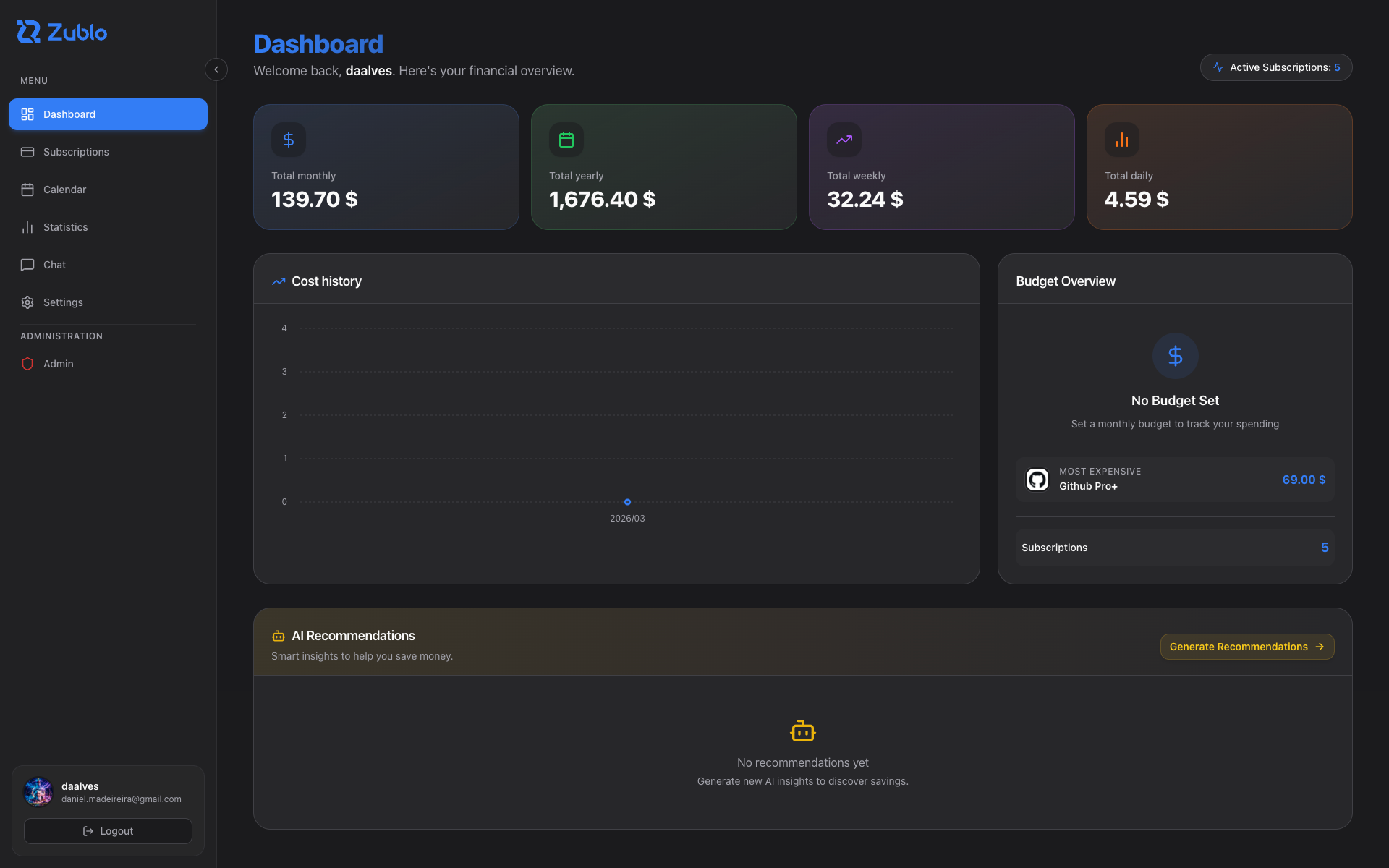
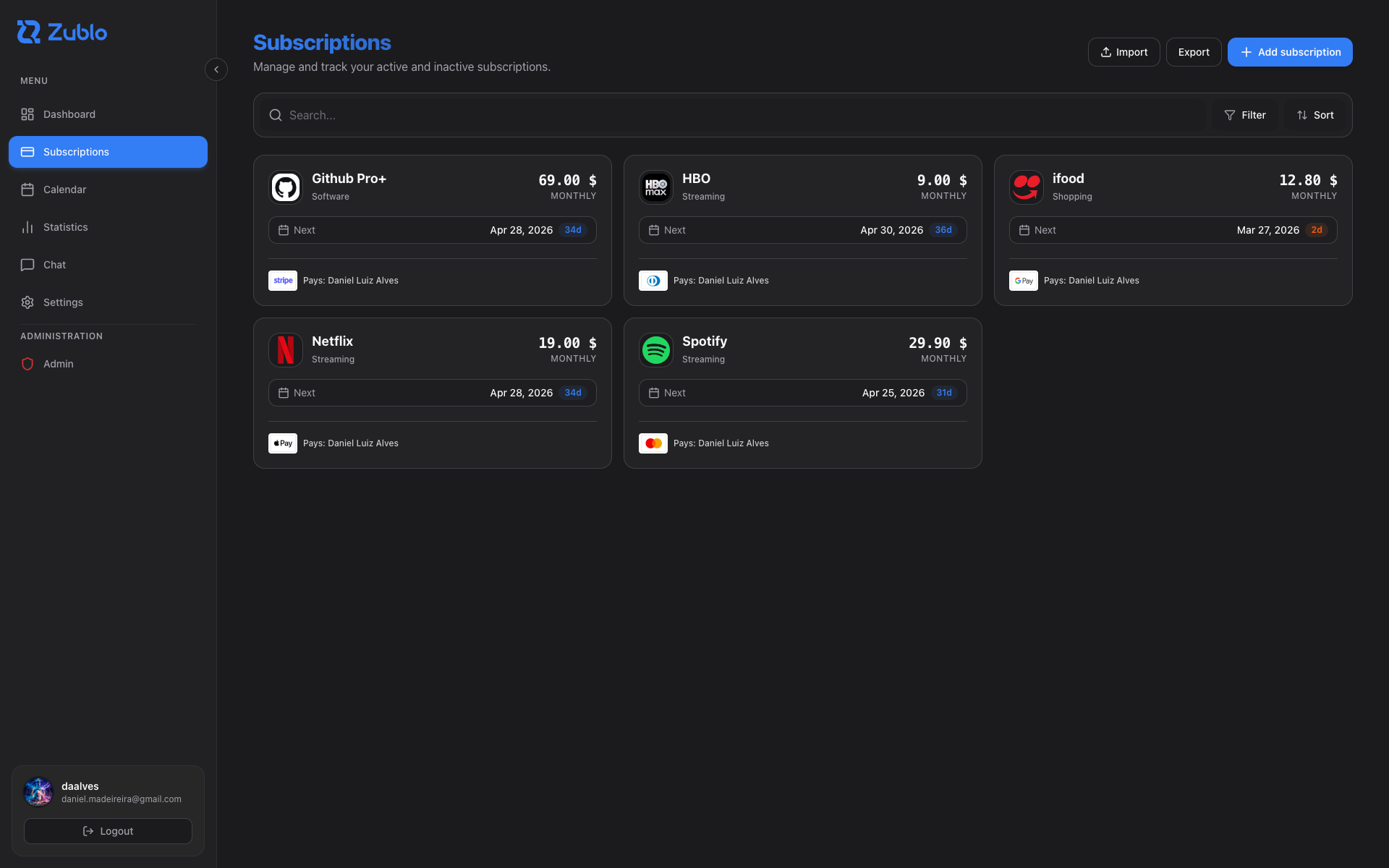
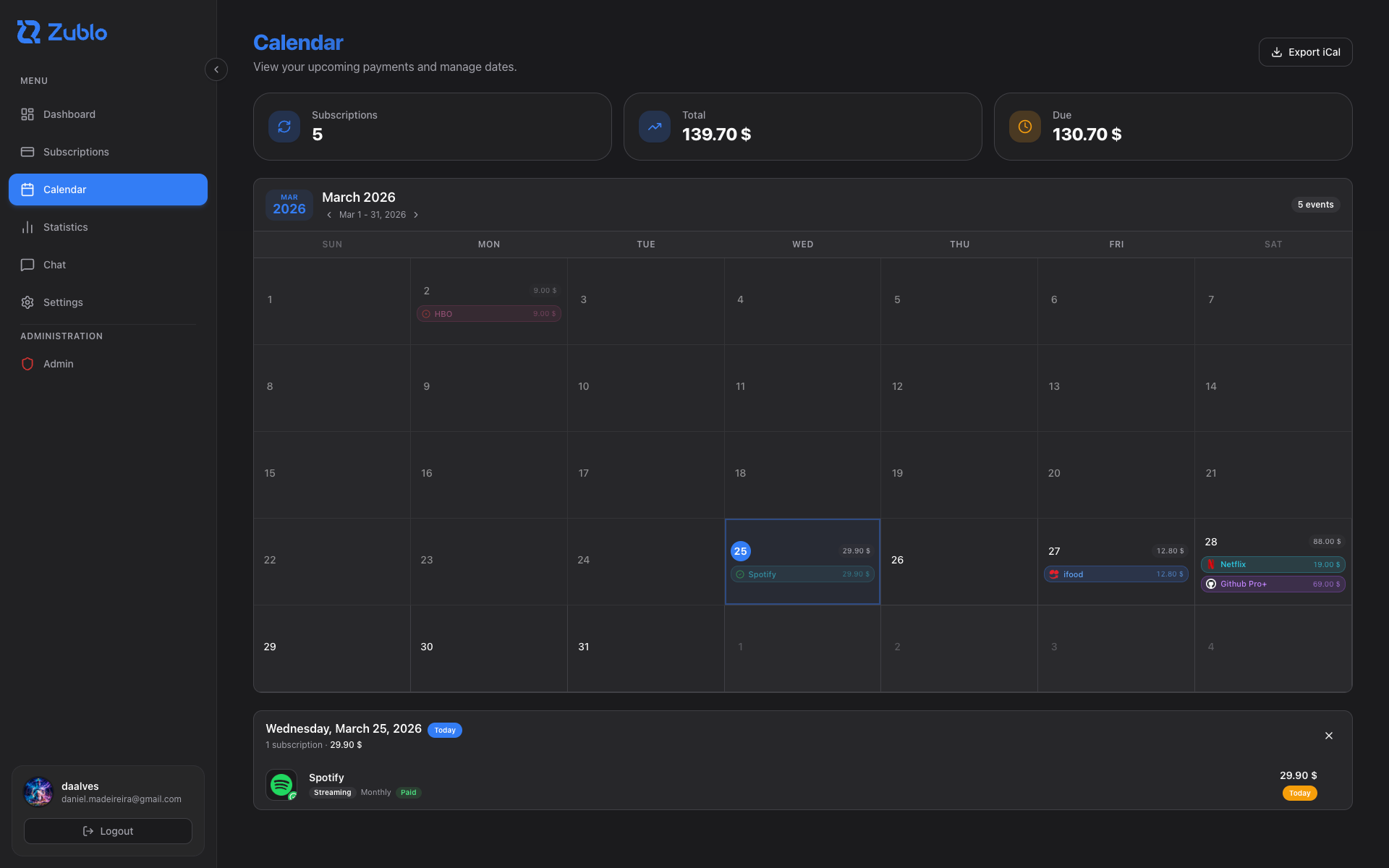
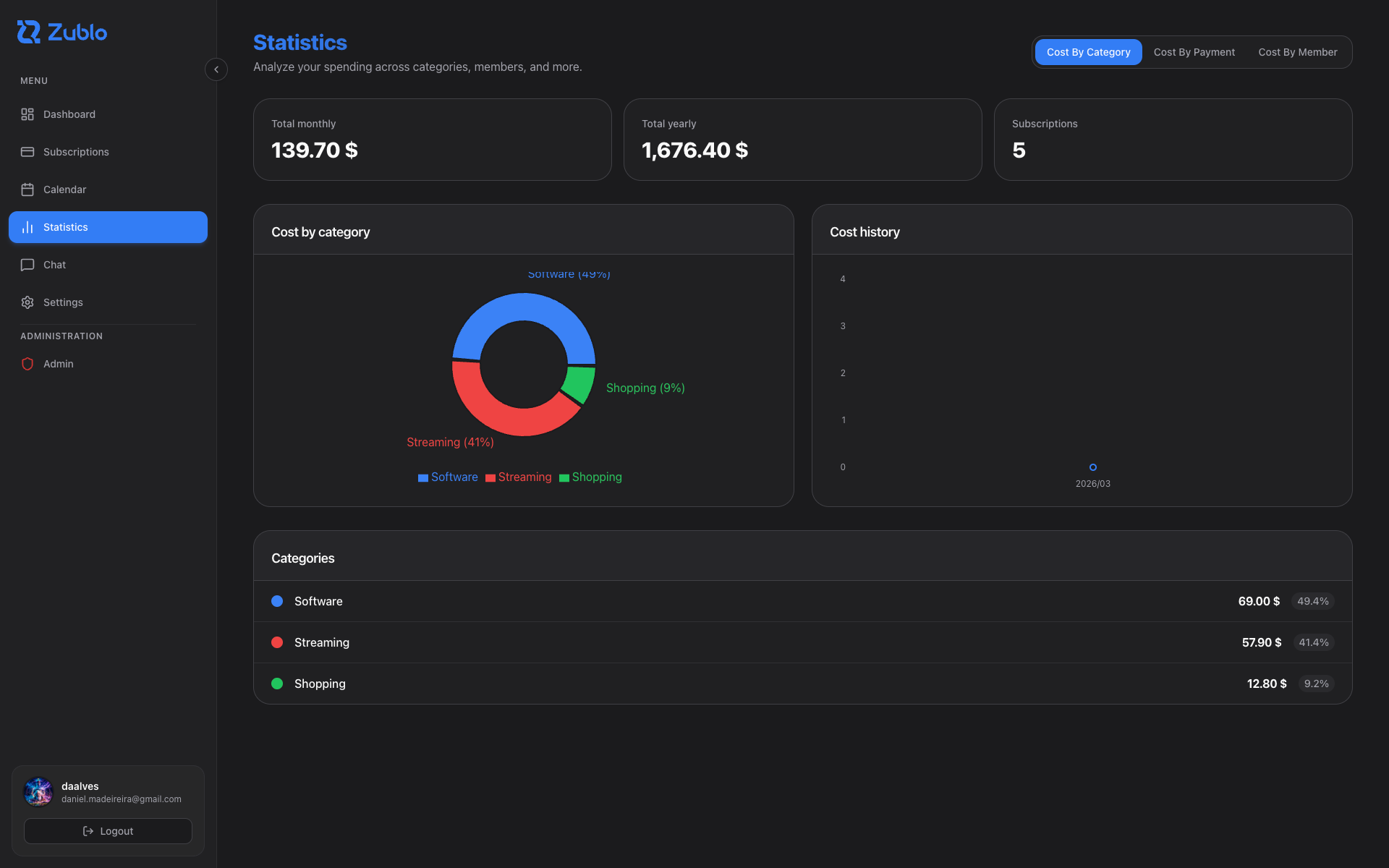
It gives you a clean web UI, recurring payment visibility, reminders, calendar and statistics views, API access, and a Docker-first setup built for self-hosters.
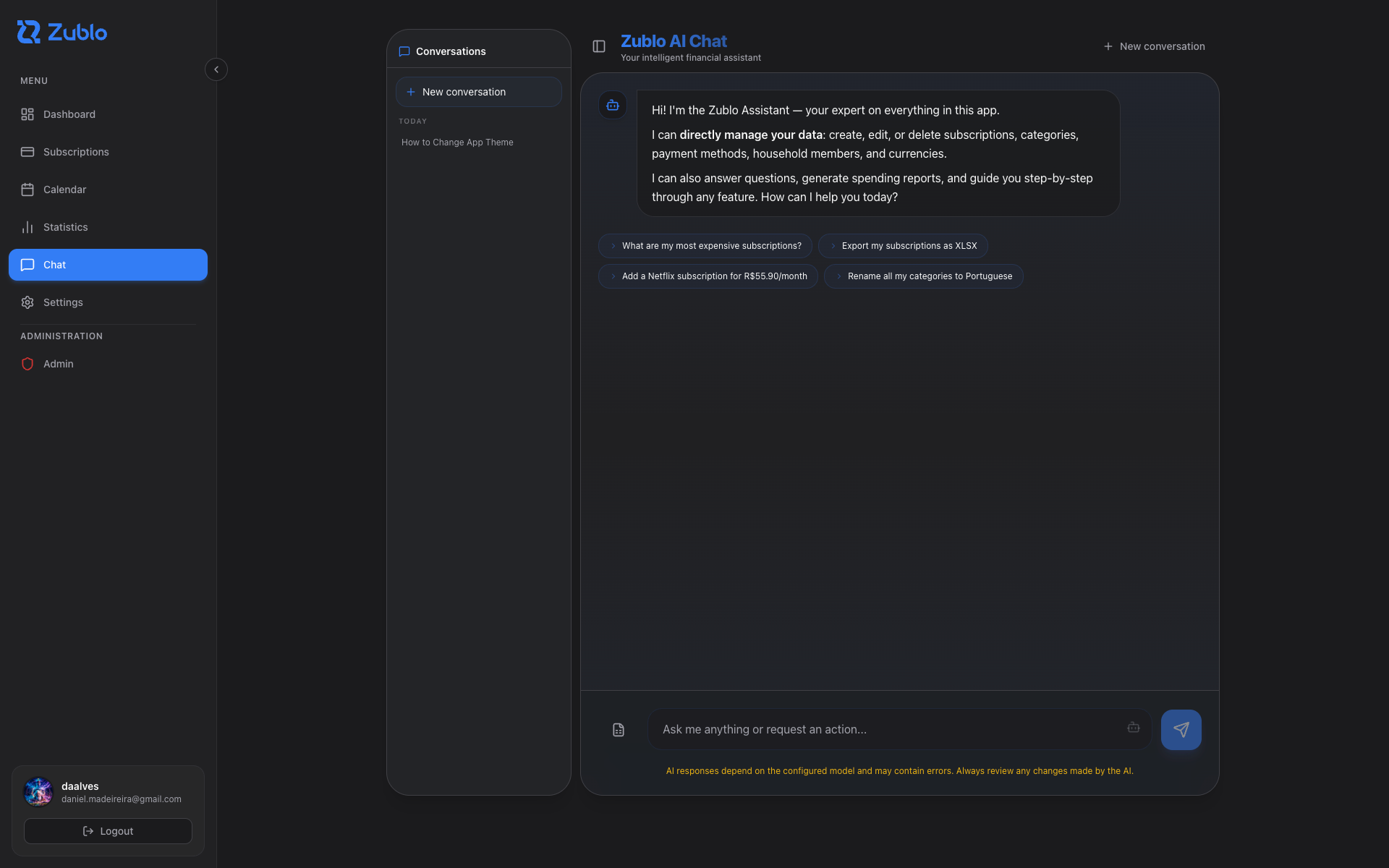
It also has one of the most differentiated parts of the product built in: an AI layer that can analyze spending, power chat-based workflows, and connect to multiple LLM providers instead of locking you into a single vendor.
If you want a focused alternative to bloated finance software or closed SaaS trackers, this is the repo.
## Why This Repo Gets Attention
- It solves a real problem with a narrow, practical scope
- It is self-hosted, so your data stays under your control
- It is easy to deploy and easy to understand
- It uses a compact stack instead of a pile of infrastructure
- It is useful on day one, even if you never touch the code
## At A Glance
| What matters | Why it lands |
|---|---|
| One job, done well | Track recurring payments without turning into a full finance suite |
| Fast deployment | A simple Docker setup gets the app running quickly |
| Real ownership | Your data lives on your infrastructure |
| AI that is actually useful | Chat, recommendations, and provider flexibility are part of the product |
| Compact architecture | React frontend, PocketBase runtime, no unnecessary platform sprawl |
| Forkable codebase | Small enough to understand, practical enough to extend |
## Perfect For
| Use case | Why Zublo fits |
|---|---|
| Self-hosters | One container, SQLite persistence, no heavy platform requirements |
| Homelab users | Small footprint, easy backup story, easy reverse proxy integration |
| Privacy-minded users | Your subscription data stays on your own infrastructure |
| Indie builders | Compact full-stack codebase that is practical to fork and extend |
| Teams tracking shared spend | Clear recurring cost visibility without adopting a full finance suite |
## Demo
Demo screenshots
## Feature Overview
| Area | What you get |
|---|---|
| Subscriptions | Recurring billing cycles, due dates, payment context, change history with total spent |
| Calendar | Upcoming payments in a calendar view |
| Dashboard | High-level cost visibility and summary metrics |
| Statistics | Spending breakdowns and trend visibility |
| Currencies | Multi-currency handling with exchange-rate sync |
| API access | REST usage through scoped API keys |
| AI | Chat-based workflows, recommendations, and pluggable providers |
| Authentication | TOTP-based 2FA |
| Deployment | Single self-hosted app with Docker |
## AI Built In
This is not a cosmetic AI checkbox.
Zublo includes an AI layer that can work with your subscription data and support real product workflows:
- AI-powered recommendations from your spending data
- chat interface wired into app capabilities
- support for multiple provider setups instead of a single locked vendor
- compatibility with local or self-hosted inference paths
Supported provider model includes:
- Google Gemini
- OpenAI
- Ollama
- OpenAI-compatible endpoints such as OpenRouter, Groq, Mistral, and similar gateways
That makes Zublo interesting not only as a self-hosted subscription tracker, but also as a practical example of an AI-enabled product that still keeps deployment and ownership simple.
## Why It Feels Good To Self-Host
| Characteristic | What that means in practice |
|---|---|
| Single app runtime | Frontend and backend ship together |
| SQLite persistence | Simple backups and low operational overhead |
| PocketBase core | Auth, data, and admin capabilities without a large backend stack |
| Docker-first packaging | Easy to run on VPS, NAS, mini-PC, or homelab |
| Narrow product scope | Less maintenance drag than a general finance platform |
## What Zublo Is Not
- not a full accounting suite
- not a bookkeeping platform
- not a bank sync product
- not a cloud-only SaaS
That narrow scope is the point.
## Stack
| Layer | Technology |
|---|---|
| Frontend | React 18, Vite, TypeScript, TanStack Router, React Query, Tailwind CSS |
| Backend runtime | PocketBase |
| Backend customization | PocketBase JS hooks and migrations |
| Persistence | SQLite via PocketBase |
| Packaging | Docker, Docker Compose, GHCR |
## Deploy In Minutes
Create a `docker-compose.yml` like this:
```yaml
services:
zublo:
image: ghcr.io/danielalves96/zublo:latest
container_name: zublo
restart: unless-stopped
ports:
- "9597:9597"
environment:
PB_ENCRYPTION_KEY: "change-me-in-production"
volumes:
- ./zublo-data:/pb/pb_data
```
Start it:
```bash
docker compose up -d
```
Then open:
- `http://localhost:9597` for the app
- `http://localhost:9597/_/` for PocketBase admin
- `http://localhost:9597/api/` for the REST API
Important:
- persist `/pb/pb_data`
- set `PB_ENCRYPTION_KEY` in real deployments
- the first registered user becomes the initial admin
### Running Behind A Reverse Proxy
Zublo is a single PocketBase process, so any proxy that forwards plain HTTP to `9597` without buffering or rewriting the request body works. A minimal Caddy example:
```
zublo.example.com {
reverse_proxy localhost:9597
}
```
If you enable MFA or update your profile and get unexpected `400` responses, the most common cause is a proxy directive that buffers, compresses, or rewrites the request body (large `client_max_body_size`/`request_body` tweaks, aggressive compression, or a `Content-Length`/chunked mismatch). Keep the proxy config as close to a plain passthrough as possible; there's no proxy-specific handling required on the Zublo side.
## Local Development
If you want to work on the repo itself:
```bash
bun install
bun run dev
```
This starts:
- Vite on `http://localhost:5173`
- PocketBase on `http://127.0.0.1:8080`
For non-Docker local development, the repository expects a PocketBase binary at `apps/backend/pocketbase`.
## Architecture At A Glance
Zublo is intentionally compact.
- `apps/web` contains the React application
- `apps/backend` contains PocketBase hooks, migrations, runtime assets, and backend behavior
- the frontend is built into `apps/backend/pb_public` for production serving
- PocketBase serves both the API and the built frontend in production
- mutable runtime data lives in `/pb/pb_data`
In local development:
- Vite serves the frontend
- PocketBase serves the API
- Vite proxies `/api` to PocketBase
In production:
- one container serves the frontend and backend together
For the full repository-level architecture, see [ARCHITECTURE.md](./ARCHITECTURE.md).
For frontend-specific structure and page composition rules, see [apps/web/ARCHITECTURE.md](./apps/web/ARCHITECTURE.md).
## Repository Layout
```text
.
├── apps/
│ ├── backend/ # PocketBase hooks, migrations, runtime assets
│ └── web/ # React application
├── scripts/ # Maintainer utilities
├── Dockerfile
├── docker-compose.yml
├── Makefile
└── README.md
```
## Who This Repository Is For
- self-hosters
- homelab users
- contributors who want a small, understandable full-stack app
- developers interested in PocketBase-backed products
## Why The Codebase Stays Approachable
- React frontend and PocketBase backend live in the same repo
- custom backend logic is grouped by domain in hook files
- the production runtime is compact and easy to reason about
- the deployment model is simple enough for solo operators
- the product scope is intentionally constrained
## Contributing
Zublo is still shaping its public open source surface. Good contributions right now are the ones that improve clarity, onboarding, maintainability, and narrowly scoped behavior.
Start here:
- [CONTRIBUTING.md](./CONTRIBUTING.md)
- [SUPPORT.md](./SUPPORT.md)
- [SECURITY.md](./SECURITY.md)
- [CODE_OF_CONDUCT.md](./CODE_OF_CONDUCT.md)
## Maintainer
Zublo is maintained by Daniel Luiz Alves.
GitHub: `@danielalves96`
## License
Zublo is licensed under Apache License 2.0.
Copyright Daniel Luiz Alves.
See [LICENSE](./LICENSE) and [NOTICE](./NOTICE).