# PAI v5.0.0 โ Life Operating System
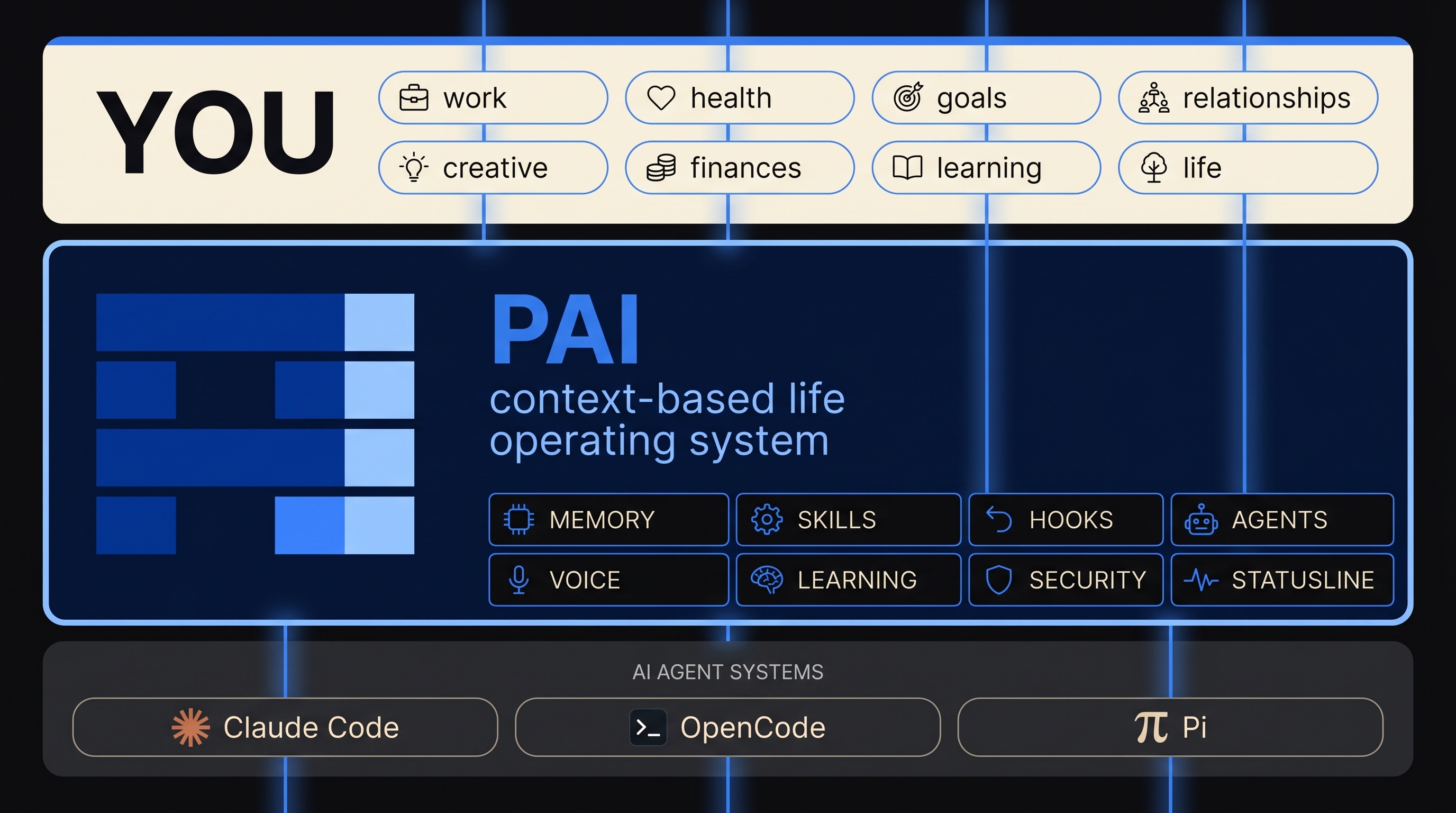
**The biggest release in PAI history.** PAI is no longer "AI scaffolding" โ it is a **Life Operating System** with a unified daemon, a Life Dashboard, a personalized Digital Assistant, and a fully-articulated execution algorithm.
[](https://docs.ourpai.ai)
[](.claude/skills/)
[](.claude/hooks/)
[](.claude/skills/)
[](.claude/PAI/ALGORITHM/)

[](.claude/PAI/MEMORY/)
[](.claude/PAI/PULSE/)
**๐ Full documentation lives at [docs.ourpai.ai](https://docs.ourpai.ai)** โ every subsystem (Algorithm, ISA, Memory, Skills, Hooks, Pulse, Containment) has its own deep-dive page with diagrams, examples, and reference material.
---
## One-Line Install
```bash
curl -sSL https://ourpai.ai/install.sh | bash
```
That's it. The installer wizard handles Bun, Git, Claude Code verification, ElevenLabs key (optional), DA identity setup, voice picker, Pulse launchd registration, and validation. Existing `~/.claude/` is auto-backed-up to `~/.claude.backup-{TIMESTAMP}` before anything is overwritten.
**Prefer to inspect first?** [Read the script](https://ourpai.ai/install.sh) before piping it. Or clone manually:
```bash
git clone https://github.com/danielmiessler/PAI.git ~/.claude
cd ~/.claude && ./install.sh
```
After install:
```bash
open http://localhost:31337 # the Life Dashboard
```
---
## TL;DR
**Stop thinking of PAI as a Claude Code config.** PAI is the framework that turns AI from a chatbot you talk to into a system that **runs your life** โ it knows your goals, your people, your workflows, your current state, your ideal state, and continuously hill-climbs you from one to the other.
- **PAI** = Personal AI Infrastructure = the **Life Operating System**
- **Your DA** = your Digital Assistant = the primary interface to the OS (you name it)
- **Pulse** = the **Life Dashboard** + central daemon (port 31337)
- **The Algorithm** = the universal Current State โ Ideal State execution loop
If you're upgrading from v4.x, this is a **different system**, not a patch. Read the [Migration Guide](#migration-guide-from-v4x) before installing.
---
## The Core Shift โ Your DA is the center of your AI universe

PAI v4.x was scaffolding for AI. **PAI v5.0.0 is the Life Operating System** โ and the way you experience that OS is one named DA.
We've spent the last few years arguing about agents and harnesses and context engineering and prompt engineering. Those are all real, and PAI runs every one of them inside it. But none of them are the point. The point is the **single named entity** with full context about your life โ the conduit, the friend, the trusted assistant who knows everything about you and works on your behalf 24/7.
The principal โ you, the human โ is at the center. Your DA wraps around you. Skills, memory, the algorithm, hooks, agents, Pulse, the web, devices, robots, other people's DAs โ all of it is infrastructure your DA reaches into. You don't talk to an army of agents. You talk to one entity. That entity has the army.
The prime directive is simple: **read your current state from every signal it can reach, compare it to your TELOS-articulated ideal state, and constantly close the gap.** That is what AI is for. That is what we are building.
> Daniel walks through the full thesis in [**We're All Building a Single Digital Assistant**](https://danielmiessler.com/blog/we-are-all-building-single-digital-assistant) โ blog post + [companion video](https://www.youtube.com/watch?v=uUForkn00mk). v5.0.0 is the implementation of the architecture argued for in that piece.
The Life OS thesis is canonical inside the repo as well: [`PAI/DOCUMENTATION/LifeOs/LifeOsThesis.md`](.claude/PAI/DOCUMENTATION/LifeOs/LifeOsThesis.md).
### What changed in v5.0.0 โ in priority order
The release is large. If you only read four bullets, read these:
1. **The OS transition.** PAI is now a Life Operating System with your DA at the center. The framing change is bigger than any individual feature.
2. **PRD โ ISA migration.** Every project, task, and decision now articulates its **Ideal State Artifact** โ one document, twelve sections, five identities. This replaces the old ad-hoc PRD pattern across the entire system.
3. **Pulse โ the unified daemon.** One bun process, one port (`31337`), one launchd service, one log file. Replaces every loose voice/observability/hook script from v4.x.
4. **45 skills shipped โ the most ever.** Up from 36 leaf skills in v4.0.3 and 41 in v3.0. Catalog with descriptions and use cases below.
**Plus a new constitutional layer:** v5.0.0 adds a top-level **system prompt** (`PAI/PAI_SYSTEM_PROMPT.md`) loaded via `--append-system-prompt-file`, which encodes the non-negotiable behavioral rules โ output format, verification doctrine, security protocol โ at the highest priority above `CLAUDE.md`. Adherence is dramatically stronger than v4.x.
---
## Headline Changes
### 1. Pulse โ the unified daemon (THE big new component)
**`PAI/PULSE/pulse.ts`** โ one bun process, one port (31337), one launchd plist, one log file.
Pulse replaces every previous loose service. It runs:
- **Voice notifications** via ElevenLabs (`/notify` endpoint)
- **Hook execution** for the entire PAI lifecycle (SessionStart, PreToolUse, PostToolUse, Stop, PreCompact, etc.)
- **Observability** โ tool activity, failures, satisfaction signals, Algorithm reflections
- **Performance** monitoring
- **Syslog capture** (UniFi, etc.)
- **Cron scheduling** for routines and recurring jobs
- **The Life Dashboard** at `http://localhost:31337` โ Next.js app served from `Observability/out/`
- **Wiki API** โ exposes your KNOWLEDGE archive + system docs over HTTP
- **Optional integrations** โ Telegram bot, iMessage bridge, DA messaging
After install, Pulse runs as a supervised macOS launchd service (`com.pai.pulse`) with a menu bar app. **You should leave it running.** It's how your DA reaches you with voice, how the dashboard stays live, how scheduled work fires.
The dashboard surfaces **22 routes**: Life, Health, Finances, Business, Work, Telos, Goals, Air, Performance, Hooks, Skills, Agents, Security, Knowledge, Knowledge Graph, System Docs, System Graph, Arbol, Ladder, Novelty, Assistant, root.
### 2. The DA system โ your AI gets a name
Every PAI install picks a **DA identity**: name, voice, color, personality. This is your AI โ the peer you work with daily. The reference implementation ships with a generic "PAI" DA on free ElevenLabs public voices so you can hear it work out of the box. **Run `/interview` after install** and your DA will guide you through naming itself, picking a voice, capturing your TELOS.
| File | What it owns |
|------|--------------|
| `PAI/USER/PRINCIPAL_IDENTITY.md` | Who **you** are โ name, role, location, worldview, preferences, work patterns |
| `PAI/USER/DA_IDENTITY.md` | Who your **DA** is โ name, voice ID, personality, writing style, what they love, what they dislike |
| `PAI/USER/TELOS/` | Mission, goals, beliefs, wisdom, challenges, narratives โ the spine of every recommendation |
Both files are **loaded at session start** so the DA always has them in context. The Life OS frame requires this โ without the DA knowing who you are, none of the upstream features have anything to climb against.
### 3. The Algorithm v6.3.0 โ Current State โ Ideal State, formalized

**`PAI/ALGORITHM/v6.3.0.md`** is doctrine. Every non-trivial task runs through the seven phases: **OBSERVE โ THINK โ PLAN โ BUILD โ EXECUTE โ VERIFY โ LEARN**. The Algorithm is the centerpiece of PAI โ everything else feeds it.
What's new in v6.x:
- **Mode classifier** โ a Sonnet-backed `UserPromptSubmit` hook decides MINIMAL / NATIVE / ALGORITHM and tier (E1โE5) for every prompt. The executor obeys the classifier; no regex layer, no model judgment.
- **Closed-list thinking capabilities** โ IterativeDepth, ApertureOscillation, FirstPrinciples, SystemsThinking, RootCauseAnalysis, Council, RedTeam, Science, BeCreative, Ideate, BitterPillEngineering, Evals, WorldThreatModel, Fabric patterns, ContextSearch, ISA, Advisor, ReReadCheck, FeedbackMemoryConsult. Phantom capabilities (anything outside this list) are a CRITICAL FAILURE.
- **Effort tiers** โ E1 (<90s) through E5 (<2h+). Time budget is the hard constraint; thinking-floor and ISC-count are tier-graded.
- **Voice phase announcements** โ every phase transition narrates over Pulse so you can follow long tasks audibly.
- **Verification doctrine** โ live-probe required for user-facing artifacts, advisor calls at commitment boundaries, Cato cross-vendor audit at E4/E5, conflict surfacing on advisor/empirical contradictions.
### 4. The ISA โ the universal "ideal state" primitive (PRD โ ISA migration)
This is the second-biggest shift in v5.0.0. **The Ideal State Artifact replaces the PRD as the unit of work across PAI.**

Old PRDs were task-shaped: a description of a thing to build, separate from how you'd verify it, separate from where the build's truth lived. The ISA collapses all of that into one document with five identities at once:
- **Ideal state articulation** โ what "done" actually looks like, as a hard-to-vary explanation (David Deutsch)
- **Test harness** โ the criteria are the tests, with named tool probes for each
- **Build verification** โ passing the criteria verifies what was built
- **Done condition** โ task complete when every criterion passes
- **System of record** โ the canonical truth for the thing being articulated
12 fixed sections, in order: `Problem` โ `Vision` โ `Out of Scope` โ `Principles` โ `Constraints` โ `Goal` โ `Criteria` โ `Test Strategy` โ `Features` โ `Decisions` โ `Changelog` โ `Verification`. Required sections per effort tier are HARD-gated (E1: Goal+Criteria; E4/E5: all twelve).
**Two homes:**
- **Project ISAs** live with the project โ `