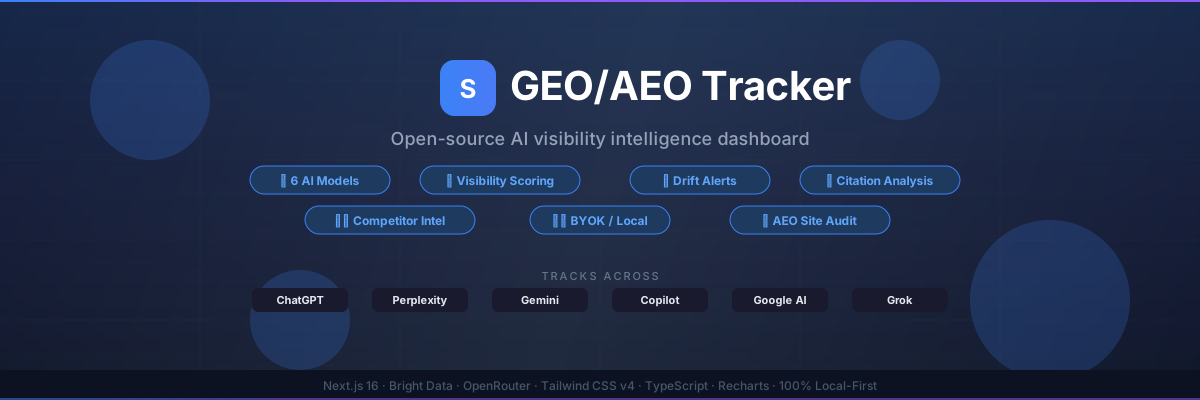



Open-source, local-first AI visibility intelligence dashboard.
Track your brand across 6 AI models with zero vendor lock-in.
Now with SRO Analysis — deep cross-platform search result optimization.
Mobile-responsive — works seamlessly on desktop, tablet, and phone.
Features · Quick Start · Deploy · Cloud Sync · API
--- > 🌐 **Built with [Bright Data](https://brightdata.com/?utm_source=geo-tracker-os)** — the world's leading web data platform. > GEO/AEO Tracker uses Bright Data's AI Scraper API to reliably collect structured responses from 6 AI models. > [Get your API key →](https://brightdata.com/?utm_source=geo-tracker-os) --- ## Why AI models are replacing traditional search for millions of queries. If your brand isn't visible in ChatGPT, Perplexity, or Gemini responses, you're invisible to a growing audience. Existing tools charge **$200–$500+/month**, lock you into closed ecosystems, and store your data on their servers. **GEO/AEO Tracker** is the alternative: - 🔑 **BYOK** (Bring Your Own Keys): your data never leaves your machine - 🤖 **6 AI models** simultaneously: more coverage than paid tools - 💸 **$0/month**: self-hosted, open-source, forever free - 🛡️ **Local-first** by default: IndexedDB + localStorage, no external database - ☁️ **Optional cloud sync** via your own Supabase project (free tier) for multi-device access ## Features ### 📋 13 Feature Tabs | Tab | What it does | |-----|-------------| | ⚙️ **Project Settings** | Brand name, aliases, website, industry, keywords, description | | 💬 **Prompt Hub** | Manage tracking prompts with `{brand}` injection. Run single or batch across models in parallel | | 🎭 **Persona Fan-Out** | Generate persona-specific prompt variants (CMO, SEO Lead, Founder, etc.) | | 🔍 **Niche Explorer** | AI-generated high-intent queries for your niche | | 📝 **Responses** | Browse AI responses with brand/competitor highlighting, filters, and search | | 📊 **Visibility Analytics** | Score trends over time via Recharts line charts. CSV export | | 🔗 **Citations** | Domain-grouped citation frequency analysis | | 🎯 **Citation Opportunities** | URLs where competitors get cited but you don't, with outreach briefs | | ⚔️ **Competitor Battlecards** | AI-generated side-by-side competitor analysis with strengths/weaknesses | | 🏥 **AEO Audit** | Site readiness check: llms.txt, Schema.org, BLUF density, heading structure | | 📡 **SRO Analysis** | 6-stage deep pipeline: Gemini Grounding → Cross-Platform Citations → SERP → Page Scraping → Site Context → LLM Analysis. Produces SRO Score (0–100), prioritized recommendations, content gaps & competitor insights | | ⏱️ **Automation** | Cron / GitHub Actions templates for scheduled runs | | 📖 **Documentation** | Searchable 18-section guide covering every feature | ### 🚀 Core Capabilities - 🤖 **Multi-model tracking** across ChatGPT, Perplexity, Gemini, Copilot, Google AI Overview, Grok - � **SRO Analysis**: 6-stage pipeline scoring how well your page is optimized for AI search results - 📈 **Visibility scoring** (0–100): brand mentions, position, frequency, citations, sentiment - 🔔 **Drift alerts**: automatic notifications when your score changes significantly - ⏰ **Scheduled auto-runs**: configurable interval-based batch scraping - 🚀 **Fully parallel batch runs**: all prompt × provider combos execute simultaneously - 📅 **Historical comparison**: delta tracking across time periods - 🏢 **Multi-workspace**: manage multiple brands/projects independently - 🎨 **Dark/light/system** theme with a polished sidebar UI - 📱 **Mobile-responsive**: collapsible sidebar with hamburger menu, adaptive KPI grid, and scrollable model toolbar — works on any screen size ## Architecture ``` Next.js 16.1 + Turbopack ├── app/ │ ├── page.tsx # Main dashboard (or demo via env var) │ ├── demo/page.tsx # Standalone demo route │ └── api/ │ ├── scrape/route.ts # Bright Data AI Scrapers (Node runtime) │ ├── analyze/route.ts # OpenRouter LLM analysis (Edge runtime) │ ├── audit/route.ts # AEO site audit crawler │ ├── sro-analyze/route.ts # SRO final LLM analysis │ ├── serp/route.ts # Bright Data SERP results │ ├── site-context/route.ts # Homepage context extraction │ ├── unlocker/route.ts # Bright Data Web Unlocker (single/batch) │ ├── brightdata-platforms/ # 6-platform AI citation polling │ ├── bulk-sro/route.ts # SSE bulk SRO analysis │ └── state/route.ts # Cloud KV store (GET/PUT/DELETE — Node runtime) ├── components/ │ ├── sovereign-dashboard.tsx # Main shell — state, tabs, KPIs │ └── dashboard/ │ ├── types.ts # AppState, ScrapeRun, Provider, etc. │ └── tabs/ # 13 tab components ├── lib/ │ ├── client/ │ │ ├── sovereign-store.ts # Storage API — IDB default, cloud when configured │ │ └── cloud-mode.ts # isCloudActive / isCloudAvailable helpers │ ├── server/ │ │ ├── supabase.ts # Server-side Supabase singleton (service_role) │ │ ├── kv-store.ts # kvGet / kvSet / kvDelete helpers │ │ ├── brightdata-scraper.ts # Bright Data AI Scraper integration │ │ ├── brightdata-platforms.ts # 6-platform citation scraper │ │ ├── gemini-grounding.ts # Gemini Grounding via Google Search │ │ ├── openrouter-sro.ts # SRO analysis via OpenRouter │ │ ├── serp.ts # SERP data via Bright Data │ │ ├── sro-types.ts # SRO type definitions │ │ └── unlocker.ts # Web Unlocker scraping │ └── demo-data.ts # Deterministic seed data for demo mode ├── supabase/ │ └── migrations/ │ └── 001_kv_store.sql # kv_store table + updated_at trigger └── scripts/ ├── test-scraper.js # API validation script └── test-pillar.js # Feature pillar tests ``` **Key decisions:** - **IndexedDB** primary store (no size limit) with localStorage as best-effort cache; same public API whether cloud is active or not - **Cloud storage routes through `/api/state`** — the client never calls Supabase directly, so `service_role` stays server-side and RLS isn't a concern - **Auto-opt-in cloud**: when `NEXT_PUBLIC_CLOUD_STORAGE_ENABLED=true` the IDB write path becomes a cache; IDB is the authoritative fallback if the cloud route fails - **Edge runtime** for `/api/analyze` (Gemini Flash via OpenRouter) — fast global inference - **Bright Data Web Scraper API** for AI model scraping — reliable, structured data - **Bright Data SERP + Web Unlocker** for SRO pipeline data gathering - **Google Gemini API** for grounding analysis in SRO pipeline - **Zod** schema validation on all API routes - **Recharts** for analytics visualizations - **Tailwind CSS v4** with CSS custom properties for theming ## Quick Start ### Prerequisites - Node.js 18+ - [Bright Data](https://brightdata.com/) API key + AI Scraper dataset IDs - [OpenRouter](https://openrouter.ai/) API key ### Install & Run ```bash git clone https://github.com/danishashko/geo-aeo-tracker.git cd geo-aeo-tracker npm install ``` Create `.env` in the project root: ```env BRIGHT_DATA_KEY=your_bright_data_api_key # AI Scraper dataset IDs (from Bright Data Scrapers Library) BRIGHT_DATA_DATASET_CHATGPT=gd_xxx BRIGHT_DATA_DATASET_PERPLEXITY=gd_xxx BRIGHT_DATA_DATASET_COPILOT=gd_xxx BRIGHT_DATA_DATASET_GEMINI=gd_xxx BRIGHT_DATA_DATASET_GOOGLE_AI=gd_xxx BRIGHT_DATA_DATASET_GROK=gd_xxx # OpenRouter (powers /api/analyze, /api/sro-analyze, /api/site-context) OPENROUTER_KEY=your_openrouter_api_key # Gemini API (powers Gemini Grounding in SRO Analysis) GEMINI_API_KEY=your_gemini_api_key # Bright Data zones for the SRO pipeline (SERP + Web Unlocker). # Use your own zone names from the Bright Data dashboard. BRIGHT_DATA_SERP_ZONE=your_serp_zone BRIGHT_DATA_UNLOCKER_ZONE=your_web_unlocker_zone # Optional: override the OpenRouter model used by /api/analyze, # /api/sro-analyze, and /api/site-context (default: google/gemini-3.5-flash). # OPENROUTER_MODEL=google/gemini-3.5-flash ``` ```bash npm run dev ``` Open [http://localhost:3000](http://localhost:3000). ### Validate Setup ```bash npm run test:scraper # Test Bright Data API connection npm run build # Full production build check npm run lint # ESLint ``` ## Deploy to Vercel > ✅ **The deploy button launches a fully functional production instance.** You'll be prompted for your API keys during setup. No demo mode, no restrictions. [](https://vercel.com/new/clone?repository-url=https%3A%2F%2Fgithub.com%2Fdanishashko%2Fgeo-aeo-tracker&env=BRIGHT_DATA_KEY,BRIGHT_DATA_DATASET_CHATGPT,BRIGHT_DATA_DATASET_PERPLEXITY,BRIGHT_DATA_DATASET_COPILOT,BRIGHT_DATA_DATASET_GEMINI,BRIGHT_DATA_DATASET_GOOGLE_AI,BRIGHT_DATA_DATASET_GROK,BRIGHT_DATA_SERP_ZONE,BRIGHT_DATA_UNLOCKER_ZONE,OPENROUTER_KEY,GEMINI_API_KEY) 1. Click the button above (or run `vercel --prod` from your clone) 2. Enter your [Bright Data](https://brightdata.com/?utm_source=geo-tracker-os) and [OpenRouter](https://openrouter.ai/) API keys when prompted 3. Done! Your tracker deploys automatically with full production capabilities ### 🧪 Demo-Only Mode (optional) Want to deploy a read-only preview with sample data and no API keys? 1. Add env var `NEXT_PUBLIC_DEMO_ONLY` = `true` in Vercel → Project Settings → Environment Variables 2. Redeploy. The dashboard will load with pre-generated demo data instead of making live API calls ### ☁️ Optional: Cloud persistence with Supabase By default, **all your data stays in your browser** (IndexedDB). That's great for a single device, but if you want your runs, prompts, and settings to persist across devices — or survive clearing browser data — you can plug in a free Supabase project. **Why it's optional** - Local-first still works 100% without Supabase. - When enabled, the client never talks to Supabase directly. Every read/write goes through a server-side Next.js route using your service-role key, so your key stays private and RLS is a non-issue. - You can toggle cloud sync on/off per-browser from **Project Settings → Cloud Sync**. **Setup (5 minutes)** 1. Create a free project at [supabase.com](https://supabase.com/). 2. In the Supabase SQL editor, paste and run `supabase/migrations/001_kv_store.sql` from this repo. This creates a single `kv_store` table with RLS enabled. 3. In Supabase → **Project Settings → API**, grab: - `Project URL` → `SUPABASE_URL` (or `NEXT_PUBLIC_SUPABASE_URL` — either is accepted) - `service_role` secret key → `SUPABASE_SERVICE_ROLE_KEY` 4. In Vercel → **Project Settings → Environment Variables**, add: ```env SUPABASE_URL=https://your-project.supabase.co SUPABASE_SERVICE_ROLE_KEY=your_service_role_key NEXT_PUBLIC_CLOUD_STORAGE_ENABLED=true # Shared secret that authenticates the cloud sync API. Generate a long # random string (e.g. `openssl rand -hex 24`). REQUIRED when cloud sync is # enabled — without it the /api/state route rejects every request. STATE_SYNC_SECRET=your_long_random_secret ``` 5. Redeploy. Open **Project Settings → Cloud Sync**, enable it, and paste the same `STATE_SYNC_SECRET` value into the **Sync passphrase** field. This is what keeps your KV store private: the API denies any request without it, so the secret never ships in the client bundle. **Free tier caveats** (always check [supabase.com/pricing](https://supabase.com/pricing) for current limits) - Free tier includes a generous Postgres database, but projects pause after a week of inactivity on the free plan — first request after a pause may be slow. - The `service_role` key has full DB access — keep it server-side only (Vercel env vars are fine; never commit it). - Single-tenant by design: one deployment = one Supabase project = your data. If you want multi-user auth, you'll need to extend the schema with a user_id column + RLS policies. **What gets synced** - All app state keyed by workspace (`sovereign-aeo-tracker-*`) — runs, prompts, settings, SRO results. - NOT synced (kept local on purpose): theme preference, workspace list, active workspace — these are per-device UI choices. ## API Routes | Route | Runtime | Purpose | |-------|---------|---------| | `POST /api/scrape` | Node.js | Bright Data AI Scrapers — query AI models for brand mentions | | `POST /api/analyze` | Edge | OpenRouter LLM inference — battlecards, niche queries | | `POST /api/audit` | Node.js | AEO site audit — llms.txt, schema, BLUF, heading checks | | `POST /api/sro-analyze` | Node.js | SRO final analysis — synthesizes all data into score + recommendations | | `POST /api/serp` | Node.js | Bright Data SERP — organic search results for a keyword | | `POST /api/site-context` | Node.js | Homepage scrape + context extraction via OpenRouter | | `POST /api/unlocker` | Node.js | Bright Data Web Unlocker — single or batch URL scraping | | `POST /api/brightdata-platforms` | Node.js | 6-platform AI citation polling via Bright Data datasets | | `POST /api/bulk-sro` | Node.js | SSE streaming — bulk SRO analysis across multiple keywords | | `GET/PUT/DELETE /api/state` | Node.js | Cloud KV store proxy — reads/writes to Supabase using service-role key (disabled when cloud not configured) | All routes include input validation and error handling. Most routes use in-memory caching to minimize API costs. ## Tech Stack | Layer | Technology | |-------|-----------| | Framework | Next.js 16.1 + Turbopack | | Language | TypeScript (strict) | | Styling | Tailwind CSS v4 with `@theme inline` | | Charts | Recharts | | Validation | Zod | | Storage | IndexedDB (idb-keyval) + localStorage, optional Supabase cloud sync | | AI Scraping | Bright Data Web Scraper API | | LLM Inference | OpenRouter (Gemini Flash) | | SRO Grounding | Google Gemini API (`@google/genai`) | | SERP Data | Bright Data SERP API | | Web Scraping | Bright Data Web Unlocker | | Deployment | Vercel | ## License MIT — use it, fork it, ship it. ---
Built by Daniel Shashko
Powered by Bright Data