下载:
https://huggingface.co/lerobot/smolvla_base
模型可以用我们的工具
https://huggingface.co/datasets/nikriz/aopoli-lv-libero_combined_no_noops_lerobot_v21
数据还是推荐使用git lfs clone,因为单个比较小,总量比较大
```bash
git clone https://github.com/huggingface/lerobot
cd lerobot && git stash
cd lerobot && git checkout d602e816 # 必须要这个版本,后续版本可能会报错!
git clone https://github.com/Lifelong-Robot-Learning/LIBERO
```
```bash
export DATA_ROOT=/path/to/data
python3 download_hf_files.py nikriz/aopoli-lv-libero_combined_no_noops_lerobot_v21 main --repo-type dataset --download_path "$DATA_ROOT/aopoli-lv-libero"
```
### 最开始需要进行环境配置
```bash
~$ micromamba create -n smolvla python=3.10 -c conda-forge --yes
~$ mamba activate smolvla_new
~$ pip install torch==2.7.1+cu121 torchvision==0.22.1+cu121 torchaudio==2.7.1+cu121 -f https://mirror.sjtu.edu.cn/pytorch-wheels/cu121/
pip install torch==2.7.1 torchvision==0.22.1 torchaudio==2.7.1 -f https://mirror.sjtu.edu.cn/pytorch-wheels/cu121/
# 特别注意!如果是windows,请执行这句:
pip install torch torchvision torchaudio --index-url https://download.pytorch.org/whl/cu124
cd lerobot && pip install -e ".[smolvla]"
cd LIBERO
pip install -e .
pip install robosuite==1.4.0
pip install bddl
pip install easydict
pip install gym
pip install matplotlib
```
为了避免 Hugging Face `tokenizers` 库可能产生的警告或死锁问题,建议在运行脚本前设置以下环境变量:
```bash
export TOKENIZERS_PARALLELISM=false
```
你可以将这行命令加入到你的 `~/.bashrc` 或 `~/.zshrc` 文件中,这样每次登录就不用重新设置了。
#### 第 4 步:修复 `torch.load` 问题 (如遇到)
在运行评估脚本时,如果遇到 `_pickle.UnpicklingError: Weights only load failed.` 这个错误,需要手动修改 LIBERO 的代码。
1. 找到文件:`.../LIBERO/libero/libero/benchmark/__init__.py` (在你克隆的 LIBERO 仓库路径下)。
2. 定位到第 164 行左右。
3. 将:
Python
```
init_states = torch.load(init_states_path)
```
修改为:
Python
```
init_states = torch.load(init_states_path, weights_only=False)
```
保存文件即可。
现在,你的环境已经完全配置好了,可以按照 Issue 中总结的训练和评估命令来复现 SmolVLA 在 LIBERO 上的结果了。
### 第一步是在自由子集上训练 smolvla
```bash
export MODEL_ROOT=/path/to/models
export DATA_ROOT=/path/to/data
export OUTPUT_ROOT=/path/to/outputs
python -m lerobot.scripts.train \
--policy.type="$MODEL_ROOT/smolvla_base" \
--policy.load_vlm_weights True \
--dataset.repo_id="$DATA_ROOT/aopoli-lv-libero" \
--batch_size=64 \
--steps=200000 \
--wandb.enable=true \
--save_freq 10000 \
--output_dir="$OUTPUT_ROOT/libero_smolvla_scratch" \
--job_name=libero_smolvla_scratch_ckk \
--policy.push_to_hub=False
# 继续训练的方法
python -m lerobot.scripts.train \
--resume=true \
--config_path="$OUTPUT_ROOT/libero_smolvla_scratch/checkpoints/200000/pretrained_model/train_config.json" \
--steps=200170
20260124
python -m lerobot.scripts.train \
--resume=true \
--config_path="$OUTPUT_ROOT/libero_smolvla_scratch/checkpoints/200000/pretrained_model/train_config.json" \
--steps=200340
```
170步大概5min
我用的镜像是yaya1
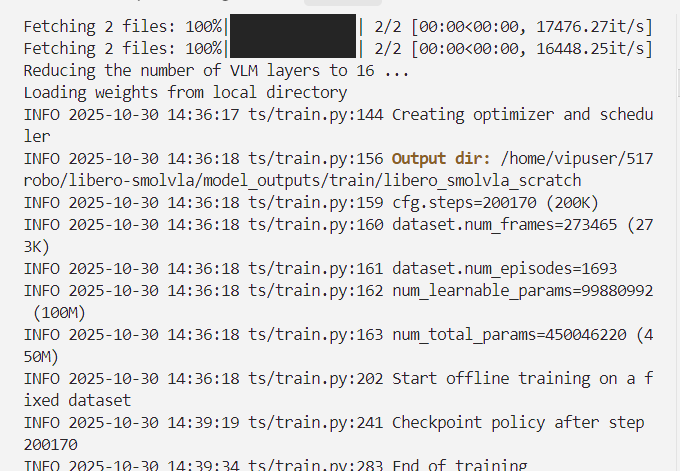
CUDA\_VISIBLE\_DEVICEs="0" 用于解决多 GPU 训练中的问题。另外,我建议将 save\_freq 调高。
我在 RTX 3090 上的训练如下:
 训练10小时左右

上面其他人报告的结果在 60k 步以上时还不错。我提前停止了,因为我想测试一下评估脚本。
2. 安装 LIBERO
其中最困难的部分是安装[LIBERO](https://github.com/Lifelong-Robot-Learning/LIBERO)。
忽略 LIBERO 的官方安装脚本。这是我安装后的安装步骤`lerobot`:
conda activate lerobot
cd
pip install -e .
pip install robosuite==1.4.0
pip install bddl
pip install easydict
pip install gym
3. 使用以下方法评估[@zlw21gxy](https://github.com/zlw21gxy)的剧本
我要再次将其复制并粘贴到这里,我做了一些日志更改。
```python
"""
This script demonstrates how to evaluate a pretrained smolVLA policy on the LIBERO benchmark.
https://github.com/huggingface/lerobot/issues/1316
"""
import collections
import dataclasses
import logging
import math
import pathlib
import os
import cv2
import draccus
import imageio
import numpy as np
import torch
from libero.libero import benchmark, get_libero_path
from libero.libero.envs import OffScreenRenderEnv
from tqdm import tqdm
from lerobot.policies.smolvla.modeling_smolvla import SmolVLAPolicy
torch.serialization.add_safe_globals([np.core.multiarray._reconstruct])
os.environ["TOKENIZERS_PARALLELISM"] = "false"
LIBERO_DUMMY_ACTION = [0.0] * 6 + [-1.0]
LIBERO_ENV_RESOLUTION = 256 # resolution used to render training data
def normalize_gripper_action(action, binarize=True):
"""
Changes gripper action (last dimension of action vector) from [0,1] to [-1,+1].
Necessary for some environments (not Bridge) because the dataset wrapper standardizes gripper actions to [0,1].
Note that unlike the other action dimensions, the gripper action is not normalized to [-1,+1] by default by
the dataset wrapper.
Normalization formula: y = 2 * (x - orig_low) / (orig_high - orig_low) - 1
"""
# Just normalize the last action to [-1,+1].
orig_low, orig_high = 0.0, 1.0
action[..., -1] = 2 * (action[..., -1] - orig_low) / (orig_high - orig_low) - 1
if binarize:
# Binarize to -1 or +1.
action[..., -1] = np.sign(action[..., -1])
return action
def invert_gripper_action(action):
"""
Flips the sign of the gripper action (last dimension of action vector).
This is necessary for some environments where -1 = open, +1 = close, since
the RLDS dataloader aligns gripper actions such that 0 = close, 1 = open.
"""
action[..., -1] = action[..., -1] * -1.0
return action
@dataclasses.dataclass
class Args:
"""
Evaluation arguments for smolVLA on LIBERO.
"""
# --- Hugging Face arguments ---
policy_path: str = "lerobot/smolvla_base"
"""Path to the pretrained policy on the Hugging Face Hub or local directory."""
# --- LIBERO environment-specific parameters ---
task_suite_name: str = "libero_spatial"
"""Task suite. Options: libero_spatial, libero_object, libero_goal, libero_10, libero_90"""
num_steps_wait: int = 10
"""Number of steps to wait for objects to stabilize in sim."""
num_trials_per_task: int = 1 #TODO:你可以修改这里
"""Number of rollouts per task."""
# --- Evaluation arguments ---
video_out_path: str = "data/libero/videos"
"""Path to save videos."""
device: str = "cuda"
"""Device to use for evaluation."""
seed: int = 7
"""Random Seed (for reproducibility)"""
@draccus.wrap()
def eval_libero(args: Args) -> None:
# Set random seed
torch.manual_seed(args.seed)
np.random.seed(args.seed)
# --- Load Policy ---
policy = SmolVLAPolicy.from_pretrained(args.policy_path)
policy.to(args.device)
policy.eval()
# --- Initialize LIBERO task suite ---
benchmark_dict = benchmark.get_benchmark_dict()
try:
task_suite = benchmark_dict[args.task_suite_name]()
except KeyError:
raise ValueError(
f"Unknown task suite: {args.task_suite_name}. "
f"Available options are: {list(benchmark_dict.keys())}"
)
num_tasks_in_suite = task_suite.n_tasks
logging.info(f"Task suite: {args.task_suite_name}")
pathlib.Path(args.video_out_path).mkdir(parents=True, exist_ok=True)
if args.task_suite_name == "libero_spatial":
max_steps = 220 # longest training demo has 193 steps
elif args.task_suite_name == "libero_object":
max_steps = 280 # longest training demo has 254 steps
elif args.task_suite_name == "libero_goal":
max_steps = 300 # longest training demo has 270 steps
elif args.task_suite_name == "libero_10":
max_steps = 520 # longest training demo has 505 steps
elif args.task_suite_name == "libero_90":
max_steps = 400 # longest training demo has 373 steps
else:
# Fallback for custom task suites
max_steps = 520
# --- Evaluation Loop ---
total_episodes, total_successes = 0, 0
for task_id in tqdm(range(num_tasks_in_suite), desc="Tasks"):
# Get task
task = task_suite.get_task(task_id)
# Get default LIBERO initial states
initial_states = task_suite.get_task_init_states(task_id)
# Initialize LIBERO environment and task description
env, task_description = _get_libero_env(task, LIBERO_ENV_RESOLUTION, args.seed)
# Start episodes
task_episodes, task_successes = 0, 0
for episode_idx in tqdm(
range(min(args.num_trials_per_task, len(initial_states))),
desc=f"Task {task_id}: {task.language}",
leave=False,
):
logging.info(f"\nTask: {task_description}")
# Reset environment and policy
env.reset()
policy.reset()
# Set initial states
obs = env.set_init_state(initial_states[episode_idx])
# IMPORTANT: Do nothing for the first few timesteps because the simulator drops objects
# and we need to wait for them to fall
for _ in range(args.num_steps_wait):
obs, _, _, _ = env.step(LIBERO_DUMMY_ACTION)
# Setup
t = 0
frames = []
done = False
# Add initial frame
agentview_image = np.ascontiguousarray(obs["agentview_image"][::-1, ::-1])
# frames.append(agentview_image)
# import ipdb; ipdb.set_trace()
logging.info(f"Starting episode {task_episodes+1}...")
while t < max_steps:
try:
# Get preprocessed image
# IMPORTANT: rotate 180 degrees to match train preprocessing
wrist_img = np.ascontiguousarray(obs["robot0_eye_in_hand_image"][::-1, ::-1])
agentview_image = np.ascontiguousarray(obs["agentview_image"][::-1, ::-1])
frames.append(agentview_image)
# Prepare observations dict
state = np.concatenate(
(
obs["robot0_eef_pos"],
_quat2axisangle(obs["robot0_eef_quat"]),
obs["robot0_gripper_qpos"],
)
)
observation = {
"observation.images.image": torch.from_numpy(agentview_image / 255.0)
.permute(2, 0, 1)
.to(torch.float32)
.to(args.device).unsqueeze(0),
"observation.images.wrist_image": torch.from_numpy(wrist_img / 255.0)
.permute(2, 0, 1)
.to(torch.float32)
.to(args.device).unsqueeze(0),
"observation.state": torch.from_numpy(state).to(torch.float32).to(args.device).unsqueeze(0),
"task": task_description,
}
# Query model to get action
with torch.inference_mode():
action_tensor = policy.select_action(observation)
action = action_tensor.cpu().numpy()[0]
# action[-1] = 1 - action[-1]
action = normalize_gripper_action(action, binarize=False)
action = invert_gripper_action(action)
# Execute action in environment
obs, _, done, _ = env.step(action)
if done:
task_successes += 1
total_successes += 1
break
t += 1
except Exception as e:
logging.error(f"Caught exception: {e}")
break
task_episodes += 1
total_episodes += 1
# Save a replay video of the episode
suffix = "success" if done else "failure"
task_segment = task_description.replace(" ", "_").replace("/", "_")
video_path = (
pathlib.Path(args.video_out_path) / f"rollout_task_{task_id}_episode_{episode_idx}_{task_segment}_{suffix}.mp4"
)
fps = 30
writer = imageio.get_writer(video_path, fps=fps)
for image in frames:
writer.append_data(image)
writer.close()
logging.info(f"Saved video to {video_path}")
# import ipdb; ipdb.set_trace()
# Log current results
logging.info(f"Success: {done}")
if total_episodes > 0:
logging.info(f"# episodes completed so far: {total_episodes}")
logging.info(f"# successes: {total_successes} ({total_successes / total_episodes * 100:.1f}%)")
# Log final results for the task
if task_episodes > 0:
logging.info(f"Task {task_id} success rate: {float(task_successes) / float(task_episodes):.2f}")
if total_episodes > 0:
logging.info(f"Cumulative success rate: {float(total_successes) / float(total_episodes):.2f}")
logging.info("--- Evaluation finished ---")
if total_episodes > 0:
logging.info(f"Total success rate: {float(total_successes) / float(total_episodes):.2f}")
logging.info(f"Total episodes: {total_episodes}")
logging.info(f"Total successes: {total_successes}")
# cv2.destroyAllWindows()
def _get_libero_env(task, resolution, seed):
"""Initializes and returns the LIBERO environment, along with the task description."""
task_description = task.language
task_bddl_file = pathlib.Path(get_libero_path("bddl_files")) / task.problem_folder / task.bddl_file
env_args = {
"bddl_file_name": str(task_bddl_file),
"camera_heights": resolution,
"camera_widths": resolution,
}
env = OffScreenRenderEnv(**env_args)
env.seed(seed) # IMPORTANT: seed seems to affect object positions even when using fixed initial state
return env, task_description
def _quat2axisangle(quat):
"""
Copied from robosuite:
https://github.com/ARISE-Initiative/robosuite/blob/eafb81f54ffc104f905ee48a16bb15f059176ad3/robosuite/utils/transform_utils.py#L490C1-L512C55
"""
# clip quaternion
if quat[3] > 1.0:
quat[3] = 1.0
elif quat[3] < -1.0:
quat[3] = -1.0
den = np.sqrt(1.0 - quat[3] * quat[3])
if math.isclose(den, 0.0):
# This is (close to) a zero degree rotation, immediately return
return np.zeros(3)
return (quat[:3] * 2.0 * math.acos(quat[3])) / den
if __name__ == "__main__":
logging.basicConfig(
level=logging.INFO,
format="%(asctime)s - %(levelname)s - %(message)s",
handlers=[
logging.FileHandler("evaluation_log.txt"),
logging.StreamHandler() # Optional: keeps logging in the terminal too
]
)
eval_libero()
```
针对task编号1的脚本如下
```
"""
This script demonstrates how to evaluate a pretrained smolVLA policy on the LIBERO benchmark.
https://github.com/huggingface/lerobot/issues/1316
"""
import collections
import dataclasses
import logging
import math
import pathlib
import os
from typing import Optional
import cv2
import draccus
import imageio
import numpy as np
import torch
from libero.libero import benchmark, get_libero_path
from libero.libero.envs import OffScreenRenderEnv
from tqdm import tqdm
from lerobot.policies.smolvla.modeling_smolvla import SmolVLAPolicy
torch.serialization.add_safe_globals([np.core.multiarray._reconstruct])
os.environ["TOKENIZERS_PARALLELISM"] = "false"
LIBERO_DUMMY_ACTION = [0.0] * 6 + [-1.0]
LIBERO_ENV_RESOLUTION = 256 # resolution used to render training data
def normalize_gripper_action(action, binarize=True):
"""
Changes gripper action (last dimension of action vector) from [0,1] to [-1,+1].
Necessary for some environments (not Bridge) because the dataset wrapper standardizes gripper actions to [0,1].
Note that unlike the other action dimensions, the gripper action is not normalized to [-1,+1] by default by
the dataset wrapper.
Normalization formula: y = 2 * (x - orig_low) / (orig_high - orig_low) - 1
"""
# Just normalize the last action to [-1,+1].
orig_low, orig_high = 0.0, 1.0
action[..., -1] = 2 * (action[..., -1] - orig_low) / (orig_high - orig_low) - 1
if binarize:
# Binarize to -1 or +1.
action[..., -1] = np.sign(action[..., -1])
return action
def invert_gripper_action(action):
"""
Flips the sign of the gripper action (last dimension of action vector).
This is necessary for some environments where -1 = open, +1 = close, since
the RLDS dataloader aligns gripper actions such that 0 = close, 1 = open.
"""
action[..., -1] = action[..., -1] * -1.0
return action
@dataclasses.dataclass
class Args:
"""
Evaluation arguments for smolVLA on LIBERO.
"""
# --- Hugging Face arguments ---
policy_path: str = "lerobot/smolvla_base"
"""Path to the pretrained policy on the Hugging Face Hub or local directory."""
# --- LIBERO environment-specific parameters ---
task_suite_name: str = "libero_spatial"
"""Task suite. Options: libero_spatial, libero_object, libero_goal, libero_10, libero_90"""
num_steps_wait: int = 10
"""Number of steps to wait for objects to stabilize in sim."""
num_trials_per_task: int = 10 #TODO:你可以修改这里
"""Number of rollouts per task."""
# --- Evaluation arguments ---
video_out_path: str = "data/libero/videos_task1"
"""Path to save videos."""
device: str = "cuda"
"""Device to use for evaluation."""
seed: int = 7
"""Random Seed (for reproducibility)"""
specific_task_id: Optional[int] = 1 # TODO: 你可以修改这里更改任务
"""Specific task ID to run (if None, runs all tasks). For task1, set to 1."""
@draccus.wrap()
def eval_libero(args: Args) -> None:
# Set random seed
torch.manual_seed(args.seed)
np.random.seed(args.seed)
# --- Load Policy ---
policy = SmolVLAPolicy.from_pretrained(args.policy_path)
policy.to(args.device)
policy.eval()
# --- Initialize LIBERO task suite ---
benchmark_dict = benchmark.get_benchmark_dict()
try:
task_suite = benchmark_dict[args.task_suite_name]()
except KeyError:
raise ValueError(
f"Unknown task suite: {args.task_suite_name}. "
f"Available options are: {list(benchmark_dict.keys())}"
)
num_tasks_in_suite = task_suite.n_tasks
logging.info(f"Task suite: {args.task_suite_name}")
pathlib.Path(args.video_out_path).mkdir(parents=True, exist_ok=True)
if args.task_suite_name == "libero_spatial":
max_steps = 220 # longest training demo has 193 steps
elif args.task_suite_name == "libero_object":
max_steps = 280 # longest training demo has 254 steps
elif args.task_suite_name == "libero_goal":
max_steps = 300 # longest training demo has 270 steps
elif args.task_suite_name == "libero_10":
max_steps = 520 # longest training demo has 505 steps
elif args.task_suite_name == "libero_90":
max_steps = 400 # longest training demo has 373 steps
else:
# Fallback for custom task suites
max_steps = 520
# --- Evaluation Loop ---
total_episodes, total_successes = 0, 0
# Determine which tasks to run
if args.specific_task_id is not None:
if args.specific_task_id >= num_tasks_in_suite:
raise ValueError(f"Task ID {args.specific_task_id} is out of range. Available tasks: 0-{num_tasks_in_suite-1}")
task_ids = [args.specific_task_id]
logging.info(f"Running only task {args.specific_task_id}")
else:
task_ids = list(range(num_tasks_in_suite))
logging.info(f"Running all {num_tasks_in_suite} tasks")
for task_id in tqdm(task_ids, desc="Tasks"):
# Get task
task = task_suite.get_task(task_id)
# Get default LIBERO initial states
initial_states = task_suite.get_task_init_states(task_id)
# Initialize LIBERO environment and task description
env, task_description = _get_libero_env(task, LIBERO_ENV_RESOLUTION, args.seed)
# Start episodes
task_episodes, task_successes = 0, 0
for episode_idx in tqdm(
range(min(args.num_trials_per_task, len(initial_states))),
desc=f"Task {task_id}: {task.language}",
leave=False,
):
logging.info(f"\nTask: {task_description}")
# Reset environment and policy
env.reset()
policy.reset()
# Set initial states
obs = env.set_init_state(initial_states[episode_idx])
# IMPORTANT: Do nothing for the first few timesteps because the simulator drops objects
# and we need to wait for them to fall
for _ in range(args.num_steps_wait):
obs, _, _, _ = env.step(LIBERO_DUMMY_ACTION)
# Setup
t = 0
frames = []
done = False
# Add initial frame
agentview_image = np.ascontiguousarray(obs["agentview_image"][::-1, ::-1])
# frames.append(agentview_image)
# import ipdb; ipdb.set_trace()
logging.info(f"Starting episode {task_episodes+1}...")
while t < max_steps:
try:
# Get preprocessed image
# IMPORTANT: rotate 180 degrees to match train preprocessing
wrist_img = np.ascontiguousarray(obs["robot0_eye_in_hand_image"][::-1, ::-1])
agentview_image = np.ascontiguousarray(obs["agentview_image"][::-1, ::-1])
frames.append(agentview_image)
# Prepare observations dict
state = np.concatenate(
(
obs["robot0_eef_pos"],
_quat2axisangle(obs["robot0_eef_quat"]),
obs["robot0_gripper_qpos"],
)
)
observation = {
"observation.images.image": torch.from_numpy(agentview_image / 255.0)
.permute(2, 0, 1)
.to(torch.float32)
.to(args.device).unsqueeze(0),
"observation.images.wrist_image": torch.from_numpy(wrist_img / 255.0)
.permute(2, 0, 1)
.to(torch.float32)
.to(args.device).unsqueeze(0),
"observation.state": torch.from_numpy(state).to(torch.float32).to(args.device).unsqueeze(0),
"task": task_description,
}
# Query model to get action
with torch.inference_mode():
action_tensor = policy.select_action(observation)
action = action_tensor.cpu().numpy()[0]
# action[-1] = 1 - action[-1]
action = normalize_gripper_action(action, binarize=False)
action = invert_gripper_action(action)
# Execute action in environment
obs, _, done, _ = env.step(action)
if done:
task_successes += 1
total_successes += 1
break
t += 1
except Exception as e:
logging.error(f"Caught exception: {e}")
break
task_episodes += 1
total_episodes += 1
# Save a replay video of the episode
suffix = "success" if done else "failure"
task_segment = task_description.replace(" ", "_").replace("/", "_")
video_path = (
pathlib.Path(args.video_out_path) / f"rollout_task_{task_id}_episode_{episode_idx}_{task_segment}_{suffix}.mp4"
)
fps = 30
writer = imageio.get_writer(video_path, fps=fps)
for image in frames:
writer.append_data(image)
writer.close()
logging.info(f"Saved video to {video_path}")
# import ipdb; ipdb.set_trace()
# Log current results
logging.info(f"Success: {done}")
if total_episodes > 0:
logging.info(f"# episodes completed so far: {total_episodes}")
logging.info(f"# successes: {total_successes} ({total_successes / total_episodes * 100:.1f}%)")
# Log final results for the task
if task_episodes > 0:
logging.info(f"Task {task_id} success rate: {float(task_successes) / float(task_episodes):.2f}")
if total_episodes > 0:
logging.info(f"Cumulative success rate: {float(total_successes) / float(total_episodes):.2f}")
logging.info("--- Evaluation finished ---")
if total_episodes > 0:
logging.info(f"Total success rate: {float(total_successes) / float(total_episodes):.2f}")
logging.info(f"Total episodes: {total_episodes}")
logging.info(f"Total successes: {total_successes}")
# cv2.destroyAllWindows()
def _get_libero_env(task, resolution, seed):
"""Initializes and returns the LIBERO environment, along with the task description."""
task_description = task.language
task_bddl_file = pathlib.Path(get_libero_path("bddl_files")) / task.problem_folder / task.bddl_file
env_args = {
"bddl_file_name": str(task_bddl_file),
"camera_heights": resolution,
"camera_widths": resolution,
}
env = OffScreenRenderEnv(**env_args)
env.seed(seed) # IMPORTANT: seed seems to affect object positions even when using fixed initial state
return env, task_description
def _quat2axisangle(quat):
"""
Copied from robosuite:
https://github.com/ARISE-Initiative/robosuite/blob/eafb81f54ffc104f905ee48a16bb15f059176ad3/robosuite/utils/transform_utils.py#L490C1-L512C55
"""
# clip quaternion
if quat[3] > 1.0:
quat[3] = 1.0
elif quat[3] < -1.0:
quat[3] = -1.0
den = np.sqrt(1.0 - quat[3] * quat[3])
if math.isclose(den, 0.0):
# This is (close to) a zero degree rotation, immediately return
return np.zeros(3)
return (quat[:3] * 2.0 * math.acos(quat[3])) / den
if __name__ == "__main__":
logging.basicConfig(
level=logging.INFO,
format="%(asctime)s - %(levelname)s - %(message)s",
handlers=[
logging.FileHandler("evaluation_log.txt"),
logging.StreamHandler() # Optional: keeps logging in the terminal too
]
)
eval_libero()
```
要运行此脚本,请使用:
```
export OUTPUT_ROOT=/path/to/outputs
python eval_LIBERO.py --policy_path="$OUTPUT_ROOT/libero_smolvla_scratch/checkpoints/140000/pretrained_model/"
python eval_LIBERO.py --policy_path="$OUTPUT_ROOT/libero_smolvla_scratch/checkpoints/130000/pretrained_model/"
python eval_LIBERO.py --policy_path="$OUTPUT_ROOT/libero_smolvla_scratch/checkpoints/200000/pretrained_model/"
python eval_LIBERO.py --policy_path="$OUTPUT_ROOT/libero_smolvla_scratch/checkpoints/200170/pretrained_model/"
python eval_LIBERO-task1.py --policy_path="$OUTPUT_ROOT/libero_smolvla_scratch/checkpoints/200170/pretrained_model/"
python eval_LIBERO.py --policy_path="$OUTPUT_ROOT/libero_smolvla_scratch/checkpoints/200340/pretrained_model/"
python eval_LIBERO-task1.py --policy_path="$OUTPUT_ROOT/libero_smolvla_scratch/checkpoints/200340/pretrained_model/"
python eval_LIBERO-task1-libero10.py --policy_path="$OUTPUT_ROOT/libero_smolvla_scratch/checkpoints/200340/pretrained_model/"
```
如果您遇到此错误:
File "/home/tay/Documents/robo-intel-action/finetuning\_lerobot/LIBERO/libero/libero/benchmark/\_\_init\_\_.py", line 164, in get\_task\_init\_states
init\_states = torch.load(init\_states\_path)
File "/home/tay/miniconda3/envs/lerobot/lib/python3.10/site-packages/torch/serialization.py", line 1524, in load
raise pickle.UnpicklingError(\_get\_wo\_message(str(e))) from None
\_pickle.UnpicklingError: Weights only load failed. This file can still be loaded, to do so you have two options, do those steps only if you trust the source of the checkpoint.
`libero.benchmark.__init__.py`将第 164 行从以下内容更改:
init\_states \= torch.load(init\_states\_path)
对此:
init_states = torch.load(init_states_path, weights_only=False)
4. 结果
评估脚本在终端中输出一些部署和统计数据(我将它们输出到`evaluation_log.txt`)。
2025-08-07 10:49:34,622 - INFO - --- Evaluation finished ---
2025-08-07 10:49:34,622 - INFO - Total success rate: 0.71
2025-08-07 10:49:34,622 - INFO - Total episodes: 500
2025-08-07 10:49:34,622 - INFO - Total successes: 356
推出任务9第47集:把黑碗放到木柜上并放到盘子上成功.mp4 推出任务3第26集:拿起饼干盒上的黑碗并将其放在盘子上成功.mp4
训练10小时左右

上面其他人报告的结果在 60k 步以上时还不错。我提前停止了,因为我想测试一下评估脚本。
2. 安装 LIBERO
其中最困难的部分是安装[LIBERO](https://github.com/Lifelong-Robot-Learning/LIBERO)。
忽略 LIBERO 的官方安装脚本。这是我安装后的安装步骤`lerobot`:
conda activate lerobot
cd
pip install -e .
pip install robosuite==1.4.0
pip install bddl
pip install easydict
pip install gym
3. 使用以下方法评估[@zlw21gxy](https://github.com/zlw21gxy)的剧本
我要再次将其复制并粘贴到这里,我做了一些日志更改。
```python
"""
This script demonstrates how to evaluate a pretrained smolVLA policy on the LIBERO benchmark.
https://github.com/huggingface/lerobot/issues/1316
"""
import collections
import dataclasses
import logging
import math
import pathlib
import os
import cv2
import draccus
import imageio
import numpy as np
import torch
from libero.libero import benchmark, get_libero_path
from libero.libero.envs import OffScreenRenderEnv
from tqdm import tqdm
from lerobot.policies.smolvla.modeling_smolvla import SmolVLAPolicy
torch.serialization.add_safe_globals([np.core.multiarray._reconstruct])
os.environ["TOKENIZERS_PARALLELISM"] = "false"
LIBERO_DUMMY_ACTION = [0.0] * 6 + [-1.0]
LIBERO_ENV_RESOLUTION = 256 # resolution used to render training data
def normalize_gripper_action(action, binarize=True):
"""
Changes gripper action (last dimension of action vector) from [0,1] to [-1,+1].
Necessary for some environments (not Bridge) because the dataset wrapper standardizes gripper actions to [0,1].
Note that unlike the other action dimensions, the gripper action is not normalized to [-1,+1] by default by
the dataset wrapper.
Normalization formula: y = 2 * (x - orig_low) / (orig_high - orig_low) - 1
"""
# Just normalize the last action to [-1,+1].
orig_low, orig_high = 0.0, 1.0
action[..., -1] = 2 * (action[..., -1] - orig_low) / (orig_high - orig_low) - 1
if binarize:
# Binarize to -1 or +1.
action[..., -1] = np.sign(action[..., -1])
return action
def invert_gripper_action(action):
"""
Flips the sign of the gripper action (last dimension of action vector).
This is necessary for some environments where -1 = open, +1 = close, since
the RLDS dataloader aligns gripper actions such that 0 = close, 1 = open.
"""
action[..., -1] = action[..., -1] * -1.0
return action
@dataclasses.dataclass
class Args:
"""
Evaluation arguments for smolVLA on LIBERO.
"""
# --- Hugging Face arguments ---
policy_path: str = "lerobot/smolvla_base"
"""Path to the pretrained policy on the Hugging Face Hub or local directory."""
# --- LIBERO environment-specific parameters ---
task_suite_name: str = "libero_spatial"
"""Task suite. Options: libero_spatial, libero_object, libero_goal, libero_10, libero_90"""
num_steps_wait: int = 10
"""Number of steps to wait for objects to stabilize in sim."""
num_trials_per_task: int = 1 #TODO:你可以修改这里
"""Number of rollouts per task."""
# --- Evaluation arguments ---
video_out_path: str = "data/libero/videos"
"""Path to save videos."""
device: str = "cuda"
"""Device to use for evaluation."""
seed: int = 7
"""Random Seed (for reproducibility)"""
@draccus.wrap()
def eval_libero(args: Args) -> None:
# Set random seed
torch.manual_seed(args.seed)
np.random.seed(args.seed)
# --- Load Policy ---
policy = SmolVLAPolicy.from_pretrained(args.policy_path)
policy.to(args.device)
policy.eval()
# --- Initialize LIBERO task suite ---
benchmark_dict = benchmark.get_benchmark_dict()
try:
task_suite = benchmark_dict[args.task_suite_name]()
except KeyError:
raise ValueError(
f"Unknown task suite: {args.task_suite_name}. "
f"Available options are: {list(benchmark_dict.keys())}"
)
num_tasks_in_suite = task_suite.n_tasks
logging.info(f"Task suite: {args.task_suite_name}")
pathlib.Path(args.video_out_path).mkdir(parents=True, exist_ok=True)
if args.task_suite_name == "libero_spatial":
max_steps = 220 # longest training demo has 193 steps
elif args.task_suite_name == "libero_object":
max_steps = 280 # longest training demo has 254 steps
elif args.task_suite_name == "libero_goal":
max_steps = 300 # longest training demo has 270 steps
elif args.task_suite_name == "libero_10":
max_steps = 520 # longest training demo has 505 steps
elif args.task_suite_name == "libero_90":
max_steps = 400 # longest training demo has 373 steps
else:
# Fallback for custom task suites
max_steps = 520
# --- Evaluation Loop ---
total_episodes, total_successes = 0, 0
for task_id in tqdm(range(num_tasks_in_suite), desc="Tasks"):
# Get task
task = task_suite.get_task(task_id)
# Get default LIBERO initial states
initial_states = task_suite.get_task_init_states(task_id)
# Initialize LIBERO environment and task description
env, task_description = _get_libero_env(task, LIBERO_ENV_RESOLUTION, args.seed)
# Start episodes
task_episodes, task_successes = 0, 0
for episode_idx in tqdm(
range(min(args.num_trials_per_task, len(initial_states))),
desc=f"Task {task_id}: {task.language}",
leave=False,
):
logging.info(f"\nTask: {task_description}")
# Reset environment and policy
env.reset()
policy.reset()
# Set initial states
obs = env.set_init_state(initial_states[episode_idx])
# IMPORTANT: Do nothing for the first few timesteps because the simulator drops objects
# and we need to wait for them to fall
for _ in range(args.num_steps_wait):
obs, _, _, _ = env.step(LIBERO_DUMMY_ACTION)
# Setup
t = 0
frames = []
done = False
# Add initial frame
agentview_image = np.ascontiguousarray(obs["agentview_image"][::-1, ::-1])
# frames.append(agentview_image)
# import ipdb; ipdb.set_trace()
logging.info(f"Starting episode {task_episodes+1}...")
while t < max_steps:
try:
# Get preprocessed image
# IMPORTANT: rotate 180 degrees to match train preprocessing
wrist_img = np.ascontiguousarray(obs["robot0_eye_in_hand_image"][::-1, ::-1])
agentview_image = np.ascontiguousarray(obs["agentview_image"][::-1, ::-1])
frames.append(agentview_image)
# Prepare observations dict
state = np.concatenate(
(
obs["robot0_eef_pos"],
_quat2axisangle(obs["robot0_eef_quat"]),
obs["robot0_gripper_qpos"],
)
)
observation = {
"observation.images.image": torch.from_numpy(agentview_image / 255.0)
.permute(2, 0, 1)
.to(torch.float32)
.to(args.device).unsqueeze(0),
"observation.images.wrist_image": torch.from_numpy(wrist_img / 255.0)
.permute(2, 0, 1)
.to(torch.float32)
.to(args.device).unsqueeze(0),
"observation.state": torch.from_numpy(state).to(torch.float32).to(args.device).unsqueeze(0),
"task": task_description,
}
# Query model to get action
with torch.inference_mode():
action_tensor = policy.select_action(observation)
action = action_tensor.cpu().numpy()[0]
# action[-1] = 1 - action[-1]
action = normalize_gripper_action(action, binarize=False)
action = invert_gripper_action(action)
# Execute action in environment
obs, _, done, _ = env.step(action)
if done:
task_successes += 1
total_successes += 1
break
t += 1
except Exception as e:
logging.error(f"Caught exception: {e}")
break
task_episodes += 1
total_episodes += 1
# Save a replay video of the episode
suffix = "success" if done else "failure"
task_segment = task_description.replace(" ", "_").replace("/", "_")
video_path = (
pathlib.Path(args.video_out_path) / f"rollout_task_{task_id}_episode_{episode_idx}_{task_segment}_{suffix}.mp4"
)
fps = 30
writer = imageio.get_writer(video_path, fps=fps)
for image in frames:
writer.append_data(image)
writer.close()
logging.info(f"Saved video to {video_path}")
# import ipdb; ipdb.set_trace()
# Log current results
logging.info(f"Success: {done}")
if total_episodes > 0:
logging.info(f"# episodes completed so far: {total_episodes}")
logging.info(f"# successes: {total_successes} ({total_successes / total_episodes * 100:.1f}%)")
# Log final results for the task
if task_episodes > 0:
logging.info(f"Task {task_id} success rate: {float(task_successes) / float(task_episodes):.2f}")
if total_episodes > 0:
logging.info(f"Cumulative success rate: {float(total_successes) / float(total_episodes):.2f}")
logging.info("--- Evaluation finished ---")
if total_episodes > 0:
logging.info(f"Total success rate: {float(total_successes) / float(total_episodes):.2f}")
logging.info(f"Total episodes: {total_episodes}")
logging.info(f"Total successes: {total_successes}")
# cv2.destroyAllWindows()
def _get_libero_env(task, resolution, seed):
"""Initializes and returns the LIBERO environment, along with the task description."""
task_description = task.language
task_bddl_file = pathlib.Path(get_libero_path("bddl_files")) / task.problem_folder / task.bddl_file
env_args = {
"bddl_file_name": str(task_bddl_file),
"camera_heights": resolution,
"camera_widths": resolution,
}
env = OffScreenRenderEnv(**env_args)
env.seed(seed) # IMPORTANT: seed seems to affect object positions even when using fixed initial state
return env, task_description
def _quat2axisangle(quat):
"""
Copied from robosuite:
https://github.com/ARISE-Initiative/robosuite/blob/eafb81f54ffc104f905ee48a16bb15f059176ad3/robosuite/utils/transform_utils.py#L490C1-L512C55
"""
# clip quaternion
if quat[3] > 1.0:
quat[3] = 1.0
elif quat[3] < -1.0:
quat[3] = -1.0
den = np.sqrt(1.0 - quat[3] * quat[3])
if math.isclose(den, 0.0):
# This is (close to) a zero degree rotation, immediately return
return np.zeros(3)
return (quat[:3] * 2.0 * math.acos(quat[3])) / den
if __name__ == "__main__":
logging.basicConfig(
level=logging.INFO,
format="%(asctime)s - %(levelname)s - %(message)s",
handlers=[
logging.FileHandler("evaluation_log.txt"),
logging.StreamHandler() # Optional: keeps logging in the terminal too
]
)
eval_libero()
```
针对task编号1的脚本如下
```
"""
This script demonstrates how to evaluate a pretrained smolVLA policy on the LIBERO benchmark.
https://github.com/huggingface/lerobot/issues/1316
"""
import collections
import dataclasses
import logging
import math
import pathlib
import os
from typing import Optional
import cv2
import draccus
import imageio
import numpy as np
import torch
from libero.libero import benchmark, get_libero_path
from libero.libero.envs import OffScreenRenderEnv
from tqdm import tqdm
from lerobot.policies.smolvla.modeling_smolvla import SmolVLAPolicy
torch.serialization.add_safe_globals([np.core.multiarray._reconstruct])
os.environ["TOKENIZERS_PARALLELISM"] = "false"
LIBERO_DUMMY_ACTION = [0.0] * 6 + [-1.0]
LIBERO_ENV_RESOLUTION = 256 # resolution used to render training data
def normalize_gripper_action(action, binarize=True):
"""
Changes gripper action (last dimension of action vector) from [0,1] to [-1,+1].
Necessary for some environments (not Bridge) because the dataset wrapper standardizes gripper actions to [0,1].
Note that unlike the other action dimensions, the gripper action is not normalized to [-1,+1] by default by
the dataset wrapper.
Normalization formula: y = 2 * (x - orig_low) / (orig_high - orig_low) - 1
"""
# Just normalize the last action to [-1,+1].
orig_low, orig_high = 0.0, 1.0
action[..., -1] = 2 * (action[..., -1] - orig_low) / (orig_high - orig_low) - 1
if binarize:
# Binarize to -1 or +1.
action[..., -1] = np.sign(action[..., -1])
return action
def invert_gripper_action(action):
"""
Flips the sign of the gripper action (last dimension of action vector).
This is necessary for some environments where -1 = open, +1 = close, since
the RLDS dataloader aligns gripper actions such that 0 = close, 1 = open.
"""
action[..., -1] = action[..., -1] * -1.0
return action
@dataclasses.dataclass
class Args:
"""
Evaluation arguments for smolVLA on LIBERO.
"""
# --- Hugging Face arguments ---
policy_path: str = "lerobot/smolvla_base"
"""Path to the pretrained policy on the Hugging Face Hub or local directory."""
# --- LIBERO environment-specific parameters ---
task_suite_name: str = "libero_spatial"
"""Task suite. Options: libero_spatial, libero_object, libero_goal, libero_10, libero_90"""
num_steps_wait: int = 10
"""Number of steps to wait for objects to stabilize in sim."""
num_trials_per_task: int = 10 #TODO:你可以修改这里
"""Number of rollouts per task."""
# --- Evaluation arguments ---
video_out_path: str = "data/libero/videos_task1"
"""Path to save videos."""
device: str = "cuda"
"""Device to use for evaluation."""
seed: int = 7
"""Random Seed (for reproducibility)"""
specific_task_id: Optional[int] = 1 # TODO: 你可以修改这里更改任务
"""Specific task ID to run (if None, runs all tasks). For task1, set to 1."""
@draccus.wrap()
def eval_libero(args: Args) -> None:
# Set random seed
torch.manual_seed(args.seed)
np.random.seed(args.seed)
# --- Load Policy ---
policy = SmolVLAPolicy.from_pretrained(args.policy_path)
policy.to(args.device)
policy.eval()
# --- Initialize LIBERO task suite ---
benchmark_dict = benchmark.get_benchmark_dict()
try:
task_suite = benchmark_dict[args.task_suite_name]()
except KeyError:
raise ValueError(
f"Unknown task suite: {args.task_suite_name}. "
f"Available options are: {list(benchmark_dict.keys())}"
)
num_tasks_in_suite = task_suite.n_tasks
logging.info(f"Task suite: {args.task_suite_name}")
pathlib.Path(args.video_out_path).mkdir(parents=True, exist_ok=True)
if args.task_suite_name == "libero_spatial":
max_steps = 220 # longest training demo has 193 steps
elif args.task_suite_name == "libero_object":
max_steps = 280 # longest training demo has 254 steps
elif args.task_suite_name == "libero_goal":
max_steps = 300 # longest training demo has 270 steps
elif args.task_suite_name == "libero_10":
max_steps = 520 # longest training demo has 505 steps
elif args.task_suite_name == "libero_90":
max_steps = 400 # longest training demo has 373 steps
else:
# Fallback for custom task suites
max_steps = 520
# --- Evaluation Loop ---
total_episodes, total_successes = 0, 0
# Determine which tasks to run
if args.specific_task_id is not None:
if args.specific_task_id >= num_tasks_in_suite:
raise ValueError(f"Task ID {args.specific_task_id} is out of range. Available tasks: 0-{num_tasks_in_suite-1}")
task_ids = [args.specific_task_id]
logging.info(f"Running only task {args.specific_task_id}")
else:
task_ids = list(range(num_tasks_in_suite))
logging.info(f"Running all {num_tasks_in_suite} tasks")
for task_id in tqdm(task_ids, desc="Tasks"):
# Get task
task = task_suite.get_task(task_id)
# Get default LIBERO initial states
initial_states = task_suite.get_task_init_states(task_id)
# Initialize LIBERO environment and task description
env, task_description = _get_libero_env(task, LIBERO_ENV_RESOLUTION, args.seed)
# Start episodes
task_episodes, task_successes = 0, 0
for episode_idx in tqdm(
range(min(args.num_trials_per_task, len(initial_states))),
desc=f"Task {task_id}: {task.language}",
leave=False,
):
logging.info(f"\nTask: {task_description}")
# Reset environment and policy
env.reset()
policy.reset()
# Set initial states
obs = env.set_init_state(initial_states[episode_idx])
# IMPORTANT: Do nothing for the first few timesteps because the simulator drops objects
# and we need to wait for them to fall
for _ in range(args.num_steps_wait):
obs, _, _, _ = env.step(LIBERO_DUMMY_ACTION)
# Setup
t = 0
frames = []
done = False
# Add initial frame
agentview_image = np.ascontiguousarray(obs["agentview_image"][::-1, ::-1])
# frames.append(agentview_image)
# import ipdb; ipdb.set_trace()
logging.info(f"Starting episode {task_episodes+1}...")
while t < max_steps:
try:
# Get preprocessed image
# IMPORTANT: rotate 180 degrees to match train preprocessing
wrist_img = np.ascontiguousarray(obs["robot0_eye_in_hand_image"][::-1, ::-1])
agentview_image = np.ascontiguousarray(obs["agentview_image"][::-1, ::-1])
frames.append(agentview_image)
# Prepare observations dict
state = np.concatenate(
(
obs["robot0_eef_pos"],
_quat2axisangle(obs["robot0_eef_quat"]),
obs["robot0_gripper_qpos"],
)
)
observation = {
"observation.images.image": torch.from_numpy(agentview_image / 255.0)
.permute(2, 0, 1)
.to(torch.float32)
.to(args.device).unsqueeze(0),
"observation.images.wrist_image": torch.from_numpy(wrist_img / 255.0)
.permute(2, 0, 1)
.to(torch.float32)
.to(args.device).unsqueeze(0),
"observation.state": torch.from_numpy(state).to(torch.float32).to(args.device).unsqueeze(0),
"task": task_description,
}
# Query model to get action
with torch.inference_mode():
action_tensor = policy.select_action(observation)
action = action_tensor.cpu().numpy()[0]
# action[-1] = 1 - action[-1]
action = normalize_gripper_action(action, binarize=False)
action = invert_gripper_action(action)
# Execute action in environment
obs, _, done, _ = env.step(action)
if done:
task_successes += 1
total_successes += 1
break
t += 1
except Exception as e:
logging.error(f"Caught exception: {e}")
break
task_episodes += 1
total_episodes += 1
# Save a replay video of the episode
suffix = "success" if done else "failure"
task_segment = task_description.replace(" ", "_").replace("/", "_")
video_path = (
pathlib.Path(args.video_out_path) / f"rollout_task_{task_id}_episode_{episode_idx}_{task_segment}_{suffix}.mp4"
)
fps = 30
writer = imageio.get_writer(video_path, fps=fps)
for image in frames:
writer.append_data(image)
writer.close()
logging.info(f"Saved video to {video_path}")
# import ipdb; ipdb.set_trace()
# Log current results
logging.info(f"Success: {done}")
if total_episodes > 0:
logging.info(f"# episodes completed so far: {total_episodes}")
logging.info(f"# successes: {total_successes} ({total_successes / total_episodes * 100:.1f}%)")
# Log final results for the task
if task_episodes > 0:
logging.info(f"Task {task_id} success rate: {float(task_successes) / float(task_episodes):.2f}")
if total_episodes > 0:
logging.info(f"Cumulative success rate: {float(total_successes) / float(total_episodes):.2f}")
logging.info("--- Evaluation finished ---")
if total_episodes > 0:
logging.info(f"Total success rate: {float(total_successes) / float(total_episodes):.2f}")
logging.info(f"Total episodes: {total_episodes}")
logging.info(f"Total successes: {total_successes}")
# cv2.destroyAllWindows()
def _get_libero_env(task, resolution, seed):
"""Initializes and returns the LIBERO environment, along with the task description."""
task_description = task.language
task_bddl_file = pathlib.Path(get_libero_path("bddl_files")) / task.problem_folder / task.bddl_file
env_args = {
"bddl_file_name": str(task_bddl_file),
"camera_heights": resolution,
"camera_widths": resolution,
}
env = OffScreenRenderEnv(**env_args)
env.seed(seed) # IMPORTANT: seed seems to affect object positions even when using fixed initial state
return env, task_description
def _quat2axisangle(quat):
"""
Copied from robosuite:
https://github.com/ARISE-Initiative/robosuite/blob/eafb81f54ffc104f905ee48a16bb15f059176ad3/robosuite/utils/transform_utils.py#L490C1-L512C55
"""
# clip quaternion
if quat[3] > 1.0:
quat[3] = 1.0
elif quat[3] < -1.0:
quat[3] = -1.0
den = np.sqrt(1.0 - quat[3] * quat[3])
if math.isclose(den, 0.0):
# This is (close to) a zero degree rotation, immediately return
return np.zeros(3)
return (quat[:3] * 2.0 * math.acos(quat[3])) / den
if __name__ == "__main__":
logging.basicConfig(
level=logging.INFO,
format="%(asctime)s - %(levelname)s - %(message)s",
handlers=[
logging.FileHandler("evaluation_log.txt"),
logging.StreamHandler() # Optional: keeps logging in the terminal too
]
)
eval_libero()
```
要运行此脚本,请使用:
```
export OUTPUT_ROOT=/path/to/outputs
python eval_LIBERO.py --policy_path="$OUTPUT_ROOT/libero_smolvla_scratch/checkpoints/140000/pretrained_model/"
python eval_LIBERO.py --policy_path="$OUTPUT_ROOT/libero_smolvla_scratch/checkpoints/130000/pretrained_model/"
python eval_LIBERO.py --policy_path="$OUTPUT_ROOT/libero_smolvla_scratch/checkpoints/200000/pretrained_model/"
python eval_LIBERO.py --policy_path="$OUTPUT_ROOT/libero_smolvla_scratch/checkpoints/200170/pretrained_model/"
python eval_LIBERO-task1.py --policy_path="$OUTPUT_ROOT/libero_smolvla_scratch/checkpoints/200170/pretrained_model/"
python eval_LIBERO.py --policy_path="$OUTPUT_ROOT/libero_smolvla_scratch/checkpoints/200340/pretrained_model/"
python eval_LIBERO-task1.py --policy_path="$OUTPUT_ROOT/libero_smolvla_scratch/checkpoints/200340/pretrained_model/"
python eval_LIBERO-task1-libero10.py --policy_path="$OUTPUT_ROOT/libero_smolvla_scratch/checkpoints/200340/pretrained_model/"
```
如果您遇到此错误:
File "/home/tay/Documents/robo-intel-action/finetuning\_lerobot/LIBERO/libero/libero/benchmark/\_\_init\_\_.py", line 164, in get\_task\_init\_states
init\_states = torch.load(init\_states\_path)
File "/home/tay/miniconda3/envs/lerobot/lib/python3.10/site-packages/torch/serialization.py", line 1524, in load
raise pickle.UnpicklingError(\_get\_wo\_message(str(e))) from None
\_pickle.UnpicklingError: Weights only load failed. This file can still be loaded, to do so you have two options, do those steps only if you trust the source of the checkpoint.
`libero.benchmark.__init__.py`将第 164 行从以下内容更改:
init\_states \= torch.load(init\_states\_path)
对此:
init_states = torch.load(init_states_path, weights_only=False)
4. 结果
评估脚本在终端中输出一些部署和统计数据(我将它们输出到`evaluation_log.txt`)。
2025-08-07 10:49:34,622 - INFO - --- Evaluation finished ---
2025-08-07 10:49:34,622 - INFO - Total success rate: 0.71
2025-08-07 10:49:34,622 - INFO - Total episodes: 500
2025-08-07 10:49:34,622 - INFO - Total successes: 356
推出任务9第47集:把黑碗放到木柜上并放到盘子上成功.mp4 推出任务3第26集:拿起饼干盒上的黑碗并将其放在盘子上成功.mp4