**Open source by [DevsLab](https://devslab.kr/)** · [OSS brand guide](https://devslab.kr/brand/open-source/) · Registry O05
[](https://www.npmjs.com/package/@devslab/kokey)
[](https://github.com/devslab-kr/kokey/actions/workflows/ci.yml)

[](./LICENSE)
[](https://stackblitz.com/github/devslab-kr/kokey/tree/main/examples/vanilla)
Keyboard layout converter — restore text typed with the wrong layout.
Korean (Dubeolsik ↔ QWERTY) built in; Russian, Ukrainian, Hebrew, Greek,
Thai, Arabic and Georgian available as tree-shakeable subpath imports.
TypeScript-first, **zero dependencies**, ESM/CJS dual package.
**English** · [한국어](./README.ko.md) · [Русский](./README.ru.md) · [Українська](./README.uk.md) · [עברית](./README.he.md) · [Ελληνικά](./README.el.md) · [ไทย](./README.th.md) · [العربية](./README.ar.md) · [ქართული](./README.ka.md) · [Live demo](https://devslab-kr.github.io/kokey/)
Try it online: [⚡ StackBlitz — Vanilla](https://stackblitz.com/github/devslab-kr/kokey/tree/main/examples/vanilla) · [Vue](https://stackblitz.com/github/devslab-kr/kokey/tree/main/examples/vue) · [React](https://stackblitz.com/github/devslab-kr/kokey/tree/main/examples/react) · [Svelte](https://stackblitz.com/github/devslab-kr/kokey/tree/main/examples/svelte) · [Solid](https://stackblitz.com/github/devslab-kr/kokey/tree/main/examples/solid) | [📦 CodeSandbox](https://codesandbox.io/s/github/devslab-kr/kokey/tree/main/examples/vanilla)
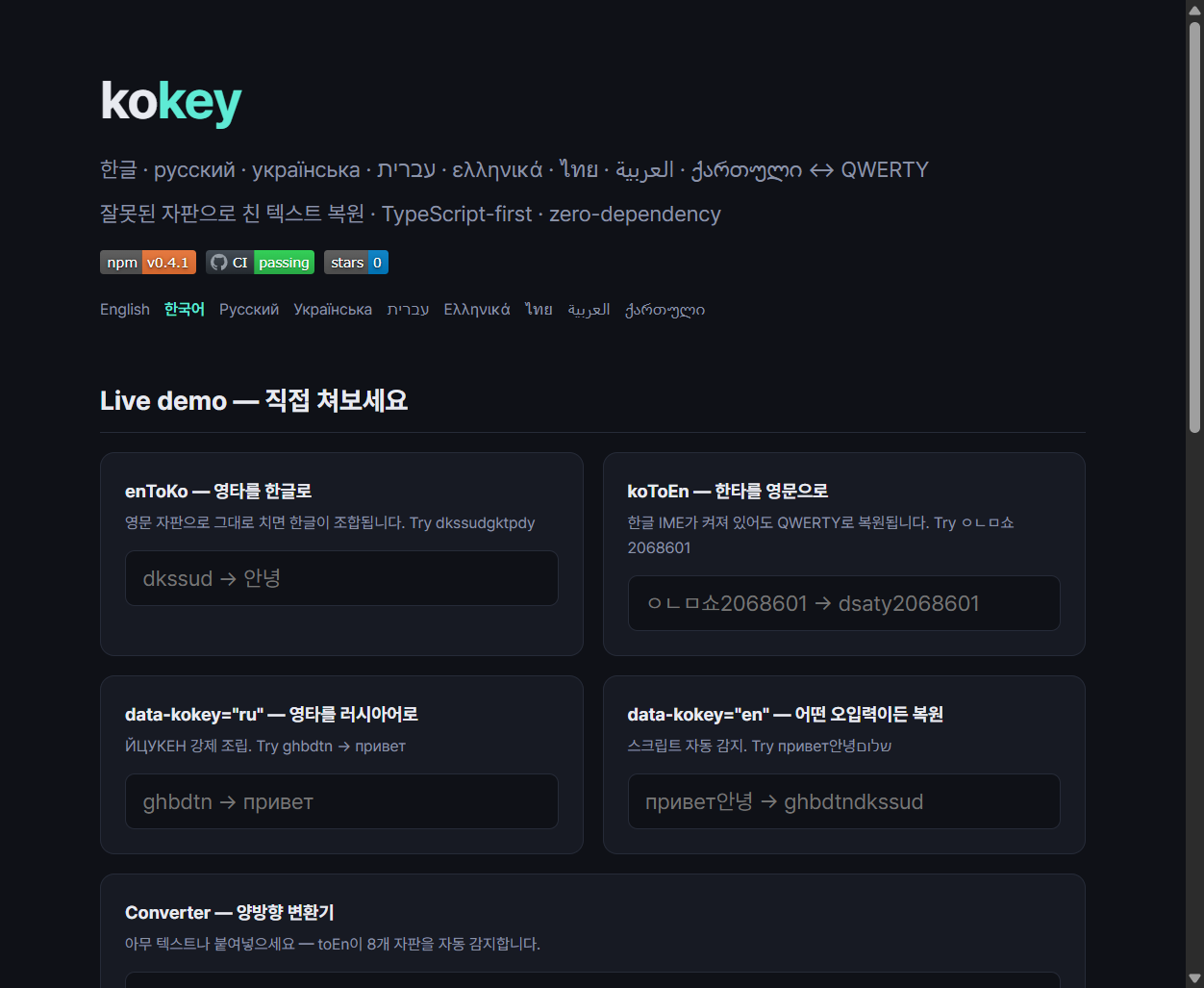
Ever typed `dkssud` when you meant `안녕`, or scanned a barcode while the
Korean IME was on and got `ㅇㄴㅁ쇼2068601` instead of `DSATY2068601`?
`kokey` converts between what was typed and what was meant — in both
directions, exactly the way a Dubeolsik IME composes Hangul.
The same slip exists in every language that toggles a non-Latin layout with
QWERTY: Russians type `ghbdtn` for `привет`, Israelis `akuo` for `שלום`,
Thais scan barcodes with Kedmanee on. `kokey` covers those layouts too —
see [Beyond Korean](#beyond-korean--any-registered-layout).
*Numeric fields in the same form — amounts that need live comma grouping,
a stable caret, and right alignment? That's kokey's sibling,
[numkey](https://github.com/devslab-kr/numkey).*
## Install
```sh
npm install @devslab/kokey
```
Or straight from a CDN — no build step, everything under the `kokey` global:
```html
```
## Usage
```ts
import { koToEn, enToKo } from '@devslab/kokey'
// Hangul → the QWERTY keystrokes that produced it
koToEn('안녕') // 'dkssud'
koToEn('값없는 닭갈비') // 'rkqtdjqtsms ekfrrkfql'
koToEn('ㅇㄴㅁ쇼2068601') // 'dsaty2068601' (wedge-scanner rescue)
// QWERTY keystrokes → composed Hangul (full IME automaton)
enToKo('dkssud') // '안녕'
enToKo('gksrmf') // '한글'
enToKo('ekfrl') // '달기' (compound-final split, like a real IME)
```
### Details that matter
- **Shift is honored**: `R` → ㄲ, `r` → ㄱ, `koToEn('뛰다') === 'Enlek'`
- **Compound vowels/finals**: ㅘ ↔ `hk`, ㄵ ↔ `sw`, …
- **받침 넘김 (final-consonant carry-over)**: `enToKo('dkswk') === '안자'`
- **Pass-through**: digits, punctuation, and unmapped letters are left as-is
- Round-trip safe for Korean text: `enToKo(koToEn(s)) === s`
### Beyond Korean — any registered layout
Each layout is a subpath import (unused ones never reach your bundle) and
plugs into the same machinery:
```ts
import { register, toEn, fromEn } from '@devslab/kokey'
import { ru, ruToEn, enToRu } from '@devslab/kokey/ru'
import { he } from '@devslab/kokey/he'
// direct, per-layout
ruToEn('привет') // 'ghbdtn' — the Punto Switcher classic
enToRu('ghbdtn') // 'привет'
// or register + auto-detect by script, mixed strings included
register(ru, he)
toEn('안녕 привет שלום') // 'dkssud ghbdtn akuo'
fromEn('ghbdtn', 'ru') // 'привет'
```
| Layout | Import | Notes |
| --- | --- | --- |
| Korean 두벌식 | built-in (`ko`) | full IME composition automaton |
| Russian ЙЦУКЕН | `@devslab/kokey/ru` | moved punctuation (ё on backtick, №, `.` on `/`) mapped faithfully |
| Ukrainian Enhanced | `@devslab/kokey/uk` | і/є/ї; AltGr-only ґ restored in reverse; ru/uk auto-disambiguated |
| Hebrew | `@devslab/kokey/he` | final forms, swapped brackets, caps-lock safe |
| Greek | `@devslab/kokey/el` | tonos/dialytika dead keys (`;a` → ά), final sigma |
| Thai Kedmanee | `@devslab/kokey/th` | full digit-row remap — barcode rescue works for Thai too |
| Arabic (101) | `@devslab/kokey/ar` | lam-alef لا on `b`, hamza forms, tashkeel |
| Georgian QWERTY | `@devslab/kokey/ka` | near-phonetic (`gamarjoba` ↔ გამარჯობა) |
Languages whose IME needs a candidate-selection step (Chinese pinyin,
Japanese kanji) are out of scope by construction — the keystroke ↔ text
relation there isn't deterministic. Need another deterministic layout?
It's one `defineLayout({ id, script, fromKey })` table —
[PRs welcome](https://github.com/devslab-kr/kokey/pulls).
### DOM layer — enforce an input mode
Force an ``/`