# prepr  [](https://gitlab.com/dickoa/prepr/pipelines)
[](https://ci.appveyor.com/project/dickoa/prepr)
[](https://codecov.io/gl/dickoa/prepr)
[](http://www.r-pkg.org/pkg/prepr)
An R package to repair broken GIS polygons using the
[`prepair`](https://github.com/tudelft3d/prepair) C++ library.
## Installation
The `prepair` C++ library need these two libraries to compile:
- [`CGAL`](https://www.cgal.org/)
- [`GDAL`](https://gdal.org/)
The R package `prepr` solves the CGAL dependencies by shipping with a
subset of the CGAL header. We also use
[`rwinlib`](https://github.com/rwinlib) to provide `GDAL` on Windows in
order to build this package from source. You will need the latest
version of [`rtools`](https://cran.r-project.org/bin/windows/Rtools/) in
order to build the source code on Windows.
`prepair` can also use these optional libraries:
- [`GMP`](https://gmplib.org/)
- [`MPFR`](https://www.mpfr.org/)
They are disabled by default on Windows but required if you want to
build the package in a Linux/OS X environment. After installing all
these libraries, you can now install the development version of the
`prepr` R package from [Gitlab](https://gitlab.com/dickoa/prepr) using
the `remotes` R package with:
``` r
# install.packages("remotes")
remotes::install_gitlab("dickoa/prepr")
remotes::install_github("dickoa/prepr") ## mirror
```
## A quick tutorial
This is a simple tutorial which shows you how to solve common problems
we can find with polygons:
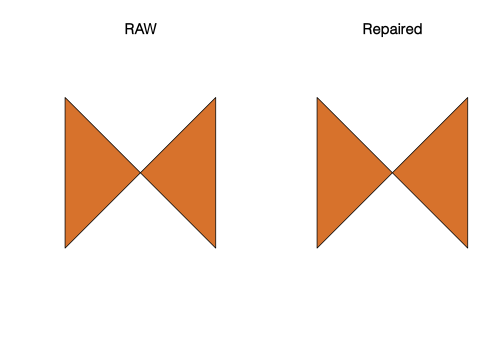
### A ‘bowtie’ polygon:
``` r
library(prepr)
library(sf)
p1 <- st_as_sfc("POLYGON((0 0, 0 10, 10 0, 10 10, 0 0))")
st_is_valid(p1, reason = TRUE)
#> [1] "Self-intersection[5 5]"
p11 <- st_prepair(p1)
st_is_valid(p11)
#> [1] TRUE
st_as_text(p11)
#> [1] "MULTIPOLYGON (((0 0, 5 5, 0 10, 0 0)), ((5 5, 10 0, 10 10, 5 5)))"
par(mfrow = c(1, 2))
plot(p1, main = "RAW", col = "#D7722C")
plot(p11, main = "Repaired", col = "#D7722C")
```
[](https://gitlab.com/dickoa/prepr/pipelines)
[](https://ci.appveyor.com/project/dickoa/prepr)
[](https://codecov.io/gl/dickoa/prepr)
[](http://www.r-pkg.org/pkg/prepr)
An R package to repair broken GIS polygons using the
[`prepair`](https://github.com/tudelft3d/prepair) C++ library.
## Installation
The `prepair` C++ library need these two libraries to compile:
- [`CGAL`](https://www.cgal.org/)
- [`GDAL`](https://gdal.org/)
The R package `prepr` solves the CGAL dependencies by shipping with a
subset of the CGAL header. We also use
[`rwinlib`](https://github.com/rwinlib) to provide `GDAL` on Windows in
order to build this package from source. You will need the latest
version of [`rtools`](https://cran.r-project.org/bin/windows/Rtools/) in
order to build the source code on Windows.
`prepair` can also use these optional libraries:
- [`GMP`](https://gmplib.org/)
- [`MPFR`](https://www.mpfr.org/)
They are disabled by default on Windows but required if you want to
build the package in a Linux/OS X environment. After installing all
these libraries, you can now install the development version of the
`prepr` R package from [Gitlab](https://gitlab.com/dickoa/prepr) using
the `remotes` R package with:
``` r
# install.packages("remotes")
remotes::install_gitlab("dickoa/prepr")
remotes::install_github("dickoa/prepr") ## mirror
```
## A quick tutorial
This is a simple tutorial which shows you how to solve common problems
we can find with polygons:
### A ‘bowtie’ polygon:
``` r
library(prepr)
library(sf)
p1 <- st_as_sfc("POLYGON((0 0, 0 10, 10 0, 10 10, 0 0))")
st_is_valid(p1, reason = TRUE)
#> [1] "Self-intersection[5 5]"
p11 <- st_prepair(p1)
st_is_valid(p11)
#> [1] TRUE
st_as_text(p11)
#> [1] "MULTIPOLYGON (((0 0, 5 5, 0 10, 0 0)), ((5 5, 10 0, 10 10, 5 5)))"
par(mfrow = c(1, 2))
plot(p1, main = "RAW", col = "#D7722C")
plot(p11, main = "Repaired", col = "#D7722C")
```
 ### Square with wrong orientation:
``` r
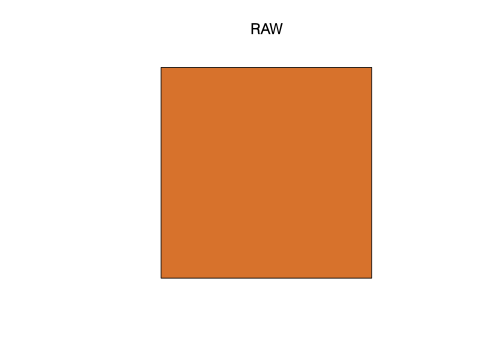
p2 <- st_as_sfc("POLYGON((0 0, 0 10, 10 10, 10 0, 0 0))")
st_is_valid(p2, reason = TRUE)
#> [1] "Valid Geometry"
plot(p2, main = "RAW", col = "#D7722C")
```
### Square with wrong orientation:
``` r
p2 <- st_as_sfc("POLYGON((0 0, 0 10, 10 10, 10 0, 0 0))")
st_is_valid(p2, reason = TRUE)
#> [1] "Valid Geometry"
plot(p2, main = "RAW", col = "#D7722C")
```
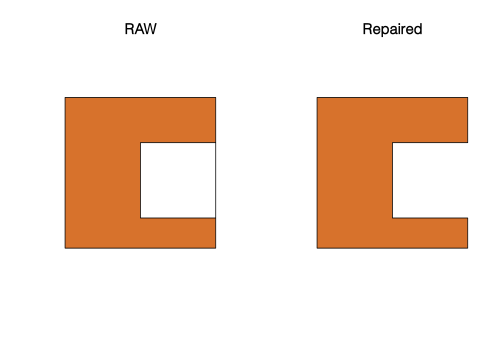
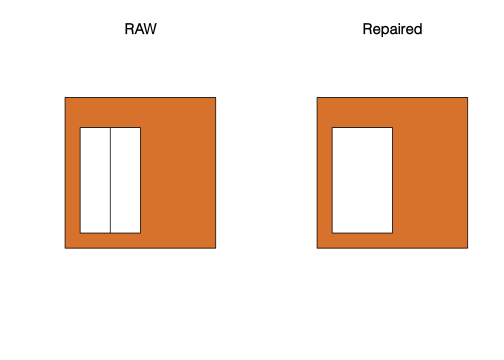
 ### Inner ring with one edge sharing part of an edge of the outer ring:
``` r
p3 <- st_as_sfc("POLYGON((0 0, 10 0, 10 10, 0 10, 0 0),(5 2, 5 7, 10 7, 10 2, 5 2))")
st_is_valid(p3, reason = TRUE)
#> [1] "Self-intersection[10 2]"
p33 <- st_prepair(p3)
st_is_valid(p33)
#> [1] TRUE
st_as_text(p33)
#> [1] "POLYGON ((0 0, 10 0, 10 2, 5 2, 5 7, 10 7, 10 10, 0 10, 0 0))"
par(mfrow = c(1, 2))
plot(p3, main = "RAW", col = "#D7722C")
plot(p33, main = "Repaired", col = "#D7722C")
```
### Inner ring with one edge sharing part of an edge of the outer ring:
``` r
p3 <- st_as_sfc("POLYGON((0 0, 10 0, 10 10, 0 10, 0 0),(5 2, 5 7, 10 7, 10 2, 5 2))")
st_is_valid(p3, reason = TRUE)
#> [1] "Self-intersection[10 2]"
p33 <- st_prepair(p3)
st_is_valid(p33)
#> [1] TRUE
st_as_text(p33)
#> [1] "POLYGON ((0 0, 10 0, 10 2, 5 2, 5 7, 10 7, 10 10, 0 10, 0 0))"
par(mfrow = c(1, 2))
plot(p3, main = "RAW", col = "#D7722C")
plot(p33, main = "Repaired", col = "#D7722C")
```
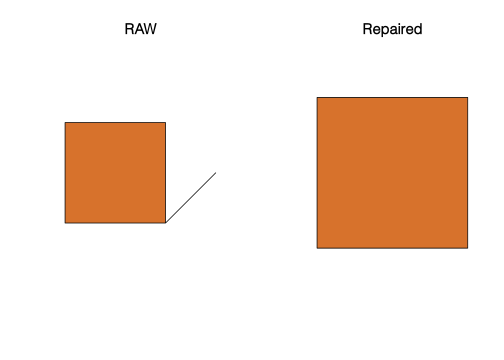
 ### Dangling edge:
``` r
p4 <- st_as_sfc("POLYGON((0 0, 10 0, 15 5, 10 0, 10 10, 0 10, 0 0))")
st_is_valid(p4, reason = TRUE)
#> [1] "Self-intersection[15 5]"
p44 <- st_prepair(p4)
st_is_valid(p44)
#> [1] TRUE
st_as_text(p44)
#> [1] "POLYGON ((0 0, 10 0, 10 10, 0 10, 0 0))"
par(mfrow = c(1, 2))
plot(p4, main = "RAW", col = "#D7722C")
plot(p44, main = "Repaired", col = "#D7722C")
```
### Dangling edge:
``` r
p4 <- st_as_sfc("POLYGON((0 0, 10 0, 15 5, 10 0, 10 10, 0 10, 0 0))")
st_is_valid(p4, reason = TRUE)
#> [1] "Self-intersection[15 5]"
p44 <- st_prepair(p4)
st_is_valid(p44)
#> [1] TRUE
st_as_text(p44)
#> [1] "POLYGON ((0 0, 10 0, 10 10, 0 10, 0 0))"
par(mfrow = c(1, 2))
plot(p4, main = "RAW", col = "#D7722C")
plot(p44, main = "Repaired", col = "#D7722C")
```
 ### Two adjacent inner rings:
``` r
p6 <- st_as_sfc("POLYGON((0 0, 10 0, 10 10, 0 10, 0 0), (1 1, 1 8, 3 8, 3 1, 1 1), (3 1, 3 8, 5 8, 5 1, 3 1))")
st_is_valid(p6, reason = TRUE)
#> [1] "Self-intersection[3 8]"
p66 <- st_prepair(p6)
st_is_valid(p66)
#> [1] TRUE
st_as_text(p66)
#> [1] "POLYGON ((0 0, 10 0, 10 10, 0 10, 0 0), (1 1, 1 8, 3 8, 5 8, 5 1, 3 1, 1 1))"
par(mfrow = c(1, 2))
plot(p6, main = "RAW", col = "#D7722C")
plot(p66, main = "Repaired", col = "#D7722C")
```
### Two adjacent inner rings:
``` r
p6 <- st_as_sfc("POLYGON((0 0, 10 0, 10 10, 0 10, 0 0), (1 1, 1 8, 3 8, 3 1, 1 1), (3 1, 3 8, 5 8, 5 1, 3 1))")
st_is_valid(p6, reason = TRUE)
#> [1] "Self-intersection[3 8]"
p66 <- st_prepair(p6)
st_is_valid(p66)
#> [1] TRUE
st_as_text(p66)
#> [1] "POLYGON ((0 0, 10 0, 10 10, 0 10, 0 0), (1 1, 1 8, 3 8, 5 8, 5 1, 3 1, 1 1))"
par(mfrow = c(1, 2))
plot(p6, main = "RAW", col = "#D7722C")
plot(p66, main = "Repaired", col = "#D7722C")
```
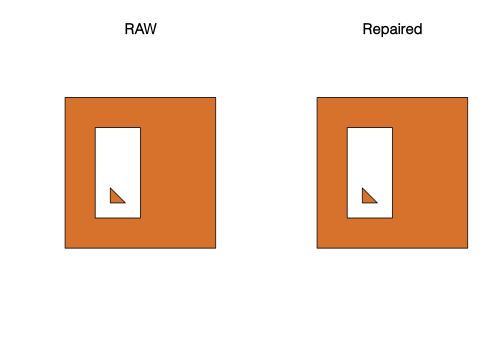
 ### Polygon with an inner ring inside another inner ring:
``` r
p7 <- st_as_sfc("POLYGON((0 0, 10 0, 10 10, 0 10, 0 0), (2 8, 5 8, 5 2, 2 2, 2 8), (3 3, 4 3, 3 4, 3 3))")
st_is_valid(p7, reason = TRUE)
#> [1] "Holes are nested[3 3]"
p77 <- st_prepair(p7)
st_is_valid(p77)
#> [1] TRUE
st_as_text(p77)
#> [1] "MULTIPOLYGON (((0 0, 10 0, 10 10, 0 10, 0 0), (2 2, 2 8, 5 8, 5 2, 2 2)), ((3 3, 4 3, 3 4, 3 3)))"
par(mfrow = c(1, 2))
plot(p7, main = "RAW", col = "#D7722C")
plot(p77, main = "Repaired", col = "#D7722C")
```
### Polygon with an inner ring inside another inner ring:
``` r
p7 <- st_as_sfc("POLYGON((0 0, 10 0, 10 10, 0 10, 0 0), (2 8, 5 8, 5 2, 2 2, 2 8), (3 3, 4 3, 3 4, 3 3))")
st_is_valid(p7, reason = TRUE)
#> [1] "Holes are nested[3 3]"
p77 <- st_prepair(p7)
st_is_valid(p77)
#> [1] TRUE
st_as_text(p77)
#> [1] "MULTIPOLYGON (((0 0, 10 0, 10 10, 0 10, 0 0), (2 2, 2 8, 5 8, 5 2, 2 2)), ((3 3, 4 3, 3 4, 3 3)))"
par(mfrow = c(1, 2))
plot(p7, main = "RAW", col = "#D7722C")
plot(p77, main = "Repaired", col = "#D7722C")
```
 ## Details and how to cite
Details of how we automatically repair broken polygons, and what results
you can expect, are available in this scientific article by the original
authors of `prepair`:
> Ledoux, H., Arroyo Ohori, K., and Meijers, M. (2014). A
> triangulation-based approach to automatically repair GIS polygons.
> *Computers & Geosciences* 66:121–131.
> [\[DOI\]](http://dx.doi.org/10.1016/j.cageo.2014.01.009)
> [\[PDF\]](http://3dgeoinfo.bk.tudelft.nl/hledoux/pdfs/14_cgeo_prepair.pdf)
If you use the R package `prepr` for a scientific project, please cite
their original work.
## License
This package is released under the GPL-3 license.
## Details and how to cite
Details of how we automatically repair broken polygons, and what results
you can expect, are available in this scientific article by the original
authors of `prepair`:
> Ledoux, H., Arroyo Ohori, K., and Meijers, M. (2014). A
> triangulation-based approach to automatically repair GIS polygons.
> *Computers & Geosciences* 66:121–131.
> [\[DOI\]](http://dx.doi.org/10.1016/j.cageo.2014.01.009)
> [\[PDF\]](http://3dgeoinfo.bk.tudelft.nl/hledoux/pdfs/14_cgeo_prepair.pdf)
If you use the R package `prepr` for a scientific project, please cite
their original work.
## License
This package is released under the GPL-3 license.