CertVault — centrally managed TLS certificates

[![CI](https://github.com/dougmaitelli/CertVault/actions/workflows/ci.yml/badge.svg)](https://github.com/dougmaitelli/CertVault/actions/workflows/ci.yml) [![GitHub release](https://img.shields.io/github/v/release/dougmaitelli/CertVault)](https://github.com/dougmaitelli/CertVault/releases) [![GHCR](https://img.shields.io/badge/container-ghcr.io-blue)](https://github.com/dougmaitelli/CertVault/pkgs/container/certvault) CertVault is a self-hosted ACME certificate controller for homelabs. It obtains wildcard and multi-domain certificates through DNS-01, renews them automatically, stores private material encrypted, and exposes scoped download endpoints for clients on the local network. The web console shows certificate health, issuance history, and API-key usage. ## Project documentation - [Documentation site](https://dougmaitelli.github.io/CertVault/) - [Security policy](SECURITY.md) - [Contributing](CONTRIBUTING.md) ## Screenshots
Certificate management dashboard

Certificate inventory — current health, validity, domains, key types, downloads, and manual renewal controls.

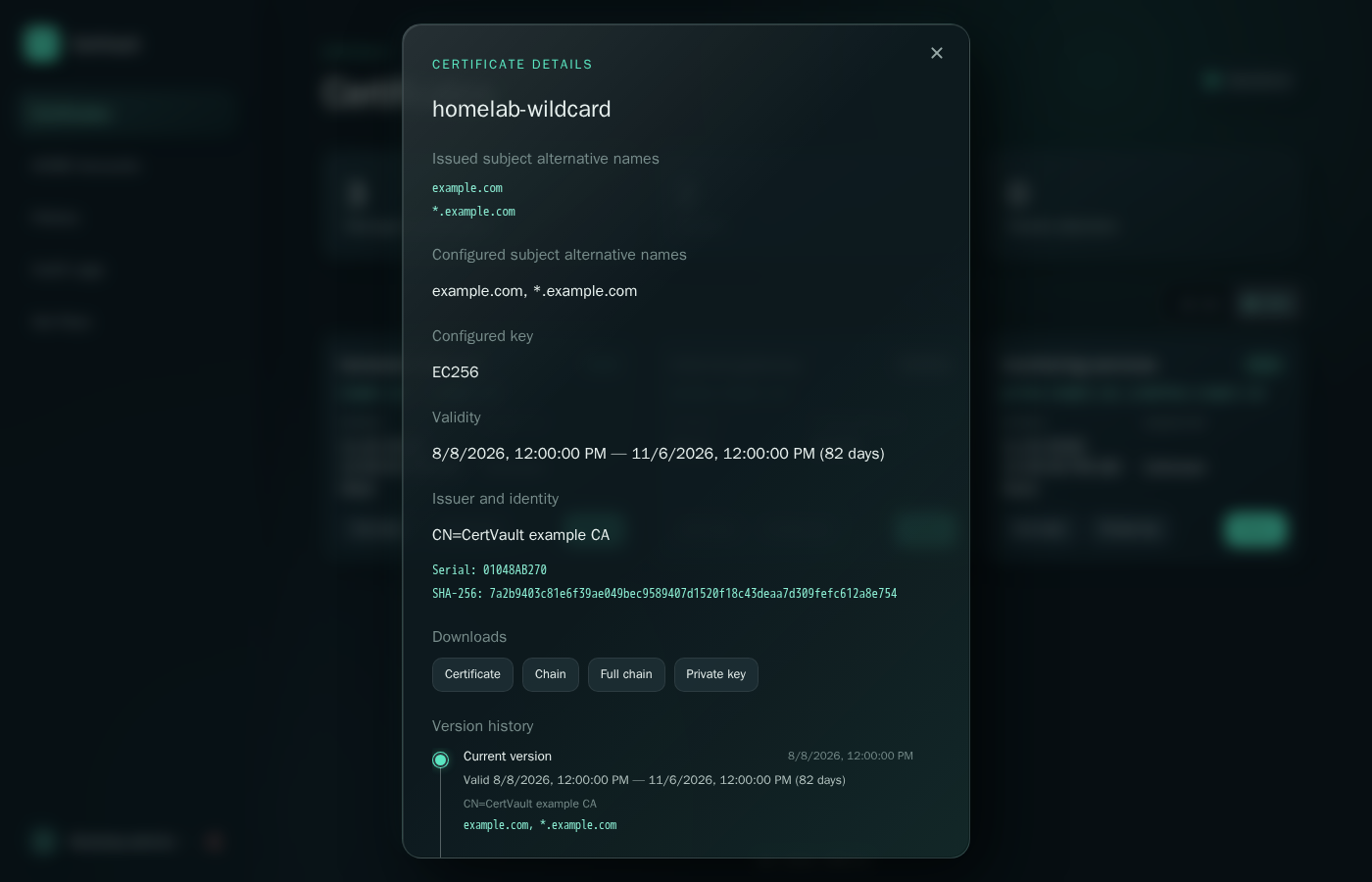
Certificate details and version history

Certificate inspection — identity, validity, downloadable artifacts, and an immutable version timeline.

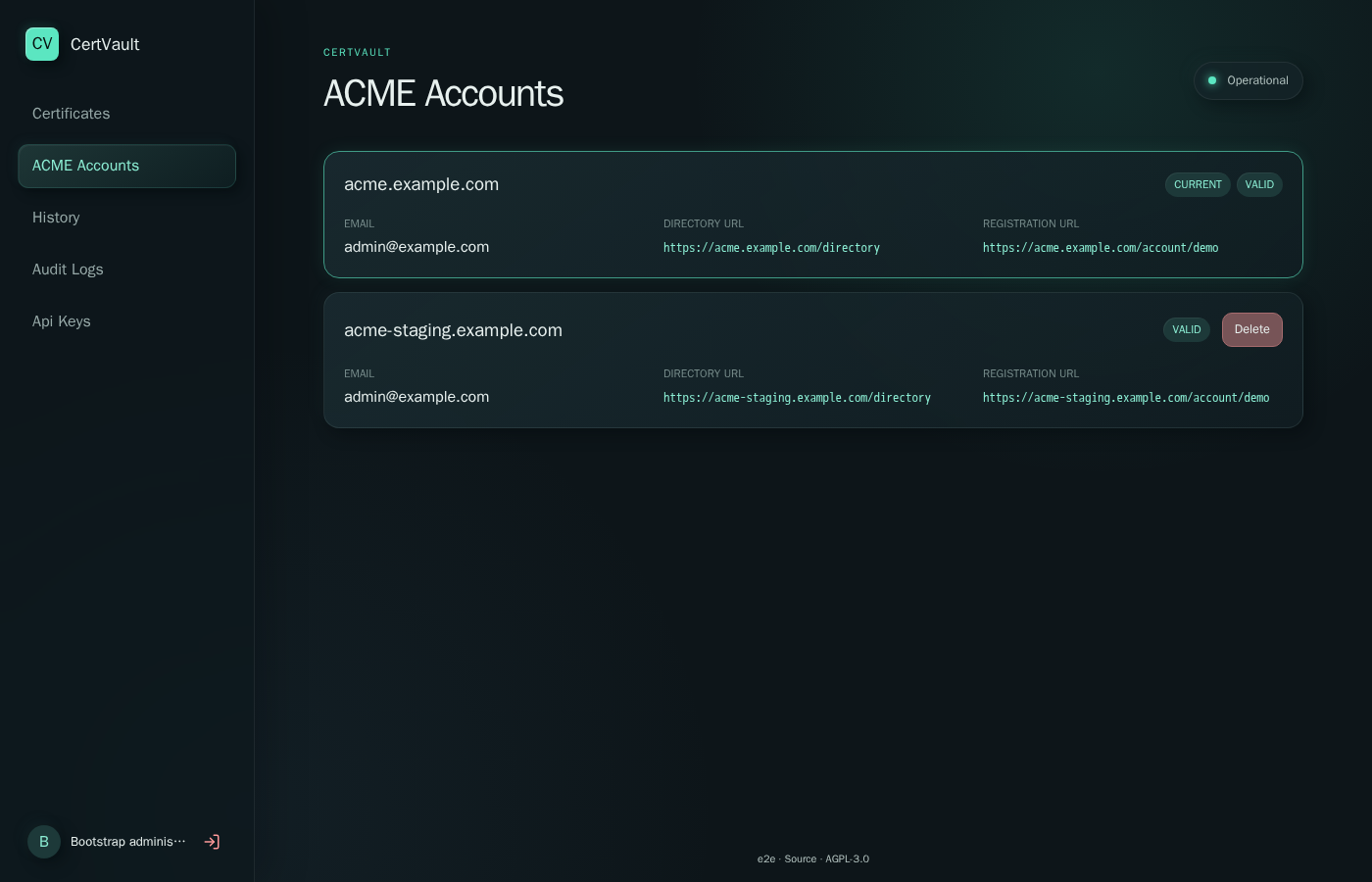
ACME account management

ACME accounts — separate registrations and status for every certificate authority directory.

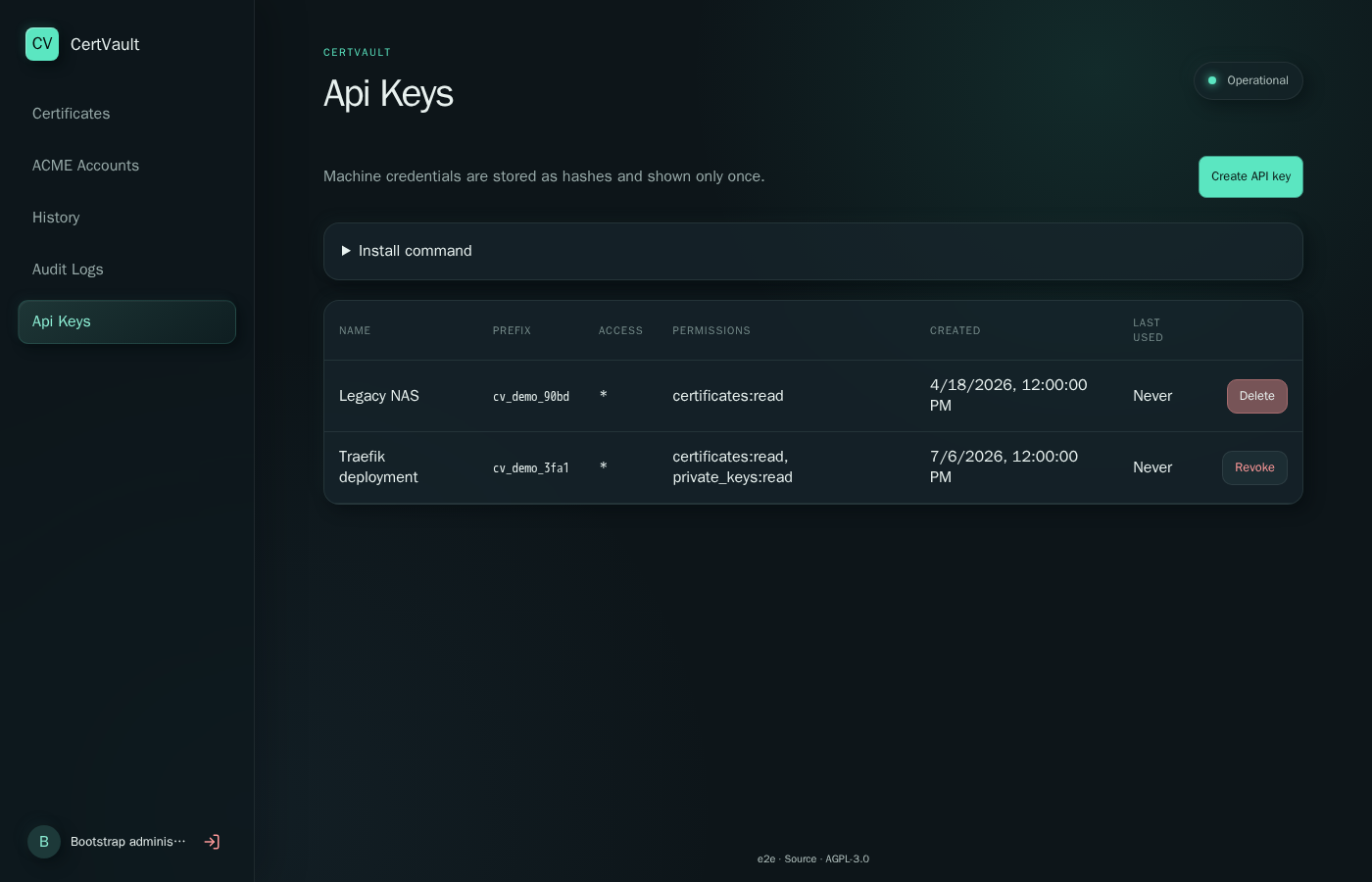
Scoped API key management

Client access — scoped, revocable API keys with certificate allowlists and usage visibility.

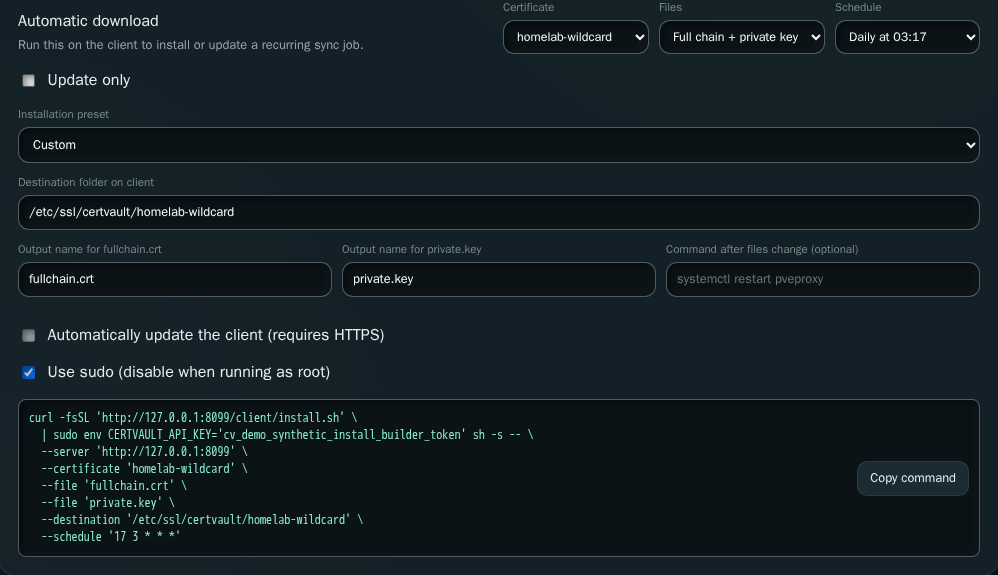
Installation command builder

Installation command builder — configure certificate files, destination, sync schedule, and a post-update reload command.

## Features - Headless YAML and environment configuration - Multiple DNS zones, credentials, domains, and certificates - Every DNS provider supported by [`go-acme/lego`](https://go-acme.github.io/lego/dns/) - Let's Encrypt staging/production or another ACME v2 directory - Encrypted ACME account keys and certificate private keys (AES-256-GCM) - Immutable, atomic certificate versions with GORM-managed SQLite metadata - Six-hour renewal reconciliation with per-certificate locking - Hashed, revocable API keys scoped by operation and certificate - Optional OIDC Authorization + PKCE login - Signed webhooks and restricted executable hooks - Apprise notifications for certificate issuance, renewal, and failures - Responsive React Console - Non-root, capability-free Docker deployment ## Quick start Create `config.yaml` and replace the example email and domain. The example uses Let's Encrypt staging so initial testing cannot exhaust production rate limits. ```yaml server: public_url: http://localhost:8080 log_level: info # Only add the IP or network of a reverse proxy you operate. # trusted_proxies: [172.18.0.0/16] # Optional. Audit events are retained indefinitely when omitted. audit: retention: 90d acme: email: admin@example.com directory_url: https://acme-staging-v02.api.letsencrypt.org/directory accept_terms: true # Uncomment to enable OIDC. Keep the client secret in .env. # auth: # oidc: # issuer_url: https://auth.example.com # client_id: certvault # scopes: [openid, profile, email, groups] # allowed_groups: [cert-admins] dns_credentials: cloudflare: provider: cloudflare zones: - name: example.com credential: cloudflare certificates: - name: example-wildcard domains: [example.com, "*.example.com"] renew_before: 720h ``` Create an untracked `.env` file beside it. Generate the master key with `openssl rand -base64 32`, then replace all three values: ```dotenv CERTVAULT_MASTER_KEY=replace-with-output-of-openssl-rand-base64-32 CERTVAULT_BOOTSTRAP_ADMIN_TOKEN=replace-with-a-long-random-login-token CLOUDFLARE_DNS_API_TOKEN=replace-with-cloudflare-token # CERTVAULT_OIDC_CLIENT_SECRET=replace-with-oidc-client-secret ``` Create `docker-compose.yaml` beside both files: ```yaml services: certvault: image: ghcr.io/dougmaitelli/certvault:latest container_name: certvault restart: unless-stopped ports: - "8080:8080" env_file: - .env volumes: - ./config.yaml:/config/config.yaml:ro - certvault-data:/data healthcheck: test: - CMD-SHELL - wget -q --spider http://127.0.0.1:8080/api/v1/health || exit 1 interval: 30s timeout: 5s retries: 3 start_period: 10s security_opt: - no-new-privileges:true cap_drop: - ALL volumes: certvault-data: ``` ```sh docker compose up -d ``` Open `http://localhost:8080` and sign in with the value assigned to `CERTVAULT_BOOTSTRAP_ADMIN_TOKEN`. Put CertVault behind an HTTPS reverse proxy before using it across the network—the API can return private keys and must not be exposed over plaintext HTTP. When staging succeeds, change the directory URL to: ```text https://acme-v02.api.letsencrypt.org/directory ``` The production and staging ACME accounts are cryptographically separate. Back up the `/data` volume and master key together. Encrypted data cannot be recovered without that key. ## DNS providers Cloudflare is used only as a familiar Quick Start example. It is not required. CertVault supports the DNS providers available through lego; choose a provider and its required environment variables from the [lego DNS provider documentation](https://go-acme.github.io/lego/dns/). For the Cloudflare example, create an API token restricted to the required zones with `Zone:Read` and `DNS:Edit`. Do not use the Cloudflare global API key. DNS credentials are not persisted in SQLite. ## Client access Create an API key in the web console, or create one without the UI from inside the container: ```sh docker compose exec certvault certvault api-key create \ --name traefik \ --scope certificates:read \ --scope private_keys:read \ --certificate homelab-wildcard ``` The raw value is shown once. See [Client access](https://dougmaitelli.github.io/CertVault/client-access/) for the complete headless management workflow. Fetch artifacts with: ```sh curl --fail --silent --show-error \ -H 'Authorization: Bearer cv_live_PREFIX.SECRET' \ https://certvault.home.example.com/api/v1/certificates/homelab-wildcard/fullchain.crt \ --output fullchain.crt curl --fail --silent --show-error \ -H 'Authorization: Bearer cv_live_PREFIX.SECRET' \ https://certvault.home.example.com/api/v1/certificates/homelab-wildcard/private.key \ --output private.key ``` Downloads include an `ETag`, so clients may use `If-None-Match`. A client key needs `certificates:read` for public certificate files and the separately privileged `private_keys:read` scope for private keys. The API Keys page can also generate a command that installs an automatic download job through `/client/install.sh`. The installer requires a Linux or Unix-like client with `curl`, `crontab`, and `install`. It stores the API key in a mode `0600` file, downloads through an atomic temporary directory, installs the selected cron schedule, and immediately performs the first download. Run the generated command again to replace an existing job for the same certificate files, including its token, server, schedule, and destination, instead of creating a duplicate. The default bundle installs `fullchain.crt` and `private.key` together into a certificate-specific destination directory. Artifact output names can be customized for services that require fixed filenames, and an optional reload command runs when files change. The client stores each file's `ETag` and uses conditional requests on scheduled runs; unchanged files return `304 Not Modified`, are not rewritten, and do not create certificate-download audit events. Expand **Install command** on the API Keys page at any time to build a client command. After creating a key, the builder opens and includes that key in the command. Otherwise it defaults to `--reuse-key`. Select the **Proxmox VE** installation preset to download the full chain as `pveproxy-ssl.pem` and the private key as `pveproxy-ssl.key` into `/etc/pve/local`, sync daily at 03:17, and run `systemctl restart pveproxy` after files change. Run the command on each node as root. The preset disables **Use sudo**; enable it when running through a user with sudo access. Preset values remain editable, and selecting **Custom** restores the default deployment settings. Proxmox VE requires certificate and private-key download permissions. To update the client scripts without remembering the original settings, check **Update only** in the builder. Its command uses `--update-client-only --server URL` and requires no API key or job options. Run it as the original installation user (disable **Use sudo** if already running as root). It preserves all job wrappers, keys, cron schedules, destinations, file mappings, reload commands, and download validators, and does not run a sync. Installations with automatic updates also perform an immediate signed update check for that server using their existing pinned public key. Custom installations should retain their `CERTVAULT_CLIENT_CONFIG_DIR` and `CERTVAULT_CLIENT_SCRIPT_DIR` overrides. When reusing a saved key, run the command on the original client as the same user, selecting the same certificate and file set. The installer reads the saved local token and redeploys the job with the chosen destination, output names, schedule, and reload command. No token is included in the generated command. Reuse fails if the matching token file is missing; it does not prompt for a replacement key. ## Configuration Global values can be overridden with: | Variable | Purpose | | -------------------------------------- | ----------------------------------------------------------------------------------------------- | | `CERTVAULT_CONFIG` | YAML path; defaults to `/config/config.yaml` | | `CERTVAULT_DATA_DIR` | Persistent data directory | | `CERTVAULT_LISTEN` | HTTP listen address | | `CERTVAULT_PUBLIC_URL` | Browser-visible HTTPS origin | | `CERTVAULT_UI_ENABLED` | Enable or disable the web console and browser authentication routes | | `CERTVAULT_LOG_LEVEL` | Logging level | | `CERTVAULT_ACME_EMAIL` | ACME account email | | `CERTVAULT_ACME_DIRECTORY_URL` | ACME directory override | | `CERTVAULT_ACME_DNS_RESOLVERS` | Comma-separated recursive resolvers used for DNS-01 checks; defaults to `1.1.1.1:53,1.0.0.1:53` | | `CERTVAULT_MASTER_KEY` | Base64-encoded 32-byte encryption key | | `CERTVAULT_MASTER_KEY_FILE` | Path to a file containing the Base64-encoded encryption key | | `CERTVAULT_SESSION_DURATION` | Browser session lifetime; defaults to `8h` | | `CERTVAULT_BOOTSTRAP_ADMIN_TOKEN` | Break-glass UI token | | `CERTVAULT_BOOTSTRAP_ADMIN_TOKEN_FILE` | Path to a file containing the break-glass UI token | | `CERTVAULT_OIDC_ISSUER_URL` | OIDC issuer used for provider discovery | | `CERTVAULT_OIDC_CLIENT_ID` | OIDC client identifier | | `CERTVAULT_OIDC_CLIENT_SECRET` | OIDC client secret | | `CERTVAULT_OIDC_CLIENT_SECRET_FILE` | Path to a file containing the OIDC client secret | | `CERTVAULT_OIDC_SCOPES` | Comma-separated OIDC scopes; must include `openid` | | `CERTVAULT_OIDC_ALLOWED_GROUPS` | Comma-separated administrator group allowlist | | `CERTVAULT_APPRISE_URL` | Apprise REST notification endpoint | | `CERTVAULT_APPRISE_URLS` | Comma-separated inline Apprise delivery URLs | | `CERTVAULT_APPRISE_TAGS` | Comma-separated Apprise routing tags | Some values may end in `_FILE`. CertVault reads that file and supplies its contents to the provider without retaining the value. Set either `CERTVAULT_MASTER_KEY` directly or `CERTVAULT_MASTER_KEY_FILE` to the path of a mounted secret. They cannot both be set. The file form is recommended for Docker because the key is not exposed in the container's environment metadata. The bootstrap administrator credential is optional. When enabled, set either `CERTVAULT_BOOTSTRAP_ADMIN_TOKEN` directly or `CERTVAULT_BOOTSTRAP_ADMIN_TOKEN_FILE` to a secret file path, but not both. It can also be configured with `auth.bootstrap_token_file` in YAML. Omit all three settings to disable bootstrap login. The file form remains recommended for Docker deployments. Certificate key types are `ec256` (default), `ec384`, `rsa2048`, `rsa3072`, and `rsa4096`. `renew_before` and `audit.retention` accept Go duration syntax plus whole days such as `30d` or `90d`. When audit retention is enabled, expired events are removed at startup and daily afterward. Set `acme.automatic_issuance` to control initial issuance and scheduled renewal globally. A certificate can set its own `automatic_issuance` value to override the global setting; omitted values inherit it. Manual renewal requests remain available regardless of these settings. ## OIDC Uncomment `auth.oidc` in the Quick Start and add `CERTVAULT_OIDC_CLIENT_SECRET` to `.env`. Register `{server.public_url}/auth/callback` with the provider. The client secret may instead be supplied through `CERTVAULT_OIDC_CLIENT_SECRET_FILE`, but both forms cannot be set together. If `allowed_groups` is empty, any successfully authenticated identity is an administrator; setting an allowlist is strongly recommended. The bootstrap token remains available as break-glass access. ## Hooks Webhook bodies identify the event, certificate, version, and timestamp. If `secret_file` is configured, requests contain: ```text X-CertVault-Signature-256: sha256= ``` Executable hooks are disabled unless explicitly present in YAML. They run directly without a shell, receive only a minimal `PATH` and `CERTVAULT_EVENT_JSON`, and are killed at the configured timeout. Mount executables read-only under `/hooks`. Supported events are `certificate.issued`, `certificate.renewed`, and `certificate.failed`. ## Data and security model - SQLite contains metadata, hashes, history, and audit events—not raw API keys or DNS credentials. - Certificate and ACME private keys are authenticated-encrypted with the external master key. - Certificate versions are written through temporary files and atomic renames. - A failed renewal leaves the prior version untouched. - Only one issuance runs at a time because lego provider construction reads process environment. By default, audit entries record the direct network peer and ignore forwarded address headers. Set `server.trusted_proxies` to proxy IPs or CIDRs to accept `X-Forwarded-For` and `X-Real-IP` only from those peers. CertVault walks trusted proxy chains from right to left so client-supplied entries cannot override the address added by your proxy. Never configure an untrusted network such as `0.0.0.0/0`. ## Development See [Contributing](CONTRIBUTING.md) for local development and quality checks, and the [browser test guide](e2e/README.md) for integration testing. The API outline is in [`docs/openapi.yaml`](docs/openapi.yaml). ## License CertVault is free software licensed under the [GNU Affero General Public License v3.0](LICENSE). Copyright 2026 Douglas Maitelli.