# dsh-session-manager
English | [中文](README.md)
Possibly the most feature-complete DSH session manager plugin out there: full session management for the DeepSeek Harness web UI, including delete (with a trash to restore or purge), restore archived sessions, recent-activity stats, continue/pause sessions, unread/read markers, fork into a new chat, revealing log folders, workspace grouping and reordering, and a context compaction threshold — from a Settings section and the conversation header. No harness changes.
Built independently with dsh + Deepseek-V4-Flash0731
If you find it useful, please give it a ⭐ Star. Thank you!
## Features
- A dedicated **Session Manager** section in Settings (a settings section, sibling to Notifications)
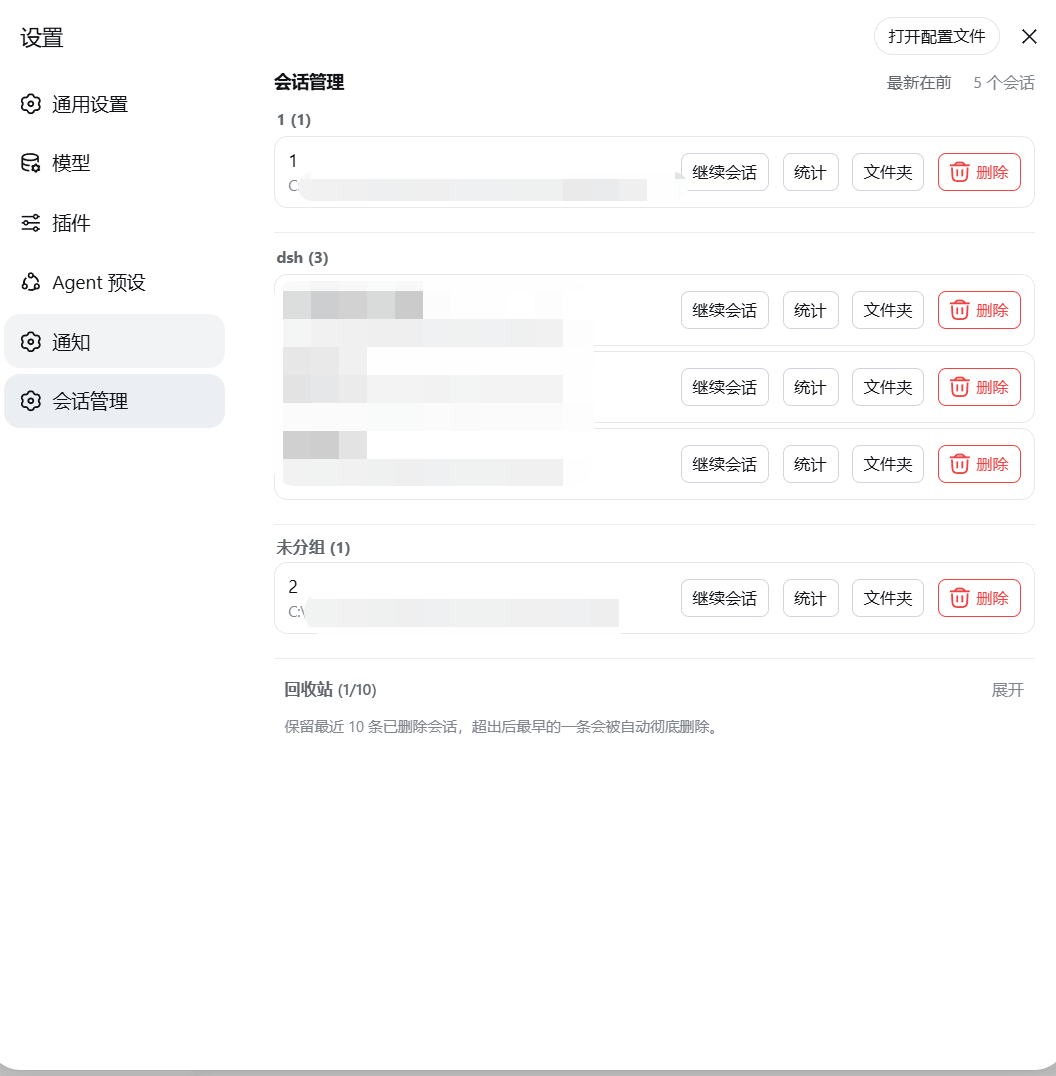
- Lists all sessions (title / working directory); **archived sessions** are grouped in a collapsible area at the bottom with a **one-click Restore** back to the list
- **Trash**: deleted sessions move to the trash (keeps the most recent 10, the oldest is purged automatically), with **Restore** and **Delete permanently** actions
- **Stats**: expand any session to see recent activity (turns / user messages / assistant messages / tool calls / activity window)
- **Continue session**: open a session and close the panel; **Pause**: stop a running session's current turn
- **Unread / read**: a status dot next to each session's title — blue for manually marked unread, amber for the official waiting-for-input state, green for the official completion reminder, spinner while running; clicking an official dot marks it read **in place** (no navigation), clicking the blue dot clears the unread, opening a session auto-reads it; the official sidebar shows a matching blue unread dot on the session row
- **Fork into a new chat**: one click forks a child session (official `sessions.fork`) and opens it
- **Folder**: reveal the session's log directory in the system file manager
- **Delete this session**: a red button in the conversation header (left of Session log) to delete the current session
- **Session Manager / Trash** header buttons: a self-drawn right drawer (pin to keep open, outside-click to close); a "More" popover in each row holds Stats / Folder / Fork
- **Workspace management**: sessions are grouped by workspace, sorted by last use within each group (toggle newest/oldest first); drag a workspace title to reorder (insert before/after, swap on the title, drag to the bottom to append); hovering a title shows **Move to top / Rename / Delete** buttons (delete follows the official definition: it only removes the workspace from the list — the folder and session logs are kept, and its sessions appear under Ungrouped)
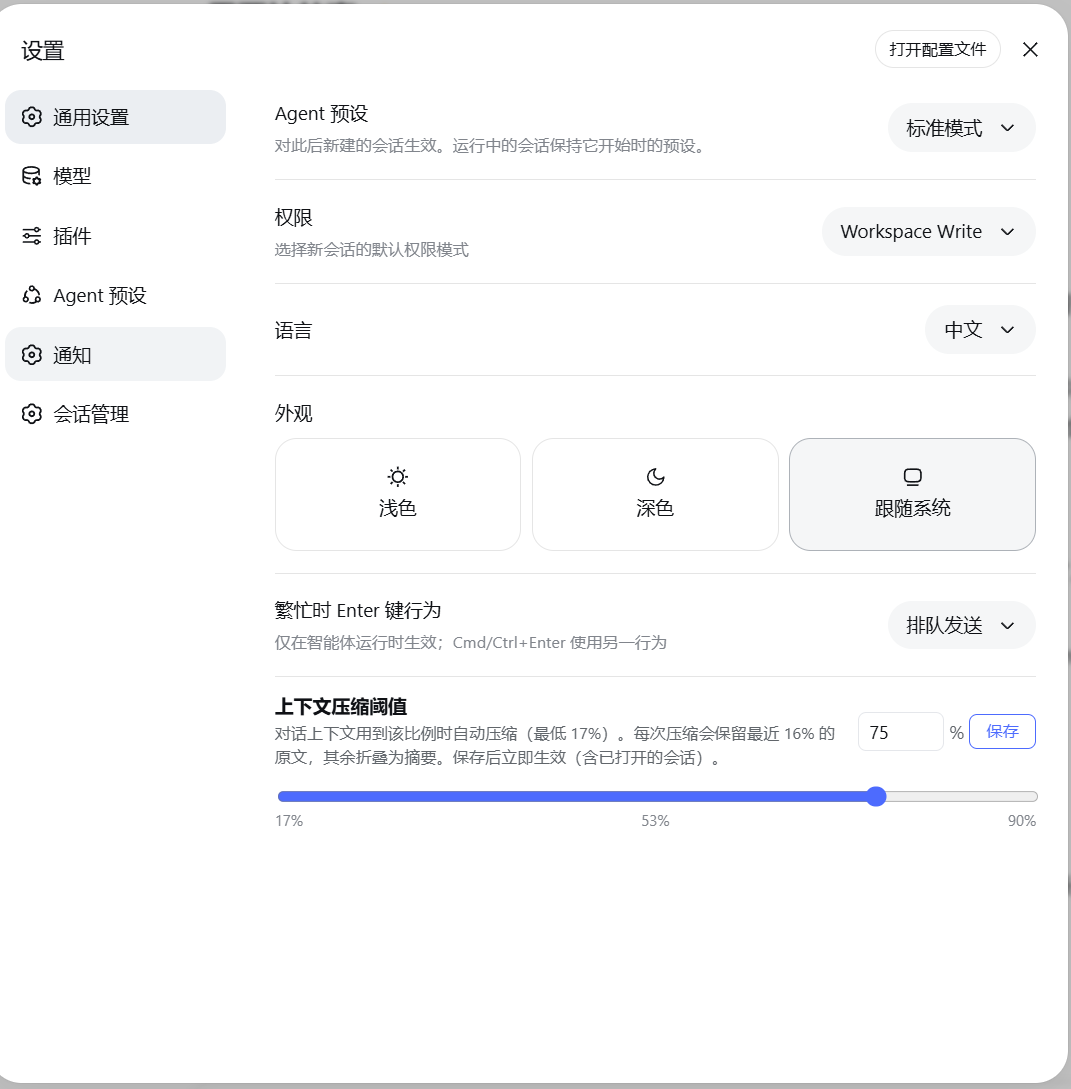
- **Context compaction threshold** (General settings): set at what fraction of the 1M-token model window the conversation context auto-compacts (17%–90%), keeping the most recent 16% verbatim; applies **globally to all agent presets** (immediate on save + persisted + auto-applied on restart)
- Delete restriction: only sessions **currently thinking** are protected; an open-but-idle session can be deleted
- Subagent functionality is unaffected: their sessions are managed by DSH delegation, and this plugin does not offer a delete entry for them (end/clean them up within their parent session)
- UI language follows the page language (Chinese / English)
## Screenshots
The Settings "Session Manager" section (workspace groups, row actions and trash):
Conversation header shortcuts (Session Manager / Trash / Delete this session):

The session management drawer (workspace groups, pin to keep open, outside-click to close):

The "Context compaction threshold" in General settings (17%–90% with slider scale):
## Install
### From GitHub
```sh
dsh plugin --profile web add 'github:dream12347/dsh-session-manager#v0.1.6'
```
### From a local directory
```sh
dsh plugin --profile web add /absolute/path/to/dsh-session-manager
```
### From a tarball
```sh
pnpm pack
dsh plugin --profile web add /absolute/path/to/dsh-session-manager-0.1.6.tgz
```
After installing, **restart** `dsh web` (the host plugin and the served client bundle load at startup).
## Usage
### Settings section
1. Open **Settings** (the gear icon at the bottom of the sidebar)
2. A dedicated **Session Manager** section appears in the settings left navigation — click it
3. The main list shows unarchived sessions; the **Archived sessions** collapsible area at the bottom lets you view, **restore**, or delete archived sessions
4. Deleting moves a session to the **Trash** collapsible area (keeps the most recent 10)
5. In the trash you can **Restore** (back to the list) or **Delete permanently** (irreversible)
6. Per-row actions: **Continue session** (open and enter), **Pause** (stop the running turn), **Stats** (expand recent activity), **Folder** (reveal the log directory), **Delete**
7. Workspace title actions (shown on hover): **Move to top**, **Rename**, **Delete** (red, with a confirmation dialog)
8. Drag a workspace title to reorder: drop above/below another workspace to insert, drop on a title to swap, drag to the very bottom to append
9. The sort toggle (newest first / oldest first) switches the session order inside each group
### General settings: context compaction threshold
1. Open **Settings** → **General**
2. Find "Context compaction threshold": slider / input for 17%–90%
3. Saving applies immediately (including already-open sessions); the value applies globally to all agent presets and survives restarts
### Conversation header shortcuts
Top right of any conversation (left of Session log):
- **Session Manager**: opens the management drawer (full list + archived + trash); pin it to keep open, outside-click closes it
- **Trash**: opens the drawer with the trash expanded
- **Delete this session** (red): deletes the current conversation (moves it to the trash)
### Unread / read status dots
The dot next to a session's title shows one of four states: **blue** = manually marked unread, **amber** = official waiting-for-input, **green** = official completion reminder, **spinner** = running. Clicking an amber/green dot marks it read **in place** (clears the official reminder without navigating); clicking the blue dot clears the unread; clicking the empty spot marks it unread; opening the session auto-reads it. The official sidebar mirrors the blue unread dot on the matching session row (matched by title text — sessions with duplicate titles share the dot).
## How it works
| Layer | Implementation |
|---|---|
| Host | `src/index.ts` registers 7 routes: `POST /delete` (archive + move non-live session files to the trash + record the entry), `POST /restore` (move files back + unarchive + drop the entry), `POST /purge` (clear trash and original files + drop the entry), `GET /trash` (trash listing), `POST /open-folder` (reveal the log directory), `POST /pause` (pause a running session), and `GET|POST /compaction-threshold` (read/write the global compaction threshold). It resolves sessions via `ctx.sessionPersistence`, archives/unarchives through `ctx.workspaceRegistry`, and persists trash entries, the archive set and the threshold via `ctx.storageDomain`; `ctx.agents` detects running sessions and refuses to delete them |
| Client | `src/client/index.ts` registers the dedicated section through the official `settings.section` slot, lists sessions (with the archived group) from the `useSessions` / `useWorkspaces` standard feeds, and calls the host routes to delete/restore/purge; the drawer subscribes to the live session list via `sessions.list` (an ObservableSnapshot); removed session ids are remembered in browser localStorage so a live session does not "resurrect" after refresh |
- **Unread mechanism**: the manual unread set lives in browser localStorage under the shared key `dsh.session-unread.v1` (format `{version:1, ids:[]}` — interoperable with other session-manager plugins); the official dots (amber/green/spinner) are driven by the official `SessionSummary` fields `pendingInteraction` / `completed` / `running`, and clicking one marks it read in place by clearing the official reminder (no session open); the sidebar blue dots are decorated onto the official tree rows by a MutationObserver (official row elements carry no session-id attribute, so rows are matched by title text)
- **Global threshold**: stored in the storage domain (`dsh_delete_session` → `thresholdRatio`) and in the current agent preset's `agent.cordis.yml`; the host writes the threshold into every preset's compaction-engine config in an `agent/pre-step` hook, so it applies to all presets uniformly and survives restarts
- Deletion goes through the official archive channel first: the sidebar hides the session immediately
- Trash entries persist in the DSH storage domain (`~/.dsh/storages/dsh_delete_session.json`); files live in `~/.dsh/dsh-delete-session-trash/`
- Workspace accounting (`sessionIds` slots / the archive set) is reconciled automatically on the next startup when the registry rebuilds its header index — no manual file editing
- No system-prompt changes, no new model-facing tools: zero impact on tokens and model behavior
## Limitations
- **Running sessions cannot be deleted** (button disabled and the host refuses); with multiple tabs, stop the session elsewhere first
- Subagent sessions cannot be deleted
- A live session (opened in this process) has its in-memory state cleaned up by DSH on restart; deleted ids are recorded in browser localStorage so they do not reappear after a refresh
- Sidebar unread dots are matched by title text: sessions with duplicate titles share the same dot (the drawer is unaffected — it marks by real session id)
## Compatibility
Current version targets DSH `0.1.0-rc.6` (depends on the `settings.section` / `settings.general.item` / `conversation.session.header.utilities` slots and the `ctx.sessionPersistence` / `ctx.workspaceRegistry` / `ctx.agents` / `ctx.storageDomain` / `ctx.agentPresets` services). If slots or service APIs change in a future DSH version, the plugin needs a matching update.
## Development
```sh
pnpm install # installs dependencies (@deepseek-ai packages are linked local dev dependencies)
pnpm run check # typecheck + test + build
```
`lib/` holds the committed build artifacts: rebuild and commit `lib/` with every source change.