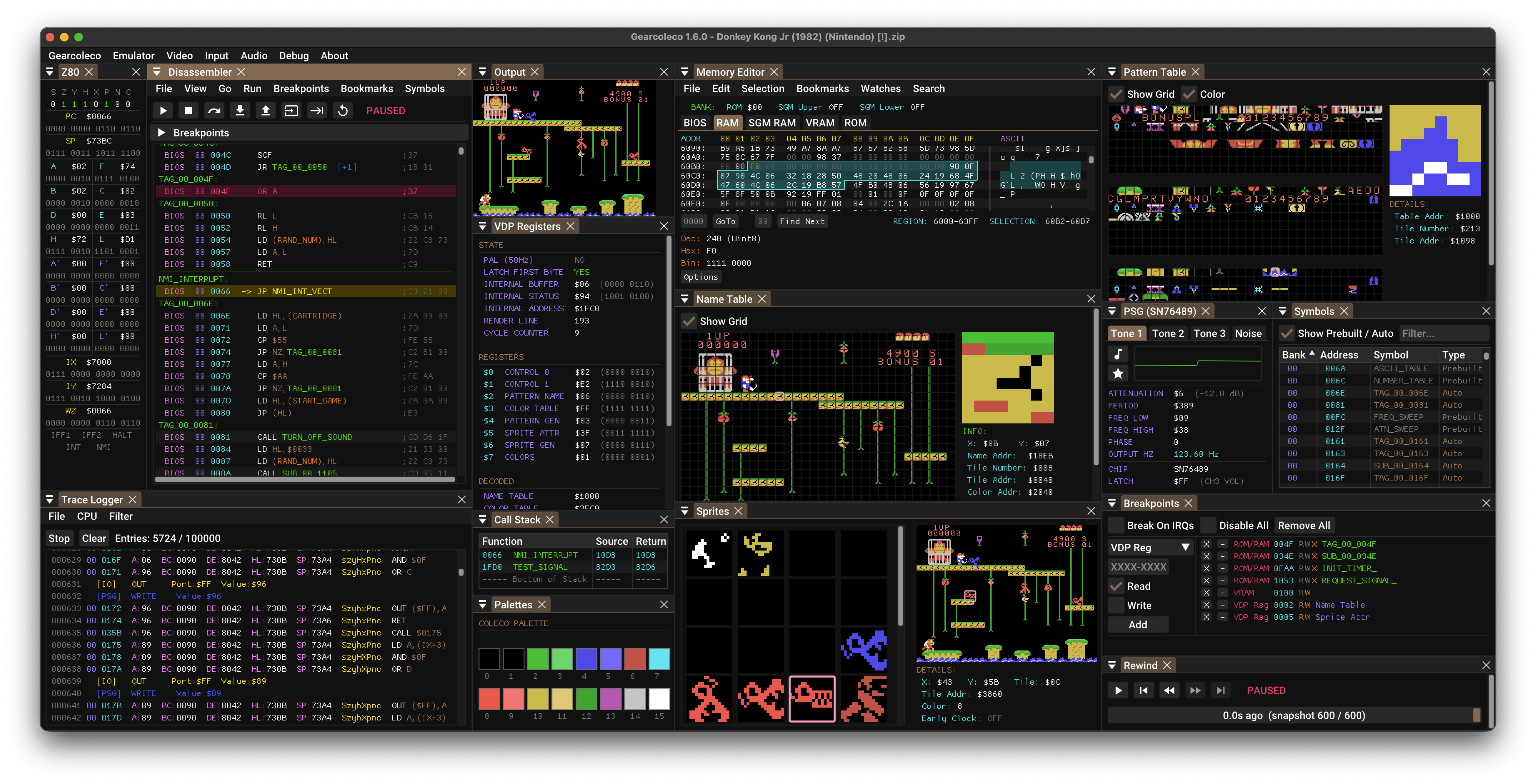
# Gearcoleco [![GitHub Workflow Status](https://img.shields.io/github/actions/workflow/status/drhelius/Gearcoleco/gearcoleco.yml)](https://github.com/drhelius/Gearcoleco/actions/workflows/gearcoleco.yml) [![GitHub Releases)](https://img.shields.io/github/v/tag/drhelius/Gearcoleco?label=version)](https://github.com/drhelius/Gearcoleco/releases) [![commits)](https://img.shields.io/github/commit-activity/t/drhelius/Gearcoleco)](https://github.com/drhelius/Gearcoleco/commits/main) [![GitHub contributors](https://img.shields.io/github/contributors/drhelius/Gearcoleco)](https://github.com/drhelius/Gearcoleco/graphs/contributors) [![GitHub Sponsors](https://img.shields.io/github/sponsors/drhelius)](https://github.com/sponsors/drhelius) [![License](https://img.shields.io/github/license/drhelius/Gearcoleco)](https://github.com/drhelius/Gearcoleco/blob/main/LICENSE) [![Twitter Follow](https://img.shields.io/twitter/follow/drhelius)](https://x.com/drhelius) Gearcoleco is a very accurate, cross-platform ColecoVision and Coleco ADAM emulator written in C++ that runs on Windows, macOS, Linux, BSD and RetroArch, with an embedded MCP server for AI debugging and development. This is an open source project with its ongoing development made possible thanks to the support by these awesome [backers](backers.md). If you find it useful, please consider [sponsoring](https://github.com/sponsors/drhelius). Don't hesitate to report bugs or ask for new features by [opening an issue](https://github.com/drhelius/Gearcoleco/issues). ## Downloads
Platform Architecture Download Link
Windows Desktop x64 Gearcoleco-1.8.0-desktop-windows-x64.zip
Desktop ARM64 Gearcoleco-1.8.0-desktop-windows-arm64.zip
macOS Homebrew brew install --cask drhelius/geardome/gearcoleco
Desktop Apple Silicon Gearcoleco-1.8.0-desktop-macos-arm64.zip
Desktop Intel Gearcoleco-1.8.0-desktop-macos-intel.zip
Linux Ubuntu PPA drhelius/ppa-geardome
Fedora RPM drhelius/rpm-geardome
Desktop Ubuntu 26.04 x64 Gearcoleco-1.8.0-desktop-ubuntu26.04-x64.zip
Desktop Ubuntu 26.04 ARM64 Gearcoleco-1.8.0-desktop-ubuntu26.04-arm64.zip
Desktop Ubuntu 24.04 x64 Gearcoleco-1.8.0-desktop-ubuntu24.04-x64.zip
Desktop Ubuntu 24.04 ARM64 Gearcoleco-1.8.0-desktop-ubuntu24.04-arm64.zip
MCPB All platforms MCP Readme
RetroArch All platforms Libretro core documentation
Dev Builds All platforms GitHub Actions
**Notes:** - **Windows**: May need [Visual C++ Redistributable](https://go.microsoft.com/fwlink/?LinkId=746572) and [OpenGL Compatibility Pack](https://apps.microsoft.com/detail/9nqpsl29bfff) - **Homebrew**: If Homebrew asks you to trust the third-party tap, run `brew trust --tap drhelius/geardome` - **Linux**: May need `libsdl3` ## Features - Very accurate Z80 core, TMS9918A VDP, SN76489 PSG and AY-3-8910 SGM emulation. - Support for ColecoVision Super Game Module (SGM) and MegaCart ROMs. - Coleco ADAM computer and cartridge boot modes, full keyboard, ADAMnet, printer, Digital Data Pack and floppy support. - In-game ADAM keyboard mapper to bind host keys per game. - Optional F18A v1.9 emulation. - Support for Super Action Controller (SAC), Wheel Controller and Roller Controller. - Save states with preview and rewind support. - Run-ahead support to reduce input latency. - Compressed ROM support (ZIP). - VGM recorder. - Supported platforms (standalone): Windows, Linux, BSD and macOS. - Supported platforms (libretro): Windows, Linux, macOS, Raspberry Pi, Android, iOS, tvOS, webOS, PlayStation Vita, PlayStation 3, Nintendo 3DS, Nintendo GameCube, Nintendo Wii, Nintendo WiiU, Nintendo Switch, Emscripten, Classic Mini systems (NES, SNES, C64, ...), OpenDingux, RetroFW and QNX. - Full debugger with just-in-time disassembler, CPU breakpoints, memory access breakpoints, code navigation (goto address, JP JR and CALL double clicking), debug symbols, automatic labels, memory editor, trace logger, IO inspector and VRAM viewer including registers, tiles, sprites and backgrounds. - MCP server for AI-assisted debugging with Claude Code, Codex and similar, exposing tools for execution control, memory inspection, hardware status, rewind and more. - Windows, Linux and macOS *Portable Mode*. - [Programmable Shader Chain](platforms/shared/desktop/shaders/README.md). - Content loading from the command line by adding the cartridge, ADAM media or playlist path as an argument. - Content loading using drag & drop. - Support for modern game controllers through [gamecontrollerdb.txt](https://github.com/mdqinc/SDL_GameControllerDB) file located in the same directory as the application binary. ## Tips ### Basic Usage - **BIOS and ADAM Firmware**: Firmware is not included. Select the ColecoVision BIOS (OS-7) under **Emulator > BIOS**; the original BIOS is recommended (CRC32 `3aa93ef3`; filenames `colecovision.rom`, `coleco.rom` or `os7.u2`). ADAM additionally needs **ADAM > EOS ROM** (`eos.rom`, 8192 bytes, common CRC32 `05a37a34`) and **ADAM > SmartWriter ROM** (`writer.rom`, `wp.rom` or `wp_r80.rom`, 32768 bytes, common CRC32 `58d86a2a`). - **ADAM Startup and Media**: Insert images through the **ADAM** menu's disk or data pack submenus, then select **Power On**. Supported formats are 256 KiB `.ddp`, 160/320 KiB `.dsk`, ZIP archives containing one valid ADAM image, and `.m3u` playlists containing images of the same type. Each drive has its own recent images, playlist and write protection controls. Insert/eject affects only that drive; dropped images use an available matching drive or prompt for a destination. **Gearcoleco > Open ROM...** starts ColecoVision cartridges. - **ADAM Power and Saves**: **Power Off** saves modified media and keeps it inserted. Firmware changes apply at the next **Power On**; **Computer Reset** retains the current firmware and mounted media. Changes are stored as complete images under **Save Files**, leaving source files untouched. Drive menus also provide **Save Changes** and **Save As**; a failed save keeps the modified image mounted. - **ADAM Input**: Type directly into ADAM; in debug mode, focus **Output** to type or a debugger tool to use its shortcuts. Configure special keys under **ADAM > Keyboard** (see [defaults below](#desktop-adam-keyboard)) and change them per game with the [keyboard mapper](#adam-keyboard-mapper); `Alt+Enter` toggles fullscreen. **ADAM > Controller 1 / Controller 2** selects gamepad (default), keyboard or no hand controller per port. Bindings come from **Input > Gamepads** or **Input > Keyboard Configuration**; keys mapped to a hand controller do not type into ADAM. ADAM controller choices are saved separately from ColecoVision settings. - **Spinners**: The mouse drives them while the pointer is over the screen. For free movement, press `Ctrl+F10` or go fullscreen to enter **Game Focus**, which locks the mouse in the window; `Ctrl+F10` leaves it. Disable spinners for software that does not use them. - **Hotkeys**: `Ctrl+F10` Game Focus, `Alt+Enter` fullscreen, `Ctrl+F9` quit (`Cmd+Q` on macOS), `Ctrl+Shift+S` / `Ctrl+Shift+L` save and load state, `Ctrl+Shift+R` reset, `Ctrl+Shift+P` pause. On macOS, `Cmd` replaces `Ctrl` and `Option` replaces `Alt` in all of them. In Game Focus every hotkey is off except `Ctrl+F10`, `Alt+Enter`, `Ctrl+F1` and `Ctrl+F2`. Change them in **Emulator > Hotkeys**, where **Reset to Defaults** brings these back. - **Rewind**: Hold the configured rewind hotkey (`Ctrl+Shift+B` by default) or a mapped gamepad shortcut to step backwards through recent gameplay. - **Overscan**: For a precise representation of the original image, select **Overscan** `Top+Bottom` and **Aspect Ratio** `Standard (4:3 DAR)` in the **Video** menu. - **Mouse Cursor**: Automatically hides when hovering over the main output window or when Main Menu is disabled. - **Portable Mode**: Run with `--portable`, or create an empty file named `portable.ini` in the same directory as the application binary. On macOS, place the file next to the `.app` bundle. ### Desktop ADAM Keyboard Normal letters, digits, punctuation, Return, Escape, Backspace, Tab, Shift, Control, Caps Lock and arrow keys map directly. The dedicated ADAM keys use these defaults: | Host key | ADAM key | |---|---| | F1-F6 | SmartKey I-VI | | F7 / F8 | Undo / Wild Card | | Home / Insert / Delete | ADAM Home / Insert / Delete | | Page Up / Page Down | Move-Copy / Store-Fetch | | End | Clear | | Print Screen | Print | Saved keyboard mappings are preserved. Use **ADAM > Keyboard > Restore Defaults** to adopt this layout in an existing configuration. Keys type into ADAM while the window has focus. Hotkeys use `Ctrl+Shift` or `Ctrl` with an F-key, so SmartKeys and editing keys reach the emulated keyboard. In Game Focus only `Ctrl+F10`, `Alt+Enter`, `Ctrl+F1` and `Ctrl+F2` stay active. Leaving the window releases every held ADAM key and leaves Game Focus. On Windows and Linux, `Ctrl+F1` and `Ctrl+F2` belong to the [keyboard mapper](#adam-keyboard-mapper), so software that needs Control with SmartKey I or II needs them moved in **Emulator > Hotkeys**. ADAM keyboard input follows focus automatically. In normal use, type directly; in debug mode, focus Output to type into ADAM or focus a debugger tool to use its shortcuts. `Alt+Enter` toggles fullscreen. ### ADAM Keyboard Mapper Press `Ctrl+F1` (`Cmd+F1` on macOS), or use **ADAM > Keyboard > Keyboard Mapper...**, to stop ADAM and show its keyboard: - Click an ADAM key, then press the host key that should drive it, on its own. It stays selected for more host keys; click it again to deselect it. - Each ADAM key lists the host keys that drive it, built-in ones first. Click the **x** on one to remove it, or right click the ADAM key to remove all but the built-in ones. - Red keys are ones no host key reaches. - **Reset All**, clicked twice, drops the game's changes. - Press the same hotkey again, or click **Close**, to go back. `Ctrl+F2` (`Cmd+F2` on macOS), or **ADAM > Keyboard > Key Mapping**, turns the game's changes off and on, for instance to type text in a game whose letter keys were moved. Every game starts with them on. Both hotkeys can be changed in **Emulator > Hotkeys**, and the mapper can also have a gamepad shortcut. The mapper's changes sit on top of the **ADAM > Keyboard** bindings and are kept for that game only, in a `.keys` file named after the content (`ADAM.keys` with nothing loaded) in the **Save Files** folder, written when the mapper closes. The file can be edited by hand. Host keys without a line keep their usual job: ```ini [keys] w = up s = down f9 = control + smart_1 grave = none ``` - **Host keys**: `a`-`z`, `0`-`9`, `f1`-`f24`, `return`, `escape`, `backspace`, `tab`, `space`, `minus`, `equals`, `left_bracket`, `right_bracket`, `backslash`, `non_us_hash`, `semicolon`, `apostrophe`, `grave`, `comma`, `period`, `slash`, `non_us_backslash`, `caps_lock`, `print_screen`, `scroll_lock`, `pause`, `insert`, `home`, `page_up`, `delete`, `end`, `page_down`, `up`, `down`, `left`, `right`, `num_lock`, `kp_0`-`kp_9`, `kp_00`, `kp_000`, `kp_divide`, `kp_multiply`, `kp_minus`, `kp_plus`, `kp_enter`, `kp_period`, `kp_equals`, `kp_comma`, `menu`, `help`, `sysreq`, `international1`-`international5`, `lang1`-`lang5`, `left_ctrl`, `left_shift`, `left_alt`, `left_gui`, `right_ctrl`, `right_shift`, `right_alt`, `right_gui`. - **ADAM keys**: `a`-`z`, `0`-`9`, `smart_1`-`smart_6`, `space`, `minus`, `plus`, `caret`, `semicolon`, `quote`, `open_bracket`, `close_bracket`, `backslash`, `comma`, `period`, `slash`, `return`, `escape`, `backspace`, `tab`, `home`, `wild_card`, `undo`, `move`, `store`, `insert`, `print`, `clear`, `delete`, `up`, `down`, `left`, `right`, `shift`, `control`, `lock`. - A host key takes up to four ADAM keys joined with `+`, pressed in that order, such as `control + smart_1`, or `none` to do nothing. ### ADAM in Libretro - **Startup**: Place OS-7, EOS and SmartWriter in the frontend system directory or its `gearcoleco` subdirectory using the [firmware names above](#basic-usage). ADAM starts automatically for `.ddp`, `.dsk`, ADAM `.zip`, `.m3u` or no content; without bootable media it opens SmartWriter. Cartridges use ColecoVision unless **Cartridge Hardware** is set to ADAM. - **Media and Saves**: Media is write protected by default. Enable `Save-directory working copy` to save complete modified images in the frontend save directory, leaving source files untouched. **ADAM Disk Control Drive** selects Disk 1/2 or Data Pack 1/2; **Loaded media** (default) targets the primary content drive. Each drive has its own image list. Swap through the frontend's eject, select and close sequence; other drives stay mounted. - **Multiple Images**: The optional **ADAM** subsystem (`adam`) loads up to five slots before boot: **Cartridge, Disk 1, Disk 2, Data Pack 1, Data Pack 2**, in that order. All slots are optional and each drive supports playlists. Update older three-slot configurations to this layout; use normal content loading for a single image or playlist. - **Keyboard**: Bindings start from the [desktop defaults](#desktop-adam-keyboard), including Escape for Escape/WP and Shift/Control as modifiers. `Ctrl+F1` (`Cmd+F1` on macOS) opens the [keyboard mapper](#adam-keyboard-mapper), clicked with the mouse or a touch screen, and `Ctrl+F2` (`Cmd+F2`) turns its changes off and on. They are kept in `.keys` in the save directory (`ADAM.keys` without content). In RetroArch, set **Settings > Input > Auto Enable 'Game Focus' Mode** to **Detect**, or toggle Game Focus with Scroll Lock before typing or using these hotkeys; the core reminds you when ADAM content loads. Turn it off to use RetroArch shortcuts. Without Scroll Lock, assign **Game Focus Toggle** to F10; F9-F12 and Scroll Lock are unmapped in ADAM. - **Reset**: Frontend Reset keeps the current boot mode. **ADAM Computer Reset** boots from mounted media without ejecting it; if the option does not return to Idle automatically, select Idle before requesting another reset. ### Debugging Features - **Docking Windows**: In debug mode, you can dock windows together by pressing SHIFT and dragging a window onto another. - **Multi-viewport**: In Windows or macOS, you can enable "multi-viewport" in the debug menu. You must restart the emulator for the change to take effect. Once enabled, you can drag debugger windows outside the main window. - **Single Instance**: You can enable "Single Instance" in the `Emulator` menu. When enabled, opening a ROM while another instance is running will send the ROM to the running instance instead of starting a new one. - **Debug Symbols**: The emulator automatically tries to load a symbol file when loading a ROM (.sym, .noi). For example, for `path_to_rom_file.rom` it tries to load `path_to_rom_file.sym`. You can also load a symbol file using the GUI or the CLI. It supports SDCC/NoICE (.noi), wla-dx and vasm/generic file formats. - **Rewind Scrubbing**: In debug mode, pause emulation and open the Rewind window to scrub through captured snapshots. ### Command Line Usage ``` gearcoleco [options] [content_file] [symbol_file] Arguments: [content_file] Cartridge or ADAM media (.col, .cv, .rom, .bin, .ddp, .dsk, .zip, .m3u) [symbol_file] Optional symbol file for debugging Options: -f, --fullscreen Start in fullscreen mode -w, --windowed Start in windowed mode with menu visible --load-state SLOT Load save state slot 1-5, or a state file, once the media is loaded --mcp-stdio Auto-start MCP server with stdio transport --mcp-http Auto-start MCP server with HTTP transport --mcp-router Enable compact MCP tool routing --mcp-http-address A HTTP bind address (default: 127.0.0.1) --mcp-http-port N HTTP port for MCP server (default: 7777) --headless Run without GUI (requires --mcp-stdio or --mcp-http) --portable Store configuration and user data beside the application -v, --version Display version information -h, --help Display this help message ``` ### MCP Server Gearcoleco includes a [Model Context Protocol](https://modelcontextprotocol.io/introduction) (MCP) server that enables AI-assisted debugging through AI agents like Claude Code, Codex and similar. The server provides tools for execution control, memory inspection, breakpoints, disassembly, hardware status, and more. STDIO and HTTP transports are supported, with STDIO preferred. For complete setup instructions and tool documentation, see [MCP_README.md](MCP_README.md). ### Agent Skills Gearcoleco provides [Agent Skills](https://agentskills.io/) that teach AI assistants how to effectively use the emulator for specific tasks: - **[gearcoleco-debugging](skills/gearcoleco-debugging/SKILL.md)** — Game debugging, code tracing, breakpoint management, hardware inspection, and reverse engineering. - **[gearcoleco-romhacking](skills/gearcoleco-romhacking/SKILL.md)** — Cheat creation, memory searching, ROM data modification, text translation, and game patching. Install with `npx skills add drhelius/gearcoleco`. See the [skills README](skills/README.md) for details. ## Build Instructions ### Windows - Install Microsoft Visual Studio Community 2026 or later. - Download the latest SDL3 VC development libraries from [SDL3 Releases](https://github.com/libsdl-org/SDL/releases) (the file named `SDL3-devel-x.y.z-VC.zip`). - Extract the archive and rename the resulting folder (e.g. `SDL3-x.y.z`) to `SDL3`. - Place the `SDL3` folder inside `platforms/windows/dependencies/` so that the include path is `platforms/windows/dependencies/SDL3/include/SDL3/`. - Open the Gearcoleco Visual Studio solution `platforms/windows/Gearcoleco.sln` and build. ### macOS - Install Xcode and run `xcode-select --install` in the terminal for the compiler to be available on the command line. - Run these commands to generate a Mac *app* bundle: ``` shell brew install sdl3 cd platforms/macos make dist ``` ### Linux - Ubuntu / Debian / Raspberry Pi (Raspbian): If you are using Ubuntu 26.04, you can install SDL3 directly. Use the following commands to build: ``` shell sudo apt install build-essential pkg-config libsdl3-dev libgl-dev cd platforms/linux make ``` For Ubuntu 24.04, you need to build SDL3 from source first. Use the following commands to build both SDL3 and Gearcoleco: ``` shell sudo apt install build-essential cmake git curl jq pkg-config \ libx11-dev libxext-dev libxrandr-dev libxcursor-dev libxfixes-dev \ libxi-dev libxss-dev libxkbcommon-dev libwayland-dev libdecor-0-dev \ libdrm-dev libgbm-dev libgl1-mesa-dev libegl1-mesa-dev libdbus-1-dev libudev-dev libxtst-dev SDL3_TAG=$(curl -s https://api.github.com/repos/libsdl-org/SDL/releases/latest | jq -r '.tag_name') git clone --depth 1 --branch "$SDL3_TAG" https://github.com/libsdl-org/SDL.git /tmp/SDL3 cmake -S /tmp/SDL3 -B /tmp/SDL3/build -DCMAKE_INSTALL_PREFIX=/usr -DSDL_TESTS=OFF -DSDL_EXAMPLES=OFF cmake --build /tmp/SDL3/build -j$(nproc) sudo cmake --install /tmp/SDL3/build cd platforms/linux make ``` - Fedora: ``` shell sudo dnf install @development-tools gcc-c++ SDL3-devel cd platforms/linux make ``` - Arch Linux: ``` shell sudo pacman -S base-devel sdl3 cd platforms/linux make ``` ### BSD - FreeBSD: ``` shell su root -c "pkg install -y git gmake pkgconf sdl3" cd platforms/bsd USE_CLANG=1 gmake ``` - NetBSD: ``` shell su root -c "pkgin install gmake pkgconf SDL3" cd platforms/bsd gmake ``` - OpenBSD ``` shell doas pkg_add gmake sdl3 cd platforms/bsd LDFLAGS=-L/usr/X11R6/lib/ USE_CLANG=1 gmake ``` ### Libretro - Ubuntu / Debian / Raspberry Pi (Raspbian): ``` shell sudo apt install build-essential cd platforms/libretro make ``` - Fedora: ``` shell sudo dnf install @development-tools gcc-c++ cd platforms/libretro make ``` ## Screenshots Screen Shot 2021-08-14 at 21 20 23Screen Shot 2021-08-14 at 21 18 33 Screen Shot 2021-08-14 at 21 27 59Screen Shot 2021-08-14 at 21 29 49 Screen Shot 2021-08-14 at 21 24 57Screen Shot 2021-08-14 at 21 25 20 Screen Shot 2021-08-14 at 21 24 42Screen Shot 2021-08-14 at 21 27 31 ## Contributors Thank you to all the people who have already contributed to Gearcoleco! [![Contributors](https://contrib.rocks/image?repo=drhelius/gearcoleco)](https://github.com/drhelius/gearcoleco/graphs/contributors) ## License Gearcoleco is licensed under the GNU General Public License v3.0 License, see [LICENSE](LICENSE) for more information.