# drt — data reverse tool
### The reverse leg of your data stack.
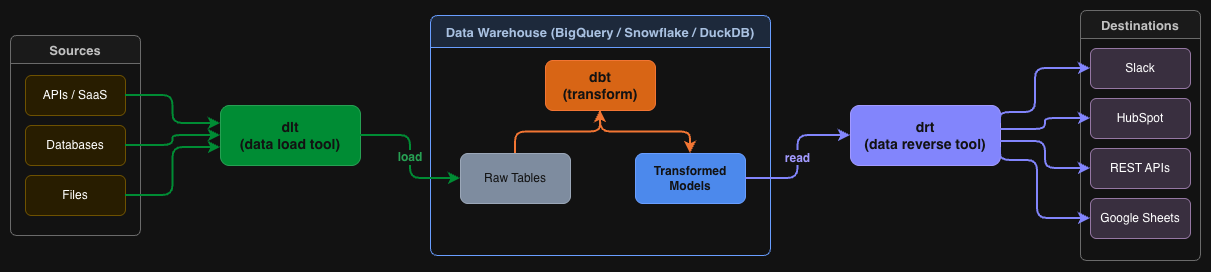
dlt loads data in, dbt transforms it, and **drt** activates it back out — reverse ETL from your warehouse to the tools your team works in, as YAML in your own repo. No dashboard to babysit, no audience builder duplicating what dbt already does, no hosted runtime billing you per row. Your data goes straight from your warehouse to the destination — never through a drt-hosted intermediary.
**Same DX as dbt.** If you know `dbt run`, you already know `drt run` — declarative YAML, versioned in Git, reviewed in PRs.
**CI-native.** Exit codes and `--output json` drop straight into GitHub Actions, cron, or Dagster / Airflow / Prefect — no GUI, no clickops.
**LLM-native.** A built-in MCP server and Claude Code skills let AI tools author and run your syncs.
**Free and open source.** Every connector, the CLI, the MCP server, and the sync engine — Apache 2.0, self-hosted, no lock-in.
**Review before you write.** `drt plan` shows the exact rows a sync would create, update or delete; `drt apply` writes only if nothing changed since you looked, and guards stop a runaway delete.
**Fill, don't overwrite.** `write_policy: fill_empty` writes a column only where the destination is empty, so values people already entered stay.
> **What's always free?** All connectors, CLI, MCP server, and sync engine. See [OPEN_CORE.md](./OPEN_CORE.md) for the open core boundary.
---
## Quickstart
No cloud accounts needed — DuckDB + httpbin.org, three commands.
```bash
pip install drt-core
mkdir my-drt-project && cd my-drt-project
drt init --template duckdb_to_rest
```
That scaffolds a runnable `syncs/duckdb_to_rest.yml`. Seed a tiny
DuckDB table and run:
```bash
python -c "
import duckdb
c = duckdb.connect('warehouse.duckdb')
c.execute('''CREATE TABLE IF NOT EXISTS users AS SELECT * FROM (VALUES
(1, 'Alice', 'alice@example.com'),
(2, 'Bob', 'bob@example.com'),
(3, 'Carol', 'carol@example.com')
) t(id, name, email)''')
c.close()
"
drt run --dry-run # preview, no data sent
drt run # POST each row to httpbin.org
drt status # check results
```
### Other starter templates
```bash
drt init --template list # see all available templates
drt init --template postgres_to_slack
drt init --template duckdb_to_hubspot
```
Each template prints next-steps for the env vars / source data it needs.
See [examples/](examples/) for the full collection (Discord, Google
Sheets, GitHub Actions, MySQL, ClickHouse, BigQuery, …) and
[docs/connectors/](docs/connectors/) for per-connector reference.
### Customizing your sync
For a guided wizard that walks you through profile + project setup:
```bash
drt init # interactive — picks a source, configures profile, scaffolds project
```
Both flows produce the same project shape (`drt_project.yml`, `syncs/`,
`.drt/`). `drt sources --detailed` and `drt destinations --detailed`
print every connector's required env vars and a sample YAML stanza —
useful when hand-authoring beyond the templates.
Existing metadata can seed the same sync files: `drt init --from-dbt
target/manifest.json` interactively scaffolds dbt models, while `drt init
--from-ossie semantic_model.yaml [--dataset NAME ...] [--destination
postgres|hubspot]` scaffolds keyed Apache Ossie datasets. Review the
generated TODOs, then run `drt validate`.
---
## Review before you write
`drt plan` is a read-only, key-level change set; `drt apply` re-computes it and refuses to write if the data, the config or the plan itself changed since you reviewed it.
```bash
drt plan fill_industry --out plan.json # nothing is written
drt apply plan.json # writes only what you reviewed
```
In the demo above (Docker + pip, no cloud accounts), a CRM table already has an `industry` filled in by reps for about 70% of companies. The sync uses `write_policy: fill_empty`: the plan says **450 rows to update, 300 rep-entered values kept**, and apply fills only the blanks. A deliberately bad variant (a 25-row mirror into the whole table) proposes 1,487 deletes; a `max_delete_pct: 5` guard stops it at plan time and apply refuses.
- **Try it:** [`examples/review-demo`](examples/review-demo) — one script, a 60-second walkthrough, with copy-paste prompts for an AI agent (`drt_plan` → human approval → `drt_apply`).
- **In CI:** `drt deploy github-actions --with-plan` scaffolds a plan comment on the pull request and an apply on merge.
- **Read the guide:** [plan / apply](docs/guides/plan.md), including what it guarantees and what it does not (it is a guard in front of a normal run, not a transaction; plan needs a destination drt can read back, which today means SQL databases and warehouses).
## CLI Reference
```bash
drt init # initialize project
drt init --from-dbt target/manifest.json # scaffold selected dbt models
drt init --from-ossie model.yaml # scaffold keyed Apache Ossie datasets
drt list # list sync definitions
drt sources # list available source connectors
drt destinations # list available destination connectors
drt run # run all syncs
drt run --select # run a specific sync (globs work: 'users_*')
drt run --select tag: # run syncs matching a tag (repeat --select to union)
drt run --select destination: # run syncs by destination type
drt run --exclude # subtract syncs (same grammar as --select)
drt run --failed # re-run only syncs that failed last time
drt run --limit 10 # sampled run: send only N rows (watermark frozen)
drt run --fail-fast # stop scheduling after the first failure
drt run --vars 'lookback_days: 1' # override project vars: for this run
drt run --threads 4 # parallel sync execution
drt run --dry-run # dry run
drt run --verbose # show row-level error details
drt run --output json # structured JSON output for CI/scripting
drt run --log-format json # structured JSON logging to stderr
drt run --profile prd # override profile (or DRT_PROFILE env var)
drt run --cursor-value '…' # override watermark cursor for backfill
drt run --force-guards # explicitly override a tripped run-time delete guard
drt test # run post-sync validation tests
drt test --select # test a specific sync
drt test --store-failures # sample up to N failing rows per failed test (masked)
drt build # run each sync and its tests in one pass
drt validate # validate sync YAML configs
drt plan --out plan.json # save a reviewable change set (read-only)
drt apply plan.json # apply it only if the world still matches
drt apply plan.json --force-guards # explicitly override reviewed guard trips
drt deploy github-actions --with-plan # PR comment with the plan; apply on merge
drt status # show recent sync status
drt status --output json # JSON output for status
drt profile list # list credential profiles in ~/.drt/profiles.yml
drt profile show # show a profile (secrets masked)
drt profile test # verify a profile's source connectivity
drt profile add # interactively add a profile
drt profile remove # remove a profile
drt serve # start HTTP webhook endpoint
drt docs generate --format mermaid # print project DAG as Mermaid
drt docs generate --format dbt-exposures # print dbt exposure YAML for ref() syncs
drt deploy github-actions # scaffold a scheduled sync workflow (drt-action + secrets wired)
drt mcp run # start MCP server (requires drt-core[mcp])
drt --install-completion # install shell completion (bash/zsh/fish)
drt --show-completion # show completion script
```
### Visualize your syncs
Generate a Mermaid DAG from your local `drt_project.yml` and `syncs/*.yml` files:
```bash
drt docs generate --format mermaid > dag.md
```
```mermaid
graph LR
subgraph Sources
src_bigquery_prod["bigquery_prod bigquery"]
end
subgraph Syncs
sync_users_to_hubspot{{"users_to_hubspot upsert"}}
sync_accounts_to_hubspot{{"accounts_to_hubspot upsert"}}
end
subgraph Destinations
dst_hubspot_contacts["hubspot (contacts) hubspot"]
end
src_bigquery_prod -->|extract| sync_users_to_hubspot
src_bigquery_prod -->|extract| sync_accounts_to_hubspot
sync_users_to_hubspot -->|load| dst_hubspot_contacts
sync_accounts_to_hubspot -->|load| dst_hubspot_contacts
sync_users_to_hubspot -.lookup.-> sync_accounts_to_hubspot
```
### Shell completion
Shell completion is supported for bash, zsh, and fish:
```bash
# Recommended: auto-install for your current shell (idempotent)
drt --install-completion
# Or manually add to your shell config (run once from the target shell)
drt --show-completion >> ~/.bashrc # bash
drt --show-completion >> ~/.zshrc # zsh
drt --show-completion > ~/.config/fish/completions/drt.fish # fish
```
> **Note:** `--show-completion` outputs the script for your _current_ shell. Run it from the shell you want to configure. The manual `>>` append is not idempotent — run it once only.
After installation, restart your shell and tab-complete commands and options.
---
## MCP Server
Connect drt to Claude, Cursor, or any MCP-compatible client so you can run syncs, check status, and validate configs without leaving your AI environment.
```bash
pip install drt-core[mcp]
drt mcp run
```
**Claude Desktop** (`~/Library/Application Support/Claude/claude_desktop_config.json`):
```json
{
"mcpServers": {
"drt": {
"command": "drt",
"args": ["mcp", "run"]
}
}
}
```
**Available MCP tools:**
| Tool | What it does |
| --------------------- | ------------------------------------------------------------------------------------- |
| `drt_list_syncs` | List all sync definitions |
| `drt_run_sync` | Run a sync (`dry_run`, `compute_diff`; forced guards require `approved_by`) |
| `drt_run_test` | Run post-sync validation tests (mirrors `drt test`) |
| `drt_get_status` | Get last run result(s) |
| `drt_get_history` | Get recent sync run history |
| `drt_validate` | Validate sync YAML configs |
| `drt_get_schema` | Return JSON Schema for config files |
| `drt_list_connectors` | List available sources and destinations |
| `drt_dlq` | Inspect a sync's Dead Letter Queue (depth + failed records) |
| `drt_retry` | Replay a sync's Dead Letter Queue (mirrors `drt retry`) |
| `drt_get_manifest` | Machine-readable sync catalog + lineage (`drt docs` JSON) |
| `drt_list_profiles` | List credential profiles (name + type, no secrets) |
| `drt_test_profile` | Connectivity check for a credential profile |
| `drt_doctor` | Environment diagnostics (mirrors `drt doctor`) |
| `drt_state_show` | Stored watermark + last-run state |
| `drt_state_reset` | Reset watermark / run state / tracked-mirror keys |
| `drt_plan` | Read-only change set for a sync + a `plan_id` (mirrors `drt plan`) |
| `drt_apply` | Apply a fetched plan; needs `approved_by`, with optional explicit `force_guards` |
---
## AI Skills for Claude Code
Install the official Claude Code skills to generate YAML, debug failures, and migrate from other tools — all from the chat interface.
### Install via Plugin Marketplace (recommended)
```bash
/plugin marketplace add drt-hub/drt
/plugin install drt@drt-hub
```
> **Tip:** Enable auto-update so you always get the latest skills when drt is updated:
> `/plugin` → Marketplaces → drt-hub → Enable auto-update
### Manual install (slash commands)
Copy the files from `.claude/commands/` into your drt project's `.claude/commands/` directory.
| Skill | Trigger | What it does |
| ------------------ | --------------------- | ------------------------------------------ |
| `/drt-create-sync` | "create a sync" | Generates valid sync YAML from your intent |
| `/drt-debug` | "sync failed" | Diagnoses a specific error and suggests fixes |
| `/drt-review-sync` | "what will this change?" | Plans a sync, explains it, applies only after human approval |
| `/drt-troubleshoot` | "drt isn't working" | Walks a full top-to-bottom diagnostic checklist |
| `/drt-init` | "set up drt" | Guides through project initialization |
| `/drt-migrate` | "migrate from Census" | Converts existing configs to drt YAML |
---
## Connectors
> Per-connector reference: [docs/connectors/](docs/connectors/) · Discoverable from the CLI: `drt sources --detailed` / `drt destinations --detailed`
### Sources
| Connector | Status | Install | Auth |
| ---------- | --------- | ---------------------------------- | --------------------------------------------- |
| BigQuery | ✅ v0.1 | `pip install drt-core[bigquery]` | Application Default / Service Account Keyfile |
| DuckDB | ✅ v0.1 | (core) | File path |
| PostgreSQL | ✅ v0.1 | `pip install drt-core[postgres]` | Password (env var) |
| Snowflake | ✅ v0.5 | `pip install drt-core[snowflake]` | Password (env var) |
| SQLite | ✅ v0.4.2 | (core) | File path |
| Redshift | ✅ v0.3.4 | `pip install drt-core[redshift]` | Password (env var) |
| ClickHouse | ✅ v0.4.3 | `pip install drt-core[clickhouse]` | Password (env var) |
| MySQL | ✅ v0.5 | `pip install drt-core[mysql]` | Password (env var) |
| Databricks | ✅ v0.6 | `pip install drt-core[databricks]` | Access Token (env var) |
| Delta Lake | ✅ v0.8 | `pip install drt-core[deltalake]` | Storage options (env var) |
| Iceberg | ✅ v0.8 | `pip install drt-core[iceberg]` | Catalog properties (env var) |
| SQL Server | ✅ v0.6 | `pip install drt-core[sqlserver]` | Password (env var) |
| REST API | ✅ v0.7 | (core) | Bearer / API Key / Basic / OAuth2 |
### Destinations
36 destinations — warehouses, SaaS APIs, cloud storage, files & webhooks (click to expand)
| Connector | Status | Install | Auth |
| ----------------------- | --------- | ---------------------------------- | --------------------------------- |
| REST API | ✅ v0.1 | (core) | Bearer / API Key / Basic / OAuth2 |
| Slack Incoming Webhook | ✅ v0.1 | (core) | Webhook URL |
| Discord Webhook | ✅ v0.4.2 | (core) | Webhook URL |
| GitHub Actions | ✅ v0.1 | (core) | Token (env var) |
| HubSpot | ✅ v0.1 | (core) | Token (env var) |
| Zendesk | ✅ v0.7 | (core) | Basic (email + API token) |
| Amplitude | ✅ v0.7 | (core) | Project API key (env var) |
| Klaviyo | ✅ v0.8 | (core) | Private API key (env var) |
| Mixpanel | ✅ v0.8 | (core) | Project token / service account |
| Google Ads | ✅ v0.6 | (core) | OAuth2 Client Credentials |
| Meta Conversions | ✅ next | (core) | Long-lived access token (env var) |
| Google Sheets | ✅ v0.4 | `pip install drt-core[sheets]` | Service Account Keyfile |
| PostgreSQL (upsert) | ✅ v0.4 | `pip install drt-core[postgres]` | Password (env var) |
| MySQL (upsert) | ✅ v0.4 | `pip install drt-core[mysql]` | Password (env var) |
| ClickHouse | ✅ v0.5 | `pip install drt-core[clickhouse]` | Password (env var) |
| Parquet file | ✅ v0.5 | `pip install drt-core[parquet]` | File path |
| Amazon S3 | ✅ v0.7.9 | `pip install drt-core[s3]` | AWS credential chain / env vars |
| [Amazon SQS](docs/connectors/sqs.md) | ✅ next | `pip install drt-core[sqs]` | AWS credential chain / env vars |
| Google Cloud Storage | ✅ v0.7.9 | `pip install drt-core[gcs]` | Application Default / Service Account Keyfile |
| Azure Blob Storage | ✅ v0.7.9 | `pip install drt-core[azure]` | Connection string env / DefaultAzureCredential |
| Microsoft Teams Webhook | ✅ v0.5 | (core) | Webhook URL |
| CSV / JSON / JSONL file | ✅ v0.5 | (core) | File path |
| Jira | ✅ v0.5 | (core) | Basic (email + API token) |
| Linear | ✅ v0.5 | (core) | API Key (env var) |
| SendGrid | ✅ v0.5 | (core) | API Key (env var) |
| Notion | ✅ v0.6 | (core) | Bearer Token (env var) |
| Airtable | ✅ v0.8 | (core) | Personal Access Token (env var) |
| Twilio SMS | ✅ v0.6 | (core) | Basic (Account SID + Auth Token) |
| Intercom | ✅ v0.6 | (core) | Bearer Token (env var) |
| Email SMTP | ✅ v0.6 | (core) | Username / Password (env var) |
| Salesforce Bulk API 2.0 | ✅ v0.6 | (core) | OAuth2 (username-password) |
| Staged Upload | ✅ v0.6 | (core) | Configurable per provider |
| Elasticsearch / OpenSearch | ✅ v0.7.9 | (core) | API key / HTTP Basic (env var) |
| Snowflake | ✅ v0.7 | `pip install drt-core[snowflake]` | Password (env var) |
| Databricks Delta Lake | ✅ v0.7.9 | `pip install drt-core[databricks]` | Personal Access Token (env var) |
| BigQuery | ✅ v0.8 | `pip install drt-core[bigquery]` | ADC / Service Account keyfile |
### Integrations
| Connector | Status | Install |
| ------------------- | ------- | ------------------------- |
| Dagster | ✅ v0.4 | `pip install dagster-drt` |
| Prefect | ✅ v0.6 | (core) |
| Airflow | ✅ v0.6 | (core) |
| dbt manifest reader | ✅ v0.4 | (core) |
---
## Roadmap
> **Upcoming releases → [ROADMAP.md](ROADMAP.md)** (scope, themes, targets)
> **Issue-level tracking → [GitHub Milestones](https://github.com/drt-hub/drt/milestones)**
> **Looking to contribute? → [Good First Issues](https://github.com/drt-hub/drt/issues?q=is%3Aopen+label%3A%22good+first+issue%22)**
**Shipped:** now on **v1.1.0** — Warehouse parity: managed tables, warehouse-backed state/history/DLQ, diff-based incremental and `mirror.strategy: diff` now run on Snowflake, Databricks and BigQuery as well as Postgres, each verified against a live warehouse. Builds on v1.0.0, the first stable release (frozen Source/Destination/StateManager Protocols, `VERSIONING.md` deprecation policy). No breaking changes.
| Milestone | Highlights |
| -------------------- | -------------------------------------------------------------------------------------------------------------------------------------------------------------------- |
| **v0.1–0.3** | Core CLI · BigQuery / DuckDB / Postgres sources · REST / Slack / HubSpot destinations · incremental sync · MCP server + AI Skills for Claude Code |
| **v0.4–0.6** | 20+ destinations (Sheets, SQL upserts, Notion, Twilio, Salesforce…) · dagster-drt / Airflow / Prefect · `drt test` · parallel `--threads` · JSON Schema validation |
| **v0.7** ✅ | **Production Ready** — graceful shutdown · sync history · atomic table swaps · `drt doctor` · opt-in telemetry · `sync.mode: mirror` · DLQ + `drt profile` |
| **v0.7.9–0.7.11** ✅ | Cloud destinations (S3 / GCS / Azure / Databricks / BigQuery / Elasticsearch) · Delta Lake + Iceberg sources · tracked & scoped mirror · PII masking · VS Code extension |
| **v0.8.0** ✅ | **`drt docs` lineage site** (safe-by-default labels, static SVG DAG, byte-identical) · project `vars:` · `drt build` · `--fail-fast` / `--limit` / `--failed` · selection v2 · incremental REST API · `watermark.lag` · `drt deploy github-actions` |
| **v0.8.1** ✅ | **`sync.match_policy`** `update_only` / `create_only` (Postgres + HubSpot) · `drt docs generate --inline` (self-contained HTML for object-store hosting) · manifest schema v2 (run history · column facts · DLQ depth) · tracked-mirror no-`CREATE`-grant · `Retry-After` |
| **v0.8.2** ✅ | **`drt docs --inline` → single navigable HTML object** — the whole catalog in one file with in-page nav, so it renders *and* navigates on an authenticated GCS / S3 object URL (completes v0.8.1's `--inline`) |
| **v0.8.3** ✅ | **`--dry-run --diff` previews mirror `DELETE`s** (tracked / destination / scoped, read-only, labelled apart from a replace rebuild) · keyed destination lookup instead of a full scan · **`alerts.on_degraded`** (row-error %, duration SLA, empty source, DLQ depth) · `drt test` custom SQL `query` tests, `severity: warn`, `--store-failures` |
| **v0.8.4** ✅ | **Mirror symmetry closes out** — `strategy: tracked` + `scope` composed together, on every SQL destination (Postgres/MySQL/Snowflake/ClickHouse/Databricks) · tracked mirror's state diff moves from Python to a server-side SQL join · **query tagging** (SQL comment + native BigQuery/Snowflake/Databricks tags) · streaming extraction · source-side retry · rate limiting v2 · `--full-refresh` + `drt state show/reset` |
| **v0.8.5** ✅ | Databricks composite-key mirror fix — `sync.mode: mirror` + `tracked`/`scope` on a multi-column `upsert_key` now goes through `MERGE` instead of the tuple-`IN` anti-join Delta rejects |
| **v0.9.0** ✅ | **Engine Foundation** — [ADR 0005](docs/adr/0005-state-location-and-write-grants.md) remote state (GCS/S3 backends for state/history/DLQ, CI-safe, team-shared) · `computed_fields` · `metadata_columns` + `run_id`/`sync_run_id` correlation · REST API `body_mode: batch` · `state:modified` selection · `sync.unit_tests` · secret provider URIs (AWS/GCP Secret Manager, Vault) · `drt serve` real delivery contract (coalescing, `202` + poll, pluggable auth) · CLI/MCP parity gate, 11 gaps closed |
| **v0.10.0** ✅ | **Enterprise Boundary & Ecosystem** — Protocol stability/freeze prep · OSS product and Enterprise extension boundaries · age-encrypted project secrets · `QueryableDestination` · entry-point plugins usable from YAML · dbt exposures · benchmark/real-I/O/PyO3 evidence · pluggable rate-limit coordination · dagster-drt v0.4.0 event-driven sensors · FileDestination and least-privilege Snowflake mirror fixes |
| **v1.0.0** ✅ | **Stable Release** — Source/Destination/StateManager Protocol freeze (semver-guaranteed) · migration guide for connector/plugin authors · `Development Status :: 5 - Production/Stable` · hardening pass: `drt serve --auth oidc`, `klaviyo.backfill`, `target/drt/run_results.json` run artifact, `google_ads.cloud_project_id`, DLQ/destination-batch correctness fixes |
| **v1.1.0** ✅ | **Warehouse parity** — managed tables · warehouse-backed state/history/DLQ · diff-based incremental · `replace`/`mirror` and `mirror.strategy: diff` across Snowflake, Databricks and BigQuery |
**Next:** [v1.2 Reviewable syncs](ROADMAP.md) → [v1.x Rust Engine](ROADMAP.md#v1x--rust-engine)
---
## Orchestration: dagster-drt
Community-maintained [Dagster](https://dagster.io/) integration. Expose drt syncs as Dagster assets with full observability.
```bash
pip install dagster-drt
```
```python
from dagster import AssetExecutionContext, Definitions
from dagster_drt import drt_assets, DagsterDrtResource
@drt_assets(project_dir="path/to/drt-project")
def my_syncs(context: AssetExecutionContext, drt: DagsterDrtResource):
yield from drt.run(context=context)
defs = Definitions(
assets=[my_syncs],
resources={"drt": DagsterDrtResource(project_dir="path/to/drt-project")},
)
```
For event-driven activation, `build_drt_change_sensor()` watches metadata-only
change signals from Delta Lake, Iceberg, Snowflake, or SQL Server. The same
resource also runs explicitly selected syncs from a plain Dagster `@op`, returns
a chainable `DrtEventIterator` for source row-count checks, and powers the
declarative `DrtSyncComponent` for `defs.yaml` projects.
See [dagster-drt README](integrations/dagster-drt/README.md) for full API docs
(sensors, Components, `@op`, Translator, Pipes support, and dry-run config).
---
## CI/CD: GitHub Action
Run drt syncs straight from CI/CD with the official [**drt-hub/drt-action**](https://github.com/drt-hub/drt-action) — no infrastructure, just a few lines of YAML. Trigger on a schedule, on every push, or right after dbt finishes.
```yaml
- uses: drt-hub/drt-action@v1
with:
select: '*'
extras: postgres
env:
PG_PASSWORD: ${{ secrets.PG_PASSWORD }}
```
Inputs cover sync selection (`select`), connector `extras`, `profile`, `dry-run` and `threads`; outputs expose `status`, `succeeded`, `failed` and `duration-seconds` (plus a step-summary table). Secrets are passed via `env:` and resolved by drt's `*_env` keys. See the [action README](https://github.com/drt-hub/drt-action#readme) for the secrets pattern and more examples (run-after-dbt, PR preview).
---
## Ecosystem
drt is designed to work alongside, not against, the modern data stack:
---
## Telemetry
drt collects **no telemetry by default**. Opting in helps us understand which sources / destinations / sync modes are actually used, so we can prioritise.
```bash
drt config set telemetry.enabled true # opt in
drt config show-telemetry # preview the exact payload that would be sent
drt config set telemetry.enabled false # opt out
DO_NOT_TRACK=1 drt run # universal kill switch — overrides everything
```
When opted in, drt sends one `sync_completed` event per sync. The **only `properties`** we collect are these 9 fields: `drt_version`, `python_version`, `os`, `source_type`, `destination_type`, `sync_mode`, `rows_synced`, `duration_seconds`, `status`. The wire envelope additionally carries `event`, `distinct_id` (a per-machine random UUID at `~/.drt/.anonymous_id`), `timestamp`, and `api_key`. Sync names, model SQL, destination URLs, credentials, and project paths are **never** transmitted — the allow-list is enforced at the function-signature level in [`drt/telemetry.py`](drt/telemetry.py). By default events go to **PostHog Cloud (EU region)**; override with `DRT_TELEMETRY_ENDPOINT` and `DRT_TELEMETRY_API_KEY` for self-hosted PostHog or a custom collector.
> Note: drt itself never transmits your IP, but the receiving PostHog backend records the TCP source IP as `$ip`. See [docs/telemetry.md](docs/telemetry.md) for details and how to disable / substitute the backend.
For full details see [docs/telemetry.md](docs/telemetry.md).
## Contributing
We welcome contributions of all sizes — from typo fixes to new connectors. drt has a transparent [contributor ladder](GOVERNANCE.md#roles) so your work builds toward greater trust and responsibility over time.
- **Get started:** [CONTRIBUTING.md](CONTRIBUTING.md) — setup, workflow, and your first connector tutorial
- **Pick something to work on:** [Good First Issues](https://github.com/drt-hub/drt/issues?q=is%3Aopen+label%3A%22good+first+issue%22)
- **Understand how decisions are made:** [GOVERNANCE.md](GOVERNANCE.md)
- **What's free vs. enterprise:** [OPEN_CORE.md](OPEN_CORE.md)
- **Versioning & breaking changes:** [VERSIONING.md](VERSIONING.md)
## Contributors ✨
Every contribution — code, docs, bug reports, ideas — makes drt better. Thank you 💜
## Sponsors
drt is free and open source. If it saves your team time, [sponsoring drt-hub](https://github.com/sponsors/drt-hub) keeps it maintained: it pays for the live warehouse accounts every release is tested against. See [SPONSORS.md](SPONSORS.md) for how it works and who is backing it.
## Disclaimer
drt is an independent open-source project and is **not affiliated with,
endorsed by, or sponsored by** dbt Labs, dlt-hub, or any other company.
"dbt" is a registered trademark of dbt Labs, Inc.
"dlt" is a project maintained by dlt-hub.
drt is designed to complement these tools as part of the modern data stack,
but is a separate project with its own codebase and maintainers.
## License
Apache 2.0 — see [LICENSE](LICENSE).