
Gemma 4 26B-A4B inference in about 2 GB of RAM
A custom Swift + Metal runtime for any Apple Silicon Mac, even the 8 GB ones.



Quick start · Local server · Benchmarks · Contribute results · How it works · Experiments · References
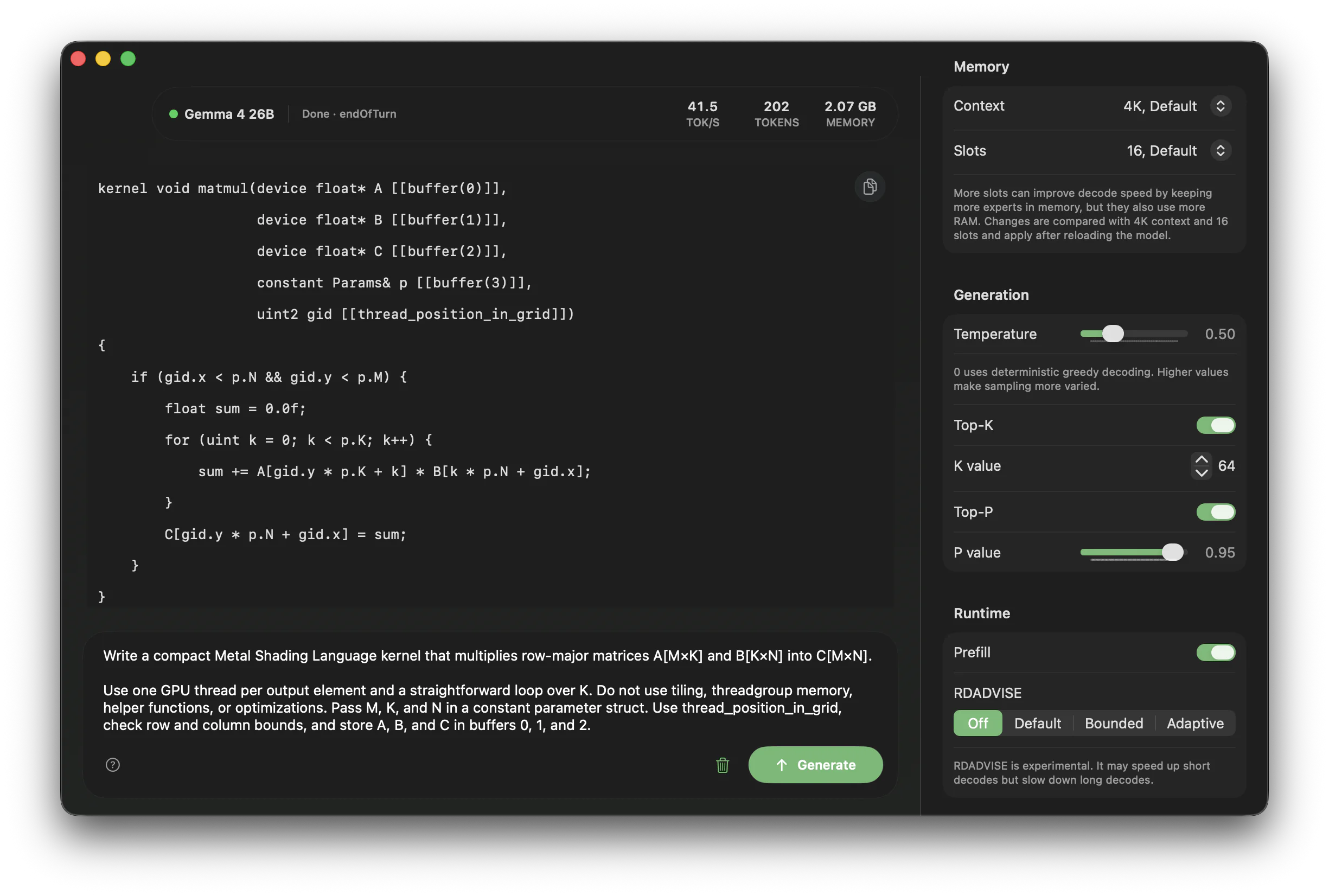 Memory got expensive. So I gave a 26-billion-parameter model a ~2 GB budget. TurboFieldfare runs the instruction-tuned **[Gemma 4 26B-A4B](https://ai.google.dev/gemma/docs/core/model_card_4)** without loading the entire 14.3 GB model into memory. It keeps the shared 1.35 GB core and FP16 KV cache in memory, then streams only the experts needed for each token from SSD. This is what lets the model run on Macs with 8 GB of RAM. The runtime, streaming installer, CLI, and native Mac app are written in Swift and Metal. TurboFieldfare is model-specific rather than a wrapper around MLX or llama.cpp. The curated [experiment record](docs/experiments/EXPERIMENT_INVENTORY.md) summarizes 103 measured results across kernels, caching, I/O, prefill, and decode. ## Try it ```bash git clone https://github.com/drumih/turbo-fieldfare.git cd turbo-fieldfare swift build -c release .build/release/TurboFieldfareMac ``` On the first run, Swift Package Manager downloads and builds the Swift packages required by the tokenizer. The complete release build includes the foreground Mac app and its sibling decode-service executable. When the app opens, choose **Download** and let TurboFieldfare fetch and repack the pinned model (about 15 GB). Once it is ready, choose **Load Model**, type your prompt, and press **Generate**. ## At a glance | Metric | Value | | --------------- | ------------------------------------------------------------------------------------------------------------------------ | | Model | Gemma 4 26B-A4B IT, 26B total parameters, about 3.88B active per token | | Weights | MLX affine 4-bit, group 64; 8-bit router; 4-bit shared and routed experts | | Memory | ~2 GB of weights and 4K KV cache | | Storage | About 14.3 GB for the installed text-only model | | Hardware | Apple Silicon Mac; 8 GB of RAM | | Platform | macOS 26, Metal 4, Swift 6.2 | | M2 measured decode | [5.1-6.3 tok/s](docs/BENCHMARKS.md#m2-measured-decode) on an 8 GB M2 MacBook Air | | M5 measured decode | [31-35 tok/s](docs/BENCHMARKS.md#m5-measured-decode) on a 24 GB M5 Pro | The measured result is a reference point, not a performance ceiling. Prompt length, generated length, page-cache state, and hardware all affect throughput. To help measure another Apple Silicon Mac, follow the [community benchmark guide](docs/COMMUNITY_BENCHMARKS.md). ## Using TurboFieldfare TurboFieldfare provides a native Mac app, a command-line interface, and an experimental loopback OpenAI-compatible server. They use the same `.gturbo` model directory, but only one model-owning product should run at a time. The Swift package exposes six products: | Product | Purpose | | --- | --- | | `TurboFieldfare` | Swift library containing the runtime and Metal kernels | | `TurboFieldfareMac` | Native Mac app for installation and generation | | `TurboFieldfareDecodeService` | One-shot local model and Metal owner used by the Mac app | | `TurboFieldfareCLI` | Command-line instruction chat and raw completion | | `TurboFieldfareServer` | Loopback OpenAI-compatible Chat Completions server | | `TurboFieldfareRepack` | Streaming model installer and install verifier | ### Requirements - An Apple Silicon Mac; the validated target is an 8 GB M2 MacBook Air - macOS 26 with Metal 4 - Xcode 26 and Swift 6.2 or newer - Enough free storage for the ~14.3 GB model installation - An internet connection for the first model install The package is arm64-only. Older macOS and Metal versions are not supported. ### Prompting the model The Mac app treats what you type as an instruction and handles Gemma's chat formatting automatically. Just describe the task and include any context the model needs. Generation defaults to temperature `0.2`, Top-K `64`, and Top-P `0.95`. Set temperature to `0` for deterministic greedy output. The model can still repeat itself or give incorrect answers, so check important results. TurboFieldfare is text-only. The app and CLI support user and model messages plus optional system guidance; they do not expose or execute tools. The loopback server accepts function-tool declarations and returns model-produced tool calls for the client to authorize and execute. Images, audio, and video are not supported. ### Mac app Clone the repository, then run the app from its root: ```bash swift build -c release .build/release/TurboFieldfareMac ``` Build the complete package so the app and its sibling decode service are both available. When launched from this checkout, the app stores the model in `scratch/gemma4.gturbo`. #### Install the model On first launch, the app checks the available storage and shows the download and installed sizes. Choose **Download** to begin. The installer never materializes the full source checkpoint. It streams the required byte ranges from the pinned Hugging Face revision and repacks them directly into the `.gturbo` layout as they arrive. This avoids a second full checkpoint on disk and keeps scratch memory bounded. The first installation transfers about 15 GB through bounded Hugging Face range requests. Network speed and Hugging Face response times vary, so it can take a while. The completed `.gturbo` installation occupies about 14.3 GB and is accepted only after its manifest and file hashes have been validated. Installation does not load the model into memory. #### Load and generate After installation: 1. Choose **Load Model**. 2. Enter a prompt in the composer. 3. Choose **Generate**, or press Command+Return. 4. Use the stop button or Escape to end generation early. The status bar shows generation progress, decode speed, and memory use. Use the right pane to configure sampling, context length, expert-cache slots, and runtime options. See [Runtime controls](docs/RUNTIME_CONTROLS.md) for details and defaults. ### Command-line interface The CLI uses an existing `.gturbo` installation. If you installed the model through the Mac app, it is already available at `scratch/gemma4.gturbo`. Otherwise, install it from the command line: ```bash swift run -c release TurboFieldfareRepack \ --output scratch/gemma4.gturbo \ --overwrite ``` Continue a cancelled or interrupted download: ```bash swift run -c release TurboFieldfareRepack \ --output scratch/gemma4.gturbo \ --overwrite \ --resume ``` Remove saved download state: ```bash swift run -c release TurboFieldfareRepack \ --discard-partial \ --output scratch/gemma4.gturbo ``` The runtime accepts only a completed `.gturbo` directory with a final `manifest.json`. Verify an existing installation without loading the model: ```bash swift run -c release TurboFieldfareRepack \ --verify-install \ --input-gturbo scratch/gemma4.gturbo ``` #### Instruction chat Put chat messages in a JSON array and pass it with `--messages-file`: ```json [ {"role": "user", "content": "Explain why chunked prefill reduces time to first token while keeping memory bounded."} ] ``` ```bash swift run -c release TurboFieldfareCLI \ --model scratch/gemma4.gturbo \ --messages-file messages.json ``` This formats messages in the same way as the Mac app. The CLI response limit is set with `--max-new`, which defaults to 1,024 tokens. The Mac app can generate until the selected context window is full. #### Raw completion `--prompt` is available for raw completion and reproducible comparisons. It passes the text directly to the model without chat formatting. Use `--messages-file` for instruction-response conversations. ```bash swift run -c release TurboFieldfareCLI \ --model scratch/gemma4.gturbo \ --prompt "The capital of France is" \ --max-new 64 \ --temperature 0 ``` This example deliberately requests a short greedy completion. Common generation options include `--max-context`, `--temperature`, `--top-k`, `--top-p`, `--repetition-penalty`, `--seed`, and repeatable `--stop` strings. The public CLI uses production runtime defaults. Run the following command for the complete option list: ```bash swift run -c release TurboFieldfareCLI --help ``` Generated text goes to standard output. Timing statistics go to standard error; add `--quiet` to suppress that footer in scripts. ### Local OpenAI-compatible server Build the server and point it at an installed model: ```bash swift build -c release --product TurboFieldfareServer .build/release/TurboFieldfareServer \ --model scratch/gemma4.gturbo ``` It listens on `http://127.0.0.1:8080/v1` and supports Chat Completions, streaming, function tools, and single-prefix prompt reuse. The client must authorize and run every tool call. Keep the server on loopback; it has no remote authentication or TLS. See [Local server](docs/OPENAI_SERVER.md) for a test request, Python and OpenCode setup, prompt reuse, tool handling, and the supported API subset. ## Test and contribute Run the public test suite serially: ```bash Scripts/test.sh ``` Before starting a model run, close memory-heavy apps and check `memory_pressure -Q`. If it reports little free memory, postpone the run. Run only one TurboFieldfare app, decode service, CLI, server, test, or other local-model process at a time. To contribute a comparable performance result, follow the [community benchmark guide](docs/COMMUNITY_BENCHMARKS.md). ## How the inference engine works At each transformer layer, Metal computes attention and the router from resident weights. The CPU uses the router's top-8 expert IDs to plan against the layer's 16-slot LFU cache, then fills misses with bounded parallel `pread` calls into Metal-visible buffers. Metal computes the resident shared-expert branch while those reads run, then combines the shared and routed outputs. Prompt prefill uses chunks of up to 128 tokens so one fetched expert can serve multiple rows. Generation repeats the routed layer loop one token at a time. The installer applies the same bounded-memory rule: it repacks remote ranges directly into `.gturbo` without staging a full shard or tensor. For a visual introduction to the model architecture, see Maarten Grootendorst's [A Visual Guide to Gemma 4](https://newsletter.maartengrootendorst.com/p/a-visual-guide-to-gemma-4). [System design](docs/SYSTEM_DESIGN.md) explains the `.gturbo` layout, memory ownership, prefill, router handoff, `cb1`/`io`/`cb2` phases, Metal kernels, and correctness invariants. ## Status and scope TurboFieldfare currently includes: - Remote streaming repack into the `.gturbo` model format - Instruction-tuned Gemma 4 26B-A4B with verified text-only chat formatting - 4-bit MLX affine embedding, attention, shared-expert, and routed-expert weights, with an 8-bit router - Custom Metal kernels for quantized GEMV, attention, MoE, normalization, RoPE, sampling, and production fusions - SSD-backed routed-expert streaming with a bounded expert cache - Chunked single-prompt prefill and token-by-token generation - FP16 KV storage with bounded circular storage for 25 sliding-window layers and linear storage for 5 full-attention layers - Exact split-K/V decode attention with distinct normalized K and V paths - A Swift library, streaming installer, command-line interface, loopback OpenAI-compatible server, and native SwiftUI/AppKit Mac app with a one-shot local decode service Current scope is text-only inference from the pinned Gemma 4 26B-A4B instruction checkpoint on Apple Silicon Macs with at least 8 GB of RAM. ### Future work - Build iPhone and iPad apps, then measure inference speed and memory use on mobile hardware. - Benchmark more Apple Silicon Macs, especially the base 16 GB M4 Mac mini and other 8 GB models. ## Experiments and technical documentation The [experiments that shaped TurboFieldfare](docs/OPTIMIZATION_JOURNEY.md) explain the largest wins, the plausible ideas that failed, and the early results that reversed under stronger validation. The detailed [experiment record](docs/experiments/EXPERIMENT_INVENTORY.md) keeps all 103 audited entries as optional evidence. Useful entry points: - [Local OpenAI-compatible server](docs/OPENAI_SERVER.md) - [System design](docs/SYSTEM_DESIGN.md) - [Benchmarks](docs/BENCHMARKS.md) - [The experiments that shaped TurboFieldfare](docs/OPTIMIZATION_JOURNEY.md) - [Experiment inventory and summaries](docs/experiments/EXPERIMENT_INVENTORY.md) - [Implementation references](docs/IMPLEMENTATION_REFERENCES.md) ## License and model terms TurboFieldfare's source and documentation are licensed under the [Apache License 2.0](LICENSE). Model weights are not included. The installer downloads them separately from the pinned Hugging Face checkpoint, and the weights remain governed by their source terms. See [THIRD_PARTY_NOTICES.md](THIRD_PARTY_NOTICES.md) for the model and Swift package license review. TurboFieldfare is an independent research project. It is not affiliated with, sponsored by, or endorsed by Google. ## Afterword and the project name Thanks for checking out this project! My name is Andrey Mikhaylov. You can find me on [LinkedIn](https://www.linkedin.com/in/andrey-mikhaylov-ios-dev/). I am the author of TurboFieldfare and an iOS and Metal engineer. Most of my work is with images, video, and on-device AI. I dedicate this project to my wife, Sasha, the most supportive person I know. She stands by me even through the hardest times. She loves wildlife, goes birdwatching, and volunteers with our local birding community. Because of her, I have also grown closer to birds and nature. TurboFieldfare is named after the fieldfare, a member of the thrush family and my favourite bird. It is not the most noticeable or brightly coloured bird, but it definitely has a character and unique features of its own. I think the same is true of this project: it may not be the most practical, but I built it with my favourite tools, especially Metal, in my favourite field, on-device ML inference. It definitely has its own character and unique features. Next time you are outside, touch the grass and listen to the birds. Sometimes it is the most beautiful thing you can do. And if you can, support your local wildlife community. They do important work. Thank you!