





Something is rewriting your agent's context.
Distil measures what it cost you.
Your provider now edits the context window for you — clearing old tool results, summarizing history — by default, server-side, with no report of what changed.
Distil is the instrument that answers the only question that matters: did the agent still do the same thing?
|
**We pointed it at the providers.** Anthropic's **default** context-editing policy (`keep=3`) changed the
agent's next action in **95–100% of cases**, against a 2.5% A/A noise floor. Keeping the 3 most recent
tool uses didn't lower the change rate at all — it turned *stalling* into *acting on missing facts*.
OpenAI's compaction changed **12.5–20%**. Pre-registered, replicated, n=40 per run.
**[Read the study →](https://dshakes.github.io/distil/provider-compaction.html)** · [rerun it on your own config](https://dshakes.github.io/distil/provider-compaction.html#reproduce)
|
Distil also compresses — the tool output, logs, and history your agent re-sends every turn, reversibly.
It's the one context operation that ships with its own certificate, its own adversarial gate, and a number it is willing to refuse to print.
The 60-second version
Compression that cannot be checked is a guess about your agent's behaviour.
Distil is built so every part of it is checkable, and so the checks are allowed to come back no.
- **It proves decision-equivalence per request — and can say no.** Shadow mode replays a sampled request three times: twice on the original context and once on the compressed one, then reports `1{A=B} − 1{A=A'}` — a *paired difference* against the model's own self-agreement, with a bootstrap 95% CI, **unclipped, so it is allowed to be negative**. One reporting floor (50 A/B + 30 A/A) gates every surface; below it, every surface says *below reporting floor* instead of a number. The current live sample cleared that floor on 2026-09-15 and reads **97.5%** [95.5, 99.5] over n=398 A/B — under 99%, so the status line flags it ⚠ rather than ✓.
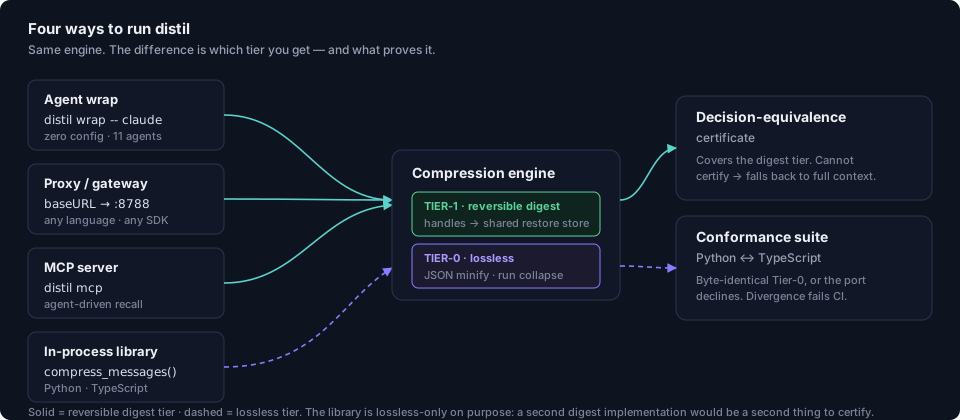
- **What it folds, it can give back byte-exact.** A digest is a marker plus a handle into a local content-addressed store, and the agent gets a `distil_expand` tool to recover the original mid-task. The gateway ships **Tier-0 only** rather than emit a stub it cannot restore.
- **It will not digest a line your agent has to quote back.** An `Edit(old_string=…)` is a literal match. Reading exact-quote provenance from the *shell command*, not just the tool name, took byte-exact quote loss from **39.3% → 16.2%** on real coding traffic — and it costs real savings, which we price rather than hide.
- **It does not break your prompt cache.** Compression is suffix-only and cache-monotonic by construction: a later turn may never rewrite bytes the provider has already cached. We shipped that bug once, measured it at *2× the cost of compressing nothing*, and made the invariant enforced. **[The cache contract →](https://dshakes.github.io/distil/cache-contract.html)**
- **It has been pointed at a hostile input, not just a hard one.** `distil validate --adversarial` runs a COMA-class battery through the same path the proxy uses, and we publish the two cases that do not come back clean. **[Threat model →](https://dshakes.github.io/distil/threat-model.html)**
- **Every rung of the dial is measured, not just the default.** `distil bench --curve` traces savings against fact recall across the whole ladder, offline and free. **[The curve →](https://dshakes.github.io/distil/benchmark.html#degradation-curve)**
Proof and provenance
Every claim above is checkable, and so is the supply chain that shipped it. Releases carry PEP 740 attestations so you can verify a build came from this repo's CI, not a compromised laptop; a CycloneDX SBOM ships with every release so you know what's inside; OpenSSF Scorecard runs weekly against the repo itself. The adversarial path is documented rather than assumed: see the threat model and the security whitepaper for what's in scope and what isn't, and run distil validate yourself to gate a deployment against hostile input before you trust it with one.
## What it does
- **Wrap your agent** — 11 presets: `distil wrap -- claude` · `codex` · `gemini` · `aider` · `opencode` · `qwen` · `goose` · `grok` · `openhands` · `copilot` · `kimi`. Zero config, no code change.
- **Run a proxy** — point any `base_url` client at it. Python, TypeScript, any language, any framework. Sync proxy, async proxy, and a standalone gateway, with the **same** provider coverage in each: Anthropic Messages, OpenAI Chat Completions **and** the Responses API, Azure OpenAI, and Gemini `generateContent`.
- **Call it as a library** — `from distil import compress_messages` in your own agent loop.
- **Give your agent a recall tool** — MCP server: it compresses its own output and gets the exact bytes back on demand.
- **Framework hooks** — LangChain · LangGraph · LiteLLM · Agno · Strands · AutoGen · LlamaIndex, in-process, no network hop — plus an **ASGI middleware** for any Starlette/FastAPI app that hosts its own LLM endpoint, and the [npm package](https://www.npmjs.com/package/distil-llm) for the Vercel AI SDK.
- **On a subscription** — `distil hook --install`: Claude Code compresses its own tool output through
the documented `PostToolUse` extension point. No proxy, no credentials touched. `distil quota` shows
the rate-limit window it buys back. [Details →](https://dshakes.github.io/distil/subscription.html)
- **See what it did** — live status line, session dissect, per-request headers, OTel spans, Prometheus metrics.
```bash
pipx install distil-llm && distil onboard # detects your agent + billing, wires everything
```
> **Not sure which of those you want?** [Two questions pick your mode →](https://dshakes.github.io/distil/which-mode.html) — plain language, honest savings ranges, no jargon.
> **Will it save you money?** On **metered billing** (an API key), yes — directly, off the bill.
> On a **flat-rate Pro/Max subscription** there is no per-token bill to cut, but there *is* a
> rate-limit window, and spending fewer tokens per turn leaves more of it for the next task.
> `distil quota` shows that window live. Savings come from **large, repetitive** tool output:
> verbose JSON and duplicated log runs compress 25–99%, while prose and unique-line output
> compress ~0% — a short session that never reads a big file showing near 0% is the tool working
> correctly, not failing. [Why →](#-compression-modes--in-plain-english)
◉ LIVE · measured from the opt-in census on a public git branch, never estimated



▶ Watch the counter tick live & audit every number →
Use it ·
Library ·
Integrations ·
Install ·
Why trust it ·
Full Docs → ·
llms.txt
AI agents: read /docs/llms.txt for a compact, machine-oriented summary of what distil is and how to call it.
---
## 🧩 Use it as a library
Building the agent yourself? Compress the message list where it lives — no proxy, no network hop:
```python
from distil import compress_messages, expand_handle
result = compress_messages(messages) # OpenAI/Anthropic-style dicts
print(f"{result.saved_pct:.1f}% smaller")
response = client.messages.create(model=..., messages=result.messages)
original = expand_handle(result.handles[0]) # byte-exact, any time, any process
```
Tool results get the reversible digest; user and system text get lossless transforms only; **the model's own turns are never rewritten**. Handles resolve across processes and restarts, so a digest made by the proxy expands here and vice versa. `verbatim=True` disables digests entirely.
Named `compress_messages`/`expand_handle` rather than `compress`/`expand` because `distil.compress` and `distil.expand` are modules — a top-level export sharing those names would resolve to the function or the module depending on unrelated import order.
TypeScript too — `compress(messages)` from the [npm package](https://www.npmjs.com/package/distil-llm), byte-identical to the Python engine. Full reference: **[Library API →](https://dshakes.github.io/distil/library.html)** · runnable examples: [`python_library.py`](examples/python_library.py) · [`js_library.ts`](examples/js_library.ts).
**Maintain a framework?** [`docs/INTEGRATING.md`](docs/INTEGRATING.md) is the ~20 lines and the four rules — we would rather the integration live in your repo than ours.
---
Why trust it 📊
Every other compressor asks you to trust it won't break your agent. Distil is the only one that proves it won't.
On 500 real coding tasks, compressed context matched full context within statistical noise: 42.0% vs 39.2% tasks solved. (SWE-bench Verified)
Honest scope: +2.8pp is a point estimate (CI −0.6..+6.2pp — non-inferiority certified, superiority not yet). Details, incl. what doesn't transfer →
On a real 500-instance long-horizon agent
(SWE-bench Verified, official harness) | task success | tied with full context? | reversible + certified? |
|---|
| Distil (gated + surprise digest, measured on v1.7) | 42.0% | ✅ tied (+2.8pp point est., CI −0.6..+6.2 — n.s.) | ✅ |
| Distil (relevance-gated, E8) | 36.8% | ✅ | ✅ |
| Headroom (lossy) | 32.6% | ❌ −6.6pp | ❌ |
| LLMLingua-2 (lossy — only 16/500 runs completed) | 2.4% | ❌ −36.8pp | ❌ |
| no compression (full) | 39.2% | — | — |
Why Distil — the properties, not the adjectives
Headroom column read directly against the public headroom-ai 0.37.0 source, as of v0.37.0, 2026-09-04; every line there cites a file:line in that release. Facts, not adjectives — and where it is genuinely strong, we say so.
| Property | Distil | Headroom 0.37.0 (2026-09-04) |
|---|---|---|
| **Per-request behavioural check** | Paired A/A′/B replay, unclipped difference, bootstrap CI, one reporting floor | No shadow or dual-send path in the codebase; `accuracy_guard="strict"` is echoed on `/healthz` and `/stats` but nothing branches on it |
| **Recovery of what was folded** | Content-addressed store + agent-facing `distil_expand`, byte-exact, verified by a gate | A TTL cache (SQLite, 1800s, 1000-entry FIFO), no integrity or round-trip check |
| **Lossy paths with no recovery** | None — the gateway ships Tier-0 only rather than emit a stub it cannot restore | Four: OpenAI chat streaming, Responses under ChatGPT auth, Gemini streaming, Bedrock |
| **Savings number** | Counted, then calibrated against the provider's billed `usage` | Falls back to `chars/3.5` |
| **Exact-quote guarantee for coding agents** | Provenance read from the shell command, not just the tool name; **quote loss 39.3% → 16.2%** | Not a property the tool has |
| **Cache contract** | Suffix-only, cache-monotonic, enforced as an invariant | Genuinely strong prompt-cache replay (`overlay_cached_prefix`) — real engineering |
| **Adversarial gate** | COMA-class battery in CI; the two cases that don't come back clean are published | None shipped |
| **Degradation curve** | Every ladder rung measured, offline and free | Point configuration only |
| **Shipped default** | Compresses | Mode `cache` — a full bypass on Bedrock, freeze-only on OpenAI |
On the same corpus, re-run 2026-09-04 with Headroom's model preloaded: distil 52.9% tokens / 58.7% $ / 100% decision-equivalent / PASS vs Headroom 1.7% / 2.0% / 81% / FAIL. On a read→edit→re-read coding workload Headroom reaches 35.6% tokens where distil's digest is 0.0% by design — that is the exact-quote guarantee being paid for, and both numbers are on one page with the raw output committed.
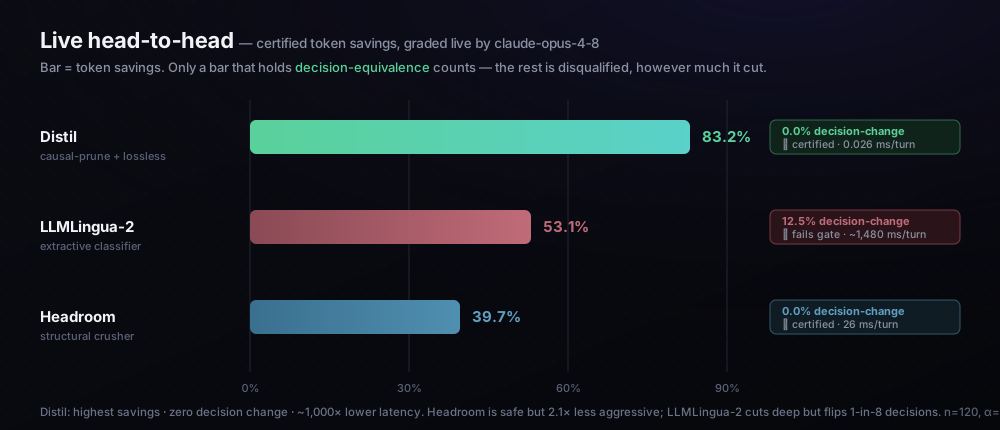
Distil is the only compressor statistically tied with full context — its v1.7 surprise-preserving digest reaches 42.0% vs 39.2% (paired non-inferiority certified; superiority not significant) while every lossy tool craters. And on the live head-to-head above (graded by claude-opus-4-8), it certifies 83.2% savings at a 0% decision-change rate (2026-07-05, distil 1.10.1 vs llmlingua 0.2.2 and headroom-ai 0.27.0), ~1,000× faster than the nearest tool (distil is pure-Python heuristics — no local ML model; competitors run transformer inference). Full breakdown ↓
---
## 🚀 Use it now
**One command sets you up and tells you what to do next:**
```bash
pipx install distil-llm
distil onboard # detects your agent + billing, wires the status line, prints a guided tour
```
It detects your environment (Claude Code · Codex · Gemini CLI; metered vs subscription) and hands you the exact commands. Or wrap your agent directly — **no config, no code change:**
```bash
# Claude Code on a metered API key — saves real $$:
distil wrap --expand -- claude
# Claude Code on a Pro/Max subscription — flat-rate, ToS-safe (trims context, not $):
distil wrap --lossless-only -- claude
# Codex, Gemini CLI, aider — same pattern; env var auto-selected per agent:
distil wrap --expand -- codex # → OPENAI_BASE_URL
distil wrap --expand -- gemini # → GOOGLE_GEMINI_BASE_URL
distil wrap --expand -- aider # → OPENAI_BASE_URL
# Headless too — print mode, CI, and Agent SDK scripts route the same way:
distil wrap -- claude -p "summarise this diff"
distil wrap -- python my_agent_sdk_script.py
```
> **Using Cursor, Cline, or Windsurf?** They are IDE extensions — no argv to wrap and no documented env var, so `distil wrap` cannot reach them. Run a proxy and point the editor's base-URL setting at it: [docs/IDE-AGENTS.md](docs/IDE-AGENTS.md). (GitHub Copilot is not redirectable at all, and that page says so rather than wasting your afternoon. The **Continue CLI** — as opposed to its VS Code extension — routes only through a config file, and `distil wrap -- cn` manages that file for you; see the same page.)
Each recognized agent (`claude` / `codex` / `gemini` / `aider` / `opencode` / `qwen` / `goose`) auto-selects the right env var and upstream — no `--env-var` or `--upstream` flag needed. Prints `preset: detected → ` on start. Explicit flags always win.
Make it the default — never type distil wrap again
**Tired of typing `distil wrap` every time?** Make it the default — once:
```bash
distil default # adds a managed shell alias so `claude` always routes through distil
distil default --undo # remove it anytime (backed up before any change)
```
It detects your shell (zsh / bash / fish / PowerShell) and billing mode, writes the
right line to the rc file your shell actually reads, and **tells you what it detected**.
Want every SDK covered (not just the agent you type)? `distil default --always-on`
runs a persistent proxy service — powerful, but it pins `ANTHROPIC_BASE_URL`, so
every client on the machine goes through one local process.
That pin used to be a single point of failure: a proxy that was down for one
second meant sessions failing with `ConnectionRefused`, an error that names the
provider rather than distil. It no longer is. The service supervisor
(launchd/systemd) owns the **listening socket**, so a crash or a restart leaves
connections queued in the kernel backlog instead of refused — the client waits
about a second rather than dying. `distil default --always-on` also verifies the
service is genuinely registered and serving before it wires anything, and refuses
to wire at all if it isn't.
If you ever need out and distil is already uninstalled, `sh ~/.distil/uninstall.sh`
removes the pin, the service, and the shell block using nothing but `sh`.
Then watch genuine savings from **your** traffic — measured, not estimated:
```bash
distil leaderboard # cumulative tokens + $ saved, from the local ledger
distil dashboard # live terminal TUI — token-trim + decision-equiv bars, Ctrl-C to exit
distil dissect # per-session deep-dive: savings, digest inventory, anomalies (--html/--serve)
```
**Validate it on your traffic.** `--shadow` runs a fraction of requests twice (compressed **and** full) and compares the agent's chosen next action:
```bash
distil wrap --shadow 0.1 -- claude # wrap + shadow 10% of requests
distil shadow-stats # live decision-equivalence rate
```
Honest scope: that's next-action equivalence — a **proxy**, not task success ([E7](#-the-proof) shows it doesn't fully transfer under aggressive *lossy* compression). Distil fails safe to full context.
> **Will it save money?** On **metered** billing (API key) — fewer tokens, fewer dollars, directly. On a flat-rate **subscription** there is no per-token bill, so the saving is **rate-limit headroom**: fewer tokens per turn means more turns before you hit the window (`distil quota` shows it live). Coding agents: short sessions ~7%, big wins on **long, many-turn** sessions the model never re-reads.
---
## 💡 Why Distil is different
You don't need byte-equivalence — you need **decision-equivalence**: your agent taking the *same actions* with compressed context. That's measurable and certifiable.
- **Certified, not estimated** — a strategy ships only if a non-inferiority test passes; can't certify → full context.
- **An estimator that can report harm** — the live check is a *paired* statistic, `1{A=B} − 1{A=A'}`, with a bootstrap 95% CI and no clamp at zero. The old ratio estimator printed exactly 100% whenever chance favoured it and could not express harm at all. One reporting floor now gates the status line, the proof ledger, `shadow-stats`, the census feed and the public dashboard alike — and prints *below reporting floor* rather than a flattering number.
- **Byte-exact quotes survive, so `Edit` still applies** — an `Edit(old_string=…)` is a literal match against bytes the agent read earlier; digest that read and the edit silently does nothing while the agent reports success. Provenance is read from the shell command (`cat`, `head`, `sed -n`), not just the tool name — that is **33.6% of tool-result mass** the name rule never covered. It costs savings, and the [changelog prices it](CHANGELOG.md) instead of hiding it.
- **Adversarially gated, and honest about the two hits** — `distil validate --adversarial` runs seven COMA-class cases through the same public path the proxy uses. Trusted/untrusted budget isolation is structural: there is **no keep budget shared between blocks anywhere**, asserted as an equality in CI. Two results we publish rather than smooth over: dedup-baiting *does* fold the genuine error line (reversibility is what saves it), and decoy-verdict flooding is a real, unmitigated **denial of savings** — 0.0% on that block.
- **The whole dial is measured, not just the default** — `distil bench --curve` reports savings, fact recall, visible recall, facts lost and reversibility at every rung, offline and free.
- **Certified end-to-end, too** — `distil certify-trajectories` bounds how many solvable tasks compression can cost (no other compressor certifies either level).
- **Reversible, not lossy** — digests behind a handle, keeps the original, hands the agent a `distil_expand` tool. Compress fearlessly.
- **Keeps the answer, folds the noise** — a per-content-type keep policy pins each kind's load-bearing lines (a log's pass/fail verdict, a traceback's frames, a diff's hunk headers); repeated near-identical error spam is deduped, and on a green run dedup tightens further since that noise didn't fail anything.
- **Query-aware — keeps the line you're actually asking about** — distil is a proxy, so it sees the agent's intent (its tool_use args + latest ask) in the *same request* as the output. The line matching what you searched for (a grep hit, a config value, a SHA) is pinned even in arbitrary output — additively, so reversibility and the certificate are untouched. No post-hoc compressor has that query/output pairing. It also goes **semantic**, and always-on: a zero-dependency bridge — morphology, a curated technical synonym map, and char-trigram fuzz — pins lines that **answer** the query without sharing a word with it. Ask "the retry limit?" and it keeps `max_attempts = 5`; ask "the connection timeout?" and it keeps `deadline_ms`. Two more layers grow from **your own traffic**, never from a shipped blob: associations distil learns from its content-free expand flywheel (hashed pairs, `--expand` sessions), and a learned relevance model that is promoted only after its held-out recall beats the lexical baseline on your labels — until promotion, the lexical + bridge layers are exactly what runs. An optional distributional-vector table can be supplied too (pure-Python cosine; none ships). Every layer is additive — it can only widen keeps, so reversibility and the certificate are untouched — and it needs no embeddings or model to work.
- **Lossless even on a flat-rate plan** — subscription/lossless mode isn't just verbatim: it minifies JSON, collapses duplicate runs, and folds tabular tool output into a compact self-describing table (~70–79% smaller, ToS-safe, no lossy digest). Recent tool outputs stay byte-exact.
- **See exactly what happened** — `distil dissect` turns a wrap session into a report: savings by model/mechanism, the digest inventory, billed-usage calibration, latency by path, and a *worth-your-attention* anomaly list that catches silent failures automatically.
- **Compounds on outcomes** — expansions and matched failures teach the policy what to protect (signatures only, never content) — always *more* conservative.
- **Re-reads cost what changed, not what it re-read** — a coding agent re-reads the same file constantly (51.4% of reads on 2,489 measured sessions) and almost never at the same offset, so block-level dedup misses it. Distil matches on *lines*: the run a new read shares with an earlier one still in context becomes a reversible reference, everything else stays byte-exact, and the freshest read is never touched. It runs *inside* the exact-quote guarantee — the only transform that recovers savings on content distil has promised to keep verbatim — and stays safe because an `Edit`'s `old_string` only has to exist byte-exact *somewhere* in the forwarded payload. → [ADR 0010](docs/adr/0010-the-re-read-delta.md)
- **Streams like it isn't there** — SSE relays chunk-by-chunk; TTFT preserved — *including recoverable digest*, which speculatively streams and only intercepts an actual `distil_expand` call mid-stream, splicing the recovery in without buffering the turn (no TTFT tax on the reversible tier).
> **Fidelity tiers:** lossless (`--verbatim`) · reversible (byte-recoverable on demand — default) · lossy (every other tool). Only Distil *certifies* the reversible tier (Headroom ships an uncertified retrieve; Distil's recovery is agent-facing — the model expands mid-task — and gated by the decision-equivalence certificate).
---
## ⚡ Prove the numbers yourself — no API key
Don't take the table above on faith. `distil bench` re-certifies savings *and* decision-equivalence on a bundled 8-domain corpus, offline, in seconds — the same gate that runs in CI. How we evaluate — and why a compression ratio without a task-success delta is meaningless — is written up in [docs/EVALUATION.md](docs/EVALUATION.md), including our own negative result:
```bash
uvx --from distil-llm distil bench # certify savings + quality across 9 domains, in seconds
distil verify # byte-fidelity: every compression is exactly reversible
distil validate # adversarial real-path gate: invariants on hostile inputs
distil retention # fact recall: what stays visible vs expand-recoverable
distil retention --dataset hotpotqa # graded against a PUBLIC benchmark's ground truth
distil fidelity # state probes: artifact state, overclaim, continuation
```
Five gates, all in CI: **`bench`** (non-inferiority on the corpus), **`verify`** (byte-fidelity), **`retention`** (fact-level recall), **`fidelity`** (state probes, below), and **`validate`** — which drives the compressor against *adversarial* inputs (huge/unicode/nested/malformed/marker-injection/secret-looking) and asserts reversibility, reject-if-bigger, recency-exactness, fail-open, and content-free telemetry hold on every one. That last gate exists because a green unit suite kept coexisting with real-traffic bugs; `validate` is the adversarial layer that catches them.
**Recall is not enough, and here's the case that proves it.** A trajectory creates `net/scratch_bench.py` at turn 2 and deletes it at turn 4. Compress away turn 4 and every path token is still present — string recall reads **100%** — while the agent now believes a file exists that doesn't, and will plan around it. `distil fidelity` folds tool calls into a file-state ledger and grades the *final state*, separating **`lost`** (path gone — the agent can see the gap) from **`stale`** (path present, state wrong — the agent acts confidently on a falsehood). On that case: string recall 100%, state fidelity **0%**.
It reports three more things recall can't see: **overclaim** (`"approximately 4200 ms"` → `"4200 ms"` — the value survives, its uncertainty doesn't), **continuation** (does the agent still know what's left to do?), and **error propagation** (does a loss at turn *k* show up as a behaviour change at turn *k+n*?). The gate is on *silent* failures only — CI runs `--max-silent 15` — because loud loss is already `retention --max-lost`'s job, and gating one regression twice hides which property broke. The bound is the **measured** one, not zero: Tier-1 digests hedged spans behind restore handles and drops the qualifier on 9 of 171 claims, so gating at zero would assert a property the compressor does not have. On top of that, `distil suite` grades **twelve public benchmarks** whose answer keys were written by someone else — including **BFCL**, which compresses the *tool schema* and checks that every name the gold call needs — the function and each argument — survives. At matched savings (90.1% vs 89.3%) **truncation keeps 0 of 70 names; distil keeps all 70** — though *none of them visibly*: the schema sits behind a restore handle, one `distil_expand` away. The suite prints that gap (`visible → true support: bfcl 0%→100%`) rather than the flattering number alone, because a reader who assumes the model can *see* a schema it must actually expand first has been misled by figures that are individually correct. Names are matched as **identifiers** — a quoted JSON token, escaping tolerated — not as prose: the generic matcher was crediting 11 of 85 golds by accident (`'a'` matching inside `"tool-schemas"`). Fifteen golds BFCL genuinely names `a`, `b`, `c` are excluded and *counted*, since a one-letter token can be neither credited nor failed honestly. Every row is labelled `rich` or `thin` payload, because a benchmark with nothing to compress is a control, not evidence — and a run that grades only controls exits 1. It needs no API key and no spend, so it is wired into `make gate` and the CI gate job rather than run before a launch. Full methodology, including what these probes found wrong with our own corpus, in [docs/EVALUATION.md §6](docs/EVALUATION.md); how to run everything, in [docs/RUNNING-EVALS.md](docs/RUNNING-EVALS.md).
**Recall, and a number you can check yourself.** The three gates above are graded on *our* corpus against *our* oracle — rigorous, but not checkable by you. `distil retention --dataset hotpotqa` grades against ground truth written by someone else (HotpotQA's gold supporting sentences, amid 8 distractor paragraphs), next to a truncation baseline tuned to distil's own savings on the same case:
| HotpotQA, n=100 | savings | answer recall | gold-sentence recall |
|---|---|---|---|
| **distil** (reversible) | 14.3% | **100.0%** | **100.0%** |
| truncation @ matched savings | 14.1% | 91.6% | 82.7% |
`distil retention` also splits recall into **visible** (in front of the model) and **recoverable** (one `distil_expand` away, verified against the handle's restore bytes). On the corpus that's 100% true recall with 0 lost, and being reversible instead of lossy is worth **21.4% recall** — the mean across all 9 domains, each counted once. That's deliberately the *macro* average: the fact-weighted one reads 62.6%, but it's set by whichever domain carries the most probes, and one HTML fixture moved it from 9.8% to 62.6% without the compressor changing at all — the moat, as a measurement rather than an argument. `distil retention --live` reports the same on your own traffic; the meter stores counts only, never content.
**And it found a real hole.** The first thing the recall harness caught was not a regression but a missing capability: distil was compressing **0.0%** of HTML tool results — minified markup is one long line, so line-folding had nothing to fold. Agents with a fetch or browser tool were paying full price for `