# pyGAM
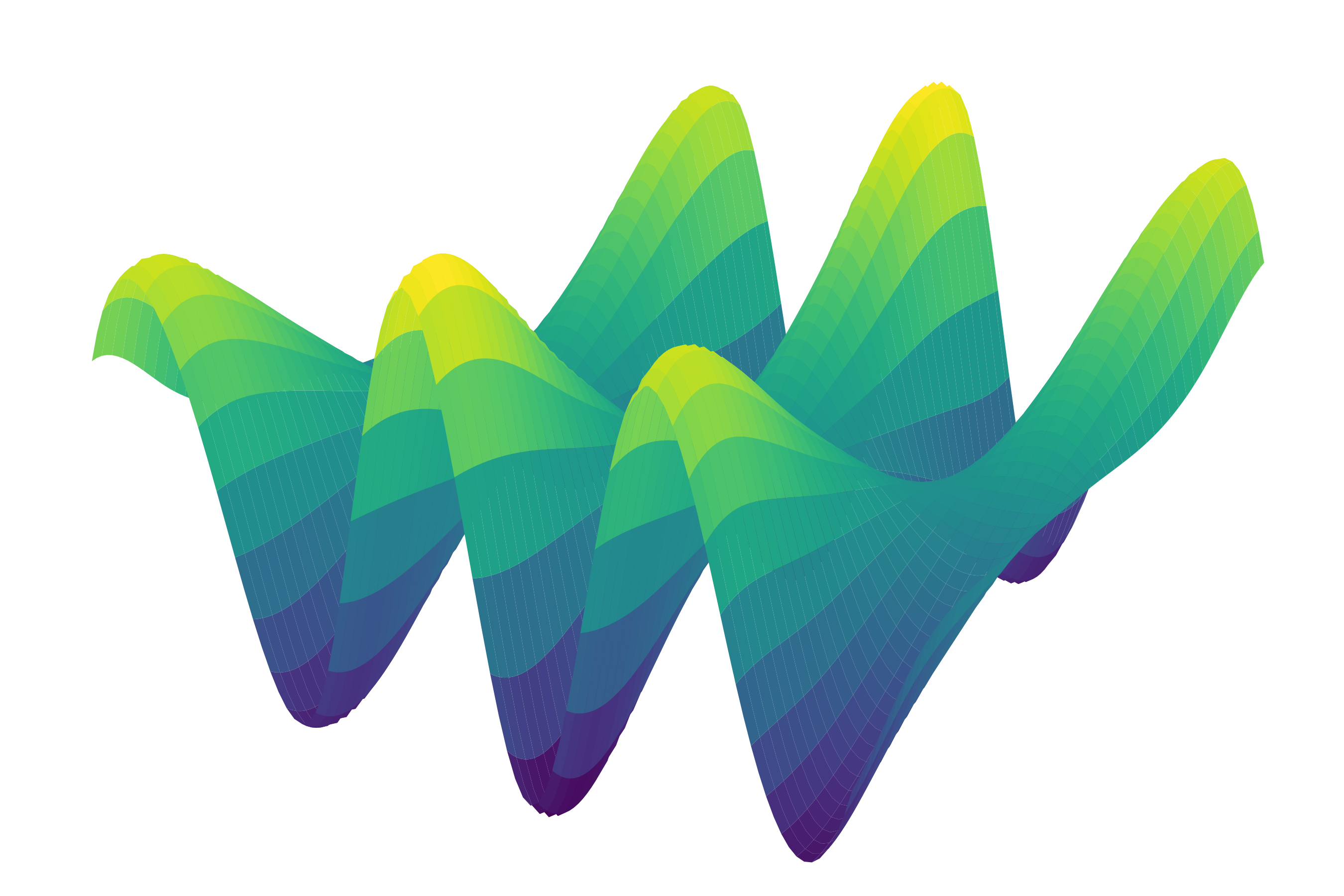 Generalized Additive Models in Python.
:rocket: **Version 0.12.0 out now!** [See release notes here](https://github.com/dswah/pyGAM/releases).
`pyGAM` is a package for building Generalized Additive Models in Python, with an emphasis on modularity and performance.
The API is designed for users of `scikit-learn` or `scipy`.
| | **[Documentation](https://pygam.readthedocs.io/en/latest/?badge=latest)** · **[Tutorials](https://pygam.readthedocs.io/en/latest/notebooks/tour_of_pygam.html)** · **[Medium article](https://medium.com/just-another-data-scientist/building-interpretable-models-with-generalized-additive-models-in-python-c4404eaf5515)** |
|---|---|
| **Open Source** | [](https://github.com/dswah/pygam/blob/main/LICENSE) [](https://gc-os-ai.github.io/) |
| **Community** | [](https://discord.gg/Rt8By5Jj) [](https://www.linkedin.com/company/german-center-for-open-source-ai) |
| **CI/CD** | [](https://github.com/dswah/pygam/actions/workflows/pypi.yml) [](https://pygam.readthedocs.io/en/latest/?badge=latest) |
| **Code** | [](https://pypi.org/project/pygam/) [](https://anaconda.org/conda-forge/pygam) [](https://www.python.org/) [](https://github.com/psf/black) |
| **Downloads** |   [)](https://pepy.tech/project/pygam) |
| **Citation** | [](https://doi.org/10.5281/zenodo.1208723) |
## Documentation
- [Official pyGAM Documentation: Read the Docs](https://pygam.readthedocs.io/en/latest/?badge=latest)
- [Building interpretable models with Generalized additive models in Python](https://medium.com/just-another-data-scientist/building-interpretable-models-with-generalized-additive-models-in-python-c4404eaf5515)
## Installation
```pip install pygam```
### Acceleration
Most of pyGAM's computations are linear algebra operations.
To speed up optimization on large models with constraints, it helps to have [intel MKL](https://www.intel.com/content/www/us/en/developer/tools/oneapi/onemkl.html) installed.
It is currently a bit tricky to install a Numpy linked to the MKL routines with Conda because you have to be careful with which channel you are using. Pip's Numpy-MKL is outdated.
An alternative is to use a [third-party build](https://urob.github.io/numpy-mkl):
```
pip install numpy scipy --extra-index-url https://urob.github.io/numpy-mkl
```
## Contributing - HELP REQUESTED
Contributions are most welcome!
You can help pyGAM in many ways including:
- Working on a [known bug](https://github.com/dswah/pyGAM/labels/bug).
- Trying it out and reporting bugs or what was difficult.
- Helping improve the documentation.
- Writing new [distributions](https://github.com/dswah/pyGAM/blob/main/pygam/distributions.py), and [link functions](https://github.com/dswah/pyGAM/blob/main/pygam/links.py).
- If you need some ideas, please take a look at the [issues](https://github.com/dswah/pyGAM/issues).
To start:
- **fork the project** and cut a new branch
- **install** `pygam`, editable with developer **dependencies** (in a new python environment)
```
pip install --upgrade pip
pip install -e ".[dev]"
```
Make some changes and write a test...
- **Test** your contribution (eg from the `.../pyGAM`):
```py.test -s```
- When you are happy with your changes, make a **pull request** into the `main` branch of the main project.
## About
Generalized Additive Models (GAMs) are smooth semi-parametric models of the form:
$$g\left(\mathbb{E}[y|X]\right)=\beta_0+f_1(X_1)+f_2(X_2)+\dots+f_p(X_p)$$
where $X = [X_1, X_2, ..., X_p]$ are independent variables, $y$ is the dependent variable, and $g$ is a link function that relates our predictor variables to the expected value of the dependent variable.
The feature functions $f_i$ are built using **penalized B-splines**, which allow us to **automatically model non-linear relationships** without having to manually try out many different transformations on each variable.
Generalized Additive Models in Python.
:rocket: **Version 0.12.0 out now!** [See release notes here](https://github.com/dswah/pyGAM/releases).
`pyGAM` is a package for building Generalized Additive Models in Python, with an emphasis on modularity and performance.
The API is designed for users of `scikit-learn` or `scipy`.
| | **[Documentation](https://pygam.readthedocs.io/en/latest/?badge=latest)** · **[Tutorials](https://pygam.readthedocs.io/en/latest/notebooks/tour_of_pygam.html)** · **[Medium article](https://medium.com/just-another-data-scientist/building-interpretable-models-with-generalized-additive-models-in-python-c4404eaf5515)** |
|---|---|
| **Open Source** | [](https://github.com/dswah/pygam/blob/main/LICENSE) [](https://gc-os-ai.github.io/) |
| **Community** | [](https://discord.gg/Rt8By5Jj) [](https://www.linkedin.com/company/german-center-for-open-source-ai) |
| **CI/CD** | [](https://github.com/dswah/pygam/actions/workflows/pypi.yml) [](https://pygam.readthedocs.io/en/latest/?badge=latest) |
| **Code** | [](https://pypi.org/project/pygam/) [](https://anaconda.org/conda-forge/pygam) [](https://www.python.org/) [](https://github.com/psf/black) |
| **Downloads** |   [)](https://pepy.tech/project/pygam) |
| **Citation** | [](https://doi.org/10.5281/zenodo.1208723) |
## Documentation
- [Official pyGAM Documentation: Read the Docs](https://pygam.readthedocs.io/en/latest/?badge=latest)
- [Building interpretable models with Generalized additive models in Python](https://medium.com/just-another-data-scientist/building-interpretable-models-with-generalized-additive-models-in-python-c4404eaf5515)
## Installation
```pip install pygam```
### Acceleration
Most of pyGAM's computations are linear algebra operations.
To speed up optimization on large models with constraints, it helps to have [intel MKL](https://www.intel.com/content/www/us/en/developer/tools/oneapi/onemkl.html) installed.
It is currently a bit tricky to install a Numpy linked to the MKL routines with Conda because you have to be careful with which channel you are using. Pip's Numpy-MKL is outdated.
An alternative is to use a [third-party build](https://urob.github.io/numpy-mkl):
```
pip install numpy scipy --extra-index-url https://urob.github.io/numpy-mkl
```
## Contributing - HELP REQUESTED
Contributions are most welcome!
You can help pyGAM in many ways including:
- Working on a [known bug](https://github.com/dswah/pyGAM/labels/bug).
- Trying it out and reporting bugs or what was difficult.
- Helping improve the documentation.
- Writing new [distributions](https://github.com/dswah/pyGAM/blob/main/pygam/distributions.py), and [link functions](https://github.com/dswah/pyGAM/blob/main/pygam/links.py).
- If you need some ideas, please take a look at the [issues](https://github.com/dswah/pyGAM/issues).
To start:
- **fork the project** and cut a new branch
- **install** `pygam`, editable with developer **dependencies** (in a new python environment)
```
pip install --upgrade pip
pip install -e ".[dev]"
```
Make some changes and write a test...
- **Test** your contribution (eg from the `.../pyGAM`):
```py.test -s```
- When you are happy with your changes, make a **pull request** into the `main` branch of the main project.
## About
Generalized Additive Models (GAMs) are smooth semi-parametric models of the form:
$$g\left(\mathbb{E}[y|X]\right)=\beta_0+f_1(X_1)+f_2(X_2)+\dots+f_p(X_p)$$
where $X = [X_1, X_2, ..., X_p]$ are independent variables, $y$ is the dependent variable, and $g$ is a link function that relates our predictor variables to the expected value of the dependent variable.
The feature functions $f_i$ are built using **penalized B-splines**, which allow us to **automatically model non-linear relationships** without having to manually try out many different transformations on each variable.
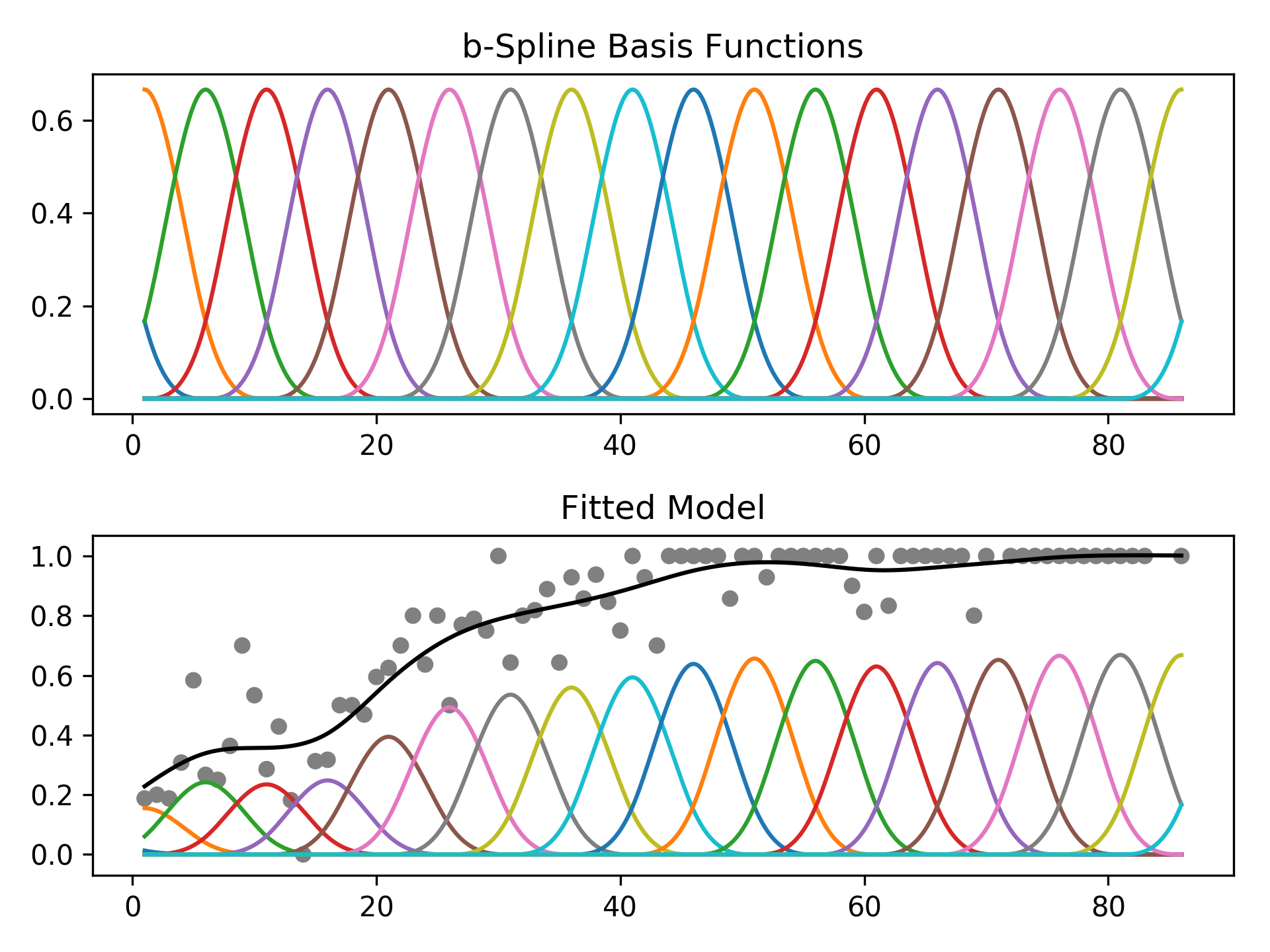 GAMs extend generalized linear models by allowing non-linear functions of features while maintaining additivity.
Since GAMs are additive, it is easy to examine the effect of each $X_i$ on $y$ individually while holding all other predictors constant.
As a result, GAMs are a class of very flexible and interpretable models, which also make it is easy to incorporate prior knowledge and control overfitting.
## Citing pyGAM
Please consider citing pyGAM if it has helped you in your research or work:
Daniel Servén, & Charlie Brummitt. (2018, March 27). pyGAM: Generalized Additive Models in Python. Zenodo. [DOI: 10.5281/zenodo.1208723](http://doi.org/10.5281/zenodo.1208723)
BibTex:
```
@misc{daniel\_serven\_2018_1208723,
author = {Daniel Servén and
Charlie Brummitt},
title = {pyGAM: Generalized Additive Models in Python},
month = mar,
year = 2018,
doi = {10.5281/zenodo.1208723},
url = {https://doi.org/10.5281/zenodo.1208723}
}
```
## References
1. Simon N. Wood, 2006
Generalized Additive Models: an introduction with R
0. Hastie, Tibshirani, Friedman
The Elements of Statistical Learning
https://www.sas.upenn.edu/~fdiebold/NoHesitations/BookAdvanced.pdf
0. James, Witten, Hastie, Tibshirani, and Taylor
An Introduction to Statistical Learning with Applications in Python
https://hastie.su.domains/ISLP/ISLP_website.pdf.download.html
0. Paul Eilers & Brian Marx, 1996
Flexible Smoothing with B-splines and Penalties
https://sites.stat.washington.edu/courses/stat527/s14/readings/EilersMarx_StatSci_1996.pdf
0. Kim Larsen, 2015
GAM: The Predictive Modeling Silver Bullet
http://multithreaded.stitchfix.com/assets/files/gam.pdf
0. Paul Eilers, Brian Marx, and Maria Durbán, 2015
Twenty years of P-splines
https://e-archivo.uc3m.es/rest/api/core/bitstreams/4e23bd9f-c90d-4598-893e-deb0a6bf0728/content
0. Keiding, Niels, 1991
Age-specific incidence and prevalence: a statistical perspective
https://academic.oup.com/jrsssa/article-abstract/154/3/371/7106499
GAMs extend generalized linear models by allowing non-linear functions of features while maintaining additivity.
Since GAMs are additive, it is easy to examine the effect of each $X_i$ on $y$ individually while holding all other predictors constant.
As a result, GAMs are a class of very flexible and interpretable models, which also make it is easy to incorporate prior knowledge and control overfitting.
## Citing pyGAM
Please consider citing pyGAM if it has helped you in your research or work:
Daniel Servén, & Charlie Brummitt. (2018, March 27). pyGAM: Generalized Additive Models in Python. Zenodo. [DOI: 10.5281/zenodo.1208723](http://doi.org/10.5281/zenodo.1208723)
BibTex:
```
@misc{daniel\_serven\_2018_1208723,
author = {Daniel Servén and
Charlie Brummitt},
title = {pyGAM: Generalized Additive Models in Python},
month = mar,
year = 2018,
doi = {10.5281/zenodo.1208723},
url = {https://doi.org/10.5281/zenodo.1208723}
}
```
## References
1. Simon N. Wood, 2006
Generalized Additive Models: an introduction with R
0. Hastie, Tibshirani, Friedman
The Elements of Statistical Learning
https://www.sas.upenn.edu/~fdiebold/NoHesitations/BookAdvanced.pdf
0. James, Witten, Hastie, Tibshirani, and Taylor
An Introduction to Statistical Learning with Applications in Python
https://hastie.su.domains/ISLP/ISLP_website.pdf.download.html
0. Paul Eilers & Brian Marx, 1996
Flexible Smoothing with B-splines and Penalties
https://sites.stat.washington.edu/courses/stat527/s14/readings/EilersMarx_StatSci_1996.pdf
0. Kim Larsen, 2015
GAM: The Predictive Modeling Silver Bullet
http://multithreaded.stitchfix.com/assets/files/gam.pdf
0. Paul Eilers, Brian Marx, and Maria Durbán, 2015
Twenty years of P-splines
https://e-archivo.uc3m.es/rest/api/core/bitstreams/4e23bd9f-c90d-4598-893e-deb0a6bf0728/content
0. Keiding, Niels, 1991
Age-specific incidence and prevalence: a statistical perspective
https://academic.oup.com/jrsssa/article-abstract/154/3/371/7106499