# kb
AI-orchestrated task board. Like Trello, but your tasks get specified, executed, and delivered by AI — powered by [pi](https://github.com/badlogic/pi-mono).
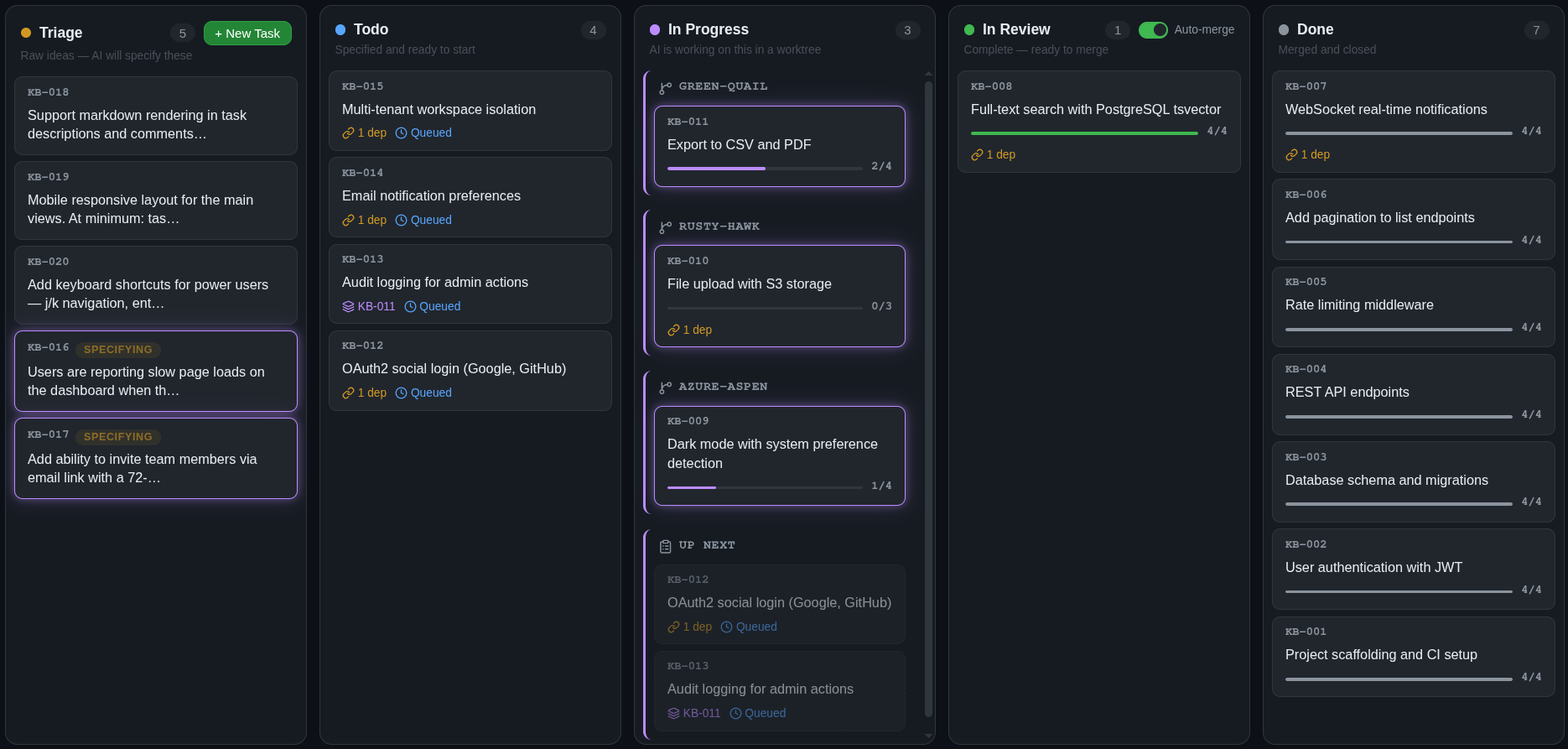
## Workflow
```mermaid
graph TD
H((You)) -->|rough idea| T["Triage\nauto-specification"]
T --> TD["Todo\nscheduled for execution"]
TD --> IP["In Progress\nfor each step:\nplan, review, execute, review "]
subgraph IP["In Progress"]
direction TD
NS([Begin step]) --> P[Plan]
P[Plan] --> R1{Review}
R1 -->|revise| P
R1 -->|approve| E[Execute]
E --> R2{Review}
R2 -->|revise| E
R2 -->|next step| NS
R2 -->|rethink| P
end
R2 -->|done| IR["In Review\nready to merge,\nor auto-merge"]
IR -->|squash merge| D["Done"]
style H fill:#161b22,stroke:#8b949e,color:#e6edf3
style T fill:#2d2006,stroke:#d29922,color:#d29922
style TD fill:#0d2044,stroke:#58a6ff,color:#58a6ff
style IP fill:#1a0d2e,stroke:#bc8cff,color:#bc8cff
style P fill:#1a0d2e,stroke:#bc8cff,color:#e6edf3
style R1 fill:#1a0d2e,stroke:#bc8cff,color:#e6edf3
style E fill:#1a0d2e,stroke:#bc8cff,color:#e6edf3
style R2 fill:#1a0d2e,stroke:#bc8cff,color:#e6edf3
style NS fill:#1a0d2e,stroke:#bc8cff,color:#e6edf3
style IR fill:#0d2d16,stroke:#3fb950,color:#3fb950
style D fill:#1a1a1a,stroke:#8b949e,color:#8b949e
```
Tasks with dependencies are processed sequentially. Independent tasks run in parallel.
## Quick Start
```bash
npm i -g @dustinbyrne/kb
```
Then from the root of your repository:
```bash
kb dashboard
```
Open [http://localhost:4040](http://localhost:4040) — create tasks from the board or the CLI.
### CLI commands
```bash
kb task create "Fix the login redirect bug"
kb task create "Button misaligned" --attach screenshot.png
kb task list
kb task show KB-001
kb task move KB-001 todo
kb task merge KB-001
```
Agents can use these same commands, or see [`.agents/skills/`](.agents/skills/) for structured skill docs.
### Prerequisites
The AI engine uses [pi](https://github.com/badlogic/pi-mono) under the hood:
1. `npm i -g @mariozechner/pi-coding-agent`
2. Run `pi` and use `/login`, or set `ANTHROPIC_API_KEY`
kb reuses your existing pi authentication.
## Packages
| Package | Description |
| --------------- | --------------------------------------------------------------- |
| `@kb/core` | Domain model — tasks, board columns, file-based store |
| `@kb/dashboard` | Web UI — Express server + kanban board with SSE |
| `@kb/engine` | AI engine — triage (pi), execution (pi + worktrees), scheduling |
| `kb` (cli) | CLI — `kb dashboard`, `kb task create/list/move/attach` |
## Architecture
### Task Storage
Tasks live on disk in `.kb/tasks/` in the project root:
```
.kb/
├── config.json # Board config + ID counter
└── tasks/
└── KB-001/
├── task.json # Metadata (column, deps, timestamps)
├── PROMPT.md # Task specification
└── attachments/ # File attachments — images & text files (optional)
```
### Board UI
Real-time kanban board at `localhost:4040`:
- Drag-and-drop cards between columns
- Create tasks from the web UI
- Click cards for detail view with move/delete actions
- Server-Sent Events for live updates across tabs
### AI Engine
The AI engine starts automatically with the dashboard. Three components run:
- **TriageProcessor** — Watches triage column. Spawns a pi agent session that reads the project, understands context, and writes a full PROMPT.md specification. Moves task to todo.
- **Scheduler** — Watches todo column. Resolves dependency graphs. Moves tasks to in-progress when deps are satisfied and concurrency allows (default: 2 concurrent). When `groupOverlappingFiles` is enabled in settings, tasks whose `## File Scope` sections share files are serialized to prevent merge conflicts.
- **TaskExecutor** — Listens for tasks entering in-progress. Creates a git worktree, spawns a pi agent session with full coding tools scoped to the worktree, and executes the specification. Moves to in-review on completion.
Each pi agent session gets:
- Custom system prompt for its role (triage specifier vs task executor)
- Tools scoped to the correct directory (`createCodingTools(cwd)`)
- In-memory sessions (no persistence needed)
- The user's existing pi auth (API keys from `~/.pi/agent/auth.json`)
## Development
```bash
pnpm install
pnpm dev dashboard # Board + AI engine
pnpm dev task list # CLI commands
```
## Building a standalone executable
You can build a single self-contained `kb` binary using [Bun](https://bun.sh/):
```bash
pnpm build:exe
```
This compiles all TypeScript, builds the dashboard client, and produces:
- `packages/cli/dist/kb` — the standalone binary
- `packages/cli/dist/client/` — co-located dashboard assets
Run the binary directly — no Node.js, pnpm, or workspace setup needed:
```bash
./packages/cli/dist/kb --help
./packages/cli/dist/kb task list
./packages/cli/dist/kb dashboard
```
To distribute, copy both the `kb` binary and the `client/` directory together.
### Cross-compilation
Build binaries for all supported platforms from a single machine:
```bash
pnpm build:exe:all
```
This produces binaries for all supported targets in `packages/cli/dist/`:
| Target | Output |
| ------------------ | -------------------- |
| `bun-linux-x64` | `kb-linux-x64` |
| `bun-linux-arm64` | `kb-linux-arm64` |
| `bun-darwin-x64` | `kb-darwin-x64` |
| `bun-darwin-arm64` | `kb-darwin-arm64` |
| `bun-windows-x64` | `kb-windows-x64.exe` |
To build for a specific platform:
```bash
pnpm --filter kb build:exe -- --target bun-linux-x64
```
The `client/` directory is shared across all binaries (platform-independent assets).
You can override the dashboard asset path via the `KB_CLIENT_DIR` environment variable:
```bash
KB_CLIENT_DIR=/path/to/client ./kb dashboard
```
**Prerequisites:** Bun ≥ 1.0 (`bun --version`)
## Releases
Packages are published to npm automatically via GitHub Actions and [changesets](https://github.com/changesets/changesets).
### Installing from npm
```bash
npm install -g kb
```
### Triggering a release
Releases are automated via [changesets](https://github.com/changesets/changesets). See [RELEASING.md](./RELEASING.md) for the full workflow.
In short: add a changeset with `pnpm changeset`, merge to main, then merge the auto-generated "Version Packages" PR. Once merged, the workflow automatically publishes all updated packages to npm.
### CI pipeline
- **Pull requests & pushes to main** — runs tests and build (`.github/workflows/ci.yml`)
- **Push to main** — creates a version PR (if changesets exist) or publishes to npm (`.github/workflows/version.yml`)
## License
ISC