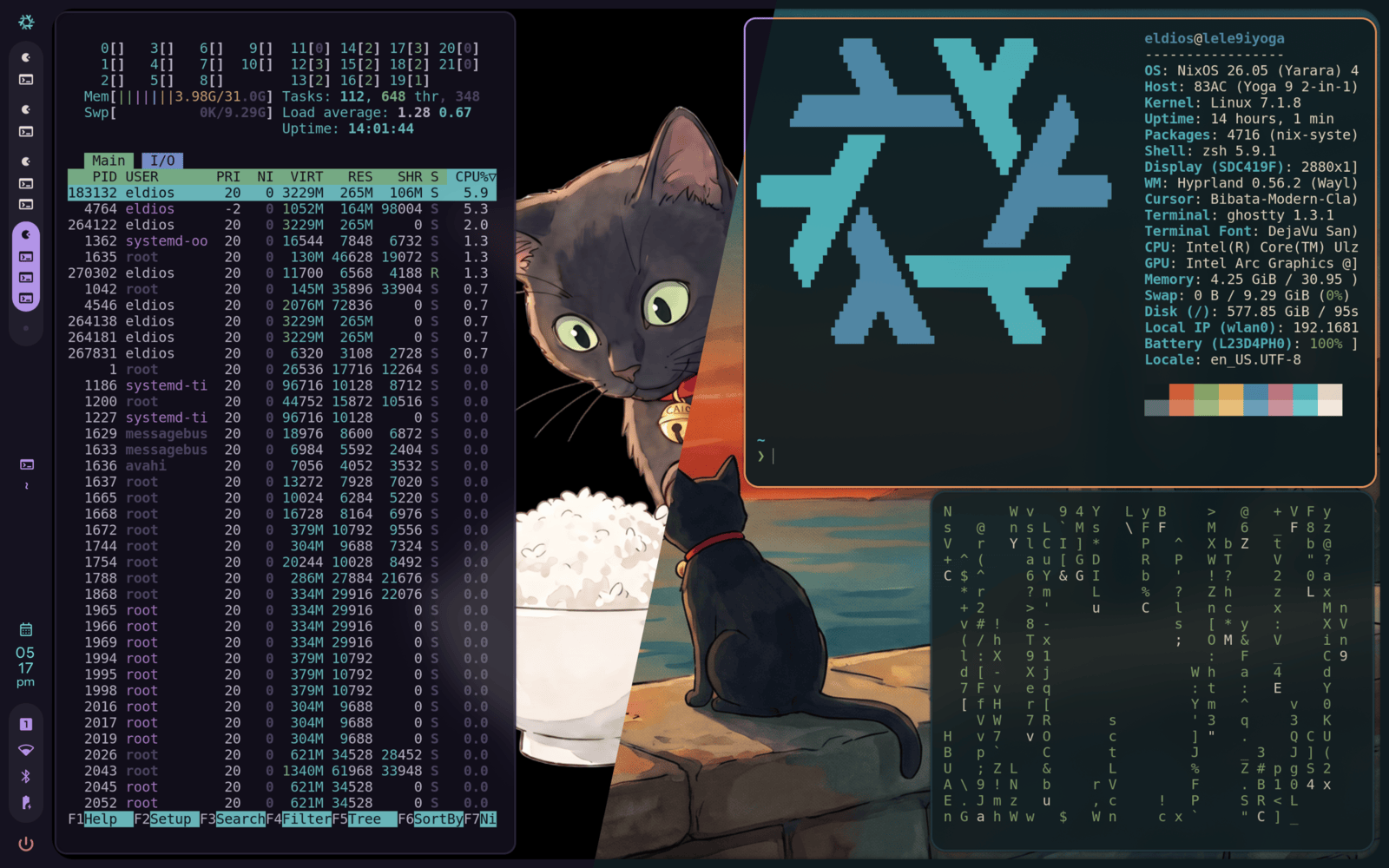
riso ### One palette, your whole desktop A ricing framework for Linux: themes are data, riso renders them into the files your desktop reads. [![CI](https://img.shields.io/github/actions/workflow/status/eldios/riso/ci.yml?branch=main&style=for-the-badge&label=ci&labelColor=101418&color=8ac79a)](https://github.com/eldios/riso/actions/workflows/ci.yml) [![Release](https://img.shields.io/github/v/release/eldios/riso?style=for-the-badge&labelColor=101418&color=7ad4d8)](https://github.com/eldios/riso/releases/latest) [![AUR](https://img.shields.io/aur/version/riso?style=for-the-badge&labelColor=101418&color=b195e8)](https://aur.archlinux.org/packages/riso) [![License](https://img.shields.io/github/license/eldios/riso?style=for-the-badge&labelColor=101418&color=d8bd78)](LICENSE) one desktop, two themes: caio on the left, tuscany-sunset on the right

Install  Quick start  Commands  How it works  Themes  Cleanup
## Features - One palette renders seventeen applications out of the box: terminals, bars, notifiers, lockers, editors - Full-screen carousel (`--gui`) and terminal picker with image previews (`--tui`) for themes, wallpapers and the catalog - Themes are data, never code: executables, run directives, symlinks and escaping paths are refused at install time - Your configs stay yours: riso renders fragments your configs include, and `riso restore` puts back every byte it ever wrote over - Hyprland, Sway, niri and Omarchy recognized from the session; reads Omarchy themes byte-for-byte compatibly - Wallpapers per theme, remembered per theme - `riso config check` says what a fresh system is missing and the exact include line each application needs; `riso config apps` says what the current configuration can theme - One binary, a manpage, `git` and `curl` for fetching things ## Install ### Prerequisites - A desktop riso can tell about the change: the Hyprland, Sway or niri compositors, or Omarchy, where riso is a drop-in. Anywhere else the files are still written, but nothing reloads and nothing reads them until you wire it. - `git` and `curl` on the PATH: themes install and update through them. - `quickshell`, only for the `--gui` carousel; `--tui` works in any terminal. - Each application reads its theme through one include line in its own config. Run `riso config check` after installing: it lists what is missing and the exact line each application needs; `riso config wire` adds those lines for you, one confirmation per file, and `riso restore` puts every touched file back.

Arch and the Arch family One AUR package serves the whole family: [`riso`](https://aur.archlinux.org/packages/riso) builds from source and verifies the PGP-signed release tag, [`riso-bin`](https://aur.archlinux.org/packages/riso-bin) ships the prebuilt binary. Each member has its own front door: | Distro | Install | Worth knowing | | --- | --- | --- | | Arch and derivatives (EndeavourOS, CachyOS, Garuda, ...) | `paru -S riso` | [*] | | Omarchy | `omarchy pkg aur add riso` | `riso-bin` for the prebuilt binary; or the menu, Install > AUR; updates go through `omarchy update` | | Manjaro | `pamac build riso` | enable AUR in pamac's preferences first; Manjaro's repos lag Arch and its team does not support the AUR | [*] any AUR helper works the same, `yay` included. Without a helper, clone and build: ```bash git clone https://aur.archlinux.org/riso.git cd riso && makepkg -si ``` > [!NOTE] > The source package verifies the release tag against the maintainer > key: `gpg --recv-keys AA6BC7743F8F9AD84BBA15C72CCBF4B71EFFDD46` once > before the first build.
NixOS Try it without installing anything: ```bash nix run github:eldios/riso -- theme list ``` To keep it, add `github:eldios/riso` as a flake input and pull `overlays.default` (or `packages..default`) into your NixOS or home-manager configuration.
Debian, Ubuntu, Mint Grab the `.deb` from the [latest release](https://github.com/eldios/riso/releases/latest) and `sudo dpkg -i` it.
Fedora, RHEL, openSUSE Grab the `.rpm` from the [latest release](https://github.com/eldios/riso/releases/latest) and `sudo rpm -i` it.
From source, if you must ```bash git clone https://github.com/eldios/riso.git cd riso && cargo build --release ``` The binary lands in `target/release/riso`; the manpage is `docs/riso.1`. On Arch, `cd packaging && makepkg -si` does the same through the package manager.
## Quick start ```bash riso theme install caio riso theme set caio riso backgrounds next ``` Themes come from anywhere, not only the catalog, and previews come before choices: ```bash riso theme install riso theme install --gui riso theme set --tui ```
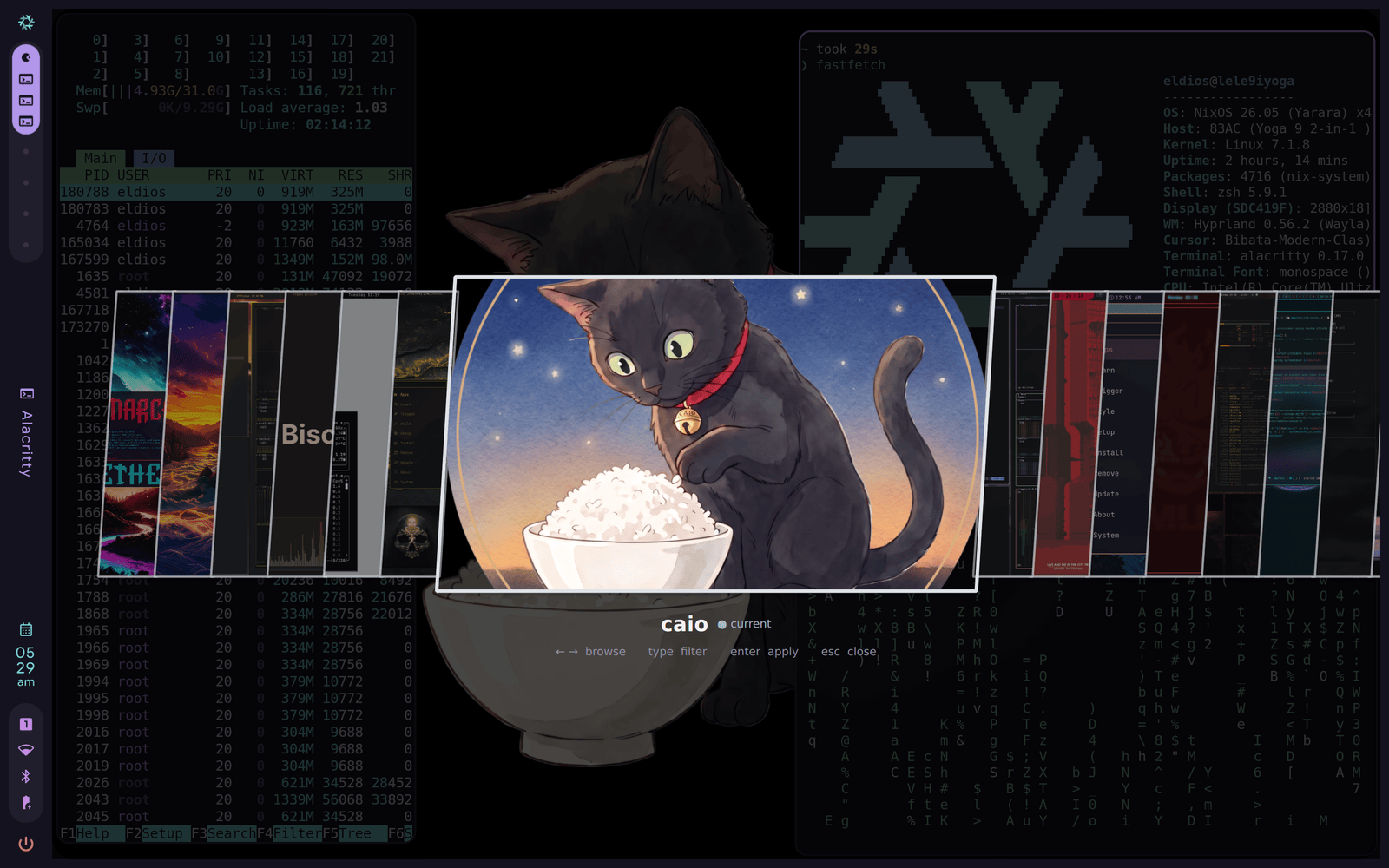
riso theme set --gui: the carousel of theme previews
## Commands | Command | What it does | | --- | --- | | `riso theme install \|\|--gui` | from the catalog, from anywhere, or from previews | | `riso theme set ` | apply a theme and tell the desktop | | `riso theme set --gui\|--tui` | pick from previews: carousel or terminal | | `riso theme get\|list` | what is applied, what is installed | | `riso theme update` | bring installed themes up to date | | `riso theme validate ` | is this safe to install | | `riso backgrounds set\|next` | the wallpaper: which image... | | `riso backgrounds mode\|get` | ...and how it scales | | `riso plugin list` | what teaches riso about more applications | | `riso dev palette\|render` | theme-author tools | | `riso config` | the few persistent options | | `riso config check [name]` | can this system carry riso, whole or one check by name | | `riso config apps` | what the current configuration can theme, and from where | | `riso config wire [app...]` | add the missing include lines, cautiously; `riso restore` undoes | | `riso restore` | put back what riso wrote over | | `riso uninstall --yes` | put everything back and forget the state | Every component has a single-letter alias (`riso t s` is `riso theme set`, `backgrounds` also answers to `b`) and every command takes `-o human|json|yaml`, so scripts read structure instead of parsing prose. `riso(1)` has the options; the handful worth keeping live in `~/.config/riso/config.toml`, managed by `riso config`. ## How a theme is put together Four layers decide any given file, strongest first: 1. a file the theme ships by hand 2. a user template directory 3. a template directory the desktop provides 4. the templates compiled into `riso` Layer 4 is what makes a theme impossible to leave incomplete; layer 1 is what lets an author overrule the generator on the file they care about. Fonts are tokens like colours, so a theme carries its own typography instead of leaving it to a setting somewhere else. ### Your configuration stays yours `riso` renders fragments into its own tree and never rewrites an application's config file. Your config, which belongs to you, includes the fragment: mako's `include=`, waybar's `@import`, hyprlock's `source`, a terminal's import directive. A theme change rewrites the fragment; every rule you wrote around the include survives it, and your own overrides can be included after the fragment so they win. The one exception is a plugin, whose whole point is reaching a path the application dictates. What was there first is copied aside for `riso restore`, byte for byte, and the file opens with a comment saying it is generated and where edits belong, in whatever comment syntax the format speaks. A format with no comments, JSON above all, gets none. ### Safety A theme is data and `riso` enforces it. Executable files, directives that name a program to run, symlinks, and paths that climb out of the theme directory are all refused, on the client as well as in the catalog. A theme that arrives from a git URL never passed through a catalog at all, which is exactly why the check runs twice. ## Themes These two are the official themes. The catalog grows with community submissions: browse it at [catalog.riso.re](https://catalog.riso.re). It is a [static index](https://github.com/eldios/riso-themes) pointing at ordinary git repositories, so publishing a theme needs no account anywhere and installing one is a clone with a checksum. | | | | :---: | :---: | | [![caio](https://raw.githubusercontent.com/eldios/riso-theme-caio/main/preview.png)](https://github.com/eldios/riso-theme-caio) | [![tuscany-sunset](https://raw.githubusercontent.com/eldios/riso-theme-tuscany-sunset/main/preview.png)](https://github.com/eldios/riso-theme-tuscany-sunset) | | [`caio`](https://github.com/eldios/riso-theme-caio) | [`tuscany-sunset`](https://github.com/eldios/riso-theme-tuscany-sunset) | ## Extending A plugin teaches `riso` to theme an application it does not know about: a directory with a manifest and its templates, installed from git. ```toml id = "eldios.zed" api = 1 reload = ["zed", "--reload"] [[render]] template = "zed.json.tpl" target = "~/.config/zed/themes/riso.json" ``` `riso` also reads themes written for [Omarchy](https://github.com/basecamp/omarchy) and renders them identically: the conformance suite resolves every palette that project publishes byte for byte against its pipeline. A theme written for either works on both. See [NOTICE](NOTICE). ## Develop ```bash nix develop # toolchain plus every tool the gates need just ci # format, lint, tests just conformance # the interoperability check ``` ## Cleanup Leaving is as safe as arriving. Put back every file `riso` wrote over, or put everything back and forget the generated state too: ```bash riso restore riso uninstall --yes ``` Then remove the package with whatever installed it: `paru -Rns riso`, `apt remove riso`, `dnf remove riso`, or drop the flake input.