






# Epure
Self-hosted error tracking: grouped issues and stack traces, one Rust binary and PostgreSQL 16.
Keep the official Sentry SDK. Change the DSN to Epure. Docker Compose runs two containers (app + Postgres). You own backups and upgrades. Hosting the data means you are not billed per event.
| Lightweight | Keep your Sentry SDK | Built for agents |
| :--- | :--- | :--- |
| **~53 MiB combined idle.** App plus Postgres on a small VPS. | **DSN only.** Official Sentry SDK. Tracing, replay, and profiling sample rates stay at 0. | **Copy for AI.** Stack and breadcrumbs into Cursor or Claude, or [MCP and CLI](https://epure.sh/docs/guides/mcp-and-cli). |
## From clone to Issues
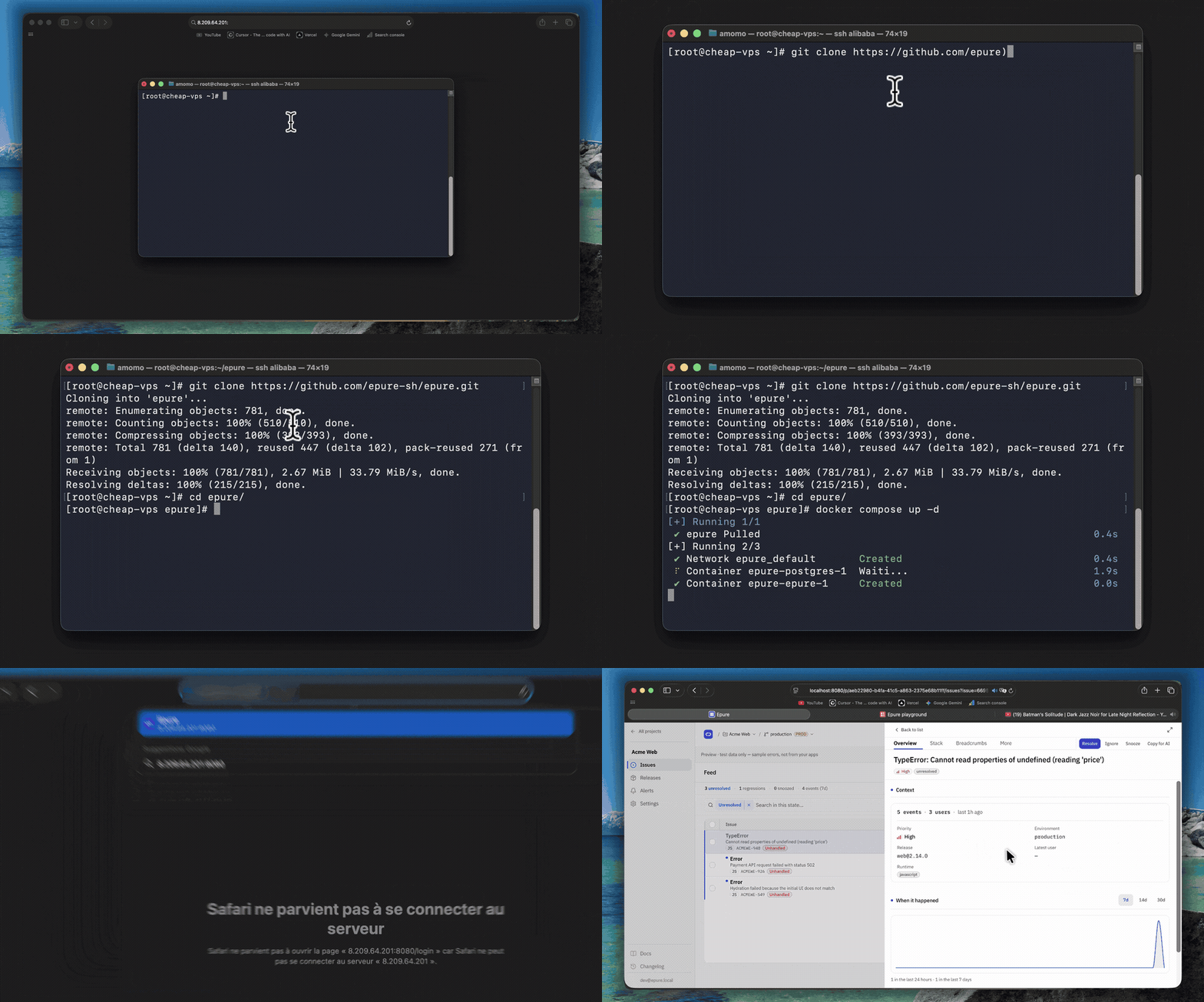
Docs: [architecture, deploy, and DSN migration](https://epure.sh/docs).
## Quickstart
**1. Start it**
```bash
git clone https://github.com/epure-sh/epure.git
cd epure
docker compose up -d
```
**2. Copy the DSN**
Open [http://localhost:8080](http://localhost:8080). Register, create a project, copy the DSN.
**3. Throw one error**
Keep the official Sentry SDK. Paste the Epure DSN. Set tracing, replay, and profiling sample rates to **0** (Epure does not store those payloads).
```javascript
import * as Sentry from "@sentry/node";
Sentry.init({
dsn: process.env.SENTRY_DSN, // DSN from step 2
tracesSampleRate: 0,
replaysSessionSampleRate: 0,
replaysOnErrorSampleRate: 0,
profilesSampleRate: 0,
});
Sentry.captureException(new Error("Epure test event"));
```
**4. Open Issues**
`Epure test event` is on the page. Grouped, with the stack.
Other languages, same DSN: [Pick your SDK](https://epure.sh/docs/platforms). It also lives under **Settings → SDK connection**, and the in-app **Setup** wizard shows it.
## Deploy
**On a VPS**
```bash
./configure --prod
docker compose -f docker-compose.yml -f deploy/docker-compose.prod.yml --profile tls up -d
```
Run `./configure --prod` **before** the first `up`, or after `docker compose … down -v`. If Postgres data already exists, the script **reuses** secrets from `.env` or **applies** new ones into the database — it does not overwrite `.env` with fresh random passwords while leaving the volume on the old ones. To rotate secrets intentionally: `./configure --prod-rotate-secrets`. `./configure --prod` asks for a public HTTPS hostname (not a raw IP). `--profile tls` starts Caddy on ports 80 and 443. Open `https://your-hostname/login` and repeat steps 2 to 4.
`http://YOUR_SERVER:8080` will not keep you signed in. `/health` can still return ok. The browser drops the Secure session cookie and sends you back to the login form with no error. Drop `--profile tls` only when you already terminate HTTPS yourself.
After that account exists, set `EPURE_REGISTRATION=false` and recreate the container. Sign-in stays available. New workspaces cannot be created from the public URL. Invitation links still work.
Pin `EPURE_IMAGE` to the current release tag once the URL is public ([Releases](https://github.com/epure-sh/epure/releases) · [Installation](https://epure.sh/docs/self-hosting/installation)).
**On a platform**
| Platform | Start here |
| --- | --- |
| Render | Blueprint [`render.yaml`](render.yaml). |
| Railway | Drag [`deploy/railway/docker-compose.yml`](deploy/railway/docker-compose.yml) onto the project. [Notes](deploy/railway/README.md). |
| Coolify | Compose, base directory [`deploy/templates/coolify`](deploy/templates/coolify). |
| Dokploy | Compose file [`deploy/templates/dokploy/docker-compose.yml`](deploy/templates/dokploy/docker-compose.yml). |
Then the same steps: register, copy the DSN, throw once, open **Issues**. Longer list: [Installation](https://epure.sh/docs/self-hosting/installation) · [`deploy/`](deploy/README.md).
## Architecture
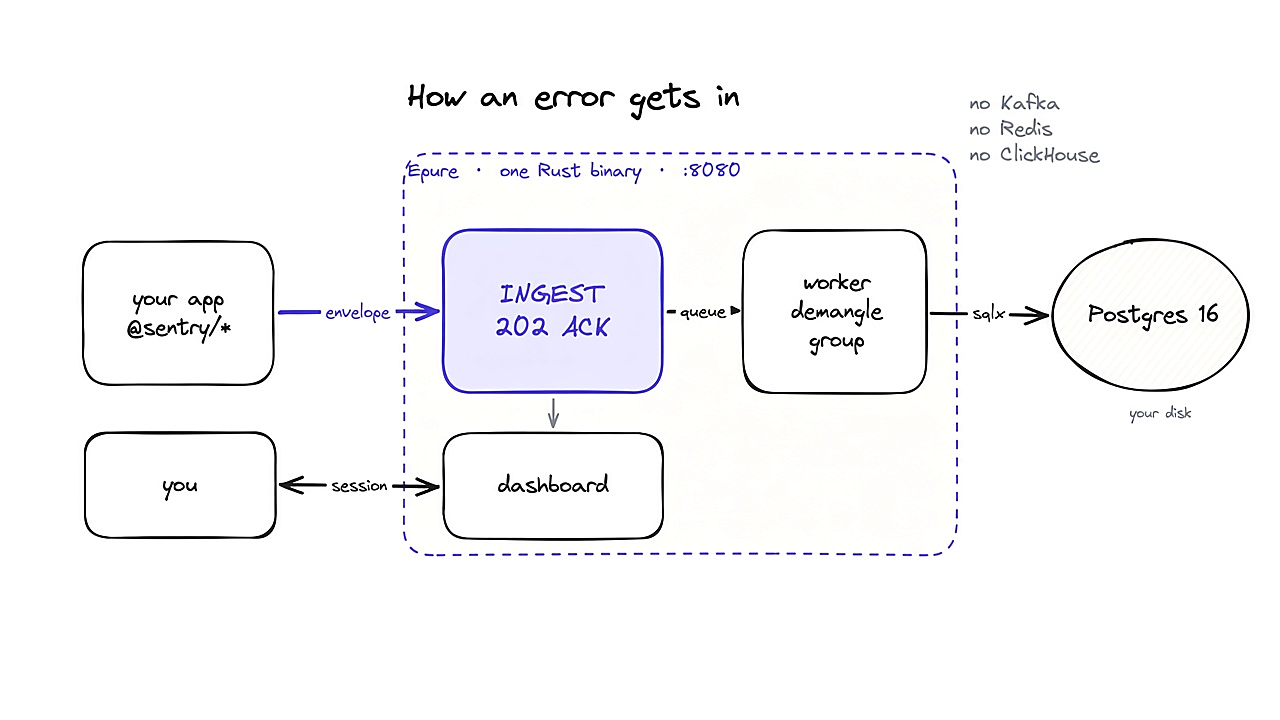
Two containers. The SDK talks to ingest; ingest returns 202 and a worker writes Postgres. The dashboard is the same binary.
---
## Details
* Grouped issues and readable stack traces
* JS/TS sourcemaps
* Releases and regressions
* Alerts and webhooks
* Multi-project orgs and DSN rotation
* RBAC and PostgreSQL RLS
* Keyboard triage
* Spike protection
Epure does not store distributed traces, session replay, continuous profiling, generic logs, or infrastructure metrics. It does not symbolicate iOS/Android. Keep those sample rates at 0 in the SDK.
| | Epure | Bugsink | Sentry self-hosted | GlitchTip |
| --- | --- | --- | --- | --- |
| **Primary focus** | Error tracking | Self-hosted error tracking | Errors plus tracing, replay, profiling | Errors and performance |
| **Deployment** | Two-container Compose | Single-container `docker run` | Large multi-service cluster | Multiple options |
| **License** | Apache 2.0. No `ee/` folder | PolyForm Shield 1.0.0 | Check current Sentry license | MIT |
| **Database** | PostgreSQL 16 | See their docs | Multiple datastores | PostgreSQL |
**Project Status:** Early release. Fits homelabs, side projects, and small teams who have tested backup and upgrade paths. Expect SDK and protocol gaps; [file them](https://github.com/epure-sh/epure/issues). [Changelog](CHANGELOG.md).
* [Report an Issue](https://github.com/epure-sh/epure/issues)
* [Join Discussions](https://github.com/epure-sh/epure/discussions)
* [Read CONTRIBUTING.md](CONTRIBUTING.md)
* [Security Policy](.github/SECURITY.md)
**License:** [Apache License 2.0](LICENSE). No separate closed-source core.