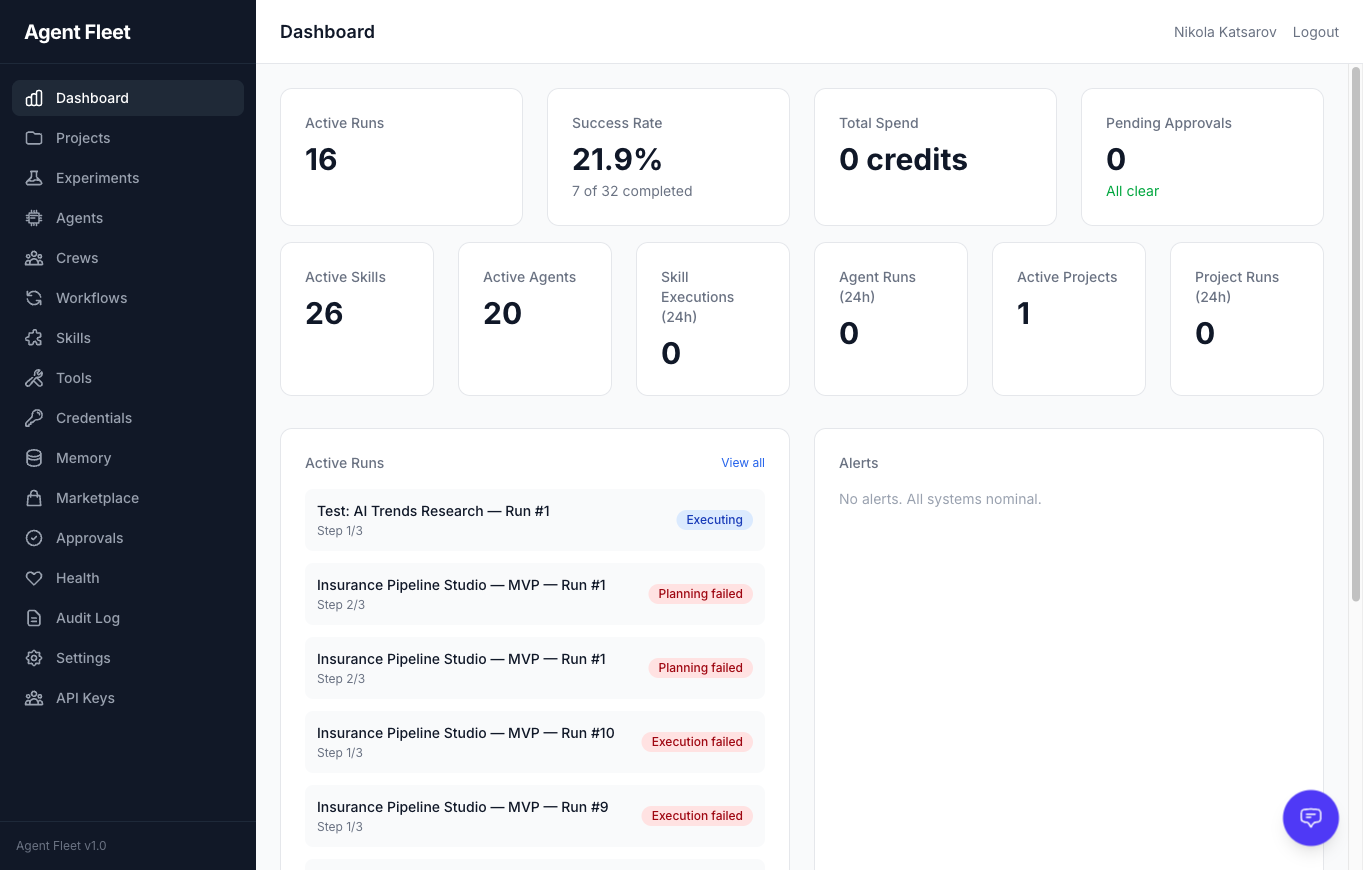
**Dashboard**
KPI overview with active experiments, success rate, budget spend, and pending approvals.
|
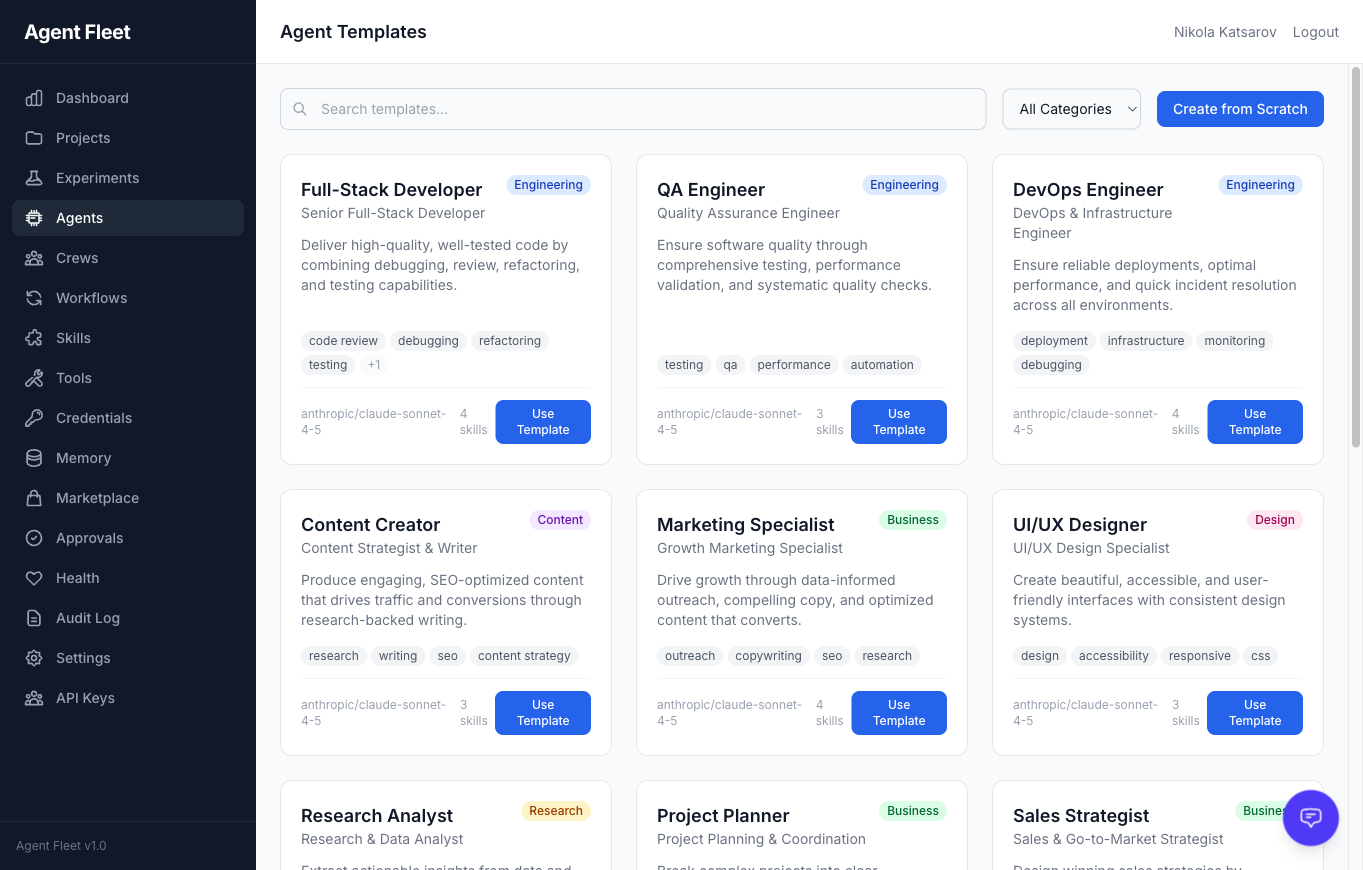
**Agent Template Gallery**
Browse 14 pre-built agent templates across 5 categories. Search, filter by category, and deploy with one click.
|
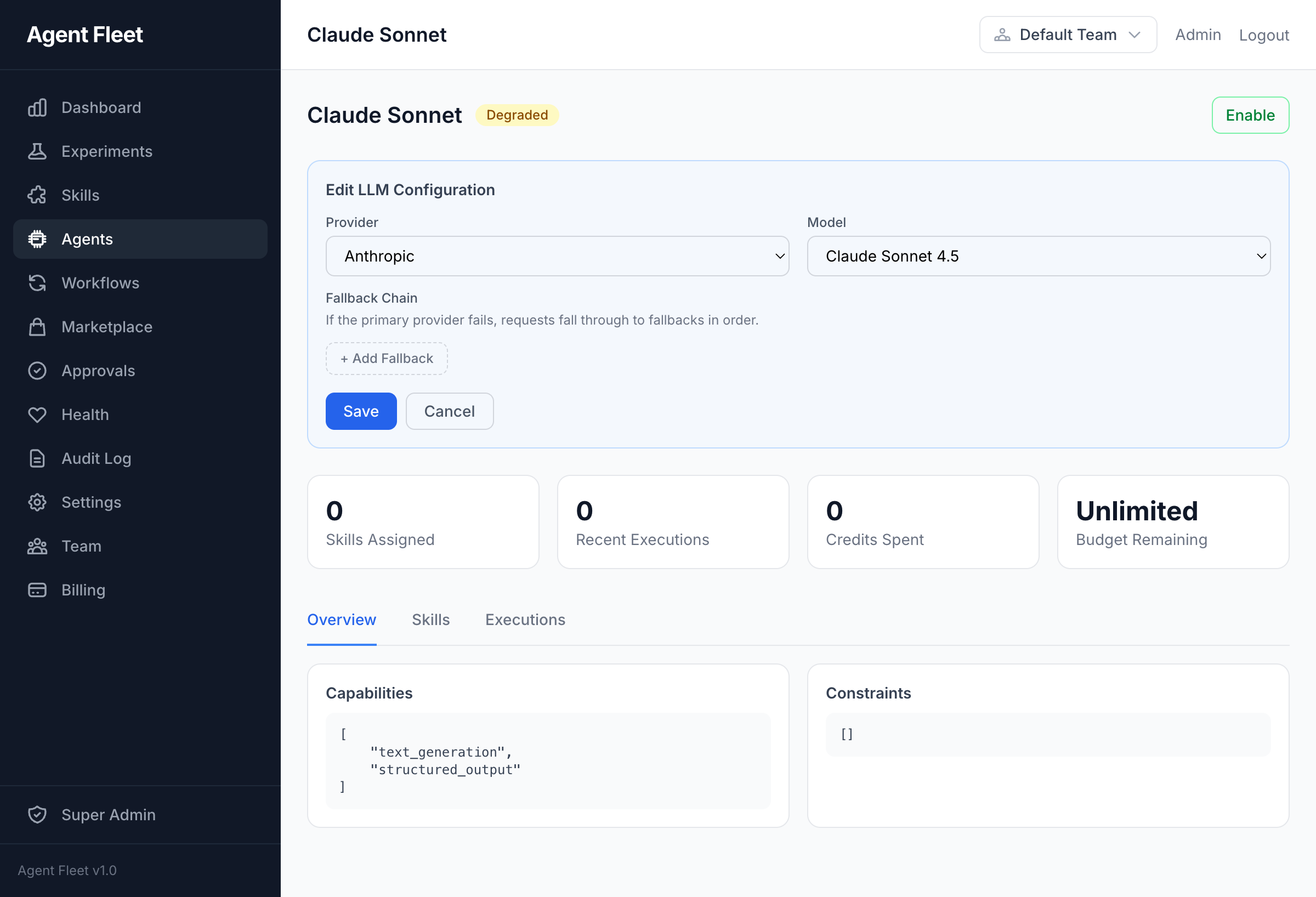
**Agent LLM Configuration**
Per-agent provider and model selection with fallback chains. Supports Anthropic, OpenAI, Google, and local agents.
|
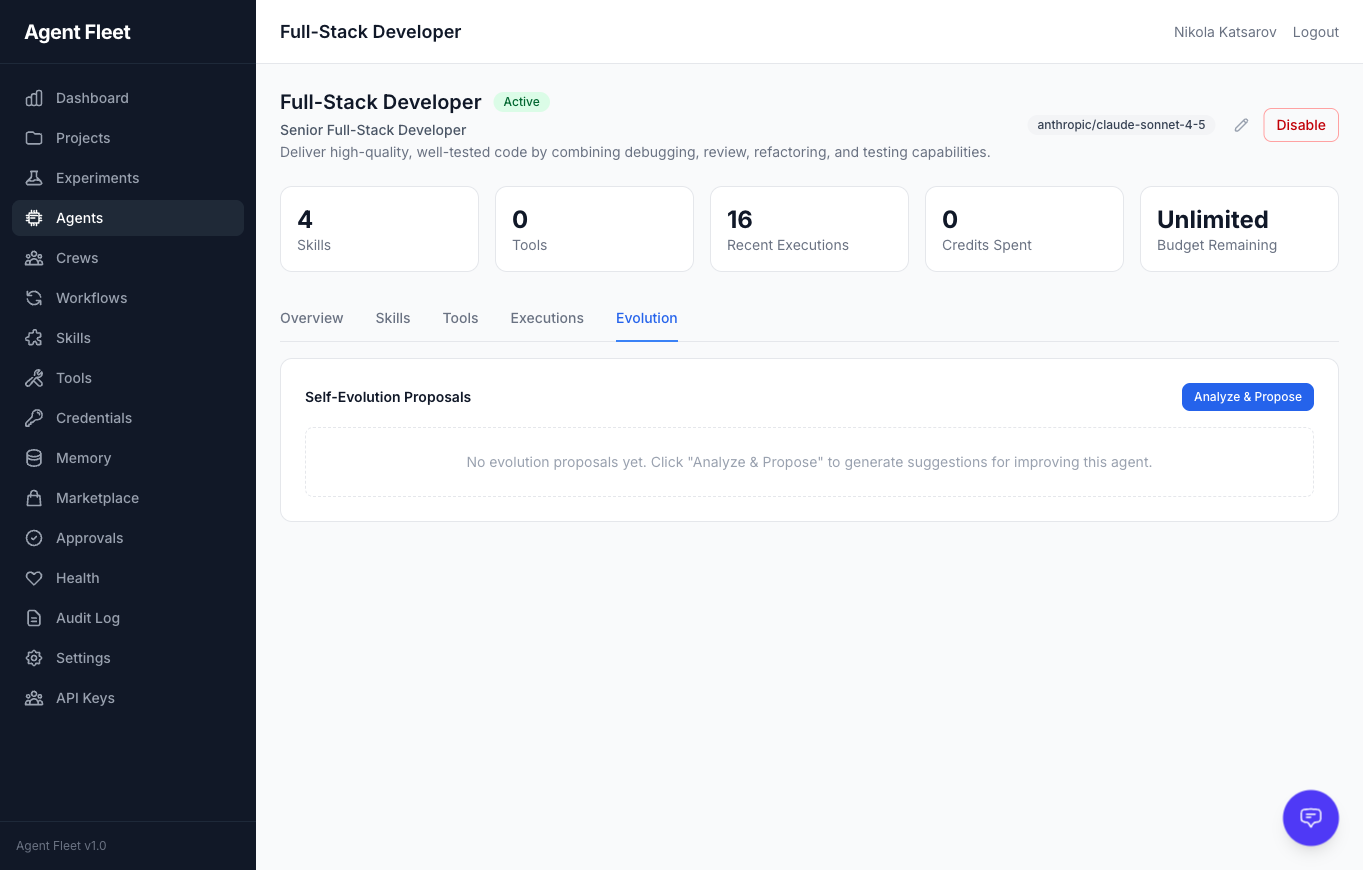
**Agent Evolution**
AI-driven agent self-improvement. Analyze execution history, propose personality and config changes, and apply with one click.
|
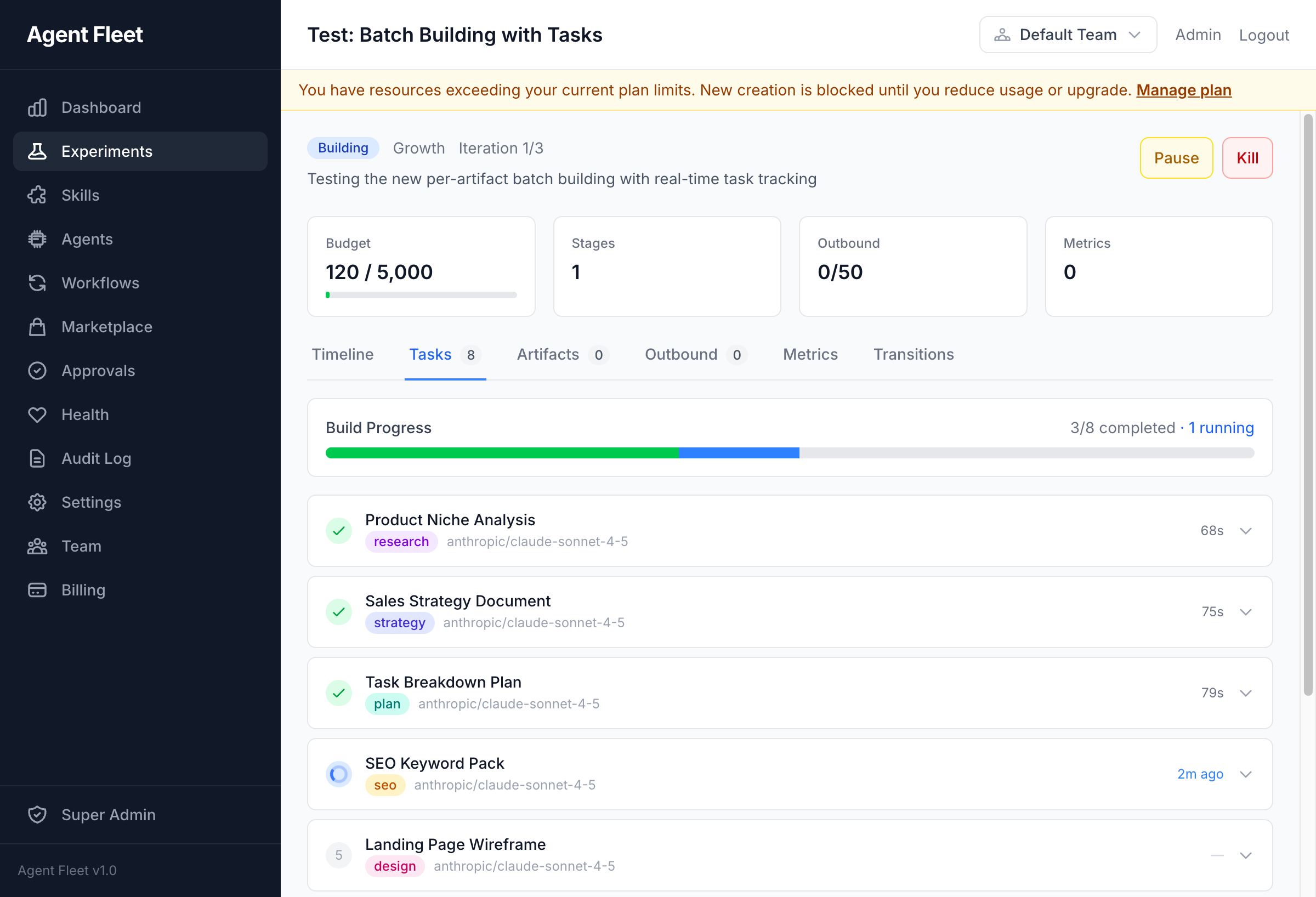
**Crew Execution**
Live progress tracking during multi-agent crew execution. Each task shows its assigned skill, provider, and elapsed time.
|
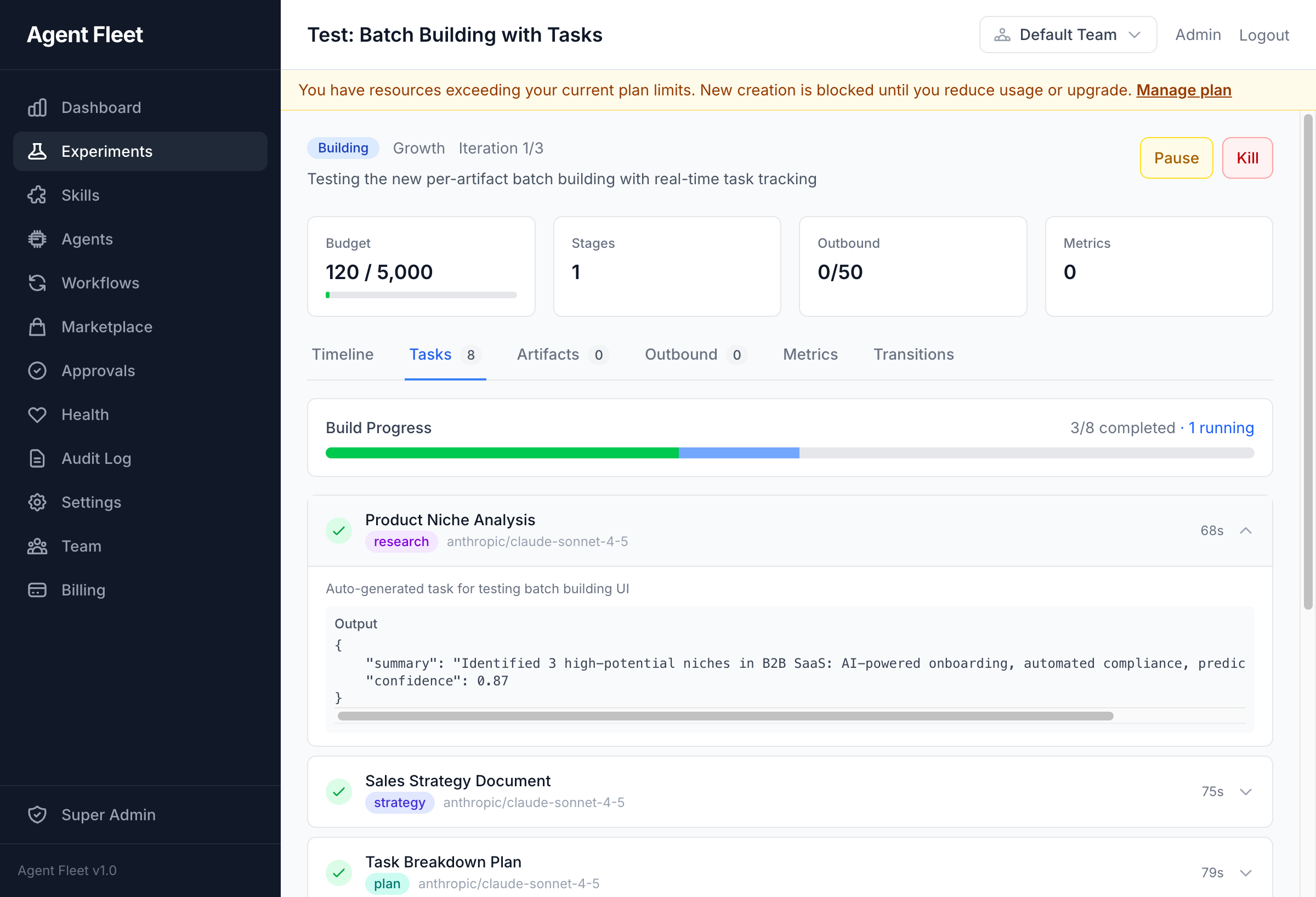
**Task Output**
Expand any completed task to inspect the AI-generated output, including structured JSON responses.
|
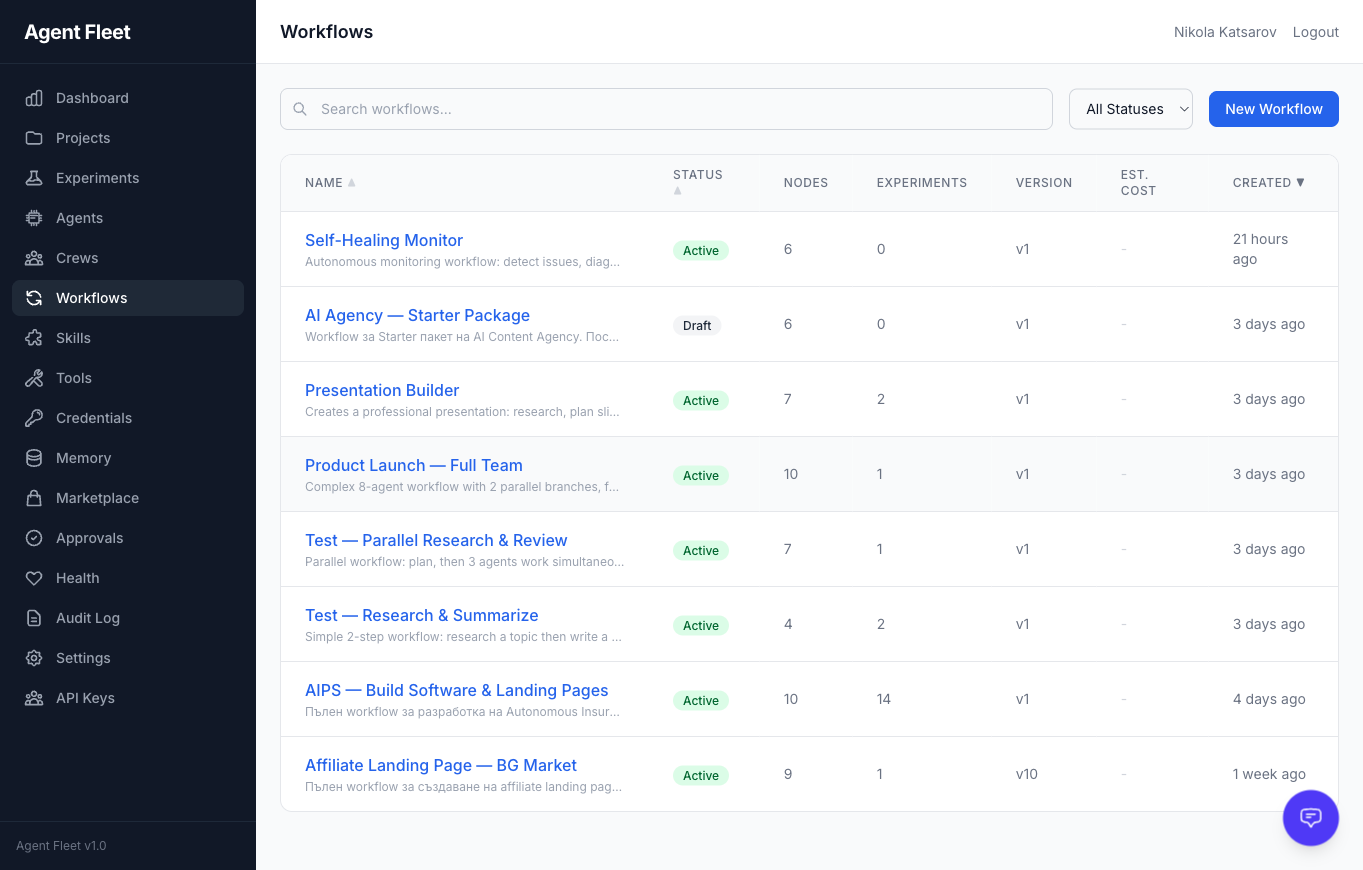
**Visual Workflow Builder**
DAG-based workflow editor with conditional branching, human tasks, switch nodes, and dynamic forks.
|
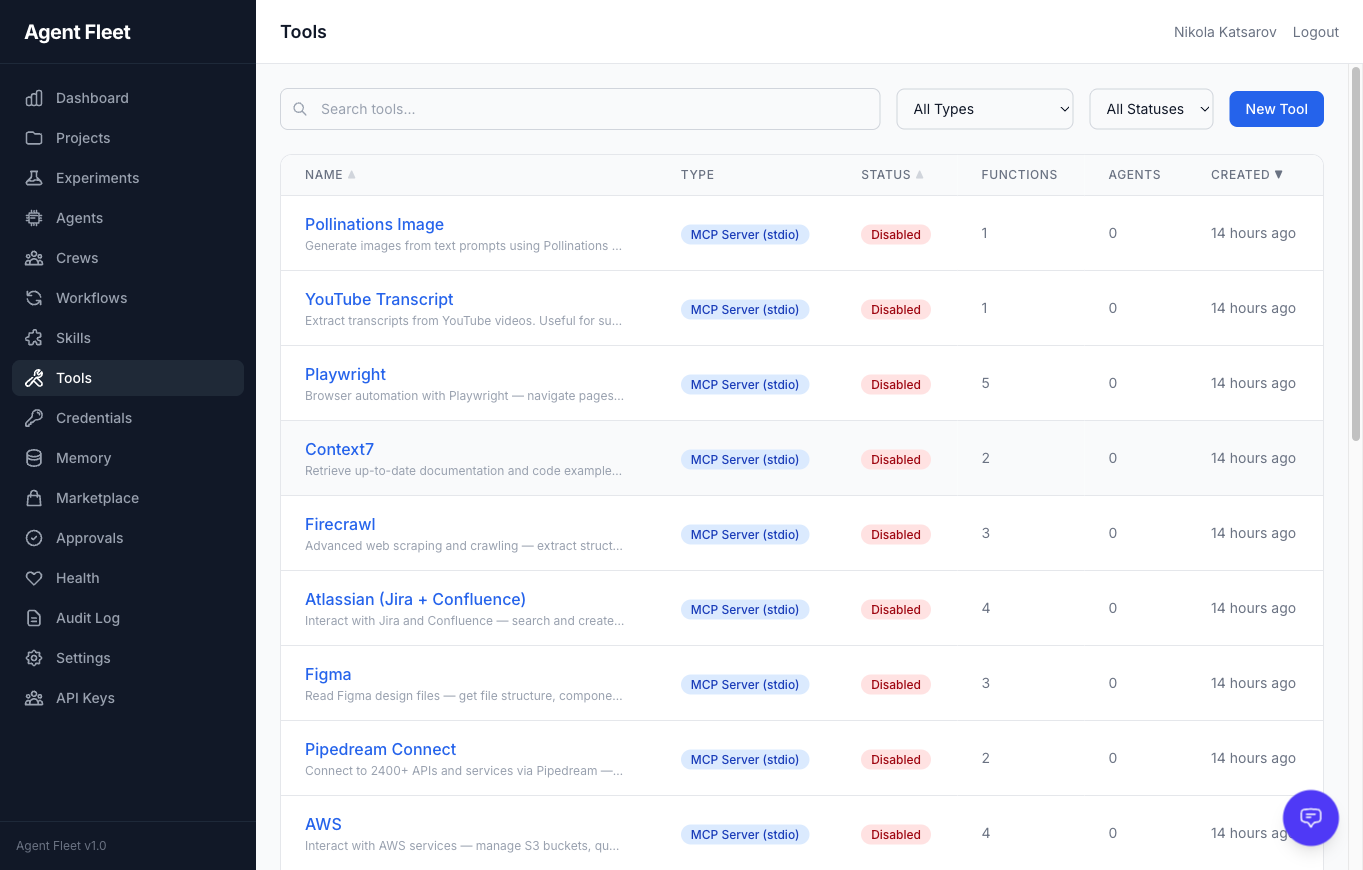
**Tool Management**
Manage MCP servers, built-in tools, and external integrations with risk classification and per-agent assignment.
|
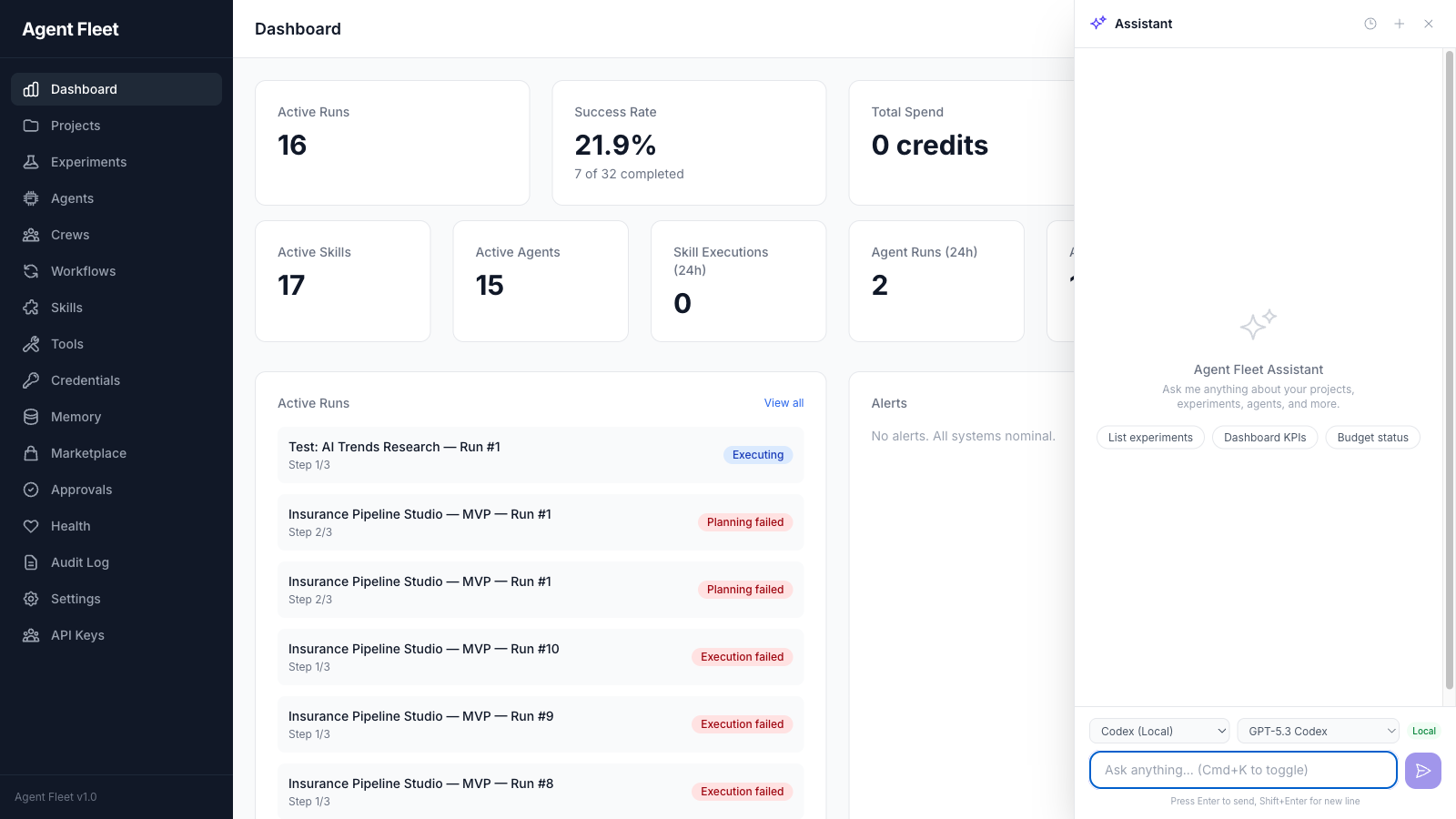
**AI Assistant Sidebar**
Context-aware AI chat embedded in every page with 28 built-in tools for querying and managing the platform.
|
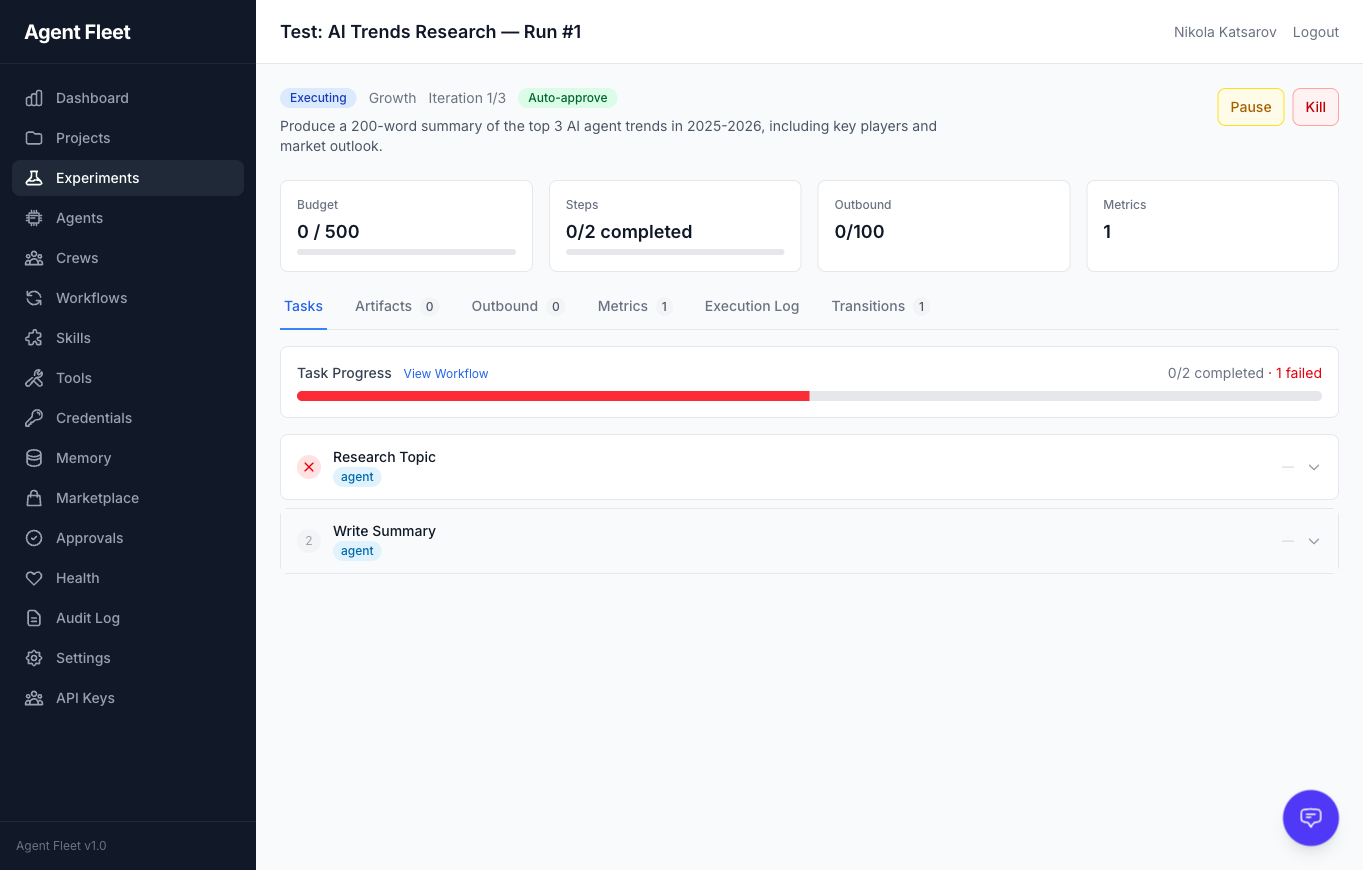
**Experiment Detail**
Full experiment lifecycle view with timeline, tasks, transitions, artifacts, metrics, and outbound delivery.
|
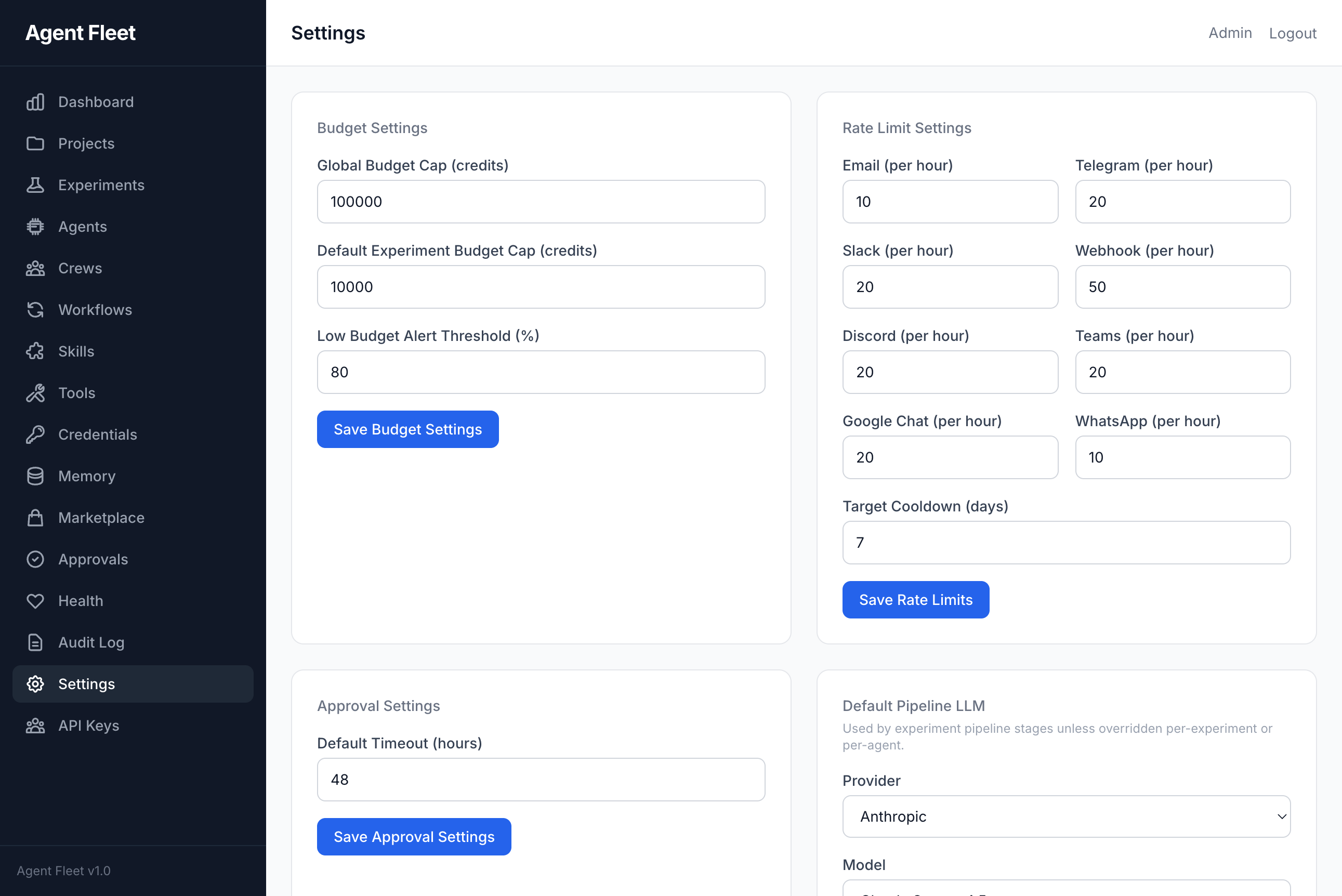
**Settings & Webhooks**
Global platform settings, AI provider keys (BYOK), outbound connectors, and webhook configuration.
|
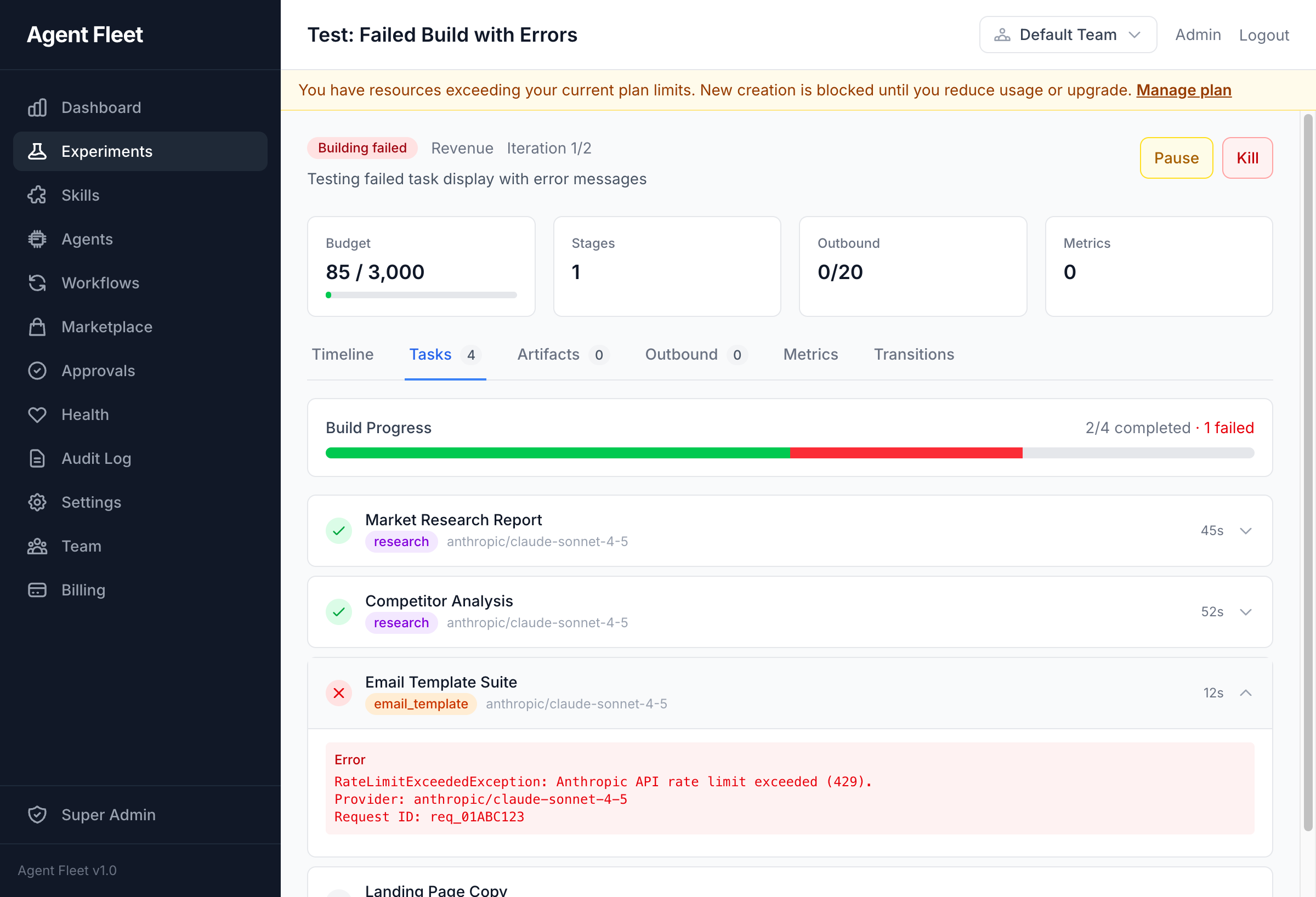
**Error Handling**
Failed tasks display detailed error information including provider, error type, and request IDs for debugging.
|
## Features
### Agents, crews, and workflows
- **AI Agents** — role, goal, backstory, personality traits, skill assignments, per-agent provider/model fallback chains
- **Agent Templates** — 14 pre-built templates across 5 categories (engineering, content, business, design, research)
- **Agent Evolution** — LLM analyzes execution history, proposes config changes, one-click approval
- **Agent Crews** — Multi-agent teams with coordinator/QA/worker roles, 7 process types (sequential, parallel, hierarchical, self-claim, adversarial, fanout, chat-room), weighted QA scoring
- **Pre-Execution Scout Phase** — cheap LLM pre-call identifies what knowledge the agent needs → targeted semantic search instead of generic recall
- **Step Budget Awareness** — agent system prompt targets 80% of allowed steps for core work, reserves the rest for synthesis
- **Experiment Pipeline** — 20-state machine with automatic stage progression (scoring → planning → building → approval → executing → metrics → evaluating)
- **Visual Workflow DAG** — 8 node types (agent, conditional, human-task, switch, dynamic-fork, do-while, compensation, sub-workflow). Pre-built Web Dev Cycle template. NL → workflow generator.
- **Projects** — one-shot and continuous projects with cron scheduling, budget caps, milestones, overlap policies
### LLMs and compute
- **BYOK** — bring your own keys for Anthropic (Claude), OpenAI (GPT-4o), Google (Gemini)
- **Local LLMs** — Ollama, LM Studio, vLLM, llama.cpp via OpenAI-compatible endpoints; 17 preset Ollama models; SSRF protection
- **Local Agents** — Codex and Claude Code as execution backends (auto-detected, zero cost)
- **Portkey Gateway** — optional drop-in that unlocks 250+ LLM providers with semantic caching and fallbacks
- **RunPod GPU Integration** — invoke RunPod serverless endpoints or manage full GPU pod lifecycles as skills; BYOK API key; spot pricing
- **Pluggable Compute Providers** — `gpu_compute` skills backed by RunPod, Replicate, Fal.ai, Vast.ai
- **AI Gateway** — provider-agnostic via PrismPHP with 6-layer middleware (rate-limit, budget, idempotency, semantic-cache, schema-validation, usage-tracking), circuit breakers, fallback chains
- **Semantic Cache** — pgvector-backed cosine similarity (threshold 0.92) cross-team cache — cuts LLM spend on repeat prompts
### Signals, triggers, outbound
- **Signal connectors** — 20+ drivers: webhook, RSS, IMAP, Slack, Discord, WhatsApp, GitHub, Linear, Jira, PagerDuty, Sentry, Datadog, ClearCue, Telegram, Matrix, Notion, Confluence, Screenpipe, Searxng, more
- **Bug Report signals** — lightweight QA pipeline with public JS widget, screenshot + console + network + action log capture, threaded comments (reporter + agent + support), agent delegation, SLA escalation
- **Trigger rules** — event-driven automation with condition evaluator, dry-run testing
- **Multi-Channel Outbound** — Email (SMTP), Webhook, ntfy plus eight chat channels as first-class drivers (Telegram, Slack, Discord, Microsoft Teams, Google Chat, Matrix, Signal, Supabase Realtime), each with a config page, rate limiting and blacklist
- **Webhooks** — inbound (HMAC-SHA256) + outbound (retry, event filtering)
### Human-in-the-loop, budgets, security
- **Approvals** — inbox with SLA enforcement + escalation
- **Human Tasks** — embedded form schemas on workflow nodes
- **Credit Ledger** — per-experiment and per-project with pessimistic locking and auto-pause on overspend
- **Credential Vault** — encrypted external service credentials with rotation, OAuth2, expiry tracking, per-project injection
- **SSH tools** — TOFU (Trust On First Use) fingerprint verification, per-tool allowed-commands whitelist, multi-layer command security policy
- **Audit Trail** — full activity log (spatie/activitylog), searchable + filterable
- **Tenant Isolation** — multi-layer `TeamScope` + `BelongsToTeam` + `withoutGlobalScopes()` discipline
### Integrations & web dev pipeline
- **Integrations** — GitHub, Slack, Notion, Airtable, Linear, Stripe, Vercel, Netlify, generic webhook/polling with OAuth 2.0
- **Autonomous Web Dev Pipeline** — agents can open PRs, merge, dispatch CI workflows, create releases, trigger Vercel/Netlify/SSH deploys through MCP tools
- **Website Builder** — AI-generated static sites with 8 widget types, Vercel + ZIP deployment drivers, form submissions, blog/navigation/contact widgets
- **Founder Mode pack** — marketplace bundle of 6 persona agents (Strategist, Product Lead, Growth Hacker, Finance Advisor, Ops Manager, Risk Officer), 20 framework skills (RICE, SPIN, BANT, MEDDIC, OKRs, Shape Up, Unit Economics, Kano, TAM-SAM-SOM, K-Factor, NPV-IRR, RACI, A/B Testing, OWASP), 5 pre-built workflows
- **Marketplace** — browse, publish, install shared skills, agents, workflows, and bundles with AI risk scanning
### API & MCP surface
- **REST API** — 175+ endpoints under `/api/v1/` with Sanctum auth, cursor pagination, auto-generated OpenAPI 3.1 at `/docs/api`
- **MCP Server** — **675+ Model Context Protocol tools across 45 domains (62 tool groups)** (stdio + HTTP/SSE + OAuth2/PKCE)
- **Real-World Action governance** — `ActionProposal` flow gates assistant tool calls, integration writes, and git pushes through a per-tier risk policy with auto-execute on approval
- **Public discovery endpoint** — `GET /.well-known/fleetq` returns a config-gated capability manifest so external AI tools can auto-configure
- **Live team graph** — `/team-graph` page with real-time updates via Laravel Reverb WebSockets
- **Structured MCP errors** — canonical gRPC-style error codes (`UNAVAILABLE`, `PERMISSION_DENIED`, `RESOURCE_EXHAUSTED`, `DEADLINE_EXCEEDED`, `INVALID_ARGUMENT`, `FAILED_PRECONDITION`, `NOT_FOUND`, `INTERNAL`) with retryable hints — agents know when to retry vs. fail fast
- **Per-tool deadlines** — optional `deadline_ms` parameter on every MCP tool; agents can bound wall-clock time per call
- **OpenTelemetry tracing** — OTLP HTTP exporter, Jaeger all-in-one via `docker compose --profile observability up`, spans for MCP tool → AI gateway → LLM provider
- **Tool Management** — MCP servers (stdio/HTTP), built-in tools (bash/filesystem/browser), risk classification, per-agent assignment
- **MCP client compatibility** — Claude Desktop, Claude.ai, ChatGPT Apps, Cursor, Codex, Claude Code, Gemini CLI, any OAuth2 client
### Infrastructure
- **Queue Management** — Laravel Horizon with 6 priority queues and auto-scaling
- **Testing** — regression test suites for agent outputs with automated evaluation
- **Per-Call Working Directory** — local/bridge agents can operate in a configured working directory per-agent, isolated project contexts
## Use Cases
FleetQ is built for teams running AI agents in production, not toy demos.
- **Autonomous dev pipelines** — agent opens PR → CI runs → reviewer agent approves → merge → deploy. Human approves only on risk signals.
- **Customer support triage** — bug report widget → agent extracts reproduction steps from console/network log → experiment runs → notifies reporter with fix or agent-generated workaround.
- **Multi-agent research** — crew of Strategist + Researcher + Writer with QA reviewer. Each step weighted by domain rubric.
- **Scheduled content ops** — continuous project runs daily, each run executes a DAG: draft → review → SEO-check → publish → schedule social.
- **Incident response** — PagerDuty/Sentry signal → trigger rule → diagnosis agent → human approval on runbook action → Slack notify.
- **GPU workloads** — agent calls `gpu_compute` skill on RunPod serverless (Whisper, FLUX, Bark) as part of a larger workflow, with cost accounting.
- **Local-first agent dev** — Ollama + Codex + Claude Code auto-detected, zero API cost for prototyping; switch to cloud providers for production.
- **Bring FleetQ into Claude** — expose your internal data + tools as MCP server, Claude Desktop/ChatGPT/Cursor can drive the platform programmatically.
## How FleetQ compares
| | FleetQ | n8n | CrewAI | LangGraph | Make.com |
|---|---|---|---|---|---|
| **Open source** | ✅ AGPLv3 | ✅ Sustainable Use | ✅ MIT | ✅ MIT | ❌ Proprietary |
| **Visual DAG builder** | ✅ 8 node types | ✅ (not AI-first) | ❌ | ❌ | ✅ |
| **Multi-agent crews** | ✅ 7 process types | ❌ | ✅ | ✅ (build-your-own) | ❌ |
| **MCP server (native)** | ✅ 675+ tools | ❌ | ❌ | ❌ | ❌ |
| **Human-in-the-loop** | ✅ native | ⚠️ workaround | ⚠️ code | ⚠️ code | ⚠️ approve-node |
| **Budget ledger + locks** | ✅ pessimistic | ❌ | ❌ | ❌ | ❌ |
| **Audit trail** | ✅ every action | ✅ | ❌ | ❌ | ✅ |
| **BYOK + local LLMs** | ✅ both | ⚠️ BYOK only | ⚠️ depends | ⚠️ BYOK | ❌ |
| **Self-hosted** | ✅ Docker Compose | ✅ | n/a (library) | n/a (library) | ❌ |
| **Agent evolution (self-improve)** | ✅ | ❌ | ❌ | ❌ | ❌ |
| **OpenTelemetry tracing** | ✅ native | ❌ | ❌ | ⚠️ partial | ❌ |
| **Credit/usage metering** | ✅ per-team/project | ❌ | ❌ | ❌ | per-workspace |
*TL;DR — if you're building production agent systems with LLMs and want visual workflows + MCP + human oversight, FleetQ is the only platform that bundles all of it.*
## Quick Start (Docker)
```bash
git clone https://github.com/escapeboy/agent-fleet-o.git
cd agent-fleet
make install
```
This will:
1. Copy `.env.example` to `.env`
2. Build and start all Docker services
3. Run the interactive setup wizard (database, admin account, LLM provider)
Visit **http://localhost:8080** when complete.
## Quick Start (Manual — Web Setup)
Requirements: PHP 8.4+, PostgreSQL 17+, Redis 7+, Node.js 20+, Composer
```bash
git clone https://github.com/escapeboy/agent-fleet-o.git
cd agent-fleet
composer install
npm install && npm run build
cp .env.example .env
# Edit .env — set DB_HOST, DB_DATABASE, DB_USERNAME, DB_PASSWORD, REDIS_HOST
php artisan key:generate
php artisan migrate
php artisan horizon &
php artisan serve
```
Then open **http://localhost:8000** in your browser. The setup page will guide you through creating your admin account.
> **Alternative:** Run `php artisan app:install` for an interactive CLI setup wizard that also seeds default agents and skills.
## Authentication
- **No email verification** — the self-hosted edition skips email verification entirely. Accounts are active immediately on registration.
- **Single user** — all registered users join the default workspace automatically.
### No-Password Mode (local installs)
If you're running FleetQ locally on your own machine and don't want to enter a password on every visit, set `APP_AUTH_BYPASS=true` in `.env`:
```bash
APP_AUTH_BYPASS=true # Auto-login as first user
APP_ENV=local # Required — bypass is disabled in production
```
With bypass enabled, the app logs you in automatically on every request. A logout link is still shown but you'll be logged back in on the next page load — this is intentional.
> **Warning:** Never set `APP_AUTH_BYPASS=true` on a server accessible from the internet.
## Configuration
All configuration is in `.env`. Key variables:
```bash
# Database (PostgreSQL required)
DB_CONNECTION=pgsql
DB_HOST=postgres
DB_DATABASE=agent_fleet
# Redis (queues, cache, sessions, locks)
REDIS_HOST=redis
REDIS_DB=0 # Queues
REDIS_CACHE_DB=1 # Cache
REDIS_LOCK_DB=2 # Locks
# LLM Providers -- at least one required for AI features
ANTHROPIC_API_KEY=
OPENAI_API_KEY=
GOOGLE_AI_API_KEY=
# Auth bypass -- local no-password mode (never use in production)
APP_AUTH_BYPASS=false
```
Additional LLM keys can be configured in **Settings > AI Provider Keys** after login.
To use local models (Ollama, LM Studio, vLLM):
```bash
LOCAL_LLM_ENABLED=true
LOCAL_LLM_SSRF_PROTECTION=false # set false if Ollama is on a LAN IP (192.168.x.x)
LOCAL_LLM_TIMEOUT=180
```
Then configure endpoints in **Settings > Local LLM Endpoints**.
## SSH Host Access
Agents can execute commands on the host machine (or any remote server) via SSH using the built-in SSH tool type. This is useful for running local scripts, interacting with the filesystem, or orchestrating host-level processes from an agent.
### How it works
1. The platform stores SSH private keys encrypted in the Credential vault.
2. An SSH Tool is configured with `host`, `port`, `username`, `credential_id`, and an optional `allowed_commands` whitelist.
3. On the first connection to a host, the server's public key fingerprint is stored via **TOFU** (Trust On First Use). Subsequent connections verify the fingerprint — a mismatch raises an error to prevent MITM attacks.
4. Manage trusted fingerprints via **Settings > SSH Fingerprints** or the `tool_ssh_fingerprints` MCP tool.
### Setup (Docker — connecting container to host)
The containers reach the host machine via `host.docker.internal`, which is pre-configured in `docker-compose.yml` via `extra_hosts: host.docker.internal:host-gateway`.
**Step 1 — Enable SSH on the host**
| OS | Command |
|----|---------|
| macOS | System Settings → General → Sharing → **Remote Login** → On |
| Ubuntu/Debian | `sudo apt install openssh-server && sudo systemctl enable --now ssh` |
| Fedora/RHEL | `sudo dnf install openssh-server && sudo systemctl enable --now sshd` |
| Windows | Settings → System → Optional Features → **OpenSSH Server**, then `Start-Service sshd` |
**Step 2 — Generate an SSH key pair**
```bash
ssh-keygen -t ed25519 -C "fleetq-agent@local" -f ~/.ssh/fleetq_agent_key -N ""
```
**Step 3 — Authorize the key on the host**
```bash
cat ~/.ssh/fleetq_agent_key.pub >> ~/.ssh/authorized_keys
chmod 600 ~/.ssh/authorized_keys
```
**Step 4 — Create a Credential in FleetQ**
Navigate to **Credentials → New Credential**:
- Type: `SSH Key`
- Paste the contents of `~/.ssh/fleetq_agent_key` (private key)
Or via API:
```bash
curl -X POST http://localhost:8080/api/v1/credentials \
-H "Authorization: Bearer $TOKEN" \
-H "Content-Type: application/json" \
-d '{
"name": "Host SSH Key",
"credential_type": "ssh_key",
"secret_data": {"private_key": "