# EgoExoMoCap: Distributed Ego-Exo Human Motion Capture
**ECCV 2026 (Oral)**
[Jiaxi Jiang1,2*](https://www.jiaxi-jiang.com/), [Bharat Lal Bhatnagar1](https://virtualhumans.mpi-inf.mpg.de/people/Bhatnagar.html), [Nan Yang1](https://nan-yang.me/), [Lingni Ma1](https://scholar.google.com/citations?user=eUAgpwkAAAAJ), [Sebastian Starke1](https://www.sebastianxstarke.com/), [Robin Kips1](https://scholar.google.com/citations?user=RwyrWEkAAAAJ&hl=fr), [Nadine Bertsch1](https://ps.is.mpg.de/person/nrueegg), [Christian Holz2](https://www.christianholz.net), [Federica Bogo1](https://fbogo.github.io/)
1 Meta Reality Labs
2 ETH Zürich


___________
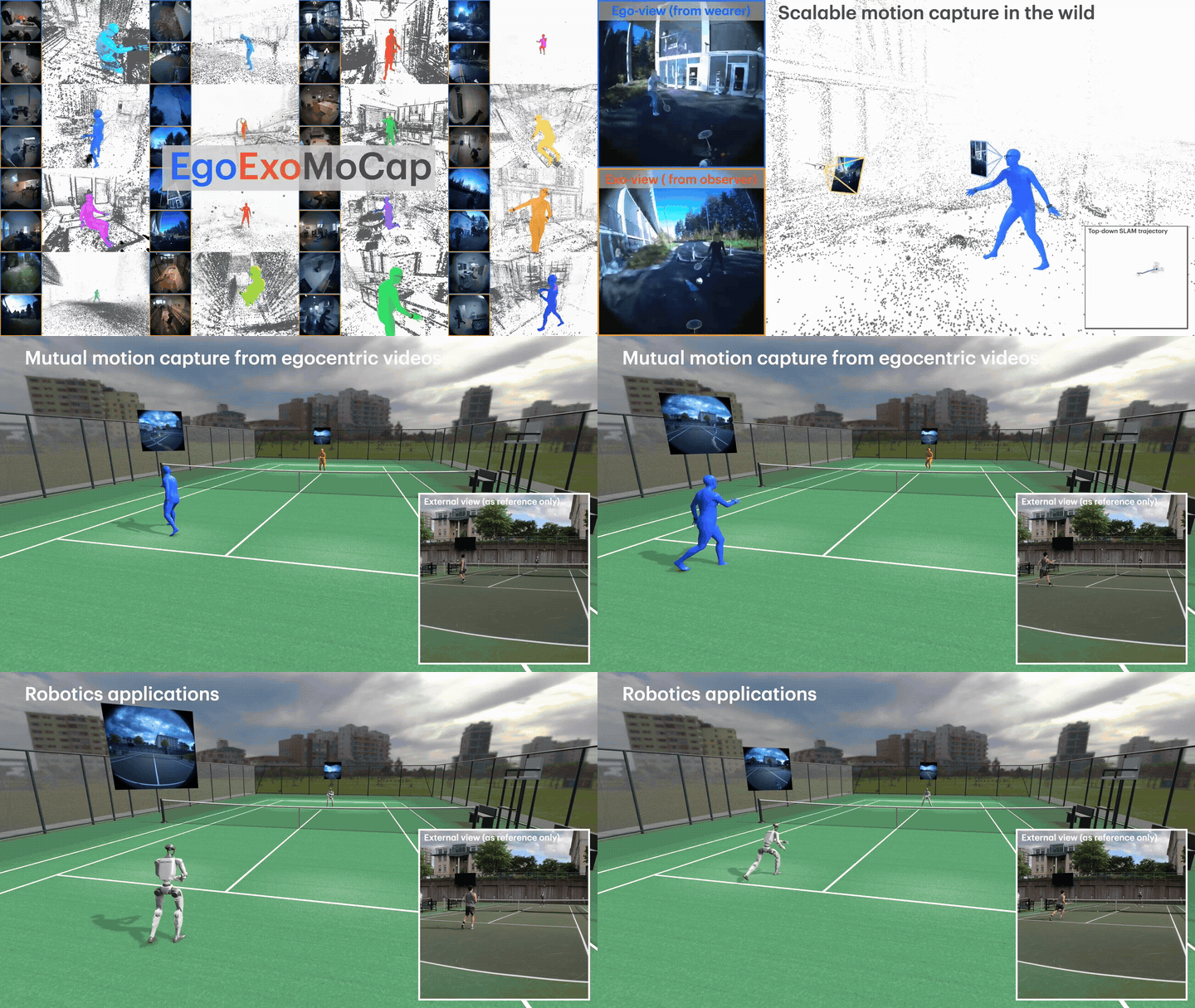
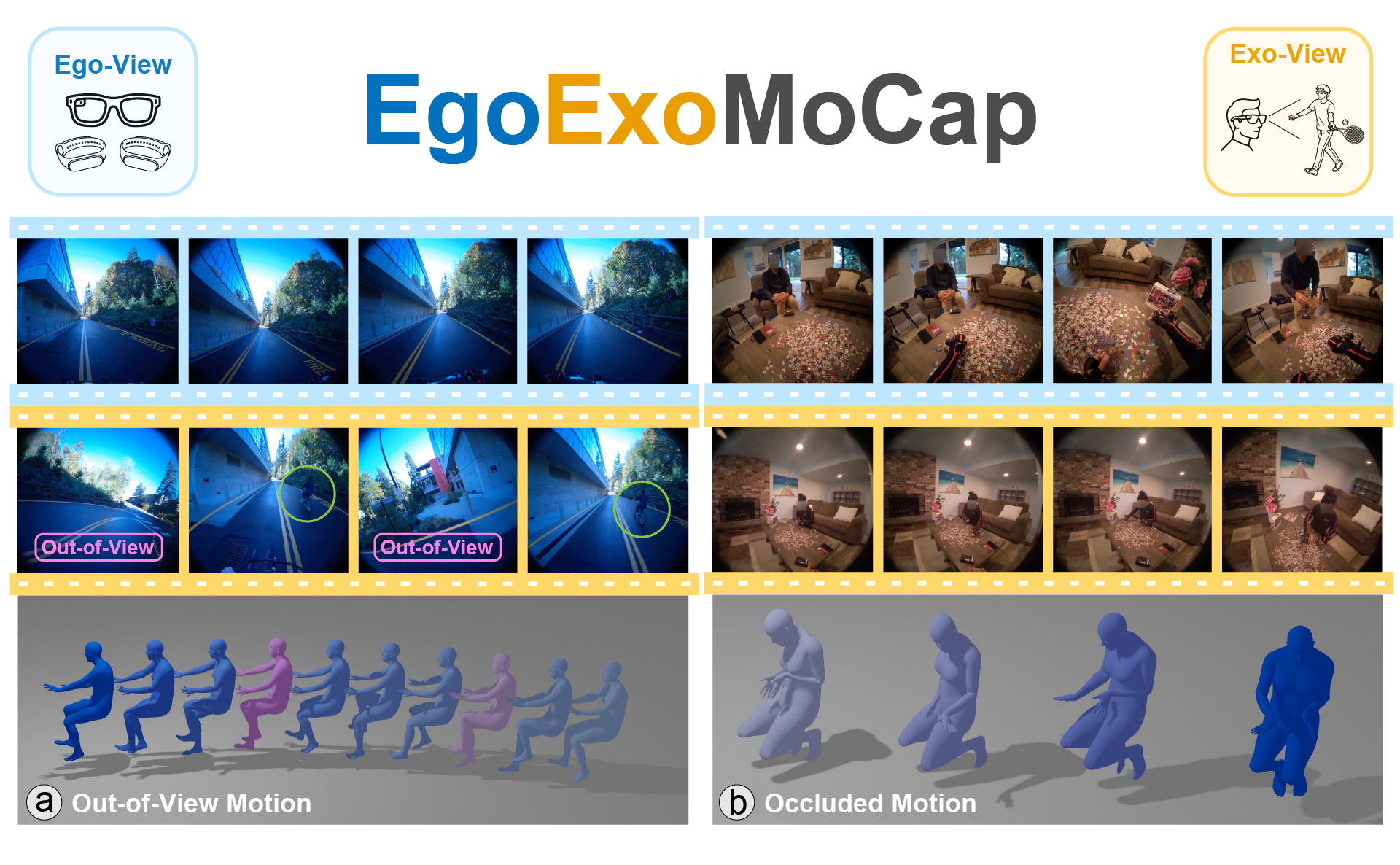
>Human motion capture from head-mounted devices (HMDs) offers a scalable way to acquire real-world human motion and interaction data, which is crucial for applications in embodied AI and VR/AR. Existing approaches focus on either egocentric body tracking, estimating the motion of the subject wearing the device, or exocentric tracking, capturing the movements of people in the wearer’s surroundings. So far, these two paradigms have largely been explored in isolation. In this paper, we propose a novel distributed framework that jointly leverages ego- and exocentric multi-modal signals for human motion estimation from HMDs. Unlike traditional motion capture systems requiring bulky multi-camera setups or obtrusive mocap suits, our approach, EgoExoMoCap, is as simple as two (or more) people, each wearing a pair of smart glasses. The method leverages head (plus potentially wrist) tracking signals for accurate estimation of global motion in the 3D world and combines context-aware image features based on DINOv3 to achieve robustness in the presence of noise and occlusions. Extensive experiments on two in-the-wild datasets show that our approach can robustly reconstruct motion even in challenging scenarios.
## Method
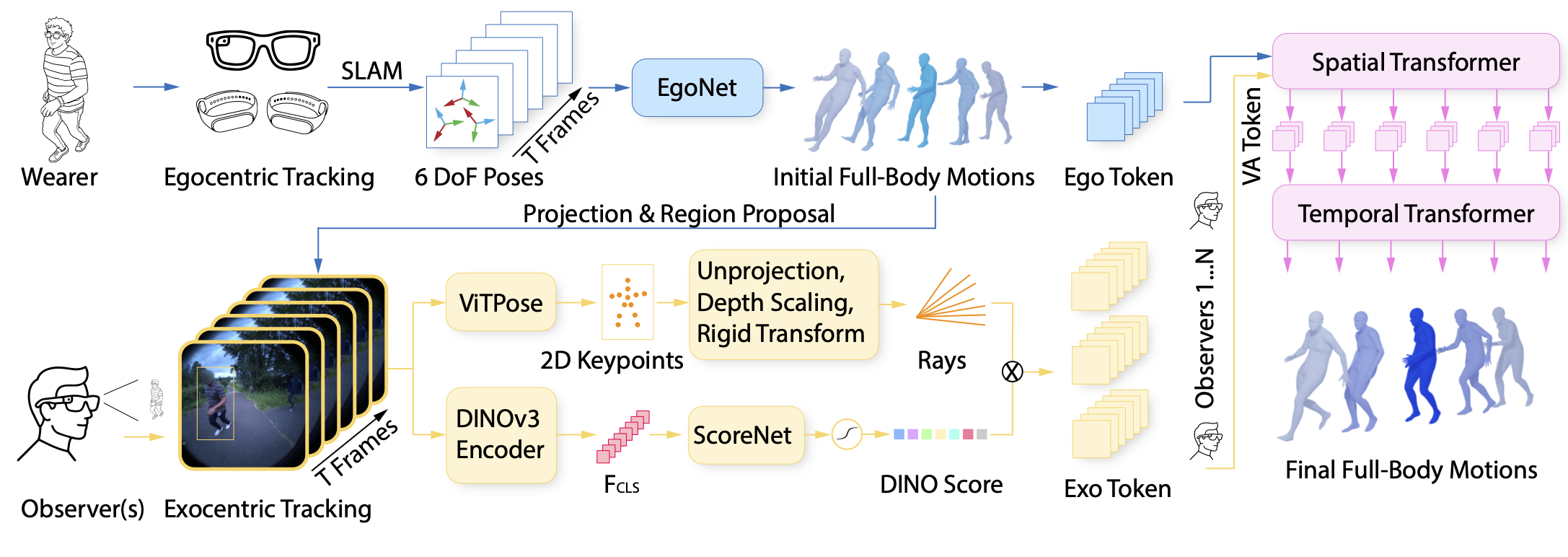
Given an egocentric and one or more exocentric streams from HMDs, we first roughly estimate
3D body poses from egocentric streams (EgoNet) to identify regions of interest in exocentric
frames. From these, ViTPose-extracted 2D keypoints are unprojected into 3D rays and softly
weighted by DINOv3-based confidence scores to form Exo Tokens. A Spatial Transformer fuses
Ego and Exo tokens into View-Aggregated (VA) Tokens, followed by a Temporal Transformer for
smoothness to output final full-body motions.
## Installation
```bash
conda create -n egoexomocap python=3.10 -y
conda activate egoexomocap
# install PyTorch matching your CUDA version first (https://pytorch.org/)
pip install -r requirements.txt
```
Some dependencies are installed from source (see `requirements.txt`):
`dinov3`, `projectaria-tools`, `nymeria`, `human_body_prior`.
**SMPL-H body models** are required but not distributed here (license). Download the
"Extended SMPL+H model" from [mano.is.tue.mpg.de](https://mano.is.tue.mpg.de/) (free
registration) and place the neutral/male/female models at:
```
third_party/body_models/smplh/{male,female,neutral}/model.npz
third_party/body_models/smplh/SMPLH_NEUTRAL.npz
```
## Repository layout
```
main_train.py training entry point
main_test.py evaluation entry point
models/ model classes + base + selector + loss
model_egoexomocap.py ego+exo fusion model (inherits the chain below)
model_egoposer_seq2seq.py, model_egoposer.py
networks/ egoexomocap (ego+exo net), fusion (observer-fusion module), egonet (coarse per-frame ego net)
data_loaders/ Nymeria dataset + selector
utils/ options, transforms, metrics, logging helpers
options/ the 8 config files for the reported results
model_zoo/ final checkpoints for the reported results (one model.pth per model)
splits/ benchmark sequence splits + eval protocols
data_prep/
shared/ DINO/ViT backbones + EgoNet-bbox extraction (dataset-agnostic)
nymeria/ Nymeria download + SMPL-H + observer video/features
egohumans/ EgoHumans -> Nymeria-schema pair extraction (4 stages)
```
## Configs
Configs are named by the **tracker input type** (the head/wrist signal driving the
model), which is the real axis of variation:
- **`nymeria_real_tracker`** — real headset device signals (real Aria head + wristband
wrists). Trained and evaluated on **Nymeria**.
- **`egohumans_syn_tracker`** — synthetic FK-derived head/wrist (EgoHumans has no wrist
trackers, so inputs come from GT SMPL by FK). Trained on Nymeria-FK, evaluated
**zero-shot on EgoHumans**.
| config (train / test) | eval dataset | inputs |
| --- | --- | --- |
| `train_nymeria_real_tracker_3pt.yaml` / `test_nymeria_real_tracker_3pt.yaml` | Nymeria | 3-point (head + wrists) |
| `train_nymeria_real_tracker_1pt.yaml` / `test_nymeria_real_tracker_1pt.yaml` | Nymeria | 1-point (head only) |
| `train_nymeria_syn_tracker_3pt.yaml` / `test_egohumans_syn_tracker_3pt.yaml` | EgoHumans (zero-shot) | 3-point |
| `train_nymeria_syn_tracker_1pt.yaml` / `test_egohumans_syn_tracker_1pt.yaml` | EgoHumans (zero-shot) | 1-point |
Body-pose ground truth comes from **NymeriaPlus** official SMPL
(`smplh_nymeriaplus.npz`). Training uses GT observer bboxes (the default `bbox_source`);
evaluation uses EgoNet-derived observer bboxes (`bbox_source: egonet` in each config's
test set) — i.e. the trained model's own EgoNet proposes the crop at test time.
## Data preparation
The raw datasets are obtained separately: **Nymeria** (VRS + MPS, plus NymeriaPlus SMPL-H
GT) by [requesting access](https://www.projectaria.com/datasets/nymeria/) and exporting its
per-sequence signed-URL manifests, and **EgoHumans** from the
[EgoHumans repo](https://github.com/rawalkhirodkar/egohumans) (OAuth download). See
[`data_prep/README.md`](data_prep/README.md) for the full guide — dataset access, the
ViTPose / DINOv3 checkpoints, and the path / env-var configuration; the condensed pipeline
below assumes those are in place.
Run all `data_prep/` scripts from the repository root. Put the repo root **and**
`data_prep/shared` on the path so the shared DINO/ViT backbones resolve:
`PYTHONPATH=.:data_prep/shared`. VRS-reading steps need the `pymeria` env
(projectaria_tools / nymeria SDK); the GPU feature steps need torch + transformers.
```bash
export PYTHONPATH=.:data_prep/shared
```
### Nymeria
```bash
# 1. download sequences (see splits/ for the benchmark split) + NymeriaPlus SMPL (GT)
python data_prep/nymeria/download_test_split_parallel.py
python data_prep/nymeria/download_train_split_parallel.py
python data_prep/nymeria/download_nymeriaplus_smpl.py
# 2. SMPL-H GT @ 30 fps from NymeriaPlus (also establishes the meta.json /
# timestamps.csv grid that every downstream step aligns to)
python data_prep/nymeria/extract_smplh_30fps_from_nymeriaplus.py # smplh_nymeriaplus.npz
python data_prep/nymeria/extract_wearer_smplh_fk.py \
--input_smplh smplh_nymeriaplus.npz --output_fk wearer_smplh_fk_nymeriaplus.npz
# 3. observer (exo) video + head/wrist + bbox, then DINO/ViT features
python data_prep/nymeria/extract_observer_video.py # observer_full.mp4, wearer_ego.npz, observer.npz, bbox.npz
python data_prep/nymeria/extract_features_from_video.py # vitpose.npz, dino_features.npz
# 4. EgoNet-derived bboxes + features recomputed on them (for eval, bbox_source: egonet).
# Uses the trained model's own EgoNet, so run this after training — or download the
# released checkpoint first (see Evaluation) and point --opt at its test config.
python data_prep/shared/extract_egonet_bboxes.py --opt options/test_nymeria_real_tracker_3pt.yaml
python data_prep/shared/rerun_vitpose_dino_egonet_bbox.py # vitpose_egonet.npz, dino_features_egonet.npz
```
### EgoHumans (zero-shot)
Produces Nymeria-schema sequences under `dataset/egohumans_extracted/`, then reuse
the shared EgoNet-bbox step above with an EgoHumans config.
```bash
python data_prep/egohumans/extract_egohumans_pairs_stage1.py
python data_prep/egohumans/extract_egohumans_pairs_stage2_bbox.py
python data_prep/egohumans/extract_egohumans_pairs_stage2_video.py
python data_prep/egohumans/extract_egohumans_pairs_stage3_features.py
```
## Training
Train with any of the four `train_*` configs (see [Configs](#configs)):
```bash
# Nymeria, real device tracker (3-point: head + wrists)
python main_train.py -opt options/train_nymeria_real_tracker_3pt.yaml
# Nymeria-FK, synthetic tracker (for zero-shot EgoHumans evaluation)
python main_train.py -opt options/train_nymeria_syn_tracker_3pt.yaml
```
Swap `_3pt` for `_1pt` for the head-only variants. Training uses GT observer bboxes
(data-prep step 3). Checkpoints and logs are written under `results//`
(`models/.pth`, `train.log`); the checkpoint / validation / print intervals and the
loss weights live in each config's `train:` block (`checkpoint_save`, `checkpoint_test`,
`checkpoint_print`, `*_weight`), and `gpu_ids` selects the device(s).
After training, generate the EgoNet-derived bboxes and features from your trained
checkpoint (data-prep step 4) before running the evaluation below.
## Evaluation
Download the final checkpoints from **[Google Drive](https://drive.google.com/drive/folders/1nID3fKYi7HudVeT5kY2mlA9imxTAeBJG?usp=sharing)**
and place the four folders under `model_zoo/`, so each `model.pth` sits at:
```
model_zoo/nymeria_real_tracker_3pt/model.pth
model_zoo/nymeria_real_tracker_1pt/model.pth
model_zoo/egohumans_syn_tracker_3pt/model.pth
model_zoo/egohumans_syn_tracker_1pt/model.pth
```
Every test config's `pretrained_model:` already points at the matching one.
Nymeria (real tracker):
```bash
python main_test.py -opt options/test_nymeria_real_tracker_3pt.yaml
```
EgoHumans (zero-shot, synthetic tracker):
```bash
python main_test.py -opt options/test_egohumans_syn_tracker_3pt.yaml
```
Fuse multiple observer views at test time with `--multi_observer` (`--protocol` restricts
to a scene subset):
```bash
python main_test.py -opt options/test_egohumans_syn_tracker_3pt.yaml \
--multi_observer --protocol splits/egohumans_multiobs_protocol.json
```
## Citation
```bibtex
@article{jiang2026egoexomocap,
title={EgoExoMoCap: Distributed Ego-Exo Human Motion Capture},
author={Jiaxi Jiang and Bharat Lal Bhatnagar and Nan Yang and Lingni Ma and Sebastian Starke and Robin Kips and Nadine Bertsch and Christian Holz and Federica Bogo},
journal={arXiv preprint arXiv:2607.15868},
year={2026}
}
```
## Acknowledgements
This code builds on [EgoPoser](https://github.com/eth-siplab/EgoPoser), which is itself
adapted from [AvatarPoser](https://github.com/eth-siplab/AvatarPoser). We train and
evaluate on the [Nymeria](https://www.projectaria.com/datasets/nymeria/) and
[EgoHumans](https://github.com/rawalkhirodkar/egohumans) datasets, and use the
[SMPL-H](https://mano.is.tue.mpg.de/) body model for the human representation. The
observer (exo) branch relies on [ViTPose](https://github.com/ViTAE-Transformer/ViTPose)
for 2D keypoint detection and [DINOv3](https://github.com/facebookresearch/dinov3) for
visibility-gating features. We thank the authors of these projects for releasing their
code, models, and data.