# A world model of protein biology: ESMC, ESMFold2, & ESM Atlas [ESMC & ESMFold2 Preprint](https://www.biorxiv.org/content/10.64898/2026.06.03.729735) ⋅ [Atlas](https://biohub.ai/esm/protein/atlas) ⋅ [Tutorials](https://github.com/Biohub/esm/tree/main/cookbook/tutorials) ⋅ [Slack](https://bit.ly/esm-slack)
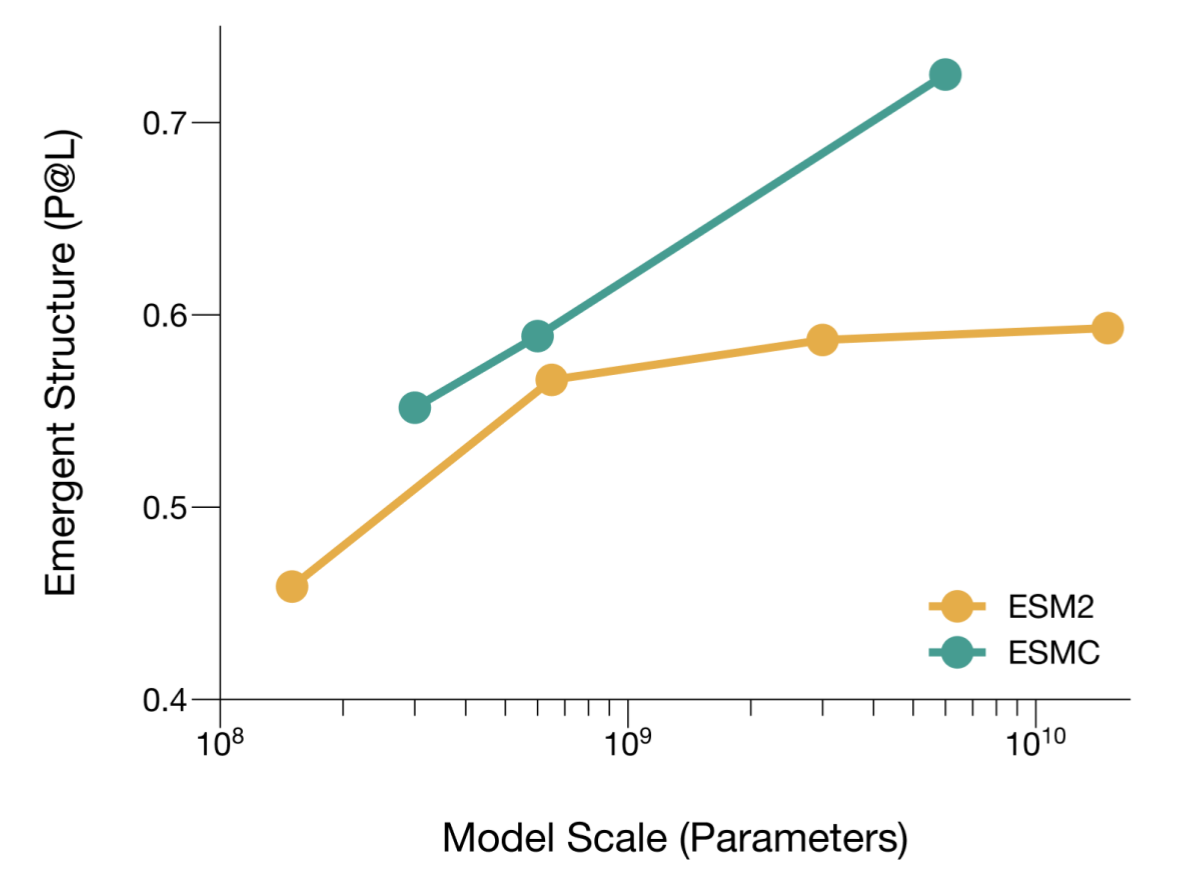
We are releasing a world model for protein biology: a scientific engine for prediction, design, and discovery. Built on the latest generation of Evolutionary Scale Modeling (ESM), this system learns from the protein sequences produced by evolution and uses that knowledge to represent, map, predict, and design proteins across scales — from atomic interactions to evolutionary relationships spanning billions of years. The system includes three artifacts: ESMC, ESMFold2, and ESM Atlas. **[ESMC](https://biohub.ai/esm/protein)** is a state-of-the-art protein language model that has learned the rules of protein biology from training on billions of protein sequences. ESMC defines a new scaling frontier relative to ESM2, achieving stronger performance in emergent long-range structural understanding as model scale increases.
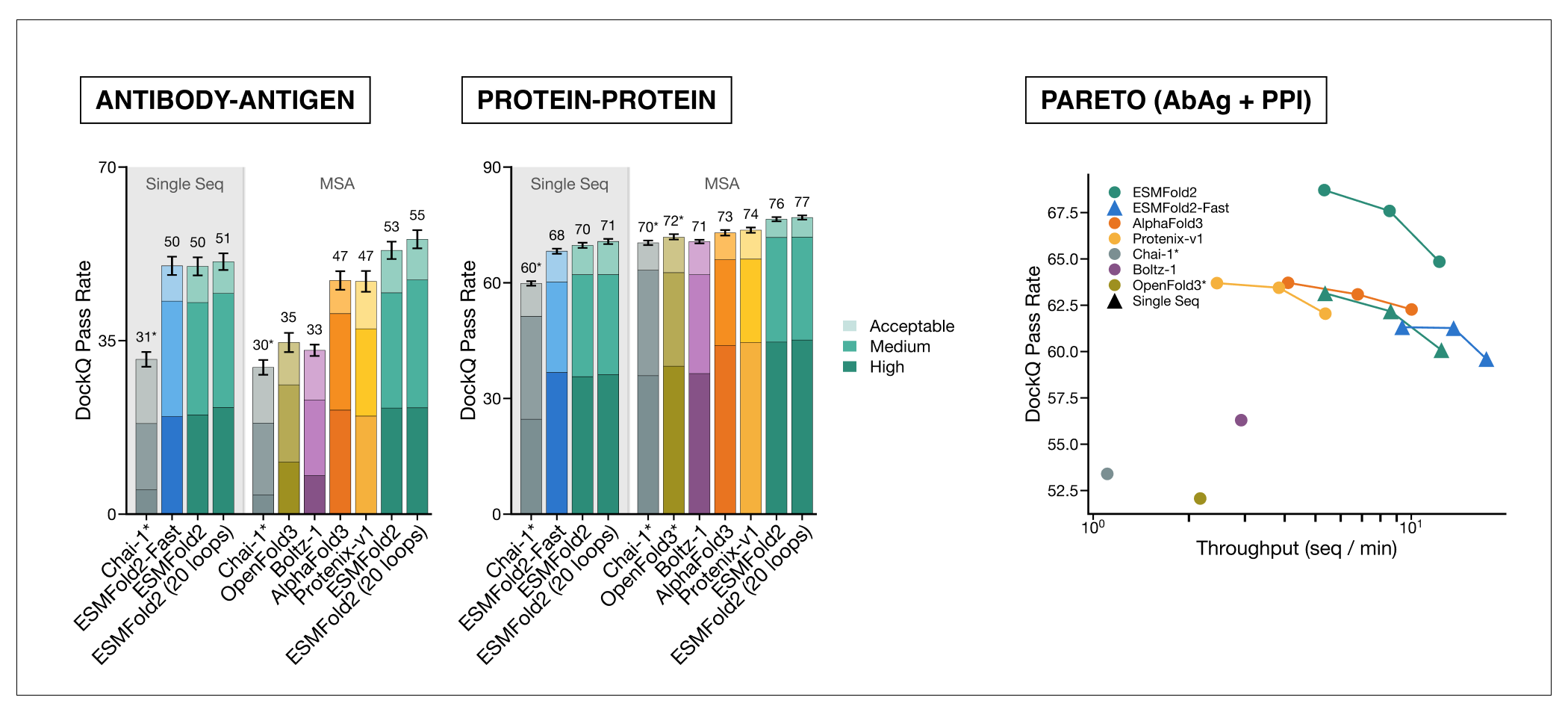
**[ESMFold2](https://huggingface.co/biohub/ESMFold2)**, built on the ESMC 6B model, is a state-of-the-art structure prediction model that has been validated for the design of protein-protein interactions. ESMFold2 surpasses other models in DockQ pass-rate on Foldbench protein-protein and antibody-antigen complexes, and can be used in single-sequence mode for an order of magnitude speedup in folding.
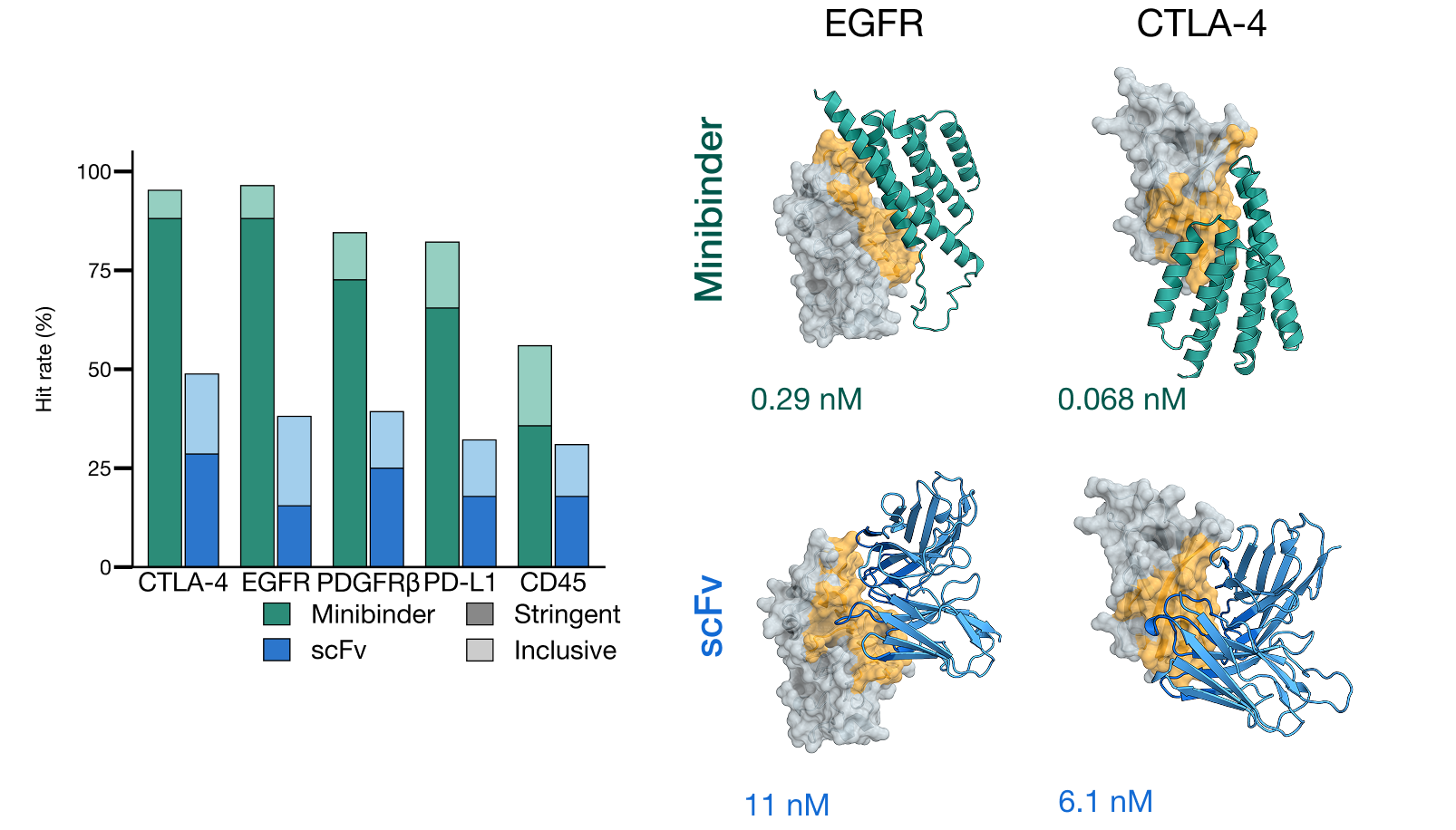
ESMFold2 is validated in the lab across five therapeutic targets. Inversion of ESMFold2 enables generation of de novo minibinders and antibody-derived scFvs with high hit rates, nanomolar affinities, target specificity, and functional activity. We've released the full protocol from target sequence to ranked binder design in this [notebook](https://github.com/Biohub/esm/blob/main/cookbook/tutorials/binder_design.ipynb). For additional details, please refer to the [preprint](https://www.biorxiv.org/content/10.64898/2026.06.03.729735).
The **[ESM Atlas](https://biohub.ai/esm/protein/atlas)** is a map of 6.8 billion proteins covering the full breadth of life’s biodiversity. ESMFold2’s folding throughput enabled the prediction of more than one billion predicted structures. The Atlas is organized according to the internal world model of ESMC. We make this world model interpretable by training sparse autoencoders (SAEs). SAEs are unsupervised neural networks trained to decompose ESMC internal representations into a sparse set of ~16,000 interpretable features that reveal the functional relationships between proteins that ESMC has learned. Each feature is summarized in natural language with an agentic pipeline that maps features onto known biology from protein databases. We release a collection of SAEs trained on different model scales, layers, and at different levels of granularity. Learn more about how to use the ESM Atlas on the [Biohub Platform](https://biohub.ai/). For information on using ESM3, see the [ESM3 README](https://github.com/Biohub/esm/blob/main/_assets/ESM3_README.md). ## Table of Contents - [ESM on PyPI](#esm-on-pypi) - [ESM Package vs. Hugging Face Transformers Usage](#esm-package-vs-hugging-face-transformers-usage) - [ESMC](#esmc) - [ESMC Sparse Autoencoders](#esmc-sparse-autoencoders) - [ESMFold2](#esmfold2) - [Parallel Job Execution](#parallel-job-execution) - [Frontier-Safety](#frontier-safety) - [Licenses](#licenses) - [Citations](#citations) ## ESM on PyPI [`esm v3.4.post1`](https://github.com/Biohub/esm/releases/tag/v3.4.1.post1) is now available on PyPI with full support for ESMC and ESMFold2. ## ESM Package vs. Hugging Face Transformers Usage ESMC and ESMFold2 are now available in Hugging Face Transformers starting with [v5.16.0](https://github.com/huggingface/transformers/releases/tag/v5.16.0) (and subsequent releases, including v5.16.1). The ESM package and the Hugging Face Transformers implementation are suited for differing purposes: | | Esm Package | Hugging Face Transformers | | :---- | :---- | :---- | | Use cases |