
Standard serving reuses only prefix-matched cache, while SCR reuses cached states for all surviving tokens, reducing re-prefilling.
## Results SCR effectively reduces cache re-prefilling, matching the standard SGLang serving with 65.0% of its empirical prefix-reuse FLOPs on BrowseComp-Plus (BCP). SCR is not limited to CLMs: serving engines commonly strip prior reasoning tokens from chat histories, causing subsequent preserved tokens to be re-prefilled, and SCR also reduces this re-prefilling cost.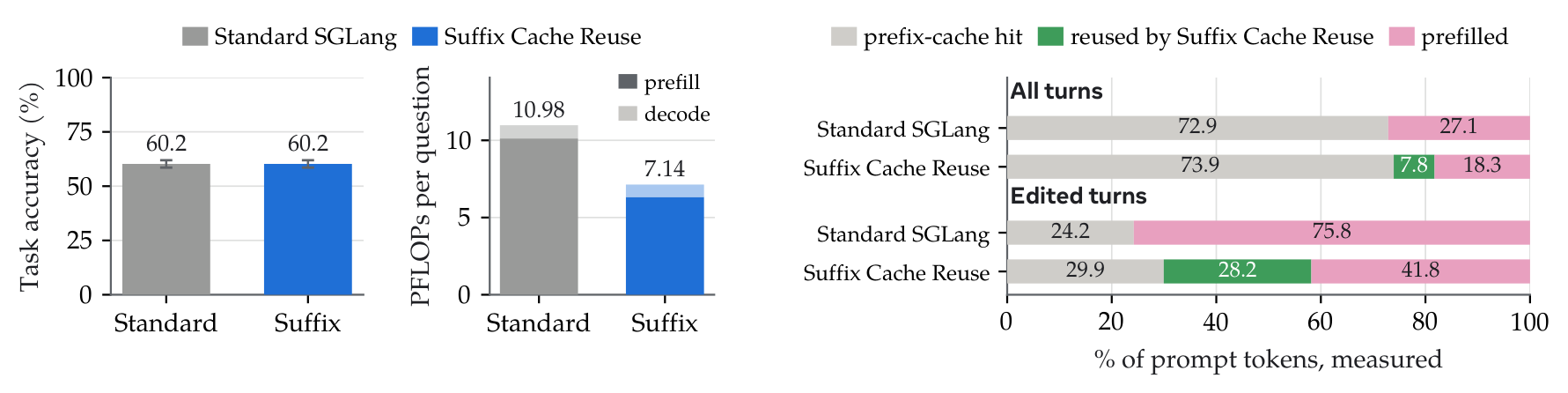
SCR and standard SGLang serving on BCP with Qwen3.6-27B. Left: task accuracy and prefix-reuse FLOPs per question. Right: server-side compute decomposition, showing the fraction of prompt tokens by compute type across all turns and turns following context edits.
## How it works **Background: the radix tree in SGLang.** SGLang keeps the KV cache of served requests in a radix tree over token sequences. A new request walks the tree to its longest matching prefix, reuses the KV entries along that path, and prefills only the remaining tokens, so reuse stops at the first mismatched token. After an in-the-middle edit, every token after the edit is re-prefilled, including text that survived unchanged. SCR keeps this tree as is and extends reuse to the surviving tokens beyond the matched prefix.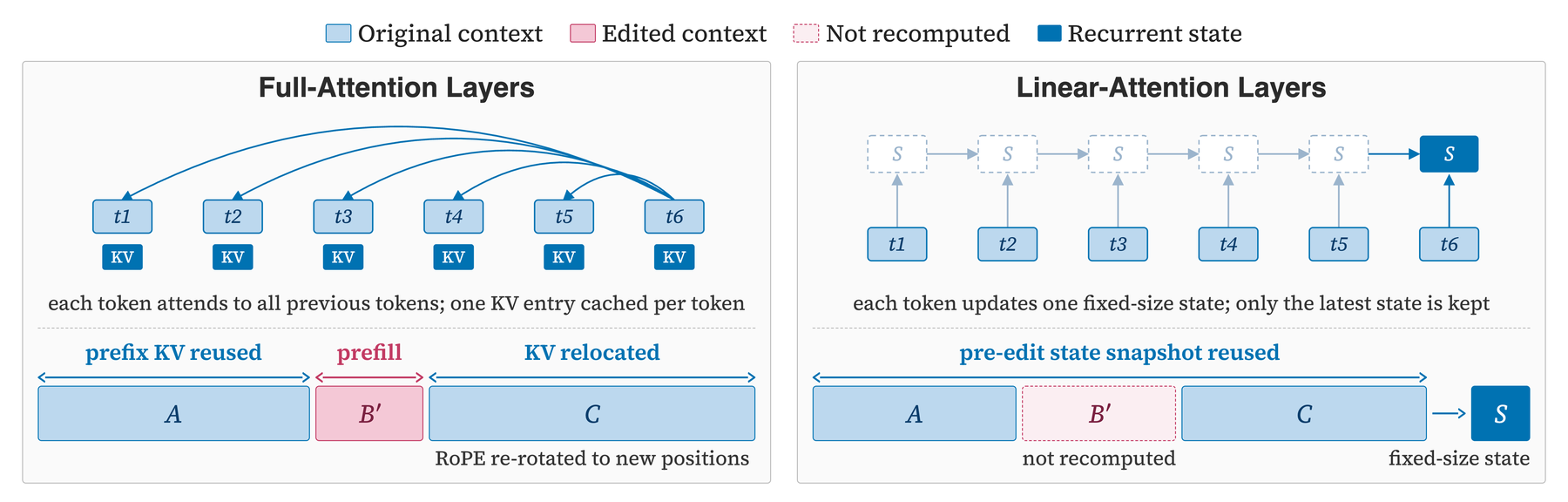
Suffix Cache Reuse for full-attention layers (left) and linear-attention layers (right).
**Full-attention layers.** Consider a context `[A B C]` in which an edit replaces B with B′. Standard serving matches only A and re-prefills B′ and C. When a new prompt arrives, SCR diffs it against the session's previous prompt to find the spans that survived the edit, and relocates up to K of them, largest first (K=6 by default). For each relocated span such as C, it reuses the cached keys and values, re-rotates the keys' rotary position encodings to their new positions, and splices them in after B′. Only B′ and newly appended tokens are prefilled. Relocated entries live in session-private cache slots, so the shared radix tree never holds a moved entry; if these slots cannot be allocated, the server falls back to standard re-prefilling. **Linear-attention layers.** In hybrid models such as Qwen3.6-27B (48 of 64 layers use linear attention), linear-attention layers maintain a fixed-size recurrent state rather than per-token caches, so there are no token-level entries to relocate. For these layers, SCR snapshots the recurrent state before the edit and continues from that snapshot, while the edit is reflected in the 16 full-attention layers that retain token-level context. B′ is still recomputed in the full-attention layers and can influence later linear-attention layers through their inputs. **Multiple surviving spans.** A single edit may leave multiple surviving spans after the edit point. SCR caps the number of relocated spans per edit at K, reusing the K longest spans and re-prefilling the rest. This bounds the amount of approximation introduced at once. On 64 BCP questions with Qwen3.6-27B, performance is robust across K, while cache-reuse gains largely saturate by K=6.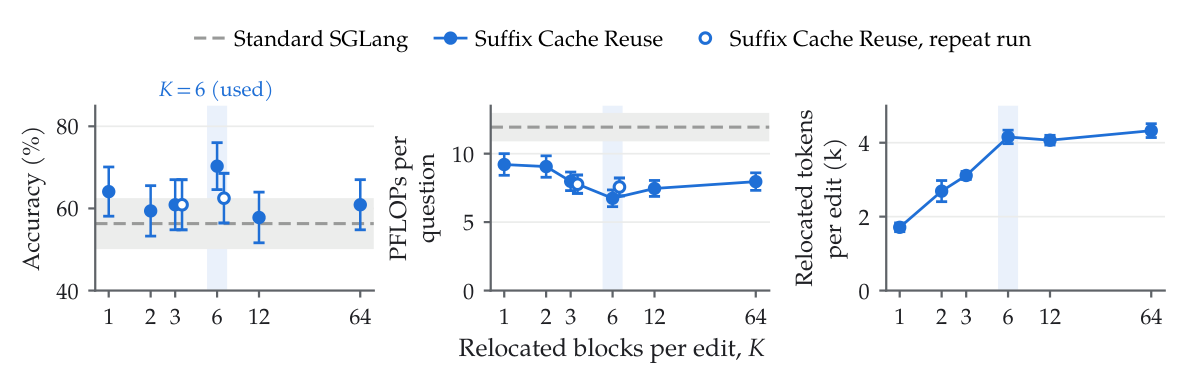
Relocated spans per edit, K, on 64 BCP questions with Qwen3.6-27B. Left: task accuracy. Middle: prefix-reuse PFLOPs per question. Right: relocated tokens per edited request. Dashed lines show standard SGLang; the shaded column marks K=6.
**Bonus: stripped reasoning tokens.** Chat templates for reasoning models, including Qwen3.6, often remove the reasoning block from earlier assistant turns once the next user message arrives. Standard serving then re-prefills all preserved text after the first removed block, even when the agent never edits its own context. SCR treats reasoning stripping as another context edit and reuses the cached states of the preserved text. On BCP, of the 7.8% of all prompt tokens reused by SCR beyond prefix-cache hits, 5.3 points come from reasoning stripping and 2.5 from other context edits.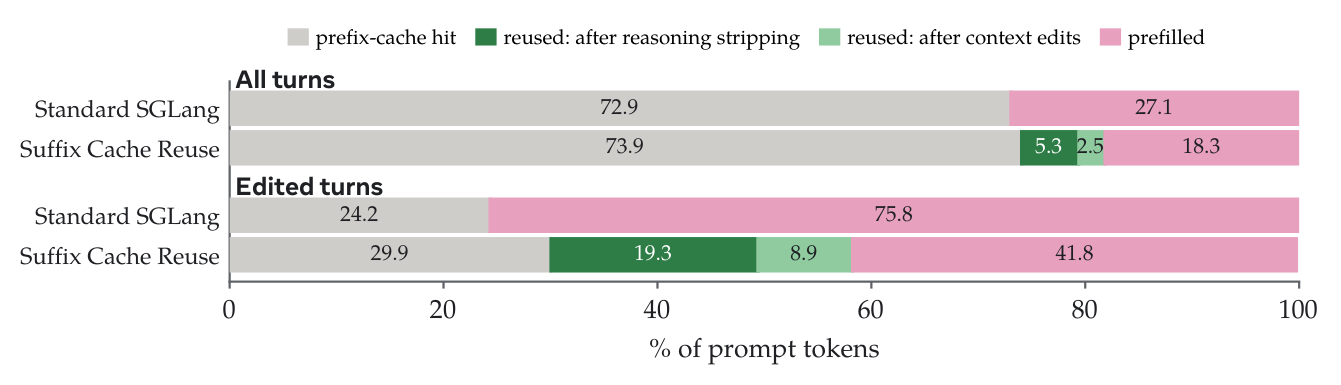
SCR reuses cached states after model-driven context edits and after reasoning tokens are stripped from prior turns. Qwen3.6-27B on 830 BCP questions, K=6.
**Future improvement space.** SCR removes most re-prefilling of unchanged suffix tokens after an edit. Much of the remaining redundant prefill instead comes from unchanged prefixes that standard prefix caching should ideally reuse. Linear-attention layers maintain recurrent states, which SGLang stores only at cached request boundaries; when a later prompt diverges inside a cached span, no recurrent state is available near the branch point, so cache matching can fall back to a much shorter prefix. This affects both standard prefix caching and the efficiency attainable with SCR. Storing recurrent states at finer-grained locations, such as message boundaries, is therefore a promising direction for improving both.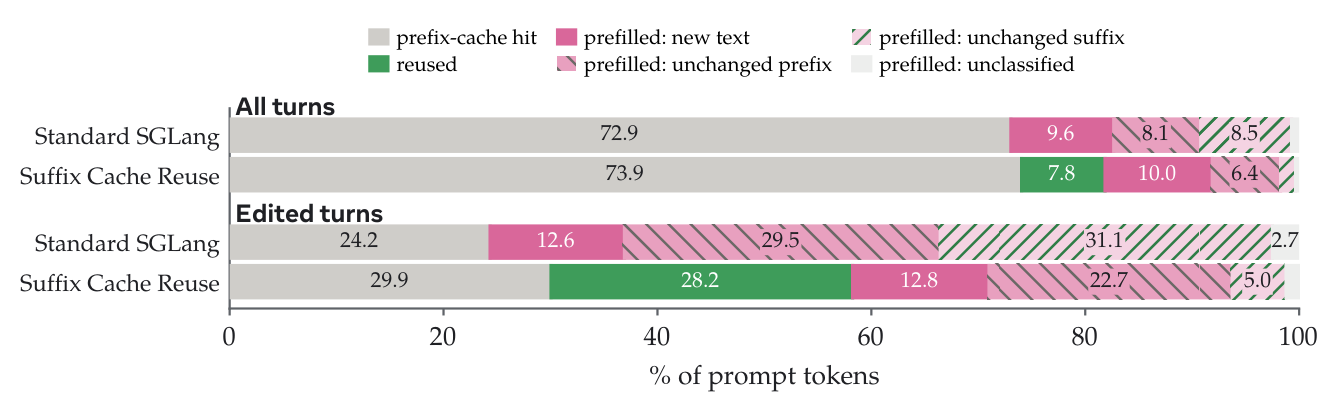
Remaining re-prefill under SCR on BCP. SCR removes most re-prefilling of unchanged suffix tokens, while unchanged-prefix prefill remains due to the current hybrid-model caching behavior in SGLang. Same runs as the figure above.
## Implementation SCR is a monkeypatch applied at start-up to an installed SGLang ([`suffix_cache_reuse/overlay.py`](suffix_cache_reuse/overlay.py)); no SGLang source file is modified. Per request: ``` previous prompt [ A ][ B ][ C1 ][ x ][ C2 ][ ... ] new prompt [ A ][ B'][ C1 ][ C2 ][ ... ][ D ] radix | | | cache | relocated spans (re-rotated K/V from the side buffer) prefilled: B', the last few tokens of each span, D ``` | step | what the code does | setting | |---|---|---| | session match | attaches the request to the tracked conversation with the same `cache_salt`, the longest common prefix (at least 1024 tokens) and high token overlap; no session header needed | `KVREUSE_MAX_SESSIONS` | | session-private slots | keeps each conversation's previous-turn K/V in a separate GPU side buffer | `KVREUSE_SIDE_SESSIONS`, `KVREUSE_SIDE_TOKENS` | | diff and relocate | diffs the new prompt against the previous one and relocates the K longest surviving spans: copies their K/V into fresh KV-cache slots, re-rotates RoPE keys, and splices them into the request's prefix | `KVREUSE_MAX_BLOCKS` (K) | | span tail | prefills the last few tokens of each span instead of relocating them | `KVREUSE_V6_MIN_EXTEND` | | linear attention | restores the recurrent state saved at the end of the previous prompt when splicing the first span | `KVREUSE_SSM_MODE=fork` | | fallback | serves the request with standard prefix caching when no plan applies or slots cannot be allocated; a request whose A came from the radix cache keeps its own recurrent state | — | ## Install ```bash pip install sglang==0.5.16 # the SGLang version SCR is built for git clone https://github.com/facebookresearch/context-language-models.git cd context-language-models/suffix_cache_reuse pip install -e . ``` ## Run ```bash bash examples/serve_qwen36.sh # Qwen3.6-27B, one GPU, SCR on KVREUSE_ENABLED=0 bash examples/serve_qwen36.sh # the same server with SCR off ``` The example is a thin wrapper around ```bash python -m suffix_cache_reuse.serve --model-path Qwen/Qwen3.6-27B [any sglang.launch_server args] ``` `suffix_cache_reuse.serve` fills in the SCR environment defaults, puts `suffix_cache_reuse/_site` (a `sitecustomize.py`) on `PYTHONPATH` so that every SGLang process loads the patch, and then runs `python -m sglang.launch_server` with your arguments. It adds `--log-requests --log-requests-level 0` if `--log-requests` is not given; level 0 logs request metadata only (ids and token counts, no text), which is what the analysis script reads. The server prints one start-up line per scheduler process: ``` [kvreuse-site] ... max_blocks=6 mb_min_gap=0 splice_retry=8 ``` and one line per relocated block: ``` [kvreuse] v6 splice OK: rid=