Presence icon # Presence **Your SSH hosts, as local tabs.** Persistent remote workspaces, native file editing, search, exec, terminals and port forwards for coding agents — with **nothing installed on the remote host**. [English](README.md) · [简体中文](README.zh-CN.md) · [Releases](docs/RELEASE.md) · [MCP server](mcp/README.md) [![npm plugin](https://img.shields.io/npm/v/@rjfan/dsh-presence?label=dsh%20plugin&color=2f6bff)](https://www.npmjs.com/package/@rjfan/dsh-presence) [![npm mcp](https://img.shields.io/npm/v/presence-mcp?label=presence-mcp&color=2f6bff)](https://www.npmjs.com/package/presence-mcp) [![license](https://img.shields.io/badge/license-MIT-2f6bff)](LICENSE) [![awesome-dsh-plugin](https://img.shields.io/badge/awesome--dsh--plugin-listing-2f6bff)](https://github.com/awesome-dsh-plugin/awesome-dsh-plugin)


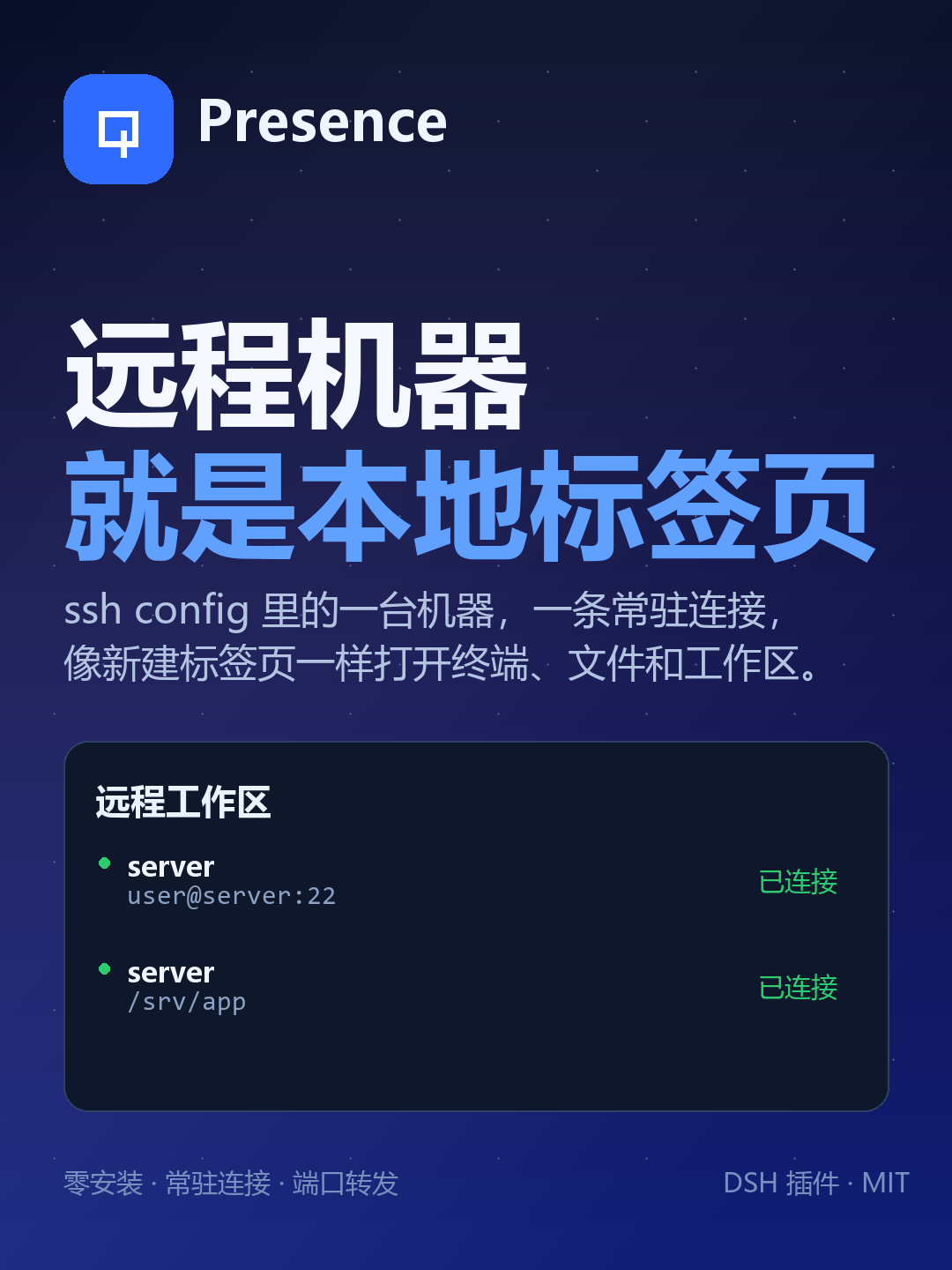
![Presence — remote machines as local tabs](docs/social/cover-light.png) --- > ⚠️ **A local session is not bound to a remote workspace.** Opening a remote workspace in > Presence does not turn a local agent session into a remote one. When your session's > working directory is outside the presence mounts root, `presence_exec` and every other > `presence_*` tool require an explicit `host` (or `PRESENCE_HOST`); without one they refuse > with the session's cwd instead of silently running on the last-activated machine. Sessions > started inside a remote workspace resolve to that machine automatically. See > [Known limits](#known-limits). ## Why Running an agent on every remote machine means installing it N times, upgrading it N times and configuring proxies per host. Running `ssh host ''` from the local agent means a new handshake per command, no native file tools and no continuity. Presence keeps the agent local and **extends its reach through one persistent SSH connection per host**. The remote side is still plain `sshd`: SFTP, exec and a PTY. | Approach | Cost | | --- | --- | | Install the agent on every host | N installs, N upgrades, per-host proxying | | `ssh host ''` per call | Handshake per command, no file tools, no sessions | | **Presence** | One connection per host, native tools, nothing installed remotely | ## Features - **Remote zero-install** — uses only `sshd` built-ins: the SFTP subsystem, exec channels and a PTY. - **One handshake** — a pool keeps one connection per host; every later call is a request on it. - **Native remote tools** — `rg`/`grep` runs on the target, commands run in the target shell; path, permission and encoding semantics are the remote ones. - **Local-like edits** — atomic writes, mode preservation, ambiguity refusal, read-before-write guard, `presence_edit` with dry-run diffs. - **Real workspaces** — a remote directory becomes a normal DSH workspace with a file tree and terminals that open **on the remote machine**. - **Sessions are scoped (0.20 hotfix)** — a local session no longer silently borrows the last-activated remote workspace: `presence_*` needs an explicit `host` or `PRESENCE_HOST`, and the system prompt tells each session whether it is local or remote. - **Conditions instead of sleeps** — `presence_wait` blocks on a file (`exists`/`minBytes`/`mtimeAfter`), a grep match count, a process (`pid`/`pattern`), a port state or a job id; a timeout is `met:false`, not an error. - **Jobs that survive a restart** — background jobs are persisted to `~/.dsh/presence/jobs.json` with pid/pgid. `logPath` is the job log to tail; `commandLogPath` is the command's own log and equals `logPath` on current kernels (a separate wrapper log only exists when a kernel records one) — use `commandLogPath ?? logPath`. After a restart their state is `unknown` until probed — never a false `running`, and an exit code may be missing. - **Batch transfer and append** — `presence_import`/`presence_export` take `paths[]` (1–50) or a glob and return per-file results; `presence_write { mode:"append" }` appends without rewriting the file. - **Recoverable deletes** — destructive shell commands dry-run first; `presence_trash` moves paths to a remote trash with restore. - **`@` completes remote files** — inside a remote workspace, file-reference completion indexes the machine itself (`rg --files`, `find` fallback), not a local mirror. - **File operations, not just reads** — `presence_mkdir` / `move` / `copy` / `chmod` plus a right-click menu in the file tree; deletes go to the recoverable trash. - **Diff and live logs** — unified diff between two remote files or a remote file and a local one; follow a log file from the panel without keeping a `tail -f` job around. - **Ports that come back** — save forwards with auto-restore on reconnect, and let the Ports panel discover newly listening ports and forward them with one click. - **Job notifications** — a toast (and desktop notification) when a background job finishes, plus an optional local `notifyCommand` for daemons and phones. - **Two shells, one kernel** — the DSH plugin and a standalone MCP server (`presence-mcp`, 20 core tools) share the same kernel. ## Screenshots
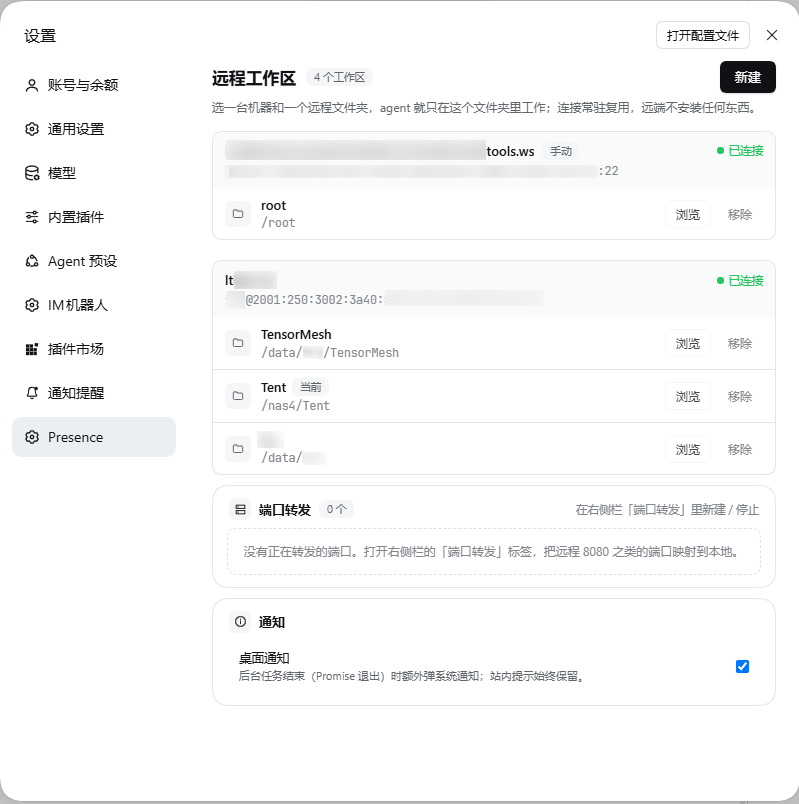
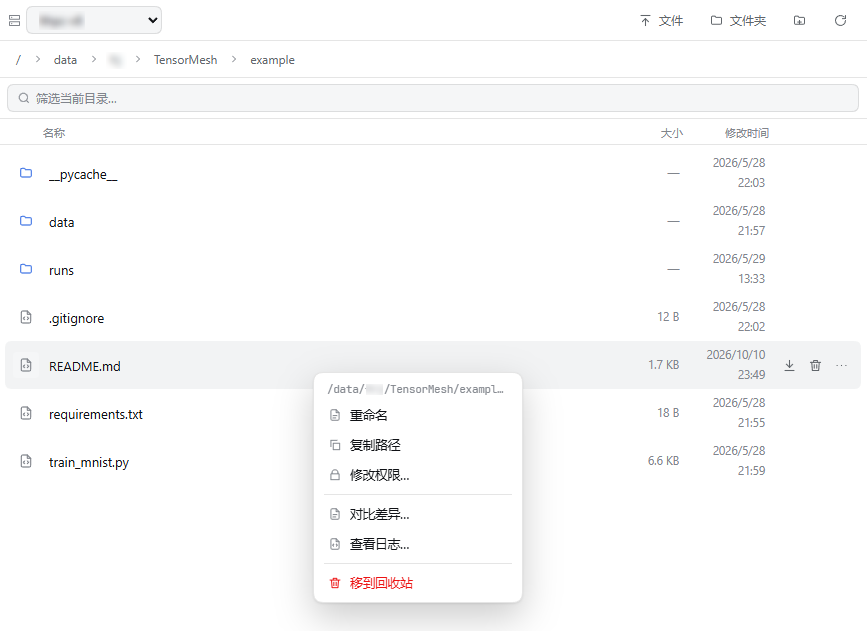
Settings — Presence hosts and workspaces Remote workspace: file tree and editor
Settings — every host and folder is a local tab Remote workspace — the file tree and editor are on the host
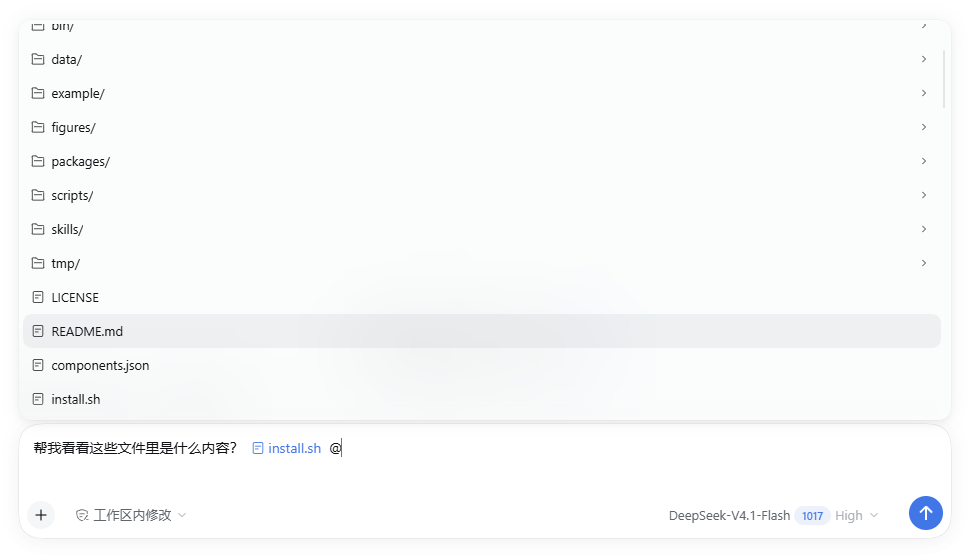
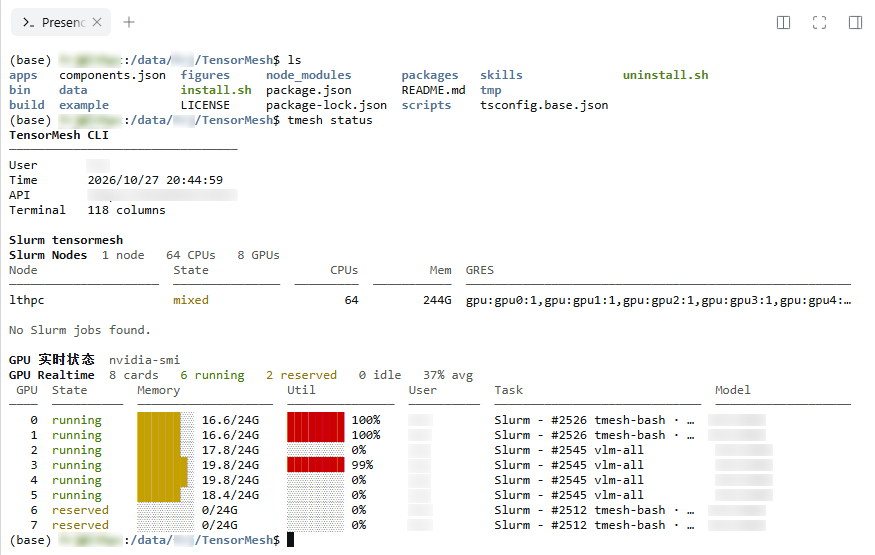
@ completes remote file paths A terminal on the remote host
@ files — completion indexes the remote machine itself Terminal — the shell runs on the host, not locally
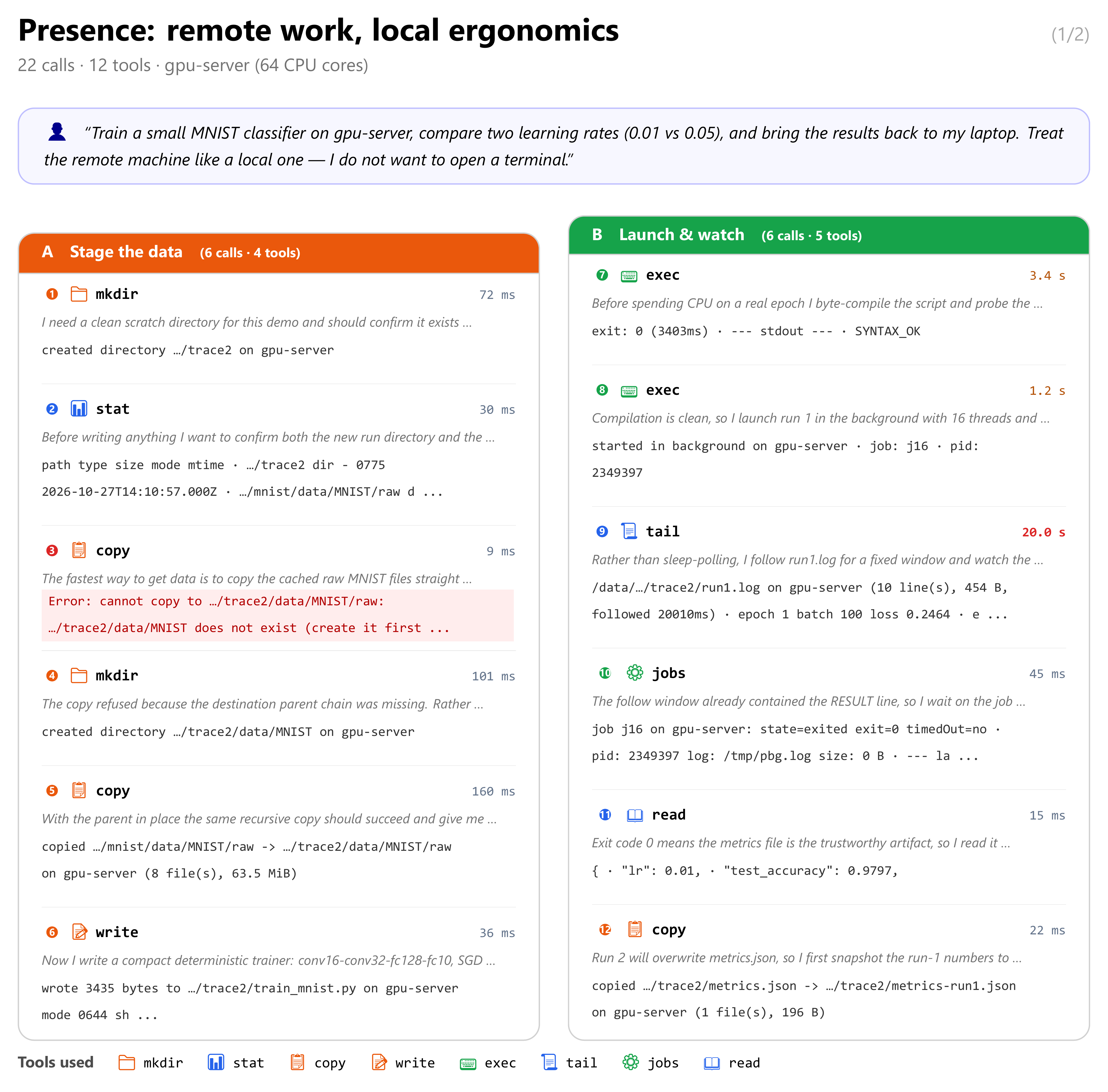
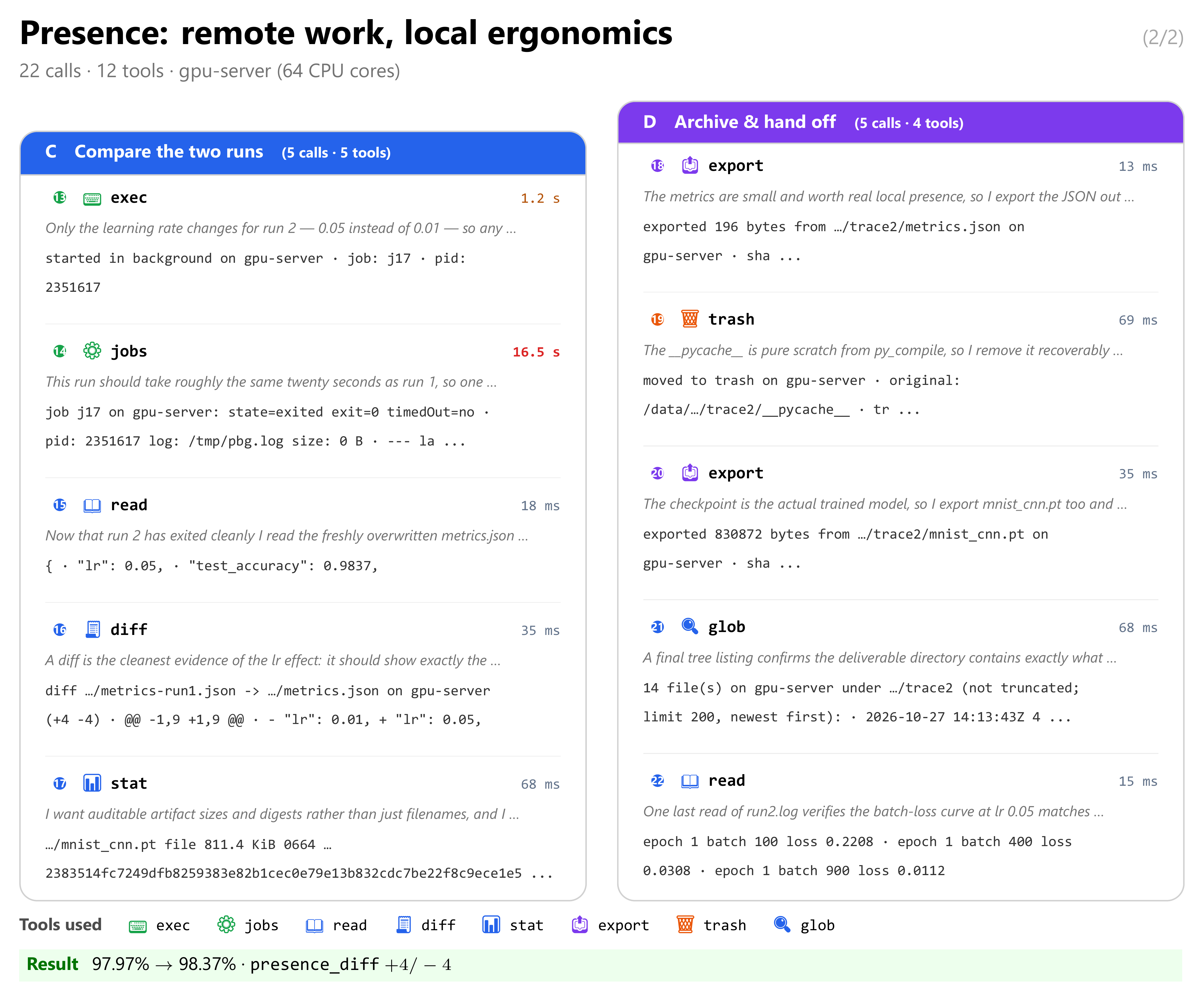
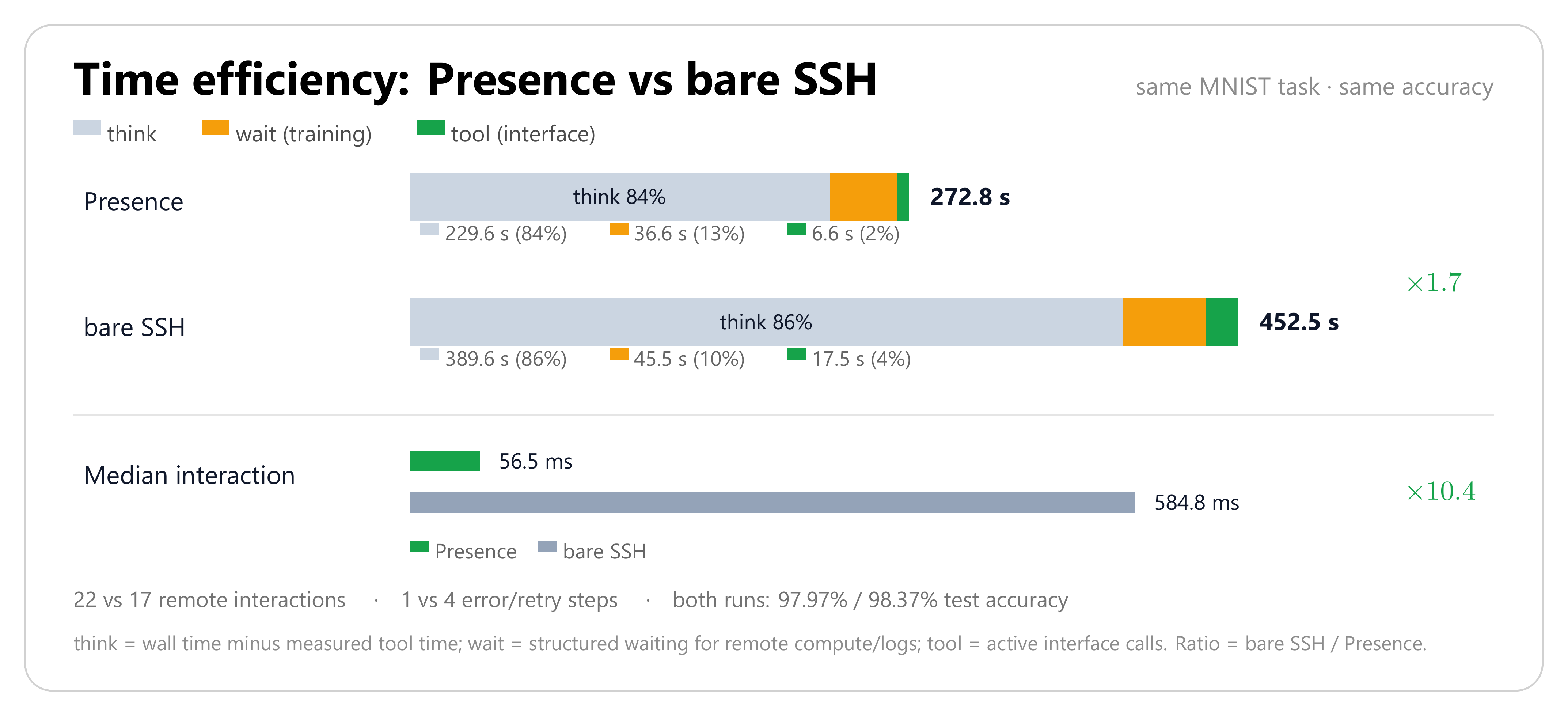
### A real trajectory These three figures are rendered from a recorded 22-call session: train an MNIST classifier twice on a remote 64-core host, compare two learning rates, and export the result. Every row is one tool call with its measured duration; red rows are real failures kept verbatim.

Trajectory 1/3: staging the data and launching the first run

Trajectory 2/3: comparing the two runs and archiving

Time composition: Presence vs bare SSH

Figure 3 stacks end-to-end time into think / wait / tool. The same task through bare ssh/scp takes 452.5 s versus 272.8 s, with a 10.4× higher median interaction latency. ## Quick start ### 1. Install the DSH plugin ```sh dsh plugin add @rjfan/dsh-presence@0.21.1 ``` From a source checkout: ```sh dsh plugin add /path/to/dsh-presence ``` ### 2. Pick a host and open a workspace Open **Settings → Presence → New**, choose a host from `~/.ssh/config` (or paste a manual `ssh` command), then pick a remote folder. It appears as a workspace; the left sidebar, file tree, terminal and agent tools all use that remote directory. A session started in that workspace is remote. A session started anywhere else (for example a normal local project) stays local: it must pass `host` explicitly — or set `PRESENCE_HOST` — before calling `presence_exec` / `presence_*`. ### 3. Work ```text You: 把远程 8000 端口转发到本地,然后打开看看 Agent: presence_forward { remotePort: 8000 } → http://127.0.0.1:8000 ``` ## MCP server The same kernel is available to agents that cannot install DSH plugins (Codex CLI, Claude Code, OpenCode, Cursor, …). ```sh npx -y presence-mcp # 20 tools over stdio ``` ```jsonc // Claude Desktop / OpenCode style { "mcpServers": { "presence": { "command": "npx", "args": ["-y", "presence-mcp"], "env": { "PRESENCE_HOST": "server", "PRESENCE_WORKSPACE": "server:/srv/app" } } } } ``` See [mcp/README.md](mcp/README.md) for Codex TOML, Claude Code, OpenCode and Cursor/Windsurf examples. ## How it works ```text ┌───────────────────────────────┐ │ DSH plugin / MCP server │ two shells, one kernel └──────────────┬────────────────┘ │ Presence kernel ├── ssh-config hosts, ports, users, keys, jumps from ~/.ssh/config ├── connection one persistent connection: SFTP / exec / PTY + pool + cancel └── host pool one connection per host, created on demand, idle-collected │ SSH (your existing keys, known_hosts, jumps, proxies) │ target: Linux / macOS, stock sshd ``` | Agent operation | Channel | Remote dependency | | --- | --- | --- | | read / write / edit / list / stat | SFTP subsystem | `sftp-server` (stock sshd) | | exec, search (`rg`/`grep`), git | exec channel | commands already on the host | | interactive terminal | shell channel + PTY | the host's login shell | Measured on a Linux host: | Operation | Latency | | --- | --- | | `ssh host ''` (new connection every time) | 520–540 ms | | Presence connect (one handshake, key auth) | 145 ms | | Presence `sftp stat` | p50 0.6 ms / p95 0.9 ms | | Presence `exec true` (new channel + shell) | p50 7.6 ms | | 8 concurrent exec channels | 15 ms total | > Keep TCP_NODELAY on: without it, request/response hits delayed ACK and p95 goes > from 0.9 ms to 48 ms. ## Tools The DSH plugin exposes 25 tools. Inside a remote-workspace session relative paths resolve against that workspace and `host` is optional; a **local** session must pass `host` explicitly (or configure `PRESENCE_HOST`) — there is no fallback to the globally last-activated workspace. Argument aliases are accepted at execute time (`path`/`file_path`/`filePath`, `old`/`oldString`, `new`/`newString`, `cwd`/`workdir`, …), so an agent's habitual spelling still works.
Show all tools | Tool | What it does | | --- | --- | | `presence_hosts` | List SSH hosts, connection state and default host (`format:"json"` supported); `workspace:true` marks this session's machine and `degraded` rows carry the last error. `default` is session-scoped: this session's mounted host or `PRESENCE_HOST`, never a global last-active workspace. | | `presence_connect` | Open/reuse a host connection and report the remote identity. | | `presence_exec` | Run a remote command; `pipefail`, `background`, `waitForPort`, structured JSON, `saveStdout`; timeout defaults to 300 s; `progress` normalizes `\r` progress bars; long output spills to a remote file whose path is returned (`tailLines`); text reports start with `host: remote cwd: `; destructive commands dry-run first — `confirm:true` runs the whole command, `confirm:"partial"` runs only the safe segments. A local session must pass `host`. | | `presence_jobs` | Background jobs: `list`, `status`, `wait` (with `timedOut`), `stop` (with `alive`/`verified`/`portReleased`), `purge`. Jobs persist to `~/.dsh/presence/jobs.json` with `pid`/`pgid`; `logPath` is the job log to tail (the command's stdout/stderr on current kernels) and `commandLogPath` the command's own log — equal to `logPath` on current kernels, so use `commandLogPath ?? logPath`. After a restart, state is `unknown` until a liveness probe succeeds and the exit code may be missing. `/presence/api/state` job rows also carry `pid`, `pgid`, `commandLogPath` and `persisted`. `wait` accepts `label`/`description`/`task` (a short description of the actual task; the wait dock shows it), `progressPattern` (two capture groups, done and total, e.g. "Epoch\\s+(\\d+)/(\\d+)") and `progressUnit`; the running wait appears in the floating **wait dock** with elapsed, progress, ETA and the last log line. | | `presence_wait` | Block until exactly one remote condition is true: `file {path, exists?, minBytes?, mtimeAfter?}`, `grep {path, pattern, count?}`, `process {pid\|pattern, alive?}`, `port {port, state:"open"\|"closed"}` or `job {jobId}` (a job condition needs no `host` — the registry knows where it ran). Returns `{ met, timedOut, elapsedMs, observed, condition, polls }`; a timeout is `met:false` and **never an error**. `timeoutMs` default 120 s (cap 1 h), `pollMs`/`intervalMs` default 1000 ms. Optional `label`/`description`/`task` (task summary), `progressTotal` and `progressUnit` feed the same wait dock (file bytes, grep matches, process/port state). | | `presence_read` | Read a remote file with line numbers, `offset`/`limit`, or `raw:true` for verbatim content. | | `presence_read_many` | Read 1–50 remote files in one call, with per-file byte/line caps. | | `presence_write` | Atomic write; preserves mode; returns real mode, size and full sha256; `ifMatchSha256` optimistic lock; `mode:"append"` appends at EOF and reports appended bytes + total size (`ifMatchSha256` is overwrite-only and append rejects it); `mode` also accepts an octal string such as `"755"` to set permissions on an overwrite. | | `presence_edit` | Exact-text replacement or line-range replacement, with compact diff, `dryRun`, JSON fields. | | `presence_stat` | Batch `stat` for 1–100 paths: type, size, mode, mtime, optional sha256; missing paths return `exists:false`. | | `presence_mkdir` | Create a remote directory (recursive by default); idempotent when it already exists. | | `presence_move` | Rename or move a path inside the same machine; refuses to replace an existing file unless `overwrite:true`. | | `presence_copy` | Copy a remote file (SFTP stream, or `cp -p` for large files) or a directory with `recursive:true`. | | `presence_chmod` | Change permissions with an octal mode (`755`, `0644`), optionally recursive. | | `presence_diff` | Unified diff of two remote files, or a remote file against a local one; context lines and JSON stats. | | `presence_tail` | Read the last N lines of a remote file, or follow it for a bounded time (`follow:true`, `timeoutMs`). | | `presence_search` | Remote `rg`/`grep` search, count-only mode, JSON matches. | | `presence_glob` | Find remote files by glob with size/mtime. | | `presence_import` | Local → remote binary-safe upload with mode and sha256; batch `paths[]` (1–50) and/or a local `glob` into a `to` directory, with one result per file. | | `presence_export` | Remote → local real file (content-addressed), for preview or native apps; batch `paths[]` or a remote `glob`; the local name defaults to the basename and a collision becomes `name-.ext`; one result per file. A batch skips files recorded in the export manifest (`~/.dsh/presence/exports/manifest.json`) when the remote path, size and mtime still match (`skipExisting:false` re-exports); live progress goes to `~/.dsh/presence/exports/latest.json`, reads use parallel SFTP requests, and each read times out after 30 s instead of hanging the call. | | `presence_forward` | Forward a remote port to `127.0.0.1`; open/list/close with JSON. | | `presence_port_probe` | Check listeners and TCP reachability for up to 20 ports; `expect:open|closed`, polling. | | `presence_http_probe` | Wait for port → forward → local HTTP assertions → close → verify the local port was released. | | `presence_terminal` | Persistent PTY: `open` with `cwd`/`command`, `write` (`ackOnly`), `read`, `close`; tmux-backed sessions survive reconnects. | | `presence_trash` | Recoverable delete: move to remote trash, list/restore; batch `paths[]`; returns `sourceRemoved` and `restoreHint`. |
### Batch transfer and append ```text presence_export { paths: ["/data/a.pt", "/data/b.pt"] } # files:[{remotePath, localPath, bytes, sha256}] presence_export { glob: "/data/ckpt-*.pt" } # every match; name-.ext on collision presence_import { glob: "dist/*.whl", to: "/data/wheels" } # local → remote, one result per file presence_write { path: "/data/train.log", mode: "append", content: "epoch 6 done\n" } ``` Single-path calls keep the existing `path`/`to` behaviour, so none of this is required for one file. ## Which tool for which path | Where the path lives | Use | Why | | --- | --- | --- | | under the workspace mount (`~/.dsh/presence/mounts/...`) | built-in `read` / `write` / `edit` / `grep` / `glob` | they reach the remote machine; `grep`/`glob` are routed to it automatically | | remote absolute path outside the workspace (`/data`, `/scratch`, GPFS) | `presence_read` / `write` / `edit` / `stat` / `search` / `glob` (list a directory with `presence_exec`) | the built-in tools only see the mount, not the rest of the machine | | local file, for preview or Office | `presence_export` first, then `present` / native open | the mount path is virtual; only a real local file can be opened natively | In a **local** session (cwd outside the mounts root) the built-in tools only touch local files; every `presence_*` call needs `host` explicitly, or configure `PRESENCE_HOST` once. ## Long-running tasks `presence_exec` waits for the command, so it is the wrong tool for a training run, a build or a server. The recipe: ```text 1. presence_exec { command: "python train.py --lr 3e-4", background: true, label: "train-3e-4" } → { id: "j7", pid: 4242, pgid: 4242, logPath: ".../job.log", commandLogPath: ".../job.out" } 2. presence_jobs { action: "wait", jobId: "j7" } # or presence_wait { job: { jobId: "j7" } } 3. presence_tail { path: , follow: true } # watch progress presence_wait { grep: { path: , pattern: "epoch 6", count: 1 } } # readiness ``` - `presence_jobs { action: "status" }` gives a snapshot; `stop` terminates the process group and verifies the port was released. Jobs persist to `~/.dsh/presence/jobs.json`: after a DSH restart a job shows `unknown` until a liveness probe succeeds (never a false `running`) and its exit code may be missing. - `logPath` is the job log to tail — the command's stdout/stderr on current kernels. `commandLogPath` is the command's own log; it equals `logPath` unless the kernel records a separate wrapper log, so tail `commandLogPath ?? logPath`. - `presence_wait` replaces hand-written sleep+tail loops: wait for a port (`presence_wait { port: { port: 8000, state: "open" } }`), a checkpoint (`presence_wait { file: { path: "/data/ckpt.pt", minBytes: 1000000 } }`), a log line or a process. A timeout returns `met:false` — a normal answer, not an error. - While a wait runs, the **wait dock** floats at the bottom right of the chat: elapsed time, `done/total unit`, an ETA computed from the sample rate, the last log line, and a click-through detail view (job id, log path, samples). It polls `/presence/api/waits`; an older host simply hides it. Pass `progressPattern`/`progressUnit` to `presence_jobs wait` or `progressTotal`/`progressUnit` to `presence_wait` when you want a bar and an ETA. - Interactive work: `presence_terminal { action: "open", session: "train" }` — the tmux-backed session survives a reconnect. - **Do not** start `nohup`, `tmux new-session` or a trailing `&` inside a foreground `presence_exec` for long jobs: when the login-node session ends, the cluster may clean up what it left behind. `background: true` already detaches through `setsid`; on scheduler-managed clusters start the job with the cluster's own launcher (`rlaunch -d …`, `salloc`/`sbatch`) so the scheduler owns it. ## Safety and recovery - **Destructive commands never run unconfirmed.** `rm -r/-f`, `git clean -fdx`, `find -delete`, `shred`, `truncate` and `dd of=` are first replayed with no-op shims to expand their real targets; unset variables and protected paths (workspace root, home, `/`, `.git`) are refused. A second call with `confirm:true` is required to execute. A rejected mixed command also lists the segments that are safe on their own (`Safe segments you can run separately:`); `confirm:"partial"` runs only those. Removing one file with a literal `rm -f ` inside the workspace is exempt — it cannot remove a tree. - **Prefer `presence_trash`** for anything under a workspace: it moves the path to `~/.dsh/presence-trash//` and returns a restore hint. - **Writes are atomic** and keep the original file mode; `presence_edit` refuses ambiguous anchors instead of guessing. - **Read before write**: built-in `read`/`write`/`edit` share a read-before-write guard. Path keys are canonicalised across `presence://`, mount paths, workspace-relative and absolute remote paths, and successful `presence_read` / `presence_write` / `presence_edit` calls count as a read (a write counts too). `presence_exec` running `cat file` does **not** count — the guard cannot see shell output; read with `presence_read` or the built-in `read` before editing. ## Configuration The plugin reads these environment variables on the host process: | Variable | Default | Meaning | | --- | --- | --- | | `PRESENCE_HOST` | — | Default SSH host for **local** sessions (explicit opt-in; also used by the MCP server). Remote-workspace sessions ignore it in favour of their mounted host. | | `PRESENCE_WORKSPACE` | — | `host:/abs/path` to bind a remote workspace. | | `PRESENCE_JOBS_FILE` | `~/.dsh/presence/jobs.json` | Override the persisted background-job registry path. | | `PRESENCE_PASSWORD_` | — | Password for a host; `` is uppercase with non-alphanumerics replaced by `_`. | | `PRESENCE_MAX_CHANNELS` | 8 | Concurrent channels per connection. | | `PRESENCE_CONNECT_TIMEOUT_MS` | 25000 | Connection attempt timeout. | | `PRESENCE_IDLE_TIMEOUT_MS` | 900000 | Idle connection timeout (connections with terminals are kept). | | `PRESENCE_READ_ONLY` | false | Refuse writes/edits; reads, search and exec still work. | Full configuration and the path/permission matrix are in [docs/VERIFICATION.md](docs/VERIFICATION.md) and [docs/HANDOFF.md](docs/HANDOFF.md). ## Development ```sh npm install npm install --prefix .dev --ignore-scripts rollup @rollup/plugin-node-resolve \ @rollup/plugin-commonjs @rollup/plugin-terser codemirror @codemirror/language-data \ @codemirror/theme-one-dark node scripts/build-client.mjs powershell -NoProfile -ExecutionPolicy Bypass -File scripts/package.ps1 -Version 0.21.1 # → dist/presence-plugin-0.21.1.zip ``` After a DSH update, prove the plugin still activates against the shipped runtime (Electron-as-Node; this is what caught the 0.2.1-rc.5 tool-schema tightening): ```powershell $env:ELECTRON_RUN_AS_NODE = '1' & 'C:\...\DeepSeek Harness.exe' scripts\host-compat-check.mjs # ACTIVATED OK with 25 tools ``` Tests need one SSH-reachable host unless noted: ```sh node scripts/regression.mjs server # transport, symlinks, timeouts, binary node scripts/job-probe.mjs server # jobs + port forwarding node scripts/feature-probe.mjs server # wait, sessions, pgid, readiness, search node scripts/import-probe.mjs server # local→remote binary, mode, sha256 node scripts/safety-probe.mjs server # destructive guard + observation store node scripts/p0-guard-probe.mjs # guard split/partial/single-rm (no host needed) node scripts/p1-docs-probe.mjs # README/zh/RELEASE anchors (no host needed) ``` ## Known limits - **Local sessions.** A local session calling `presence_*` without `host` now raises `this session is local (cwd=...); pass an explicit host ...`. That is the intended 0.20 behavior, not a bug: the old silent fallback to the last-activated remote workspace could run commands on another session's machine. Pass `host` per call, or set `PRESENCE_HOST` once as the explicit opt-in default; a local session still never inherits another session's workspace, and `presence_hosts`' `default` is session-scoped for the same reason. - The read-before-write guard cannot observe shell output: `presence_exec { command: "cat file" }` (or `sed -n`) does **not** mark the file as read; `presence_read` and the built-in `read` do, and `presence_write`/`presence_edit` count as reads. A guarded built-in `edit` after only `exec cat` can still fail. - The mount path (`~/.dsh/presence/mounts/...`) is virtual: it works through `ctx.fs` / agent tools, but native apps (Explorer, Office, host Python) cannot see it — use `presence_export` first. - `presence_exec` defaults to a 300 s timeout; longer work must use `background: true` (foreground output over the cap is spilled to a remote file, and `tailLines` keeps the end of a long report). Background jobs persist to `~/.dsh/presence/jobs.json`; after a DSH restart their state is `unknown` until a liveness probe succeeds — never assume a persisted job is still running, and its exit code may be missing. Tail `commandLogPath ?? logPath` (`logPath` holds the command output on current kernels). - `presence_export` moves at most 64 MiB per file and processes a batch sequentially. Progress is written to `~/.dsh/presence/exports/latest.json` while it runs, a stalled read fails after 30 s instead of hanging the call, and a re-run skips files recorded in the export manifest with the same remote path, size and mtime (`~/.dsh/presence/exports/manifest.json`). For multi-GB transfers over a slow WAN use `scp`/`rsync`/`tar` from a shell instead of a single export call. - A login node may clean up processes left behind when a session closes: do not rely on `nohup` / `tmux new-session` / `&` started inside a foreground `presence_exec` for long jobs. Use `background: true` (detached with `setsid`) or `presence_terminal` (tmux), and let the cluster scheduler own the job where required (`rlaunch -d`, `salloc`/`sbatch`). - Argument aliases are accepted (`path`/`file_path`/`filePath`, `old`/`oldString`, `new`/`newString`, `replaceAll`/`replace_all`, `dryRun`/`dry_run`, `cwd`/`workdir`); the canonical name is what the tool schema documents. - SSH `MaxSessions` (default 10) bounds concurrent channels; the pool uses at most 8. - PTY terminals follow the connection; cross-reconnect shells need `tmux` on the target (used automatically by `presence_terminal { session }`). - ProxyJump/ProxyCommand are parsed and warned about, but not used for dialing yet. - `@` file completion indexes the remote tree lazily (about 10 s per workspace); on a very large tree the first query can take a few seconds. - Port auto-restore runs when the connection is re-established; a forward whose saved local port is already taken falls back to another free port. ## Contributing Issues and PRs are welcome. For a feature, open an issue describing the remote workflow you want; for a fix, keep the diff focused and add a probe under `scripts/` when behavior changes. ## License [MIT](LICENSE) ## Star History [![Star History Chart](assets/star-history.png)](https://star-history.com/#fanrj3/dsh-presence&Date)