
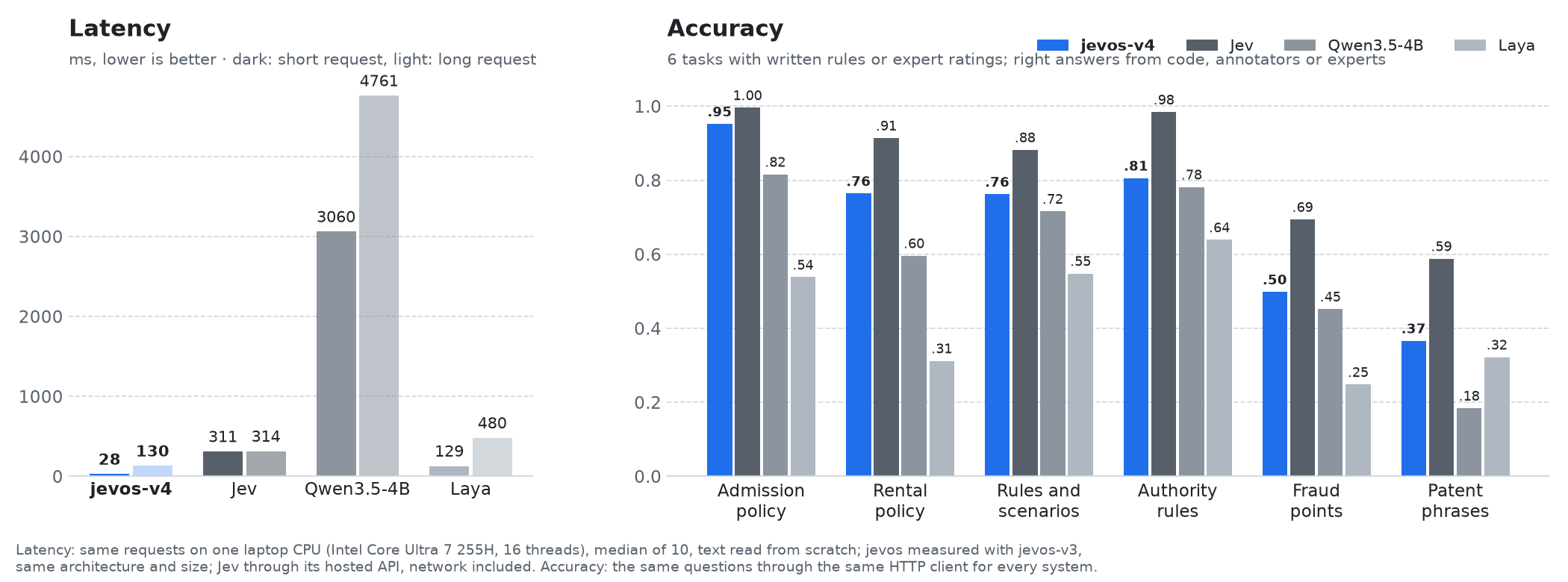
 Same questions for every system, through the same HTTP client. Latency is the median of 10 requests on an
Intel Core Ultra 7 255H laptop, 16 threads, each text read from scratch. No task text was used to train
jevos; five of the six sets helped choose the released checkpoint.
| | **jevos-v4** | Jev | Laya |
|---|:---:|:---:|:---:|
| Yes/no questions | ✓ | ✓ | ✓ |
| Multiple choice | ✓ | ✓ | ✓ |
| Scores | ✓ (early) | ✓ | ✓ |
| Runs on | your machine | cloud | your machine |
| Cost | free | per token | free |
| Context | 8,192 tokens | not stated | 512 tokens |
## API
`POST /v1/systemone`, in TypeSafe Jev's wire format: code written for Jev's SDK works unchanged for yes/no
questions. One request can ask several questions about the same text, which is read once:
```json
{
"model": "jev-latest",
"state": {"item": "wireless mouse", "customer_message": "The box arrived empty. This is the second time!"},
"questions": {
"refund": {"type": "noul", "instructions": "Our policy refunds items reported missing within 30 days of delivery. Should this customer get a refund?"},
"team": {"type": "choice", "instructions": "Which team should handle this message?",
"criteria": {"billing": "payments, refunds", "shipping": "deliveries, missing parcels", "tech": "a product that does not work"}},
"anger": {"type": "score", "instructions": "How angry is the customer?", "criteria": ["calm", "annoyed", "angry", "furious"]}
}
}
```
A `noul` returns P(yes); a `choice` the most probable option; a `score` the expected level. Choices and scores
also return a probability per answer and a `confidence`: when it is low, send the case to a person. Put the
rule in the question, and do sums in code.
`GET /health` reports readiness and the SHA-256 of the model files; `./jev decide request.json` answers a
request file without a server.
## Options
| Option | Default | |
|---|---|---|
| `--threads` | all logical CPUs | fewer if other heavy apps are running |
| `--host`, `--port` | `127.0.0.1`, `8017` | where the server listens |
| `--model-dir` | `model` beside the binary | the model folder |
With `JEV_API_KEY` set, every call but `/health` needs `Authorization: Bearer
Same questions for every system, through the same HTTP client. Latency is the median of 10 requests on an
Intel Core Ultra 7 255H laptop, 16 threads, each text read from scratch. No task text was used to train
jevos; five of the six sets helped choose the released checkpoint.
| | **jevos-v4** | Jev | Laya |
|---|:---:|:---:|:---:|
| Yes/no questions | ✓ | ✓ | ✓ |
| Multiple choice | ✓ | ✓ | ✓ |
| Scores | ✓ (early) | ✓ | ✓ |
| Runs on | your machine | cloud | your machine |
| Cost | free | per token | free |
| Context | 8,192 tokens | not stated | 512 tokens |
## API
`POST /v1/systemone`, in TypeSafe Jev's wire format: code written for Jev's SDK works unchanged for yes/no
questions. One request can ask several questions about the same text, which is read once:
```json
{
"model": "jev-latest",
"state": {"item": "wireless mouse", "customer_message": "The box arrived empty. This is the second time!"},
"questions": {
"refund": {"type": "noul", "instructions": "Our policy refunds items reported missing within 30 days of delivery. Should this customer get a refund?"},
"team": {"type": "choice", "instructions": "Which team should handle this message?",
"criteria": {"billing": "payments, refunds", "shipping": "deliveries, missing parcels", "tech": "a product that does not work"}},
"anger": {"type": "score", "instructions": "How angry is the customer?", "criteria": ["calm", "annoyed", "angry", "furious"]}
}
}
```
A `noul` returns P(yes); a `choice` the most probable option; a `score` the expected level. Choices and scores
also return a probability per answer and a `confidence`: when it is low, send the case to a person. Put the
rule in the question, and do sums in code.
`GET /health` reports readiness and the SHA-256 of the model files; `./jev decide request.json` answers a
request file without a server.
## Options
| Option | Default | |
|---|---|---|
| `--threads` | all logical CPUs | fewer if other heavy apps are running |
| `--host`, `--port` | `127.0.0.1`, `8017` | where the server listens |
| `--model-dir` | `model` beside the binary | the model folder |
With `JEV_API_KEY` set, every call but `/health` needs `Authorization: Bearer