Figma To Code MCP
Transform Figma design data into a compact, LLM-friendly format for code generation and UI building.


## Why This Project?
Figma To Code MCP specializes in **extracting only the information LLMs need to build UIs** while removing Figma-specific metadata that isn't relevant for code generation. The result:
- ✅ **99.5% size reduction** on real Figma files (65 MB → 128 KB)
- ✅ **CSS-aligned property names** (backgroundColor, flexDirection, etc.) matching LLM training data
- ✅ **Complete UI-building data** preserved (layout, styling, text, components)
- ✅ **Inline styles** - no separate dictionaries to parse
- ✅ **Omits Figma internals** - no bounding boxes, constraints, or prototype data
- ✅ **Variable resolution** - resolves Figma variables to actual values
- ✅ **SVG support** - exports vector graphics to disk
- ✅ **Pattern collapsing** - deduplicates repeating UI patterns
---
Give [Cursor](https://cursor.sh/) and other AI-powered coding tools access to your Figma files with this [Model Context Protocol](https://modelcontextprotocol.io/introduction) server.
## Available Tools
| Tool | Description |
| -------------------- | ---------------------------------------------------------------------------------- |
| `get_figma_design` | Fetches CSS-aligned, LLM-optimized design data. Supports SVG export to custom dir. |
| `get_image_fills` | Retrieves image fill URLs from a Figma file |
| `render_node_images` | Renders Figma nodes as PNG images |
| `read_vector_svg` | Reads vector node data as SVG |
## Required Scopes
Create a Figma personal access token with these scopes:
| Scope | Purpose |
| ---------------------- | ------------------------------------------ |
| `file_content:read` | Read file nodes, layout, styles |
| `library_content:read` | Read published components/styles |
| `file_variables:read` | Read variables (Enterprise only, optional) |
> **Note:** Variable resolution requires Enterprise plan. Set `resolveVariables: false` if not on Enterprise.
## How it works
1. Open your IDE's chat (e.g. agent mode in Cursor).
2. Paste a link to a Figma file, frame, or group.
3. Ask Cursor to implement the design.
4. Cursor fetches **CSS-aligned, LLM-optimized** design data and generates accurate code.
This MCP server transforms [Figma API](https://www.figma.com/developers/api) data into an LLM-friendly format:
- **CSS property names** (`backgroundColor`, `flexDirection`, `fontSize`) instead of Figma internals
- **Inline styles** directly in nodes (no separate dictionaries)
- **Flexbox primitives** for layout (no absolute positioning)
- **Complete UI data** (colors, typography, spacing, effects)
- **99.5% size reduction** while preserving all UI-critical information
See [`V2_CSS_PROPERTY_MAPPING.md`](./V2_CSS_PROPERTY_MAPPING.md) for complete property mapping details.
## Getting Started
Many code editors and other AI clients use a configuration file to manage MCP servers.
This server requires Node.js 18 or later.
The `tmegit-figma-to-code-mcp` server can be configured by adding the following to your configuration file.
### MacOS / Linux
```json
{
"mcpServers": {
"Figma To Code MCP": {
"command": "npx",
"args": ["-y", "@tmegit/figma-to-code-mcp", "--figma-api-key=YOUR-KEY", "--stdio"]
}
}
}
```
### Windows
```json
{
"mcpServers": {
"Figma To Code MCP": {
"command": "cmd",
"args": [
"/c",
"npx",
"-y",
"@tmegit/figma-to-code-mcp",
"--figma-api-key=YOUR-KEY",
"--stdio"
]
}
}
}
```
Or you can set `FIGMA_API_KEY` and `PORT` in the `env` field.
## Configuration
The server reads configuration from CLI flags and environment variables. If both are set, the CLI flag wins.
| Option | CLI | Env | Default |
| -------------------------- | ------------------------ | ------------------------------------------- | --------------- |
| Figma API key | `--figma-api-key` | `FIGMA_API_KEY` | required |
| Figma OAuth token | `--figma-oauth-token` | `FIGMA_OAUTH_TOKEN` | unset |
| Port | `--port` | `FIGMA_TO_CODE_MCP_PORT` or `PORT` | `3333` |
| Host | `--host` | `FIGMA_TO_CODE_MCP_HOST` | `127.0.0.1` |
| Output format | `--json` | `OUTPUT_FORMAT` | `yaml` |
| Skip image tools | `--skip-image-downloads` | `SKIP_IMAGE_DOWNLOADS=true` | `false` |
| SVG output dir | `--svg-output-dir` | `FIGMA_SVG_OUTPUT_DIR` | temp dir |
| Prefetch library variables | `--library-file-keys` | `FIGMA_LIBRARY_VARIABLE_PREFETCH_FILE_KEYS` | unset |
| Cache path | `--library-cache-path` | `FIGMA_MCP_CACHE_PATH` | temp cache file |
| Cache TTL | `n/a` | `FIGMA_MCP_CACHE_TTL_MS` | `7 days` |
| Force cache refresh | `n/a` | `FIGMA_MCP_REFRESH_CACHE` | off |
Notes:
- `--library-file-keys` and `FIGMA_LIBRARY_VARIABLE_PREFETCH_FILE_KEYS` are comma-separated Figma library file keys.
- `FIGMA_MCP_CACHE_PATH` may point to either a file or a directory. If it is a directory, the cache file is stored as `figma-mcp-library-cache.json` inside it.
- The library cache is used only when library file keys are configured.
- `FIGMA_MCP_REFRESH_CACHE` forces a re-fetch on startup even if a cache file exists.
Example `.env`:
```env
FIGMA_API_KEY=your_figma_pat
# prefetch variables (tokens etc) from specific library files on startup to avoid T2 calls during design fetch
FIGMA_LIBRARY_VARIABLE_PREFETCH_FILE_KEYS=abc123,def456
FIGMA_MCP_CACHE_PATH=./cache
FIGMA_MCP_CACHE_TTL_MS=604800000
# Uncomment to force cache refresh on next startup
# FIGMA_MCP_REFRESH_CACHE=1
```
## API Calls & Rate Limits
One execution of `get_figma_design` makes the following API calls:
| Call | Endpoint | Tier | Description |
| ---- | ----------------------------------------- | ---- | ---------------------------------------------------- |
| 1 | `GET /v1/files/{fileKey}/nodes` | T1 | Fetch requested nodes (geometry=paths) |
| 2 | `GET /v1/files/{fileKey}/styles` | T3 | Fetch all styles |
| 3 | `GET /v1/files/{fileKey}/variables/local` | T2 | Fetch local variables (if resolveVariables=true) |
| 4 | `GET /v1/components/{key}` | T3 | Resolve component key → library file (up to 3 tries) |
| 5 | `GET /v1/files/{libFileKey}/components` | T3 | Fetch all components from library |
| 6+ | `GET /v1/files/{libFileKey}/nodes` | T1 | Fetch component definitions from each library |
Amount of T1 calls: 1 + N (N=number of unique library files)
Amount of T2 calls: 1 (if resolveVariables=true)
Amount of T3 calls: 2 + N (styles + component key resolution + N library components)
For Professional plan with Dev/Full seat: **10 req/min** (Tier 1), **25 req/min** (Tier 2), **50 req/min** (Tier 3).
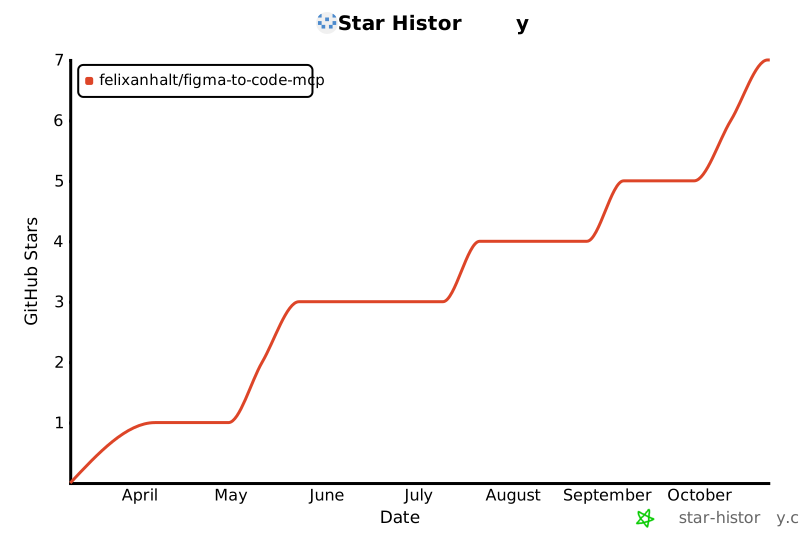
## Star History
 ## Acknowledgment
This project was initially inspired by the ideas explored in the original Figma Context MCP by GLips:
https://github.com/glips/figma-context-mcp
While the original project provides a Model Context Protocol (MCP) server that simplifies Figma data for use with AI coding agents, this implementation has been substantially redesigned with a different data model, API, and processing approach, and should be considered an independent system.
## Acknowledgment
This project was initially inspired by the ideas explored in the original Figma Context MCP by GLips:
https://github.com/glips/figma-context-mcp
While the original project provides a Model Context Protocol (MCP) server that simplifies Figma data for use with AI coding agents, this implementation has been substantially redesigned with a different data model, API, and processing approach, and should be considered an independent system.