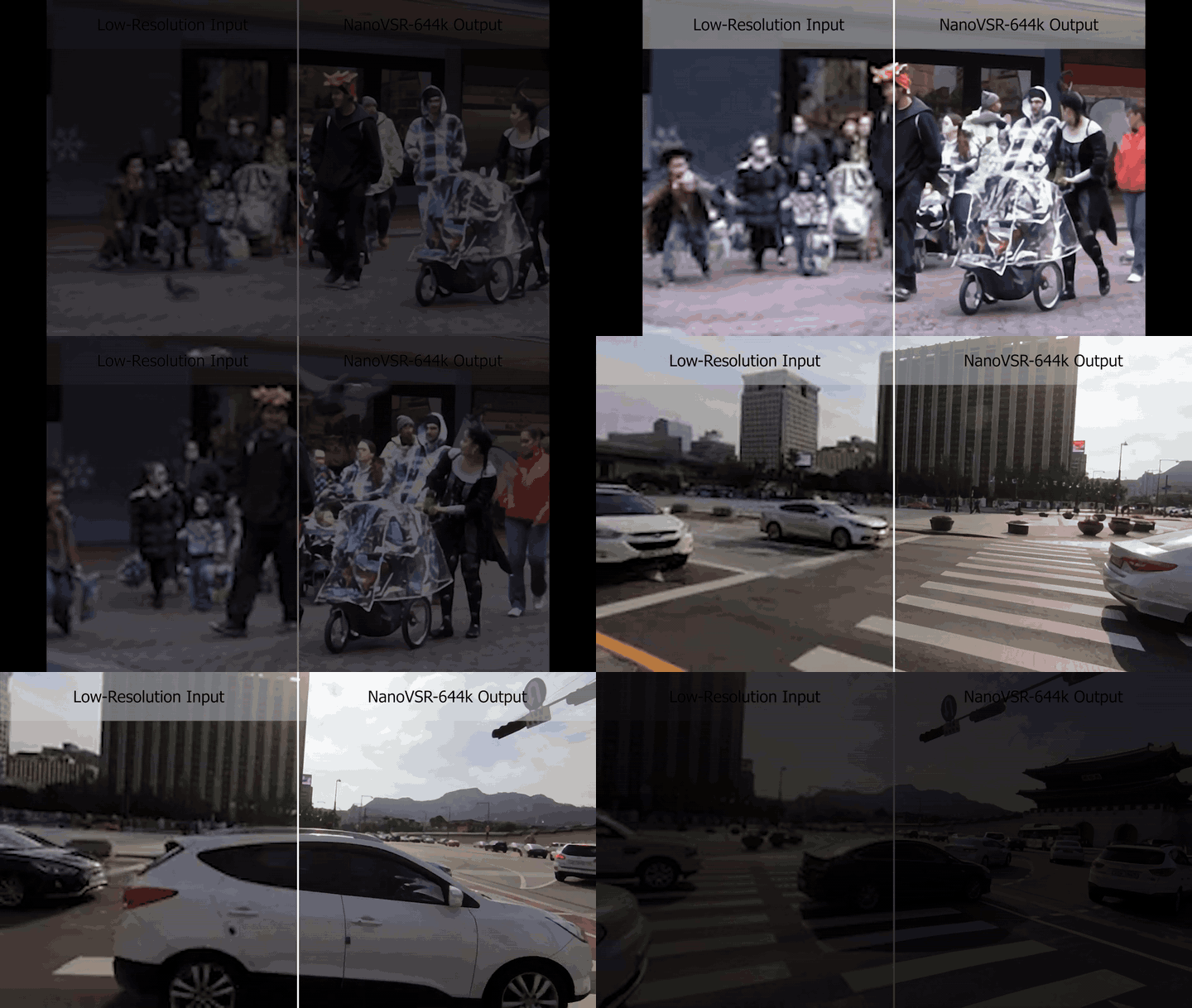
# NanoVSR: Towards Real-Time Video Super-Resolution on Edge Devices ### ECCV 2026 [Filip Pawlicki](https://orcid.org/0009-0001-3375-8091) · [Marcel Kańduła](https://orcid.org/0009-0001-1314-5511) · [Marcin Pucek](https://orcid.org/0009-0003-9879-8195) · [Kamil Dobies](https://orcid.org/0009-0007-0441-2140) Gdańsk University of Technology [![arXiv](https://img.shields.io/badge/arXiv-2607.10495-b31b1b)](https://arxiv.org/abs/2607.10495) [![🤗 Space](https://img.shields.io/badge/%F0%9F%A4%97%20Space-Live%20Demo-blue)](https://huggingface.co/spaces/filippawlicki/nanovsr-demo) [![License: MIT](https://img.shields.io/badge/License-MIT-green.svg)](LICENSE) Low-resolution input vs. NanoVSR-644k output (4x upscaling) *4× video super-resolution with NanoVSR-644k — 27.2 FPS on a Jetson Orin NX (25 W).*

## Overview **NanoVSR** is a scalable, fully convolutional video super-resolution (VSR) architecture designed for resource-constrained edge devices. Instead of relying on transformers or explicit optical flow, NanoVSR: - uses a **bidirectional recurrent** design with a **direct additive propagation** scheme that avoids channel concatenation, reducing memory bandwidth; - is built from **reparameterizable multi-branch blocks** (3×3 + 1×1 + identity) that collapse into a single stream of plain 3×3 convolutions at inference — no custom CUDA ops, natively ONNX/TensorRT compatible; - learns spatio-temporal alignment **implicitly** through a two-stage progressive training curriculum (short Vimeo-90K sequences → long REDS sequences). The baseline NanoVSR-644k reaches **28.64 dB PSNR on REDS4 at 27.20 FPS** on an NVIDIA Jetson Orin NX 16GB (25 W), and the scaled NanoVSR-1.7M reaches **29.15 dB at 19.58 FPS**. ## News - **2026-07**: Code and pretrained models are released. - **2026-06**: NanoVSR is accepted to **ECCV 2026**! 🎉 ## Model Zoo All models perform 4× upscaling and were trained with the two-stage curriculum (50k iterations on Vimeo-90K, then 100k on REDS). PSNR/SSIM: RGB for REDS4, Y-channel for Vid4 and Vimeo-90K-T. Runtime is ms/frame for a 180×320 input on an H100 (FP32); FPS is measured on Jetson Orin NX 16GB (25 W) with TensorRT FP16, 180×320 input, T=15. | Model | Params | REDS4 | Vid4 | Vimeo-90K-T | H100 (ms) | Orin NX (FPS) | Download | | :--- | ---: | :---: | :---: | :---: | ---: | ---: |:-------------------------------------------------------------------------------------------------------:| | NanoVSR-226k | 226k | 28.23 / 0.8057 | 25.26 / 0.7252 | 34.31 / 0.9130 | 1.910 | 43.86 | [weights](https://github.com/filippawlicki/nanovsr/releases/download/v1.0/nanovsr_226k.pth) | | **NanoVSR-644k** (baseline) | 644k | 28.64 / 0.8215 | 26.05 / 0.7761 | 35.00 / 0.9226 | 2.982 | 27.20 | [weights](https://github.com/filippawlicki/nanovsr/releases/download/v1.0/nanovsr_644k.pth) | | NanoVSR-1.7M | 1.7M | 29.15 / 0.8364 | 26.44 / 0.7964 | 35.49 / 0.9294 | 4.268 | 19.58 | [weights](https://github.com/filippawlicki/nanovsr/releases/download/v1.0/nanovsr_1.7m.pth) | | NanoVSR-5.4M | 5.4M | 29.73 / 0.8526 | 26.76 / 0.8089 | 35.85 / 0.9335 | 8.547 | 8.66 | [weights](https://github.com/filippawlicki/nanovsr/releases/download/v1.0/nanovsr_5.4m.pth) |
All architectural configurations (scaling study) | Model | Parameters | Blocks N | Channels F | REDS4 PSNR | | :--- | ---: | ---: | ---: | ---: | | NanoVSR-22k | 22,107 | 3 | 10 | 27.62 | | NanoVSR-31k | 31,153 | 4 | 12 | 27.79 | | NanoVSR-48k | 48,245 | 4 | 16 | 27.96 | | NanoVSR-226k | 225,797 | 8 | 32 | 28.23 | | NanoVSR-644k | 644,245 | 12 | 48 | 28.64 | | NanoVSR-1.7M | 1,709,605 | 20 | 64 | 29.15 | | NanoVSR-5.4M | 5,447,365 | 30 | 96 | 29.73 | | NanoVSR-9.6M | 9,630,309 | 30 | 128 | 29.90 |
## Installation ```bash git clone https://github.com/filippawlicki/nanovsr.git cd nanovsr conda create -n nanovsr python=3.11 -y conda activate nanovsr # Install PyTorch first (pick the right CUDA build for your system): # https://pytorch.org/get-started/locally/ pip install -r requirements.txt ``` The code was tested with Python 3.13, PyTorch 2.10.0, CUDA 12.8 (training/inference on H100) and TensorRT 10.3 (deployment on Jetson Orin NX). ## Quick Demo Upscale any low-resolution video (or a directory of frames) 4× with a pretrained checkpoint — no datasets required: ```bash python demo.py --checkpoint checkpoints/nanovsr_644k.pth --input my_clip.mp4 ``` The result is written next to the input as `my_clip_x4.mp4`. Useful flags: - `--compare` — write a labeled side-by-side *LR (nearest-neighbor) vs. NanoVSR* video (like the teaser above); - `--input frames_dir/ --fps 30` — read a directory of PNG/JPG frames instead of a video file; - `--chunk_size 15` — temporal window per forward pass (the paper's edge setting); lower it if you run out of memory; - `--fp16` — half-precision inference on CUDA; - `--max_frames 100` — quick test on the first N frames. NanoVSR expects genuinely low-resolution input (the paper operates on 180×320 and 270×480 frames); feeding an HD video will be slow and memory-hungry. ## Data Preparation We train on **Vimeo-90K** (phase 1) and **REDS** (phase 2), and evaluate on **REDS4**, **Vid4** and **Vimeo-90K-T**. 1. **REDS** — download `train_sharp` (GT) and `train_sharp_bicubic` (LR, X4) from the [official REDS page](https://seungjunnah.github.io/Datasets/reds.html). The four REDS4 clips (`000`, `011`, `015`, `020`) are excluded from training automatically and used for testing. 2. **Vimeo-90K** — download the septuplet dataset from the [OpenDataLab page](https://opendatalab.com/OpenDataLab/Vimeo90K) (includes `sep_trainlist.txt` / `sep_testlist.txt`). The 4× LR frames (`vimeo_septuplet_matlabLRx4`) are generated with MATLAB bicubic downsampling, following standard practice ([BasicSR guide](https://github.com/XPixelGroup/BasicSR/blob/master/docs/DatasetPreparation.md)). If the LR folder is missing, the training dataloader falls back to on-the-fly PIL bicubic downsampling — convenient for a quick start, but use the MATLAB LR data to reproduce paper numbers. 3. **Vid4** — download GT and BIx4 using [MMagic dataset guide](https://github.com/open-mmlab/mmagic/blob/main/docs/en/user_guides/dataset_prepare.md). Organize everything under `data/`: ``` data/ ├── REDS/ │ ├── GT/ │ │ └── train/ │ │ └── train_sharp/ # 000, 001, ..., 269 │ └── LR/ │ └── train/ │ └── train_sharp_bicubic/ │ └── X4/ # 000, 001, ..., 269 ├── vimeo_septuplet/ │ ├── sequences/ # 00001/0001/im1.png ... im7.png │ ├── sep_trainlist.txt │ └── sep_testlist.txt ├── vimeo_septuplet_matlabLRx4/ │ └── sequences/ └── Vid4/ ├── GT/ # calendar, city, foliage, walk └── BIx4/ ``` ## Training The two-stage curriculum is handled automatically: 7-frame Vimeo-90K sequences for the first 50k iterations, then 30-frame REDS sequences until 150k. 256×256 GT patches, Charbonnier loss, cosine annealing from 3e-4 to 1e-7, BF16 AMP and gradient clipping are the script defaults. **Multi-GPU (paper setup)** — launch with `torchrun`; the paper uses 4 GPUs with a per-GPU batch size of 3 (**global batch size 12**): ```bash # NanoVSR-644k (baseline) torchrun --nproc_per_node=4 train.py \ --vimeo_root data/vimeo_septuplet \ --reds_root data/REDS \ --output_dir experiments/nanovsr_644k \ --num_blocks 12 \ --num_feat 48 \ --batch_size 3 ``` **Single GPU** — run the same script with plain `python` (DDP is bypassed automatically): ```bash python train.py \ --vimeo_root data/vimeo_septuplet \ --reds_root data/REDS \ --output_dir experiments/nanovsr_644k \ --num_blocks 12 \ --num_feat 48 \ --batch_size 12 ``` The global batch size is `#GPUs × --batch_size`; to reproduce paper results keep it at 12 (reduce `--batch_size` if you run out of memory, at the cost of a slightly different training trajectory). To train other variants, change the architecture flags according to the Model Zoo table, e.g. `--num_blocks 8 --num_feat 32` for NanoVSR-226k or `--num_blocks 20 --num_feat 64` for NanoVSR-1.7M.
All training options | Flag | Default | Description | | :--- | :--- | :--- | | `--vimeo_root` | — | Path to `vimeo_septuplet/` | | `--reds_root` | — | Path to `REDS/` | | `--output_dir` | `output_auto_curriculum` | Checkpoint directory | | `--num_feat` | 32 | Feature channels F | | `--num_blocks` | 8 | Propagation blocks N per direction | | `--batch_size` | 3 | Per-GPU batch size | | `--lr` | 3e-4 | Initial learning rate | | `--patch_size` | 256 | GT patch size | | `--switch_iter` | 50000 | Iteration to switch Vimeo-90K → REDS | | `--total_iterations` | 150000 | Total iterations | | `--long_num_frames` | 30 | Sequence length in the REDS phase | | `--num_workers` | 10 | Dataloader workers per GPU |
## Evaluation A single command runs the model on the benchmarks and reports PSNR/SSIM with the paper's protocol (REDS4 in RGB; Vid4 and Vimeo-90K-T on the Y channel; Vimeo-90K-T on the center frame of each septuplet). The architecture is detected from the checkpoint and the model is automatically reparameterized into its fused deploy form: ```bash python evaluate.py --checkpoint checkpoints/nanovsr_644k.pth --data_root data ``` - `--datasets REDS4 Vid4` evaluates a subset; benchmarks missing under `--data_root` are skipped. - `--save_images` additionally writes the SR frames to `results/NanoVSR/{REDS4,Vid4,Vimeo90K}//` (off by default). Pre-computed SR frames — e.g. produced by a TensorRT engine — can be scored directly, without running the model: ```bash python evaluate.py --datasets REDS4 \ --sr_root results/trt/REDS4 \ --gt_root data/REDS/GT/train/train_sharp ``` ## Pretrained Models Download the checkpoints from the [Releases page](https://github.com/filippawlicki/nanovsr/releases) (direct links in the [Model Zoo](#model-zoo)) and place them in `checkpoints/`: ```bash mkdir -p checkpoints wget -P checkpoints https://github.com/filippawlicki/nanovsr/releases/download/v1.0/nanovsr_644k.pth ``` Checkpoints store the multi-branch (training) topology; `demo.py`, `evaluate.py` and `export_onnx.py` fuse them into the single-branch deploy form on load. ## ONNX Export & TensorRT Deployment Export a reparameterized model to ONNX (the paper uses a fixed temporal window of T=15 for chunk-based execution on Jetson): ```bash python export_onnx.py \ --checkpoint checkpoints/nanovsr_644k.pth \ --num_frames 15 --height 180 --width 320 ``` Then build a TensorRT engine on the target device (paper setup: TensorRT 10.3, FP16): ```bash trtexec --onnx=checkpoints/nanovsr_644k.onnx \ --saveEngine=checkpoints/nanovsr_644k.engine \ --fp16 ``` Measured edge throughput (TensorRT FP16, T=15): | Model | Resolution | Orin NX 8GB / 15 W | Orin NX 16GB / 25 W | | :--- | :--- | ---: | ---: | | NanoVSR-226k | 180×320 | 23.55 FPS | 43.86 FPS | | NanoVSR-644k | 180×320 | 16.12 FPS | 27.20 FPS | | NanoVSR-1.7M | 180×320 | 11.57 FPS | 19.58 FPS | | NanoVSR-226k | 270×480 | 10.51 FPS | 19.55 FPS | | NanoVSR-644k | 270×480 | 7.19 FPS | 12.82 FPS | ## Citation If you find this work useful, please cite: ```bibtex @InProceedings{pawlicki2026nanovsr, author = {Pawlicki, Filip and Ka{\'n}du{\l}a, Marcel and Pucek, Marcin and Dobies, Kamil}, title = {NanoVSR: Towards Real-Time Video Super-Resolution on Edge Devices}, booktitle = {Computer Vision -- ECCV 2026}, year = {2026}, publisher = {Springer Nature Switzerland}, address = {Cham}, pages = {620--639}, isbn = {978-3-032-37356-4}, doi = {10.1007/978-3-032-37356-4_34}, url = {https://doi.org/10.1007/978-3-032-37356-4_34}, } ``` ## License This project is released under the [MIT License](LICENSE). ## Contact For questions, please open an [issue](https://github.com/filippawlicki/nanovsr/issues) or contact the authors: - Filip Pawlicki (s198371@student.pg.edu.pl) - Marcel Kańduła (s197677@student.pg.edu.pl) - Marcin Pucek (s197893@student.pg.edu.pl) - Kamil Dobies (s197875@student.pg.edu.pl)