# Voice Activity Detection project





Keywords: Python, PyTorch, Deep Learning, Audio, Time Series classification, uv, Docker
## Table of contents
1. [ Installation ](#1-installation)
2. [ Introduction ](#2-introduction)
3. [ Project structure ](#3-project-structure)
4. [ Dataset ](#4-dataset)
5. [ Project usage ](#5-project-usage)
6. [ Testing ](#6-testing)
7. [ Continuous integration & delivery ](#7-continuous-integration--delivery)
8. [ Contributing ](#8-contributing)
9. [ Todo ](#9-todo)
10. [ License ](#10-license)
11. [ Resources ](#11-resources)
## 1. Installation
This project uses:
* Python 3.11+
* PyTorch 2.2+
* [uv](https://docs.astral.sh/uv/) package manager
```bash
git clone https://github.com/filippogiruzzi/voice_activity_detection.git
cd voice_activity_detection/
```
### 1.1 Install with uv (recommended)
```bash
# Install uv if you don't have it
curl -LsSf https://astral.sh/uv/install.sh | sh
# Install all dependencies
uv sync
```
### 1.2 Development setup
```bash
# Install with dev dependencies (ruff, pytest, etc.)
uv sync
# Run linters
make lint
# Run tests
make test
# Auto-format code
make format
```
### 1.3 Docker installation
Build and run the CPU Docker image:
```bash
make build
make local-nobuild
```
For GPU support (requires NVIDIA Docker runtime):
```bash
make build-gpu
```
## 2. Introduction
### 2.1 Goal
The purpose of this project is to design and implement a real-time Voice Activity Detection algorithm based on Deep Learning.
The designed solution is based on a simple pipeline with MFCC feature extraction and a small 1D-ResNet model (PyTorch) that classifies whether an audio signal is speech or noise.
### 2.2 Results
| Model | Train acc. | Val acc. | Test acc. |
| :---: |:---:| :---:| :---: |
| 1D-Resnet | 99 % | 98 % | 97 % |
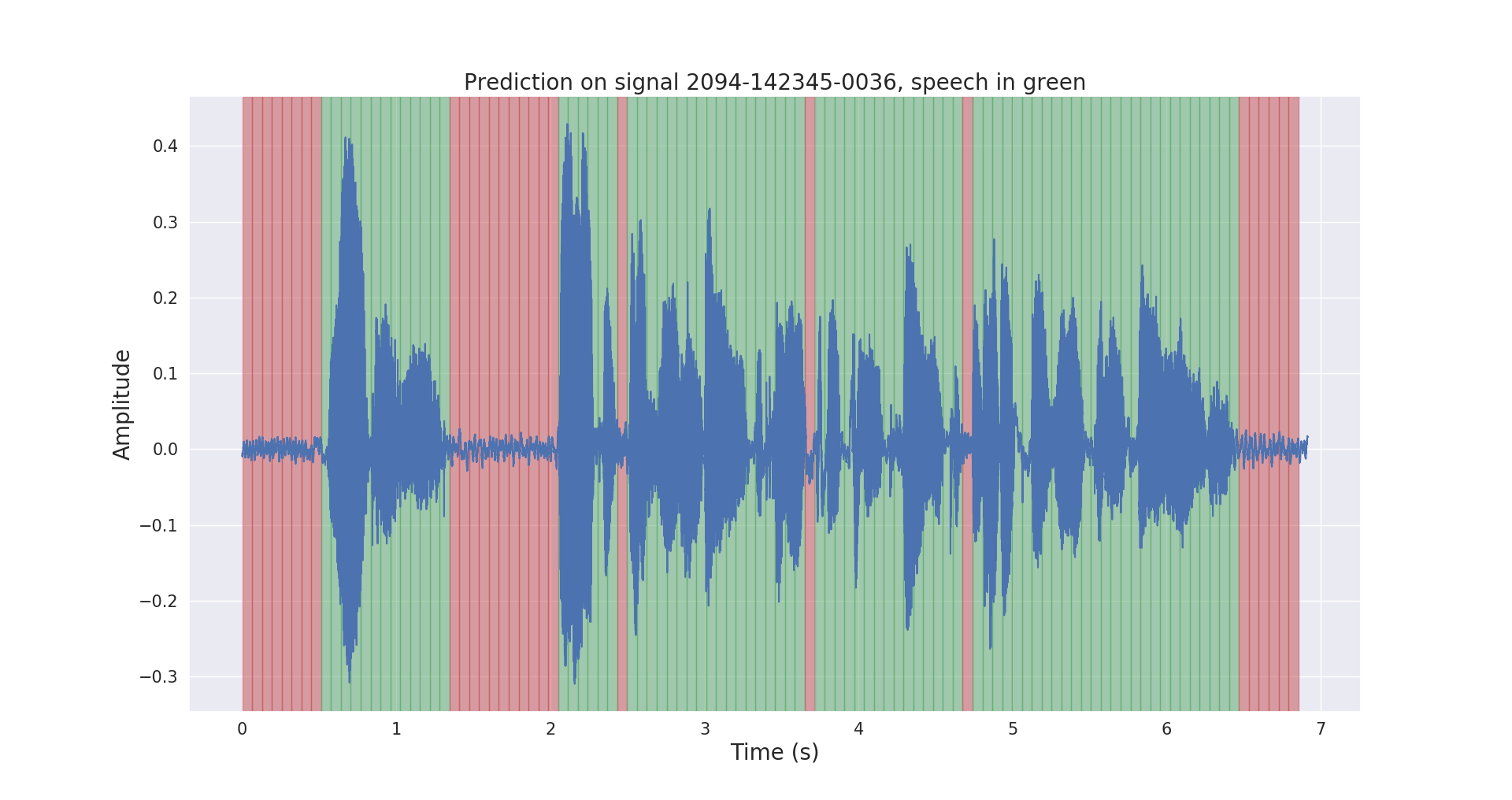
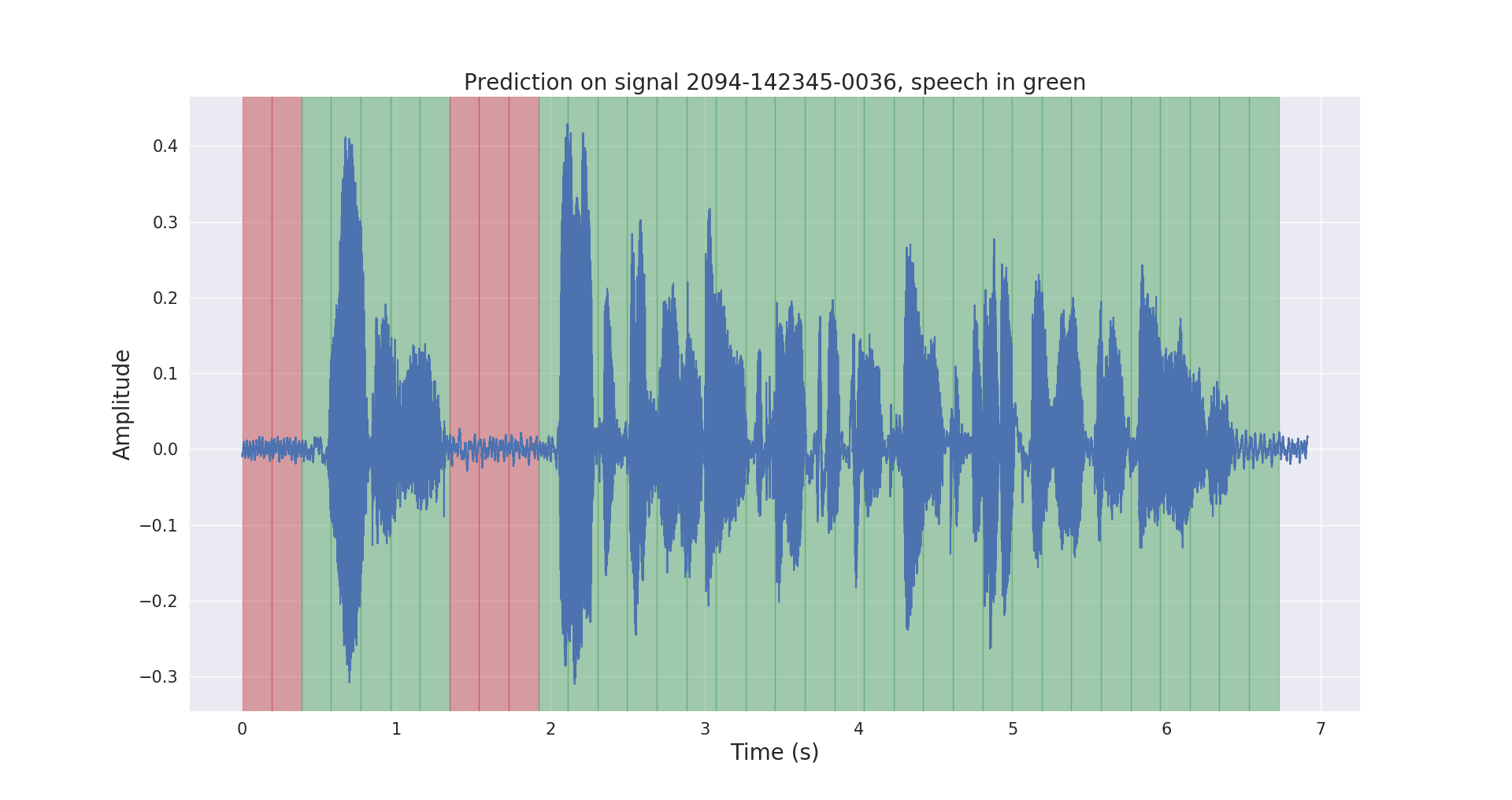
Raw and post-processed inference results on a test audio signal are shown below.
### 2.3 Model & features
Each audio window of `SEQ_LEN = 1024` samples (16 kHz) is converted into a
**16 × 65** feature tensor stacking:
* 5 MFCC coefficients,
* 5 MFCC deltas (1st order),
* 5 MFCC delta-deltas (2nd order),
* 1 RMS energy.
These features feed a configurable 1D-ResNet (`vad.model.Resnet1D`):
stacked residual blocks (3 × `Conv1d → BatchNorm1d` with a 1×1 shortcut) →
global average pooling → a fully connected head producing a single speech logit.
The architecture is fully described by the `ModelConfig` dataclass, so the same
configuration must be used at training, export, and inference time.
## 3. Project structure
The core code lives flat inside `vad/`:
* `vad/model.py`: the `Resnet1D` model architecture and its `ModelConfig` dataclass
* `vad/data.py`: feature extraction, dataset building & the PyTorch DataLoader
* `vad/train.py`: training loop & model export (state dict + TorchScript)
* `vad/inference.py`: sliding-window inference & visualization
Supporting files:
* `tests/`: pytest integration tests (training → export → inference)
* `scripts/`: Docker build / run helpers
* `Makefile`: common developer commands (`install`, `lint`, `format`, `test`, `build`, ...)
* `pyproject.toml`: project metadata, dependencies & tooling configuration
## 4. Dataset
Please download the LibriSpeech ASR corpus dataset from https://openslr.org/12/,
and extract all files to: `/path/to/LibriSpeech/`.
The dataset contains approximately 1000 hours of 16kHz read English speech
from audiobooks, and is well suited for Voice Activity Detection.
I automatically annotated the `test-clean` set of the dataset with a
pretrained VAD model.
Please feel free to use the `labels/` folder and the pre-trained VAD model (only for inference) from this
[ link ](https://drive.google.com/open?id=1ZPQ6wnMhHeE7XP5dqpAEmBAryFzESlin).
**Important note:** As this is only a toy project, it is designed to split the `test-clean` sub-dataset intro train / val / test for quick iteration, but can be extended to a full large-scale dataset.
## 5. Project usage
### 5.1 Create PyTorch dataset from raw audio
```bash
uv run vad-data --data-dir /path/to/LibriSpeech/
```
This saves processed `.pt` files to `/path/to/LibriSpeech/dataset/{train,val,test}/`.
Use `--max-files N` to process only a few files per split for a quick run.
### 5.2 Train & export the VAD model
```bash
uv run vad-train --data-dir /path/to/LibriSpeech/dataset/ --model-dir /path/to/models/
```
Checkpoints are saved to `--model-dir`, and the final model is exported (state dict +
TorchScript) to `/exported/` unless `--no-export` is passed.
Useful flags: `--epochs/-e`, `--batch-size/-b`, `--lr`, and the architecture flags
`--n-filters` / `--fc-units`. Training device (CUDA, Apple MPS, or CPU) is selected
automatically. TensorBoard logs are written to `/logs/`:
```bash
uv run tensorboard --logdir /path/to/models/logs/
```
### 5.3 Run inference
```bash
uv run vad-inference \
--data-dir /path/to/LibriSpeech/ \
--checkpoint /path/to/models/exported/model_state_dict.pt \
--smoothing --max-files 1
```
> **Note:** if you trained with custom `--n-filters` / `--fc-units`, pass the same
> values to `vad-inference` so the checkpoint loads into a matching architecture.
## 6. Testing
Run the test suite with coverage:
```bash
make test
```
This runs `pytest` with coverage over the `vad` package, printing a
term report with missing lines and writing an HTML report to `htmlcov/`.
## 7. Continuous integration & delivery
* **CI** ([`.github/workflows/ci.yml`](.github/workflows/ci.yml)): on every push and
pull request, runs `ruff` lint, `ruff format --check`, and the pytest suite.
* **CD** ([`.github/workflows/cd.yml`](.github/workflows/cd.yml)): on push to
`master`/`main`, builds the Docker image and pushes it to Docker Hub
(tagged with the commit SHA and `latest`).
## 8. Contributing
Contributions are welcome! Please:
1. Fork the repository and create a feature branch.
2. Install the dev environment with `uv sync`.
3. Make sure `make lint` and `make test` pass before opening a pull request.
4. Use clear commit messages and keep changes focused.
## 9. Todo
### 9.1 ML Engineering
- [ ] Add MLflow experiment tracking (params, metrics, artifacts)
- [ ] Reach full unit-test coverage and add CI coverage reporting
- [ ] Add online / streaming real-time inference
- [ ] Serve the model via a REST/gRPC API (e.g. FastAPI + ONNX Runtime)
- [ ] Add data/version control (DVC) and a model registry
### 9.2 Data Science
- [ ] Compare the model against a simple baseline and train on the full dataset
- [ ] Add time-series data augmentation and improve class balancing
- [ ] Study the ROC curve & tune the classification threshold
- [ ] Explore self-supervised speech encoders (e.g. WavLM, wav2vec 2.0)
- [ ] Benchmark modern lightweight VAD models (e.g. Silero VAD, Pyannote 3.x)
## 10. License
This project is licensed under the terms of the [GNU GPL v3](LICENSE).
## 11. Resources
* _Voice Activity Detection for Voice User Interface_,
[Medium](https://medium.com/linagoralabs/voice-activity-detection-for-voice-user-interface-2d4bb5600ee3)
* _Deep learning for time series classifcation: a review_,
Fawaz et al., 2018, [Arxiv](https://arxiv.org/abs/1809.04356)
* _Time Series Classification from Scratch
with Deep Neural Networks: A Strong Baseline_, Wang et al., 2016,
[Arxiv](https://arxiv.org/abs/1611.06455)