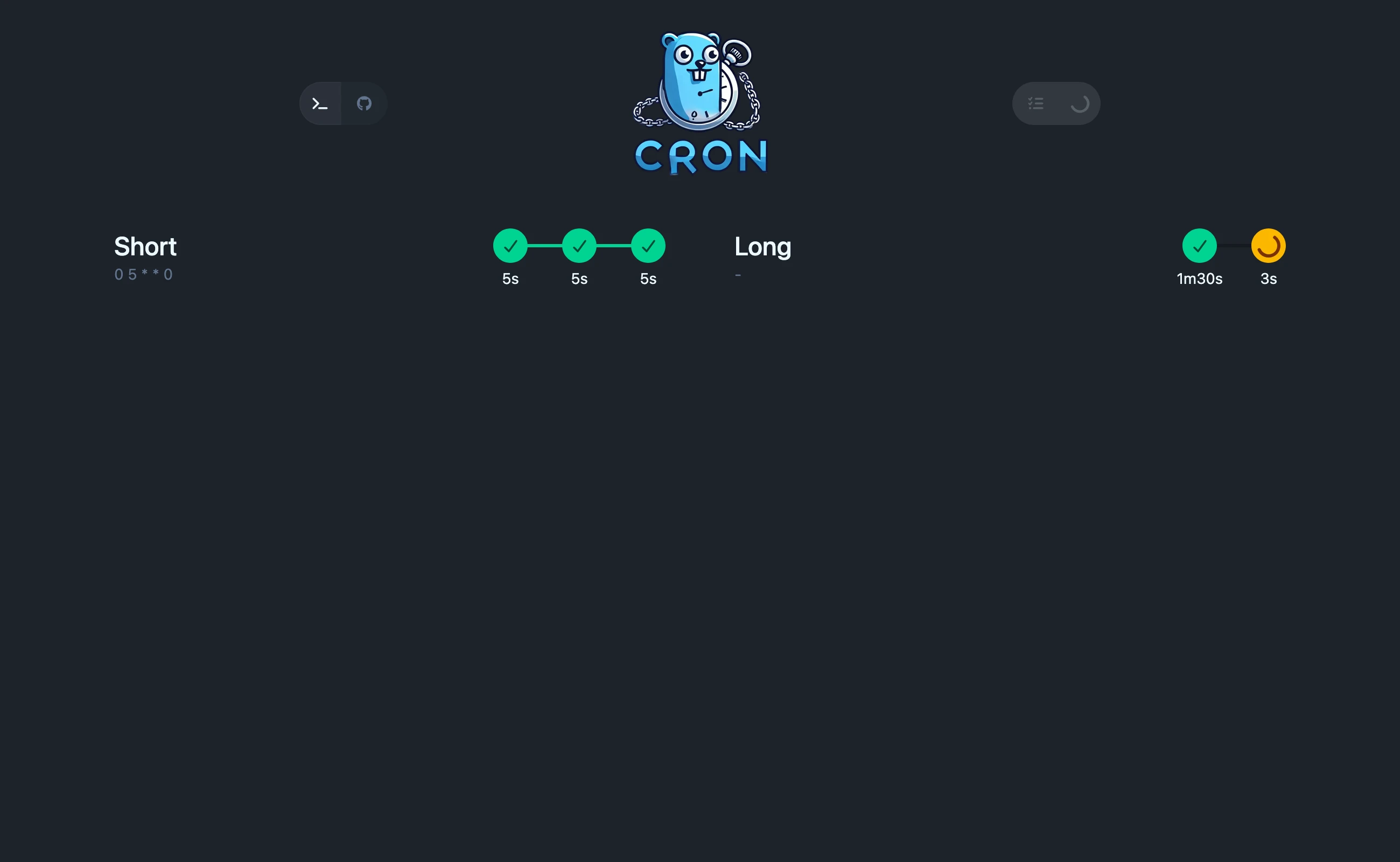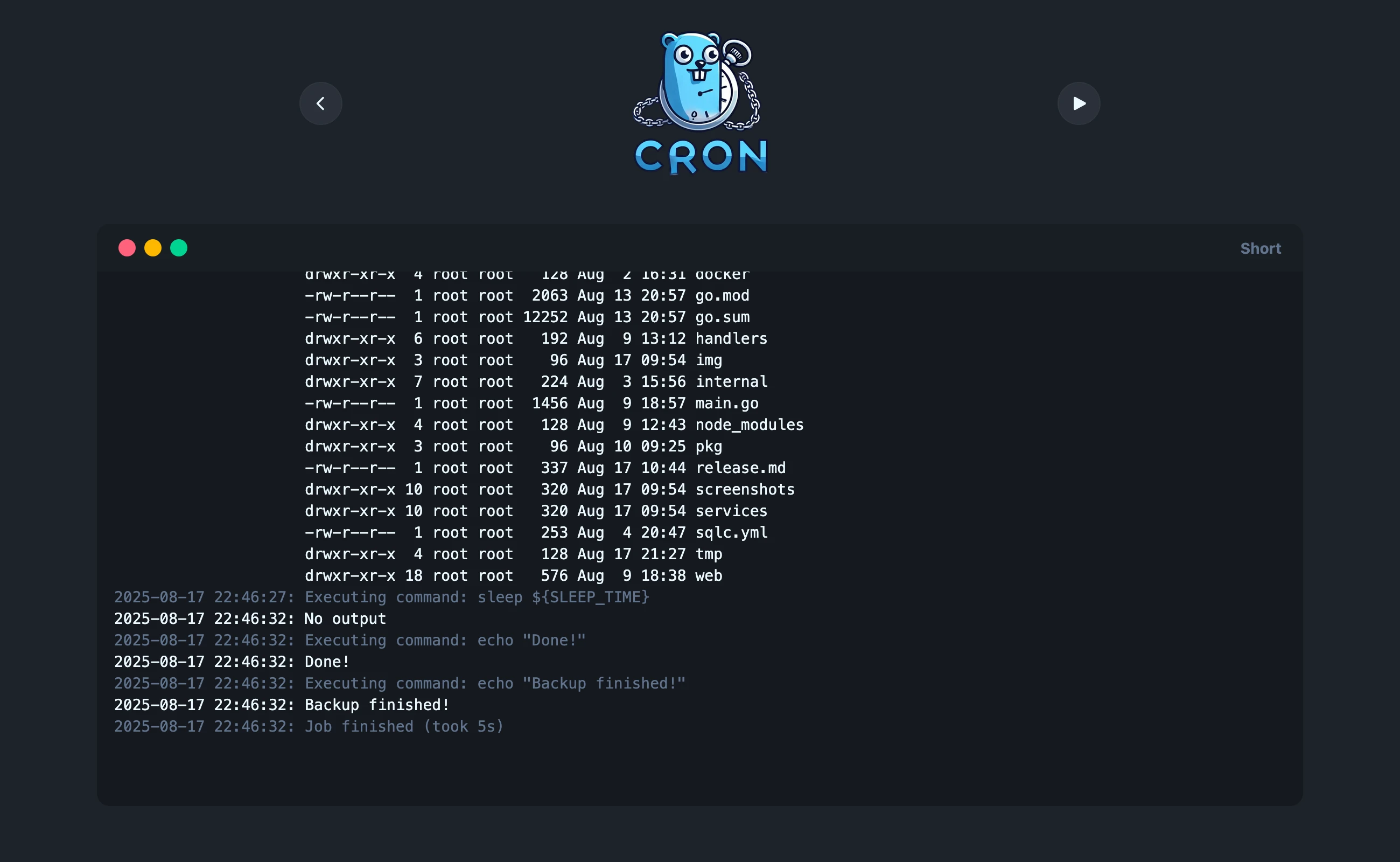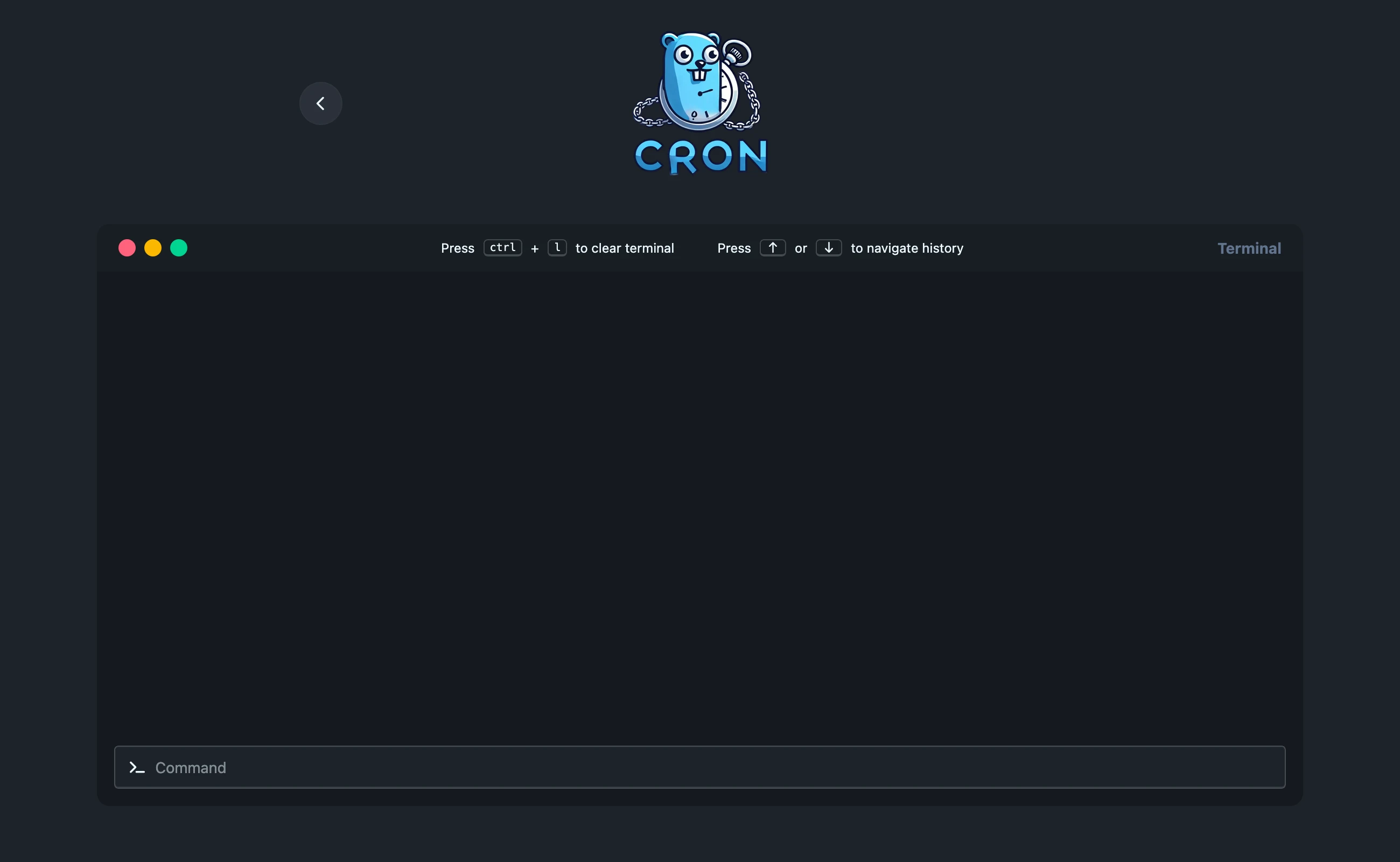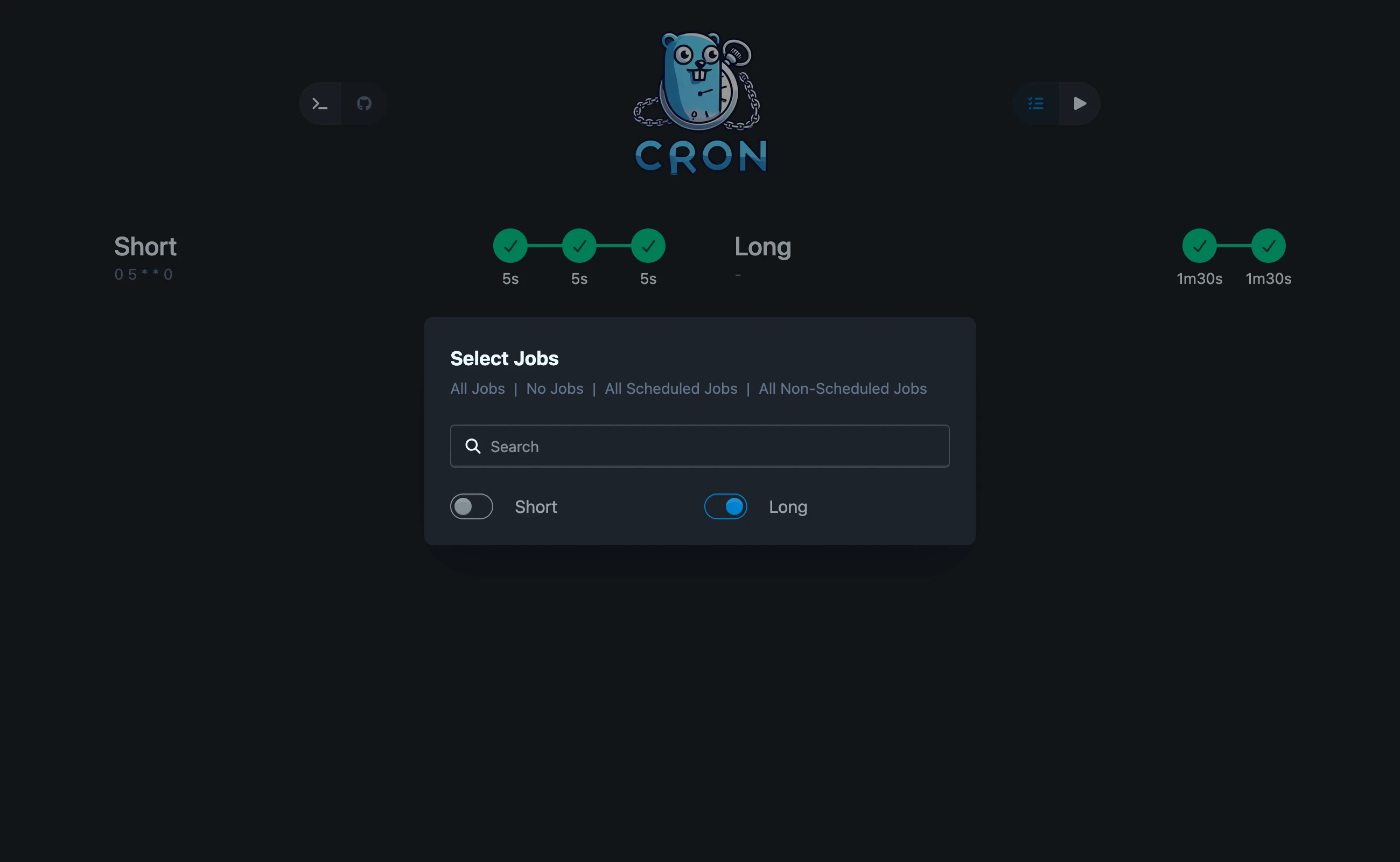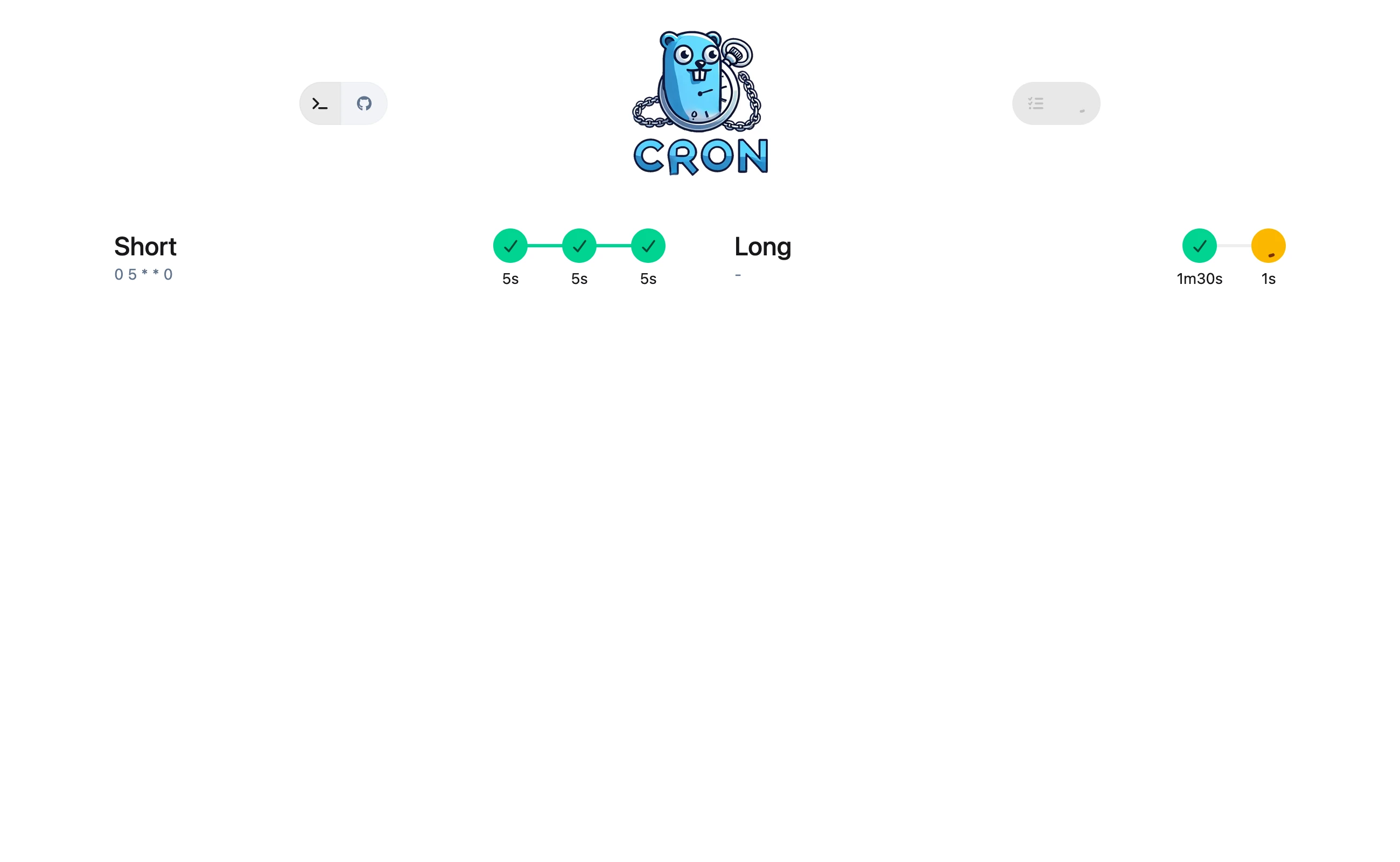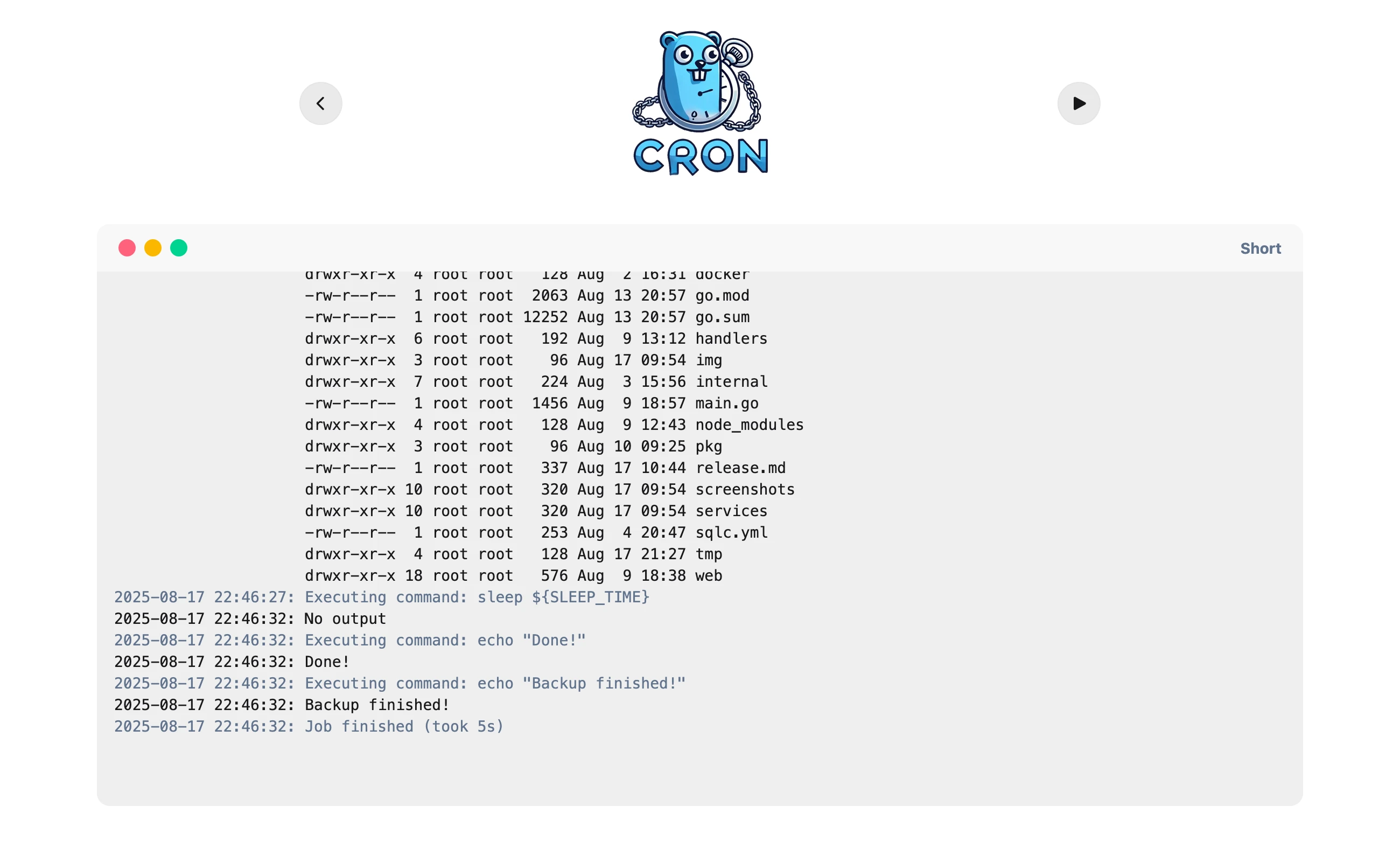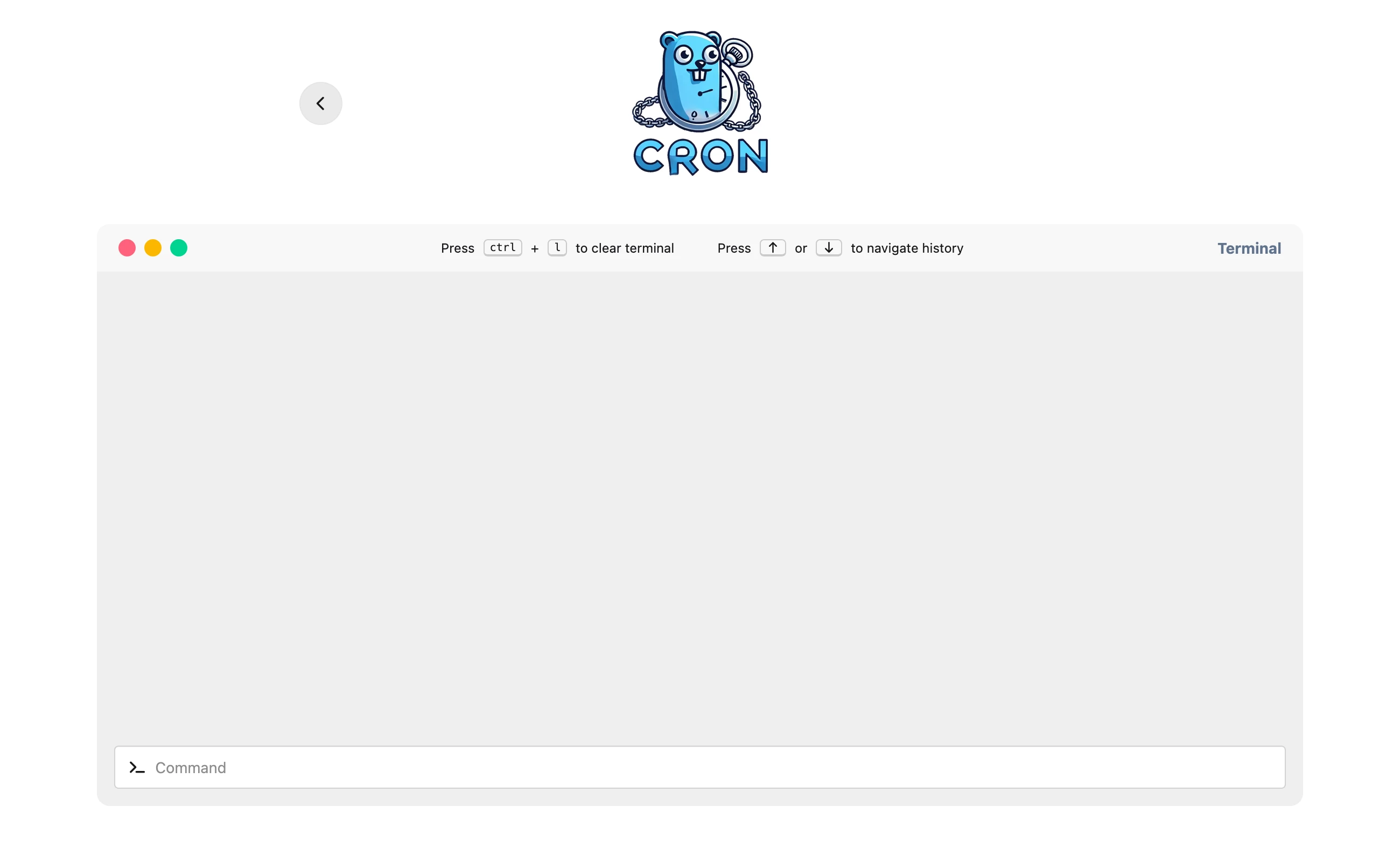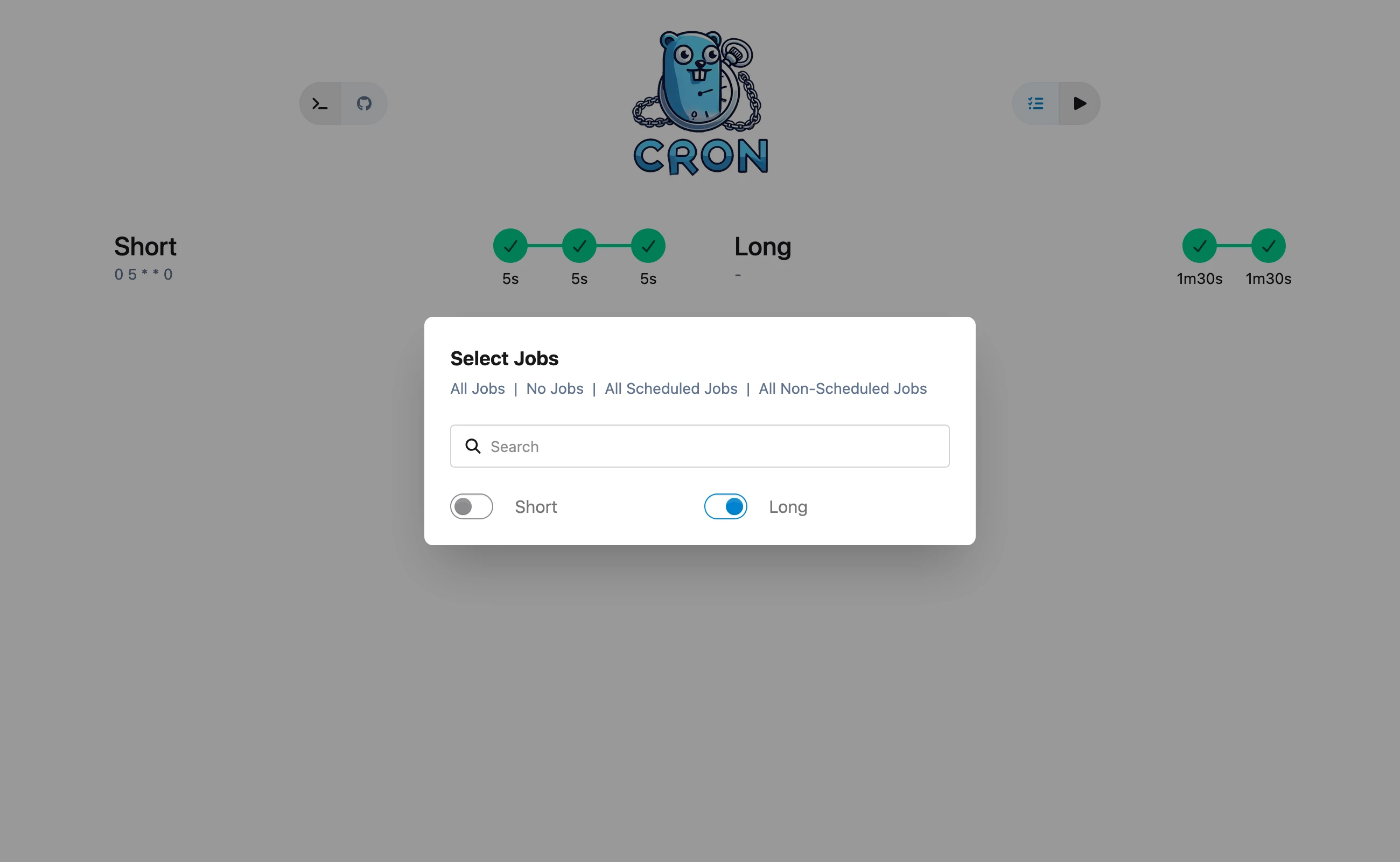
[![CI](https://github.com/flohoss/gocron/actions/workflows/ci.yaml/badge.svg)](https://github.com/flohoss/gocron/actions/workflows/ci.yaml) [![Coverage](https://raw.githubusercontent.com/wiki/flohoss/gocron/coverage.svg)](https://github.com/flohoss/gocron/wiki/coverage.html) [![RepoRanker](https://reporanker.com/badge/flohoss/gocron)](https://reporanker.com/repos/flohoss/gocron) A self-hosted task scheduler built with Go and Vue.js. Define recurring jobs in a YAML file, run them on cron schedules, pass per-job environment variables, and manage everything through a web UI backed by SQLite.


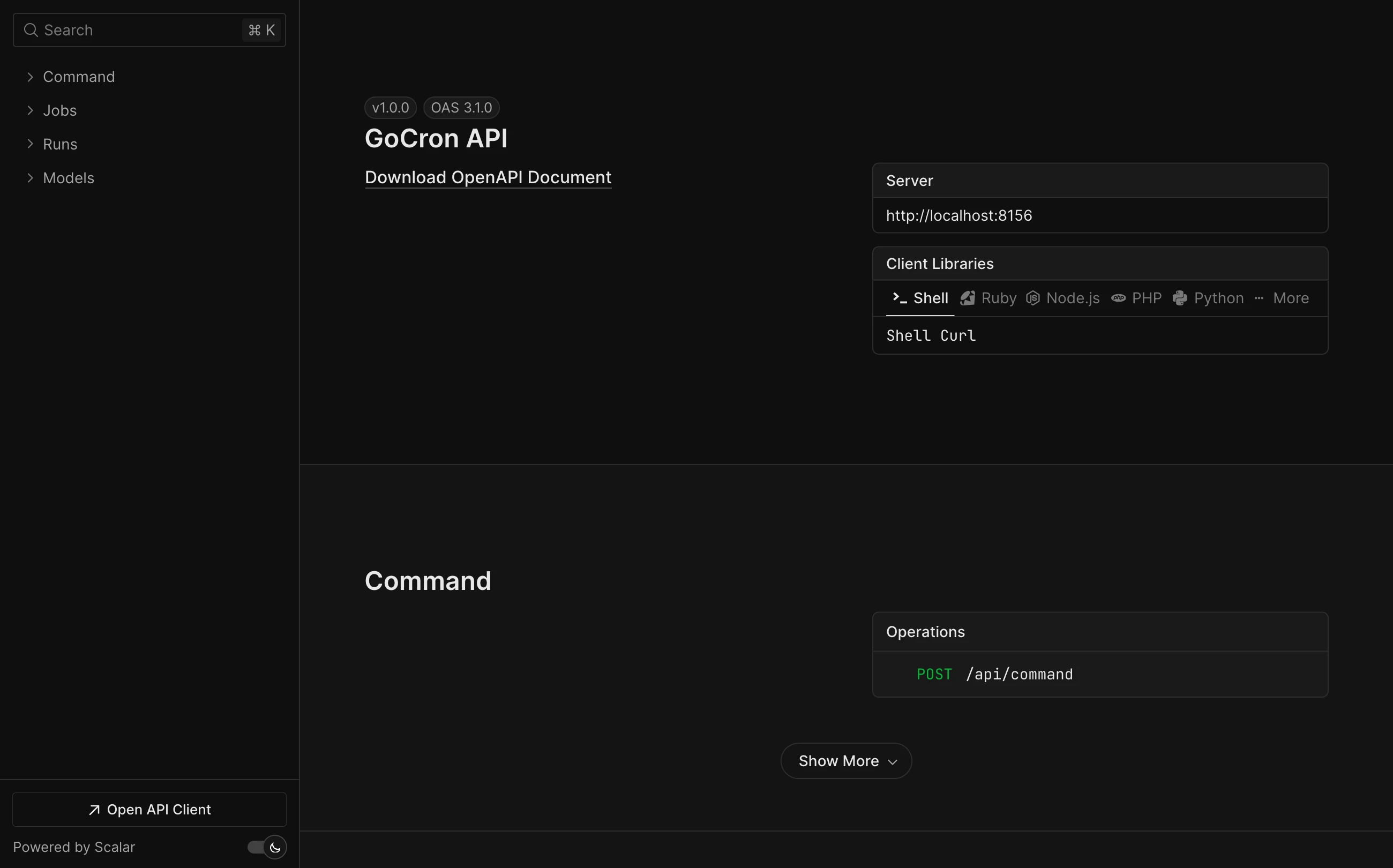
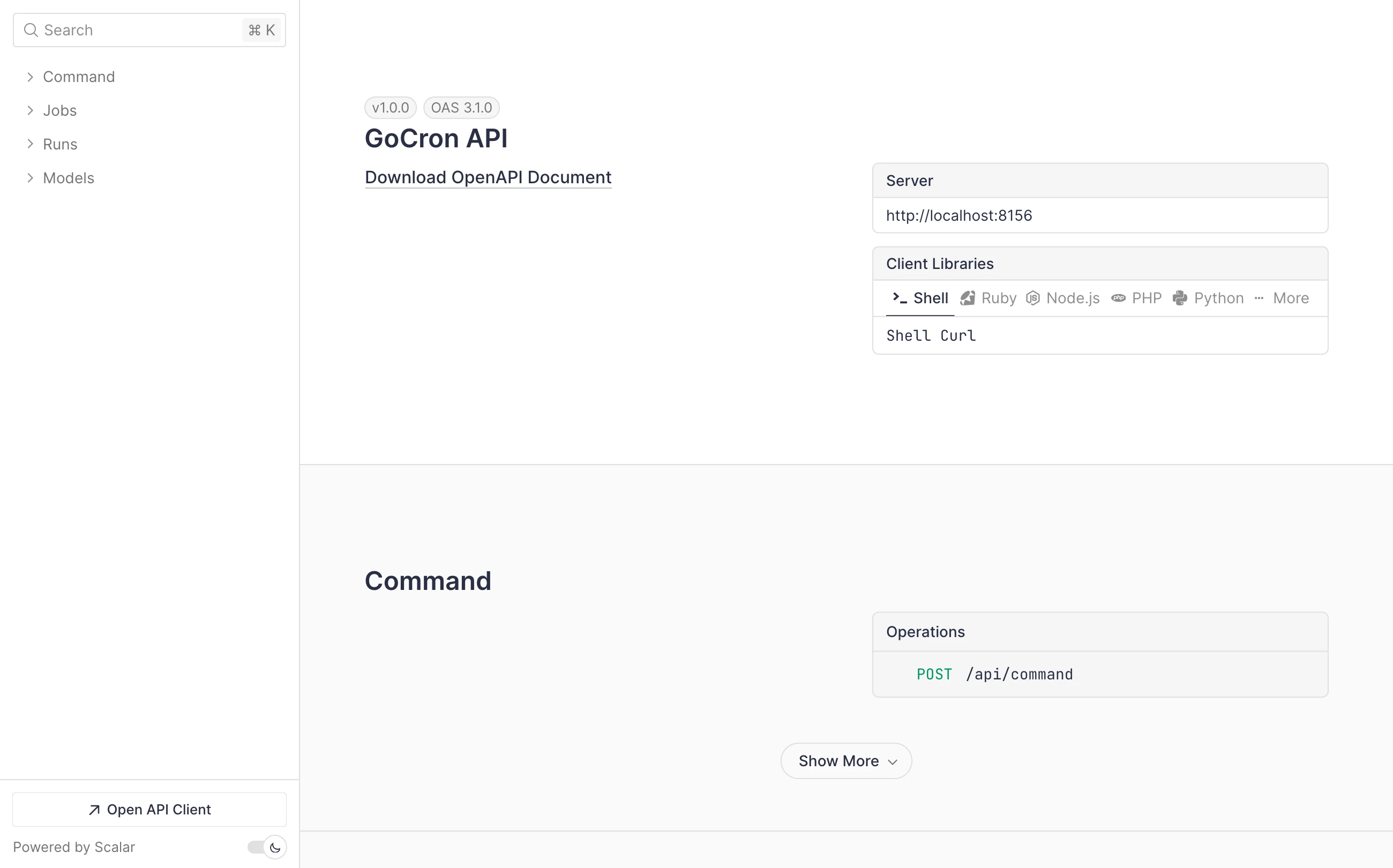
## Table of Contents - [Quick Start](#quick-start) - [NixOS](#nixos) - [Features](#features) - [Configuration](#configuration) - [Job defaults](#job-defaults) - [Jobs](#jobs) - [Software](#software) - [Environment overrides](#environment-overrides-gc_) - [Database location](#database-location) - [Failure semantics](#failure-semantics) - [Safety & security](#safety--security) - [Screenshots](#screenshots) - [Development](#development) - [Star History](#star-history) - [License](#license) ## Quick Start Just run the container — GoCron creates a default config with example jobs on first start if none exists: ```sh docker run -it --rm \ --name gocron \ -p 8156:8156 \ -v ./config/:/app/config/ \ ghcr.io/flohoss/gocron:latest ``` Open to view your jobs, trigger runs manually, and inspect logs. Edit `./config/config.yaml` to add your own jobs — changes are picked up automatically (no restart needed). Or with Docker Compose: ```yml services: gocron: image: ghcr.io/flohoss/gocron:latest restart: always ports: - '8156:8156' volumes: - ./config/:/app/config/ ``` Tagged GitHub releases also include downloadable Linux binaries. Run `./gocron__linux_ --version` to inspect the embedded version metadata. ### NixOS GoCron is packaged in nixpkgs with a NixOS module. Enable the service and point it at a config file: ```nix services.gocron = { enable = true; openFirewall = true; settings = { time_zone = "UTC"; job_defaults.cron = "0 3 * * 0"; jobs = [{ name = "Hello World"; commands = [ ''echo "Hello from GoCron"'' ]; }]; }; }; ``` See the [package](https://search.nixos.org/packages?query=gocron) and [module options](https://search.nixos.org/options?query=gocron) on search.nixos.org for the full list of settings. ## Features - **YAML-driven** — define jobs, cron schedules, and environment variables in one file. - **Cron scheduling** — standard 5-field cron expressions. - **Per-job environment variables** — each job gets its own env, with `${VAR}` expansion in commands. Job-specific values override defaults with the same key. - **Default inheritance** — jobs inherit a default cron, timeout, retries, env vars, and pre/post commands from `job_defaults`. - **Web UI** — view jobs, trigger runs, read logs, and use a sandboxed terminal (dark/light mode). - **SQLite state** — run history and logs persist in a local SQLite database. - **Health checks** — HTTP callbacks at job start, end, and failure for alerting. - **Pre-installed backup tools** — optionally install restic, borgbackup, rclone, and more. ## Configuration GoCron reads `./config/config.yaml` by default. Override the path with `--config /path/to/config.yaml`. The full reference config is [`config/config.yaml`](config/config.yaml). ```yaml time_zone: 'UTC' # Sets the TZ environment variable for the process log_level: 'info' # debug | info | warn | error | off delete_runs_after_days: 7 # Delete run history after N days (0 = keep forever) db: location: '.' # Absolute, or relative to the config file name: 'db.sqlite' server: address: '0.0.0.0' port: 8156 job_defaults: cron: '0 3 * * 0' # Inherited by jobs without their own cron # timeout: '30s' # Optional: inherited by jobs without their own timeout # retries: 2 # Optional: inherited by jobs without their own retries envs: - key: SLEEP_TIME value: '5' pre_commands: - echo "Starting backup..." post_commands: - echo "Backup finished!" jobs: - name: 'Nightly Backup' cron: '0 5 * * 0' # Overrides job_defaults.cron timeout: '30s' # Abort a single command after this duration retries: 2 # Retry each failing command up to N times disable_fail_fast: false # Stop on first failing command (default) envs: - key: RESTIC_REPOSITORY value: '/backups/nightly' commands: - restic backup /data - restic forget --keep-daily 7 ``` ### Job defaults The `job_defaults` block defines values inherited by every job that doesn't override them: | Field | Required | Description | | --------------- | -------- | ---------------------------------------------------------------- | | `cron` | no | Default cron expression for jobs without one. | | `timeout` | no | Abort any single command after this duration (e.g. `30s`, `5m`). | | `retries` | no | Retry each failing command up to N additional times. | | `envs` | no | Environment variables applied to every job. | | `pre_commands` | no | Commands run once before the job's own commands. | | `post_commands` | no | Commands run once after the job's commands. | ### Jobs Each job in the `jobs` list runs its `commands` in sequence: | Field | Required | Description | | ------------------- | -------- | ------------------------------------------------------------------------------------------------------------------------------- | | `name` | yes | Human-readable job name (shown in the UI). | | `cron` | no | Cron expression. Overrides `job_defaults.cron`. If neither is set, the job is manual-only (equivalent to `disable_cron: true`). | | `disable_cron` | no | If `true`, the job only runs when triggered manually. | | `timeout` | no | Per-command timeout. Overrides `job_defaults.timeout`. | | `retries` | no | Per-command retry count. Overrides `job_defaults.retries`. | | `disable_fail_fast` | no | If `true`, continue remaining commands after a failure. Default `false`. | | `envs` | no | Per-job environment variables. Merged with `job_defaults.envs` — job-specific values override defaults with the same key. | | `commands` | yes | Shell commands executed in order. | Each command runs through `sh -c`, so you can use pipes, redirects, and shell features directly — no need to wrap commands in `sh -c '...'` yourself: ```yaml commands: - echo "hello" | wc -l - echo "to stderr" >&2 - if [ -f /data/backup.lock ]; then echo "locked"; exit 1; fi ``` For multi-line scripts, use YAML block scalars: ```yaml commands: - | if [ -f /data/backup.lock ]; then echo "locked" exit 1 fi echo "proceeding" ``` ### Software You can install common backup and container tools directly in the image. Available packages: `apprise`, `borgbackup`, `docker`, `git`, `podman`, `rclone`, `rdiff-backup`, `restic`, `rsync`, `logrotate`, `sqlite3`, and `kopia`. Recreate the container for changes to take effect. ```yaml software: - name: 'restic' version: '0.14.0' - name: 'git' - name: 'rsync' ``` Version formats depend on the installation method: - **apprise** (via pipx): e.g. `1.2.0` - **docker** (via apt): e.g. `5:24.0.5-1~debian.11~bullseye` - **Others** (via apt): standard apt version format ### Environment overrides (`GC_`) Any config value can be overridden via an environment variable with the `GC_` prefix. Dots become underscores and keys are uppercased. - `GC_LOG_LEVEL=debug` overrides `log_level` - `GC_SERVER_PORT=9000` overrides `server.port` - `GC_HEALTHCHECK_TYPE=GET` overrides `healthcheck.type` ### Database location SQLite data is stored next to the config file by default. Override with `db.location` (absolute, or relative to the config file) and `db.name` (default `db.sqlite`). ## Failure semantics Because GoCron executes shell commands on a schedule, it's important to understand how it handles failures, overlaps, and shutdowns. ### Concurrency and overlapping runs GoCron is **single-flight**: while any job is running, no other job will start. Scheduled runs that arrive while a job is active are **skipped**, not queued. If you need parallel jobs, run multiple GoCron instances with separate config files. ### Missed schedules GoCron uses standard cron semantics. If the container is down when a schedule fires, that run is **not** caught up on restart. There is no `@reboot` or missed-run replay. ### Time zones and DST Set `time_zone` in the config (it sets the `TZ` environment variable). All schedules run in that timezone. During a DST "spring forward" gap, a cron expression targeting the skipped hour will not fire. During "fall back", a target in the repeated hour may fire once or twice. Test schedules around DST transitions. ### Command timeouts Set a per-job `timeout` (e.g. `30s`, `5m`) to abort any single command that runs longer than the given duration. A timed-out command counts as a failure. A `timeout` in `job_defaults` is inherited by jobs that don't set their own. If neither is set, commands run without a deadline. ### Retries Set `retries` on a job to retry each failing command up to N additional times (N+1 total attempts). Retries apply **per-command**, not per-job, and are immediate (no backoff). A `retries` value in `job_defaults` is inherited by jobs that don't set their own. ### Fail-fast behavior - `disable_fail_fast: false` (default) stops the job on the first failing command. - `disable_fail_fast: true` continues running remaining commands even if one fails. The run is still marked as failed. ### Graceful shutdown On `SIGTERM` or `SIGINT` (e.g. `docker stop` or `Ctrl+C`), GoCron: 1. Stops the scheduler — no new jobs start. 2. Cancels any running command — the command's process group receives `SIGKILL`. 3. Marks the interrupted run as **Canceled** in the database. If the container is killed hard (`SIGKILL`, OOM, power loss), the graceful path doesn't run. On the next startup, any run still marked as `Running` is reset to `Canceled` automatically. ### Log retention `delete_runs_after_days` controls how long run history (logs, exit status) is kept in SQLite. Set to `0` to retain forever. A daily cleanup job runs at midnight to prune old records. ### Failure notifications Configure the `healthcheck` section to send HTTP callbacks at three phases: `start`, `end`, and `failure`. Each phase supports a URL, query params, and a JSON body. This is designed for [Gatus external endpoints with heartbeat](https://gatus.io/docs/monitoring-push-based) — Gatus marks the endpoint unhealthy if it stops receiving pings, so you're alerted both when a job fails and when it doesn't run at all. ```yaml healthcheck: type: 'POST' authorization: 'Bearer token' start: url: https://twin.sh/health/api/v1/endpoints/backups_nightly/external params: success: true end: url: https://twin.sh/health/api/v1/endpoints/backups_nightly/external params: success: true failure: url: https://twin.sh/health/api/v1/endpoints/backups_nightly/external params: success: false error: 'Backup failed' ``` Alternatively, install `apprise` via the `software` list to push notifications from within a command. ## Safety & security ### Trust boundaries and permissions - Commands run inside the container as the process user (root by default in the published image). Use the least-privileged user for jobs that touch sensitive data. - The web UI terminal is gated by an allow-list (`terminal.allowed_commands` in the config). Do **not** set `allow_all_commands: true` in production. - The working directory is the container's `/app`. Mount only the directories a job needs. ### Secrets Do not store passwords, API tokens, or repository credentials in plaintext inside `config.yaml` or `envs` blocks. Prefer one of: - **Docker secrets / Compose secrets** — mount a secrets file and reference it from the command, e.g. `restic -r $(cat /run/secrets/repo) backup /data`. - **Environment files** — pass sensitive values via `docker run --env-file` or `environment:` in Compose, and reference them with `${VAR}` expansion in commands. ### Supply-chain considerations Pre-installing backup tools (`restic`, `borgbackup`, `docker`, `podman`, etc.) increases the image's attack surface. Only list the software you actually need in the `software` section, and pin versions explicitly to avoid surprise upgrades on image rebuild. ## Screenshots ### Dark mode
### Light mode

### API Docs

## Development All development workflows — tests, code generation, formatting, dependency updates, and automatic rebuild — are documented in [`AGENTS.md`](AGENTS.md). ## Star History Star History Chart ## License This project is licensed under the MIT License — see the [LICENSE](LICENSE) file for details.