# MCP Google Sheets Server
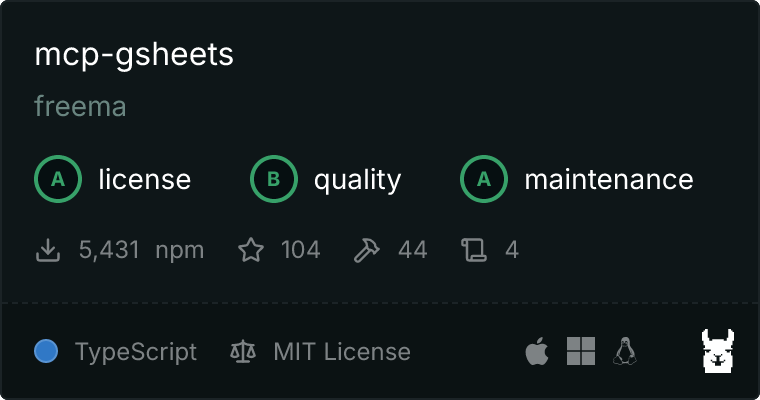 [](https://www.npmjs.com/package/mcp-gsheets)





A Model Context Protocol (MCP) server for Google Sheets API integration. Enables reading, writing, and managing Google Sheets documents directly from your MCP client (e.g., Claude Code, Claude Desktop, Cursor, etc.).
## Key Features
- **Complete Google Sheets Integration**: Read, write, and manage spreadsheets
- **Advanced Operations**: Batch operations, formatting, charts, and conditional formatting
- **Flexible Authentication**: Support for both file-based and JSON string credentials
- **Production Ready**: Built with TypeScript, comprehensive error handling, and full test coverage
## Requirements
- [Node.js](https://nodejs.org/) v20 or higher
- [Google Cloud Project](https://console.cloud.google.com) with Sheets API enabled
- Service Account with JSON key file
- [npm](https://www.npmjs.com/)
## Getting Started
### Quick Install (Recommended)
Add the following config to your MCP client:
```json
{
"mcpServers": {
"mcp-gsheets": {
"command": "npx",
"args": ["-y", "mcp-gsheets@latest"],
"env": {
"GOOGLE_PROJECT_ID": "your-project-id",
"GOOGLE_APPLICATION_CREDENTIALS": "/absolute/path/to/service-account-key.json"
}
}
}
}
```
> [!NOTE]
> Using `mcp-gsheets@latest` ensures that your MCP client will always use the latest version of the MCP Google Sheets server.
### MCP Client Configuration
[](https://www.npmjs.com/package/mcp-gsheets)





A Model Context Protocol (MCP) server for Google Sheets API integration. Enables reading, writing, and managing Google Sheets documents directly from your MCP client (e.g., Claude Code, Claude Desktop, Cursor, etc.).
## Key Features
- **Complete Google Sheets Integration**: Read, write, and manage spreadsheets
- **Advanced Operations**: Batch operations, formatting, charts, and conditional formatting
- **Flexible Authentication**: Support for both file-based and JSON string credentials
- **Production Ready**: Built with TypeScript, comprehensive error handling, and full test coverage
## Requirements
- [Node.js](https://nodejs.org/) v20 or higher
- [Google Cloud Project](https://console.cloud.google.com) with Sheets API enabled
- Service Account with JSON key file
- [npm](https://www.npmjs.com/)
## Getting Started
### Quick Install (Recommended)
Add the following config to your MCP client:
```json
{
"mcpServers": {
"mcp-gsheets": {
"command": "npx",
"args": ["-y", "mcp-gsheets@latest"],
"env": {
"GOOGLE_PROJECT_ID": "your-project-id",
"GOOGLE_APPLICATION_CREDENTIALS": "/absolute/path/to/service-account-key.json"
}
}
}
}
```
> [!NOTE]
> Using `mcp-gsheets@latest` ensures that your MCP client will always use the latest version of the MCP Google Sheets server.
### MCP Client Configuration
Claude Code
Use the Claude Code CLI to add the MCP Google Sheets server (guide):
```bash
claude mcp add mcp-gsheets npx mcp-gsheets@latest
```
After adding, edit your Claude Code config to add the required environment variables:
```json
{
"mcpServers": {
"mcp-gsheets": {
"command": "npx",
"args": ["mcp-gsheets@latest"],
"env": {
"GOOGLE_PROJECT_ID": "your-project-id",
"GOOGLE_APPLICATION_CREDENTIALS": "/absolute/path/to/service-account-key.json"
}
}
}
}
```
Claude Desktop
Add to your Claude Desktop config:
- macOS: `~/Library/Application Support/Claude/claude_desktop_config.json`
- Windows: `%APPDATA%\Claude\claude_desktop_config.json`
- Linux: `~/.config/claude/claude_desktop_config.json`
```json
{
"mcpServers": {
"mcp-gsheets": {
"command": "npx",
"args": ["-y", "mcp-gsheets@latest"],
"env": {
"GOOGLE_PROJECT_ID": "your-project-id",
"GOOGLE_APPLICATION_CREDENTIALS": "/absolute/path/to/service-account-key.json"
}
}
}
}
```
Cursor
Go to `Cursor Settings` → `MCP` → `New MCP Server`. Use the config provided above.
Cline
Follow https://docs.cline.bot/mcp/configuring-mcp-servers and use the config provided above.
Other MCP Clients
For other MCP clients, use the standard configuration format shown above. Ensure the `command` is set to `npx` and include the environment variables for Google Cloud authentication.
### Google Cloud Setup
1. Go to [Google Cloud Console](https://console.cloud.google.com)
2. Create a new project or select existing
3. Enable Google Sheets API:
- Navigate to "APIs & Services" → "Library"
- Search for "Google Sheets API" and click "Enable"
4. Create Service Account:
- Go to "APIs & Services" → "Credentials"
- Click "Create Credentials" → "Service Account"
- In the service accounts list, click the three dots in the `Actions` column → `Manage keys` → `Add key` → `Create new key` → select JSON format
- Download the JSON key file
5. Share your spreadsheets:
- Open your Google Sheet
- Click Share and add the service account email (from JSON file)
- Grant "Editor" permissions
### Alternative Authentication Methods
#### Option 1: JSON String Authentication
Instead of using a file path for credentials, you can provide the service account credentials directly as a JSON string. This is useful for containerized environments, CI/CD pipelines, or when you want to avoid managing credential files.
```json
{
"mcpServers": {
"mcp-gsheets": {
"command": "npx",
"args": ["-y", "mcp-gsheets@latest"],
"env": {
"GOOGLE_PROJECT_ID": "your-project-id",
"GOOGLE_SERVICE_ACCOUNT_KEY": "{\"type\":\"service_account\",\"project_id\":\"your-project\",\"private_key_id\":\"...\",\"private_key\":\"-----BEGIN PRIVATE KEY-----\\n...\\n-----END PRIVATE KEY-----\\n\",\"client_email\":\"...@....iam.gserviceaccount.com\",\"client_id\":\"...\",\"auth_uri\":\"https://accounts.google.com/o/oauth2/auth\",\"token_uri\":\"https://oauth2.googleapis.com/token\",\"auth_provider_x509_cert_url\":\"https://www.googleapis.com/oauth2/v1/certs\",\"client_x509_cert_url\":\"...\"}"
}
}
}
}
```
**Note**: When using `GOOGLE_SERVICE_ACCOUNT_KEY`:
- The entire JSON must be on a single line
- All quotes must be escaped with backslashes
- Newlines in the private key must be represented as `\\n`
- If the JSON includes a `project_id`, you can omit `GOOGLE_PROJECT_ID`
#### Option 2: Private Key Authentication (Simplified)
For the most user-friendly approach, you can provide just the private key and email directly. This is the simplest method and requires only two fields from your service account JSON:
```json
{
"mcpServers": {
"mcp-gsheets": {
"command": "npx",
"args": ["-y", "mcp-gsheets@latest"],
"env": {
"GOOGLE_PRIVATE_KEY": "-----BEGIN PRIVATE KEY-----\\nMIIEvgIBADANBgkqhkiG9w0BAQEFAASCBKgwggSkAgEAAoIBAQCgR6bvMNOUHZ29\\n+YgbVHAXsT/s+L/jnXTCB193zikCzspSBSfxLu8VRDjkNq9WUoDxizTATzMFNvNf\\n...\\n-----END PRIVATE KEY-----\\n",
"GOOGLE_CLIENT_EMAIL": "spreadsheet@your-project.iam.gserviceaccount.com"
}
}
}
}
```
**Note**: When using `GOOGLE_PRIVATE_KEY`:
- Newlines in the private key should be represented as `\\n`
- The private key must include the `-----BEGIN PRIVATE KEY-----` and `-----END PRIVATE KEY-----` markers
- The client email should be the service account email from your JSON file
- `GOOGLE_PROJECT_ID` is optional when using this method
## Local Development Setup
If you want to develop or contribute to this project, you can clone and build it locally:
```bash
# Clone the repository
git clone https://github.com/freema/mcp-gsheets.git
cd mcp-gsheets
# Install dependencies
npm install
# Build the project
npm run build
```
### Interactive Setup Script
Run the interactive setup script to configure your local MCP client:
```bash
npm run setup
```
This will:
- Guide you through the configuration
- Automatically detect your Node.js installation (including nvm)
- Find your Claude Desktop config
- Create the proper JSON configuration
- Optionally create a .env file for development
### Manual Local Configuration
If you prefer manual configuration with a local build, add to your MCP client config:
```json
{
"mcpServers": {
"mcp-gsheets": {
"command": "node",
"args": ["/absolute/path/to/mcp-gsheets/dist/index.js"],
"env": {
"GOOGLE_PROJECT_ID": "your-project-id",
"GOOGLE_APPLICATION_CREDENTIALS": "/absolute/path/to/service-account-key.json"
}
}
}
}
```
## 📦 Build & Development
### Development Commands
```bash
# Development mode with hot reload
npm run dev
# Build for production
npm run build
# Type checking
npm run typecheck
# Clean build artifacts
npm run clean
# Run MCP inspector for debugging
npm run inspector
# Run MCP inspector in development mode
npm run inspector:dev
```
### Task Runner (Alternative)
If you have [Task](https://taskfile.dev) installed:
```bash
# Install dependencies
task install
# Build the project
task build
# Run in development mode
task dev
# Run linter
task lint
# Format code
task fmt
# Run all checks
task check
```
### Development Setup
1. Create `.env` file for testing:
```bash
cp .env.example .env
# Edit .env with your credentials:
# GOOGLE_PROJECT_ID=your-project-id
# GOOGLE_APPLICATION_CREDENTIALS=/path/to/service-account.json
# TEST_SPREADSHEET_ID=your-test-spreadsheet-id
```
2. Run in development mode:
```bash
npm run dev # Watch mode with auto-reload
```
## 🎚️ Reducing context cost with toolsets
All 44 tools together cost about **9,900 tokens of context in every session**,
before the model does anything. Most workflows need a fraction of that.
`GSHEETS_TOOLSETS` limits which tools the server exposes:
```json
{
"mcpServers": {
"gsheets": {
"command": "npx",
"args": ["mcp-gsheets"],
"env": {
"GOOGLE_PROJECT_ID": "your-project-id",
"GOOGLE_APPLICATION_CREDENTIALS": "/path/to/key.json",
"GSHEETS_TOOLSETS": "core,charts"
}
}
}
}
```
| Toolset | Tools | What it covers |
|---|---|---|
| `core` | 11 | Read/write values, metadata, sheet structure, create spreadsheet |
| `sheets` | 9 | Sheet lifecycle, rows and columns |
| `formatting` | 15 | Colours, borders, merges, conditional rules, links, dates |
| `charts` | 3 | Create, update, delete charts |
| `tables` | 4 | Native tables |
| `analysis` | 2 | Full-sheet snapshot, range comparison |
Measured `tools/list` cost:
| Configuration | Tools | ≈ Tokens |
|---|---|---|
| _unset_ (default, all toolsets) | 44 | 9,875 |
| `GSHEETS_TOOLSETS=core` | 11 | 1,986 |
| `GSHEETS_TOOLSETS=core,sheets` | 20 | 3,548 |
| `GSHEETS_READ_ONLY=true` | 16 | 3,599 |
| `GSHEETS_TOOLSETS=core` + read-only | 6 | 912 |
Notes:
- **The default is unchanged** — leave `GSHEETS_TOOLSETS` unset and you get
every tool, exactly as before.
- **`core` is always included.** `GSHEETS_TOOLSETS=charts` means "charts as
well as core", not "charts only" — without core the server cannot read a cell.
- **A typo is a startup error**, not a silently smaller tool list.
- `GSHEETS_READ_ONLY=true` drops every writing tool and can be combined with
`GSHEETS_TOOLSETS`. It is enforced when a tool is called, not just when the
list is built, so a client cannot write by naming a hidden tool.
All tools also carry MCP annotations (`readOnlyHint`, `destructiveHint`,
`idempotentHint`), so clients can skip confirmation prompts on reads and warn
before destructive operations.
## 📋 Available Tools
### Reading Data
| Tool | Description | Key Parameters |
|------|-------------|----------------|
| `sheets_get_values` | Read cell values from a single range | `spreadsheetId`, `range` (A1 notation), `valueRenderOption` |
| `sheets_batch_get_values` | Read cell values from multiple ranges in one request | `spreadsheetId`, `ranges` (array of A1 ranges) |
| `sheets_get_metadata` | Get spreadsheet metadata: title, locale, sheets list with IDs, row/column counts | `spreadsheetId` |
| `sheets_check_access` | Verify that the service account can access a spreadsheet | `spreadsheetId` |
### Writing Data
| Tool | Description | Key Parameters |
|------|-------------|----------------|
| `sheets_update_values` | Write values to a single range (overwrites existing content) | `spreadsheetId`, `range`, `values` (2D array), `valueInputOption` |
| `sheets_batch_update_values` | Write values to multiple ranges in one request | `spreadsheetId`, `data` (array of `{range, values}`), `valueInputOption` |
| `sheets_append_values` | Append rows after the last row of an existing table. **Default `insertDataOption` is `OVERWRITE`** — set `INSERT_ROWS` to push existing rows down | `spreadsheetId`, `range`, `values`, `valueInputOption`, `insertDataOption` |
| `sheets_clear_values` | Clear all values in a range (preserves formatting) | `spreadsheetId`, `range` |
| `sheets_insert_rows` | Insert blank or pre-filled rows at a specific position | `spreadsheetId`, `range` (anchor), `rows`, `position` (BEFORE/AFTER), `values` |
| `sheets_delete_columns` | Delete one or more columns using a full-column A1 range | `spreadsheetId`, `range` (e.g. `Sheet1!B:D`) |
| `sheets_delete_rows` | Delete one or more rows using a full-row A1 range | `spreadsheetId`, `range` (e.g. `Sheet1!2:4`) |
| `sheets_insert_link` | Insert a hyperlink formula into a cell | `spreadsheetId`, `range`, `url`, `label` |
| `sheets_insert_date` | Insert a date/datetime value formatted correctly into a cell | `spreadsheetId`, `range`, `date`, `format` |
### Sheet Management
| Tool | Description | Key Parameters |
|------|-------------|----------------|
| `sheets_create_spreadsheet` | Create a new Google Sheets file | `title`, `sheets` (optional initial sheet configs) |
| `sheets_insert_sheet` | Add a new sheet tab to an existing spreadsheet | `spreadsheetId`, `title`, `index` |
| `sheets_delete_sheet` | Remove a sheet tab by its numeric sheet ID | `spreadsheetId`, `sheetId` |
| `sheets_duplicate_sheet` | Copy a sheet within the same spreadsheet | `spreadsheetId`, `sheetId`, `newSheetName`, `insertSheetIndex` |
| `sheets_copy_to` | Copy a sheet to a different spreadsheet | `spreadsheetId`, `sheetId`, `destinationSpreadsheetId` |
| `sheets_update_sheet_properties` | Rename a sheet, change tab colour, toggle grid lines, etc. | `spreadsheetId`, `sheetId`, `properties` |
| `sheets_batch_delete_sheets` | Delete multiple sheet tabs in one request | `spreadsheetId`, `sheetIds` (array) |
### Cell Formatting
| Tool | Description | Key Parameters |
|------|-------------|----------------|
| `sheets_format_cells` | Apply background colour, font style, alignment and number format to a range | `spreadsheetId`, `range`, `format` |
| `sheets_batch_format_cells` | Apply different formats to multiple ranges in one request | `spreadsheetId`, `requests` (array of `{range, format}`) |
| `sheets_update_borders` | Set or remove borders on a range (style, width, colour per side) | `spreadsheetId`, `range`, `borders` |
| `sheets_merge_cells` | Merge a range of cells | `spreadsheetId`, `range`, `mergeType` (MERGE_ALL / MERGE_COLUMNS / MERGE_ROWS) |
| `sheets_unmerge_cells` | Unmerge previously merged cells in a range | `spreadsheetId`, `range` |
| `sheets_add_conditional_formatting` | Add a conditional formatting rule (gradient or boolean) to a range | `spreadsheetId`, `range`, `rule` |
### Native Tables
| Tool | Description | Key Parameters |
|------|-------------|----------------|
| `sheets_add_table` | Create a native Google Sheets table with typed columns and optional dropdown values | `spreadsheetId`, `sheetName`, `range`, `name`, `columns` |
| `sheets_update_table` | Update an existing native Google Sheets table by table ID using an explicit field mask | `spreadsheetId`, `tableId`, `fields`, `name`, `range`, `columns` |
| `sheets_delete_table` | Delete a native Google Sheets table by table ID | `spreadsheetId`, `tableId` |
| `sheets_get_tables` | Read native tables for a spreadsheet or a specific sheet | `spreadsheetId`, `sheetName` |
### Charts
| Tool | Description | Key Parameters |
|------|-------------|----------------|
| `sheets_create_chart` | Create a bar, line, pie, column or other chart on a sheet | `spreadsheetId`, `sheetId`, `chartSpec`, `position` |
| `sheets_update_chart` | Modify an existing chart's spec or position | `spreadsheetId`, `chartId`, `chartSpec`, `position` |
| `sheets_delete_chart` | Remove a chart from a spreadsheet | `spreadsheetId`, `chartId` |
### Read / Snapshot Tools
| Tool | Description | Key Parameters |
|------|-------------|----------------|
| `sheets_get_merged_cells` | Return all merged cell ranges for a sheet, with A1 notation and raw GridRange coordinates | `spreadsheetId`, `sheetName` |
| `sheets_get_sheet_dimensions` | Return column widths, row heights, frozen column/row counts, and hidden flags for every column and row | `spreadsheetId`, `sheetName` |
| `sheets_get_sheet_formatting` | Read raw cell formatting (background colour, font, borders, alignment, number format) for a range without returning cell values | `spreadsheetId`, `range` |
| `sheets_get_conditional_formatting` | Read all conditional formatting rules and banded (alternating-colour) ranges defined on a sheet | `spreadsheetId`, `sheetName` |
| `sheets_get_sheet_structure` | Lightweight structural metadata only — no per-cell data. Returns dimensions, frozen rows/cols, tab colour, column widths, row heights, hidden columns/rows, and all merges in A1 notation. Single fast API call | `spreadsheetId`, `sheetName` |
| `sheets_get_formatting_compact` | Read cell formatting for a range and return it as compact A1Range→format pairs (run-length encoded). Identical adjacent cells are collapsed into rectangular ranges — reduces output by 90 %+ compared to per-cell data | `spreadsheetId`, `sheetName`, `range`, `useEffectiveFormat`, `fields` |
| `sheets_get_full_sheet_snapshot` | Master one-shot tool — returns all structural and formatting metadata (merges, dimensions, conditional formatting, and optionally cell formatting) in a single API call. Supports `fields` filter and `compactMode` to limit response size | `spreadsheetId`, `sheetName`, `includeFormattingRange`, `fields`, `compactMode` |
| `sheets_get_basic_filter` | Read the Basic Filter (AutoFilter) configuration for a sheet, including filtered range, sort specs, and per-column filter criteria (hidden values, conditions, colour filters) | `spreadsheetId`, `sheetName` |
| `sheets_get_data_validation` | Read data validation rules (checkboxes, dropdowns, custom formulas) from a sheet or range. Returns compact run-length-encoded list of unique rules grouped by cell ranges | `spreadsheetId`, `sheetName`, `range` |
## 🔧 Code Quality
### Linting
```bash
# Run ESLint
npm run lint
# Fix auto-fixable issues
npm run lint:fix
```
### Formatting
```bash
# Check formatting with Prettier
npm run format:check
# Format code
npm run format
```
### Type Checking
```bash
# Run TypeScript type checking
npm run typecheck
```
## ❗ Troubleshooting
### Common Issues
**"Authentication failed"**
- If using file-based auth: Verify JSON key path is absolute and correct
- If using JSON string auth: Ensure JSON is properly escaped and valid
- If using private key auth: Check that the private key includes BEGIN/END markers and newlines are escaped as `\\n`
- Verify GOOGLE_CLIENT_EMAIL is a valid service account email
- Check GOOGLE_PROJECT_ID matches your project (or is included in JSON for full JSON auth)
- Ensure Sheets API is enabled
**"Permission denied"**
- Share spreadsheet with service account email
- Service account needs "Editor" role
- Check email in JSON file (client_email field)
**"Spreadsheet not found"**
- Verify spreadsheet ID from URL
- Format: `https://docs.google.com/spreadsheets/d/[SPREADSHEET_ID]/edit`
**MCP Connection Issues**
- Ensure you're using the built version (`dist/index.js`)
- Check that Node.js path is correct in Claude Desktop config
- Look for errors in Claude Desktop logs
- Use `npm run inspector` to debug
## 🔍 Finding IDs
### Spreadsheet ID
From the URL:
```
https://docs.google.com/spreadsheets/d/1BxiMVs0XRA5nFMdKvBdBZjgmUUqptlbs74OgvE2upms/edit
↑ This is the spreadsheet ID
```
### Sheet ID
Use `sheets_get_metadata` to list all sheets with their IDs.
## 📝 Tips
1. Always test with a copy of your data
2. Use batch operations for better performance
3. Set appropriate permissions (read-only vs edit)
4. Check rate limits for large operations
5. Use `sheets_check_access` to verify permissions before operations
## 📘 Tool Details
### sheets_get_sheet_structure
Returns lightweight structural/dimensional metadata for a sheet without any per-cell data. Much faster and cheaper than `sheets_get_full_sheet_snapshot` when you only need layout information.
**Parameters:**
- `spreadsheetId` (required): The ID of the spreadsheet
- `sheetName` (required): Name of the sheet (tab)
**Returns:** `sheetName`, `sheetId`, `sheetIndex`, `tabColor`, `tabColorStyle`, `dimensions` (`rowCount`, `columnCount`), `frozen` (`rowCount`, `columnCount`), `columnWidths` (array of pixel sizes), `rowHeights` (array of pixel sizes), `hiddenColumns` (0-based indices), `hiddenRows` (0-based indices), `mergeCount`, `merges` (A1 notation array)
---
### sheets_get_formatting_compact
Read cell formatting for a range and return it as compact A1Range → format pairs. Adjacent cells with identical formatting are collapsed into rectangular ranges (run-length encoded), reducing output by 90 %+ compared to per-cell data.
**Parameters:**
- `spreadsheetId` (required): The ID of the spreadsheet
- `sheetName` (required): Name of the sheet (tab)
- `range` (required): Range without sheet prefix, e.g. `"A1:Z85"`
- `useEffectiveFormat` (optional): `false` (default) = userEnteredFormat (only explicit overrides, smaller output); `true` = effectiveFormat (all inherited defaults)
- `fields` (optional): Array of format field names to include, e.g. `["backgroundColor", "textFormat", "borders"]`
**Returns:** `{ range, formatType, rangeCount, data: { "A1:C3": { backgroundColor: {...} }, ... } }`
**Supported fields:** `backgroundColor`, `backgroundColorStyle`, `textFormat`, `horizontalAlignment`, `verticalAlignment`, `wrapStrategy`, `textRotation`, `numberFormat`, `padding`, `borders`
---
### sheets_get_full_sheet_snapshot
Master one-shot tool that returns all structural and formatting metadata in a single API call.
**Parameters:**
- `spreadsheetId` (required): The ID of the spreadsheet
- `sheetName` (required): Name of the sheet (tab)
- `includeFormattingRange` (optional): If provided (e.g. `"A1:Z100"`), per-cell formatting is included in the response
- `useEffectiveFormat` (optional): Use effectiveFormat instead of userEnteredFormat when including cell formatting (default: `false`)
- `fields` (optional): Array of format field names to return, e.g. `["backgroundColor", "textFormat"]` — reduces API transfer size and response size
- `compactMode` (optional): When `true`, identical adjacent cells are collapsed into rectangular ranges (RLE). Reduces a typical 85×28 sheet from ~60 000 lines to ~500 lines (default: `false`)
---
### sheets_insert_rows
Insert new rows at a specific position in a spreadsheet with optional data.
**Parameters:**
- `spreadsheetId` (required): The ID of the spreadsheet
- `range` (required): A1 notation anchor point where rows will be inserted (e.g., "Sheet1!A5")
- `rows` (optional): Number of rows to insert (default: 1)
- `position` (optional): 'BEFORE' or 'AFTER' the anchor row (default: 'BEFORE')
- `inheritFromBefore` (optional): Whether to inherit formatting from the row before (default: false)
- `values` (optional): 2D array of values to fill the newly inserted rows
- `valueInputOption` (optional): 'RAW' or 'USER_ENTERED' (default: 'USER_ENTERED')
**Examples:**
```javascript
// Insert 1 empty row before row 5
{
"spreadsheetId": "your-spreadsheet-id",
"range": "Sheet1!A5"
}
// Insert 3 rows after row 10 with data
{
"spreadsheetId": "your-spreadsheet-id",
"range": "Sheet1!A10",
"rows": 3,
"position": "AFTER",
"values": [
["John", "Doe", "john@example.com"],
["Jane", "Smith", "jane@example.com"],
["Bob", "Johnson", "bob@example.com"]
]
}
```
### sheets_delete_columns
Delete one or more columns from a sheet using a full-column A1 range.
**Parameters:**
- `spreadsheetId` (required): The ID of the spreadsheet
- `range` (required): Full-column A1 range to delete (e.g., "Sheet1!B:D" or "Sheet1!C:C")
**Examples:**
```javascript
// Delete columns B through D from Sheet1
{
"spreadsheetId": "your-spreadsheet-id",
"range": "Sheet1!B:D"
}
// Delete a single column from the first sheet
{
"spreadsheetId": "your-spreadsheet-id",
"range": "C:C"
}
```
### sheets_delete_rows
Delete one or more rows from a sheet using a full-row A1 range.
**Parameters:**
- `spreadsheetId` (required): The ID of the spreadsheet
- `range` (required): Full-row A1 range to delete (e.g., "Sheet1!2:4" or "Sheet1!3:3")
**Examples:**
```javascript
// Delete rows 2 through 4 from Sheet1
{
"spreadsheetId": "your-spreadsheet-id",
"range": "Sheet1!2:4"
}
// Delete a single row from the first sheet
{
"spreadsheetId": "your-spreadsheet-id",
"range": "3:3"
}
```
## 📋 Changelog
See [CHANGELOG.md](CHANGELOG.md) for a list of changes in each version.
## 🤝 Contributing
1. Fork the repository
2. Create your feature branch (`git checkout -b feature/amazing-feature`)
3. Run tests and linting (`npm run check`)
4. Commit your changes (`git commit -m 'Add some amazing feature'`)
5. Push to the branch (`git push origin feature/amazing-feature`)
6. Open a Pull Request
## 👤 Author
**Tomáš Grásl** - [tomasgrasl.cz](https://www.tomasgrasl.cz/)
## 📄 License
This project is licensed under the MIT License - see the [LICENSE](LICENSE) file for details.