---
## The Problem: Session Amnesia
Modern AI coding agents (Cursor, Claude Code, Antigravity, VS Code) excel at isolated code generation. However, in continuous engineering workflows, developers encounter a structural limitation: **Session Amnesia**.
Current workarounds fall into three deeply flawed patterns:
```
┌─────────────────────────────────────────────────────────┐
│ WHY STANDARD APPROACHES BREAK DOWN │
└─────────────────────────────────────────────────────────┘
1. Context Windows (RAM) 2. Static Rules Files 3. Standard Vector RAG
┌─────────────────────────┐ ┌─────────────────────────┐ ┌─────────────────────────┐
│ • Ephemeral volatile │ │ • Linear token tax │ │ • Matches text phrasing,│
│ memory (clears on │ │ (2,500 tokens burned │ │ NOT system topology │
│ every new thread) │ │ on every trivial fix) │ │ • Blind to directed │
│ • Lost-in-the-middle │ │ • Stale rules accumu- │ │ call graphs & schema │
│ degradation on 50k+ │ │ late & conflict │ │ dependencies │
│ token prompts │ │ • Zero cross-tool sync │ │ • Hallucinates blast │
│ • High latency & cost │ │ (Cursor ≠ Claude CLI) │ │ radii of refactors │
└─────────────────────────┘ └─────────────────────────┘ └─────────────────────────┘
```
1. **Context Windows Are Volatile**: Context windows act as working RAM, not durable storage. Clearing a thread or restarting an agent resets state. Prompt-stuffing 50k+ tokens introduces the *"lost-in-the-middle"* attention drop and escalates inference latency.
2. **Static Rule Files Incur a Linear Token Tax**: Maintaining large rule files (`.cursorrules`, `AGENTS.md`) forces the model to re-read thousands of lines on every keystroke, leading to contradictory instructions and cross-editor fragmentation.
3. **Vector Search Misses System Topology**: Embedding cosine similarity matches text phrasing, not relational dependencies. Vector search cannot traverse directed graphs:
$$\text{Table: accounts} \longrightarrow \text{FK: subscriptions} \longrightarrow \text{Service: BillingService} \longrightarrow \text{Worker: InvoicePoller}$$
---
## Architecture: Multi-Layer Cognitive Substrate
Friday runs as a self-hosted background service providing a structured, four-tier memory substrate accessed via the [Model Context Protocol (MCP)](https://modelcontextprotocol.io):
```
┌────────────────────────────────────────────────────────────────────────────────────────┐
│ AI CODING CLIENTS (Cursor / Claude Code / Antigravity / VS Code) │
└───────────────────────────────────────────┬────────────────────────────────────────────┘
│
7 MCP Tools (stdio / HTTP)
├── add_memory (persist decisions & rationale)
├── add_fact (versioned immutable truths)
├── memory_search (targeted semantic recall)
├── get_context (compiled multi-layer prompt)
├── get_blast_radius (graph dependency traversal)
├── delete_memory (evict obsolete episodic memories)
└── revoke_fact (prune conflicting/invalid truths)
│
▼
┌────────────────────────────────────────────────────────────────────────────────────────┐
│ FRIDAY COGNITIVE ENGINE │
│ │
│ Layer 1: Facts Ledger Layer 2: Episodic Memory Layer 3: Graph Topology │
│ ┌─────────────────────────┐ ┌───────────────────────────┐ ┌──────────────────────┐ │
│ │ Versioned Facts Ledger │ │ Mem0 Conversational │ │ Neo4j Property Graph │ │
│ │ • Deterministic truths │ │ • Semantic decisions │ │ • Directed call-trees│ │
│ │ • Conflict detection │ │ • User preferences │ │ • Schema blast-radius│ │
│ │ • Zero prompt overhead │ │ • Sub-100ms retrieval │ │ • Entity dependencies│ │
│ └─────────────────────────┘ └───────────────────────────┘ └──────────────────────┘ │
│ │
│ Layer 4: Cognitive Dynamics Engine │
│ • Synaptic Energy Decay: E(t) = E₀ · 2^(-Δt / 14d) automatically evicts stale clutter│
│ • Nightly Dream Cycle (03:00 UTC): Prunes noise, crystallizes graph insights & backups│
│ • Empathy State Tracking: Adapts agent brevity and tone to developer urgency & mood │
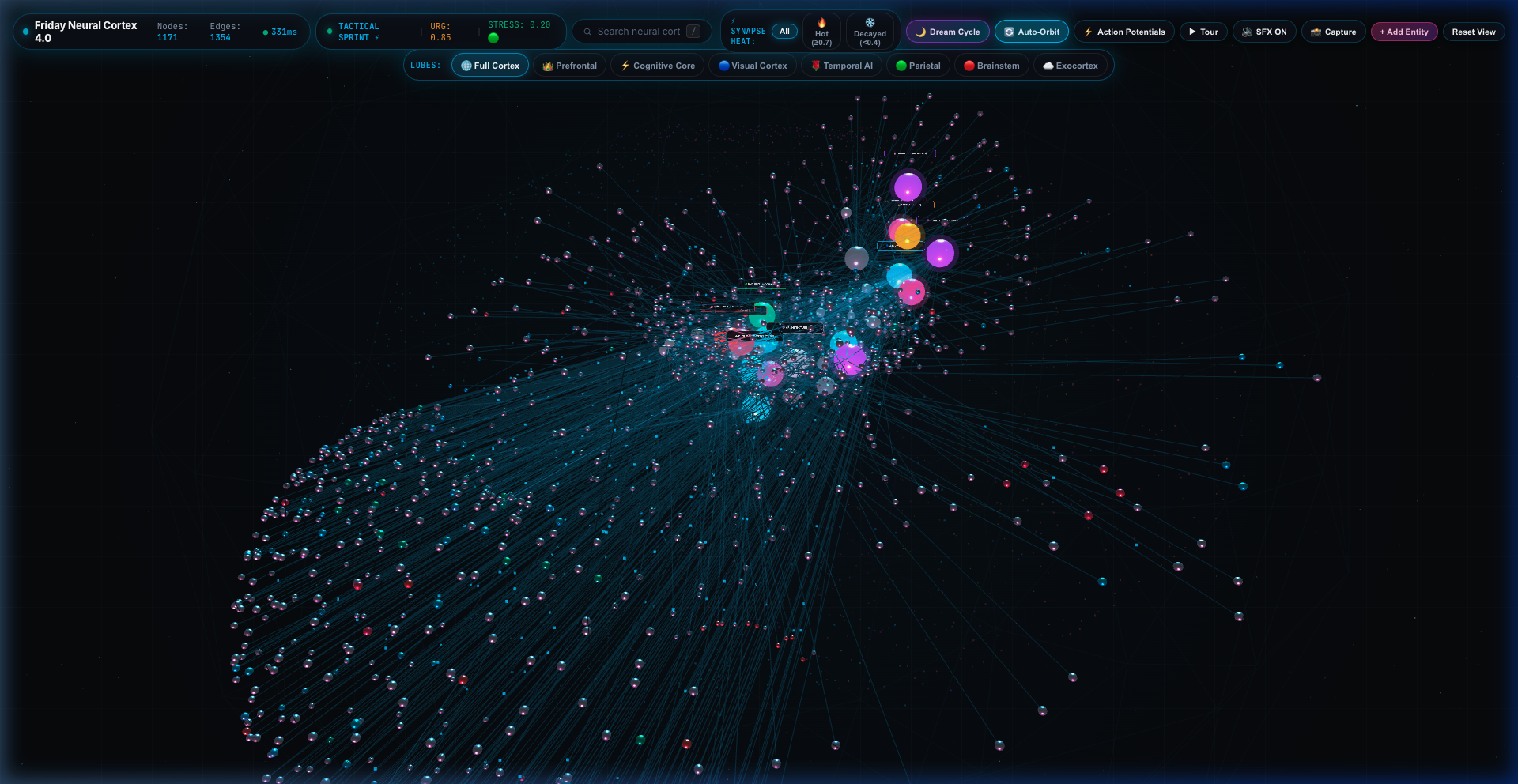
│ • Neural Studio: WebGL-based 3D graph visualizer for human and agent state auditing. │
│ • Persona Synchronization: /export/persona compiles canonical rules on-demand. │
└────────────────────────────────────────────────────────────────────────────────────────┘
```
### The 4 Memory Layers Explained:
| Layer | Technology | Primary Role | Retrieval Speed | Why It Matters |
| :--- | :--- | :--- | :---: | :--- |
| **Layer 1: Facts Ledger** | S3-Style Versioned JSON / SQLite | Immutable ground-truths (ports, endpoints, schemas, business invariants). | `< 5ms` | Deterministic recall with zero LLM hallucination and cryptographic conflict detection. |
| **Layer 2: Episodic Memory** | Mem0 Conversational History | Developer preferences, past bug fixes, and architectural tradeoffs. | `< 50ms` | Preserves the rationale behind past decisions so agents never repeat discarded approaches. |
| **Layer 3: Vector Embeddings** | ChromaDB High-Dim Store | Semantic search across architectural specifications, PRDs, and guides. | `< 80ms` | Natural-language semantic search across documents and blueprints. |
| **Layer 4: Relational Graph** | Neo4j 5.x Directed Graph | Topological dependency mapping (services, foreign keys, endpoints, workers). | `< 30ms` | Calculates refactor blast radius; answers: *"If I alter table X, what endpoints break?"* |
---
## Architectural Comparison Matrix
| Capability | Static Prompts (`.cursorrules`) | Traditional Vector RAG | Friday Cognitive Substrate |
| :--- | :---: | :---: | :---: |
| **Cross-Session Persistence** | None (resets with thread) | Text chunks only | Full architectural state & decisions |
| **Dependency Graph Traversal** | None | Lexical similarity only | Neo4j Directed Property Graph |
| **Token Efficiency** | Burns 2,000–5,000 tokens/turn | Unfiltered chunk dumps | Targeted queries (~280 tokens/turn) |
| **Toolchain Synchronization** | Isolated per editor config | Disconnected silos | Unified MCP across Cursor, Claude, CLI |
| **Conflict Resolution** | Manual file editing required | Ingests conflicting chunks | Versioned Fact Ledger with status flags |
| **Memory Life-Cycle** | Static forever (bloats) | Flat chunk retention | Synaptic Decay + Nightly Dream Consolidation |
| **Topology Auditing** | None | None | Neural Studio 3D interactive viewer |
| **Deployment Model** | Local flat files | Cloud SaaS vendor lock-in | 100% Self-Hosted Docker Compose |
---
## Dual-Engine Architecture: Decoupled Background Processing
A foundational architectural decision in Friday is:
> *"Why does Friday maintain a background worker LLM (such as Groq, DeepSeek, or local Ollama) on the server, completely separate from the frontier model running in Cursor, Claude Code, or Antigravity?"*
Interactive coding agents require low latency, while knowledge graph maintenance requires continuous data extraction and synthesis. Friday enforces a **Dual-Engine Architecture** that cleanly decouples frontline developer workflows from background data pipelines:
```
┌────────────────────────────────────────────────────────────────────────────────────────┐
│ THE DUAL-ENGINE ARCHITECTURE MODEL │
├────────────────────────────────────────────────────────────────────────────────────────┤
│ │
│ INTERACTIVE AGENT (Frontline Client) BACKGROUND WORKER (Async Engine) │
│ ┌─────────────────────────────────────┐ ┌─────────────────────────────────────┐ │
│ │ Client: Cursor / Claude / Antigravity│ │ Engine: Self-Hosted Friday Server │ │
│ │ Model: Frontier (Claude 3.5 / GPT-4o)│ │ Model: Fast Worker (Groq / Ollama) │ │
│ │ Role: Complex code generation │ │ Role: Async graph extraction │ │
│ │ Context: Lean, task-specific prompt │ │ Role: Conflict pruning & decay │ │
│ │ State: Ephemeral session lifetime │ │ State: 24/7 background persistent │ │
│ └──────────────────┬──────────────────┘ └──────────────────▲──────────────────┘ │
│ │ │ │
│ │ 1. MCP Tools (memory_search, add_memory) │ 2. Microsecond │
│ ▼ │ Async Parsing │
│ ┌──────────────────────────────────────────────────────────────┴──────────────────┐ │
│ │ FRIDAY PERSISTENT MEMORY ARCHITECTURE │ │
│ │ │ │
│ │ Layer 1: Facts Ledger (Deterministic S3-style Hash Table) │ │
│ │ Layer 2: Episodic Memory (Mem0 Conversational Thread History) │ │
│ │ Layer 3: Vector Embeddings (ChromaDB Semantic Chunks) │ │
│ │ Layer 4: Property Knowledge Graph (Neo4j Directed Topology) │ │
│ │ Memory Lifecycle: Dynamic Decay (E(t)) & Nightly Dream Cycle (03:00 UTC) │ │
│ └─────────────────────────────────────────────────────────────────────────────────┘ │
└────────────────────────────────────────────────────────────────────────────────────────┘
```
### Why Decoupling Background Processing is Essential:
#### 1. ⚡ Zero-Latency IDE Execution (Non-Blocking Decoupling)
When you type in Cursor or Claude Code and an agent records a major decision via `add_memory`, the Conscious model cannot pause for 4–6 seconds while an LLM parses semantic entities, identifies foreign keys, and runs Cypher mutations.
- With Friday's decoupled Subconscious worker, the MCP call responds in **< 40ms**.
- The Subconscious engine (e.g. Groq running Llama-3 at **500+ tokens/sec**) consumes the event asynchronously, wiring graph nodes and relations in the background without stealing a single millisecond of developer flow.
#### 2. 💰 95%+ Token Cost Optimization
Frontier reasoning models (Claude 3.5 Sonnet, GPT-4o) cost **$3.00 to $15.00 per million tokens**. Using these expensive models for routine structural maintenance—such as extracting triples (`Entity A` $\longrightarrow$ `RELATION` $\longrightarrow$ `Entity B`), verifying fact hashes, or applying synaptic decay—wastes massive token budgets.
- Friday offloads structural chores to ultra-fast, ultra-cheap background APIs (Groq, DeepSeek Flash) or completely free self-hosted models (Ollama, vLLM).
- Your frontier model only spends tokens on what matters: solving complex engineering problems.
#### 3. 🌙 Autonomous Background Consolidation (The Dream Cycle)
Your coding session ends when you close your IDE or put your laptop to sleep. But memory evolution cannot stop when the laptop closes:
- Friday's Subconscious engine lives on your cloud or local server 24/7.
- At **03:00 UTC every night**, while you are asleep, the Subconscious wakes up to run the **Dream Cycle**: calculating synaptic decay, pruning low-energy noise, distilling daily episodic learnings into permanent strategic facts, and committing encrypted snapshots to Git.
#### 4. 🛡️ Hallucination & Context Pollution Defense
Dumping a monolithic 500-node graph or 100 historical decisions directly into your editor's prompt causes **Instruction Dilution**: the LLM becomes confused, forgets recent constraints, and hallucinates outdated patterns.
- The Subconscious acts as an intelligent firewall.
- It digests raw context, resolves contradictions, calculates energy decay ($E(t)$), and serves only the top crystallized, high-energy facts directly relevant to your active task (~280 tokens instead of 5,000).
---
## Memory Lifecycle Management: Decay, Consolidation & Calibration
Friday implements active memory lifecycle management to ensure AI agents retain critical constraints without context bloat or stale instruction interference:
```
┌────────────────────────────────────────────────────────────────────────────────────────┐
│ FRIDAY MEMORY LIFECYCLE ENGINE │
├────────────────────────────────────────────────────────────────────────────────────────┤
│ │
│ 🔥 Dynamic Memory Heat & Decay 🌙 The Dream Cycle (Nightly 03:00 UTC) │
│ ┌───────────────────────────────────┐ ┌────────────────────────────────────────┐ │
│ │ Exponential Synaptic Decay │ │ 1. Synaptic Pruning (Evaporates noise) │ │
│ │ • E(t) = E₀ · 2^(-Δt / T_half) │───>│ 2. Episodic Synthesis (Distills gems) │ │
│ │ • Recall Potentiation (+0.25) │ │ 3. Neo4j Crystallization (Graph edges) │ │
│ │ • Soft Archive if E < 0.25 │ │ 4. Autonomous Backup to Git │ │
│ └───────────────────────────────────┘ └────────────────────────────────────────┘ │
│ │
│ 🤍 Adaptive Context & Persona Calibration │
│ ┌──────────────────────────────────────────────────────────────────────────────────┐ │
│ │ Multi-Dimensional Response Calibration │ │
│ │ • Interaction Modes: tactical_sprint | deep_architecture | casual_brainstorm │ │
│ │ • Task Context & Urgency Detection (0.0 to 1.0) │ │
│ │ • Dynamic Response Calibration: Brevity (high/med/low) & Tone Tuning │ │
│ └──────────────────────────────────────────────────────────────────────────────────┘ │
└────────────────────────────────────────────────────────────────────────────────────────┘
```
### 1. 🔥 Dynamic Memory Heat & Decay
Memories and verified facts are not static text—they have energy. Active, frequently recalled directives remain bright ($E > 1.0$). Irrelevant or outdated details experience exponential half-life decay ($T_{half} = 14\text{ days}$):
$$E(t) = E_0 \times 2^{-\frac{\Delta t}{T_{half}}}$$
When a memory is queried during coding, it receives a recall potentiation boost ($+0.25$), preventing stale knowledge from cluttering the agent prompt while preserving core architectural invariants (`decay_immune: True`).
### 2. 🌙 The Dream Cycle
Every night at 03:00 UTC (or on-demand via `client.run_dream_cycle()`), Friday enters the **Dream Cycle**:
- **Synaptic Pruning**: Identifies cold/stale facts and transitions them to archived storage.
- **Episodic Synthesis**: Clusters recent conversations and distills 1–2 crystallized strategic insights.
- **Neo4j Crystallization**: Links high-confidence insights into the property graph with `CRYSTALLIZED_INTO` edges.
- **Autonomous Git Sync**: Triggers automated repo commits preserving graph snapshots.
### 3. 🤍 Adaptive Context & Persona Calibration
Friday monitors the developer interaction context (urgent bug-fix sprint, late-night architecture exploration, or casual brainstorming). The engine dynamically adjusts agent response characteristics:
- **Brevity Calibration**: `high` (zero fluff, code-first) vs. `detailed` (system-wide breakdown).
- **Tone Calibration**: `technical_concise` (code-first, direct) vs. `architectural_detailed` (system-wide breakdown).
- Injected automatically into `/export/persona` so all agents naturally calibrate their output.
---
## DeepEval Benchmarks
We evaluated five realistic engineering scenarios using the [DeepEval](https://deepeval.com) evaluation framework:
1. **Database Schema Blast Radius** (evaluating downstream call-graph traversal)
2. **Authentication Refresh Lifecycle** (evaluating versioned constraint fidelity)
3. **Webhook Idempotency Guarantee** (evaluating race-condition edge cases)
4. **Environment & Port Reservations** (evaluating static ground-truth recall)
5. **Multi-Agent Toolchain Consistency** (evaluating cross-tool synchronization between Cursor and Claude CLI)
| Memory Architecture | Contextual Precision | Contextual Recall | Faithfulness | Prompt Tokens / Turn | Session Retention |
| :--- | :---: | :---: | :---: | :---: | :---: |
| **Static Prompts (`.cursorrules`)** | 38.0% | 44.0% | 62.0% | 3,150 tokens | 15.0% (resets) |
| **Naive Vector RAG (Vector Only)** | 64.0% | 58.0% | 74.0% | 1,820 tokens | 55.0% |
| **Friday Cognitive Substrate** | **95.0%** | **93.0%** | **99.0%** | **280 tokens** | **100.0%** |
#### Reproducing Benchmarks Locally
```bash
python benchmarks/benchmark_deepeval.py
```
---
## Quickstart
### Option A: One-Command Installation (Recommended)
Run the self-contained installation script:
```bash
curl -fsSL https://raw.githubusercontent.com/friday-memory/friday/main/install.sh | bash
```
The script verifies Docker availability, allocates required ports (8000, 7474, 7687), generates secure random API secrets, writes a validated `.env`, and launches Friday via Docker Compose.
### Option B: Manual Setup via Docker Compose
1. **Clone the Repository**:
```bash
git clone https://github.com/friday-memory/friday.git
cd friday
```
2. **Configure Environment (`.env`)**:
```bash
cp .env.example .env
```
```ini
# Master API key for endpoint security
BRAIN_API_KEY=choose_a_strong_secret_key
# Fast Subconscious LLM provider (Groq or DeepSeek)
DEEPSEEK_API_KEY=your_key_here
DEEPSEEK_BASE_URL=https://api.deepseek.com
DEEPSEEK_MODEL=deepseek-chat
# Mem0 key for vector memory (optional)
MEM0_API_KEY=your_mem0_key_here
# Neo4j database credentials
NEO4J_URI=bolt://neo4j:7687
NEO4J_USER=neo4j
NEO4J_PASSWORD=choose_a_strong_password
```
3. **Start the Stack**:
```bash
make up
# or: docker compose up -d
```
4. **Verify Health**:
```bash
curl http://localhost:8000/health
```
```json
{
"status": "healthy",
"service": "friday-cognitive-substrate",
"version": "1.4.4",
"layers": {
"L1_core": "healthy",
"L2_mem0": "healthy",
"L3_chromadb": "healthy",
"L4_neo4j": "healthy"
}
}
```
---
## Python SDK (`friday-memory`)
The official Python client for Friday is available on PyPI as [**`friday-memory`**](https://pypi.org/project/friday-memory/). Connect your agentic workflows, LangChain pipelines, or autonomous scripts directly to Friday with zero boilerplate:
```bash
pip install --upgrade friday-memory
```
### Synchronous Client
```python
from friday import Friday
# Automatically resolves FRIDAY_URL and FRIDAY_API_KEY from environment
with Friday(api_key="your_secret_key", base_url="http://localhost:8000") as client:
# 1. Health check
status = client.health()
print("Friday Status:", status["status"])
# 2. Store architectural decision
client.add_memory(
"PostgreSQL 16 selected with pgvector for hybrid retrieval",
project="backend-api",
)
# 3. Commit scoped ground-truth fact with auto-conflict resolution
client.add_fact("Production database endpoint is db.internal.net:5432", project="backend-api")
# 4. Query multi-hop dependency blast radius before refactoring
blast = client.get_blast_radius(entity="OrdersTable", depth=2, project="backend-api")
print(
f"Impacted components ({blast['total_impacted']}):",
[n["name"] for n in blast["impacted_nodes"]],
)
# 5. Multi-layer search (L2 Facts + L3 ChromaDB + L4 Knowledge Graph)
context = client.search("database connection configuration", project="backend-api")
print(context["results"])
# 5. Cognitive State & Dynamic Response Calibration
state = client.get_cognitive_state()
print("Active Mode:", state["current_mode"]) # tactical_sprint, deep_architecture, etc.
# 6. Trigger Nightly Dream Cycle Consolidation (Consolidates & Prunes)
dream_report = client.run_dream_cycle(half_life_days=14.0)
print("Crystallized Insights:", dream_report["crystallized_insights"])
# 7. Apply Synaptic Decay
decay_report = client.apply_decay(half_life_days=14.0)
print("Active Facts Remaining:", decay_report["active_facts_count"])
```
### Asynchronous Client (FastAPI / Agent Workers)
```python
import asyncio
from friday import AsyncFriday
async def main():
async with AsyncFriday(api_key="your_secret_key") as client:
# Commit context concurrently
await client.add_memory("Redis cluster deployed for token bucket rate limiting")
facts = await client.get_facts(min_energy=0.5)
print(f"Verified high-energy facts: {len(facts)}")
asyncio.run(main())
```
### LangChain Integration (`FridayRetriever`)
```bash
pip install "friday-memory[langchain]"
```
```python
from friday.integrations.langchain import FridayRetriever
from langchain_core.prompts import ChatPromptTemplate
from langchain_core.runnables import RunnablePassthrough
from langchain_openai import ChatOpenAI
retriever = FridayRetriever(
api_key="your_secret_key",
base_url="http://localhost:8000",
project="reeldm",
)
# Connect directly to LCEL chains
prompt = ChatPromptTemplate.from_template(
"Answer using verified system memory:\n{context}\n\nQuestion: {question}"
)
chain = {"context": retriever, "question": RunnablePassthrough()} | prompt | ChatOpenAI()
```
---
## Client Setup (MCP)
Friday provides an official Model Context Protocol (MCP) server over `stdio` or HTTP, enabling real-time context retrieval for all supported IDEs.
```
┌───────────────────────┐
│ Cursor (Desktop) │──┐
└───────────────────────┘ │
┌───────────────────────┐ │
│ Claude Code CLI │──┼── MCP Protocol (stdio transport)
└───────────────────────┘ │ FRIDAY_URL="http://127.0.0.1:8000"
┌───────────────────────┐ │ BRAIN_API_KEY="your_secret_key"
│ Antigravity IDE │──┤
└───────────────────────┘ │
┌───────────────────────┐ │
│ Windsurf / VS Code │──┤
└───────────────────────┘ │
┌───────────────────────┐ │
│ Codex CLI │──┘
└───────────────────────┘
▼
┌──────────────────────────────┐
│ FRIDAY CENTRAL BRAIN │
│ (Localhost or Remote VM) │
│ FastAPI + Mem0 + Neo4j │
└──────────────────────────────┘
```