# OxideDock
[](https://github.com/fridzema/oxide-dock/actions/workflows/ci.yml)
[](LICENSE)
[](https://github.com/fridzema/oxide-dock/stargazers)
[](https://github.com/fridzema/oxide-dock/releases)
[](CONTRIBUTING.md)
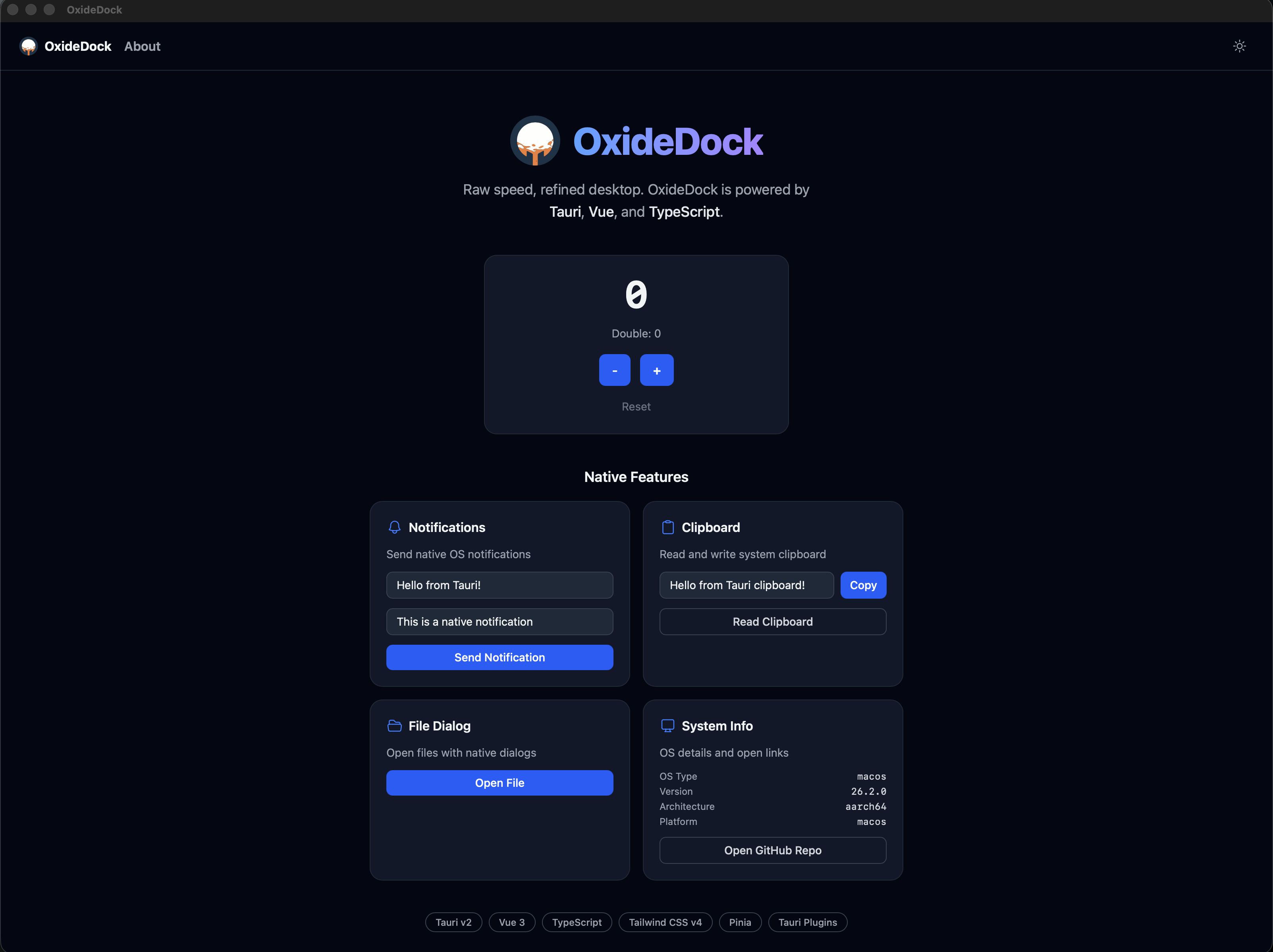
Raw speed, refined desktop.
OxideDock is a Rust + Vue 3 desktop starter built on Tauri v2 — native performance, polished DX, ship-ready apps.
## Why OxideDock?
Starting a Tauri app from scratch means wiring up routing, state management, testing, linting, CI/CD, and release pipelines yourself. OxideDock gives you all of that out of the box so you can skip the boilerplate and start building your app from day one.
- **Production-ready defaults** — linting, formatting, testing, and CI all preconfigured
- **Cross-platform releases** — push a tag and get Linux, macOS, and Windows binaries
- **One command** — `make dev` and you're running
## Features
- **Tauri v2** — lightweight, secure desktop runtime
- **Vue 3** — reactive frontend with Composition API
- **Vite** — fast dev server and build tool
- **TypeScript** — type-safe frontend and configuration
- **Guarded IPC** — a test fails the build if Rust commands and the TypeScript layer drift apart
- **Tailwind CSS v4** — utility-first styling with Vite plugin
- **Vue Router** — client-side routing
- **Pinia** — type-safe state management
- **VueUse** — essential Vue composables
- **Vitest** — fast unit and component testing
- **Playwright** — e2e testing against the web frontend
- **ESLint** — flat config with Vue 3 rules
- **Biome** — fast formatting and linting
- **Clippy + Rustfmt** — Rust linting and formatting
- **cargo-audit** — Rust dependency security auditing
- **Lefthook** — fast, parallel pre-commit hooks
- **GitHub Actions** — CI (lint + test + build) and release pipelines
- **Makefile** — unified task runner for all operations
## Prerequisites
- [Rust](https://www.rust-lang.org/tools/install) (latest stable)
- [Bun](https://bun.sh/) (v1.0+)
- [Tauri v2 system dependencies](https://v2.tauri.app/start/prerequisites/) for your OS
## Quick Start
```bash
# Clone the template
git clone https://github.com/fridzema/oxide-dock.git
cd oxide-dock
# Verify prerequisites (Rust, Bun)
make check
# Install dependencies
make setup
# (Optional) Rename the project to your own app
make bootstrap
# Start development
make dev
```
## Project Structure
```
oxidedock/
├── .github/workflows/ # CI and release pipelines
├── .vscode/ # Editor settings and extensions
├── src/ # Vue 3 frontend
│ ├── components/ # Reusable components
│ ├── composables/ # Shared composables
│ ├── layouts/ # Layout components
│ ├── pages/ # Route views
│ ├── router/ # Vue Router configuration
│ ├── stores/ # Pinia stores
│ ├── App.vue # Root component
│ ├── main.ts # App entry point
│ └── style.css # Tailwind CSS imports
├── src-tauri/ # Rust backend
│ ├── src/ # Rust source code
│ ├── capabilities/ # Permission capabilities
│ ├── Cargo.toml # Rust dependencies
│ └── tauri.conf.json # Tauri configuration
├── tests/
│ ├── unit/ # Vitest unit tests
│ └── e2e/ # Playwright e2e tests
├── Makefile # Task runner
├── lefthook.yml # Git hooks
└── README.md
```
## Available Commands
### Development
| Command | Description |
| ------------------- | ------------------------------- |
| `make dev` | Start Tauri dev with hot reload |
| `make dev-frontend` | Start Vite dev server only |
| `make build` | Build production binary |
| `make build-debug` | Build with debug console |
### Linting & Formatting
| Command | Description |
| ------------------- | ------------------------------------------ |
| `make lint` | Run all linters (ESLint + Biome + Clippy) |
| `make lint-fix` | Auto-fix linting issues |
| `make format` | Format all files |
| `make format-check` | Check formatting |
### Testing
| Command | Description |
| ----------------- | ------------------------ |
| `make test` | Run all tests |
| `make test-unit` | Run Vitest unit tests |
| `make test-e2e` | Run Playwright e2e tests |
| `make test-watch` | Run Vitest in watch mode |
### Rust
| Command | Description |
| ------------------ | ------------------------- |
| `make rust-lint` | Run Clippy |
| `make rust-format` | Run Rustfmt |
| `make rust-audit` | Check for vulnerabilities |
| `make rust-test` | Run Rust tests |
### CI, Setup & Bootstrap
| Command | Description |
| ---------------- | ---------------------------------- |
| `make check` | Verify prerequisites are installed |
| `make setup` | Install all dependencies |
| `make bootstrap` | Rename project to your own app |
| `make ci` | Run full CI pipeline locally |
| `make coverage` | Run all coverage (Rust + Vue) |
| `make clean` | Remove build artifacts |
## Tech Stack
| Technology | Version | Purpose |
| ------------ | ------- | ------------------------- |
| Tauri | v2 | Desktop runtime |
| Vue | v3 | Frontend framework |
| Vite | v8 | Build tool |
| TypeScript | v6 | Type safety |
| Tailwind CSS | v4 | Styling |
| Vue Router | v5 | Routing |
| Pinia | v4 | State management |
| VueUse | latest | Composable utilities |
| Vitest | latest | Unit testing |
| Playwright | latest | E2e testing |
| ESLint | v10 | Vue linting |
| Biome | v2 | Formatting and linting |
| Lefthook | latest | Git hooks |
## Type-Safe IPC
Commands cross the Rust/TypeScript boundary through `src/shared/ipc.ts`: every command gets a typed wrapper, and Rust's structured `AppError` gets a matching TypeScript type.
Three places have to agree for a command to work: it must be defined with `#[tauri::command]` in `src-tauri/src/handlers.rs`, registered in `tauri::generate_handler!` in `src-tauri/src/lib.rs`, and declared in `CommandResults` in `src/shared/ipc.ts`. Miss one and the failure shows up at runtime, usually as a confusing "command not found".
`tests/unit/ipc-surface.test.ts` reads all three and fails the build if they disagree, so that class of bug cannot reach a release.
This checks the command *surface* — that every command exists in all three places under the same name. It does not verify argument or payload field types; those still rely on the hand-written types in `src/shared/ipc.ts` matching the Rust structs.
## Recipes
Optional features are opt-in, not preinstalled. Each one is a **recipe** — an idempotent script that
wires the feature into your checkout: dependency, plugin registration, capability, config.
```bash
make add-window-state # remember window size and position across restarts
make add-tray # system tray icon with a menu
make add-updater # in-app auto-updates (needs signing keys)
```
Each recipe prints what it changed and points at its own README under `recipes/`. Recipes modify
your working tree and are meant to be run once and committed — review the diff like any other
change. `git checkout --` is the undo.
### Verified in CI
`recipes.yml` applies every recipe to a clean checkout on every push and pull request, then runs
ESLint, Biome, the TypeScript type check, the Vitest suite, `cargo clippy -- -D warnings` and
`cargo test` against the result. It applies the recipe a second time and fails if that produces any
diff, so a recipe that stops being idempotent cannot land.
Pull requests deliberately skip the app build to keep the feedback loop short. `recipes-nightly.yml`
covers it: once a day it runs the full `make ci` — including `bun tauri build` — for every recipe on
Linux.
## CI/CD
### CI Pipeline (`ci.yml`)
Runs on every push to `main` and on pull requests:
1. **Lint** — ESLint, Biome check, TypeScript type check
2. **Rust Lint** — Clippy + Rustfmt (Linux only)
3. **Test** — Vitest unit tests, Playwright e2e (chromium), Rust tests on all platforms with coverage on Linux
4. **Audit** — `cargo audit` runs daily and on Cargo dependency changes (separate workflow)
5. **Build** — Linux smoke build (main branch only); full cross-platform build happens at release time
### Release Pipeline
Releases are fully automated via [release-please](https://github.com/googleapis/release-please):
1. Push conventional commits to `main` (`fix:`, `feat:`, `feat!:`)
2. Release-please opens a PR bumping versions and updating `CHANGELOG.md`
3. Merging the PR tags the release, triggering cross-platform builds
4. A draft GitHub Release is created with platform binaries:
- Linux: `.deb`, `.AppImage`
- macOS: `.dmg` (Intel + Apple Silicon)
- Windows: `.msi`, `.exe`
Check release status with `make release-status`.
## Customization
### Change App Name and Icon
1. Update `name` in `package.json`
2. Update `productName` in `src-tauri/tauri.conf.json`
3. Replace icons in `src-tauri/icons/` (use `bun tauri icon /path/to/icon.png`)
### Add a UI Component Library
```bash
# Shadcn Vue
bunx shadcn-vue@latest init
# Or PrimeVue
bun add primevue
```
### Add Internationalization
```bash
bun add vue-i18n
```
Create locale files in `src/locales/` and register the plugin in `src/main.ts`.
### Code Signing
Follow the [Tauri code signing guide](https://v2.tauri.app/distribute/sign/) to set up signing for macOS and Windows distribution.
## Built with OxideDock
Apps shipped on top of OxideDock:
- [SoapDuck](https://www.soapduck.com) — a native macOS SOAP client for developers: load WSDLs, build and send SOAP requests, and inspect responses, with WS-Security and certificate signing.
Built something with OxideDock? Open a PR to add it here.
## Contributing
1. Fork the repository
2. Create a feature branch (`git checkout -b feature/your-feature`)
3. Make your changes
4. Run `make ci` to verify everything passes
5. Commit with a descriptive message
6. Push and open a pull request
## Contributors
 ## License
[MIT](LICENSE)
## License
[MIT](LICENSE)