
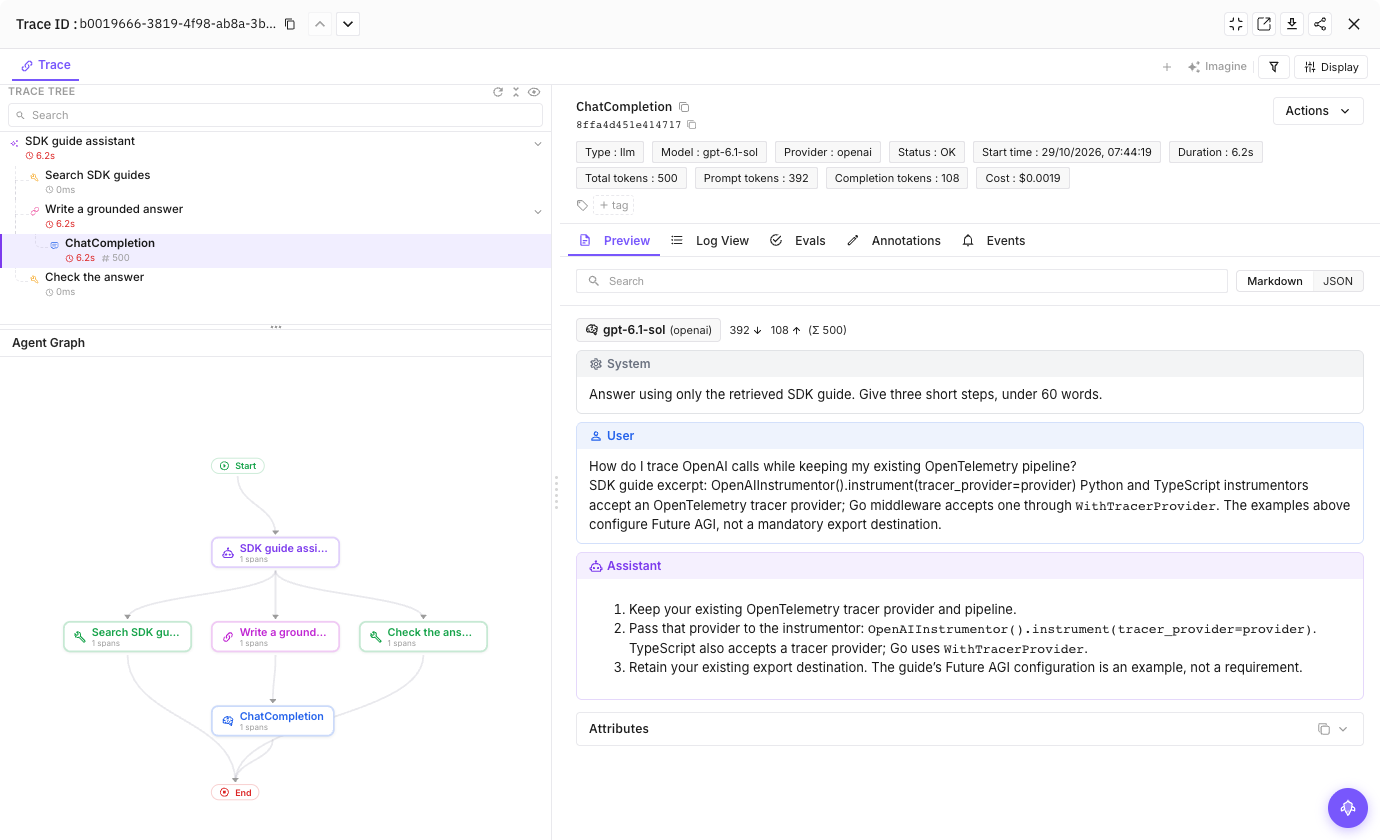
A real traced SDK guide assistant: five spans, 500 tokens, and server-computed cost. Capture and reproduction details.
- **Start at the SDK boundary.** Instrument supported clients and frameworks instead of adding logging around each call. - **Follow the request.** Connect model calls, retrieval, and tool execution with OpenTelemetry spans and context. - **Choose what leaves your app.** Configure content masking and export through your own OpenTelemetry pipeline. ## Quickstart Pick your language. These examples send traces to [Future AGI](https://app.futureagi.com); you can also supply your own OpenTelemetry tracer provider and exporter. | Language | Instrumentation | Install / coordinates | | :--- | :--- | :--- | | [Python](#python) | Framework instrumentors · Python 3.10–3.13 for this example | `pip install fi-instrumentation-otel traceai-openai` | | [TypeScript / JavaScript](#typescript--javascript) | Node.js instrumentors · OpenAI SDK 4 or 5 | `npm install @traceai/fi-core @traceai/openai` | | [Java](#java) | Client wrappers · Java 17+ | Maven: `com.futureagi:traceai-java-openai:1.0.0` | | [Go](#go) | Middleware · Go 1.26+ for OpenAI | `go get github.com/future-agi/traceAI/go/openai@latest` | | [C#](#c) | Manual spans and activities · .NET 10 | `dotnet add package fi-instrumentation-otel` | Set your credentials in the environment, not in source code. The OpenAI examples use `OPENAI_MODEL`; C# creates a manual span and needs only the Future AGI keys. ```bash export FI_API_KEY="your-future-agi-api-key" export FI_SECRET_KEY="your-future-agi-secret-key" export OPENAI_API_KEY="your-openai-api-key" export OPENAI_MODEL="gpt-4.1" # Choose a model available to your account. ``` ### Python ```bash pip install fi-instrumentation-otel traceai-openai ``` Save as `quickstart.py`, then run `python quickstart.py`. ```python import os from openai import OpenAI from fi_instrumentation import register from fi_instrumentation.fi_types import ProjectType from traceai_openai import OpenAIInstrumentor provider = register(project_name="traceai-quickstart", project_type=ProjectType.OBSERVE) OpenAIInstrumentor().instrument(tracer_provider=provider) try: response = OpenAI().chat.completions.create( model=os.environ["OPENAI_MODEL"], messages=[{"role": "user", "content": "Say hello in one word."}], ) print(response.choices[0].message.content) finally: provider.shutdown() # Flush pending spans before the process exits. ``` [Python SDK](python/) · [OpenAI integration guide](https://docs.futureagi.com/docs/integrations/traceai/openai) ### TypeScript / JavaScript **Install, instrument, and make a traced OpenAI call** ```bash npm install @traceai/fi-core @traceai/openai @opentelemetry/instrumentation openai@5 npm install --save-dev tsx typescript @types/node ``` Save as `quickstart.ts`, then run `npx tsx quickstart.ts`. The explicit patch below also works when ESM imports load OpenAI before the instrumentation hook. ```typescript import OpenAI from "openai"; import { register, ProjectType } from "@traceai/fi-core"; import { OpenAIInstrumentation } from "@traceai/openai"; import { registerInstrumentations } from "@opentelemetry/instrumentation"; const provider = register({ projectName: "traceai-quickstart", projectType: ProjectType.OBSERVE, }); const instrumentation = new OpenAIInstrumentation(); registerInstrumentations({ tracerProvider: provider, instrumentations: [instrumentation] }); instrumentation.manuallyInstrument(OpenAI); // Explicit patch for ESM imports. async function main() { try { const response = await new OpenAI().chat.completions.create({ model: process.env.OPENAI_MODEL!, messages: [{ role: "user", content: "Say hello in one word." }], }); console.log(response.choices[0].message.content); } finally { await provider.shutdown(); } } main().catch((error) => { console.error(error); process.exitCode = 1; }); ``` For CommonJS, register the instrumentation **before** `require("openai")`; the module hook then patches it automatically. Use only one patching approach per application. [TypeScript SDK](typescript/) · [OpenAI integration guide](https://docs.futureagi.com/docs/integrations/traceai/openai) ### Java **Add the Maven dependencies and wrap your client** Add these dependencies to your `pom.xml`. The OpenAI client is a provided dependency, so include it explicitly. ```xml Amazon Bedrock | [SDK](python/frameworks/bedrock/ "traceAI-bedrock") | [SDK](typescript/packages/traceai_bedrock/ "@traceai/bedrock") | [SDK](java/traceai-java-bedrock/ "traceai-java-bedrock") | [SDK](go/bedrock/ "github.com/future-agi/traceAI/go/bedrock") | — |
|
 Anthropic | [SDK](python/frameworks/anthropic/ "traceAI-anthropic") | [SDK](typescript/packages/traceai_anthropic/ "@traceai/anthropic") | [SDK](java/traceai-java-anthropic/ "traceai-java-anthropic") | [SDK](go/anthropic/ "github.com/future-agi/traceAI/go/anthropic") | — |
|
 Azure OpenAI | — | — | [SDK](java/traceai-java-azure-openai/ "traceai-java-azure-openai") | — | — |
|
 Cerebras | [SDK](python/frameworks/cerebras/ "traceAI-cerebras") | [SDK](typescript/packages/traceai_cerebras/ "@traceai/cerebras") | — | — | — |
|
 Cohere | [SDK](python/frameworks/cohere/ "traceAI-cohere") | [SDK](typescript/packages/traceai_cohere/ "@traceai/cohere") | [SDK](java/traceai-java-cohere/ "traceai-java-cohere") | — | — |
| DeepSeek | [SDK](python/frameworks/deepseek/ "traceAI-deepseek") | [SDK](typescript/packages/traceai_deepseek/ "@traceai/deepseek") | — | — | — |
| Fireworks AI | [SDK](python/frameworks/fireworks/ "traceAI-fireworks") | [SDK](typescript/packages/traceai_fireworks/ "@traceai/fireworks") | — | — | — |
|
 Google GenAI (Gemini) | [SDK](python/frameworks/google-genai/ "traceAI-google-genai") · [Live](python/frameworks/google-genai-live/ "traceAI-google-genai-live") | [Legacy SDK only](typescript/packages/traceai_google_genai/ "@google/generative-ai compatibility; not @google/genai") | [SDK](java/traceai-java-google-genai/ "traceai-java-google-genai") | [SDK](go/genai/ "github.com/future-agi/traceAI/go/genai") | — |
|
 Groq | [SDK](python/frameworks/groq/ "traceAI-groq") | [SDK](typescript/packages/traceai_groq/ "@traceai/groq") | — | — | — |
| Hugging Face | [SDK](python/frameworks/huggingface/ "traceAI-huggingface") | [SDK](typescript/packages/traceai_huggingface/ "@traceai/huggingface") | — | — | — |
| IBM watsonx | — | — | [SDK](java/traceai-java-watsonx/ "traceai-java-watsonx") | — | — |
| MiniMax | [SDK](python/frameworks/minimax/ "traceAI-minimax") | — | — | — | — |
|
 Mistral AI | [SDK](python/frameworks/mistralai/ "traceAI-mistralai") | [SDK](typescript/packages/traceai_mistral/ "@traceai/mistral") | — | — | — |
|
 Ollama | [SDK](python/frameworks/ollama/ "traceAI-ollama") | [SDK](typescript/packages/traceai_ollama/ "@traceai/ollama") | [SDK](java/traceai-java-ollama/ "traceai-java-ollama") | — | — |
| OpenAI | [SDK](python/frameworks/openai/ "traceAI-openai") · [Realtime](python/frameworks/openai-realtime/ "traceAI-openai-realtime") | [SDK](typescript/packages/traceai_openai/ "@traceai/openai") | [SDK](java/traceai-java-openai/ "traceai-java-openai") | [SDK](go/openai/ "github.com/future-agi/traceAI/go/openai") | — |
| Replicate | [SDK](python/frameworks/replicate/ "traceAI-replicate") | — | — | — | — |
|
 Together AI | [SDK](python/frameworks/together/ "traceAI-together") | [SDK](typescript/packages/traceai_together/ "@traceai/together") | — | — | — |
|
 Vertex AI | [SDK](python/frameworks/vertexai/ "traceAI-vertexai") | [SDK](typescript/packages/traceai_vertexai/ "@traceai/fi-instrumentation-vertexai") | [SDK](java/traceai-java-vertexai/ "traceai-java-vertexai") | — | — |
| vLLM | [SDK](python/frameworks/vllm/ "traceAI-vllm") | [SDK](typescript/packages/traceai_vllm/ "@traceai/vllm") | — | — | — |
| Voyage AI | [SDK](python/frameworks/voyage/ "traceAI-voyage") | — | — | — | — |
| xAI | [SDK](python/frameworks/xai/ "traceAI-xai") | [SDK](typescript/packages/traceai_xai/ "@traceai/xai") | — | — | — |
### Agent frameworks
Agent orchestration, application frameworks, and agent-to-agent communication.
| Integration | Python | TypeScript | Java | Go | C# |
| :--- | :---: | :---: | :---: | :---: | :---: |
| A2A | [SDK](python/frameworks/a2a/ "traceAI-a2a") | — | — | [SDK](go/a2a/ "github.com/future-agi/traceAI/go/a2a") | — |
| AG2 | [SDK](python/frameworks/ag2/ "traceAI-ag2") · [Classic](python/frameworks/ag2-classic/ "traceAI-ag2-classic") | — | — | — | — |
| AgentScope | [SDK](python/frameworks/agentscope/ "traceAI-agentscope") | — | — | — | — |
| Agno | [SDK](python/frameworks/agno/ "traceai-agno") | — | — | — | — |
|
 AutoGen | [SDK](python/frameworks/autogen/ "traceAI-autogen") | — | — | — | — |
| BeeAI | [SDK](python/frameworks/beeai/ "traceai-beeai") | [SDK](typescript/packages/traceai_beeai/ "@traceai/beeai") | — | — | — |
|
 CrewAI | [SDK](python/frameworks/crewai/ "traceAI-crewai") | — | — | — | — |
| Eino | — | — | — | [SDK](go/eino/ "github.com/future-agi/traceAI/go/eino") | — |
| Genkit | — | [SDK](typescript/packages/traceai_genkit/ "@traceai/genkit") | — | — | — |
| Google ADK | [SDK](python/frameworks/google-adk/ "traceAI-google-adk") | [SDK](typescript/packages/traceai_google_adk/ "@traceai/fi-instrumentation-google-adk") | — | — | — |
| Hermes Agent | [SDK](python/frameworks/hermes-agent/ "traceAI-hermes-agent") | — | — | — | — |
|
 LangChain / LangGraph | [SDK](python/frameworks/langchain/ "traceAI-langchain") | [SDK](typescript/packages/traceai_langchain/ "@traceai/langchain") | — | — | — |
|
 Mastra | — | [SDK](typescript/packages/traceai_mastra/ "@traceai/mastra") | — | — | — |
| MCP-use | [SDK](python/frameworks/mcp-use/ "traceAI-mcp-use") | — | — | — | — |
| Microsoft Agent Framework | [SDK](python/frameworks/agent-framework/ "traceAI-agent-framework") | — | — | — | — |
| OpenAI Agents | [SDK](python/frameworks/openai-agents/ "traceAI-openai-agents") | [SDK](typescript/packages/traceai_openai_agents/ "@traceai/openai-agents") | — | — | — |
| Pydantic AI | [SDK](python/frameworks/pydantic-ai/ "traceai-pydantic-ai") | — | — | — | — |
| Semantic Kernel | [SDK](python/frameworks/semantic-kernel/ "traceAI-semantic-kernel") | — | [SDK](java/traceai-java-semantic-kernel/ "traceai-java-semantic-kernel") | — | — |
| Smolagents | [SDK](python/frameworks/smolagents/ "traceAI-smolagents") | — | — | — | — |
| Strands Agents | [SDK](python/frameworks/strands/ "traceai-strands") | [SDK](typescript/packages/traceai_strands/ "@traceai/strands") | — | — | — |
| Temporal | [SDK](python/frameworks/temporal/ "traceAI-temporal") | — | — | — | — |
|
 Vercel AI SDK | — | [SDK](typescript/packages/traceai_vercel/ "@traceai/vercel") | — | — | — |
| VoltAgent | — | [SDK](typescript/packages/traceai_voltagent/ "@traceai/voltagent") | — | — | — |
### RAG & vector databases
Retrieval pipelines, vector stores, and search backends.
| Integration | Python | TypeScript | Java | Go | C# |
| :--- | :---: | :---: | :---: | :---: | :---: |
| Azure AI Search | — | — | [SDK](java/traceai-java-azure-search/ "traceai-java-azure-search") | — | — |
| Chroma | [SDK](python/frameworks/chromadb/ "traceAI-chromadb") | [SDK](typescript/packages/traceai_chromadb/ "@traceai/chromadb") | [SDK](java/traceai-java-chromadb/ "traceai-java-chromadb") | — | — |
| Cognee | [SDK](python/frameworks/cognee/ "traceai-cognee") | — | — | — | — |
| Open WebUI | [SDK](python/frameworks/openwebui/ "traceAI-openwebui") | — | — | — | — |
| Elasticsearch | — | — | [SDK](java/traceai-java-elasticsearch/ "traceai-java-elasticsearch") | — | — |
| Google Discovery Engine | [SDK](python/frameworks/discoveryengine/ "traceAI-discoveryengine") | — | — | — | — |
|
 Haystack | [SDK](python/frameworks/haystack/ "traceAI-haystack") | — | — | — | — |
| LanceDB | [SDK](python/frameworks/lancedb/ "traceAI-lancedb") | [SDK](typescript/packages/traceai_lancedb/ "@traceai/lancedb") | — | — | — |
|
 LlamaIndex | [SDK](python/frameworks/llama_index/ "traceAI-llamaindex") | [SDK](typescript/packages/traceai_llamaindex/ "@traceai/llamaindex") | — | — | — |
| Milvus | [SDK](python/frameworks/milvus/ "traceAI-milvus") | [SDK](typescript/packages/traceai_milvus/ "@traceai/milvus") | [SDK](java/traceai-java-milvus/ "traceai-java-milvus") | — | — |
| MongoDB Atlas Vector Search | [SDK](python/frameworks/mongodb-vector/ "traceAI-mongodb") | [SDK](typescript/packages/traceai_mongodb/ "@traceai/mongodb") | [SDK](java/traceai-java-mongodb/ "traceai-java-mongodb") | — | — |
| pgvector | [SDK](python/frameworks/pgvector/ "traceAI-pgvector") | [SDK](typescript/packages/traceai_pgvector/ "@traceai/pgvector") | [SDK](java/traceai-java-pgvector/ "traceai-java-pgvector") | — | — |
|
 Pinecone | [SDK](python/frameworks/pinecone/ "traceAI-pinecone") | [SDK](typescript/packages/traceai_pinecone/ "@traceai/pinecone") | [SDK](java/traceai-java-pinecone/ "traceai-java-pinecone") | — | — |
| Qdrant | [SDK](python/frameworks/qdrant/ "traceAI-qdrant") | [SDK](typescript/packages/traceai_qdrant/ "@traceai/qdrant") | [SDK](java/traceai-java-qdrant/ "traceai-java-qdrant") | — | — |
| Redis Vector Search | [SDK](python/frameworks/redis-vector/ "traceAI-redis") | [SDK](typescript/packages/traceai_redis/ "@traceai/redis") | [SDK](java/traceai-java-redis/ "traceai-java-redis") | — | — |
| Weaviate | [SDK](python/frameworks/weaviate/ "traceAI-weaviate") | [SDK](typescript/packages/traceai_weaviate/ "@traceai/weaviate") | [SDK](java/traceai-java-weaviate/ "traceai-java-weaviate") | — | — |
### Tools & search
Tool connectivity, web search, crawling, and extraction.
| Integration | Python | TypeScript | Java | Go | C# |
| :--- | :---: | :---: | :---: | :---: | :---: |
| Exa | [SDK](python/frameworks/exa/ "traceAI-exa") | — | — | — | — |
| Firecrawl | [SDK](python/frameworks/firecrawl/ "traceAI-firecrawl") | — | — | — | — |
|
 MCP | [SDK](python/frameworks/mcp/ "traceAI-mcp") | [SDK](typescript/packages/traceai_mcp/ "@traceai/mcp") | — | — | — |
| Parallel | [SDK](python/frameworks/parallel/ "traceAI-parallel") | — | — | — | — |
| Tavily | [SDK](python/frameworks/tavily/ "traceAI-tavily") | — | — | — | — |
### Voice & realtime
Voice-agent pipelines and conversations. OpenAI Realtime and Google GenAI Live are linked in their provider rows under [Model providers](#model-providers).
| Integration | Python | TypeScript | Java | Go | C# |
| :--- | :---: | :---: | :---: | :---: | :---: |
| ElevenLabs Agents | [SDK](python/frameworks/elevenlabs-agents/ "traceAI-elevenlabs-agents") | — | — | — | — |
|
 LiveKit | [SDK](python/frameworks/livekit/ "traceAI-livekit") | [SDK](typescript/packages/traceai_livekit/ "@traceai/fi-instrumentation-livekit") | — | — | — |
|
 Pipecat | [SDK](python/frameworks/pipecat/ "traceAI-pipecat") | [SDK](typescript/packages/traceai_pipecat/ "@traceai/fi-instrumentation-pipecat") | — | — | — |
### Gateways & proxies
Unified access and routing across model providers.
| Integration | Python | TypeScript | Java | Go | C# |
| :--- | :---: | :---: | :---: | :---: | :---: |
|
 LiteLLM | [SDK](python/frameworks/litellm/ "traceAI-litellm") | — | — | — | — |
| Portkey | [SDK](python/frameworks/portkey/ "traceAI-portkey") | [SDK](typescript/packages/traceai_portkey/ "@traceai/portkey") | — | — | — |
### Coding agents
In-process SDK integrations for coding-agent runs, sessions, and tools.
| Integration | Python | TypeScript | Java | Go | C# |
| :--- | :---: | :---: | :---: | :---: | :---: |
| Claude Agent SDK | [SDK](python/frameworks/claude-agent-sdk/ "traceai-claude-agent-sdk") | [SDK](typescript/packages/traceai_claude_agent_sdk/ "@traceai/claude-agent-sdk") | — | — | — |
| Codex SDK | — | [SDK](typescript/packages/traceai_codex_sdk/ "@traceai/codex-sdk") | — | — | — |
| Cursor SDK | — | [SDK](typescript/packages/traceai_cursor_sdk/ "@traceai/cursor-sdk") | — | — | — |
| Pi Coding Agent | — | [SDK](typescript/packages/traceai_pi_coding_agent/ "@traceai/pi-coding-agent") | — | — | — |
### Java frameworks
Java application-framework integrations and auto-configuration.
| Integration | Python | TypeScript | Java | Go | C# |
| :--- | :---: | :---: | :---: | :---: | :---: |
| LangChain4j | — | — | [SDK](java/traceai-langchain4j/ "traceai-langchain4j") | — | — |
|
 Spring AI | — | — | [SDK](java/traceai-spring-ai/ "traceai-spring-ai") | — | — |
| Spring Boot | — | — | [SDK](java/traceai-spring-boot-starter/ "traceai-spring-boot-starter") | — | — |
### Other
LLM programming, structured output, validation, and evaluation.
| Integration | Python | TypeScript | Java | Go | C# |
| :--- | :---: | :---: | :---: | :---: | :---: |
|
 DSPy | [SDK](python/frameworks/dspy/ "traceAI-DSPy") | — | — | — | — |
|
 Guardrails AI | [SDK](python/frameworks/guardrails/ "traceAI-guardrails") | [SDK](typescript/packages/traceai_guardrails/ "@traceai/guardrails") | — | — | — |
| Instructor | [SDK](python/frameworks/instructor/ "traceAI-instructor") | [SDK](typescript/packages/traceai_instructor/ "@traceai/instructor") | — | — | — |
| TypeSafe | [SDK](python/frameworks/typesafe/ "traceAI-typesafe") | — | — | — | — |
**Bring existing telemetry:** [OpenInference](https://docs.futureagi.com/docs/integrations/import/openinference) · [OpenLLMetry](https://docs.futureagi.com/docs/integrations/otel/openllmetry)
**Source indexes:** [Python packages](python/frameworks/) · [TypeScript packages](typescript/packages/) · [Java modules](java/) · [Go modules](go/) · [C# APIs](csharp/src/FIInstrumentation/)
[Counting method and manifest inventory](.github/assets/integration-coverage.json) · Regenerate with `python3 .github/assets/generate-coverage.py` (Python 3.11+).
Brand marks identify integrations, not partnerships or endorsements. A neutral package icon is used where no brand asset is bundled. [Asset sources and licenses](.github/assets/integrations/provenance.json).
## OpenTelemetry, without a new tracing stack
