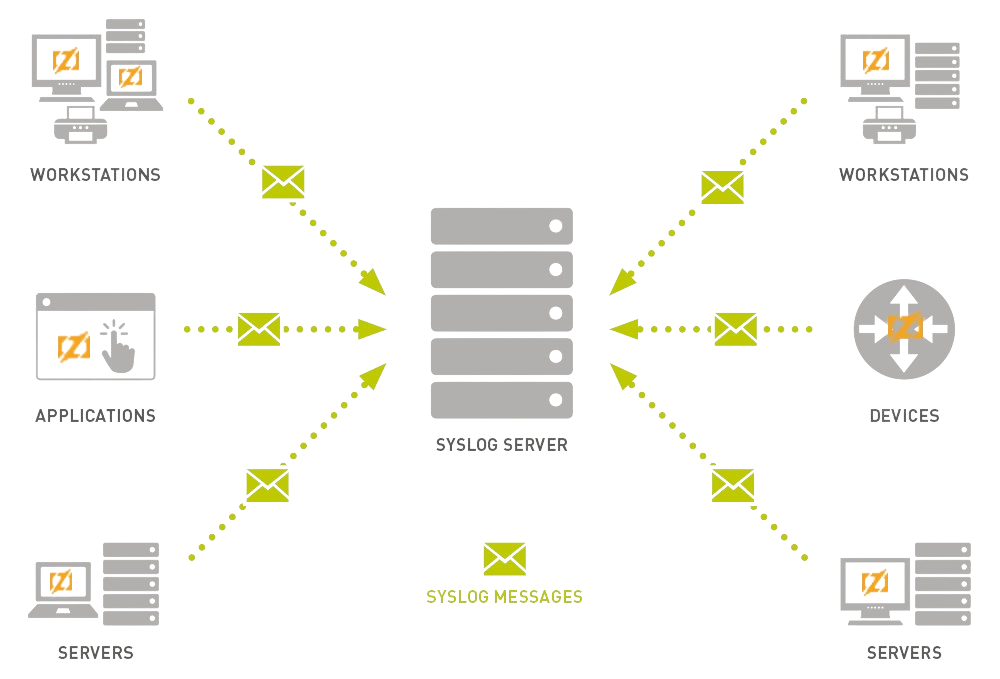
# Zig syslog client
[](https://github.com/g41797/syslog/actions/workflows/ci.yml)[](https://en.wikipedia.org/wiki/Syslog)


 This is a [syslog](https://en.wikipedia.org/wiki/Syslog) client library for Zig:
| | |
|-----------|:------------------------------------------------------------------:|
| Protocols | UDP, TCP |
| RFC | Subset of [RFC5424](https://datatracker.ietf.org/doc/html/rfc5424) |
| Tested on | Mac, Windows, Linux |
For the curious: [IT Explained:
Syslog](https://www.paessler.com/it-explained/syslog)
## Hello, Zig!
When client code calls
```zig
logger.write_info("Hello, Zig!");
```
[syslog client](src/syslog.zig) sends following text message to syslog receiver process:
>
> <190>1 2024-10-09T09:07:11+00:00 BLKF zigprocess 18548 1 - Hello, Zig!
>
Let's see what this message consist of:
| Value | RFC Definition | Description |
|:-----------:|:---------------:|:-------------------------------------------------------|
| 190 | PRIVAL | [Priority](#priority) |
| 1 | VERSION | Always 1 |
| 2024-10-09T09:07:11+00:00 | TIMESTAMP | FULL-DATE "T" FULL-TIME |
| BLKF | HOSTNAME | Hostname or '-' |
| zigprocess | APP-NAME | Application name provided by caller |
| 18548 | PROCID | Process ID or '-' |
| 1 | MSGID | Message ID - sequential number generated automatically |
| - | STRUCTURED-DATA | Always '-' |
| Hello, Zig! | MSG | Message |
### Priority
> Priority = Facility * 8 + Severity
**Facility** represents the machine process that created the Syslog event
| rfc5424.Facility | Value | Description |
|:----------------------| :---: | :--- |
| .kern | 0 | kernel messages |
| .user | 1 | random user-level messages |
| .mail | 2 | mail system |
| .daemon | 3 | system daemons |
| .auth | 4 | security/authorization messages |
| .syslog | 5 | messages generated internally by syslogd |
| .lpr | 6 | line printer subsystem |
| .news | 7 | network news subsystem |
| .uucp | 8 | UUCP subsystem |
| .cron | 9 | clock daemon |
| .authpriv | 10 | security/authorization messages (private) |
| .ftp | 11 | ftp daemon |
| .local0 | 16 | local use 0 |
| .local1 | 17 | local use 1 |
| .local2 | 18 | local use 2 |
| .local3 | 19 | local use 3 |
| .local4 | 20 | local use 4 |
| .local5 | 21 | local use 5 |
| .local6 | 22 | local use 6 |
| .local7 | 23 | local use 7 |
**Severity** describes the severity level of the syslog message in question.
| Level | rfc5424.Severity | Description |
| :---: |:-----------------| :--- |
|0| .emerg | system is unusable |
|1| .alert | action must be taken immediately |
|2| .crit | critical conditions |
|3| .err | error conditions |
|4| .warning | warning conditions |
|5| .notice | normal but significant condition |
|6| .info | informational |
|7| .debug | debug-level messages |
### Quiz
What are *Facility* and *Severity* of **"Hello, Zig!"** message?
### For leisure time
- [What is Syslog?](https://www.auvik.com/franklyit/blog/what-is-syslog/)
- [syslog-ng Open Source Edition](https://www.syslog-ng.com/products/open-source-log-management/)
- [The rocket-fast system for log processing](https://www.rsyslog.com/)
- [Old brave syslogd](https://linux.die.net/man/8/syslogd)
- [Kafka syslog connector](https://www.confluent.io/hub/confluentinc/kafka-connect-syslog)
- [Nats syslog connector](https://github.com/g41797/syslog2nats)
## Installation
Add *syslog* to build.zig.zon:
```bach
zig fetch --save=syslog git+https://github.com/g41797/syslog
```
Add *syslog* to build.zig:
```zig
const syslog = b.dependency("syslog", .{
.target = target,
.optimize = optimize,
});
const lib = b.addStaticLibrary(..);
lib.root_module.addImport("syslog", syslog.module("syslog"));
const lib_unit_tests = b.addTest(...);
lib_unit_tests.root_module.addImport("syslog", syslog.module("syslog"));
```
Import *syslog*:
```zig
const syslog = @import("syslog");
```
## Usage
### Configuration
syslog uses following configuration:
```zig
pub const SyslogOpts = struct {
// application:
name: []const u8 = "zigprocess",
fcl: rfc5424.Facility = .local7,
// transport:
proto: Protocol = .udp,
addr: []const u8 = "127.0.0.1",
port: u16 = 514,
};
```
### Initialization
```zig
var logger: syslog.Syslog = .{};
try logger.init(std.testing.allocator, .{
.name = "runner",
.fcl = .daemon
.port = 12345,
});
defer logger.deinit();
```
After initialization you can call syslog on different threads.
### Logging
There are two groups of APIs:
- write: message is straight text
```zig
pub inline fn write_(slog: *Syslog, msg: []const u8) !void {...}
....
logger.write_debug("Hello, Zig!");
```
- print: message will be formatted before send
```zig
pub inline fn print_(slog: *Syslog, comptime fmt: []const u8, msg: anytype) !void {...}
....
const name = "World";
logger.print_debug("Hello, {s}!", .{name});
```
### Filtering
Set filter:
```zig
// disable send messages with .info & .debug severities
logger.setfilter(.info);// disable send messages with .info & .debug severities
```
Reset filter:
```zig
logger.setfilter(null);
```
## AI Usage
The following refactoring was performed by [Claude Code](https://claude.com/product/claude-code):
* **Explicit Pointer Dereferencing**: Removed "Automatic pointer dereference" and replaced it with explicit `ptr.*` syntax.
* **Explicit Type Declaration**: Removed "Type Inference" by adding explicit types to all variable declarations.
Related configuration files and guidelines are located in the [.claude/rules](.claude/rules) directory.
## License
[MIT](LICENSE)
This is a [syslog](https://en.wikipedia.org/wiki/Syslog) client library for Zig:
| | |
|-----------|:------------------------------------------------------------------:|
| Protocols | UDP, TCP |
| RFC | Subset of [RFC5424](https://datatracker.ietf.org/doc/html/rfc5424) |
| Tested on | Mac, Windows, Linux |
For the curious: [IT Explained:
Syslog](https://www.paessler.com/it-explained/syslog)
## Hello, Zig!
When client code calls
```zig
logger.write_info("Hello, Zig!");
```
[syslog client](src/syslog.zig) sends following text message to syslog receiver process:
>
> <190>1 2024-10-09T09:07:11+00:00 BLKF zigprocess 18548 1 - Hello, Zig!
>
Let's see what this message consist of:
| Value | RFC Definition | Description |
|:-----------:|:---------------:|:-------------------------------------------------------|
| 190 | PRIVAL | [Priority](#priority) |
| 1 | VERSION | Always 1 |
| 2024-10-09T09:07:11+00:00 | TIMESTAMP | FULL-DATE "T" FULL-TIME |
| BLKF | HOSTNAME | Hostname or '-' |
| zigprocess | APP-NAME | Application name provided by caller |
| 18548 | PROCID | Process ID or '-' |
| 1 | MSGID | Message ID - sequential number generated automatically |
| - | STRUCTURED-DATA | Always '-' |
| Hello, Zig! | MSG | Message |
### Priority
> Priority = Facility * 8 + Severity
**Facility** represents the machine process that created the Syslog event
| rfc5424.Facility | Value | Description |
|:----------------------| :---: | :--- |
| .kern | 0 | kernel messages |
| .user | 1 | random user-level messages |
| .mail | 2 | mail system |
| .daemon | 3 | system daemons |
| .auth | 4 | security/authorization messages |
| .syslog | 5 | messages generated internally by syslogd |
| .lpr | 6 | line printer subsystem |
| .news | 7 | network news subsystem |
| .uucp | 8 | UUCP subsystem |
| .cron | 9 | clock daemon |
| .authpriv | 10 | security/authorization messages (private) |
| .ftp | 11 | ftp daemon |
| .local0 | 16 | local use 0 |
| .local1 | 17 | local use 1 |
| .local2 | 18 | local use 2 |
| .local3 | 19 | local use 3 |
| .local4 | 20 | local use 4 |
| .local5 | 21 | local use 5 |
| .local6 | 22 | local use 6 |
| .local7 | 23 | local use 7 |
**Severity** describes the severity level of the syslog message in question.
| Level | rfc5424.Severity | Description |
| :---: |:-----------------| :--- |
|0| .emerg | system is unusable |
|1| .alert | action must be taken immediately |
|2| .crit | critical conditions |
|3| .err | error conditions |
|4| .warning | warning conditions |
|5| .notice | normal but significant condition |
|6| .info | informational |
|7| .debug | debug-level messages |
### Quiz
What are *Facility* and *Severity* of **"Hello, Zig!"** message?
### For leisure time
- [What is Syslog?](https://www.auvik.com/franklyit/blog/what-is-syslog/)
- [syslog-ng Open Source Edition](https://www.syslog-ng.com/products/open-source-log-management/)
- [The rocket-fast system for log processing](https://www.rsyslog.com/)
- [Old brave syslogd](https://linux.die.net/man/8/syslogd)
- [Kafka syslog connector](https://www.confluent.io/hub/confluentinc/kafka-connect-syslog)
- [Nats syslog connector](https://github.com/g41797/syslog2nats)
## Installation
Add *syslog* to build.zig.zon:
```bach
zig fetch --save=syslog git+https://github.com/g41797/syslog
```
Add *syslog* to build.zig:
```zig
const syslog = b.dependency("syslog", .{
.target = target,
.optimize = optimize,
});
const lib = b.addStaticLibrary(..);
lib.root_module.addImport("syslog", syslog.module("syslog"));
const lib_unit_tests = b.addTest(...);
lib_unit_tests.root_module.addImport("syslog", syslog.module("syslog"));
```
Import *syslog*:
```zig
const syslog = @import("syslog");
```
## Usage
### Configuration
syslog uses following configuration:
```zig
pub const SyslogOpts = struct {
// application:
name: []const u8 = "zigprocess",
fcl: rfc5424.Facility = .local7,
// transport:
proto: Protocol = .udp,
addr: []const u8 = "127.0.0.1",
port: u16 = 514,
};
```
### Initialization
```zig
var logger: syslog.Syslog = .{};
try logger.init(std.testing.allocator, .{
.name = "runner",
.fcl = .daemon
.port = 12345,
});
defer logger.deinit();
```
After initialization you can call syslog on different threads.
### Logging
There are two groups of APIs:
- write: message is straight text
```zig
pub inline fn write_(slog: *Syslog, msg: []const u8) !void {...}
....
logger.write_debug("Hello, Zig!");
```
- print: message will be formatted before send
```zig
pub inline fn print_(slog: *Syslog, comptime fmt: []const u8, msg: anytype) !void {...}
....
const name = "World";
logger.print_debug("Hello, {s}!", .{name});
```
### Filtering
Set filter:
```zig
// disable send messages with .info & .debug severities
logger.setfilter(.info);// disable send messages with .info & .debug severities
```
Reset filter:
```zig
logger.setfilter(null);
```
## AI Usage
The following refactoring was performed by [Claude Code](https://claude.com/product/claude-code):
* **Explicit Pointer Dereferencing**: Removed "Automatic pointer dereference" and replaced it with explicit `ptr.*` syntax.
* **Explicit Type Declaration**: Removed "Type Inference" by adding explicit types to all variable declarations.
Related configuration files and guidelines are located in the [.claude/rules](.claude/rules) directory.
## License
[MIT](LICENSE)