# Authenticating with tools
Supported in ADKPython v0.1.0
The tools and services you use within ADK agents may require access to protected
resources, such as user data in email or calendar applications, or sales records
in databases. Getting access to these resources typically requires an
authentication process that includes credentials and access keys which must
be carefully managed and protected. The requirements for managing authentication
data can also change if you are running your agent locally or deploying it
to a hosted service. If multiple users, with potentially different access
permissions, are interacting with the agent, this creates another layer of
authentication management requirements.
!!! danger "WARNING: Credential storage and security risks"
Storing sensitive credentials such as access tokens and especially refresh
tokens directly in the session state can pose security risks depending on
your session storage backend, your ***SessionService*** implementation,
and overall application security posture. Carefully consider how you manage
credentials in ADK agents before deploying them for general use.
## Authentication and credential management
There are several ways to manage authentication and credentials in ADK
agents. Each of these methods carries some amount of risk, so you should
carefully consider which approach best serves your application and customers.
### Recommended: Authentication manager services {#authentication-manager}
When deploying agents to production hosted environments, your agent's ability to
properly authenticate to restricted tools and services becomes more challenging
and more important to properly manage. This authentication challenge can become
even more complicated when users of your agent have varying levels of access to
restricted tools and data.
Rather than writing code to handle the authentication process and credential
management for various tools used by your agent, use an *authentication manager*
service that manages *both* for you. This service should handle the storage of
keys and secrets, as well as the acquisition, management, and storage of OAuth
access or refresh tokens. Learn more about
[Agent Identity integration](/integrations/agent-identity/) with ADK.
### Self-managed authentication
If you decide to manage your own authentication process with ADK helper functions
and your own code, consider these recommendations:
* **API keys and client secrets:** For any API keys and client secrets used
inside ADK code, when running on a local compute environment use a local
`.env` file excluded from version control. When your agent is hosted or
otherwise in a production environment, use a secrets manager. For more
details on secrets managers, see the [next section](#secrets-manager).
* **Interactive authentication:** When using interactive three-legged auth
(3LO) OAuth or OpenID Connect (OIDC) for authentication to tools, write a
service on the client application to acquire, manage access, and refresh
tokens. Make sure to store these tokens against an authenticated user
identifier in an encrypted database.
### Secrets manager services {#secrets-manager}
For production environments, if you are not using an
[authentication manager](#authentication-manager) service, you should store
credentials in a dedicated secret manager service to protect that data. With
this approach, a secret manager securely stores the credentials for any tools or
services accessed by the agent as needed, and those secrets are not resident in
agent's operating memory. For example, a custom ADK Tool using this method would
have only short-lived access tokens or secure references in session memory, and
retrieve longer-lived refresh tokens from the secrets manager when needed. When
selecting a secrets manager, consider services from well-established providers,
such as
[Google Cloud Secret Manager](https://cloud.google.com/security/products/secret-manager)
or other secret management services.
### Local encrypted secrets storage
For agent applications that are less security sensitive, keeping credentials in
local, encrypted storage can be a viable option. Consider using dedicated local
secrets storage system or encrypting the data in a local database using a robust
encryption library, and then managing the encryption keys securely using a key
management service. Take care to only keep short-lived access tokens in
operating memory and access long-lived credentials and refresh tokens from
encrypted local storage only when needed.
### In-memory secrets
This method *should only be used in the early development* and testing of your
agent. With this approach, credentials are stored in the current
***InMemorySessionService*** instance. The data exists only in session memory
and is not persisted. However, you should carefully consider the risks of using
this method based on how long an agent session may last, who has access to the
agent, and the security of the environment where the agent is running.
## Framework components
Within the ADK framework, the ***AuthScheme*** and ***AuthCredential*** are the
key components for handling authentication methods and managing credential data:
* ***AuthScheme***: Defines *how* an API expects authentication credentials,
such as an API Key in a header or an OAuth 2.0 Bearer token. ADK supports
the same types of authentication schemes as OpenAPI 3.0 and uses specific
classes for credential types, including ***APIKey***, ***HTTPBearer***,
***OAuth2***, and ***OpenIdConnectWithConfig***. For more details on each
OpenAPI credential type, see
[OpenAPI doc: Authentication](https://swagger.io/docs/specification/v3_0/authentication/).
* ***AuthCredential***: Holds the *initial* information needed to *start* the
authentication process, such as your application's OAuth Client ID or
Secret, or an API key value. An instance of this class includes an
**auth_type**, such as `API_KEY`, `OAUTH2`, `SERVICE_ACCOUNT`, specifying
the credential type.
The general authentication flow involves providing these details when
configuring a tool. ADK then attempts to automatically exchange the initial
credential, such as an access token, before the tool makes an API call. For
flows requiring user interaction, including OAuth consent, ADK triggers a
specific interactive process with your ***Agent Client*** application.
### Supported initial credential types
* **API\_KEY:** Provides simple key-value authentication, which usually
requires no authentication exchange.
* **HTTP:** Provides Basic Auth which is not recommended and may not be
supported for exchange, or already obtained Bearer tokens. Bearer tokens do
not require an authentication exchange.
* **OAUTH2:** Provides standard OAuth 2.0 authentication flows, and requires
configuration with client ID, secret, and scopes. This method often
triggers an interactive flow for user consent.
* **OPEN\_ID\_CONNECT:** Provides authentication based on OpenID Connect.
Similar to OAuth2, this type often requires configuration and user
interaction.
* **SERVICE\_ACCOUNT:** Provides Google Cloud Service Account credentials as a
JSON key or Application Default Credentials. This type typically exchanges a
Bearer token.
## Tools and integrations quick guide
Here is a quick guide to authentication for key ADK toolsets:
* [***RestApiTool***](/tools-custom/openapi-tools/):
Set `auth_scheme` and `auth_credential` during initialization
* [***OpenAPIToolset***](/tools-custom/openapi-tools/):
Set `auth_scheme` and `auth_credential` during initialization
* [***APIHubToolset***](/integrations/apigee-api-hub/):
Set `auth_scheme` and `auth_credential` during initialization, *if* the API
requires authentication.
* [***ApplicationIntegrationToolset***](/integrations/application-integration/):
Set `auth_scheme` and `auth_credential` during initialization, *if* the API
requires authentication.
* [***GoogleApiToolSet***](https://github.com/google/adk-python/blob/main/src/google/adk/tools/google_api_tool/google_api_toolset.py):
Use this toolset's specific authentication method.
For more authentication details for other pre-built tools and integrations
see the [ADK Integrations](/integrations) catalog.
---
## Build agentic applications with authenticated tools
This section focuses on using pre-existing tools (like those from `RestApiTool/ OpenAPIToolset`, `APIHubToolset`, `GoogleApiToolSet`) that require authentication within your agentic application. Your main responsibility is configuring the tools and handling the client-side part of interactive authentication flows (if required by the tool).
### Configure tools with authentication
When adding an authenticated tool to your agent, you need to provide its required `AuthScheme` and your application's initial `AuthCredential`.
You can configure authentication differently depending on your toolset type, OpenAPI-based or Google API toolsets, and, for services protected by Cloud IAM, whether the service needs an ID token instead of an access token. The following subsections cover each case.
#### Use OpenAPI-based toolsets (`OpenAPIToolset`, `APIHubToolset`, etc.)
Pass the scheme and credential during toolset initialization. The toolset applies them to all generated tools. Here are few ways to create tools with authentication in ADK.
=== "API Key"
Create a tool requiring an API Key.
```py
from google.adk.tools.openapi_tool.auth.auth_helpers import token_to_scheme_credential
from google.adk.tools.openapi_tool.openapi_spec_parser.openapi_toolset import OpenAPIToolset
auth_scheme, auth_credential = token_to_scheme_credential(
"apikey", "query", "apikey", "YOUR_API_KEY_STRING"
)
sample_api_toolset = OpenAPIToolset(
spec_str="...", # Fill this with an OpenAPI spec string
spec_str_type="yaml",
auth_scheme=auth_scheme,
auth_credential=auth_credential,
)
```
=== "OAuth2"
Create a tool requiring OAuth2.
```py
from google.adk.tools.openapi_tool.openapi_spec_parser.openapi_toolset import OpenAPIToolset
from fastapi.openapi.models import OAuth2
from fastapi.openapi.models import OAuthFlowAuthorizationCode
from fastapi.openapi.models import OAuthFlows
from google.adk.auth import AuthCredential
from google.adk.auth import AuthCredentialTypes
from google.adk.auth import OAuth2Auth
auth_scheme = OAuth2(
flows=OAuthFlows(
authorizationCode=OAuthFlowAuthorizationCode(
authorizationUrl="https://accounts.google.com/o/oauth2/auth",
tokenUrl="https://oauth2.googleapis.com/token",
scopes={
"https://www.googleapis.com/auth/calendar": "calendar scope"
},
)
)
)
auth_credential = AuthCredential(
auth_type=AuthCredentialTypes.OAUTH2,
oauth2=OAuth2Auth(
client_id=YOUR_OAUTH_CLIENT_ID,
client_secret=YOUR_OAUTH_CLIENT_SECRET
),
)
calendar_api_toolset = OpenAPIToolset(
spec_str=google_calendar_openapi_spec_str, # Fill this with an openapi spec
spec_str_type='yaml',
auth_scheme=auth_scheme,
auth_credential=auth_credential,
)
```
=== "Service Account"
Create a tool requiring Service Account.
```py
from google.adk.tools.openapi_tool.auth.auth_helpers import service_account_dict_to_scheme_credential
from google.adk.tools.openapi_tool.openapi_spec_parser.openapi_toolset import OpenAPIToolset
service_account_cred = json.loads(service_account_json_str)
auth_scheme, auth_credential = service_account_dict_to_scheme_credential(
config=service_account_cred,
scopes=["https://www.googleapis.com/auth/cloud-platform"],
)
sample_toolset = OpenAPIToolset(
spec_str=sa_openapi_spec_str, # Fill this with an openapi spec
spec_str_type='json',
auth_scheme=auth_scheme,
auth_credential=auth_credential,
)
```
=== "OpenID connect"
Create a tool requiring OpenID connect.
```py
from google.adk.auth.auth_schemes import OpenIdConnectWithConfig
from google.adk.auth.auth_credential import AuthCredential, AuthCredentialTypes, OAuth2Auth
from google.adk.tools.openapi_tool.openapi_spec_parser.openapi_toolset import OpenAPIToolset
auth_scheme = OpenIdConnectWithConfig(
authorization_endpoint=OAUTH2_AUTH_ENDPOINT_URL,
token_endpoint=OAUTH2_TOKEN_ENDPOINT_URL,
scopes=['openid', 'YOUR_OAUTH_SCOPES']
)
auth_credential = AuthCredential(
auth_type=AuthCredentialTypes.OPEN_ID_CONNECT,
oauth2=OAuth2Auth(
client_id="...",
client_secret="...",
)
)
userinfo_toolset = OpenAPIToolset(
spec_str=content, # Fill in an actual spec
spec_str_type='yaml',
auth_scheme=auth_scheme,
auth_credential=auth_credential,
)
```
#### Use Google API toolsets (e.g., `calendar_tool_set`)
These toolsets often have dedicated configuration methods.
Tip: For how to create a Google OAuth Client ID & Secret, see this guide: [Get your Google API Client ID](https://developers.google.com/identity/gsi/web/guides/get-google-api-clientid#get_your_google_api_client_id)
```py
# Example: Configuring Google Calendar Tools
from google.adk.tools.google_api_tool import calendar_tool_set
client_id = "YOUR_GOOGLE_OAUTH_CLIENT_ID.apps.googleusercontent.com"
client_secret = "YOUR_GOOGLE_OAUTH_CLIENT_SECRET"
# Use the specific configure method for this toolset type
calendar_tool_set.configure_auth(
client_id=oauth_client_id, client_secret=oauth_client_secret
)
# agent = LlmAgent(..., tools=calendar_tool_set.get_tool('calendar_tool_set'))
```
#### Use ID token
If your agent calls a restricted service, for example a private Cloud Run or Cloud Function, the agent needs to prove your identity, not just your permissions. If you are calling a service that is accessed using Cloud IAM, you should use an ID token.
* **Access Token (Default)**: It calls Google APIs (Drive, BigQuery). Think of it as your keycard.
* **ID Token**: It calls your own services secured by IAM. Think of it as your passport.
##### Configuration
To implement ID token authentication, configure your ServiceAccount with the following parameters, ensuring you specify the target service's URL as the `audience`.
```python
from google.adk.auth.auth_credential import ServiceAccount
from google.adk.tools.openapi_tool.auth.auth_helpers import service_account_scheme_credential
from google.adk.tools.openapi_tool.openapi_spec_parser.openapi_toolset import OpenAPIToolset
# Configure the ServiceAccount to use ID token authentication.
# Replace with the URL of the service you are calling.
sa_config = ServiceAccount(
use_default_credential=True,
use_id_token=True,
audience="",
)
auth_scheme, auth_credential = service_account_scheme_credential(sa_config)
sample_toolset = OpenAPIToolset(
spec_str=sa_openapi_spec_str, # Fill this with an OpenAPI spec
spec_str_type="json",
auth_scheme=auth_scheme,
auth_credential=auth_credential,
)
```
!!! tip "Troubleshooting authentication errors"
If you receive an authentication error, verify that your service account has the 'Cloud Run Invoker' or equivalent role on the target service.
##### Key takeaways
* **Audience Requirement**: The `audience` is a security feature that binds the token to a specific destination, preventing it from being "replayed" against other services.
* **No Auto-Refresh**: Unlike standard OAuth2 access tokens for users, service-account ID tokens are fetched at the time of the request. They do not auto-refresh on a background timer.
* **The Flow**: You define the intent and ADK handles the handshake, fetches the token from Google's auth servers, and injects it into your outgoing HTTP headers.
##### ServiceAccount configuration parameters
* `service_account_credential` (Optional): Provide the path or dict for your service account JSON key file. Use this if you are running locally or outside of Google Cloud.
* `use_default_credential` (Optional): Set to True to use Application Default Credentials (ADC). Recommended if your agent is already running within Google Cloud, for example on Cloud Run or Cloud Functions, as it avoids the need for local key files.
* `use_id_token` (Required for IAM): Set to True to enable ID token-based authentication. This switches the ADK from requesting an Access Token, for Google APIs, to an ID Token, for your own IAM-secured services.
* `audience` (Required if use_id_token=True): The URL of the service you are calling, for example, `https://my-service.run.app`. This is a security binding that ensures the token is valid only for that specific destination.
* `scopes` (Optional): Use it only when requesting Access Tokens for Google Cloud APIs, like Drive or BigQuery. You do not need to set this if you are using ID tokens for private service authentication.
!!! tip "Pair `use_id_token` with `audience`"
Always use `use_id_token=True` and `audience` together. If you provide one without the other, the ADK will raise an error to prevent accidental misconfiguration.
#### Use external access tokens
The `external_access_token_key` feature allows your agent to use an existing
access token provided by the runtime environment, such as a token provided by
a frontend application, instead of starting a new authentication flow.
When configured, the credential manager skips standard OAuth flows. Instead,
retrieves the key in the agent's `tool_context.state` and directly uses the
token for authentication.
The use of this configuration parameter is mutually exclusive, and cannot
include `credentials`, `client_id`, `client_secret`, or scopes parameters in the same
configuration block.
Follow this example to configure the key:
```python
from google.adk.auth.auth_credential import AuthCredential
from google.adk.auth.auth_credential import AuthCredentialTypes
# Configure the tool to look for "my_frontend_token" in the session state
credentials_config = AuthCredential(
auth_type=AuthCredentialTypes.GOOGLE_CREDENTIALS,
google_credentials_config={
# Do not hardcode authentication keys in production code
"external_access_token_key": "get_my_frontend_token"
}
)
```
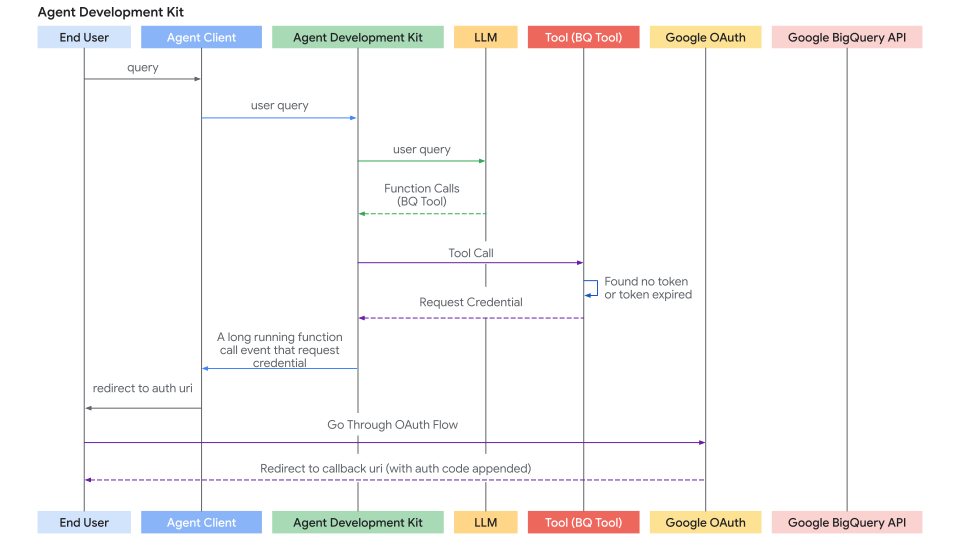
#### Authentication request flow
This diagram visualizes the end-to-end authentication handshake, tracing the path from the initial user query to the point where the ADK captures a credential request,
handles the redirection flow, and retries the tool call once authorized.
### Handle the interactive OAuth/OIDC flow (client-side)
If a tool requires user login/consent (typically OAuth 2.0 or OIDC), the ADK framework pauses execution and signals your ***Agent Client*** application. There are two cases:
* ***Agent Client*** application runs the agent directly (via `runner.run_async`) in the same process. e.g. UI backend, CLI app, or Spark job etc.
* ***Agent Client*** application interacts with ADK's fastapi server via `/run` or `/run_sse` endpoint. While ADK's fastapi server could be setup on the same server or different server as ***Agent Client*** application
The second case is a special case of first case, because `/run` or `/run_sse` endpoint also invokes `runner.run_async`. The only differences are:
* Whether to call a python function to run the agent (first case) or call a service endpoint to run the agent (second case).
* Whether the result events are in-memory objects (first case) or serialized json string in http response (second case).
Below sections focus on the first case and you should be able to map it to the second case very straightforward. We will also describe some differences to handle for the second case if necessary.
Here's the step-by-step process for your client application:
**Step 1: Run Agent & Detect Auth Request**
* Initiate the agent interaction using `runner.run_async`.
* Iterate through the yielded events.
* Look for a specific function call event whose function call has a special name: `adk_request_credential`. This event signals that user interaction is needed. You can use helper functions to identify this event and extract necessary information. (For the second case, the logic is similar. You deserialize the event from the http response).
```python
# runner = Runner(...)
# session = await session_service.create_session(...)
# content = types.Content(...) # User's initial query
print("\nRunning agent...")
events_async = runner.run_async(
session_id=session.id, user_id='user', new_message=content
)
auth_request_function_call_id, auth_config = None, None
async for event in events_async:
# Use helper to check for the specific auth request event
if (auth_request_function_call := get_auth_request_function_call(event)):
print("--> Authentication required by agent.")
# Store the ID needed to respond later
if not (auth_request_function_call_id := auth_request_function_call.id):
raise ValueError(f'Cannot get function call id from function call: {auth_request_function_call}')
# Get the AuthConfig containing the auth_uri etc.
auth_config = get_auth_config(auth_request_function_call)
break # Stop processing events for now, need user interaction
if not auth_request_function_call_id:
print("\nAuth not required or agent finished.")
# return # Or handle final response if received
```
*Helper functions `helpers.py`:*
```py
from google.adk.events import Event
from google.adk.auth import AuthConfig # Import necessary type
from google.genai import types
def get_auth_request_function_call(event: Event) -> types.FunctionCall:
# Get the special auth request function call from the event
if not event.content or not event.content.parts:
return
for part in event.content.parts:
if (
part
and part.function_call
and part.function_call.name == 'adk_request_credential'
and event.long_running_tool_ids
and part.function_call.id in event.long_running_tool_ids
):
return part.function_call
def get_auth_config(auth_request_function_call: types.FunctionCall) -> AuthConfig:
# Extracts the AuthConfig object from the arguments of the auth request function call
if not auth_request_function_call.args or not (auth_config := auth_request_function_call.args.get('authConfig')):
raise ValueError(f'Cannot get auth config from function call: {auth_request_function_call}')
if isinstance(auth_config, dict):
auth_config = AuthConfig.model_validate(auth_config)
elif not isinstance(auth_config, AuthConfig):
raise ValueError(f'Cannot get auth config {auth_config} is not an instance of AuthConfig.')
return auth_config
```
**Step 2: Redirect User for Authorization**
* Get the authorization URL (`auth_uri`) from the `auth_config` extracted in the previous step.
* **Crucially, append your application's** redirect\_uri as a query parameter to this `auth_uri`. This `redirect_uri` must be pre-registered with your OAuth provider (e.g., [Google Cloud Console](https://developers.google.com/identity/protocols/oauth2/web-server#creatingcred), [Okta admin panel](https://developer.okta.com/docs/guides/sign-into-web-app-redirect/spring-boot/main/#create-an-app-integration-in-the-admin-console)).
* Direct the user to this complete URL (e.g., open it in their browser).
```py
# (Continuing after detecting auth needed)
if auth_request_function_call_id and auth_config:
# Get the base authorization URL from the AuthConfig
base_auth_uri = auth_config.exchanged_auth_credential.oauth2.auth_uri
if base_auth_uri:
redirect_uri = 'http://localhost:8000/callback' # MUST match your OAuth client app config
# Append redirect_uri (use urlencode in production)
auth_request_uri = base_auth_uri + f'&redirect_uri={redirect_uri}'
# Now you need to redirect your end user to this auth_request_uri or ask them to open this auth_request_uri in their browser
# This auth_request_uri should be served by the corresponding auth provider and the end user should login and authorize your application to access their data
# And then the auth provider will redirect the end user to the redirect_uri you provided
# Next step: Get this callback URL from the user (or your web server handler)
else:
print("ERROR: Auth URI not found in auth_config.")
# Handle error
```
**Step 3. Handle the Redirect Callback (Client):**
* Your application must have a mechanism (e.g., a web server route at the `redirect_uri`) to receive the user after they authorize the application with the provider.
* The provider redirects the user to your `redirect_uri` and appends an `authorization_code` (and potentially `state`, `scope`) as query parameters to the URL.
* Capture the **full callback URL** from this incoming request.
* (This step happens outside the main agent execution loop, in your web server or equivalent callback handler.)
**Step 4. Send Authentication Result Back to ADK (Client):**
* Once you have the full callback URL (containing the authorization code), retrieve the `auth_request_function_call_id` and the `auth_config` object saved in Client Step 1\.
* Set the captured callback URL in the `exchanged_auth_credential.oauth2.auth_response_uri` field. Also ensure `exchanged_auth_credential.oauth2.redirect_uri` contains the redirect URI you used.
* Create a `types.Content` object containing a `types.Part` with a `types.FunctionResponse`.
* Set `name` to `"adk_request_credential"`. (Note: This is a special name for ADK to proceed with authentication. Do not use other names.)
* Set `id` to the `auth_request_function_call_id` you saved.
* Set `response` to the *serialized* (e.g., `.model_dump()`) updated `AuthConfig` object.
* Call `runner.run_async` **again** for the same session, passing this `FunctionResponse` content as the `new_message`.
```py
# (Continuing after user interaction)
# Simulate getting the callback URL (e.g., from user paste or web handler)
auth_response_uri = await get_user_input(
f'Paste the full callback URL here:\n> '
)
auth_response_uri = auth_response_uri.strip() # Clean input
if not auth_response_uri:
print("Callback URL not provided. Aborting.")
return
# Update the received AuthConfig with the callback details
auth_config.exchanged_auth_credential.oauth2.auth_response_uri = auth_response_uri
# Also include the redirect_uri used, as the token exchange might need it
auth_config.exchanged_auth_credential.oauth2.redirect_uri = redirect_uri
# Construct the FunctionResponse Content object
auth_content = types.Content(
role='user', # Role can be 'user' when sending a FunctionResponse
parts=[
types.Part(
function_response=types.FunctionResponse(
id=auth_request_function_call_id, # Link to the original request
name='adk_request_credential', # Special framework function name
response=auth_config.model_dump() # Send back the *updated* AuthConfig
)
)
],
)
# --- Resume Execution ---
print("\nSubmitting authentication details back to the agent...")
events_async_after_auth = runner.run_async(
session_id=session.id,
user_id='user',
new_message=auth_content, # Send the FunctionResponse back
)
# --- Process Final Agent Output ---
print("\n--- Agent Response after Authentication ---")
async for event in events_async_after_auth:
# Process events normally, expecting the tool call to succeed now
print(event) # Print the full event for inspection
```
!!! note "Note: Authorization response with Resume feature"
If your ADK agent workflow is configured with the
[Resume](/runtime/resume/) feature, you also must include
the Invocation ID (`invocation_id`) parameter with the authorization
response. The Invocation ID you provide must be the same invocation
that generated the authorization request, otherwise the system
starts a new invocation with the authorization response. If your
agent uses the Resume feature, consider including the Invocation ID
as a parameter with your authorization request, so it can be included
with the authorization response. For more details on using the Resume
feature, see
[Resume stopped agents](/runtime/resume/).
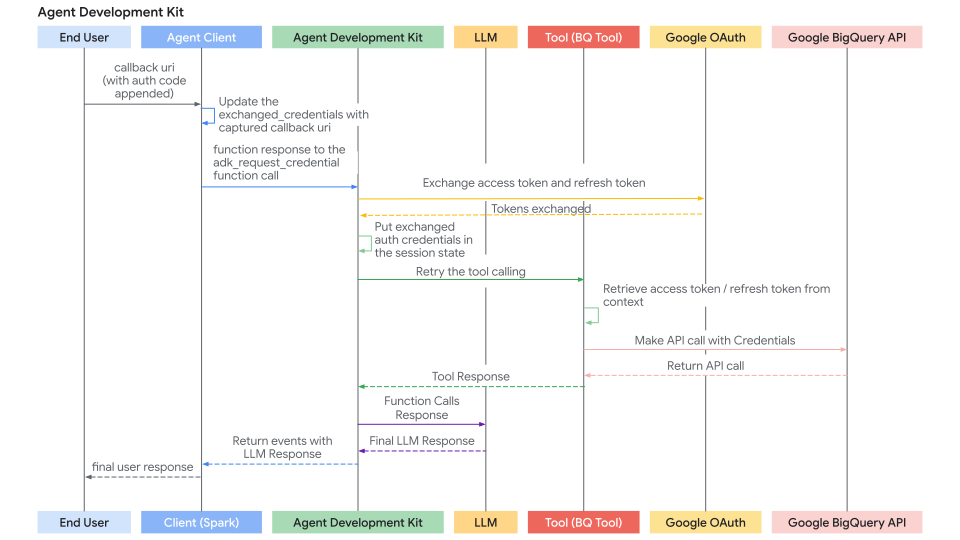
**Step 5: ADK Handles Token Exchange & Tool Retry and gets Tool result**
* ADK receives the `FunctionResponse` for `adk_request_credential`.
* It uses the information in the updated `AuthConfig` (including the callback URL containing the code) to perform the OAuth **token exchange** with the provider's token endpoint, obtaining the access token (and possibly refresh token).
* ADK internally makes these tokens available by setting them in the session state.
* ADK **automatically retries** the original tool call (the one that initially failed due to missing auth).
* This time, the tool finds the valid tokens (via `tool_context.get_auth_response()`) and successfully executes the authenticated API call.
* The agent receives the actual result from the tool and generates its final response to the user.
---
The sequence diagram of auth response flow, where the ***Agent Client*** sends back the auth response and ADK retries the tool, is as follows:
## Build custom tools (`FunctionTool`) requiring authentication
This section focuses on implementing the authentication logic *inside* your custom Python function when creating a new ADK Tool. We will implement a `FunctionTool` as an example.
### Prerequisites
Your function signature *must* include [`tool_context: ToolContext`](../tools-custom/index.md#tool-context). ADK automatically injects this object, providing access to state and auth mechanisms.
```py
from google.adk.tools import FunctionTool, ToolContext
from typing import Dict
def my_authenticated_tool_function(param1: str, ..., tool_context: ToolContext) -> dict:
# ... your logic ...
pass
my_tool = FunctionTool(func=my_authenticated_tool_function)
```
### Authentication Logic within the Tool Function
Implement the following steps inside your function:
**Step 1: Check for Cached & Valid Credentials:**
Inside your tool function, first check if valid credentials (e.g., access/refresh tokens) are already stored from a previous run in this session. Credentials for the current sessions should be stored in `tool_context.invocation_context.session.state` (a dictionary of state) Check existence of existing credentials by checking `tool_context.invocation_context.session.state.get(credential_name, None)`.
```py
from google.oauth2.credentials import Credentials
from google.auth.transport.requests import Request
# Inside your tool function
TOKEN_CACHE_KEY = "my_tool_tokens" # Choose a unique key
SCOPES = ["scope1", "scope2"] # Define required scopes
creds = None
cached_token_info = tool_context.state.get(TOKEN_CACHE_KEY)
if cached_token_info:
try:
creds = Credentials.from_authorized_user_info(cached_token_info, SCOPES)
if not creds.valid and creds.expired and creds.refresh_token:
creds.refresh(Request())
tool_context.state[TOKEN_CACHE_KEY] = json.loads(creds.to_json()) # Update cache
elif not creds.valid:
creds = None # Invalid, needs re-auth
tool_context.state[TOKEN_CACHE_KEY] = None
except Exception as e:
print(f"Error loading/refreshing cached creds: {e}")
creds = None
tool_context.state[TOKEN_CACHE_KEY] = None
if creds and creds.valid:
# Skip to Step 5: Make Authenticated API Call
pass
else:
# Proceed to Step 2...
pass
```
**Step 2: Check for Auth Response from Client**
* If Step 1 didn't yield valid credentials, check if the client just completed the interactive flow by calling `exchanged_credential = tool_context.get_auth_response()`.
* This returns the updated `exchanged_credential` object sent back by the client (containing the callback URL in `auth_response_uri`).
```py
# Use auth_scheme and auth_credential configured in the tool.
# exchanged_credential: AuthCredential | None
exchanged_credential = tool_context.get_auth_response(AuthConfig(
auth_scheme=auth_scheme,
raw_auth_credential=auth_credential,
))
# If exchanged_credential is not None, then there is already an exchanged credential from the auth response.
if exchanged_credential:
# ADK exchanged the access token already for us
access_token = exchanged_credential.oauth2.access_token
refresh_token = exchanged_credential.oauth2.refresh_token
creds = Credentials(
token=access_token,
refresh_token=refresh_token,
token_uri=auth_scheme.flows.authorizationCode.tokenUrl,
client_id=auth_credential.oauth2.client_id,
client_secret=auth_credential.oauth2.client_secret,
scopes=list(auth_scheme.flows.authorizationCode.scopes.keys()),
)
# Cache the token in session state and call the API, skip to step 5
```
**Step 3: Initiate Authentication Request**
If no valid credentials (Step 1.) and no auth response (Step 2.) are found, the tool needs to start the OAuth flow. Define the AuthScheme and initial AuthCredential and call `tool_context.request_credential()`. Return a response indicating authorization is needed.
```py
# Use auth_scheme and auth_credential configured in the tool.
tool_context.request_credential(AuthConfig(
auth_scheme=auth_scheme,
raw_auth_credential=auth_credential,
))
return {'pending': true, 'message': 'Awaiting user authentication.'}
# By setting request_credential, ADK detects a pending authentication event. It pauses execution and ask end user to login.
```
**Step 4: Exchange Authorization Code for Tokens**
ADK automatically generates oauth authorization URL and presents it to your ***Agent Client*** application. your ***Agent Client*** application should follow the same way described in [Build agentic applications with authenticated tools](#build-agentic-applications-with-authenticated-tools) to redirect the user to the authorization URL (with `redirect_uri` appended). Once a user completes the login flow, ADK extracts the authentication callback url from ***Agent Client*** applications, automatically parses the auth code, and generates auth token. At the next Tool call, `tool_context.get_auth_response` in step 2 will contain a valid credential to use in subsequent API calls.
**Step 5: Cache Obtained Credentials**
After successfully obtaining the token from ADK (Step 2) or if the token is still valid (Step 1), **immediately store** the new `Credentials` object in `tool_context.state` (serialized, e.g., as JSON) using your cache key.
```py
# Inside your tool function, after obtaining 'creds' (either refreshed or newly exchanged)
# Cache the new/refreshed tokens
tool_context.state[TOKEN_CACHE_KEY] = json.loads(creds.to_json())
print(f"DEBUG: Cached/updated tokens under key: {TOKEN_CACHE_KEY}")
# Proceed to Step 6 (Make API Call)
```
**Step 6: Make Authenticated API Call**
* Once you have a valid `Credentials` object (`creds` from Step 1 or Step 4), use it to make the actual call to the protected API using the appropriate client library (e.g., `googleapiclient`, `requests`). Pass the `credentials=creds` argument.
* Include error handling, especially for `HttpError` 401/403, which might mean the token expired or was revoked between calls. If you get such an error, consider clearing the cached token (`tool_context.state.pop(...)`) and potentially returning the `auth_required` status again to force re-authentication.
```py
# Inside your tool function, using the valid 'creds' object
# Ensure creds is valid before proceeding
if not creds or not creds.valid:
return {"status": "error", "error_message": "Cannot proceed without valid credentials."}
try:
service = build("calendar", "v3", credentials=creds) # Example
api_result = service.events().list(...).execute()
# Proceed to Step 7
except Exception as e:
# Handle API errors (e.g., check for 401/403, maybe clear cache and re-request auth)
print(f"ERROR: API call failed: {e}")
return {"status": "error", "error_message": f"API call failed: {e}"}
```
**Step 7: Return Tool Result**
* After a successful API call, process the result into a dictionary format that is useful for the LLM.
* **Crucially, include a** along with the data.
```py
# Inside your tool function, after successful API call
processed_result = [...] # Process api_result for the LLM
return {"status": "success", "data": processed_result}
```
??? "Full Code"
=== "Tools and Agent"
```py title="tools_and_agent.py"
--8<-- "examples/python/snippets/tools/auth/tools_and_agent.py"
```
=== "Agent CLI"
```py title="agent_cli.py"
--8<-- "examples/python/snippets/tools/auth/agent_cli.py"
```
=== "Helper"
```py title="helpers.py"
--8<-- "examples/python/snippets/tools/auth/helpers.py"
```
=== "Spec"
```yaml
openapi: 3.0.1
info:
title: Okta User Info API
version: 1.0.0
description: |-
API to retrieve user profile information based on a valid Okta OIDC Access Token.
Authentication is handled via OpenID Connect with Okta.
contact:
name: API Support
email: support@example.com # Replace with actual contact if available
servers:
- url:
description: Production Environment
paths:
/okta-jwt-user-api:
get:
summary: Get Authenticated User Info
description: |-
Fetches profile details for the user
operationId: getUserInfo
tags:
- User Profile
security:
- okta_oidc:
- openid
- email
- profile
responses:
'200':
description: Successfully retrieved user information.
content:
application/json:
schema:
type: object
properties:
sub:
type: string
description: Subject identifier for the user.
example: "abcdefg"
name:
type: string
description: Full name of the user.
example: "Example LastName"
locale:
type: string
description: User's locale, e.g., en-US or en_US.
example: "en_US"
email:
type: string
format: email
description: User's primary email address.
example: "username@example.com"
preferred_username:
type: string
description: Preferred username of the user (often the email).
example: "username@example.com"
given_name:
type: string
description: Given name (first name) of the user.
example: "Example"
family_name:
type: string
description: Family name (last name) of the user.
example: "LastName"
zoneinfo:
type: string
description: User's timezone, e.g., America/Los_Angeles.
example: "America/Los_Angeles"
updated_at:
type: integer
format: int64 # Using int64 for Unix timestamp
description: Timestamp when the user's profile was last updated (Unix epoch time).
example: 1743617719
email_verified:
type: boolean
description: Indicates if the user's email address has been verified.
example: true
required:
- sub
- name
- locale
- email
- preferred_username
- given_name
- family_name
- zoneinfo
- updated_at
- email_verified
'401':
description: Unauthorized. The provided Bearer token is missing, invalid, or expired.
content:
application/json:
schema:
$ref: '#/components/schemas/Error'
'403':
description: Forbidden. The provided token does not have the required scopes or permissions to access this resource.
content:
application/json:
schema:
$ref: '#/components/schemas/Error'
components:
securitySchemes:
okta_oidc:
type: openIdConnect
description: Authentication via Okta using OpenID Connect. Requires a Bearer Access Token.
openIdConnectUrl: https://your-endpoint.okta.com/.well-known/openid-configuration
schemas:
Error:
type: object
properties:
code:
type: string
description: An error code.
message:
type: string
description: A human-readable error message.
required:
- code
- message
```