# dsh-reasoning-effort
**A Codex-style model and reasoning-effort control, built directly into DeepSeek Harness.**
[中文首页](README.md) · [Latest release](https://github.com/HanaAyane/dsh-reasoning-effort/releases/latest) · [Report an issue](https://github.com/HanaAyane/dsh-reasoning-effort/issues)
[](https://github.com/HanaAyane/dsh-reasoning-effort/tree/main)
[](https://github.com/deepseek-ai/deepseek-harness)
[](LICENSE)
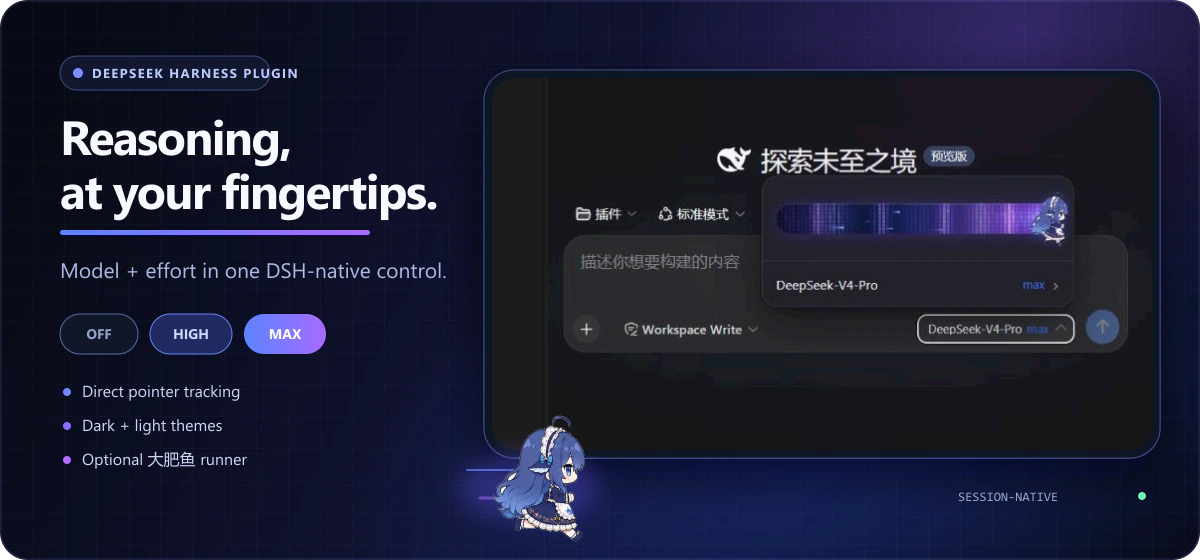
On first launch, the plugin adds a combined model control below the DSH composer. Open it to find the reasoning-effort slider, whose levels adapt to whatever the selected model exposes, above the familiar model picker. The plugin is enabled by default and stays synchronized with DSH's `/model` command.
## First use in three steps
### 1. Install the plugin
#### Ask an agent to install it (recommended)
If your current agent can run terminal commands, send it this complete prompt:
```text
Install dsh-reasoning-effort for the DeepSeek Harness web profile.
Run only these two commands and do not change any other profile:
dsh plugin --profile web add github:HanaAyane/dsh-reasoning-effort#main
dsh --profile web --dump-config
Confirm that dsh-reasoning-effort appears in the output, then report the result.
Do not stop or restart my running DSH process. Remind me to restart the DSH Web Host manually after installation.
```
The agent should report whether `dsh-reasoning-effort` appeared in the resolved configuration.
#### Install manually
Open PowerShell and run:
```powershell
dsh plugin --profile web add github:HanaAyane/dsh-reasoning-effort#main
dsh --profile web --dump-config
```
`main` is currently versioned `0.5.0`, matching the latest release tag `v0.5.0`. `#main` always installs the newest code (which may later include unreleased changes); replace `#main` with `#v0.5.0` to pin this release.
### 2. Restart the DSH Web Host
The plugin loads when the Web Host starts. After installation, stop the current host, start it again, and refresh the DSH page.
### 3. Open the model control
1. Create or open a session.
2. Click the model-and-effort button below the composer.
3. Drag the thumb or click the track; release to snap to the nearest level.
4. Click the model row below the slider to enter DSH's native model list.
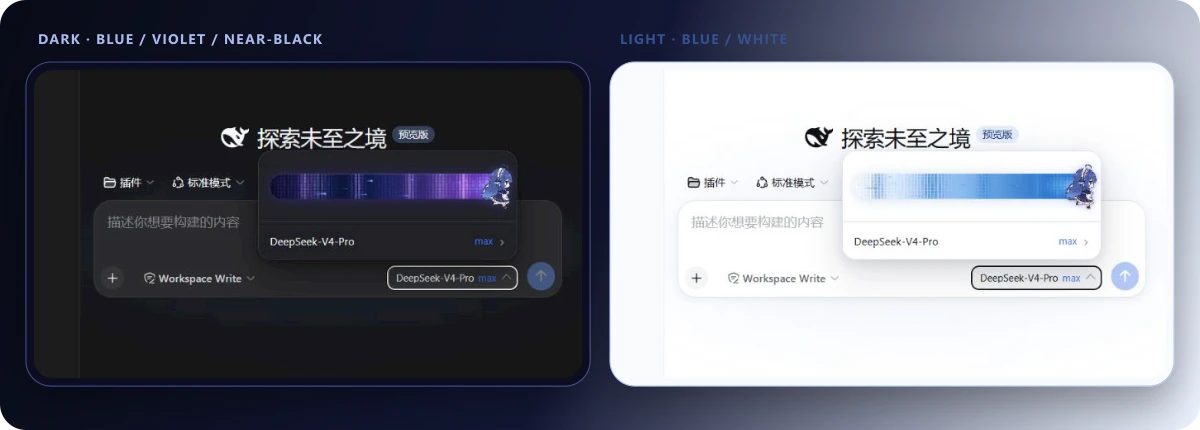
Your result should look like this:
 ## Where the levels come from
The slider renders exactly the `reasoning.efforts` the selected model exposes in the DSH model directory — count, names, and order are the model's, and the plugin adapts automatically. A common three-level combination:
| Level | Good for | Tendency |
| --- | --- | --- |
| `off` | Simple questions, rewriting, quick actions | Faster |
| `high` | Everyday coding, analysis, multi-step work | Balanced |
| `max` | Complex debugging, planning, difficult tasks | More reasoning |
DeepSeek models typically expose `off` / `high` / `max`; GLM coding models (e.g. GLM-5.2) expose five levels: `off` / `low` / `medium` / `high` / `xhigh`. The slider submits effort values exposed by the selected model; it does not bypass model or deployment limits. When a model exposes fewer than two levels, or none at all, the menu shows "current model provides no reasoning-effort levels" — see the troubleshooting section below for how to declare them.
## Effort guidance for custom providers
Built-in routes get their levels from the pi-ai catalog and the plugin never touches them. Only models you declare yourself in `llm-pi-ai` receive guidance:
1. Open the model menu. If the current model is your own declaration and the directory exposes no levels (or the declaration disagrees with the knowledge base), a **View declaration guidance** entry appears.
2. The panel shows the suggested levels (e.g. GLM-5.2 → minimal/low/medium/high) and a copy-ready complete entry YAML — including the `- id:` line, with your existing `name`/`contextWindow`/`maxTokens` preserved — plus the settings.yaml path.
3. Replace the matching `- id:` entry with the copied content (do not create a second `llm-pi-ai:` root) and save. DSH reloads automatically; if not, restart the Web Host and refresh.
Models the knowledge base does not know get an annotated template to fill from the endpoint's docs. Known-hostile gateways (e.g. Aliyun Bailian `maas/dashscope.aliyuncs.com`, which rejects the `developer` message role) get an explicit warning, because settings.yaml cannot override that behavior.
The built-in knowledge base covers GLM-5.2 (`minimal/low/medium/high`) and Kimi K3 (`low/high/max`). Add more models under the plugin's own settings namespace; user entries win over built-ins:
```yaml
dsh-reasoning-effort:
entries:
- id: my-model
provider: "*" # provider route, * wildcard
model: "my-model-id" # model id, * wildcard
note: description
efforts: # display level -> wire value the endpoint accepts
low: "low"
high: "high"
max: "max"
compat: # openai-completions routes only
thinkingFormat: "openai"
supportsReasoningEffort: true
```
The plugin only provides snippets — it never writes configuration, and catalog-declared level sets (even a single level) are never flagged.
## The Big Fat Fish slider
The eight-frame runner is **enabled by default**. To switch back to the plain white thumb:
1. Open **Settings → General**.
2. Find **Big Fat Fish slider** below Appearance.
3. Disable it and return to the model control.
## Where the levels come from
The slider renders exactly the `reasoning.efforts` the selected model exposes in the DSH model directory — count, names, and order are the model's, and the plugin adapts automatically. A common three-level combination:
| Level | Good for | Tendency |
| --- | --- | --- |
| `off` | Simple questions, rewriting, quick actions | Faster |
| `high` | Everyday coding, analysis, multi-step work | Balanced |
| `max` | Complex debugging, planning, difficult tasks | More reasoning |
DeepSeek models typically expose `off` / `high` / `max`; GLM coding models (e.g. GLM-5.2) expose five levels: `off` / `low` / `medium` / `high` / `xhigh`. The slider submits effort values exposed by the selected model; it does not bypass model or deployment limits. When a model exposes fewer than two levels, or none at all, the menu shows "current model provides no reasoning-effort levels" — see the troubleshooting section below for how to declare them.
## Effort guidance for custom providers
Built-in routes get their levels from the pi-ai catalog and the plugin never touches them. Only models you declare yourself in `llm-pi-ai` receive guidance:
1. Open the model menu. If the current model is your own declaration and the directory exposes no levels (or the declaration disagrees with the knowledge base), a **View declaration guidance** entry appears.
2. The panel shows the suggested levels (e.g. GLM-5.2 → minimal/low/medium/high) and a copy-ready complete entry YAML — including the `- id:` line, with your existing `name`/`contextWindow`/`maxTokens` preserved — plus the settings.yaml path.
3. Replace the matching `- id:` entry with the copied content (do not create a second `llm-pi-ai:` root) and save. DSH reloads automatically; if not, restart the Web Host and refresh.
Models the knowledge base does not know get an annotated template to fill from the endpoint's docs. Known-hostile gateways (e.g. Aliyun Bailian `maas/dashscope.aliyuncs.com`, which rejects the `developer` message role) get an explicit warning, because settings.yaml cannot override that behavior.
The built-in knowledge base covers GLM-5.2 (`minimal/low/medium/high`) and Kimi K3 (`low/high/max`). Add more models under the plugin's own settings namespace; user entries win over built-ins:
```yaml
dsh-reasoning-effort:
entries:
- id: my-model
provider: "*" # provider route, * wildcard
model: "my-model-id" # model id, * wildcard
note: description
efforts: # display level -> wire value the endpoint accepts
low: "low"
high: "high"
max: "max"
compat: # openai-completions routes only
thinkingFormat: "openai"
supportsReasoningEffort: true
```
The plugin only provides snippets — it never writes configuration, and catalog-declared level sets (even a single level) are never flagged.
## The Big Fat Fish slider
The eight-frame runner is **enabled by default**. To switch back to the plain white thumb:
1. Open **Settings → General**.
2. Find **Big Fat Fish slider** below Appearance.
3. Disable it and return to the model control.
 The runner changes only the thumb artwork. Snapping, keyboard control, radiation effects, and model selection remain unchanged. It animates faster while dragging and freezes on a stable frame when reduced motion is enabled.
The **Reasoning effort selector** switch on the same page disables the complete enhancement without uninstalling it. DSH's built-in model selector returns immediately. Both preferences stay in the current browser.
## What the plugin adds
- **Direct pointer tracking** — the thumb follows the pointer continuously and snaps only on release.
- **Native dark and light themes** — blue-violet-black in dark mode and progressively stronger blues on white in light mode.
- **Left-only motion effects** — waves, shock pulses, pixel radiation, particles, and trails remain behind the thumb.
- **Shared DSH session state** — the slider and `/model` command use the same session model directory.
- **Automatic rollback** — a failed update restores the last confirmed selection.
- **No extra network behavior** — no plugin telemetry, credential handling, or server-side storage.
## Troubleshooting
### The slider does not appear
Check that:
1. You restarted the DSH Web Host after installation.
2. **Settings → General → Reasoning effort selector** is enabled.
3. The selected model exposes at least two effort levels in the DSH model directory (see the next entry for models without any), and thinking is not disabled by the deployment.
### A model declares no effort levels (e.g. GLM-5.3)
Models missing from pi-ai's built-in catalog carry no reasoning levels at all, and the menu shows "current model provides no reasoning-effort levels". Declare them in `~/.dsh/settings.yaml` — for GLM-5.3 on a zai coding route:
```yaml
llm-pi-ai:
providers:
zai-coding-cn:
models:
- id: glm-5.3
name: GLM-5.3
contextWindow: 1000000
maxTokens: 131072
reasoningEfforts: # key = level shown on the slider, value = reasoning_effort sent to the API
low: "low"
high: "high"
xhigh: "max"
compat: # the zai route's detection does not send reasoning_effort by default
thinkingFormat: "zai"
supportsReasoningEffort: true
```
Notes:
- Level names come from the DSH level vocabulary (`off` / `minimal` / `low` / `medium` / `high` / `xhigh`); values are the `reasoning_effort` spellings the endpoint accepts. Leaving `off` undeclared makes it unselectable, which suits models that cannot turn thinking off.
- Models already in the pi-ai catalog (e.g. GLM-5.2) inherit their levels automatically — no configuration needed.
- Once upstream catalogs include the model, the hand-written declaration can be removed; explicit entries always win over the catalog.
- Submitted levels are validated and dispatched by the host; the plugin never bypasses model or deployment limits.
### Confirm that the plugin loaded
```powershell
dsh --profile web --dump-config
```
The output should contain `name: dsh-reasoning-effort`.
### Uninstall
```powershell
dsh plugin --profile web remove dsh-reasoning-effort
```
Restart the DSH Web Host afterward. The native model selector will return automatically.
## Compatibility
| Component | Target |
| --- | --- |
| DeepSeek Harness packages | `0.1.0-rc.6` |
| Node.js | `22.19+` |
| React | `18.x` |
DeepSeek Harness is a developer preview. Upstream UI or service changes may require a matching plugin update.
## Development
```powershell
pnpm install
pnpm run check
pnpm pack
```
`pnpm run check` validates TypeScript and rebuilds both the host entry and browser module. See [design/visual-spec.md](design/visual-spec.md) for the complete interaction contract and [SECURITY.md](SECURITY.md) for vulnerability reporting.
## License
[MIT](LICENSE) © HanaAyane
The runner changes only the thumb artwork. Snapping, keyboard control, radiation effects, and model selection remain unchanged. It animates faster while dragging and freezes on a stable frame when reduced motion is enabled.
The **Reasoning effort selector** switch on the same page disables the complete enhancement without uninstalling it. DSH's built-in model selector returns immediately. Both preferences stay in the current browser.
## What the plugin adds
- **Direct pointer tracking** — the thumb follows the pointer continuously and snaps only on release.
- **Native dark and light themes** — blue-violet-black in dark mode and progressively stronger blues on white in light mode.
- **Left-only motion effects** — waves, shock pulses, pixel radiation, particles, and trails remain behind the thumb.
- **Shared DSH session state** — the slider and `/model` command use the same session model directory.
- **Automatic rollback** — a failed update restores the last confirmed selection.
- **No extra network behavior** — no plugin telemetry, credential handling, or server-side storage.
## Troubleshooting
### The slider does not appear
Check that:
1. You restarted the DSH Web Host after installation.
2. **Settings → General → Reasoning effort selector** is enabled.
3. The selected model exposes at least two effort levels in the DSH model directory (see the next entry for models without any), and thinking is not disabled by the deployment.
### A model declares no effort levels (e.g. GLM-5.3)
Models missing from pi-ai's built-in catalog carry no reasoning levels at all, and the menu shows "current model provides no reasoning-effort levels". Declare them in `~/.dsh/settings.yaml` — for GLM-5.3 on a zai coding route:
```yaml
llm-pi-ai:
providers:
zai-coding-cn:
models:
- id: glm-5.3
name: GLM-5.3
contextWindow: 1000000
maxTokens: 131072
reasoningEfforts: # key = level shown on the slider, value = reasoning_effort sent to the API
low: "low"
high: "high"
xhigh: "max"
compat: # the zai route's detection does not send reasoning_effort by default
thinkingFormat: "zai"
supportsReasoningEffort: true
```
Notes:
- Level names come from the DSH level vocabulary (`off` / `minimal` / `low` / `medium` / `high` / `xhigh`); values are the `reasoning_effort` spellings the endpoint accepts. Leaving `off` undeclared makes it unselectable, which suits models that cannot turn thinking off.
- Models already in the pi-ai catalog (e.g. GLM-5.2) inherit their levels automatically — no configuration needed.
- Once upstream catalogs include the model, the hand-written declaration can be removed; explicit entries always win over the catalog.
- Submitted levels are validated and dispatched by the host; the plugin never bypasses model or deployment limits.
### Confirm that the plugin loaded
```powershell
dsh --profile web --dump-config
```
The output should contain `name: dsh-reasoning-effort`.
### Uninstall
```powershell
dsh plugin --profile web remove dsh-reasoning-effort
```
Restart the DSH Web Host afterward. The native model selector will return automatically.
## Compatibility
| Component | Target |
| --- | --- |
| DeepSeek Harness packages | `0.1.0-rc.6` |
| Node.js | `22.19+` |
| React | `18.x` |
DeepSeek Harness is a developer preview. Upstream UI or service changes may require a matching plugin update.
## Development
```powershell
pnpm install
pnpm run check
pnpm pack
```
`pnpm run check` validates TypeScript and rebuilds both the host entry and browser module. See [design/visual-spec.md](design/visual-spec.md) for the complete interaction contract and [SECURITY.md](SECURITY.md) for vulnerability reporting.
## License
[MIT](LICENSE) © HanaAyane