 # google-surf-mcp
English | [Korean](./README.ko.md)
[](https://www.npmjs.com/package/google-surf-mcp)
[](https://www.npmjs.com/package/google-surf-mcp)
[](https://github.com/HarimxChoi/google-surf-mcp/actions/workflows/ci.yml)
[](https://mcptoplist.com/server/io.github.HarimxChoi%2Fgoogle-surf-mcp)
[](https://glama.ai/mcp/servers/HarimxChoi/google-surf-mcp)
# google-surf-mcp
English | [Korean](./README.ko.md)
[](https://www.npmjs.com/package/google-surf-mcp)
[](https://www.npmjs.com/package/google-surf-mcp)
[](https://github.com/HarimxChoi/google-surf-mcp/actions/workflows/ci.yml)
[](https://mcptoplist.com/server/io.github.HarimxChoi%2Fgoogle-surf-mcp)
[](https://glama.ai/mcp/servers/HarimxChoi/google-surf-mcp)
Sponsored by SearchApi
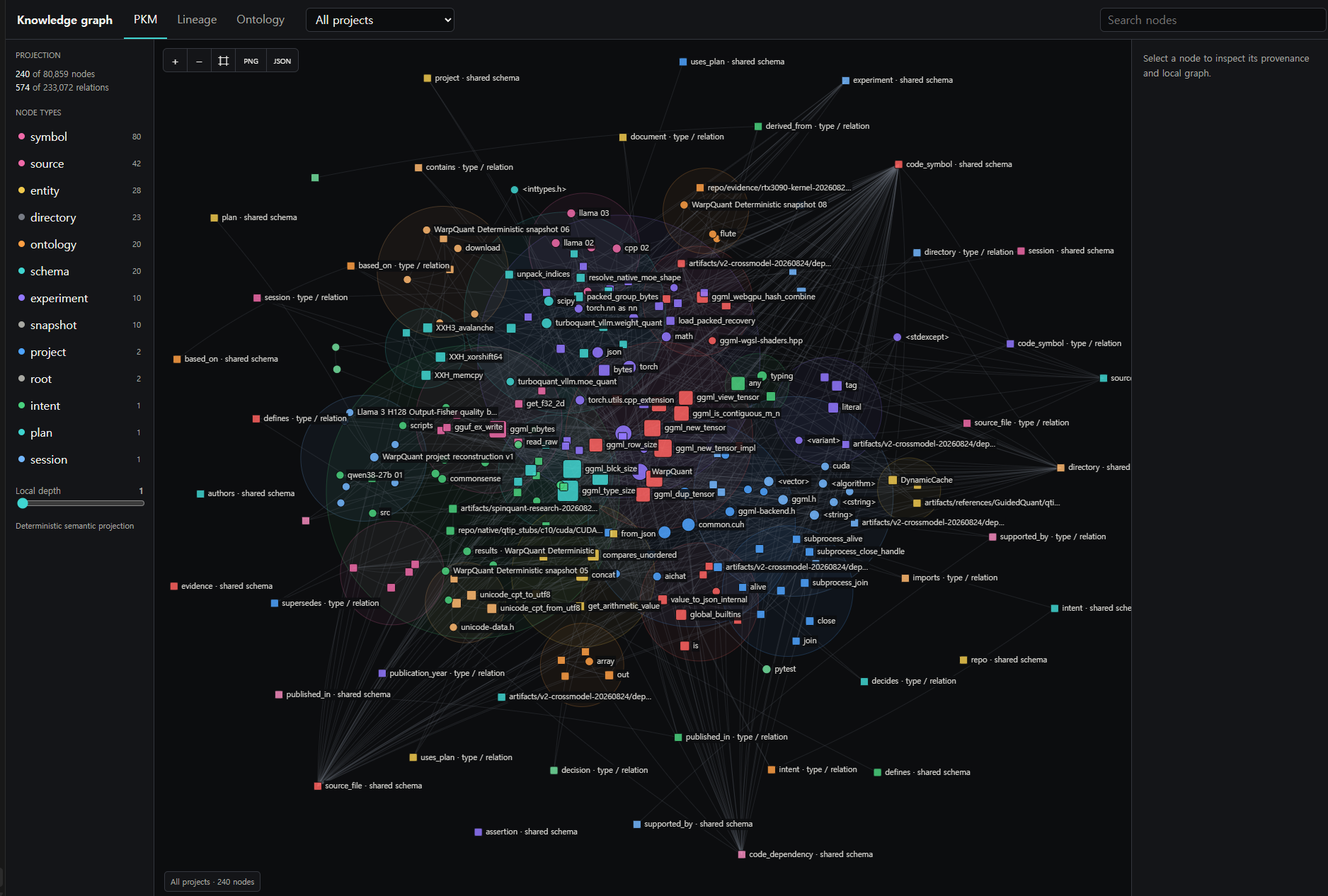 > Web searches, papers, and GitHub repositories are stored as PKM, ontology, and lineage. The view above is generated with `project_memory(action="export", export_format="html", export_view="graph", all_projects=true)`.
*"Turn Google Search, Papers, and Codebases into an Automatic Local Knowledge Graph and lineage for AI Agents with Zero API Key, Zero External Server."*
Google Surf stores search and extraction results in a project-scoped local knowledge graph.
As you search, papers, code, web sources, session intent, plans, experiments, and decisions accumulate in a personal PKM. New research searches stored knowledge and fresh web results together, reducing repeated work while continuing to discover new information.
Projects remain isolated by default. Only verifiable links such as matching DOIs, repository URLs, or explicit aliases are added, so knowledge from one project can be reused in another without merging the original records.
Retrieval runs exact search, BM25, vector search, code and graph search, and live web independently, then combines them with RRF and one shared reranker.
```text
Live web + Papers + Codebases + Project memory
↓
Exact + BM25 + Vector + Code graph + Graph PPR
↓
RRF + Shared reranker
↓
Results with evidence and provenance
```
Seven tools are available by default: `search` / `search_parallel` / `extract` / `scholar_search` / `project_memory_search` / `project_memory` / `health`.
Research mode and automatic capture are enabled by default. Set `SURF_RESEARCH=false` to use search and extraction without opening the database or graph sidecar; the project memory tools are not registered in that mode.
With research mode disabled, live `search` and `search_parallel` results still use a lightweight in-memory reranker. It fuses the provider order with query BM25 rank through RRF without loading the vector model or opening local storage.
Browser search needs no API key. SearchApi can be configured as an optional primary provider or fallback.
## Core features
- **Web, paper, and codebase search:** Google web search is the default, while Scholar is used for paper-specific metadata. SearchApi can act as an optional primary provider or fallback.
- **Web and academic document extraction:** HTML and PDF extraction returns available titles, authors, DOIs, publication metadata, and body text. `search` and `search_parallel` can include abstracts or full bodies.
- **Automatic project memory:** Search results, extracted bodies, and code repositories are stored in the current project. Unread results remain metadata; extracted content becomes active RAG evidence.
- **Structured codebase search:** Tree-sitter links files, symbols, imports, and calls from local projects and relevant GitHub repositories. Exact, BM25, vector, and graph search retrieve the code.
- **Graph hybrid retrieval:** Fresh web results, papers, stored content, codebases, and the project graph are searched independently. Exact, BM25, vector, and PPR candidates are combined through RRF and one shared reranker.
- **Ontology and data lineage:** Web sources, papers, code, plans, experiments, and decisions become typed entities and relations. Evidence paths run from source through documents, chunks, symbols, evidence, and assertions.
- **Cross-project knowledge reuse:** Projects remain isolated but selected projects can be searched together. Only verifiable links connect matching entities.
- **Durable research history:** Session intent, plans, experiments, failures, and decisions supplied by the MCP host are stored as revisions and linked to their supporting evidence.
- **Local graph analysis and export:** PageRank, PPR, connected components, and Louvain communities run without a separate Neo4j server. Results export to HTML, Graphviz, D3 JSON, and Neo4j import formats.
## Search
- API-key-free system Chrome search
- Dedicated logged-out profile that never reads or copies the user's Chrome profile
- Multi-strategy SERP parsing with geometric verification
- Sponsored block and knowledge panel removal
- CAPTCHA detection and environment-specific recovery
- Parser self-healing and context fallback
## Numbers
### Search speed
| | result |
|---|---|
| search | 4.0-5.1s/query |
| scholar_search | 3.8-5.6s/query |
### Live web search reranker check
| 32 held-out queries | nDCG@5 | MRR | Precision@5 |
|---|---:|---:|---:|
| Provider order | 0.8949 | 0.8203 | 0.6375 |
| BM25 + RRF | **0.8971** | **0.8203** | **0.6500** |
* web search responses with BM25+RRF reduce large retrieval payloads by up to *75%.*
Measured across three uncached queries per provider on a workstation with a 1Gb/s connection. Network and Google response time vary.
## Tech Stack
- **Runtime:** Node.js, TypeScript, Model Context Protocol SDK
- **Web search:** System Chrome + CDP, Playwright compatibility fallback, SearchApi fallback
- **Web extraction:** Mozilla Readability, Turndown
- **PDF extraction:** LiteParse/PDFium, optional OCR, `pdf-lib` metadata parsing
- **Code collection:** Local project roots and gated GitHub sparse download
- **Code parsing:** Tree-sitter for files, symbols, imports, and call relations
- **Code search:** Exact lookup, BM25, Multilingual E5 vector search, and graph PPR
- **Local database:** Embedded SurrealDB on RocksDB
- **Hybrid retrieval:** Live web, papers, project memory, and codebase results combined through RRF
- **Ranking:** Reciprocal Rank Fusion and shared vector reranking
- **Graph analysis:** Graphology, PageRank, PPR, connected components, and Louvain communities
- **Knowledge model:** Versioned ontology, data lineage, cross-project schema and entity linking
- **Recovery:** CAPTCHA recovery, Playwright pool fallback, and deterministic parser self-healing
## Install
Requires Node 20.18.1+. Browser mode also requires Google Chrome or Chromium.
```bash
npx google-surf-mcp # actual MCP - register in client config
```
First tool call auto-bootstraps the warm profile (you may see Chrome open briefly).
Or local clone:
```bash
git clone https://github.com/HarimxChoi/google-surf-mcp
cd google-surf-mcp
npm install
```
If auto-bootstrap fails (rare), run it manually:
```bash
npm run bootstrap
```
Override paths if needed:
```bash
CHROME_PATH=/path/to/chrome SURF_TZ=America/New_York npm run bootstrap
```
### Optional Codex output protection
Google Surf can install an opt-in [Codex hook](https://developers.openai.com/codex/hooks) that ranks oversized Bash output before it reaches the model. The host still executes the command; the hook only applies stateless source-order, exact, and BM25 ranking with RRF. It opens neither the Google Surf database nor a browser and does not store command output.
```bash
npx -y google-surf-mcp@latest hooks install --host codex
```
Restart Codex, then open `/hooks` to review and trust the definitions. Shell output is reranked from 1,500 characters, with a default 1,500-character display budget that expands up to 3,000 for distinct query-matching evidence records or blocks. An explicit override may exceed 3,000; there is no cumulative per-turn output limit. Two identical or near-duplicate searches and explicit foreground polling loops are blocked. Existing `write_stdin` polls for an already-running unified command remain controlled by the Codex runtime, not this hook.
JSON/JSONL summaries use compact records with input-relative JSON pointers, ancestor identity/condition references and original result values. Markdown table rows retain headers and adjacent context, including source lines. Selected records and their required context must fit together; the renderer reports omissions instead of slicing records. Plain logs retain block reranking. Selection is deterministic and lexical, without a model, database or extra subprocess. Context extraction uses structural/field-name heuristics, not semantic understanding; unselected fields remain in the original input. These excerpts do not replace experiment logs or SSOT history. Input-relative pointers are not persistent retrieval handles. Existing installed hook bundles require an update to use changed code.
```bash
npx -y google-surf-mcp@latest hooks status --host codex
npx -y google-surf-mcp@latest hooks update --host codex
npx -y google-surf-mcp@latest hooks uninstall --host codex
```
## Use with Claude Code
Paste this into your `~/.claude.json`:
```json
{
"mcpServers": {
"google-surf": {
"command": "npx",
"args": ["-y", "google-surf-mcp"]
}
}
}
```
Restart Claude Code. All seven tools, including `project_memory_search` and `project_memory`, are available by default.
For other MCP clients, use the same JSON shape in their config file.
## Search providers
Browser search remains the default. [SearchApi](https://www.searchapi.io/?utm_source=github&utm_medium=sponsorship&utm_campaign=google_search_api&utm_content=HarimxChoi_google-surf-mcp) can be selected as the primary provider or used only when browser search fails.
| value | behavior |
|---|---|
| `browser` | Default. Uses system Chrome with a dedicated logged-out profile, keeps native search windows hidden, and does not require `SEARCH_API`. Multiple MCP sessions share one local browser broker. |
| `searchapi` | Uses SearchApi as the primary provider and does not initialize Chrome for that tool. |
| `fallback` | Tries the current browser tier once, then uses SearchApi on browser errors, CAPTCHA/rate limits, profile failure, or parser degradation. It does not wait for human CAPTCHA recovery. Successful and normal empty browser responses are not repeated. |
`SURF_SEARCH_PROVIDER` controls `search` and `search_parallel`. `SURF_SCHOLAR_PROVIDER` controls `scholar_search`. SearchApi modes require your own SearchApi account, key, and available credits.
`SURF_BROWSER_ENGINE=auto` selects native Chrome on a local desktop and the Playwright compatibility path in cloud or remote-debug mode. Native mode uses a normal hidden Chrome window, not headless Chrome. Set `native` or `playwright` to pin the engine.
```json
{
"mcpServers": {
"google-surf": {
"command": "npx",
"args": ["-y", "google-surf-mcp"],
"env": {
"SEARCH_API": "your-searchapi-key",
"SURF_SEARCH_PROVIDER": "fallback",
"SURF_SCHOLAR_PROVIDER": "searchapi"
}
}
}
}
```
Local clone variant:
```json
{
"mcpServers": {
"google-surf": {
"command": "node",
"args": ["/abs/path/to/google-surf-mcp/build/index.js"]
}
}
}
```
## Tools
- `search(query, limit?, extract_mode?, extract_limit?, response_content?, max_chars?)` - primary single-query tool for live discovery and reading. When new sources must be found and read, set `extract_mode` in this call instead of downloading PDFs, cloning repositories, or calling `extract` separately. Use `extract` only when the exact public URL is already known and no discovery is needed. With `project_id`, stored project knowledge is fused with live results, but the call never becomes local-only. `limit` is 1-20. Extraction defaults to `none`; `extract_limit` is 1-10 with default 5. `response_content` defaults to `summary` to bound one-call output.
- `scholar_search(query, limit?)` - Google Scholar metadata search, max 10 papers. Supports browser, SearchApi primary, and fallback modes.
- `search_parallel(queries[], limit?, extract_mode?, extract_limit?, response_content?, max_chars?)` - primary multi-query tool for broad live discovery and reading through a continuous four-tab queue. Set `extract_mode` in the same call when public web pages, PDFs, papers, or GitHub repositories must be read. Use local PDF tools only for local files or visual layout work, and clone repositories only for editing, building, testing, or full Git history. `limit` is 1-20 per query. The call-wide `extract_limit` defaults to 12 and allows up to 20 for abstract; full defaults to and allows 10. `response_content` defaults to `summary` to bound one-call output.
- Integrated search extraction reports `requested`, `applied`, `skipped`, `truncated`, and `total_chars`. `remaining_urls` can be passed to `extract` without repeating the search.
- `extract(url, max_chars?, mode?, response_content?)` - secondary extraction tool for an exact public URL when no new discovery is required. If sources still need to be found, use `search` or `search_parallel` with `extract_mode` instead.
- `mode="full"` (default): reads up to 1000000 characters for research capture. Research mode stores deterministic 4000-character chunks; `response_content="full"` returns up to 50000 characters and `summary` returns a 1500-character evidence excerpt.
- `mode="abstract"`: ~1500-char survey (PDF page 1 or HTML meta description). Document metadata is included and stored with the survey when research mode is enabled.
- `mode="metadata"`: metadata without body text. Returns available title, authors, publication, dates, DOI, description, keywords, canonical URL, and PDF properties including page count.
- GitHub repository URLs read the README in metadata mode. Abstract and full use the same download gate and differ only in indexed source depth.
- Response: content fields plus available document metadata. Failures return `{ error }`, never throw.
- `project_memory_search(query, query_variants?, project_id?, include_project_ids?, all_projects?, limit?, request_id?, response_deadline_ms?)` - searches stored local knowledge only. Up to 19 optional variants run inside one broker request with batched query embeddings, RRF fusion, evidence-seeded graph expansion, and one final rerank against `query`. The response contains only bounded query-focused summaries from the final ranking; stored bodies stay in the database. A caller-supplied `request_id` makes a long query observable and cooperatively cancellable through `project_memory`. If a deadline arrives after retrieval has produced candidates, the completed lanes return as an explicitly partial result instead of being discarded. It never opens a browser or calls Google or SearchApi.
- `project_memory(action, ...)` - manages durable project knowledge when `SURF_RESEARCH=true`.
- `action="search"`: compatibility alias for `project_memory_search`.
- `action="project_update"`: updates an existing project name, purpose, constraints, or protected parents as a revision-checked profile revision.
- `action="context"`: separates the durable project purpose, confirmed session intent, provisional recent query, current plan, scientific experiment state, and observed process liveness.
- `action="get"`: returns exact typed or legacy records through bounded UTF-8 byte spans. Set `body_bytes=0` for metadata only and use `next_body_offset` for lossless paging.
- `action="show"`: always returns a bounded summary with counts and active record IDs. `detail_level="full"` is accepted for compatibility but never dumps every record body. Use `project_memory_search` for relevant bodies or `target_id` for one assertion or entity.
- `action="record"`: stores the submitted body and returns only its ID, revision, and status. Receipts distinguish the original application from an idempotent replay.
- `action="query_status"` / `action="query_cancel"`: inspects or cooperatively stops a local retrieval identified before execution by `request_id`.
- `action="export"`: writes a standalone interactive HTML explorer, Graphviz DOT, D3 node-link JSON, or a Neo4j import bundle under `
> Web searches, papers, and GitHub repositories are stored as PKM, ontology, and lineage. The view above is generated with `project_memory(action="export", export_format="html", export_view="graph", all_projects=true)`.
*"Turn Google Search, Papers, and Codebases into an Automatic Local Knowledge Graph and lineage for AI Agents with Zero API Key, Zero External Server."*
Google Surf stores search and extraction results in a project-scoped local knowledge graph.
As you search, papers, code, web sources, session intent, plans, experiments, and decisions accumulate in a personal PKM. New research searches stored knowledge and fresh web results together, reducing repeated work while continuing to discover new information.
Projects remain isolated by default. Only verifiable links such as matching DOIs, repository URLs, or explicit aliases are added, so knowledge from one project can be reused in another without merging the original records.
Retrieval runs exact search, BM25, vector search, code and graph search, and live web independently, then combines them with RRF and one shared reranker.
```text
Live web + Papers + Codebases + Project memory
↓
Exact + BM25 + Vector + Code graph + Graph PPR
↓
RRF + Shared reranker
↓
Results with evidence and provenance
```
Seven tools are available by default: `search` / `search_parallel` / `extract` / `scholar_search` / `project_memory_search` / `project_memory` / `health`.
Research mode and automatic capture are enabled by default. Set `SURF_RESEARCH=false` to use search and extraction without opening the database or graph sidecar; the project memory tools are not registered in that mode.
With research mode disabled, live `search` and `search_parallel` results still use a lightweight in-memory reranker. It fuses the provider order with query BM25 rank through RRF without loading the vector model or opening local storage.
Browser search needs no API key. SearchApi can be configured as an optional primary provider or fallback.
## Core features
- **Web, paper, and codebase search:** Google web search is the default, while Scholar is used for paper-specific metadata. SearchApi can act as an optional primary provider or fallback.
- **Web and academic document extraction:** HTML and PDF extraction returns available titles, authors, DOIs, publication metadata, and body text. `search` and `search_parallel` can include abstracts or full bodies.
- **Automatic project memory:** Search results, extracted bodies, and code repositories are stored in the current project. Unread results remain metadata; extracted content becomes active RAG evidence.
- **Structured codebase search:** Tree-sitter links files, symbols, imports, and calls from local projects and relevant GitHub repositories. Exact, BM25, vector, and graph search retrieve the code.
- **Graph hybrid retrieval:** Fresh web results, papers, stored content, codebases, and the project graph are searched independently. Exact, BM25, vector, and PPR candidates are combined through RRF and one shared reranker.
- **Ontology and data lineage:** Web sources, papers, code, plans, experiments, and decisions become typed entities and relations. Evidence paths run from source through documents, chunks, symbols, evidence, and assertions.
- **Cross-project knowledge reuse:** Projects remain isolated but selected projects can be searched together. Only verifiable links connect matching entities.
- **Durable research history:** Session intent, plans, experiments, failures, and decisions supplied by the MCP host are stored as revisions and linked to their supporting evidence.
- **Local graph analysis and export:** PageRank, PPR, connected components, and Louvain communities run without a separate Neo4j server. Results export to HTML, Graphviz, D3 JSON, and Neo4j import formats.
## Search
- API-key-free system Chrome search
- Dedicated logged-out profile that never reads or copies the user's Chrome profile
- Multi-strategy SERP parsing with geometric verification
- Sponsored block and knowledge panel removal
- CAPTCHA detection and environment-specific recovery
- Parser self-healing and context fallback
## Numbers
### Search speed
| | result |
|---|---|
| search | 4.0-5.1s/query |
| scholar_search | 3.8-5.6s/query |
### Live web search reranker check
| 32 held-out queries | nDCG@5 | MRR | Precision@5 |
|---|---:|---:|---:|
| Provider order | 0.8949 | 0.8203 | 0.6375 |
| BM25 + RRF | **0.8971** | **0.8203** | **0.6500** |
* web search responses with BM25+RRF reduce large retrieval payloads by up to *75%.*
Measured across three uncached queries per provider on a workstation with a 1Gb/s connection. Network and Google response time vary.
## Tech Stack
- **Runtime:** Node.js, TypeScript, Model Context Protocol SDK
- **Web search:** System Chrome + CDP, Playwright compatibility fallback, SearchApi fallback
- **Web extraction:** Mozilla Readability, Turndown
- **PDF extraction:** LiteParse/PDFium, optional OCR, `pdf-lib` metadata parsing
- **Code collection:** Local project roots and gated GitHub sparse download
- **Code parsing:** Tree-sitter for files, symbols, imports, and call relations
- **Code search:** Exact lookup, BM25, Multilingual E5 vector search, and graph PPR
- **Local database:** Embedded SurrealDB on RocksDB
- **Hybrid retrieval:** Live web, papers, project memory, and codebase results combined through RRF
- **Ranking:** Reciprocal Rank Fusion and shared vector reranking
- **Graph analysis:** Graphology, PageRank, PPR, connected components, and Louvain communities
- **Knowledge model:** Versioned ontology, data lineage, cross-project schema and entity linking
- **Recovery:** CAPTCHA recovery, Playwright pool fallback, and deterministic parser self-healing
## Install
Requires Node 20.18.1+. Browser mode also requires Google Chrome or Chromium.
```bash
npx google-surf-mcp # actual MCP - register in client config
```
First tool call auto-bootstraps the warm profile (you may see Chrome open briefly).
Or local clone:
```bash
git clone https://github.com/HarimxChoi/google-surf-mcp
cd google-surf-mcp
npm install
```
If auto-bootstrap fails (rare), run it manually:
```bash
npm run bootstrap
```
Override paths if needed:
```bash
CHROME_PATH=/path/to/chrome SURF_TZ=America/New_York npm run bootstrap
```
### Optional Codex output protection
Google Surf can install an opt-in [Codex hook](https://developers.openai.com/codex/hooks) that ranks oversized Bash output before it reaches the model. The host still executes the command; the hook only applies stateless source-order, exact, and BM25 ranking with RRF. It opens neither the Google Surf database nor a browser and does not store command output.
```bash
npx -y google-surf-mcp@latest hooks install --host codex
```
Restart Codex, then open `/hooks` to review and trust the definitions. Shell output is reranked from 1,500 characters, with a default 1,500-character display budget that expands up to 3,000 for distinct query-matching evidence records or blocks. An explicit override may exceed 3,000; there is no cumulative per-turn output limit. Two identical or near-duplicate searches and explicit foreground polling loops are blocked. Existing `write_stdin` polls for an already-running unified command remain controlled by the Codex runtime, not this hook.
JSON/JSONL summaries use compact records with input-relative JSON pointers, ancestor identity/condition references and original result values. Markdown table rows retain headers and adjacent context, including source lines. Selected records and their required context must fit together; the renderer reports omissions instead of slicing records. Plain logs retain block reranking. Selection is deterministic and lexical, without a model, database or extra subprocess. Context extraction uses structural/field-name heuristics, not semantic understanding; unselected fields remain in the original input. These excerpts do not replace experiment logs or SSOT history. Input-relative pointers are not persistent retrieval handles. Existing installed hook bundles require an update to use changed code.
```bash
npx -y google-surf-mcp@latest hooks status --host codex
npx -y google-surf-mcp@latest hooks update --host codex
npx -y google-surf-mcp@latest hooks uninstall --host codex
```
## Use with Claude Code
Paste this into your `~/.claude.json`:
```json
{
"mcpServers": {
"google-surf": {
"command": "npx",
"args": ["-y", "google-surf-mcp"]
}
}
}
```
Restart Claude Code. All seven tools, including `project_memory_search` and `project_memory`, are available by default.
For other MCP clients, use the same JSON shape in their config file.
## Search providers
Browser search remains the default. [SearchApi](https://www.searchapi.io/?utm_source=github&utm_medium=sponsorship&utm_campaign=google_search_api&utm_content=HarimxChoi_google-surf-mcp) can be selected as the primary provider or used only when browser search fails.
| value | behavior |
|---|---|
| `browser` | Default. Uses system Chrome with a dedicated logged-out profile, keeps native search windows hidden, and does not require `SEARCH_API`. Multiple MCP sessions share one local browser broker. |
| `searchapi` | Uses SearchApi as the primary provider and does not initialize Chrome for that tool. |
| `fallback` | Tries the current browser tier once, then uses SearchApi on browser errors, CAPTCHA/rate limits, profile failure, or parser degradation. It does not wait for human CAPTCHA recovery. Successful and normal empty browser responses are not repeated. |
`SURF_SEARCH_PROVIDER` controls `search` and `search_parallel`. `SURF_SCHOLAR_PROVIDER` controls `scholar_search`. SearchApi modes require your own SearchApi account, key, and available credits.
`SURF_BROWSER_ENGINE=auto` selects native Chrome on a local desktop and the Playwright compatibility path in cloud or remote-debug mode. Native mode uses a normal hidden Chrome window, not headless Chrome. Set `native` or `playwright` to pin the engine.
```json
{
"mcpServers": {
"google-surf": {
"command": "npx",
"args": ["-y", "google-surf-mcp"],
"env": {
"SEARCH_API": "your-searchapi-key",
"SURF_SEARCH_PROVIDER": "fallback",
"SURF_SCHOLAR_PROVIDER": "searchapi"
}
}
}
}
```
Local clone variant:
```json
{
"mcpServers": {
"google-surf": {
"command": "node",
"args": ["/abs/path/to/google-surf-mcp/build/index.js"]
}
}
}
```
## Tools
- `search(query, limit?, extract_mode?, extract_limit?, response_content?, max_chars?)` - primary single-query tool for live discovery and reading. When new sources must be found and read, set `extract_mode` in this call instead of downloading PDFs, cloning repositories, or calling `extract` separately. Use `extract` only when the exact public URL is already known and no discovery is needed. With `project_id`, stored project knowledge is fused with live results, but the call never becomes local-only. `limit` is 1-20. Extraction defaults to `none`; `extract_limit` is 1-10 with default 5. `response_content` defaults to `summary` to bound one-call output.
- `scholar_search(query, limit?)` - Google Scholar metadata search, max 10 papers. Supports browser, SearchApi primary, and fallback modes.
- `search_parallel(queries[], limit?, extract_mode?, extract_limit?, response_content?, max_chars?)` - primary multi-query tool for broad live discovery and reading through a continuous four-tab queue. Set `extract_mode` in the same call when public web pages, PDFs, papers, or GitHub repositories must be read. Use local PDF tools only for local files or visual layout work, and clone repositories only for editing, building, testing, or full Git history. `limit` is 1-20 per query. The call-wide `extract_limit` defaults to 12 and allows up to 20 for abstract; full defaults to and allows 10. `response_content` defaults to `summary` to bound one-call output.
- Integrated search extraction reports `requested`, `applied`, `skipped`, `truncated`, and `total_chars`. `remaining_urls` can be passed to `extract` without repeating the search.
- `extract(url, max_chars?, mode?, response_content?)` - secondary extraction tool for an exact public URL when no new discovery is required. If sources still need to be found, use `search` or `search_parallel` with `extract_mode` instead.
- `mode="full"` (default): reads up to 1000000 characters for research capture. Research mode stores deterministic 4000-character chunks; `response_content="full"` returns up to 50000 characters and `summary` returns a 1500-character evidence excerpt.
- `mode="abstract"`: ~1500-char survey (PDF page 1 or HTML meta description). Document metadata is included and stored with the survey when research mode is enabled.
- `mode="metadata"`: metadata without body text. Returns available title, authors, publication, dates, DOI, description, keywords, canonical URL, and PDF properties including page count.
- GitHub repository URLs read the README in metadata mode. Abstract and full use the same download gate and differ only in indexed source depth.
- Response: content fields plus available document metadata. Failures return `{ error }`, never throw.
- `project_memory_search(query, query_variants?, project_id?, include_project_ids?, all_projects?, limit?, request_id?, response_deadline_ms?)` - searches stored local knowledge only. Up to 19 optional variants run inside one broker request with batched query embeddings, RRF fusion, evidence-seeded graph expansion, and one final rerank against `query`. The response contains only bounded query-focused summaries from the final ranking; stored bodies stay in the database. A caller-supplied `request_id` makes a long query observable and cooperatively cancellable through `project_memory`. If a deadline arrives after retrieval has produced candidates, the completed lanes return as an explicitly partial result instead of being discarded. It never opens a browser or calls Google or SearchApi.
- `project_memory(action, ...)` - manages durable project knowledge when `SURF_RESEARCH=true`.
- `action="search"`: compatibility alias for `project_memory_search`.
- `action="project_update"`: updates an existing project name, purpose, constraints, or protected parents as a revision-checked profile revision.
- `action="context"`: separates the durable project purpose, confirmed session intent, provisional recent query, current plan, scientific experiment state, and observed process liveness.
- `action="get"`: returns exact typed or legacy records through bounded UTF-8 byte spans. Set `body_bytes=0` for metadata only and use `next_body_offset` for lossless paging.
- `action="show"`: always returns a bounded summary with counts and active record IDs. `detail_level="full"` is accepted for compatibility but never dumps every record body. Use `project_memory_search` for relevant bodies or `target_id` for one assertion or entity.
- `action="record"`: stores the submitted body and returns only its ID, revision, and status. Receipts distinguish the original application from an idempotent replay.
- `action="query_status"` / `action="query_cancel"`: inspects or cooperatively stops a local retrieval identified before execution by `request_id`.
- `action="export"`: writes a standalone interactive HTML explorer, Graphviz DOT, D3 node-link JSON, or a Neo4j import bundle under `
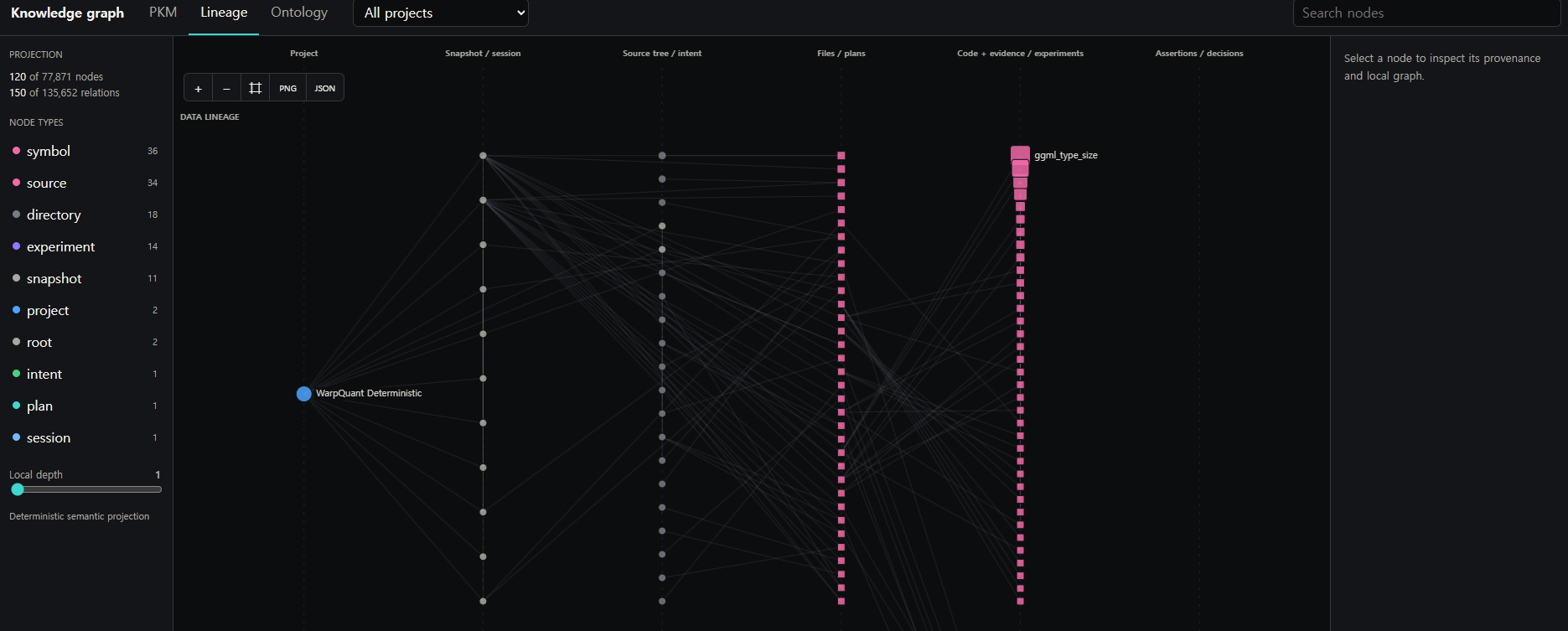 Data and research lineage |
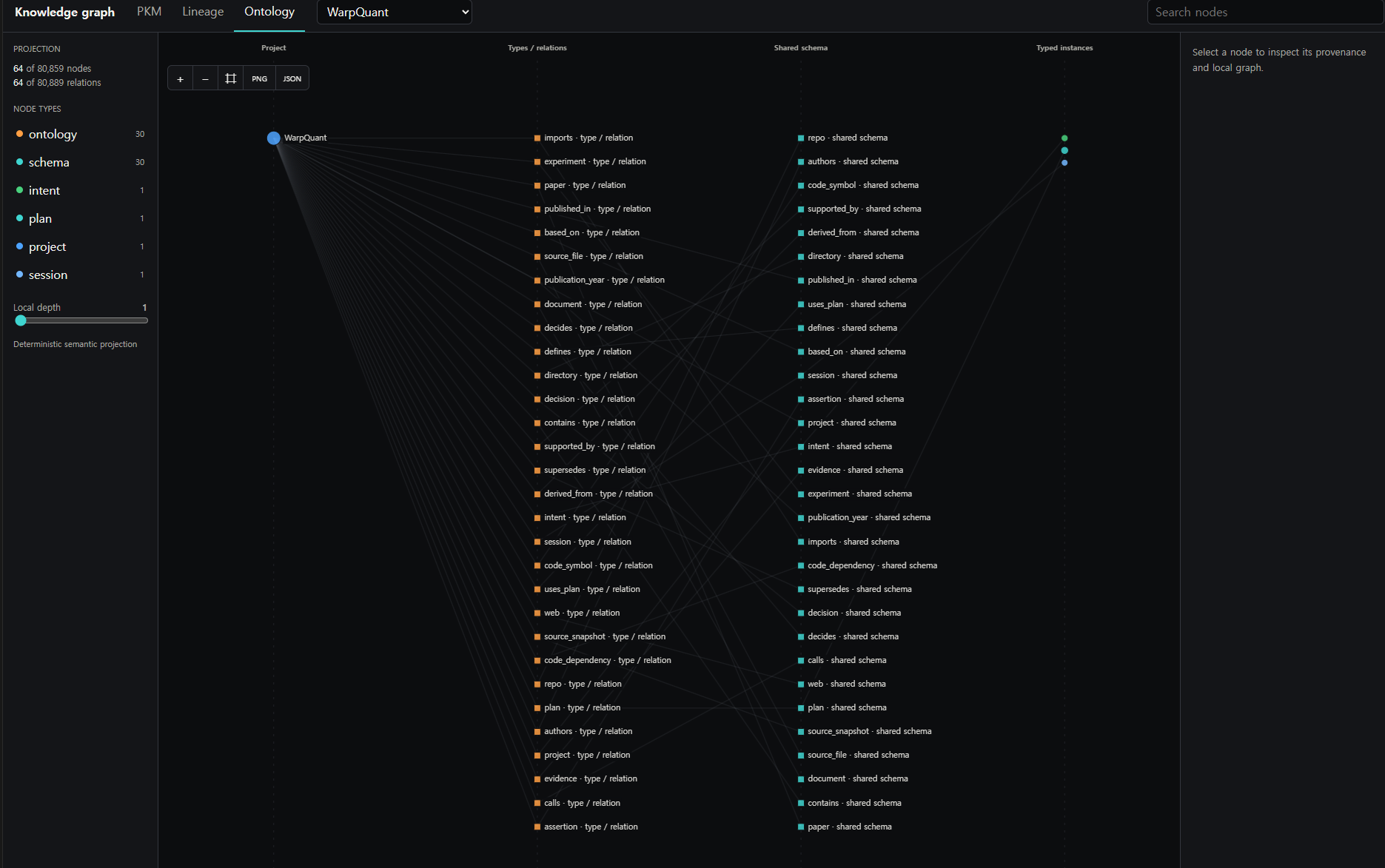 Ontology and shared schema |